Healthcare organizations rarely turn to custom software simply because they want new technology. The need usually starts with a specific problem: disconnected systems, manual workflows, outdated platforms, limited visibility, or a patient experience that existing software cannot support.
Custom healthcare software development addresses those gaps by building around the organization's clinical and administrative workflows, data requirements, integrations, security needs, and regulatory obligations. This guide explains when custom software makes sense, the types of healthcare systems organizations can build, the features and architecture decisions that matter, and how to approach development, cost, interoperability, security, and partner selection.
What Is Custom Healthcare Software Development?
Custom healthcare software development is the process of designing, building, and maintaining software created specifically for a healthcare organization's clinical or administrative workflows, rather than adapting a generic product built for thousands of unrelated businesses. It covers everything from a hospital's internal patient management system to a health-tech startup's flagship patient app, and the common thread is that the software is shaped around a specific set of users, a specific set of data requirements, and a specific regulatory environment.
Healthcare organizations that commission this kind of software range widely: hospitals and multi-location health systems modernizing internal operations, clinics and medical practices that have outgrown a generic scheduling tool, digital health startups building a product from scratch, diagnostic and radiology groups managing complex imaging workflows, and payers handling claims and member data at scale. What connects all of them is that the software has to work around real clinical and administrative constraints rather than the other way around.
A handful of things make healthcare software genuinely different from a typical line-of-business application. Clinical workflows involve sequencing that can't be rearranged casually; a scheduling change or a documentation step has downstream effects on patient care. Administrative workflows touch billing, staffing, and compliance simultaneously. Patient-facing workflows need to be usable by people who may be stressed, unwell, or unfamiliar with technology. Healthcare data requirements are particularly demanding because software may handle sensitive clinical, financial, and personal information while also needing to support complex workflows and integrations, whether that's an EHR, a lab information system, or a payer's claims platform.
It's important to recognize that custom software isn't automatically the better choice. It makes sense when your workflows, integrations, compliance requirements, or product differentiation are specific enough that configuring an existing platform creates more friction than it removes. The same build-versus-buy principles apply here, although healthcare adds another layer of clinical, security, and regulatory requirements. A broader custom software development guide provides useful context before narrowing the decision to healthcare.
When Does a Healthcare Organization Need Custom Software?
Most healthcare organizations don't decide to build custom software on a whim. The decision usually surfaces after a specific, recurring problem makes itself obvious.
Existing software doesn't fit the workflow
When staff are working around a system rather than through it, entering the same patient data twice, exporting reports to reformat manually, or maintaining a spreadsheet because the software can't handle a specific case type, that's a sign the tool was built for a more generic version of your operation than the one you actually run.
Multiple healthcare systems need to work together
A hospital running separate systems for scheduling, billing, lab results, and clinical documentation often ends up with staff manually bridging the gaps. Custom software can be built with integration as a first-class requirement rather than an afterthought bolted on through fragile point-to-point connections.
The organization needs a differentiated patient or provider experience
Digital health companies and healthcare organizations may treat the patient experience as an important part of how they deliver and differentiate their services. A generic patient portal that looks and behaves like every other clinic's portal doesn't support that kind of differentiation.
Legacy systems are slowing operations
Many hospitals and larger practices are still running on systems built a decade or more ago. These systems often can't be extended safely, and every new requirement turns into a workaround. At some point, continued patching can become increasingly difficult to justify when a legacy system limits integration, security, scalability, or operational efficiency.
The software itself is the product
For many digital health startups and health-tech companies, the software is a core part of the product itself rather than simply an internal support tool. In these cases, custom development isn't a question of whether it's worth the investment; it's simply what building a product means.
Compliance, security, or data requirements need to shape the architecture
Organizations handling protected health information across multiple states, integrating with government health data systems, or operating under specific payer requirements often find that off-the-shelf products only handle the common cases, leaving the organization to manage the compliance gaps manually.
When these gaps affect core clinical or administrative workflows, custom software development services can be evaluated against the organization's specific requirements rather than treating a new application as the starting point.
Benefits of Custom Healthcare Software Development
The advantages show up differently depending on the organization, but a few benefits come up consistently once a custom system is in place.
Workflow fit. The software matches how your team actually operates day to day, instead of forcing clinical or administrative staff to adapt their process to a generic template.
Interoperability. Connections to EHR, lab, imaging, and payer systems are built around your specific environment, rather than limited to whatever a vendor's pre-built connectors happen to support.
Operational efficiency. Manual re-entry, duplicate documentation, and the small daily workarounds that eat staff time tend to disappear once the software is built around the real workflow instead of a simplified version of it.
Better patient and provider experience. Interfaces and interactions are designed around the people actually using them, whether that's a clinician working under time pressure or a patient managing a health condition at home.
Greater control over data and roadmap. Feature priorities follow your organization's needs, not a vendor's release schedule or a majority-of-customers use case that may not reflect yours.
Scalability and modernization. New locations, new user roles, and new regulatory requirements can be built into an existing system over time, rather than requiring a platform switch every time your organization outgrows its current tool.
Types of Custom Healthcare Software
Healthcare software isn't one category, it's a set of distinct systems that solve different problems for different users. Here's how the major types typically break down.
EHR and EMR Software
Electronic health record and electronic medical record systems store and manage patient clinical information: history, diagnoses, medications, lab results, and treatment plans. Custom EHR and EMR development usually comes into play when an organization needs documentation workflows tailored to a specific specialty, tighter integration with existing systems, or a level of interoperability that off-the-shelf EHR products don't offer without expensive add-ons. Provider access controls, structured clinical documentation, and reliable data exchange with other systems are the core requirements here.
Hospital Management Software
Hospital management systems handle the administrative backbone of a facility: patient administration, department coordination, scheduling across multiple units, billing, and operational reporting. Because hospitals run many interconnected departments at once, a hospital information system built custom can reflect the actual structure of the organization instead of forcing every department into the same generic module.
Patient Portals and Patient Engagement Software
Patient portals give people a way to book appointments, view records, message their care team, and receive reminders and notifications. A well-built patient engagement platform can help reduce administrative friction and improve appointment communication when it is designed around actual patient workflows, not how a generic template assumes patients behave.
Telemedicine and Telehealth Platforms
Telemedicine software supports video consultations, provider and patient scheduling, secure messaging, and the handling of clinical data during and after a virtual visit. Custom telemedicine software solutions matter most when an organization needs specific specialty workflows (behavioral health intake looks very different from a routine follow-up), integration with an existing EHR, or compliance requirements a generic telehealth vendor doesn't fully support.
Healthcare Mobile Applications
Healthcare mobile app development covers both patient-facing apps (appointment management, medication reminders, health tracking) and provider-facing apps (clinical access on the go, secure communication, task management). Mobile is often where the differentiated patient experience mentioned earlier actually gets delivered.
Healthcare Analytics and Reporting Platforms
Healthcare analytics software turns operational and clinical data into dashboards that administrators and clinical leaders can actually use, covering everything from patient flow and staffing utilization to outcome tracking and financial performance. The value here comes from connecting data across departments rather than viewing each system's numbers in isolation.
Remote Patient Monitoring
Remote patient monitoring software collects data from connected devices, such as vital signs, glucose readings, or activity levels, and routes relevant information to clinicians with appropriate alerting and review workflows.
Medical Billing, Practice, and Revenue Cycle Systems
Medical billing software and practice management systems handle claims, payer rules, and the revenue cycle from the point of service through payment collection. Custom builds here typically focus on reducing claim denials, automating payer-specific logic, and connecting billing directly to clinical documentation so nothing falls through the cracks between departments.
Clinical Decision Support and Specialized Medical Software
Some organizations need software that supports specific clinical decision-making, flagging drug interactions, surfacing relevant patient history at the point of care, or supporting a specialty workflow that a general-purpose EHR doesn't handle well. These builds tend to be narrower in scope but higher in clinical stakes, which is why they're usually developed alongside close clinical input rather than treated as a standard feature request.
Core Features of Custom Healthcare Software
Rather than listing generic software features, it's more useful to organize them around the workflows healthcare teams actually run every day.
Patient and user management. Patient profiles, provider profiles, role-based access for different staff types, and care team assignments that reflect how your organization actually structures responsibility.
Appointment and scheduling. Availability management across providers and locations, automated reminders, rescheduling logic, and support for multi-location or multi-specialty scheduling rules that a generic calendar tool doesn't account for.
Electronic records and documentation. EHR or EMR functionality, structured clinical documentation, and controlled access to patient records based on role and need.
Secure communication. Encrypted messaging between patients and providers, internal staff communication, and notification systems that respect both urgency and privacy.
Billing and claims. Payer-specific billing logic, claims submission and tracking, and payment workflows connected to the revenue cycle rather than managed as a separate, disconnected system.
Reporting and analytics. Operational dashboards, clinical outcome tracking, and the kind of cross-departmental visibility that helps administrators spot problems before they become expensive ones.
Access control and audit logs. Role-based permissions, detailed audit trails, and activity tracking that make it possible to answer "who accessed this record, and when" without guesswork.
Integration capabilities. Connections to EHR and EMR systems, lab platforms, medical devices, payment processors, and other third-party systems your organization already relies on.
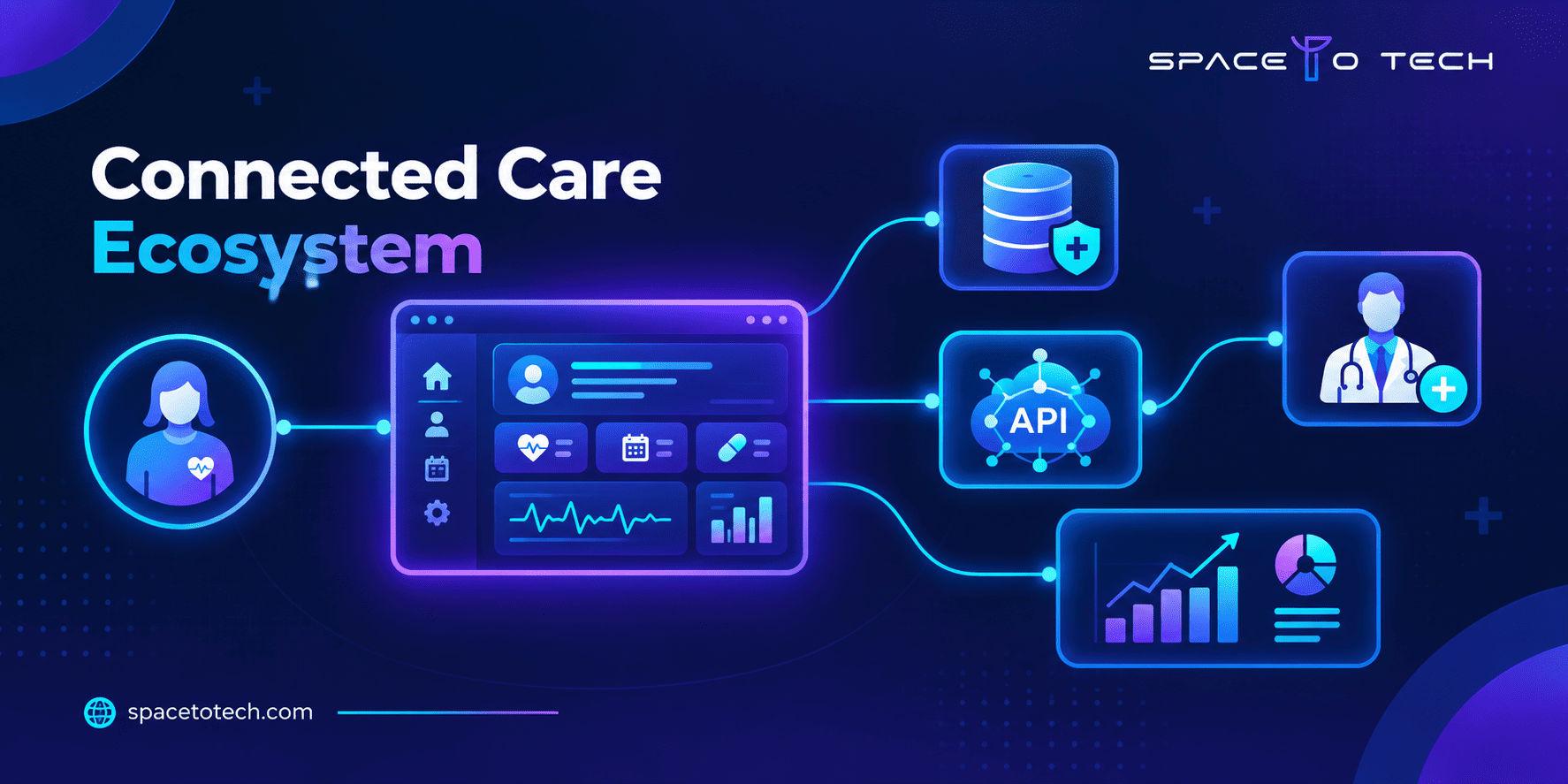
These aren't add-ons layered onto a generic application. In healthcare software, patient management, appointment scheduling, secure messaging, and care coordination need to work together as one connected system, because that's how the actual clinical and administrative workflow behaves.
Healthcare Software Architecture: Building for Security, Scale, and Integration
Architecture decisions in healthcare software carry more weight than in most other industries, because a poor choice early on tends to show up later as a security gap, an integration bottleneck, or a scaling wall. It's worth thinking about the architecture in layers.
Application layer. The web applications, mobile applications, and dashboards that patients, providers, and administrative staff actually interact with. This layer needs to reflect real user roles rather than a single generic interface stretched across very different use cases.
Backend and business logic. APIs, workflow logic, authentication, and permission handling live here. This is where clinical and administrative rules actually get enforced, not just displayed.
Data layer. Patient records, structured healthcare data, reporting data, and audit information need a data model that reflects clinical reality, not a generic schema retrofitted to fit medical data.
Integration layer. EHR and EMR connections, APIs, HL7 and FHIR interfaces, and third-party system connections all sit here. For many healthcare software projects, the integration layer can represent a significant portion of the overall build effort.
Security layer. Encryption at rest and in transit, authentication, authorization, audit logging, and ongoing monitoring need to be built in from the start rather than added once the application is functionally complete.
Cloud and infrastructure. Scalability, availability, deployment practices, and disaster recovery planning matter more in healthcare than in most industries, since downtime doesn't just cost revenue, it can directly affect patient care.
For larger health systems managing multiple facilities, departments, and data sources under one platform, this architecture starts to resemble broader enterprise custom software development patterns. The clinical context is unique, but the underlying engineering discipline, designing for scale, security, and long-term maintainability, follows many of the same principles that apply to enterprise software generally.
Healthcare Software Technology Stack
The specific technologies behind a healthcare platform matter less than whether each layer is chosen with the right requirements in mind. At a high level, most custom healthcare builds involve the following layers.
Frontend and web. The interface layer needs to hold up under real clinical use, clear information hierarchy, fast load times, and accessibility considerations for a wide range of users, not just a visually polished design.
Mobile. Native or cross-platform mobile development supports both patient-facing apps and provider tools that need to work reliably outside a desk-based setting.
Backend and API layer. This is where business logic, authentication, and workflow rules live, exposed through APIs that both the frontend and external systems can consume securely.
Databases. Healthcare data models need to represent clinical and administrative structures accurately, with the performance and reliability needed for both real-time access and long-term reporting.
Cloud infrastructure. Hosting, scaling, and disaster recovery planning are typically built on cloud infrastructure configured to meet the project's availability, security, backup, disaster recovery, and data protection requirements.
Healthcare-specific APIs and standards. HL7 and FHIR handle clinical data exchange, while DICOM supports medical imaging workflows for organizations that need it.
Security and authentication. Role-based access control, strong authentication methods, and encryption standards appropriate for protected health information run through every layer above, rather than sitting in just one place.
AI and analytics, where relevant. Machine learning components, when they're part of the build, typically sit alongside the core application rather than replacing any of the layers above, supporting functions like documentation assistance, reporting, or workflow automation.
The right combination of tools depends on the specific project, the existing systems it needs to connect to, and the compliance requirements involved, which is why this is usually one of the first things worked out during discovery rather than decided in advance.
Healthcare Software Interoperability: HL7, FHIR, APIs, and EHR Integration
If there's one area that separates serious healthcare software from a generic application with a medical skin on it, it's interoperability.
Why healthcare interoperability matters
Patient data doesn't live in one place. A single patient's information might be split across an EHR, a lab system, an imaging platform, a pharmacy system, and a payer's claims database. Software that can't move data between these systems reliably forces staff to do that work manually, which is slower, more error-prone, and harder to audit.
HL7 vs. FHIR
HL7 (Health Level Seven) is the long-standing messaging standard used for exchanging clinical data between systems, and it's still widely used across established EHR and hospital systems. FHIR (Fast Healthcare Interoperability Resources) is widely used for modern healthcare APIs and application integrations, while HL7 messaging remains common across established healthcare systems. The appropriate standard depends on the systems being connected and the integration requirements, so a project may need HL7, FHIR, both, or other interfaces depending on the environment.
EHR and EMR integration
Connecting custom software to existing EHR and EMR systems means handling patient data, appointment information, clinical records, and lab results in a way that keeps both systems accurate and in sync. EHR and EMR integration can become a significant part of the build, particularly when multiple systems, data formats, authentication methods, and vendor-specific implementation details are involved.
Healthcare APIs and integration layers
A well-designed integration layer isolates the complexity of connecting to multiple external systems so the rest of the application doesn't need to know the details of each one. This matters more as an organization adds new integrations over time; a system built around a solid integration layer can absorb new connections without a rebuild.
DICOM and imaging workflows
For organizations working with medical imaging, DICOM (Digital Imaging and Communications in Medicine) handles the storage and transmission of imaging data. Radiology and diagnostic platforms typically need DICOM support built directly into their architecture rather than handled as a separate, disconnected system.
SMART on FHIR
SMART on FHIR is a set of standards that allows third-party applications to plug into existing EHR systems securely, which is useful for organizations that want to extend an existing EHR's functionality without replacing it outright.
Healthcare Software Security and Compliance
Security and compliance in healthcare software aren't a checklist you complete once. They're a set of requirements that shape architecture decisions throughout the build.
HIPAA and protected health information
HIPAA requirements apply based on an organization's role, the type of data it handles, and the applicable regulatory context, not as a blanket rule that every piece of healthcare software must satisfy identically. It's a common misconception that any healthcare application automatically needs to be "HIPAA certified"; there's no such formal certification, and the real work is building the technical and administrative safeguards HIPAA actually requires.
Healthcare data security
This covers encryption of data at rest and in transit, strict access control, strong authentication and authorization, detailed audit logging, secure API design, and data minimization practices that limit exposure by only collecting and retaining what's genuinely needed.
Healthcare application security
Beyond data protection, the application itself needs to be resilient against common vulnerabilities, with regular security testing built into the development lifecycle rather than treated as a final pre-launch step.
Audit trails and role-based access
Access to patient data should be appropriately logged so the organization can determine who accessed information, when it was accessed, and what actions were performed, based on its compliance and operational requirements. Role-based access control ensures staff only see the information relevant to their responsibilities, which reduces both risk and the surface area for accidental exposure.
Other regulations and standards
Depending on the organization and the market it operates in, additional frameworks may apply: GDPR for organizations handling European patient data, FDA regulations for software that qualifies as a medical device (SaMD), IEC 62304 for medical device software lifecycle requirements, SOC 2 for service organizations, and HITRUST for organizations that need a recognized security framework. None of these apply universally, and it's worth clarifying early in a project which ones actually matter for your specific use case rather than assuming all of them do.
Custom Healthcare Software vs. Off-the-Shelf Software
| Factor | Custom Software | Off-the-Shelf |
| Workflow fit | Built around your specific process | Standardized across all customers |
| Integrations | Built to your existing systems | Limited to what the vendor supports |
| Control | You control the roadmap | Vendor controls the roadmap |
| Initial investment | Usually higher | Usually lower |
| Time to launch | Usually longer | Usually faster |
| Differentiation | High | Limited |
| Maintenance | Managed by your organization or a development partner | Handled by the product vendor |
| Scalability | Designed around your specific requirements | Depends on the vendor's plan tiers |
| Compliance requirements | Architected around your exact obligations | Depends on what the vendor already supports |
Neither path is universally right. Off-the-shelf software remains a reasonable choice for standardized functions where your workflow doesn't differ meaningfully from most other organizations in your position. Custom software earns its higher upfront cost when your workflows, integrations, or compliance obligations are specific enough that configuring an existing product would require heavy, ongoing workarounds anyway.
Healthcare Software Development Process
Healthcare software development doesn't follow a simple "design, code, launch" sequence. Compliance, integration testing, and workflow validation run through the entire lifecycle rather than sitting at the end of it.
1. Discovery and workflow analysis. This phase maps out actual clinical and administrative workflows, identifies the systems that need to be integrated, and documents regulatory requirements before any design work begins.
2. Requirements and product planning. Functional and non-functional requirements get documented and prioritized, distinguishing between what's needed for launch and what can follow in a later phase.
3. Architecture and technology planning. The layered architecture and technology stack discussed earlier get defined in detail, along with decisions on cloud infrastructure, data storage, and the integration approach for existing systems.
4. UX/UI design. Design decisions here need to account for clinician workflows under time pressure, patient usability across a wide range of digital literacy, and accessibility requirements that generic consumer app design doesn't always consider.
5. Development and integration. Engineers build the application in structured iterations, with EHR, lab, and third-party integrations tested continuously rather than left until the end of the build.
6. Security, QA, and validation. Healthcare software projects typically require functional, integration, performance, and security testing, along with validation against the specific compliance requirements identified during discovery.
7. Deployment. Rollouts are typically phased, starting with a pilot department or user group, so issues surface with limited impact before a full rollout across the organization.
8. Monitoring and maintenance. Launch begins an ongoing phase of monitoring, maintenance, security updates, and product improvement as clinical and operational needs evolve. Post-launch measurement should track software ROI against the original goals of the project, including time saved, error reduction, adoption, and measurable financial impact.
How Much Does Custom Healthcare Software Development Cost?
Rather than quoting a single price range that would be close to meaningless without context, it's more useful to walk through what actually drives cost up or down.
Scope and user roles. A single-department scheduling tool costs far less than a platform serving multiple user roles across an entire hospital system.
Web vs. mobile requirements. Building for web only is typically less expensive than building native or cross-platform mobile applications alongside it.
Integration complexity. EHR and EMR integration, HL7 and FHIR requirements, and connections to lab, imaging, or payer systems can have a significant effect on both cost and timeline.
Security and compliance scope. The depth of security testing, audit logging, and compliance validation required depends on the sensitivity of the data and the regulatory environment your organization operates in.
Data migration. Moving existing patient and operational data from legacy systems into a new platform adds real effort, particularly when the source data is inconsistent or poorly structured.
Analytics and AI features. Custom reporting, dashboards, and any AI-driven functionality add development time proportional to how sophisticated those features need to be.
Infrastructure, QA, and maintenance. Ongoing cloud costs, thorough testing cycles, and a maintenance plan after launch all factor into the total cost of ownership, not just the initial build.
Understanding the major custom software development cost drivers can provide a useful starting point before requesting a healthcare-specific estimate.
How Long Does Healthcare Software Development Take?
Timelines vary significantly based on the same factors that drive cost: the number of workflows involved, the complexity of integrations, the compliance scope, and how much data needs to be migrated from existing systems. A focused patient portal or scheduling tool can move considerably faster than a full hospital management platform with deep EHR integration and multi-department rollout requirements. Rather than committing to an artificial fixed timeline upfront, it's more useful to treat the discovery phase as the point where a realistic timeline actually gets defined, based on your specific scope rather than an industry average.
Healthcare Software Use Cases
The types above describe the software itself. The following examples show how different healthcare organizations use these systems to solve specific operational, clinical, and patient-facing problems.
Hospitals and health systems
Multi-department coordination, patient records management, scheduling across units, and operational analytics that give administrators visibility across an entire facility rather than one department at a time.
Clinics and medical practices
Appointment scheduling, practice management, billing, and patient communication tools sized appropriately for a smaller organization without the overhead of an enterprise hospital system.
Telemedicine providers
Virtual consultation platforms, provider and patient scheduling, and secure communication tools built around the specific workflow of remote care delivery.
Digital health and health-tech companies
Patient-facing products, health records management, remote monitoring, and integrations with the broader healthcare ecosystem, often built as the company's core product rather than an internal support tool.
Diagnostic and radiology organizations
Imaging workflow management, reporting, study assignment, and increasingly, AI-assisted components that support (not replace) radiologist review and reporting.
Pharmacies and laboratories
Software that manages prescription workflows, lab order management, and results reporting, usually integrated tightly with the broader clinical systems it feeds into.
Payers and healthcare administration
Claims processing, revenue cycle management, and administrative workflows that connect provider-submitted data to payer systems accurately and efficiently.
Real Healthcare Projects: How This Looks in Practice
Rather than relying on generic claims, it's worth looking at how these principles play out in software we've actually built.
Radin Health: Building a Connected Radiology Workflow
Radin Health is a healthcare SaaS platform focused on radiology workflows, built around RIS and PACS functionality, AI-assisted dictation, and automated study assignment. Space To Tech's contribution to this project centered on the dashboard experience: designing and developing role-based interfaces that give radiologists, technicians, and administrative staff the specific view of the workflow they each need, along with the broader integration and deployment work required to bring the platform together.
The platform centralizes patient, study, scheduling, and reporting information in one place, with AI-assisted dictation and automated workflow management reducing manual coordination across the radiology department. The result is a more centralized, scalable radiology platform with smarter workflow management and easier access to the information radiologists and administrators need day to day.
Mykaizzen: AI-Driven Digital Healthcare
Mykaizzen is an AI-driven digital healthcare platform built around digital health records, ABHA integration, and family health access, giving users and their families a connected view of their health information in one place.
Find the Doctors Online: Connected Doctor Discovery
Find the Doctors Online connects patients with verified doctors through search, video consultation, and secure appointment workflows, bringing discovery and virtual care together in a single patient-facing platform.
These projects, along with the rest of our work, are documented in our healthcare software portfolio, where you can see the specific problems each platform was built to solve.
AI in Healthcare Software
AI is increasingly a component of healthcare software rather than a separate category of its own. In practice, it shows up in clinical documentation assistance, workflow automation, diagnostic support tools, patient triage, analytics, and AI-assisted reporting like the dictation support seen in radiology platforms.
A practical AI evaluation starts with a specific business or clinical problem: whether reliable data is available, how the capability fits into the existing workflow, what human oversight is required, and how its output will be evaluated over time. AI works best as a layer that supports clinical and administrative decision-making, not one that replaces the judgment behind it. Organizations considering AI as part of a broader healthcare software strategy can evaluate AI development services alongside the underlying clinical, data, and workflow requirements.
Healthcare Software Modernization and Legacy Systems
Most healthcare organizations aren't starting from a blank slate. They're working with existing EHR systems, outdated interfaces, disconnected databases, and integrations that were never designed to scale past their original scope.
Why legacy healthcare systems are difficult to replace. Older EHR and hospital systems often sit at the center of daily operations, connected to years of accumulated data, custom configurations, and staff habits built around their quirks. A full replacement can introduce significant operational and migration risk, particularly when the existing system supports critical workflows and contains years of accumulated data and integrations.
An API and integration-layer approach. Rather than replacing a legacy system outright, many organizations build an integration layer around it, allowing new functionality, better interfaces, or additional automation to be added without disturbing the underlying system staff already depend on.
Phased modernization. Modernizing one workflow, department, or data domain at a time reduces the blast radius of any single change and gives staff time to adapt before the next phase begins.
Data migration. Moving historical patient and operational data into a modernized system needs careful validation, since inconsistent legacy data can introduce new errors if it's migrated without proper cleanup and mapping.
Security considerations. Legacy systems sometimes carry outdated security practices by default. Modernization is often the right moment to close those gaps, rather than carrying old vulnerabilities forward into a new interface.
Avoiding disruption to existing workflows. The goal of modernization isn't just newer technology, it's keeping clinical and administrative work running smoothly while the underlying system improves, which is why pilot rollouts and careful change management matter as much as the technical migration itself.
How to Choose a Healthcare Software Development Partner
The development partner can have a significant influence on project delivery, architecture, communication, and long-term support, so the selection process deserves more than a quick comparison of quotes.
Healthcare domain understanding. A partner who understands clinical and administrative workflows will ask better questions during discovery, which usually shows up as a more accurate scope and fewer surprises later.
Integration and interoperability capability. Ask specifically about experience with HL7, FHIR, and EHR integration rather than taking general "we do integrations" claims at face value.
Security and compliance maturity. Look for a partner who can explain how they approach HIPAA-relevant requirements in practice, not just a partner who lists the regulation on their website.
Product and UX capability. Healthcare software still needs to be usable by real people under real conditions; technical capability without design maturity tends to produce software that's compliant but frustrating to use.
Technical architecture and scalability. Ask how the proposed architecture would handle growth, whether that's more users, more locations, or more integrations over time.
QA and testing approach. Given the stakes involved in healthcare data and workflows, a partner's testing discipline matters more here than in most other industries.
Communication and delivery transparency. Regular, honest updates during a build tend to be a better predictor of project success than an impressive initial pitch.
Evidence from real projects. Ask to see specific examples of healthcare software the partner has actually built, and what their role was on each one.
Post-launch support. Healthcare software needs ongoing maintenance and support after launch, not a handoff the moment the initial build is complete.
Geography and delivery model. For organizations that require a US-focused delivery model, custom software development in the USA can be considered alongside healthcare expertise, interoperability experience, security practices, and communication requirements. Delivery location can also affect time-zone overlap, communication, team structure, and project economics.
Organizations considering different delivery models may also compare custom software development companies in India and custom software development companies in the USA while evaluating healthcare experience, integration capabilities, security maturity, and post-launch support.
Planning a Custom Healthcare Software Project?
Share your workflow, your integration requirements, and your product goals with our team, and we'll help you evaluate the scope, architecture, and development approach before you commit to a build. Whether you're modernizing an existing system or building a new healthcare platform, a custom software development company can help turn those requirements into a scoped implementation plan.