Top Mobile App Development Companies for Super Apps & Mini-Apps in 2026
The mobile app space has been shifting for a while, but it’s only recently that the change has felt… noticeable in practice, not just in reports or trends, but in how products behave after launch. A few years ago, building a mobile application was mostly about getting something functional out there. If users could install it, open it, and complete a task, that was already considered success. Now, that expectation feels outdated. Businesses investing in mobile app development are thinking beyond launch. They’re thinking about scale, user behavior over time, integrations, and things that don’t always show up in the early stages. That’s where things get slightly complicated. Not dramatically, just… layered. A lot of app development companies still approach projects in a fairly standard way. Requirements, development, delivery. It works, but only up to a point. Once real users start interacting with the product, patterns shift. Unexpected usage, performance dips, edge cases. That’s when experienced mobile app developers start to make a difference—not just in fixing issues, but in how those issues were anticipated earlier. Choosing between different app development companies isn’t as straightforward as it used to be. On the surface, many look similar. Similar portfolios, similar tech stacks, similar promises. But those similarities fade once execution begins. Some teams adapt quickly, others struggle to adjust. And that’s really what separates the top mobile app development companies . Not the launch, but what happens after. What Are Super Apps & Mini-Apps? (Why They Matter in 2026) Super apps didn’t arrive suddenly—they sort of evolved into relevance. One feature at a time, one integration at a time. Now they define how users expect mobile apps to behave. Instead of thinking, “Which app should I open?” users expect a single mobile application to handle multiple needs. Payments, bookings, messaging, and sometimes even services that don’t seem connected at first. Mini-apps are part of this structure. They sit inside the main system, lightweight and easy to access. No installation, no commitment. You open them, use them, and move on. It sounds minor, but it noticeably changes user behavior. People try more features when the barrier is low. That’s why these ecosystems feel smoother as mobile solutions . From a business perspective, the advantages are fairly clear—lower acquisition costs, better retention, and longer engagement time. But building this kind of system isn’t just about adding features. It requires thoughtful app development , especially in how components interact with each other. The complexity increases when working across Android and iOS app platforms. These environments don’t behave identically. Performance expectations differ, system limitations vary, and aligning them under one experience takes effort. That’s why companies building modern mobile apps are becoming more selective about who they work with. Not just for development, but for long-term stability. What to Look for in Top App Development Agencies If you spend time comparing top app development agencies , you’ll notice a pattern. Most of them present themselves in a very similar way—clean portfolios, structured case studies, confident messaging. It all looks right. But it doesn’t always reflect how projects actually unfold. A strong app development company focuses less on presentation and more on execution. Their app development services should cover the full lifecycle, but also adapt when things shift. Because they will shift. Requirements change, priorities move, sometimes mid-way through development. The development process becomes important here. Too rigid, and it breaks under pressure. Too flexible, and it loses direction. Good teams sit somewhere in between. Not perfectly balanced, but stable enough to keep progress consistent. Then there’s the technical side. Solid software development isn’t about using every available tool. It’s about choosing the right ones and knowing when to avoid unnecessary complexity. Some app development companies overbuild systems, which feels impressive at first, but creates issues later. And then there’s the idea of a development partner . It sounds simple, but it’s not always real. A true partner stays involved, questions assumptions, and helps guide decisions. That difference becomes clearer over time, not immediately. Leading Mobile App Development Company in India India has steadily become a major hub for mobile app development , and not just because of pricing. That’s still a factor, but it doesn’t explain why so many global companies continue to rely on teams here. The bigger shift comes from experience. Many mobile app developers in India have worked across industries and geographies, which changes how they approach projects. Instead of solving problems from scratch every time, they’ve already seen variations of them before. That shows up in decisions — sometimes small ones — that prevent larger issues later. If you look at some of the top indian app development companies , the difference isn’t just what they build. It’s how they handle complexity when things don’t go exactly as planned. Leading companies and what they’re known for: SpaceToTech SpaceToTech operates as a mobile app development company in India focused on building scalable and adaptable applications across industries like fintech, healthcare, logistics, and SaaS. The approach isn’t rigid — projects are shaped based on real requirements, not fixed templates. This flexibility helps when things change mid-development, which they usually do. Over time, the focus stays on building systems that continue to perform, not just apps that launch successfully. Whether you're building a fintech platform or a healthcare solution, SpaceToTech stands out as a top app developer in India known for delivering systems that scale with your business. Appinventiv Appinventiv is known for handling enterprise-scale projects and complex digital transformation work. They often work with large organizations where integrations, security, and scalability are critical. Their strength lies in structured execution and the ability to manage long-term projects with multiple moving parts. This makes them a strong choice for businesses looking for stability in large builds. Hyperlink InfoSystem Hyperlink InfoSystem has delivered a high volume of mobile applications across different industries. Their approach leans toward speed and global delivery, which works well for companies looking to launch quickly. While the focus is on execution efficiency, they also bring experience from working with diverse project types and requirements. Fueled Fueled takes a more product-focused approach, especially for startups and consumer-facing applications. They emphasize design, user experience, and usability alongside development. This makes them suitable for businesses that prioritize product experience as much as technical execution. Across these app development companies in India , one thing stands out — tools and technologies alone don’t define quality. Being considered a leading mobile app development company in India comes down to consistency over time. Not one successful build, but the ability to handle different types of projects without losing stability. Because most problems don’t come from big decisions. They come from the smaller ones that didn’t seem important at the time. Mobile App Development Services There’s a common assumption that mobile app development services begin with coding. In reality, they start earlier. Much earlier, sometimes. Most effective development services begin with understanding the problem—what needs to be built, and just as importantly, what doesn’t. That second part is often overlooked. And later, it turns into unnecessary complexity. A structured mobile application development approach includes discovery, design, development, testing, and deployment. But in real projects, these phases don’t stay separate. They overlap. Feedback loops happen. Adjustments are made mid-way. A reliable app development company accounts for this. Their application development approach isn’t rigid—it evolves as the project progresses. That flexibility becomes important when dealing with integrations, APIs, and third-party systems. Modern mobile app development isn’t isolated. It connects with multiple systems, and those connections don’t always behave predictably. That’s where experienced app development services make a difference. Post-launch support also plays a bigger role than most expect. Many mobile apps continue evolving after release. Without ongoing updates, even well-built products can start to feel outdated. Android App Development Android app development gives businesses access to a massive user base. That part is obvious, almost everyone knows it. But what’s less obvious—until you actually build something—is how inconsistent the environment can be. An Android app doesn’t run on one device type. It runs across dozens, sometimes hundreds, of variations. Different screen sizes, different hardware capabilities, different OS versions. At first, this doesn’t seem like a big issue. Everything works fine during controlled testing. But once the app reaches real users, patterns start to shift. Performance may drop on older devices. Certain UI elements behave differently. These are not rare cases—they’re quite common. This is where experienced mobile app developers approach things differently. They don’t just build for ideal conditions. They try to account for less ideal ones too. Not perfectly, but enough to reduce friction later. A skilled app developer pays attention to optimization early, instead of treating it as a final step. Another factor is compliance. Google Play Store guidelines are not always straightforward. They change, sometimes subtly. A feature that worked before might need adjustments now. A reliable app development company usually keeps track of these changes during development, not after submission. There’s also the choice between native and cross-platform. Native Android (Kotlin, Java) offers deeper control, while cross-platform frameworks can speed up delivery. Both approaches have trade-offs. Good teams don’t force one over the other—they decide based on the product. Android development isn’t difficult in one clear way. It’s more like a collection of smaller challenges that build over time. And how those are handled early tends to define the long-term stability of the app. iOS App Development iOS app development feels more predictable compared to Android. Fewer devices, more consistency in hardware and software. But that predictability also raises expectations. Users expect things to just work—smoothly, quickly, without friction. An ios app is judged differently. Even small delays or awkward transitions stand out. Not because users analyze them technically, but because they’re used to a certain level of polish. When something feels off, they notice it almost immediately. That’s why experienced app developers treat iOS projects with a different level of attention. Design consistency becomes critical. Apple’s Human Interface Guidelines provide structure, but following them properly requires understanding—not just copying patterns. Security is another area where things can’t be overlooked. Data handling, permissions, encryption—these aren’t optional considerations. A strong mobile app development company ensures these are built into the system from the beginning, not added later. When working on android ios app development together, balance becomes important. The goal isn’t to make both platforms identical, but to make the experience feel consistent. That’s a subtle difference, but it matters. There’s less room for experimentation in iOS compared to Android. But that limitation often results in better, more refined products when handled correctly. Cross-Platform Application Development Cross-platform application development is often seen as the practical approach. One codebase, multiple platforms—it sounds efficient, and in many cases, it is. It reduces duplication, speeds up mobile app development , and simplifies updates. But the reality isn’t always as smooth as it sounds. While frameworks like React Native and Flutter have improved significantly, there are still cases where platform-specific adjustments are needed. Certain features behave differently on Android and iOS, even when built from the same codebase. That’s where experience plays a role. Good teams understand where cross-platform works well and where it might create limitations. They don’t treat it as a one-size-fits-all solution. For super apps, this approach is often preferred. It allows faster scaling and easier integration of features, which is important when building large mobile solutions . But even then, some components may still require native handling. Adding a web app layer extends functionality further. Users can switch between mobile and web without losing continuity. But again, this adds complexity—more systems, more dependencies. Cross-platform development works best when used thoughtfully. It’s not just about saving time or cost. It’s about knowing where flexibility matters and where precision is more important. iPad App Development & Wearable App Development iPad App Development iPad app development is often overlooked, but it serves specific use cases really well. Larger screens change how users interact with content. For enterprise tools, dashboards, and analytics platforms, this makes a noticeable difference. Working with complex data on a phone can feel cramped. On an iPad, it becomes easier to navigate, compare, and interact. That’s why many businesses extend their mobile applications to tablets—not as a replacement, but as an enhancement. The challenge is not just scaling the interface. It’s redesigning the experience to suit the screen. Simply stretching a mobile layout rarely works well. Wearable App Development Wearable app development operates on the opposite end of the spectrum. Smaller screens, shorter interactions. These apps focus on quick actions—notifications, health tracking, and reminders. They don’t aim to replace full mobile applications . Instead, they support them. For example, a fitness app might use wearables for real-time tracking while the main app handles detailed analytics. In super app ecosystems, wearables add another layer to mobile solutions . They make interactions faster and more accessible, especially for everyday tasks. Expand Your Reach to a Complete Suite of Devices Users don’t stay on one device anymore. They switch between phones, tablets, and sometimes a web app without really thinking about it. It’s just how things work now. That shift changes how products need to be designed. Web development and mobile strategies can’t operate in isolation. They need to connect, even if the connection isn’t perfect. Top providers of mobile app development services focus on creating a unified experience. Not identical across devices, but consistent enough that users don’t feel a disconnect. This is where full-spectrum development services become important. Instead of building separate systems, everything is planned as part of a larger ecosystem. It requires more effort upfront, but it reduces complexity later. And as user expectations continue to grow, this kind of approach becomes less optional and more necessary. Technologies We Use in Mobile App Development Technology choices play a big role in mobile app development , but not always in the way people expect. It’s not about using the latest tools—it’s about using the right ones for the situation. Modern software development often includes frameworks like React Native and Flutter for the frontend, with Node.js or Python on the backend. Databases like Firebase or MongoDB support scalable mobile applications . But tools alone don’t guarantee results. The development process determines how effectively they’re used. Poor structure can turn even good technology into a problem. Advanced capabilities like AI, IoT, and AR/VR add value when applied carefully. They shouldn’t complicate the system unnecessarily. Strong app development services focus on balance—using enough technology to support growth, but not so much that it becomes difficult to manage. How to Develop a Mobile App (Step-by-Step Process) Understanding how to develop a mobile app helps set realistic expectations. The process looks structured, but in practice, it’s more flexible than it appears. Step 1: Discovery & Market Research Everything starts with understanding the idea properly—what problem the mobile application is solving, who the users are, and why they would actually use it. Skipping this often leads to confusion later during mobile app development , when changes become expensive. Step 2: UI/UX Design Once the direction is clear, wireframes and user flows are created to shape how the app will feel and function. Good design is not just visuals—it quietly decides how smoothly users move through the mobile app , even if they don’t notice it directly. Step 3: Frontend + Backend Development This is where real app development begins. The frontend handles what users see, while the backend manages logic, databases, and integrations. Both parts need to stay aligned, otherwise the mobile application development process starts to feel fragmented later. Step 4: QA Testing (Manual + Automated) Testing is where assumptions meet reality. Bugs, performance issues, and edge cases usually show up here. A proper development process includes both manual checks and automated testing to make sure the mobile app behaves consistently across conditions. Step 5: App Store / Play Store Deployment Once everything feels stable, the app is prepared for launch. This includes store listings, compliance checks, and final optimizations. A careful development partner usually handles this step smoothly to avoid last-minute rejections or delays. Step 6: Post-Launch Support & Iterations After launch, real users start interacting with the product in unpredictable ways. Feedback, usage patterns, and performance data all feed into continuous improvements. This ongoing mobile app development phase is what keeps the app relevant over time. These steps often overlap. A reliable development partner helps keep things aligned even when changes happen mid-way. Top Mobile App Development Companies in India — Final Verdict & CTA The top mobile app development companies in India don’t always stand out immediately. Their strengths become clearer over time—especially when systems scale and evolve. Choosing the right mobile app development company in India involves looking beyond initial impressions. Experience, adaptability, and long-term support play a bigger role than expected. Among various app development companies , SpaceToTech focuses on delivering scalable mobile app development services that evolve with business needs. If you’re looking for expert digital solutions for businesses , it might be time to take the next step. Looking for expert app development services for your super app idea? Connect with SpaceToTech today.
AI-First Custom Web App Development: How It Transforms Business Workflows in 2026
By the year end of 2025, 62% of businesses claimed they were at least trying out AI agents, and 23% said they were currently using them in at least one business function. AI adoption is also going from pilot projects to production. Deloitte says the number of organisations with 40% or more of their AI initiatives in production will double in the next six months. This change explains why custom web app development services are evolving quickly. AI has gone from being a plus to becoming mainstream. Traditional web app development services were meant to automate operations that don't change. AI-first platforms do more than that. They guess what users will want, help them make choices, learn from data, and make processes better over time. Businesses evaluating custom web app development services, web app development company alternatives, or a larger web application development company in 2026 should ask how profoundly AI should affect the product. This article discusses what AI-first web development truly involves, how it changes business operations, which AI features are most important, and what decision-makers should consider about ROI and deployment. This is also changing how custom web app development services are offered across sectors for organizations like Space To Tech. Learn More about AI-First Custom Web App Development "AI-first" means building software with AI as a key part of the design from the beginning. It doesn't mean adding AI afterward as a side feature or plug-in. Traditional vs. AI-First Approach: The traditional way of making web apps, the system follows rules that have been written into it, responds to what users say, and needs people to make changes. In AI-first web development , the app learns from data, adapts with trends, predicts needs, and may aid or make decisions in real time. Key Technologies Powering AI-First Apps in 2026: Machine learning predicts, natural language processing understands, computer vision analyzes, generative AI helps with content and code, and AI agents execute multi-step jobs in bespoke web app development. Developer adoption is also accelerating. Why 2026 Is the Tipping Point: GitHub observed that almost all of the developers they talked to had utilized AI coding tools at work or outside of work. Stack Overflow found that 84% of respondents were using or intended to use AI tools in development. The Business Case: In real life, AI-first custom web app development service models help companies operate faster, more accurately, and with better customer service, and automate their workflows. Workflow Transformation #1: Intelligent Process Automation 30–40% of daily job activities are still spent on manual and repetitive chores, which still take up a large portion of employee time. Things like reviewing documents, entering data, getting approvals, and addressing tickets slow things down and make mistakes more likely. This is where AI-first custom web app development services are changing the way web applications are made. How AI-First Web Apps Transform This: Smart Document Processing: Business papers may be handled automatically by AI-powered web app applications. The technology can read invoices, contracts, and forms, find relevant information, and organize documents with 95% accuracy or better. It does this using machine learning and computer vision. Automated Workflow Routing: Then, clever workflow engines decide what to do next based on the data, how important it is, and the rules that have previously been created for the business. Exception Handling: When unusual cases come up, the system identifies them and delivers them to the right person for review. Continuous Improvement: Over time, the platform gets better because it learns from its failures and how people use it. Real-World Examples: Finance Teams: Finance departments may automate fraud detection and expenditure reporting, which cuts down on processing time by 70% and makes mistakes less likely. HR Departments: HR departments use AI to evaluate resumes, set up interviews, and answer employee inquiries, resulting in 60% shorter recruiting processes. Customer Service: Client support teams use AI triage tools to quickly answer common questions, which means that more than half of client inquiries may be handled without any help from a person. Modern custom web app development services provide these automation features straight to existing company systems. Space To Tech lets companies update their workflows without replacing every technology. Workflow Transformation #2: Predictive Analytics & Decision Intelligence Many companies still make decisions based on historical reports or gut feelings. Dashboards represent what has happened in the past, but they don't always reflect what will happen in the future. AI-first web development changes this by adding predictive intelligence directly into bespoke web apps. How AI-First Web Apps Transform This: Demand Forecasting: AI algorithms employ data from the past, user behavior, and operational indicators to make guesses and give advice. Customer Behavior Prediction: Businesses can employ predictive technology to figure out what their customers will want, how many employees they need, how to best use their resources, and other operational issues. Risk Assessment: AI-powered systems may also detect attrition, highlight upsell possibilities, and decide the best time for custom client engagement. This capacity is changing how people make decisions in many kinds of businesses. Performance Optimization: AI-first bespoke web app development services have the most impact on organizations because they make them more proactive instead of reactive. Instead of waiting for problems to materialize, businesses may get ahead of them. This makes them more efficient and helps them do better in the long term. Industry-Specific Applications: AI in ecommerce predicts how many people would want to buy a product, finds the best prices, and tracks inventory levels. This reduces stockouts by 25% and boosts profitability. Health institutions employ predictive analytics to anticipate patient readmissions and appointment no-shows to better manage resources. Manufacturers use AI to guess when machines will break down and change their production schedules to cut down on unplanned downtime by 40%. Predictive models in real estate use property data and market trends to assist individuals make wiser and faster investment decisions. Workflow Transformation #3: Hyper-Personalization at Scale Strong engagement is seldom driven by generic digital experiences. Conversion rates drop and custom users disengage when all users see the same content, recommendations, or interface. By enabling hyper-personalization at scale within modern custom web app development services, AI-first web development addresses this. How AI-First Web Apps Transform This: AI-powered web apps may change how users interact with them in real time based on how they browse, what they buy, and other signals in the environment. Dynamic Content Adaptation: Dynamic content engines change the way things look, the copy, and the ads based on what users do. Unified User Profiles: The objective of developing a unified profile is to learn more about what users like by looking at their behavior on different platforms and devices. As users interact with the system, machine learning is always improving suggestions and targeting. Real-Time Personalization: Personalized product recommendations may help online stores boost their average order value (AOV) by 35% and their conversion rate by 30%. SaaS platforms employ AI to personalize dashboards, suggest features, and help users through processes to keep users and get them to use the software more. Continuous Learning: Education platforms also employ this sort of approach to make learning more effective by changing the way students learn and the way content is presented. By 2026, AI-driven customization is expected to be standard on all digital platforms. This makes it an important aspect of plans for building custom web apps. Workflow Transformation #4: Intelligent Search & Knowledge Management As per a LinkedIn post Mckinsey stated that 20% of the workers waste a large amount of their workday searching various databases for relevant data. It can be quite challenging to locate answers promptly when documents are stored in various locations such as cloud drives, emails, internal portals, or CRM platforms. Intelligent search and knowledge management are the solutions provided by AI-first web application development. How AI-First Web Apps Transform This: Semantic Search: Semantic search, not keyword-based search tools, is what AI-driven systems utilize to figure out what users are asking. Natural Language Queries: Users may ask queries in plain English, and the system discovers the right answers by getting data from many different places at once. Cross-System Search: These platforms search databases, internal papers, emails, CRM systems, and external knowledge repositories. Contextual Recommendations: This feature makes businesses that use enterprise web app development services much more productive. AI-powered knowledge bases make it easy for employees to access policies, processes, and resources. This reduces the number of internal support tickets by 60%. 70% of questions of customer self-service portals can automatically answer typical queries by figuring out what users are asking and looking up information. Modern online apps use powerful AI algorithms to make it 80% simpler to find and interpret information. These systems create summaries, pull out important information, and translate difficult papers. Workflow Transformation #5: Conversational Interfaces & AI Agents Even if they are powerful, many business systems are difficult to use. Employees normally need a lot of training when it comes to dashboards, filters, and intricate processes. AI-first web app development gets around this problem by adding conversational interfaces and smart AI agents. How AI-First Web Apps Transform This: Natural Language Interfaces: Natural language processing lets people utilize online apps without having to switch between displays. Using a conversational interface, employees may ask questions or make requests directly through the system. Voice-Enabled Operations: Voice-enabled features make it possible to utilize apps without using your hands, which is especially helpful for mobile workers or apps that focus on accessibility. Multi-Turn Conversations: Advanced systems that allow multi-turn talks let the AI maintain track of context and keep working on tasks over numerous exchanges. Autonomous AI Agents: AI agents can perform more than just chatbots. For example, they can make reports, deal with cost claims, and arrange logistical operations that include several phases. A sales manager could request a report on high-value deals closing this quarter, and the AI agent would automatically identify risks. Conversational AI is anticipated to become a standard feature of custom enterprise software applications by 2026, making custom web app development significantly simpler to use. Workflow Transformation #6: Real-Time Collaboration & Intelligence It's normal for teams to work together across divisions, tools, and time zones these days. On the other hand, disconnected systems sometimes make upgrades take longer, lead people to do the same task again, and lose chances to work together. AI-first custom web app development services put collaborative intelligence right into corporate platforms to fix this problem. How AI-First Web Apps Transform This: Smart Notifications: AI-powered systems can figure out which updates are most important and who on the team should be alerted first, which lets them set priorities for alerts. Automated Status Updates: Stakeholders may also be automatically contacted, status reports can be made, and project progress can be followed without any effort. Intelligent Meeting Assistants: One benefit of smart meeting assistants is that they make it easier for administrators to do their jobs. They can take notes, pull up action items, and schedule follow-up activities. Contextual Collaboration: Web apps may use contextual collaboration capabilities to show you relevant papers, teammates, and conversations that are related to the job at hand. AI may assist project managers make delivery times better to 35% by forecasting delays, suggesting adjustments to resources, and automating routine updates. Key AI Capabilities in Modern Custom Web Applications Core AI Features Every Business Should Consider: Generative AI Integration: Adding AI features to current custom web app development services is becoming more and more vital for making things run more smoothly, making better decisions, and giving users a better experience. Because it can autonomously write code, documentation, product descriptions, emails, and reports, generative AI integration is a game changer. When companies employ generative technologies, they usually see a 40% increase in how quickly they can generate content and documentation. Computer Vision: Compute vision, which allows for automated quality inspections, document digitization, and visual search capabilities in e-commerce platforms, is another important capability. Compute vision systems are able to detect flaws with a remarkable degree of accuracy in manufacturing environments. Sentiment Analysis: AI-powered web apps are also increasingly using sentiment analysis. This helps firms keep track of consumer feedback, see how people feel about their brand, and find unfavorable patterns early. Intelligent Automation: AI-enhanced intelligent automation is better at handling exceptions and adapting to changes in workflow than traditional robotic process automation. Self-Improving Systems: Lastly, self-improving systems may learn from how users interact with them and keep making processes better. Through innovative bespoke web application development, Space To Tech adds AI features to digital platforms that may grow. These platforms may change to meet the changing demands of enterprises. How ROI and Business Impact Are Considered by Companies Quantifiable Benefits of AI-First Web Applications: Measurable business outcomes are a major factor propelling the growth of AI-first custom web app development services. Companies that have used AI-powered web apps have seen big jumps in productivity and improvements in how well their operations run. Productivity Gains: AI can help speed up decision-making and cut down on routine responsibilities by 30–50%. For numerous companies, there is a big drop in manual data input and a 40% increase in staff productivity. Cost Savings: Saving money is another big perk. Using AI-driven self-service systems, businesses can reduce customer support expenses by up to 50% and operational costs by 35% when they use intelligent automation. Decreased infrastructure costs and software development timelines are additional benefits of AI-assisted development tools. Revenue Growth: Equally noteworthy is the effect on revenue. Personalization engines improve both conversion rates and client lifetime value. They help speed up time-to-market by speeding up the creation of new features. Customer Experience: AI-powered consumer experiences are making people more interested and happy by giving them quick answers and tailored trips. 89% of users prefer AI-powered personalization for 70% faster response times to customer inquiries through 24/7 availability for customer interactions Competitive Advantages: For many businesses, building bespoke web applications using artificial intelligence (AI) is more than simply a technical update; it's a strategic advantage. AI-first systems may need 20–30% more money up front, but they pay for themselves in full within 6–12 months. Guidelines for Building AI-Powered Web Applications What Businesses Need to Know Before Starting: Data Requirements: Companies should consider a number of implementation factors before spending money on custom web app development services that prioritize AI. Data quality must be met first. To provide useful insights, AI systems need precise, organized data. To stay in compliance with privacy regulations like GDPR or CCPA, organizations should start collecting, cleaning, and organizing data early on. Integration Complexity: Integration is also very important. AI-powered web apps must integrate with CRM, ERP, and internal databases. In many cases, integration goes smoother and long-term scalability is supported by an API-first architecture. Development Approach: When starting out with development, businesses should focus on creating a minimum viable product (MVP) that addresses one or two high-impact workflows. Before scaling, teams can test results and make adjustments during a six to eight week pilot phase. Security & Compliance: When implementing AI, it is also necessary to add security, bias monitoring, and governance. Change Management: Additionally, businesses need to train and communicate clearly with staff members to get them ready for new AI-enabled workflows. Cost Considerations: The initial investment, plus the continuing expenses for AI services and maintenance, for a custom AI web app development project might range from $50,000 to $250,000. Let’s learn more about custom web app development services including discovery, design, development, integration, and ongoing support through SpaceToTech. Conclusion & Strategic Recommendations Businesses are reinventing digital platform design and operation with AI-first custom web app development services. Automating workflows, delivering predictive insights, and customizing experiences at scale are all possible with AI-driven web applications as opposed to static systems that merely record activity. This change propels businesses toward more proactive, data-driven decision-making rather than reactive operations. The 2026 Reality: In 2026, artificial intelligence will be a common capability rather than a competitive advantage. Falling behind competitors that can innovate faster and operate more efficiently is a real possibility for businesses that fail to incorporate AI into their web app development strategies. Critical Success Factors: Companies should prioritize data quality, solve real business problems, and work with experienced custom web app development services providers to succeed. Both getting teams ready for AI-powered workflows and having clear performance indicators to measure success are equally important. Get ready to revolutionize your processes with custom web applications built with AI in mind. Need a free consultation? Space To Tech is the place to go. Building AI-powered platforms that produce measurable results is something our team assists organizations in more than 28 different industries with. For more information, you can download our AI-First Web App Implementation Checklist or look at our case studies and services related to AI development.
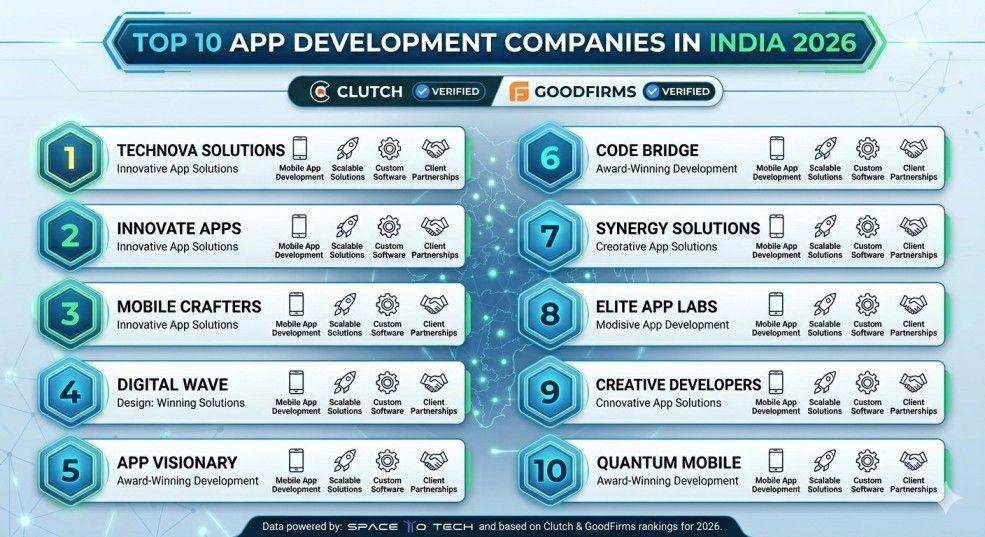
Top 10 App Development Companies in India 2026 | Clutch & GoodFirms Verified
Mobile Application Development in India India offers the largest talent pool for app development and innovation, with over 5 million software professionals calling the country home. As more organisations embrace a mobile-first approach they are turning to India's leading app development companies to create robust, scalable apps for the domestic market and abroad. Indian mobile application development market is expanding at a rapid pace, due to increasing digital adoption across various verticals of industry. Indian development companies are racing ahead to deliver innovative, customer-centric mobile applications in industries such as Healthcare, Finance, Logistics and eCommerce. The market is estimated to be 10,591.2 million USD in 2024 and is anticipated to reach 27,675.5 million USD by 2030. Our businesses provide complete solution to businesses, starting from native iOS and Android apps development and crossing the boundaries with cross-platform solutions for bigger challenges and through famous enterprise SaaS platforms. We are ready to incorporate latest technologies like AI, blockchain, IoT and many more in our offerings. We have clients from US, UK, UAE and many more countries who outsource their mobile development projects to India because of lowest possible labour cost and extreme flexibility of operations. With the aid of this guide, you may find the best technology partner for your next project among the top 10 app development firms in India for 2026. Our ranking is based on verifiable data from Clutch and GoodFirms, and client evaluations and portfolio strength. Why India Leads in Mobile App Development With the help of its strong talent pool and dynamic digital environment, India has risen to the top of the app development and software outsourcing worlds. An increasing number of top-tier mobile app development companies are being supported by the country's annual production of 1.5 million engineering graduates , a large portion of whom focus on software and app development. Every app development company in India is able to produce scalable solutions of excellent quality thanks to their ongoing supply of talent. India's application development companies are creating cutting-edge solutions for businesses of all sizes, from startups to Fortune 500 companies. Their ability to provide technical knowledge while keeping costs low makes them the go-to for clients all around the world. With thousands of new digital goods released every year, India's startup environment is booming, which is driving demand for app development services even faster. More and more budgets are being spent on developing bespoke mobile apps and solutions to boost productivity and engagement for businesses. India has emerged as one of the top destinations globally for digital transformation, with the country’s affordable pricing, qualified workforce and technologically advanced platforms offering optimal solutions for mobile app invention. Why Do Companies Choose to Outsource App Development to India India has emerged as a go-to destination for global firms seeking a perfect blend of speed, quality, and affordability in their app development services. With expertise in mobile app development, scalable teams, and effective delivery methodologies, the top app development companies in India continue to set high standards in delivering innovative and reliable digital solutions. Cost-Effective Development Among the many benefits of hiring an app development company in India is the money you can save. Without sacrificing quality, mobile app development in India may be as much as 40-60% cheaper than in the US or UK. While North American developers sometimes charge $100-$200 per hour, their Indian counterparts charge $18-$50. Access to Skilled Talent Due to a large number of qualified programmers graduating in India every year, Indian app development companies can tackle complex projects across numerous industry segments. Global startups, medium and large enterprises have come to rely on the Indian app development companies for their software projects. Faster Time-to-Market With an agile approach, most app development companies in India provide a tremendous benefit to their clients by delivering work in short sprint cycles. This results in faster launches, quicker iterations, and less risk for the project. Expertise in Advanced Technologies Indian companies have expanded their focus beyond traditional development to include innovative technologies like blockchain platforms, wearable app solutions, Internet of Things interfaces, and apps powered by artificial intelligence. India is becoming a center for innovation-driven digital products besides being a destination for cost-saving. What Companies Look for in an App Development Partner 1. How do I verify an Indian app development company? Look for experience in relevant projects within the company’s portfolio, case studies and previous work of their customers. A reputable app development company will have worked on projects in the logistics, healthcare or fintech sectors. Look for years of experience in mobile app development, size of the team and a global customer base. 2. What technology expertise should I look for? How skilled is your chosen company at modern technologies such as cloud integration & API implementation, iOS and Android application development. Experience with emerging cross-platform solutions like Flutter and React Native would also be highly valued. Some of the leading mobile app development companies in India are also specialists in AI-powered apps, blockchain and IoT integration. This means your product will be designed with future growth in mind and will be able to cope with increased demands as new technologies emerge. 3. Where can I check client reviews and ratings? Indian app development companies can now get verified client reviews on GoodFirms and Clutch. GoodFirms recommends reviewing only those app development companies that have received 5-star rating and at least 12 verified reviews to guarantee consistent performance. The ratings algorithm also considers several other factors including detail of project scope, client satisfaction and service offered. This category of businesses includes Space To Tech, a talented portfolio of work with clients such as Domino’s, Max Life Insurance & Eureka Forbes and many more. These businesses invest in high quality digital solutions and have a capability in app development with a culture of seeking customer feedback. How We Ranked These Companies Using credible industry data and performance factors, we conducted a systematic study to determine the best mobile app development companies in India. Five criteria were used to evaluate each app development company: client ratings on platforms like Clutch and GoodFirms, number of verified client reviews, portfolio strength and diversity across industries, range of app development services and technology expertise, and company experience, including years in operation and team size. The mentioned Indian app development companies are thoroughly vetted using this process to guarantee that they are trustworthy, knowledgeable, and capable of providing top-notch digital solutions. Top 10 App Development Companies in India (2026) 1. Space To Tech As per the websites like Clutch and Goodfirms below data was found: Rating out of 5.0: 5.0 | Company founded: 2023 | Employees: 150+ | Rate per hour: $25-$49 This company is based in Noida in India. SpaceToTech is a fast growing Mobile and Software App Development Company . It has delivered over 1000 digital products globally in the markets like US, UAE, and Australia. This company has been co-founded by Mr. Amit Singh. It has a specialty in Mobile App Development, AI powered platforms and cross platforms like Flutter and React Native. Major Services: Customised Mobile Apps | AI & Blockchain | React Native & Flutter | UI & UX design. Industries Served: Ecommerce, Finance, Healthcare, Education and Logistics. Highlights of the client: It has delivered quality cross-platform mobile solutions for Max Life Insurance, covering business analysis, UI\UX, iOS and QA Testing. 2. Konstant Infosolutions Rating out of 5.0: 4.8 | Company founded: 2003 | Employees: 180+ | Rate per hour: $25-$49 it is one of the most reputable mobile application development companies in India. Konstant Infosolutions specialises in developing apps for startups and corporate. The company has been crafting scalable solutions for international clients in a variety of sectors for over 20 years. Major Services: mobile app development web development and cross platform app development Industries served: Healthcare, Tourism, Ecommerce and Logistics Highlights of the client: created scalable corporate apps with a smooth user experience and flexibility to accommodate large scale user populations. 3. Techugo Rating out of 5.0: 4.9 | Company founded: 2015 | Employees: 100+ | Rate per hour: $25-$49 This company specialises app development for startups and organizations. Techugo provides world class mobile solutions with an emphasis on user interface and modern architecture. Major Services: UI\UX design, cross platform app development, IOS and Android development Industries served: Retail, Healthcare and Fintech Highlights of the client: Build and released highly engaging apps and providing startup ecosystem throughout the world with scalable infrastructure. 4. Aalpha Information Systems India Pvt. Ltd. Rating out of 5.0: 4.9 | Company founded: 2008 | Employees: 200+ | Rate per hour: $25-$49 This company offers end to end app development services for both startups and organizations. Alpha Information Systems India Pvt limited has a goal to provide digital solutions that are both affordable and scalable by utilising modern frameworks. Major Services: cloud solutions mobile apps and web apps. Industries served: Healthcare, Ecommerce and Education. Highlights of the client: this company helped small medium sized enterprises (SMEs) save money by developing and delivering customised application that performed better. 5. Developer Bazaar Technologies Rating out of 5.0: 4.9 | Company founded: 2016 | Employees: 200+ | Rate per hour: $25-$49 Developer Bazaar Technologies is comprised of professional full-stack web developers that specialize in providing innovative web development solutions for startup companies and medium-sized growing businesses. Using our agile development model, we deliver timely, scalable, robust, and maintainable web solutions. Major Services: mobile apps, SaaS platforms and web apps. Industries served: Startup companies, Ecommerce and Logistics. Highlights of the client: Developed scalable minimum valuable products [MVP] to aid businesses in their launch and verify their business concepts. 6. NetSet Software Solutions Rating out of 5.0: 5.0 | Company founded: 2011 | Employees: 200+ | Rate per hour: $25-$49 NetSet Software Solutions provides secure and scalable fintech and blockchain based software solutions to global customers. With the focus on security and robustness of developed systems, NetSet delivers comprehensive end-to-end software solutions for businesses. Major Services: Mobile Apps, Enterprise SaaS and Blockchain development. Industries served: Banking industry, Enterprises and Fintech Highlights of the client: Build fast, secure blockchain-based and other innovative financial platforms always fully compliance focused. 7. Ahex Technologies Rating out of 5.0: 4.9 | Company founded: 2009 | Employees: 250+ | Rate per hour: $25-$49 Ahex Technologies provides application development services for large, complex enterprise applications. Their team can help clients with digital transformation projects by delivering enterprise-grade solutions and migration strategies, as well as robust systems engineering and scalable architecture designs and implementation. Major Services: Apps for Enterprises, Cloud Solutions and Mobile Apps Industries served: Logistics, Healthcare and SaaS Highlights of the client: Have worked with a number of high profile clients, including performance optimisation and enhancing functionality with cloud integration of large enterprise systems. 8. SDLC Corp Rating out of 5.0: 4.8 | Company founded: 2015 | Employees: 250+ | Rate per hour: $25-$49 SDLC Corp builds connected mobile applications powered by AI and cloud infrastructure technology. SDLC Corp provides industry leading enterprise automation and the latest emerging technology solutions. Major Services: Artificial intelligence, Mobile & Cloud development Industries served: Enterprise, Finance and Gaming Highlights of the client: Worked with clients that have utilised AI in various forms to create faster, more efficient and automated systems. 9. OpenXcell Rating out of 5.0: 4.9 | Company founded: 2009 | Employees: 250+ | Rate per hour: $25-$49 They are one of the most trusted App Development companies in India catering to clients from around the world. OpenXcell has earned name and reputation in cross-platform mobile application and enterprise app development. Major Services: AI solutions, software development and mobile apps. Industries served: Enterprise, Retail and Healthcare Highlights of the client: Have developed scalable and high-performance applications for major global clients providing smooth and unified user experience. 10. Apptunix Rating out of 5.0: 4.5 | Company founded: 2013 | Employees: 250+ | Rate per hour: $25-$49 Apptunix is specialized in bringing the ideas of startups and established businesses to life through production of digital products with scaleable potentials. We provide feature rich mobile application solutions. Major Services: UI\UX design, mobile apps and SaaS platforms Industries served: On demand services, Ecommerce and startups Highlights of the client: Worked with a number of clients to scale up their mobile applications. Whether it's a high traffic social app or a fast growing e-commerce client, they have the ability to scale up our development teams quickly to meet demanding business needs. # Company Rating Hourly Rate Best For Top Technology 1 Space To Tech 5.0 $25–49 AI & cross-platform apps Flutter, React Native 2 Konstant Infosolutions 4.8 $25–49 Enterprise apps Android, iOS 3 Techugo 4.9 $25–49 UX-focused apps Cross-platform 4 Aalpha 4.9 $25–49 Startups Cloud, Mobile 5 Developer Bazaar 4.9 $25–49 MVP development SaaS 6 NetSet 5.0 $25–49 Blockchain/Fintech Blockchain 7 Ahex 4.9 $25–49 Enterprise solutions Cloud 8 SDLC Corp 4.8 $25–49 AI apps AI/ML 9 OpenXcell 4.9 $25–49 Global delivery AI, Mobile 10 Apptunix 4.5 $25–49 Startup apps SaaS Key Services from Mobile App Development Companies Custom Mobile App Development From brainstorming to building an MVP to releasing the app to the public, custom mobile app development takes care of it all. Indian app development companies create customised solutions that prioritise performance, scalability, and user engagement. Ideal for both startups and enterprises. Cross-Platform App Development Frameworks such as Flutter and React Native make it possible to build apps for both Android and iOS from a single codebase, which speeds up the development process. Market leaders in this space, such as Space To Tech, assist companies in cutting development costs by as much as 40% without sacrificing native-like performance. Explore: Flutter app development → https://spacetotech.com/Technology/flutter Explore: React Native development → https://spacetotech.com/Technology/reactnative UI/UX Design and Consulting Every app development service needs a solid UI/UX strategy since it affects user engagement and retention. The goal of the Indian development teams is to increase conversion rates through the use of user-centric design, easy navigation, and intuitive design. Maintenance and Support Post-launch support, including speed optimisation, security updates, and feature additions, is an essential component of app development services. Reliable mobile app development companies guarantee stability and ongoing enhancement of programs. Industries Served by Mobile App Development Companies in India Fintech Applications Digital wallets, mobile banking applications, and payment gateways are some of the safest fintech solutions built by Indian app development companies. For international marketplaces, these systems prioritise real-time transactions, data protection, and regulatory conformity. Healthcare Applications Telemedicine platforms, appointment booking applications, and patient monitoring tools are all part of the healthcare app ecosystem. India app development companies make sure these apps fulfil tight data protection and compliance standards while enhancing patient engagement. E-commerce & Online Marketplaces One of the most sought-after options for app development is e-commerce software, which includes both marketplaces with several sellers and those with a single vendor. These systems incorporate inventory management, payment processing, and customised user interfaces. Logistics & Enterprise SaaS Real-time tracking, automatic dispatch, and supply chain management dashboards are just a few of the features that Indian developers provide in their logistics app. Enterprise software as a service platforms allow companies to simplify processes and enhance overall productivity. Education (EdTech Applications) Electronic learning environments, online classrooms, and systems that monitor students' progress are all examples of edtech apps. Interactive learning experiences and scalable content distribution to global audiences are both supported by these technologies. Travel & Hospitality Modern users may take use of travel applications that offer solutions for hotel administration, itinerary planning, and booking systems. The platforms developed by Indian mobile app development companies improve consumer comfort and real-time service availability. Real Estate Applications Client relationship management (CRM) integration, virtual tours, and property listings are all made possible with real estate applications. Both the finding of properties and the communication between stakeholders are enhanced by these solutions. App Development Hubs in India Noida (Delhi NCR) Companies like Space To Tech have quickly established Noida as a significant technological hub. Noida excels in AI-powered platforms, enterprise SaaS, and mobile app development for international clients because of its expanding ecosystem of startups and IT companies. Bangalore Nearly 35% of India's software exports come from the city of Bangalore, which is commonly referred to as India's Silicon Valley. The city is home to over 10,000 IT companies. When it comes to artificial intelligence (AI), software as a service (SaaS), and startup innovation, it is the go-to place for complicated app development. Delhi NCR There has been a recent explosion in the number of product-centric app development companies in the Delhi NCR region, which includes the cities of Noida, Gurgaon, and Faridabad. Financial technology, healthcare technology, and business application development are areas where the region excels. Hyderabad Cloud computing and corporate software solutions are two areas in which Hyderabad excels. Building enterprise-grade platforms and scalable backend systems is a speciality of several Indian app development companies. Mumbai Mumbai is a hub for corporate software development and financial technology innovation. Digital banking systems, large-scale corporate applications, and fintech app development are all concentrated in the city. Cost of Mobile App Development in India (2026) App Type Estimated Cost Estimated Timeline Basic mobile app $10,000 – $25,000 4–8 weeks Medium complexity app $25,000 – $70,000 3–6 months Enterprise application $70,000 – $200,000+ 6–12+ months Rates in Western markets run from $100 to $200 per hour, whereas Indian mobile app development companies charge between $18 and $50 per hour, making them a far more affordable option. For example the significant cost benefit of outsourcing app development services to India, consider a 4-month project with a 5-member team working at $30/hour. In the US or UK, the corresponding cost would be over $240,000, but in India, it would be under $72,000. Space To Tech is one of several companies that provide free consultations and project cost evaluations to assist businesses plan properly. These estimates are personalized to requirements. Future of Mobile App Development Shaping by Technologies in 2026 Modern mobile app development companies in India using cutting-edge technologies are creating digital goods that are future-proof and scalable. Businesses are rethinking app development and user engagement strategies in light of these advancements. Artificial Intelligence (AI) & Machine Learning Applications driven by AI offer industry-wide automation, predictive analytics, and individualised user experiences. To enhance decision-making and productivity, top Indian app development companies include AI into healthcare, banking, and eCommerce apps. Cloud Infrastructure Scalability, security, and cross-device data access are all guaranteed by cloud-based app development services. Businesses may speed up application deployment without sacrificing performance or reliability by integrating with the cloud. Internet of Things (IoT) Connecting objects, systems, and people in real time, IoT-enabled mobile applications facilitate dialogue. A major force behind next-gen development solutions, the Internet of Things (IoT) enables smart healthcare monitoring and logistics tracking. Low-Code / No-Code Platforms The rise of low-code and no-code platforms has sped up the app development process, making prototyping and deployment more easier. Use of these technologies allows companies to speed up application development without sacrificing functionality or scalability. A 5-Step Guide to Finding the Best Indian App Developer Check Portfolio and Case Studies If you want to hire a mobile app development company, look at their previous work to be sure they've worked on projects like yours. Evaluate Technology Expertise For scalable app development, make sure the company is knowledgeable with new frameworks like Flutter, React Native, and cloud-based systems. Verify Client Reviews Use sites like GoodFirms and Clutch. Companies with at least 10 verifiable reviews and a rating of 4.7 stars are preferred. Assess Communication & Process Select groups whose members adhere to agile principles, who keep stakeholders informed at all times, and who communicate openly and often throughout the development process. Understand Pricing & Engagement Model To prevent unforeseen setbacks or budget overruns, make sure all costs, deadlines, and deliverables are crystal clear. With their solid track record, impressive portfolio, and dependable app development services, companies such as Space To Tech fulfil all of these requirements. You may schedule a free consultation or peruse their portfolio on their website. Conclusion With its exceptional technical knowledge, cost-effectiveness, and scalable delivery strategies, India has solidified its position as a world leader in mobile app development. Fintech, healthcare, shipping, and eCommerce are just a few of the many industries that continue to depend on Indian app development companies to create cutting-edge digital solutions. The correct app development company in India can drastically cut costs and speed up time-to-market for any business, from startups releasing their first MVP to large corporations updating their old systems. Space To Tech will help transform your ideas into digital solutions that can scale. With headquarters in Noida, we serve clients all around the US, UAE, UK, and Australia. You may schedule a no-cost meeting with their development staff or explore their portfolio online.
How IT Staff Augmentation Works for Growing Companies
Scaling a development team is really tough. When you try to scale a development team, you will run into problems. Finding and hiring full-time engineers for a development team takes a lot of time. It is very expensive, and there are no guarantees that it will work out for the development team. This is especially true when projects have to be done. Many growing companies get stuck because they have to meet deadlines. The recruitment process for new engineers takes too long. Staff augmentation is a solution. Of growing permanent teams, businesses use staff augmentation services to bring in skilled professionals when needed. The staff augmentation model is really useful for companies because it lets them get the people they need without having to make a long-term commitment. This means companies can easily change what they are doing when their project needs something. The staff augmentation model is great for this. In terms of staff augmentation means adding external expertise to strengthen internal teams. This article explains how IT staff augmentation works, its benefits, types, and when businesses should consider using staff augmentation. What Is Staff Augmentation? Defining Staff Augmentation – More Than Just Filling Seats At the heart of it, staff augmentation is about adding professionals to a team for a short time. Staff augmentation service is more than filling gaps in a team. In life, we use staff augmentation to bring in experts who can work with the existing team. With employee augmentation , businesses get to stay in charge of their projects while they work with these experts. These experts work alongside the regular team at the company using the same tools and ways of communicating as the regular team, and that is what makes staff augmentation so useful for businesses and their projects and teams. Staff augmentation is commonly used in areas like: IT and software development Product engineering Infrastructure and public works projects Good staff augmentation services don't just provide people; they make sure those people fit in well with the team. The goal is to make sure the new staff members work smoothly with the existing team. Staff augmentation service focuses on finding the fit for the team. The Staff Augmentation Model Explained The staff augmentation model is simple. Needs careful execution. Companies work with a staff augmentation model that has a pool of screened developers, engineers, and experts. When we know what we are looking for, the vendor gives us people who are a good fit for our company. These people work with the client; they do what the client tells them to do, not the vendor. That difference is important. There are types of staff augmentation models : Nearshore staff augmentation – Teams in nearby time zones for collaboration Staff augmentation dedicated team – A group of professionals working on a project Staff augmentation outsourcing – A mix of augmentation and partial outsourcing In practice, a staff augmentation service works well if these external resources fit in with the internal team. The staff augmentation model requires the professionals to work well with the client's team. How Staff Augmentation Works The Basics of Staff Augmentation Understanding staff augmentation is simple when you break it down into steps. Requirement Identification A company figures out what skills it lacks, project deadlines, and technical needs. Partnering with a Staff Augmentation Company Businesses look for. Choose a reliable staff augmentation company based on its expertise and past work. Companies partnering with experienced providers like Space To Tech Technology gain access to pre-vetted talent and structured delivery processes that reduce onboarding time significantly. Talent Selection The staff augmentation company provides augmented staff from its pool of workers who have already been checked for technical and communication skills. Integration with Internal Team The chosen developers join the company's team and follow the existing workflows. Project Execution and Collaboration Teams work together either remotely or in person, depending on how they agreed to work. Scaling Up or Down Companies can change the team size as staff augmentation projects change. These staff augmentation solutions help provide flexibility without disrupting operations. Flexibility at Its Core The main reason companies use the staff augmentation model is that it gives them flexibility. They do not have to hire people for a time. Businesses can add people to their teams. Take people away based on the work they have to do. This is very useful when they need someone with skills to work on a project or when they do not know how long the project will take to finish. The staff augmentation model is also good for working with people in other countries. For example, when people are in the same time zone, it is easier for them to work together on staff augmentation projects. When people work on staff augmentation projects, at the time they can talk to each other more easily and get more work done on their staff augmentation projects . Customization in Staff Augmentation Staff augmentation is not the same for every company. Companies usually change staff augmentation services to fit what they need. Some common ways to do staff augmentation include: Hiring individual staff augmentation developers for tasks Building a staff augmentation dedicated team that's just for staff augmentation Creating teams that're just for one project Using temporary employee augmentation when a company only needs help for a time This makes staff augmentation a good choice for both startups and big companies, like large enterprises. When to Consider Staff Augmentation Signs It Is Time To Add People To Your Team When your company does not have the people to do the job, you might need to find more staff augmentation solutions . There are reasons why this happens, such as having too much work for the people you already have, or your company is growing, and you need more people to keep up with the work of your company. The company is growing fast You need people with skills that your team does not have You do not have the time or money to hire people Your company is changing the way it uses technology all the time In these situations, a good team augmentation service helps companies, like yours to keep moving without waiting. Staff augmentation solutions are very useful when your team needs people. Staff augmentation is a way to get the help you need. Managing Surges in Workload Workload spikes happen in a lot of industries. Things like product launches, seasonal demand, and infrastructure upgrades can be too much for the people already working there. Companies can get help with this by using staff augmentation outsourcing . This means they do not have to hire many people. For example, companies that work on infrastructure or modernization projects for the works department often bring in temporary technical experts to help them meet their deadlines. Staff augmentation outsourcing is very helpful for these companies when they have a lot of work to do. Handling Specialized Projects with Augmented Staff Some projects need skills that the people who already work at a company may not have. These include: AI and machine learning Cybersecurity Cloud migration Mobile app development When a company needs these skills, they do not have to hire people to work for it all the time. Instead, companies use staff augmentation projects to bring in AI and machine learning experts, cybersecurity experts, cloud migration experts, and mobile app development experts for a time. To reduce development time while maintaining native performance, many companies adopt cross-platform app development using React Native’s single codebase architecture for faster product launches. Meeting Tight Deadlines with Additional Expertise Time is an issue for companies when it comes to hiring people. They have to think of ways to do it. With staff augmentation service providers, businesses get a lot of benefits, such as: Faster onboarding Access to developers Reduced recruitment timelines This helps teams finish their work on time without sacrificing the quality of the work that the teams and the global developers do. Benefits of Staff Augmentation for Businesses Key Benefits of IT Staff Augmentation Services Staff augmentation services offer benefits when done right. Here are a few: Hiring Access to a global talent pool Flexible team size Better project delivery These staff augmentation solutions help businesses stay flexible in markets with IT staff augmentation services . They help companies adapt quickly. Staff augmentation services make it easy to scale up or down. Secured Flexibility for Growing Teams One of the things about nearshore staff augmentation is that it is very scalable. Companies can do things to make their work easier. They can: Scale the number of developers up or down Control what they spend on budgets effectively Avoid making long-term commitments to hire people Nearshore staff augmentation makes things more efficient by helping people work together better. The reason for this is that nearshore staff augmentation really helps people work together. Nearshore staff augmentation is about working together as a team. Reduced Time Spent on Recruiting Recruitment is usually the problem when it comes to making teams bigger. Staff augmentation companies take care of things for you, such as Candidate sourcing Technical screening Onboarding This helps Human Resources teams a lot and makes the hiring process faster. Lower Operational and Hiring Costs When you hire people, you have to pay them a salary, you have to get them a place to work, you have to teach them what to do, and you have to keep them on for a long time. In contrast, staff augmentation outsourcing reduces a lot of things, like Infrastructure costs Human Resources work Money spent on training Businesses only pay for the staff augmentation expertise they actually need. Companies have control over a few things when they do not outsource work. These things are: Workflows Project timelines Internal team staff This control is what makes staff augmentation different from managed services. Staff augmentation is special because companies keep control over staff augmentation. This is what sets staff augmentation apart from managed services. Risks to Consider When Hiring Through IT Staff Augmentation So we have to think about the problems with this. Time Zone Differences When we work with teams in different countries, it is really tough to have a conversation with the teams because they are located in different time zones. Maintaining Quality Standards The thing is, not all companies have developers who are equally good at their jobs. Security and IP Risks We have to make sure we have contracts and non-disclosure agreements to keep everything safe. Capability Gaps If we pick the company to work with, they might not have the right skills, and that can cause a lot of problems with our projects, as well as with the Security and IP Risks and Time Zone Differences, Capability Gaps, and Maintaining Quality Standards. Different Types of Staff Augmentation Services Businesses can choose from several models: On-Site Staff Augmentation Remote Staff Augmentation Team-Based Augmentation Project-Based Augmentation Short-Term Augmentation Long-Term Augmentation Specialized Skills Augmentation Each model supports different types of staff augmentation projects . Differences Between Staff Augmentation and Other Outsourcing Models Staff Augmentation is different from a Dedicated Team. When a company uses Staff Augmentation, the company is still in control. Staff Augmentation is also different from an independent contractor. The good thing about vendors is that they are reliable and have structured processes in place. Staff Augmentation is different from Managed Services, too. With Managed Services, the vendors take on responsibility, so the company does not have to worry about it. IT Staff Augmentation Challenges Even the planned projects can have problems like: Communication gaps Onboarding delays Integration challenges Relying on the vendor's team of workers Fixing these problems makes the project better, in the long run. How to Choose the Right Staff Augmentation Vendor Choosing a partner is really important. When you are looking at a company, you need to think about a few things. Evaluating Technical Experience. You have to check if they're good at the things you need them to be good at. Then you have to think about Assessing Industry Experience. You want to make sure they know about the area you are working in. Reviewing Portfolio and Case Studies. You should look at the projects they did in the past to help companies with staff. You also have to do Checking Reputation and Reviews. This is to make sure they are trustworthy and do work. Evaluating Talent Pool. A good company will have many people working for it, and it will keep them. This is because strong vendors maintain a pool of skilled professionals, which is really important for staff augmentation . Real-World IT Staff Augmentation Success Stories Using Artificial Intelligence To Make Something People Can Actually Use A company that sells software over the internet was getting bigger. They needed some help. So they brought in some Artificial Intelligence engineers for a while. This helped them take an Artificial Intelligence idea and turn it into something that people could really use. They did not have to hire a new team of Artificial Intelligence people to do this. Making A European Ticket Website Bigger A big company that sells tickets in Europe needed to make its website better. They added some people to their team to help them do this. These new people helped them add things to the website without slowing down the things that were already working. Conclusion Understanding how IT staff augmentation works is super important for growing companies. The model gives a way to make teams bigger without the long waits and high costs of traditional hiring. Staff augmentation provides flexibility, access to people from all over the world, and better control over projects. This helps businesses adjust quickly to changes and still be in charge of their development work. When a company has a lot of work to do and not a lot of time to do it, or they have a project that needs to be done, they should think about hiring staff augmentation services . This is an idea. Companies that are getting bigger and want to make their development teams bigger can get a lot of help from staff augmentation services providers.
Choosing the Right IoT App Development Company in 2026: A Complete Guide
Introduction to the Growing Importance of IoT App Development in 2026 IoT app development is now crucial for businesses in 2026. Many organizations across manufacturing, healthcare, logistics and retail rely on devices to monitor assets, automate workflows and generate real-time insights. Instead of manual reporting, sensor networks and cloud platforms now process continuous data streams. For example predictive maintenance systems can reduce equipment downtime by up to 30–40% according to industry benchmarks. This shift fundamentally changes how businesses operate. This is where an IoT App Development Company becomes critical. Building an ecosystem requires device integration, communication protocols, mobile interfaces, cloud infrastructure and security frameworks working together. This guide explains how businesses evaluate an IoT app development company in India or the USA and choose a partner of delivering scalable long-term IoT systems. What do we mean by IoT App Development Company? An IoT App Development Company builds software systems that connect devices, process data and enable real-time control across environments. Unlike development firms these companies manage complex layers including Device communication protocols (MQTT, CoAP, HTTP) Data pipelines and cloud ingestion systems Edge processing and real-time analytics Secure device authentication frameworks Most companies offering IoT app development services provide core capabilities: IoT Software Development for backend logic and device communication IoT Mobile App Development for real-time monitoring and control Cloud infrastructure integration using platforms like AWS IoT or Azure IoT Hub Connected device lifecycle management Data analytics dashboards using tools like Power BI or Grafana The key difference from a typical app development company is architectural complexity. While a mobile-first company focuses on UI/UX a focused partner ensures reliable communication between thousands—or even millions—of devices and cloud systems. Why Do Businesses Need IoT App Development in 2026? Businesses adopt IoT app development because it delivers operational visibility and automation which provides: Real-time monitoring Continuous sensor data enables detection of anomalies in equipment, logistics or infrastructure. Automation of workflows Triggered actions reduce manual intervention—for example automated inventory restocking systems. Predictive analytics Data streams support machine learning models that forecast failures or demand patterns. When combined with solutions from an AI app development company IoT platforms evolve into systems capable of autonomous decision-making. Core IoT Application Development Services Offered by Leading Companies Leading providers deliver end-to-end IoT application development services across technical layers. IoT Mobile App Development Mobile applications provide real-time control, alerts and visualization of device data. IoT Cloud Integration Cloud platforms handle ingestion, storage and processing of high-volume data streams often exceeding millions of events per second. IoT Analytics Dashboards Dashboards convert data into actionable insights using time-series visualization and anomaly detection. Custom IoT Software Development Tailored solutions integrate with enterprise systems such as ERP, CRM or industrial control platforms. IoT Consulting and Strategy Services Effective IoT systems begin with planning and architecture design. Many IoT projects fail due to the absence of a defined system architecture particularly when scalability is not considered from the outset. Professional consulting includes: Use-case validation and ROI modeling Technical feasibility assessments Architecture design using microservices or edge-cloud hybrid models Infrastructure planning for scalability This phase ensures that a pilot deployment can scale to thousands of devices without performance degradation. IoT Mobile and Web Application Development IoT platforms require interfaces that enable real-time device control and monitoring. Modern IoT mobile app development typically includes: Real-time telemetry dashboards Remote configuration of devices Push alerts and notifications Data visualization Professional mobile app development services ensure seamless API integration between mobile applications, cloud systems and device networks maintaining latency below acceptable thresholds (often under 200 ms for real-time systems). Hardware Integration, Connectivity, and AI-Powered IoT Solutions IoT systems depend on integration between hardware and software components. Key connectivity technologies include: WiFi for high-bandwidth environments Bluetooth Low Energy (BLE) for short-range communication Zigbee for mesh networks 5G for -low latency and high device density An experienced IoT Software Development Company ensures stable device communication at scale. AI-powered analytics further enhance these systems by identifying patterns enabling maintenance and automating decision-making processes. Key Benefits of IoT App Development IoT app development delivers efficiency improvements across operations. Real-time monitoring Continuous visibility improves response time to issues. Efficiency Automated triggers reduce dependency on workflows. Improved analytics Data-driven insights support forecasting and optimization. Cost reduction Predictive maintenance minimizes downtime and repair costs. Enhanced user experience Adaptive systems respond dynamically to real-time conditions. How IoT App Development Helps Businesses Scale Operations? The IoT app development is really useful for companies because it helps companies grow without having to hire a lot of people or make things more complicated. When you connect IoTdevices and systems to the cloud you can watch what is going on with the IoTdevices and systems. Remote device monitoring Companies can see how their devices are doing and how they are working from one place. Predictive maintenance Sensors that are connected can find problems before they happen, so you do not have to stop working and lose money. Smart resource management IoT systems help companies use energy, equipment, and people in a way. Supply chain optimization You can see where things are in time, so you can get things from one place to another more easily and make the whole process better. When companies use IoT Application development , they can see what is going on in their business that they could not see before. End-to-End IoT Development Solutions Across Industries The IoTdevelopment services are used in different areas now. We use the simple technologies, like sensors and cloud infrastructure in many industries to create solutions. The IoTis really useful because it connects devices, collects data, and then turns that data into something people can actually use. This is a deal. The IoTis used in lots of areas, including: Healthcare: Doctors and nurses can keep an eye on patients from afar. Manage medical equipment better with the Internet of Things. The IoThelps doctors and nurses do their jobs better. Retail and eCommerce: Stores use the IoTto keep track of their stock. They get alerts when it is time to restock. The IoTalso helps stores see how customers shop. Smart Homes: The IoTlets you control the things like the lights in your home and your security systems from your phone. Manufacturing: The IoThas sensors on machines that help find problems before they happen, so machines do not break down often. The IoTis great for manufacturing. Fitness: Wearable devices track your performance so athletes and coaches can see how you are doing. The IoTis useful for athletes. Transportation: The IoThelps track vehicles, see if they need repairs, and monitor logistics. This makes planning trips better for people. The IoTis really helpful for transportation. Wearables and Connected Devices: The IoTincludes things like smartwatches and fitness trackers that people use every day. The IoTis around us. IoT Solutions for Healthcare Healthcare is growing faster when it comes to using IoT technology to develop services. Doctors and nurses can keep an eye on patients all the time with the help of devices not just when patients come in for a checkup. Remote patient monitoring systems keep track of signs like heart rate and blood oxygen levels. This helps doctors find problems earlier. Smart Medical Devices are used by Doctors and nurses to send information about how the devices are working. This helps hospitals keep track of their equipment and see when something needs to be fixed. Health Data tracking through devices gives doctors a better idea of a patient's health over a long period. In these systems, equipment, patient data, and monitoring devices communicate through networks. IoT Solutions for Retail and eCommerce Retail organisations are spending a lot money on developing IoTapplications. They want to solve two problems. The first one is getting the stock levels at all times. The second one is understanding how customers behave when they are, in the store. Smart Inventory Tracking: The IoT is used to track inventory levels by using sensors to watch how many products are on the shelves, so we do not run out of stock. Customer Behaviour Analytics: The IoT helps us understand how customers move around our stores. Automated Supply Chain: We can use the IoT to see where everything is in our supply chain. Smart Shelves: The IoT is used on store shelves to see if products are available and to tell us when we need to restock. These systems are powered by IoT mobile app development. Managed by skilled IoT app developers. Businesses investing in connected retail systems often also evaluate the eCommerce app development cost to plan their overall digital transformation budget effectively. What to Keep in Mind While Choosing an IoT App Development Company? When you are searching for a company that can develop an IoTapp you have to be really careful. This is because the IoTsystems have to keep working for a very long time after the IoTsystems are first set up. Technical expertise Look for experience in IoT Software Development , cloud platforms and mobile systems. Industry experience Cross-domain expertise helps anticipate real-world challenges. Security frameworks Ensure implementation of encryption standards such as TLS and AES-256. Scalability Systems must support high device volumes without latency issues. Custom development capabilities A custom IoT app development company should align solutions with existing business systems. IoT Security and Privacy Considerations Security is really important when we talk about IoT applications . The thing is, these connected devices are always collecting and sending out information like personal data. So security needs to be a part of every layer. We are talking about the IoTapplication development. This includes the firmware that runs on the devices the way they communicate with each other how they store data in the cloud and who gets to access that data. There are some security practices that we should follow, which include: Device Authentication Protocols. We need to make sure the devices are really the devices they claim to be before we let the devices connect to the network. This is important because it stops the devices that are not supposed to be in the system from getting into the system. Encrypted Communication Channels. We need to protect the data that is sent between devices and servers. We can do this by using encryption protocols. Secure Firmware Updates. We need to make sure that software updates for devices come from sources. This means we have to check that the software updates are not changed in any way. The software updates must be safe. We can trust them. Cloud Infrastructure Monitoring. We need to keep an eye on cloud systems all the time. This helps us to find any problems, security threats, or issues with performance. IoT software development services that are reliable always put security first from the beginning when they are designing the architecture of the system. What does it mean by IoT App Development Process? Most companies that specialize in IoT development follow a step-by-step approach to avoid problems and make sure the system is reliable. IoT consulting and requirement analysis Hardware integration selects sensors, microcontrollers, and communication modules, configuring them to reliably transmit device data to the connectivity layer. Hardware and device integration Hardware integration involves selecting sensors, microcontrollers, and communication modules suited to the use case. These components are configured to reliably transmit data to the connectivity layer for processing and analysis. IoT mobile app development Applications for phones and the web are created to monitor and control devices that are connected. Cloud integration and analytics setup Cloud platforms are used to manage data from devices, store it, and create dashboards to understand the data. Testing, deployment, and maintenance Systems are tested to make sure they work put in place and are constantly updated to ensure they work well and are secure. What is the Difference between Custom IoT App Development And Ready-Made IoT Solutions? The choice between custom IoT development and a made platform is a big decision. It really depends on a things. The complexity of your IoTdevice ecosystem is one thing to think about. You also have to consider your integration requirements with existing systems. Then there are your long-term IoTscalability needs. If you use a made platform you can get things done faster. Custom IoT App Development Tailored features: Solutions are designed around workflows, devices, and goals. Scalable architecture: Architectures are built to support expansion, more devices, and increased data. Better integration: Custom platforms work well with existing software, APIs, and infrastructure. Ready-Made IoT Solutions Faster implementation: Pre-built platforms let organizations start using capabilities fast. Lower initial cost: When you buy made solutions you have to pay money first. This is okay, for projects or when you just want to try something out with ready-made solutions. What are the latest IoT Development Trends to watch in 2026? IoT App Development Companies are changing how they make and use systems in 2026. This is happening because of a new technologies that are coming together. These include using Artificial Intelligence to look at data right where it is being made using 5G to talk to each other in time and making fake versions of systems to test them without actually having to test the real thing. AI-powered IoT analytics: Artificial intelligence helps process data to make predictions and automatically make decisions. Edge computing: Data from devices is handled right where the devices are, which reduces delays and makes systems respond faster. Digital twin technology: Businesses use copies of real devices to test how they work and predict if they might break. 5G-enabled device connectivity: The 5G network allows devices to communicate faster with cloud platforms. Smart city infrastructure: The IoTtechnologies are used in cities to make the traffic systems smarter. This is really useful because it helps to manage energy. The IoTtechnologies also provide services to people, in the city. How to Choose Between an IoT App Development Company in India vs USA? Businesses looking for partners often compare the IoT app development companies in India with the IoT App Development Companies in the USA . India and the United States of America are both very good at creating IoTtechnology. They are very different when it comes to how much things cost what rules they follow and how they work with people. So when you are trying to decide which one to choose you have to think about what kind of project you're doing what rules you have to follow and how much money you have to spend on IoTdevelopment. IoT App Development Company in India Indian companies offer affordable development costs without compromising on quality. India has skilled IoT developers with experience in IoT software and mobile platforms. India is an outsourcing destination for many international businesses, providing scalable development and long-term tech support from Indian teams. IoT App Development Company USA Companies in the USA understand regulatory requirements and industry standards. Many US app development companies focus on creating solutions for large enterprises and digital transformation projects. US firms often specialize in industries with compliance rules, such as healthcare, finance, and government systems, where IoT app development companies in the USA have an edge. Why Businesses Choose This IoT App Development Partner? Businesses looking for IoT development partners want teams that're good at all parts of the technology. This includes hardware integration and mobile app development well as cloud architecture and keeping systems secure. A good IoT partner builds systems that stay reliable and secure. They also make sure these systems can handle devices and data. IoT app developers who have experience: These teams are good at designing and building applications. They connect devices and sensors to cloud systems. End-to-End IoT App Development Services: They help with planning and getting everything ready. They also help with putting the system in place and keeping it running. Custom IoT solutions for startups and enterprises: They make solutions that fit the needs of new companies that are growing. They also make solutions for companies. Expertise in mobile app development services: They make mobile and web applications that let people easily check and control devices that are connected to the Internet. Scalable IoT app development solutions: People are making systems that can work with devices and a lot of data that we will have in the future. These systems will be able to handle devices and more data in the future. Why do businesses choose Space to Tech as their IoT App Development Company? Space to Tech is a company that develops apps. They are based in India. They have experience in creating solutions for clients in healthcare, manufacturing, retail and logistics. These clients are in the USA, UK, UAE and Australia. Space to Tech helps clients with: End-to-end IoT development. This includes choosing the sensor hardware and firmware. They also develop the cloud backend and mobile app. Creating apps for iOS and Android. These apps have real-time device dashboards. Building cloud architecture. They use AWS, Google Cloud or Azure. This supports high-volume IoT data. Implementing security frameworks. This includes device authentication and encrypted communication. They also ensure compliance auditing. When Space to Tech builds IoT systems they focus on long-term stability. This means the platform stays stable as more devices are added. The platform maintains performance, security and reliability. Conclusion: Choosing the best IoT App Development Company is a big decision. It will affect how reliable, secure and scalable your IoT system is for a time. The company you pick will play a role in your connected technology journey. They will shape your systems reliability. They will shape your systems security. They will shape your systems scalability. When a company has the expertise, a good architecture, strong security practices and experience, in your industry they can create a connected system that improves things.
Building Intelligent Apps in 2026: The Role of AI as Infrastructure for Mobile App Developers in the USA
Artificial intelligence is no longer just an add-on feature in mobile applications. In 2026, AI acts as the core infrastructure upon which modern mobile apps are built. Leading mobile app development companies in the USA are now designing apps where AI is integrated from the beginning of the development process. This approach enables applications to become smarter, more predictive, and continuously adaptive. What Is "AI as Infrastructure" in terms of Mobile App Development? In 2026, AI is not an add-on to a mobile app, instead it is a very basis upon which the app is constructed. Top Mobile App Development Companies in the USA Currently: From the beginning, design AI-powered native mobile apps Use AI for predictive purposes in every process Execute tasks autonomously with the help of AI bots in mobile app development companies. Use edge AI to improve speed and privacy Make apps better all the time by implementing learning systems in mobile app development companies in USA The new age of intelligent mobile app development is defined by this transition. The Importance of AI-Native Transition An increase from less than 5% in 2025 to over 40% in 2026 is attributable to the inclusion of task-specific AI agents in enterprise mobile applications. The USA mobile app development companies have progressed from creating "AI-enabled" apps to creating apps that are AI native. The change is significant because by 2027, experts predict that the app economy in the USA will have grown to over $756 billion. For mobile apps, AI app infrastructure is required. A strategic move. Current market leaders in the USA mobile app development incorporate AI into the fundamental design, as opposed to previous methods that only attached AI. The infrastructure-first concept helps companies like Space To Tech deliver scalable, secure, and intelligent solutions internationally to clients in 28+ sectors. Expanding AI Features to AI Frameworks Model from Before 2024 AI was seen as an afterthought mobile app development companies: Chatbots integrated into Plugins that include recommendation engines Poor incorporation into existing processes Being able to communicate with AI was a desirable luxury. The Reality in 2026 Top AI app development companies in the USA now consider AI essential infrastructure: Native architecture for AI Determination by itself Ongoing optimization Customization based on predictions A great deal of technological progress was made rapidly. ML models improved in capability while expenses decreased by approximately 40%. A whopping 97% of app developers in the USA are now making use of AI coding assistance. Having access to research hubs, enterprise demand, and top-tier AI expertise positions USA app development companies to dominate. The Co-Pilot Architecture Guidelines When it comes to AI custom app development in the USA in 2026, the Co-Pilot Architecture is king. Layer 1: Smart Scaffolding From needs expressed in plain English, AI may design optimum architecture. With built-in security, developers begin with 60% complete. Layer 2: Synthesis of Logic in Real Time AI makes code-writing suggestions as app developers in the USA. The app automatically optimizes battery efficiency and performance. Layer 3: Quality Automation via Autonomy In order to find edge-case bugs before they are deployed, AI models user behavior. Up to 80% fewer post-launch bug complaints are reported by many mobile app development services in the USA. This results in smaller teams developing enterprise-grade solutions , quicker validation, and reduced expenses for enterprises. AI for Predictive User Behavior Native Apps using AI foresee user demands. E-Commerce By constantly adjusting product displays based on buy intent predictions, apps can increase conversions by as much as 35%. Healthcare Improved operational efficiency is achieved through the use of apps that predict appointment no-shows and provide proactive reminders. Finance Extremely accurate fraud detection is achieved by real-time behavioral analysis. Top USA mobile software development companies use TensorFlow Lite, Core ML, and advanced analytics technologies to give this intelligence while prioritizing privacy through on-device processing. AI for on-device use (Edge AI) In the United States, cutting-edge mobile app development is defined by edge AI. The Importance of Edge AI Reduced wait times Cut down on cloud expenses Working without an internet connection Improved security Device-based AI enables biometric identification, personalization, computer vision, and speech recognition. Stringent privacy laws should be considered by any mobile app development company situated in the United States. Because of this, the "train in cloud, infer at edge" AI framework for mobile apps is being developed. AI Agents and Intelligent Automation Using AI agents will be standard in 40% of business apps by 2026. These agents: Complete multi-step tasks Evaluate decisions in context Integrate different platforms More than half of the inquiries are currently being handled automatically by customer support personnel. Business process agents streamline the scheduling and invoicing processes. Integrate LLMs, API coordination, and retrieval-based systems to create autonomous yet controllable agents. Lead app development companies in the USA. In mobile app development, this is intelligent. Core Infrastructure: Generative AI Generative AI APIs are currently used by over 80% of enterprises. In the workflows of top mobile app development companies in usa, generative AI helps with: Personalized content production Customized messaging AI-powered programming Document automation To lessen the content workload by as much as 60%, mobile app development agencies employ tools such as GPT models and picture creation APIs. This results in shortened launch times and lower operational costs for our clients. Engines for Hyper-Personalization Personalization in the year 2026 is multi-faceted. Behavioural After a user does something within the app, the app becomes responsive. Contextual Information is affected by context, which includes time, place, and device. Predictive Apps consider user needs in advance of a search. AI-native mobile apps from top USA mobile app development companies increase retention and lifetime value through analytics, deep learning, and real-time adaption. Personalization is now adaptive in structure, not just static recommendation. How USA Businesses Develop AI-First Applications Top mobile app development companies typically follow this blueprint: Data Design with an AI Focus Machine learning-ready data pipelines straight out of the gate. Microservices and AI Services AI decoupled as scalable services, with API integration. Continuous Learning Feedback procedures, tracking of models, and performance evaluations. Integrating AI across Multiple Platforms Using either React Native or Flutter, AI models can be shared between iOS and Android. USA app development companies integrate cloud AI services with edge deployment to balance scalability and performance. AI Development for Multiple Platforms As many as 70% of enterprise apps today are built using cross-platform frameworks. Using AI with React Native Highly supported AI SDK allows for rapid development. The combination of Flutter and AI Fast user interface with expanding machine learning ecosystem. Cross-platform development can save businesses between 30 and 40 percent on costs. Native app development may be preferable for enterprise apps that require deep hardware integration. The architecture of a modern mobile app development agency in the USA is determined by factors such as performance, compliance, and scalability. AI's Role in Ensuring Your Privacy and Security AI infrastructure raises the stakes and the potential pitfalls. Priorities of mobile application development companies situated in the USA include: On-device processing Privacy with a difference Clear AI decision-making Bias audits Legal compliance (CCPA, HIPAA, industry standards) The cost of a breach can exceed millions, making responsible AI architecture essential. American app developers have an ethical edge in the global trust race. Conclusion & Strategic Recommendations Among the top USA mobile app development companies in 2026, AI is seen more as a necessary component than an optional extra. The competitive truth: AI bots are becoming commonplace. Embedded generative AI Growth is propelled by Predictive Systems Privacy is protected by edge AI Businesses in the USA who prioritize AI in their app development strategy prioritize scalability, speed, and AI intelligence. Consider more than just feature lists when assessing mobile app development services in the USA. Pick a business associate with a solid grasp of the ABCs of AI for mobile apps. Are you prepared to create an API-level intelligent mobile app that is AI native? Need a free consultation? Space To Tech is the place to go. We serve clients in 28+ sectors with expertise in React Native, Flutter, Android, iOS, and cutting-edge AI technologies using USA-quality standards and global efficiency. Join me in creating the design for your smart app.
UAE
INDIA
USA

Coming Soon
Trusted development partner across USA, UK, Australia, UAE, and India