
Here's something that doesn't get said enough: most founders who decide to hire software developers from India don't do it because they read a blog post about it. They do it because someone they trust told them it worked. And then it works for them too. And then they tell someone else.
That's not a marketing story. That's just how word spreads when something actually delivers.
But if you're earlier in the process — still researching, still unsure — the "why India" question deserves a real answer. Not a list of bullet points, not a table of hourly rates pulled from thin air. An actual explanation of what's driving this, why it's held up for two decades, and what makes Indian software developers worth the coordination effort that comes with any distributed team.
That's what this is.
Why India's Developer Ecosystem Is Built to Serve Global Teams
Start with the raw numbers, because they matter more than people realise.
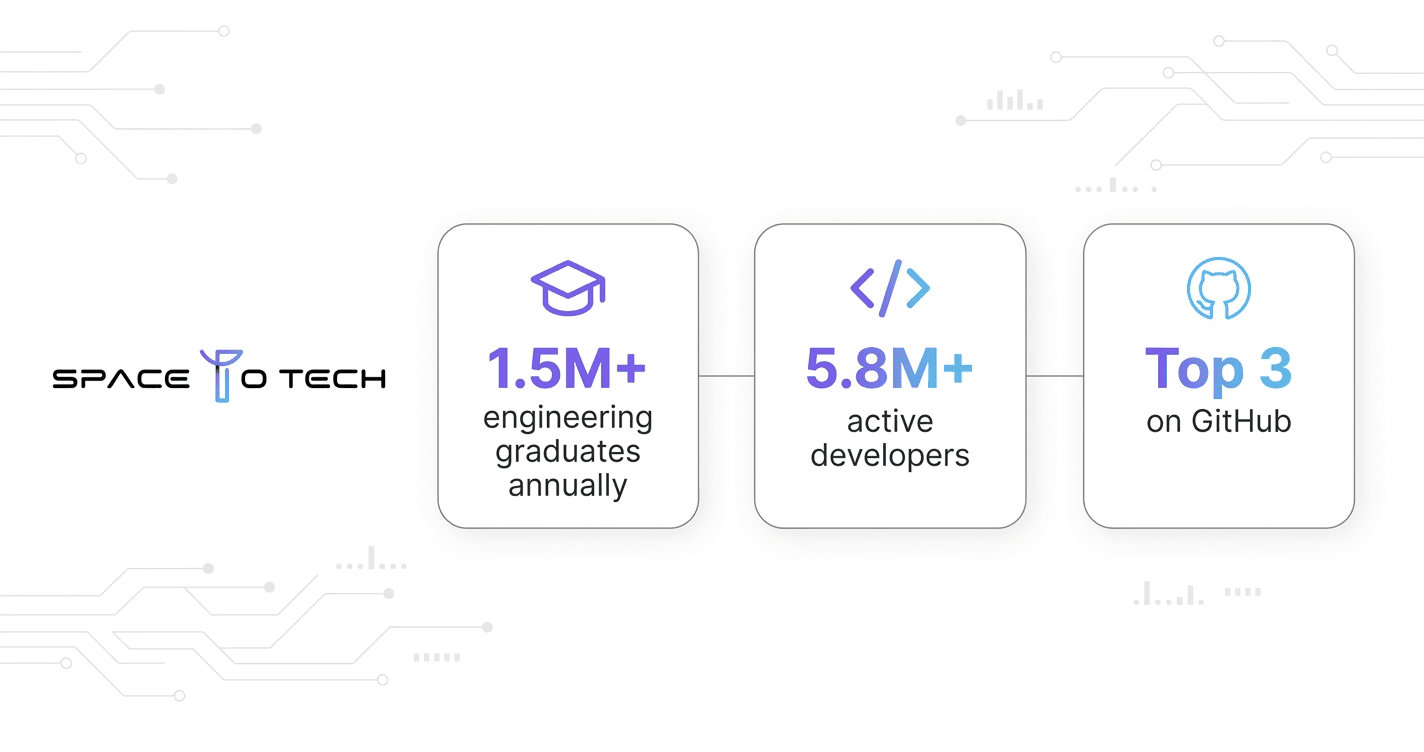
India produces over 1.5 million engineering graduates every year. Every single year. The active developer population is somewhere north of 5.8 million — NASSCOM put it there in 2024, and it's grown since. On GitHub, Indian developers are among the most active contributors on the platform. Stack Overflow's surveys have said the same thing for years running.
Quick stats worth knowing:
- 1.5M+ engineering graduates annually
- 5.8M+ active software developers India (NASSCOM, 2024)
- Top 3 globally for GitHub contribution volume
What that actually means when you're trying to hire software developers from India: you're not fishing in a small pond and hoping something bites. The talent is there — backend engineers, Android app developers, CRM developers, embedded software specialists, AI and NLP engineers, full-stack generalists. People with ten years of production experience who've shipped real things for international clients. The depth exists across the board, not just at the top end.
Step-by-Step Hiring Process
Most guides to hiring software developers in India skip straight from "why India" to a vendor pitch. What's usually missing is the actual sequence a buyer follows between deciding to hire software developers in india and having someone productive on the team. Here's that sequence:
1. Define Project Scope and Role Seniority
Write down what the role actually needs to deliver in the first 90 days, not just a tech-stack list. A vague brief is the fastest way to end up interviewing candidates who look right on paper but aren't the right fit for the actual work.
2. Choose an Engagement Model
Decide upfront whether you need a freelance software developer for a short, well-scoped task, a dedicated software developer or full dedicated software team embedded in your existing workflow, a full-time hire via an Employer of Record, or staff augmentation to extend an in-house team. Each model changes your cost structure, your management overhead, and how much continuity you get after launch.
3. Source Candidates
Depending on the model, sourcing might mean LinkedIn and Naukri searches for a direct hire, GitHub activity review for remote software developers, or a shortlist from a vetted agency partner. Referrals from other companies that hire developers in the same city tier are consistently the highest-quality source, even though they're the slowest.
4. Screen With a Real Task, Not a Puzzle
Abstract algorithm puzzles test contest skills, not whether someone can ship inside your codebase. Give every software developer candidate a small, paid task tied to your actual stack — it surfaces far more about how skilled developers and less-skilled ones diverge than a whiteboard exercise ever will.
5. Handle Contracts, IP Assignment, and Compliance
Before anyone starts, get IP assignment, confidentiality, and (for direct hires) statutory compliance terms in writing. This step is where most horror stories about hire indian software developers engagements actually originate — not from the engineering work itself.
6. Onboard With Tooling, Docs, and a Single Point of Contact
Give new software engineers repo access, environment docs, and one named contact for questions on day one. Teams that skip structured onboarding lose the first two to three weeks of a new hire's output to friction that has nothing to do with skill.
Cost & Salary Benchmarks
Rates for hire software developers engagements in India vary more by experience level than by almost anything else. Here's the typical band, all-in, for a vendor-sourced dedicated software developer (not an open-marketplace freelance developer, which carries a different risk and cost profile):
| Experience Level | Hourly (USD) | Annual (USD, all-in) | Annual (INR, approx.) |
| Junior (0–2 yrs) | $15–$25 | $18,000–$26,000 | ₹6–10 LPA |
| Mid-Level (3–6 yrs) | $25–$45 | $26,000–$40,000 | ₹12–20 LPA |
| Senior (7+ yrs) | $40–$70 | $40,000–$60,000 | ₹18–35 LPA |
| Lead / Architect (10+ yrs) | $60–$90 | $60,000–$85,000 | ₹35–55 LPA |
Two things worth stating plainly on the page: statutory employer costs (provident fund, gratuity, ESI) add roughly 20–30% on top of base salary for direct hires, and enterprise software builds with AI/ML, blockchain, or DevOps specialization typically run 15–30% above the base rates above at every seniority level.
Delhi NCR and City-Tier Talent Breakdown
None of the four competitor pages reviewed for this plan break indian software developers down below the national or generic "top hubs" level — which is exactly the gap a Delhi NCR-based team is positioned to close with first-hand specificity rather than a scraped city list.
- Bangalore, Hyderabad, Pune: the highest talent density for product-company-grade engineering, with salary premiums of roughly 10–20% over Tier-2 cities — but also the most competition for the same candidates.
- Delhi NCR (Gurugram, Noida, Delhi): a deep bench of both product and services-side talent, strong in fintech, e-commerce, and B2B SaaS specifically, with salary levels a step below Bangalore for comparable experience.
- Tier-2 hubs (Jaipur, Ahmedabad, Chandigarh): 15–25% lower cost than Tier-1 metros, lower attrition in our own hiring experience, and a growing supply of mid-level talent as more graduates stay local instead of relocating.
Remote-first hiring is narrowing these gaps: teams that hire remote developers rather than requiring relocation increasingly pull from Tier-2 cities at Tier-2 rates for roles that used to default to Bangalore or Delhi NCR by habit rather than necessity.
Compliance and Engagement-Model Risk
The riskiest part of most hire indian software developers engagements isn't the code — it's the paperwork nobody read closely. Three things worth getting right before a contract is signed:
Contractor vs. Employee Misclassification
Treating a long-term, full-time-equivalent role as an independent contractor to skip statutory obligations is a common shortcut that creates real compliance exposure in India, particularly for engagements that run past a few months. If the working pattern looks like employment, structure it like employment — direct or via an Employer of Record.
IP Assignment
Confirm in the contract, not just verbally, that code, designs, and documentation produced by any hire programmers engagement transfer to you outright, including work done by subcontractors the vendor may bring in without disclosing it upfront.
NDA and Confidentiality Basics
A short, specific NDA — naming what counts as confidential and for how long — protects both sides better than a boilerplate template neither party actually reads.
In-House vs. Freelance vs. Dedicated Team
Choosing between an in-house hire, a freelance software engagement, and a dedicated software team through a vendor comes down to how much control you need versus how fast you need to move. A rough comparison:
| Model | Typical Time-to-Start | Cost vs. In-House | Best Fit |
| In-house hire | 6–12 weeks | Baseline (100%) | Long-term core team, deep product ownership |
| Freelance developer | 3–7 days | 40–60% of in-house cost | Short, well-scoped tasks with a clear end date |
| Dedicated team (vendor) | 1–3 weeks | 50–70% of in-house cost | Ongoing feature work needing continuity without payroll overhead |
| Staff augmentation | 1–2 weeks | 55–75% of in-house cost | Extending an existing team through a busy period |
AI-Literacy as a 2026 Hiring Criterion
Screening software programmers in 2026 without asking about AI-assisted coding tools misses a real skill gap. Three things worth checking for in any hiring software developers process today:
- Comfort using Copilot-class tools day-to-day, not just awareness that they exist.
- Judgment about when AI-generated code needs closer review — security-sensitive logic, data handling, and anything touching production infrastructure.
- Practical experience integrating LLM-backed features when the project calls for it, rather than treating AI as a bolt-on after the core build is done.
This is a fast-moving bar, and it's worth revisiting the screening questions every few months rather than treating it as a one-time checklist update — the gap between "used ChatGPT once" and genuinely productive AI-assisted development is still wide across the indian developers talent pool, same as everywhere else.
The Real Reason Indian Dev Costs Are Lower — And Why Quality Stays High
Everyone knows India is cheaper. Not everyone understands why that's not the same as saying India is worse.
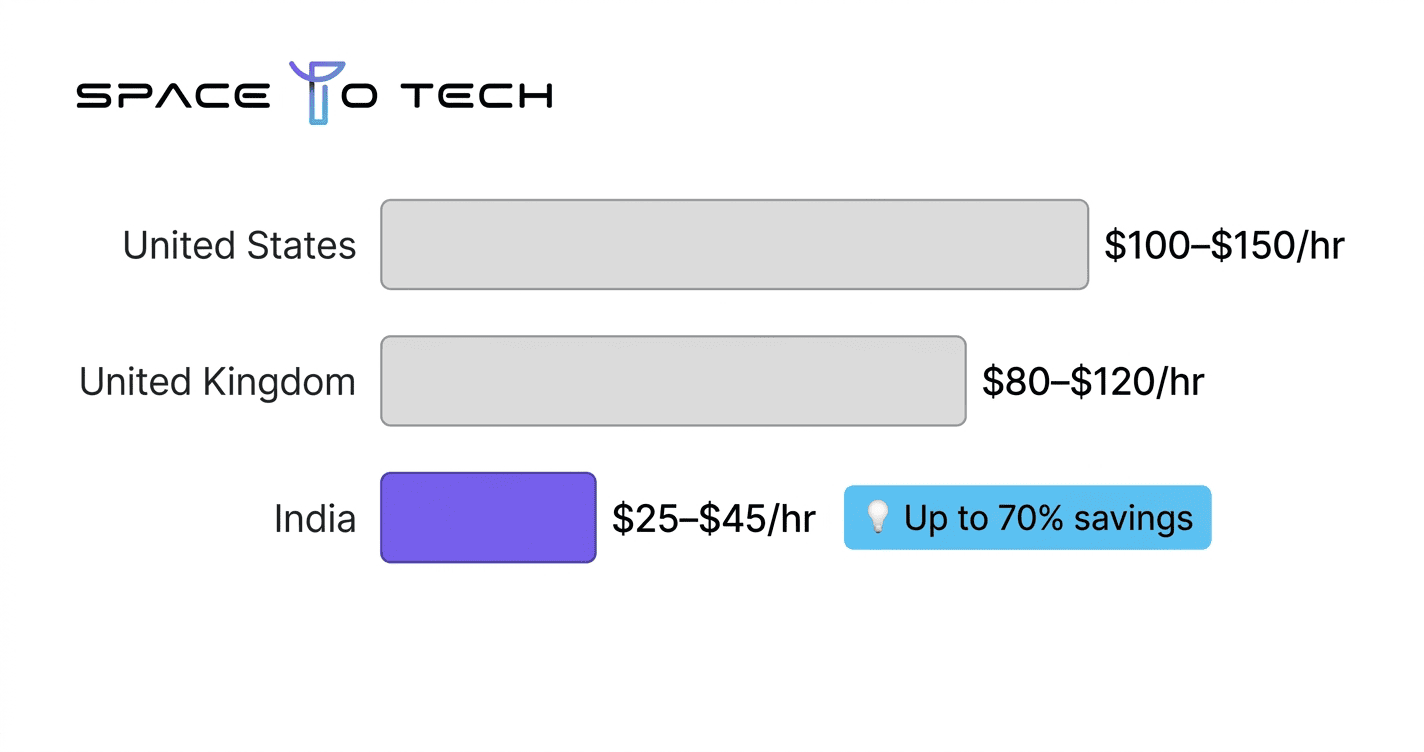
| Region | Avg. Hourly Rate | Approx. Annual Cost (Senior Dev) |
| United States | $100–$150/hr | $200,000–$300,000 |
| United Kingdom | $80–$120/hr | $160,000–$240,000 |
| India | $25–$45/hr | $50,000–$90,000 |
The gap is currency and cost of living. That's it. It's not a reflection of skill level — if it were, Google, Microsoft, Goldman Sachs, and JP Morgan wouldn't be running core engineering functions out of their India offices. They're not doing that for the novelty of it. They figured out a long time ago that the engineering talent is genuinely there.
For a startup watching every dollar of burn, hiring offshore developers India means the savings don't just sit on a spreadsheet — they go back into the product. Into hiring another designer. Into a marketing push. Into runway. That's the real case for it, honestly. Not just "it's cheaper," but "cheaper lets you do more with what you have."
What Actually Sets Indian Software Engineers Apart Technically
There's a version of this conversation where someone says "but are they really as good?" and honestly, it's a fair question to ask once. Less fair to keep asking after you've seen the work.
India's top engineering schools — IITs, NITs, BITs — compete globally. And beyond the institutions, thousands of certified developers have layered on certifications from AWS, Google, Microsoft, and specialized bootcamps that didn't exist ten years ago. The baseline has genuinely risen.
When you hire software engineers in India today, you're finding people who are current on the frameworks your product actually uses. Custom software development, Dynamics CRM, mobile app development, embedded software for IoT, AI and machine learning — it's not theoretical familiarity. These are people who've shipped in these stacks. For startups building Android-first products, this technical depth means you can find and evaluate a capable Android app development company from India using a clear, informed framework — not just instinct. For startups that need a complete AI product built — not just AI features added to an app — pairing Indian developer talent with a dedicated AI Development Company gives you the right structure and expertise for that scope The skilled developers coming out of India's tech ecosystem aren't coasting on reputation. They're building it.
Finding the Engagement Model That Actually Fits Your Startup
One thing that catches people off guard: there's more than one way to structure this. A lot of founders assume it's one thing — "outsourcing" — and that assumption colors how they think about it. It's worth clearing up.
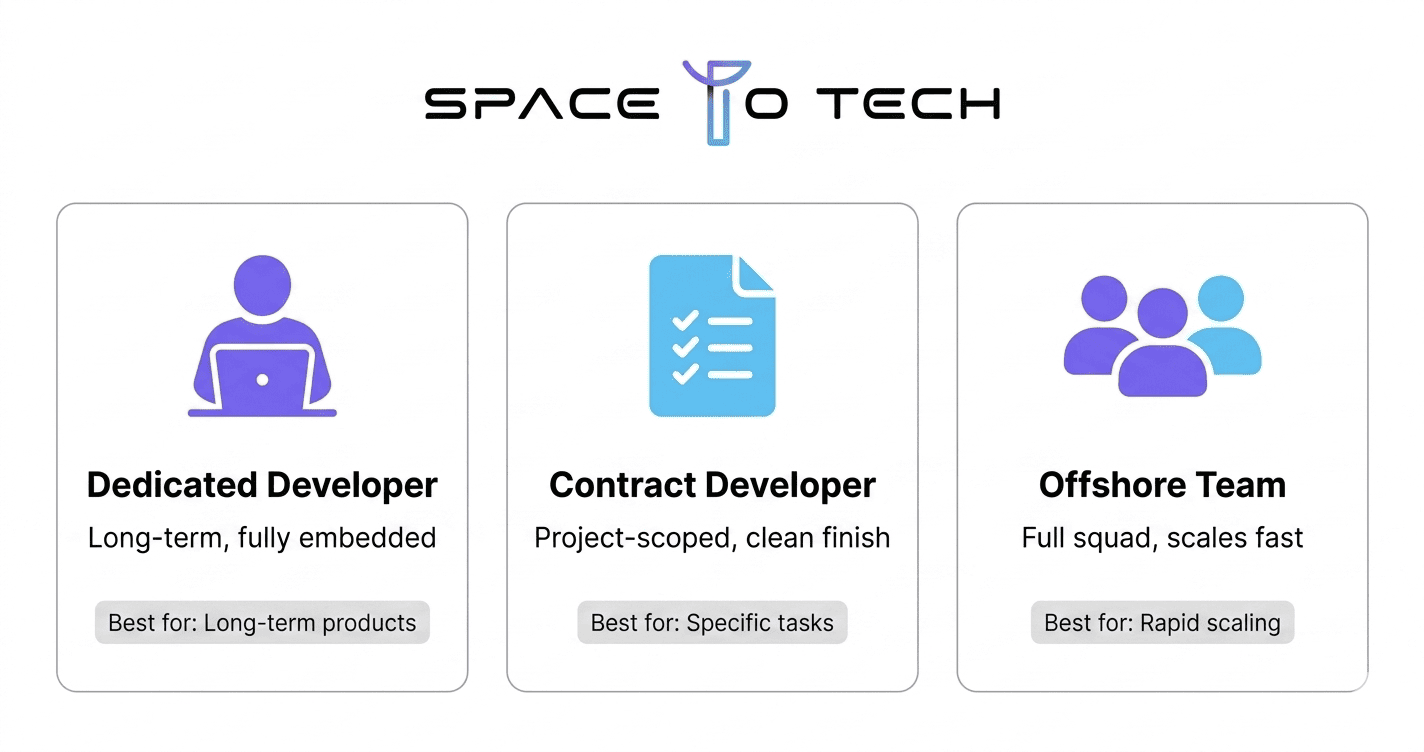
Dedicated developers work on your product, inside your team, managed by you. If you need someone embedded for the long haul, this is closer to a remote hire than any traditional outsourcing arrangement. Companies that want to hire dedicated software developers India typically find this model gives them the most control and the most consistency. The developer actually learns the codebase. That matters more than people think.
Contract developers are scoped to a project. Fast to start, clean to end. Works when you know exactly what you're building and you don't need someone to stick around after it ships.
Offshore software development teams — a full squad, sometimes with a tech lead included — are for when a single developer won't move the needle fast enough. A dedicated software development team that operates as a unit, delivers as a unit.
Most clients at SpaceToTech start with one dedicated developer and add from there as the product grows. Starting small isn't a weakness. It's just a sensible way to build trust before you scale it.
How the Time Zone Gap Becomes a Competitive Advantage
This is the thing people worry about most before they've tried it. It's rarely the thing they complain about after.
IST overlaps with European mornings and US evenings. There's a real window every day where both sides are online at the same time. That handles the conversations that actually need to be live — sprint calls, design feedback, anything ambiguous enough that back-and-forth matters.
Everything else? The remote developers keep working after your day ends. You come back the next morning and there's progress — not a message saying "waiting on your response from yesterday." For startups that are trying to hire remote talent and move faster than a traditional hiring cycle allows, that's a genuine operational advantage, not just a talking point.
Why Communication With Indian Developers Is Rarely the Problem
This one comes up less often as a concern, but it's worth addressing anyway.
India is one of the largest English-speaking countries in the world by volume. The tech workforce specifically communicates in English — documentation, pull request comments, sprint notes, everything. It's not a secondary language being managed around. It's the working language.
Beyond that, most Indian software developers working with international clients know Scrum. They know Agile. They've used Jira, Slack, Notion, GitHub. Sprint planning, retrospectives, backlog grooming — none of this is new to them. The adjustment period that people brace for usually doesn't materialise.
And if you're on the fence, here's the simplest version: the companies that hire Indian software developers and then don't renew contracts are rare. The companies that expand those contracts are common. That tells you something about how the communication actually goes once the work starts.
Every Specialist You Need, From Android Developers to AI Engineers
The range here is genuinely wide. Wider than most people expect when they first start looking.
- Android app developers in India — Kotlin, Jetpack Compose, built for mobile-first products that need to perform across device types
- AI and NLP engineers — recommendation systems, conversational interfaces, intelligent features that actually accelerate app development rather than slow it down
- CRM and Dynamics CRM developers — CRM software, enterprise tools, sales infrastructure that doesn't fall apart under real usage
- Embedded developers — IoT products, hardware-connected apps, the low-level work that most generalists won't touch
- Backend engineers — scalable infrastructure, APIs, cloud architecture that holds up when traffic actually arrives
The specialist you need is probably there. And probably available sooner than you'd expect. Software solutions at this level don't require a long search when the talent pool is this size.
A Step-by-Step Roadmap to Hire Software Developers From India
People overcomplicate this. It's actually not that many steps.
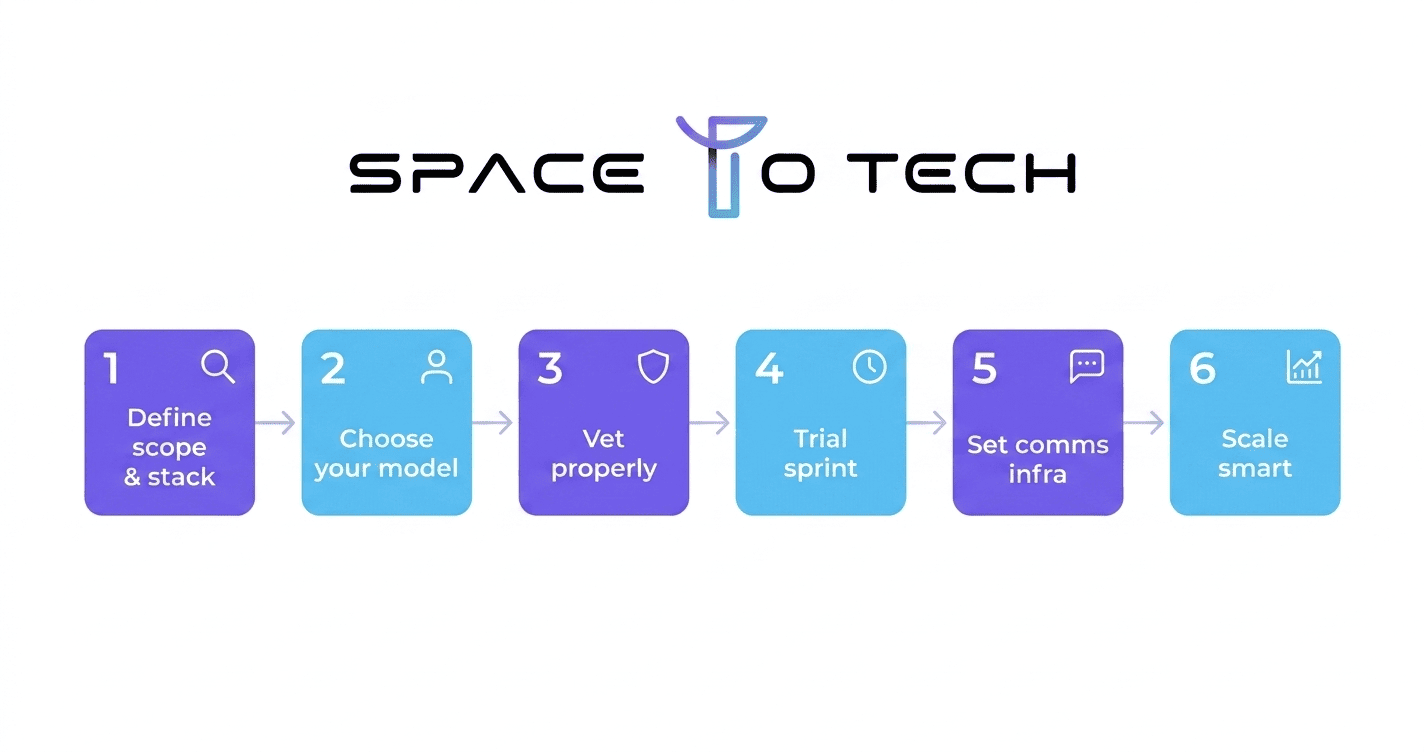
Define your scope and tech stack first. Vague briefs produce vague results. Know what you're building, what it runs on, and what skills are actually required. Do this before any conversations start.
Pick your model. Hire dedicated developer, go contract, or build an offshore software team. Each one fits a different stage. Don't default to whichever sounds most familiar.
Vet properly. GitHub history, portfolio links, live apps you can actually download. A short paid technical assessment. Whether you're looking to hire a coder in India or a senior architect, this step doesn't change.
Run a trial sprint. One to two weeks, paid. More useful than any interview. You'll know more from watching someone work than from anything they tell you about themselves.
Set the communication infrastructure before you start. Standup cadence, sprint length, how you handle scope changes. Sort this upfront. Don't improvise it mid-project.
Scale when it makes sense. One software developer to start is fine. Add when the output demands it, not before.
It's not complicated. It just requires doing it in the right order.
Red Flags to Watch Before You Hire — Don't Skip This
Moving fast is good. Moving fast past obvious red flags is how projects go sideways.
- No GitHub profile, no portfolio, no shipped work you can actually look at
- Pricing that's vague — no milestones, no defined deliverables
- Won't offer a trial sprint or paid assessment before committing
- Communication during the sales process is slow or evasive — it doesn't improve once the contract is signed
- Timeline promises that don't hold up when you ask how they were calculated
Before you hire developers or hire programmers in India, watch for these. A software expert or team that can't show you what they've built isn't hiding nothing. Any serious software development partner won't flinch at these questions. The ones who do are telling you something useful, even if they don't mean to.
How SpaceToTech Connects Global Startups With Top Indian Developer Talent
SpaceToTech is based in Noida. The clients are mostly in the USA, UK, UAE, and Australia — startups and growth-stage companies that needed engineering capacity without the overhead of local hiring.
The vetting for dedicated software developers is thorough: technical assessments, portfolio review, trial sprints. The domains covered include custom software development, mobile app development, CRM software, and AI/NLP. Not claimed expertise — delivered work.
Hiring dedicated developers through SpaceToTech is flexible in structure. Hire software developer India on a dedicated basis, run a contract engagement, or staff a full offshore team. When scope is clear, developers are ready to start within 72 hours. That's not a marketing line — it's just how the process runs when the brief is specific.
Vetting Process Transparency
Vague claims of "rigorous vetting" don't build trust on their own — specifics do. Lay out the actual steps a vetted software developer at SpaceToTech goes through before reaching a client team, with realistic turnaround times attached to each stage, for example:
- Profile and portfolio screening — 1–2 business days
- Technical assessment tied to a real task, not an abstract test — 2–3 business days
- Live pair-programming or architecture discussion with a senior engineer — 1 session
- Client introduction and start date — typically within 5–10 business days of kickoff
Stating real numbers here, and updating them if the process changes, is what separates a credible hire software developer page from one that reads like every other agency's homepage copy.
Ready to Hire Software Developers from India?
Talent, cost, flexibility, speed. India has all four. But the reason teams stay — the reason contracts get renewed and teams get expanded — isn't really about any of those things individually. It's that the work holds up. The communication is real. The developers care about what they're shipping.
That's harder to put in a table than an hourly rate. But it's the part that actually matters six months in.
Whether you need to hire software development team for a full product build or bring in one dedicated developer to move a stalled project forward — the path is the same. Start with something real, communicate clearly, and scale from there.