"How much does a custom mobile app cost?" is one of the first questions every founder, product manager, or business owner asks, and one of the hardest to get a straight answer to. Most agencies respond with "it depends" and most articles online are written to rank, not to actually explain the number.
Here is the honest version. Custom mobile app development cost in 2026 typically ranges from around $10,000 for a basic MVP to $220,000 or more for a complex, enterprise grade platform. There is no single fixed price because an app's cost is really the sum of several decisions: how complex the features are, which platforms you target, who builds it and from where, what it needs to integrate with, and how much ongoing maintenance you plan for.
This guide breaks down what drives custom mobile app development cost, from MVP to mid level to fully featured builds, across platform choice, features, backend and integrations, team location, and post launch maintenance, so you can build a realistic budget before you talk to a development company. Ecommerce is one use case we will reference along the way, but this guide applies to any business planning a custom mobile application, whether that is healthcare, fintech, logistics, or an internal enterprise tool.
What Is Custom App Development?
A custom app is not a template you buy, brand, and launch. That is a SaaS platform or a white label solution, useful for speed, but limited by someone else's system and someone else's roadmap.
Custom app development means a mobile application is built from scratch for your specific business: your workflows, your features, your brand. Nothing borrowed, nothing compromised. That approach applies broadly. Custom app development is used for ecommerce, healthcare, fintech, logistics, marketplaces, on demand services, and enterprise applications, not just online stores.
On the technical side, there are three paths: a native iOS app, a native Android app, or a cross-platform build using a framework like React Native or Flutter that covers both operating systems from a single codebase. That platform decision is one of the first things that shapes your development cost, which we will get into shortly.
If you are building for the long term, a custom build, native or cross-platform, will always outperform a plug and play tool on flexibility, scalability, and how well it reflects your brand.
Custom App vs. Template: Why It Even Matters
Custom mobile app development means someone is writing code specifically for your product, your logic, your flows, your brand. Nobody else has this exact app. It is not a Shopify mobile skin or a white label SaaS tool with your logo dropped in.
Templates and off the shelf platforms have their place. If you need to validate an idea quickly, a no code tool or a hosted platform gets you there in days. But the ceiling is low: you cannot fully control the user experience, you do not own your data the way you would like, and adding anything the platform was not built for hits a wall fast. Custom development sidesteps all of that, more upfront investment, but none of the constraints.
| Factor | Custom App | Template / Off-the-Shelf |
| Customization | High | Limited |
| Scalability | High | Depends on platform |
| Integrations | Flexible | Platform-dependent |
| Upfront cost | Higher | Usually lower |
| Long-term flexibility | High | Limited |
How Much Does Custom Mobile App Development Cost in 2026?
Here is a realistic breakdown by complexity tier for 2026. These cover design, frontend, backend, QA, and deployment, not ongoing maintenance, hosting, or App Store fees.
| App complexity | Typical scope | Estimated cost (USD) |
| Basic / MVP | Core features, single platform, simple backend | $10,000 - $45,000 |
| Mid-level | Custom UI/UX, APIs, integrations, admin panel | $45,000 - $100,000 |
| Advanced | Complex workflows, real-time features, multiple integrations | $100,000 - $220,000 |
| Enterprise | Large-scale systems, advanced security, deep integrations | $220,000+ |
Where a project lands inside these ranges comes down to a handful of variables: feature complexity, platform choice (native vs. cross-platform), the number and type of integrations, design depth, backend complexity, your development team's location, and your timeline. The next two sections break down exactly what's included in that number, and what pushes it up or down.
What Is Included in Custom Mobile App Development Cost?
The cost figures above cover a full build, but a full build means several distinct phases, each with its own share of the budget. Knowing what's included helps you sanity check a quote and spot what a suspiciously low estimate might be leaving out.
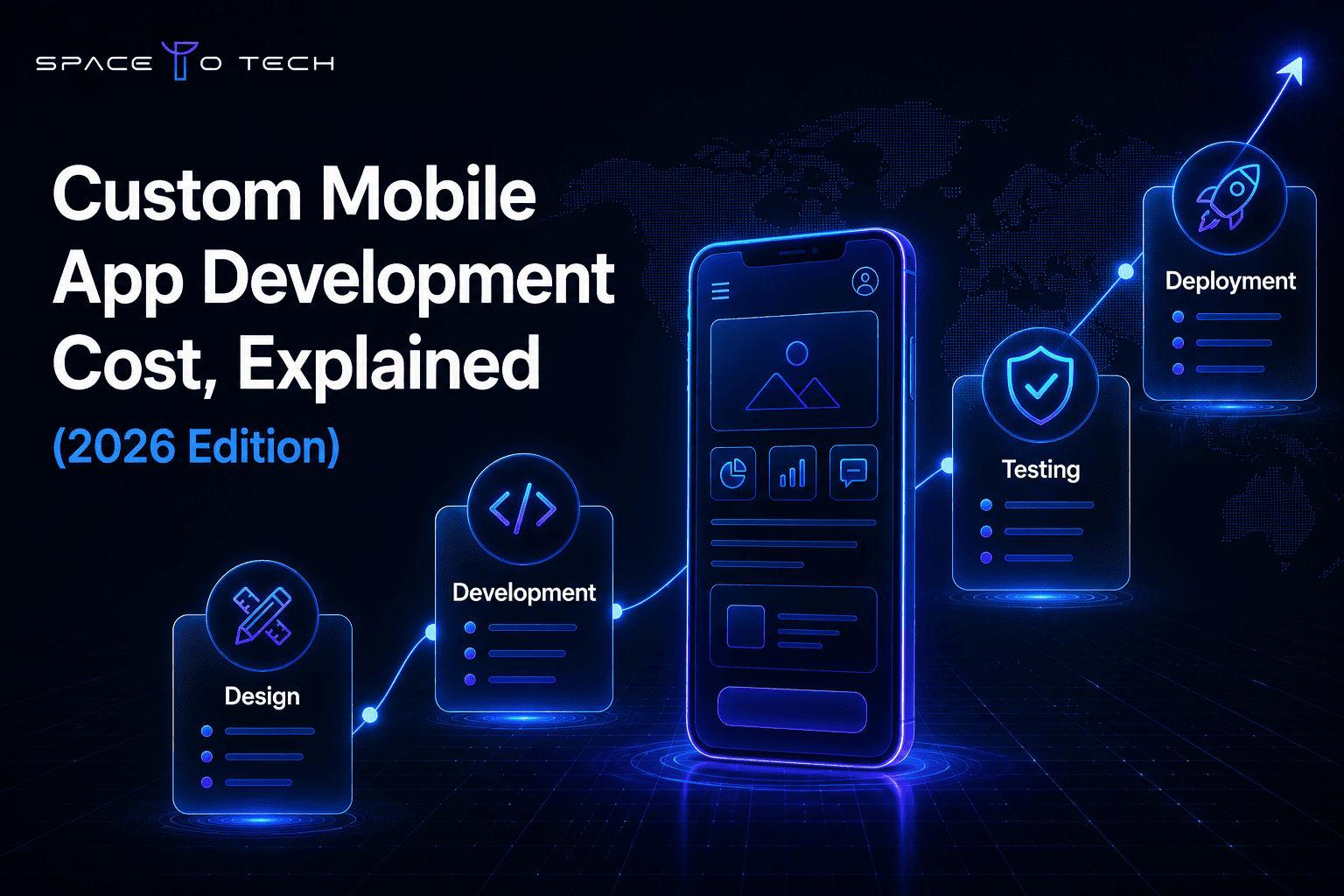
Discovery and planning comes first, defining requirements, user flows, and technical scope before any design or code starts. UI/UX covers wireframes, prototypes, and the actual interface design your users interact with. Frontend development turns that design into a working mobile interface, while backend development builds the APIs, database, and business logic that power it behind the scenes.
Integrations (payment gateways, maps, CRM systems, analytics platforms) connect your app to the tools your business already runs on. QA and testing catch bugs across devices and OS versions before launch, and deployment covers the actual App Store and Google Play submission process. Project management runs underneath all of it, keeping timeline, scope, and communication on track.
| Cost component | What it includes |
| Discovery | Requirements gathering, planning, technical scope |
| UI/UX | Wireframes, prototypes, interface design |
| Frontend | Mobile app interface and functionality |
| Backend | APIs, database, business logic |
| Integrations | Payment, maps, CRM, analytics, etc. |
| QA | Functional, device, and regression testing |
| Deployment | App Store / Google Play release |
What Factors Affect Custom Mobile App Development Cost?
Eight variables explain almost every quote you'll get from a development company.
App Complexity and Features
A basic product listing, login, and dashboard is one scope. Add AI-driven recommendations, real-time sync, augmented reality, or multi-vendor functionality and you're in a different tier entirely. Feature set is the single biggest cost driver, so be honest about what you need at launch versus what sounds good in a pitch deck.
Platform Choice
Native iOS plus native Android means two separate codebases and roughly double the development effort. A cross-platform framework like React Native or Flutter runs on both from a single codebase, typically cutting platform-related cost by 30 to 40 percent.
UI/UX Design
Design isn't decoration. A well-designed app converts better and loses fewer users at key steps. Polished UI/UX takes real time, and time costs money, but cutting corners here is a false economy; you'll spend more fixing drop-off later.
Backend and API Requirements
The part users never see (databases, APIs, admin panels, server logic) is where hidden complexity lives. A project that looks simple on the frontend can be far more complex on the backend if scope isn't nailed down early.
Third-Party Integrations
Payment gateways, CRMs, maps, analytics, and messaging tools each add integration work, testing, and sometimes ongoing licensing costs. More integrations generally mean more development hours and more points of maintenance.
Development Team Location
Hourly rates vary significantly by region, and this affects your invoice directly. We cover the actual numbers in the next section.
Development Timeline
Longer timelines mean more hours, and vague requirements are usually what causes timelines to stretch. The clearer you are upfront about what you need, the faster, and cheaper, the process goes.
Security and Compliance
If your app handles payments, health data, or personal information, security and compliance work (PCI-DSS, HIPAA, GDPR, or similar depending on your market) adds engineering time and should be scoped from day one rather than bolted on before launch.
How Features Affect Custom Mobile App Development Cost
Scope creep, adding features mid-build, is the fastest way to blow a development budget. Knowing which features move the needle on cost helps you prioritize an MVP that's lean without being underpowered.
| Feature | Cost impact |
| User authentication | Low-Medium |
| Push notifications | Low-Medium |
| Payment integration | Medium |
| Real-time chat | Medium-High |
| Geolocation | Medium |
| AI features | High |
| Real-time tracking | High |
| Multi-vendor functionality | High |
| Advanced analytics | Medium-High |
The general rule: ship the features your core user flow can't work without, and push everything else to a v2 roadmap. An ecommerce app, for example, needs a product catalog, cart, and checkout at launch; AR product previews or a loyalty program can wait until you've validated demand. The same logic applies across healthcare, fintech, or on-demand apps: launch lean, add depth once real users tell you what they actually use.
How to Estimate Custom Mobile App Development Cost
The core formula is simple:
Estimated Cost = Development Hours x Hourly Rate + Additional Project Costs
The hard part is knowing how many hours a given scope actually takes. Here is a generic hour breakdown for a mid-level custom app; your specific feature set will shift these numbers up or down.
| Development area | Estimated hours |
| Discovery & planning | 40 - 60 |
| UI/UX design | 80 - 120 |
| Frontend | 150 - 250 |
| Backend | 150 - 250 |
| Integrations | 60 - 120 |
| QA / testing | 60 - 100 |
| Deployment | 20 - 30 |
| Total | 560 - 930 |
At a blended offshore development rate of around $40 per hour, that 560 to 930 hour range works out to roughly $22,000 to $37,000, which lands inside the mid-level tier from the cost table above. At a US agency's blended $150 per hour rate, the same scope would run closer to $84,000 to $140,000. Same hours, very different invoice, purely based on where the team is based. Add integration licensing, third-party subscriptions, and a scope buffer on top of whichever total applies to your team.
What Should a Custom Mobile App Development Quotation Include?
A number on a page is only useful once you know what it actually covers. Before you sign anything, a proper mobile app development quotation should break down into line items you can check against your own requirements, not just a single total.
At minimum, a quotation worth trusting itemizes:
- Scope of work, listed feature by feature, not as a vague "full app development" line
- Estimated hours per development area (discovery, UI/UX, frontend, backend, integrations, QA, deployment), so you can see where the hours actually go
- What's excluded, App Store fees, third-party subscriptions, and post-launch maintenance are almost always separate, and a quote should say so explicitly rather than let you assume they're included
- Payment structure, most agencies split payment across milestones, commonly an upfront deposit, a mid-project payment tied to design or a working build, and a final payment on delivery
- Contract type, fixed-price for a clearly scoped build, or time-and-materials for a project where requirements are expected to evolve
- Change request terms, what happens, and what it costs, when you add a feature mid-build
Why an unusually low quote is a red flag, not a bargain
If one quote comes in dramatically lower than every other bid you've collected for the same scope, ask what's missing before you ask why it's cheaper. The most common omissions in a lowball quote are backend development scoped as an afterthought, no QA or device testing line at all, App Store and Play Store submission handled as a separate paid add-on, and no post-launch support window. A quote that looks like a bargain upfront and balloons once development starts costs more, and takes longer, than an honest estimate would have from day one.
The fix is the same one that keeps any project on budget: get the scope in writing, feature by feature, before anyone starts coding. A vendor who won't itemize a quote usually can't, because the scope was never nailed down well enough to itemize.
How Development Team Location Affects Mobile App Development Cost
Location is one of the biggest levers on your invoice, though it's often misunderstood. Here is how hourly rates typically compare across major development regions in 2026:
| Region | Typical development rate | General cost implication |
| United States | $100 - $200/hr | Higher |
| Western Europe | $80 - $150/hr | Higher |
| Eastern Europe | $40 - $80/hr | Mid-range |
| India | $25 - $75/hr | Often more cost-efficient |
Rate differences reflect cost of living, currency strength, and local market dynamics, not a fixed rule about quality. Outcome still depends on the specific team: their experience, expertise, project management process, and how well they communicate. India-based mobile app development has been part of the global outsourcing ecosystem for over two decades, serving businesses across regions with dedicated, senior engineering teams. Cost efficiency is one consideration among several, not the only one.
If you're specifically budgeting for a US-based build or want to compare US agency rates in more depth, our mobile app development company in the USA page and our dedicated Mobile App Development Cost in the USA guide break down USA-specific pricing, city-by-city rate differences, and hourly rates by seniority in more detail than we can cover here.
What Each Feature Actually Costs
Cost impact ratings are useful for prioritizing a roadmap, but they don't tell you what to budget. Here's a rough dollar range for common features at a blended offshore development rate, the same $40/hour baseline used in the estimate above. Treat these as planning figures, not fixed quotes; exact cost depends on how the feature integrates with the rest of your app.
| Feature | Estimated cost (USD) |
| User authentication (email + social login) | $1,000 - $1,600 |
| Push notifications | $800 - $1,200 |
| Payment gateway integration | $1,400 - $2,200 |
| Geolocation and maps | $1,200 - $2,000 |
| Real-time chat | $2,400 - $4,000 |
| Advanced analytics dashboard | $1,600 - $2,800 |
| Admin dashboard (web panel) | $2,400 - $4,800 |
| Multi-language support | $800 - $1,600 |
| Offline mode with data sync | $2,000 - $3,200 |
| AI features (recommendations, chatbot) | $2,000 - $6,000+ |
| Multi-vendor marketplace functionality | $6,000 - $12,000+ |
Add up the features your app actually needs and compare the total against any quote you receive. If a vendor's number is far outside these ranges for a standard feature set, ask what's driving the difference before you sign, it usually points to either unusually deep customization or a scope that isn't fully defined yet.
Can an India-Based Mobile App Development Company Serve Global Businesses?
Yes, and it's increasingly the default rather than the exception. SpaceToTech is an India-based mobile app development company that works with businesses across North America, Europe, the UAE, and Australia, building custom apps for ecommerce, healthcare, on-demand, and enterprise use cases.
Working with an offshore or nearshore partner means structured overlap hours rather than a single shared time zone, async communication for focused development work, and, for most projects, a meaningful cost advantage over hiring locally at the same seniority level. That cost advantage is real (often 40 to 60 percent lower than equivalent US agency pricing) but it's one factor among several; process, communication quality, technical depth, and post-launch support matter just as much when you're choosing who builds your app.
Native vs. Cross-Platform: Which Affects Mobile App Cost?
Building native means building twice, a separate iOS app and Android app, each with its own codebase and timeline. The advantage is performance and full access to device features; the trade-off is cost, typically 30 to 40 percent more than an equivalent cross-platform build.
Cross-platform frameworks like React Native and Flutter compile one shared codebase to both operating systems. For most business apps (product catalogs, dashboards, booking flows, checkout) the performance difference against native is negligible.
| Approach | Cost implication | Best suited for |
| Native iOS | Higher if building multiple platforms | iOS-specific requirements |
| Native Android | Higher if building multiple platforms | Android-specific requirements |
| Cross-platform | Often lower for multiple platforms | Startups and multi-platform apps |
Native makes sense for apps with heavy AR features, complex hardware integration, or millisecond-level performance needs. For most startups and SMBs, cross-platform is the more budget-efficient path. See our full comparison in React Native vs. Flutter for help deciding which framework fits your project, or our dedicated React Native App Development Cost in 2026 guide for a deeper breakdown of React Native pricing specifically.
How to Reduce Custom Mobile App Development Costs
Budget constraints aren't just a limitation, they often force better product decisions. Here's what actually works:
- Ship an MVP first. Validate the core flow before investing in every feature on the roadmap.
- Go cross-platform where it fits. The 30 to 40 percent savings on multi-platform builds is real.
- Work with an experienced offshore or nearshore team. Location-based rate differences can meaningfully stretch the same budget.
- Define your features before signing anything. Every addition mid-project typically costs 2 to 3 times what it would have cost at the start.
- Use proven open-source libraries for standard functions, authentication, notifications, maps, instead of rebuilding them.
- Run development in short, agile sprints. Scope creep gets caught early, before it gets expensive.
- Budget for maintenance from day one, not as an afterthought six months post-launch.
- Favor fixed-price contracts over open-ended time-and-materials billing when predictability matters.
The common thread across projects that run over budget: scope wasn't defined tightly enough going in. That's fixable, and usually free to fix, if it happens before development starts.
Hidden Costs of Custom Mobile App Development
These aren't edge cases, they catch nearly every first-time founder off guard. App Store and Google Play fees run $99 a year for Apple and a one-time $25 for Google. Third-party subscriptions (payment processing, push notification services, analytics platforms, cloud storage) add up monthly. Post-launch maintenance typically runs 15 to 25 percent of build cost annually, and can reach 50 percent or more in year one alone as bug fixes and OS-compatibility work get folded in. Security or compliance work isn't optional if you're handling payment or personal data.
Beyond the basics, budget for API usage costs that scale with traffic, analytics and monitoring tooling, cloud infrastructure that grows with your user base, and ongoing feature updates after launch.
| Hidden cost | When it occurs |
| Cloud hosting | Monthly |
| Third-party APIs | Usage-based |
| Maintenance | Ongoing |
| Security updates | Ongoing |
| Payment processing | Per transaction |
| App store fees | Annual / transaction-dependent |
On a $45,000 MVP build, for example, year-one maintenance and hosting alone can realistically add $8,000 to $15,000 on top of the build cost. Still very manageable, just worth planning for rather than discovering after launch.
How Much Does It Cost to Build Different Types of Mobile Apps?
App category shapes cost as much as raw feature count does, mostly because of compliance, transaction complexity, and integration depth.
| App type | Typical complexity | Estimated cost (USD) |
| Business app | Low-Medium | $10,000 - $40,000 |
| Ecommerce | Medium-High | $20,000 - $150,000 |
| Marketplace | High | $80,000 - $250,000 |
| On-demand | High | $60,000 - $200,000 |
| Healthcare | High | $40,000 - $300,000+ |
| Fintech | High | $100,000 - $300,000+ |
| Enterprise | Very High | $220,000 - $500,000+ |
Fintech and enterprise apps tend to sit at the top of this range because of regulatory compliance (PCI-DSS, KYC/AML), security infrastructure, and integration with existing systems. Healthcare follows closely due to compliance requirements around handling patient data. Ecommerce apps can run well past $150,000 for complex multi-vendor marketplaces with AI recommendations and real-time inventory, our dedicated Ecommerce App Development Cost 2026 guide covers that use case in more depth. Business and simpler ecommerce apps generally have the most predictable, lower-complexity path to launch. Treat every figure here as a planning range, not a fixed quote; exact pricing should come from a scoped estimate.
How to Choose a Custom Mobile App Development Company
The difference between a good partnership and a bad one usually comes down to a handful of things:
- Relevant portfolio: live apps in the App Store or Google Play, not just mockups, ideally in your industry.
- Technical expertise across the stack you need, not just general "we build apps" claims.
- Transparent pricing: a fixed-price quote where possible, not open-ended time-and-materials.
- A clear development process, from discovery through QA and deployment.
- Responsive communication: teams that ask smart questions and push back on scope that doesn't serve the goal.
- Security and compliance awareness relevant to your industry.
- Post-launch support and a defined maintenance plan.
- Clear ownership and IP terms: you should own your code and data outright.
- References or reviews you can actually verify.
SpaceToTech works across ecommerce, healthcare, on-demand, and enterprise mobile app development, with a process built around scoping requirements clearly before development starts. More detail is available on the mobile app development services page, and you can browse live, shipped work in our portfolio. If you're comparing multiple vendors before deciding, our roundup of top mobile app development companies is a useful starting point for building a shortlist.
When Should You Get a Custom Mobile App Development Estimate?
An estimate is only as accurate as the requirements behind it. Before requesting one, it helps to have a rough answer for: your core business objective, target users, target platform(s), must-have features for v1, required integrations, expected timeline, and an approximate budget range.
If you already have those defined, even loosely, SpaceToTech can review the scope and provide a project-specific estimate, usually within a day or two of an initial conversation.
Plan Your Custom Mobile App Development Budget
There's no universal fixed cost for custom mobile app development, and that's not a dodge, it's the honest answer. Complexity, feature set, platform choice, and where your development team is based all move the number meaningfully, and hidden costs like maintenance, hosting, and compliance deserve a place in your budget from day one rather than a surprise six months post-launch.
A clearly defined scope is the single biggest thing you control before talking to any development company. It's what turns a vague range into an accurate estimate. Starting with an MVP is usually the smartest way to control initial investment while still validating your idea with real users.
If you've got a project in mind and want a real number based on your specific requirements, not a generic range, SpaceToTech can review your scope and turn around a project-specific estimate. Get in touch to start the conversation.