
A custom software proposal can look expensive when you only look at the development quote. But that number rarely answers the question that actually matters to the business signing off on it. The more useful question isn't "How much will this cost?" It's "What will the business get back, and how long will it take to recover what we put in?" That question has a name: software ROI.
Software ROI is the metric that turns a development estimate into a business decision. It forces every stakeholder, not just the engineering team, to agree on what success looks like before a single sprint starts. This article walks through what software ROI actually means, what belongs in the cost and benefit sides of the equation, how to calculate it step by step, and how to keep measuring it after launch instead of treating the number as a one-time forecast.
If you're still deciding whether a custom build is the right move in the first place, it's worth stepping back before running any ROI numbers. Our custom software development guide covers the fundamentals, the development process, typical costs, and the build-versus-buy question in more depth, and it's a useful starting point before you get to the ROI math below.
What Is Software ROI?
The formula behind software ROI is simple:
Software ROI Formula
ROI (%) = (Total Benefits − Total Costs) ÷ Total Costs × 100
The formula is the easy part. What actually belongs in "Total Benefits" and "Total Costs" is where most calculations go wrong. Software ROI isn't just the revenue a system generates. It can include cost savings, productivity gains, revenue the software enables, fewer errors, less operational waste, and risk reduction, wherever that risk can be reasonably quantified in dollars.
It also helps to separate two related but different numbers. Projected ROI is what you expect the investment to return based on assumptions made before launch. Actual ROI is what the business measures once the software is live and being used. The gap between the two is usually where the real lessons are, and treating projected ROI as a guaranteed outcome is one of the fastest ways to lose stakeholder trust in the number.
Why Measure ROI Before Building Custom Software?
ROI isn't just a report you run after launch to justify the spend. It's more useful earlier, while the project is still a proposal.
- It validates the investment. Before committing budget, ROI forces a direct comparison: does the expected value actually justify the cost, or is the project being greenlit on assumptions nobody has tested?
- It helps prioritize features. Not every feature on a wishlist contributes equally to the business outcome. Running the numbers early makes it obvious which features drive measurable value and which ones are nice-to-haves competing for the same budget.
- It supports the build-versus-buy decision. ROI analysis works best alongside a build-versus-buy comparison, because the right question is never just the cost of custom development. It's the value and long-term cost of every realistic option, including staying with an existing tool.
- It sets measurable targets. A software project without a defined success metric tends to drift. Establishing what "working" looks like in numbers, before development starts, gives the team something concrete to build toward.
- It prevents unrealistic expectations. ROI forecasting separates assumptions from measurable outcomes early, which is a lot cheaper than discovering the gap after the software has already shipped.
What Costs Should Be Included in a Software ROI Calculation?
This is where most ROI calculations quietly fall apart. Using only the development quote as "the cost" produces a number that looks better than reality, and that gap tends to surface at the worst possible time, usually in a budget review six months after launch.
Initial Development Costs
This covers discovery, requirements gathering, UX and UI design, development itself, QA, project management, and deployment. It's the number most vendors quote up front, and it's the smallest slice of a complete picture.
Implementation and Internal Costs
Training your team, internal stakeholder time, data migration, rollout planning, change management, and user acceptance testing all cost real hours, even though none of them show up on a development invoice.
Ongoing Operating Costs
Hosting, infrastructure, maintenance, support, monitoring, third-party services, software licenses, and future improvements all continue well past launch day. A system that looks affordable to build can still be expensive to run.
Integration and Data Costs
API integrations, connections to legacy systems, data migration work, third-party API fees, and ongoing synchronization all add cost and complexity, particularly when the software has to talk to systems it wasn't originally designed around.
Often-Missed Costs
Opportunity cost, internal employee time pulled away from other work, adoption friction, additional training beyond the initial rollout, security work, unplanned integrations, and future enhancement requirements are the categories businesses forget most often, and they're rarely small.
Before calculating software ROI, you need to account for the full investment rather than looking only at the initial development quote. Our breakdown of custom software development cost explains the factors that influence the overall investment, so this article can stay focused on how those costs feed into the ROI calculation itself.
What Business Benefits Should You Include in Software ROI?
This is where software ROI becomes more useful than a generic finance formula, because software rarely creates value in just one way.
- Productivity gains. Hours saved, fewer manual tasks, faster processing, and less administrative work all have a dollar value: hours saved multiplied by loaded labor cost gives a reasonable estimate. The catch is that saved time only becomes real financial value if it's actually redeployed toward productive work, not just absorbed into slack in the day.
- Cost savings. Retiring redundant software subscriptions, reducing manual processing, cutting rework, and lowering support costs are all measurable and usually the easiest benefits to defend to a finance team.
- Revenue impact. Increased capacity, faster sales cycles, better conversion, more transactions, and new revenue-enabled workflows all count, but attribution has to be handled carefully. Not every revenue increase after a software launch should be credited entirely to the software itself.
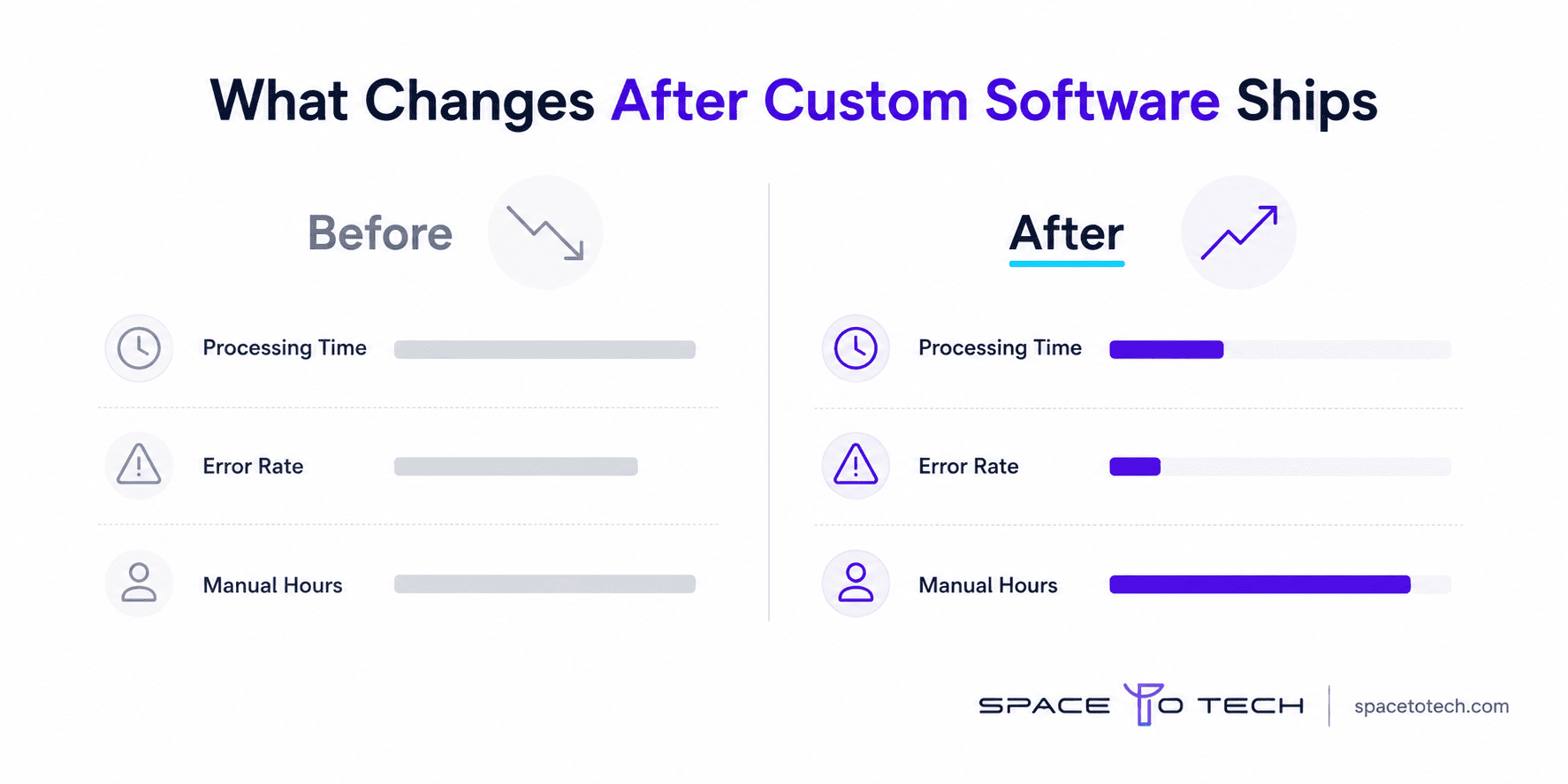
- Error and rework reduction. Compare the error rate and cost per error before the software against the rate and cost after. This is one of the more defensible benefit categories because it's directly measurable.
- Risk reduction. Worth including only where the risk can be reasonably quantified. Software doesn't automatically create financial value simply by existing; the reduction has to translate into an avoided cost.
How to Calculate Software ROI Step by Step
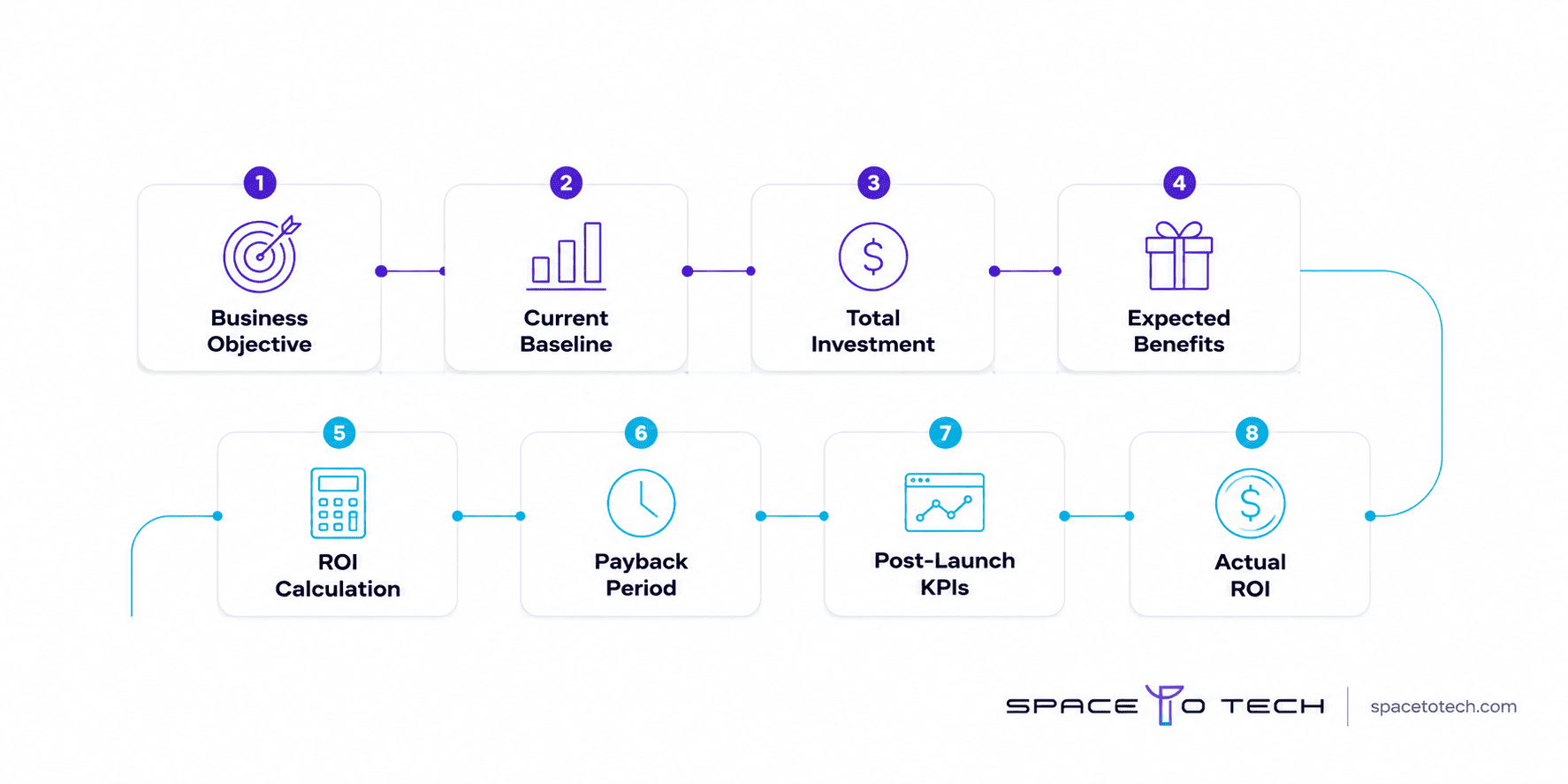
- Step 1: Define the business objective. "Reduce manual order processing time" is measurable. "Build a modern order management platform" is a technical output, not a business outcome. Start with the first kind of statement.
- Step 2: Establish the current baseline. Before development starts, measure current processing time, current labor cost, error rate, rework, existing software subscriptions, and revenue or capacity metrics where relevant. Without a baseline, you have nothing to compare the "after" number against.
- Step 3: Estimate the expected benefit. Convert measurable improvements into financial value: hours saved, costs eliminated, errors avoided, additional capacity, revenue enabled.
- Step 4: Calculate total investment. Add build cost, implementation, integrations, training, infrastructure, and maintenance, based on the ROI period you're evaluating.
- Step 5: Apply the ROI formula. ROI (%) = (Total Benefits − Total Costs) ÷ Total Costs × 100.
- Step 6: Calculate the payback period. Payback Period = Initial Investment ÷ Net Monthly Benefit. Define both sides clearly before you calculate: Initial Investment should include only the one-time costs (development plus implementation and training), while Net Monthly Benefit is the annual benefit minus annual recurring costs, divided by twelve. Keeping recurring costs out of the "initial investment" side, and out of the monthly benefit side only once, avoids double-counting the same cost in two places.
- Step 7: Test different scenarios. Run the numbers as conservative, expected, and optimistic cases. Presenting one forecast as guaranteed is where a lot of ROI projections lose credibility with finance and leadership.
Software ROI Example: A Simple Custom Software Calculation
The figures below are illustrative only, not a benchmark or a guarantee of outcomes for any specific project.
Suppose a business invests in custom software to automate a manual order processing workflow:
| Item | Amount | Cost Type |
| Development | $60,000 | One-time |
| Implementation and training | $5,000 | One-time |
| Annual operating cost | $10,000 | Recurring |
| Annual measurable benefits | $45,000 | Recurring |
Rather than stating that the project "becomes profitable" in year two, here is the actual year-by-year math, so the conclusion is easy to verify rather than something you have to take on faith:
| Year | One-time costs | Recurring costs | Total costs | Benefits | Net (Benefit − Cost) | Cumulative net |
| Year 1 | $65,000 | $10,000 | $75,000 | $45,000 | -$30,000 | -$30,000 |
| Year 2 | $0 | $10,000 | $10,000 | $45,000 | $35,000 | $5,000 |
- Year 1 ROI: ($45,000 − $75,000) ÷ $75,000 × 100 = -40%. This is expected in year one, since the full development cost lands in a single period.
- Cumulative two-year ROI: ($90,000 − $85,000) ÷ $85,000 × 100 ≈ 5.9%. The project crosses into positive territory partway through year two.
- Payback period: Using the Step 6 formula, the $65,000 one-time investment (development plus implementation) divided by a net monthly benefit of roughly $2,917 (the $45,000 annual benefit minus the $10,000 annual operating cost, divided by 12) gives a payback period of about 22.3 months, or just under one year and ten months.
 Software ROI vs. Total Cost of Ownership
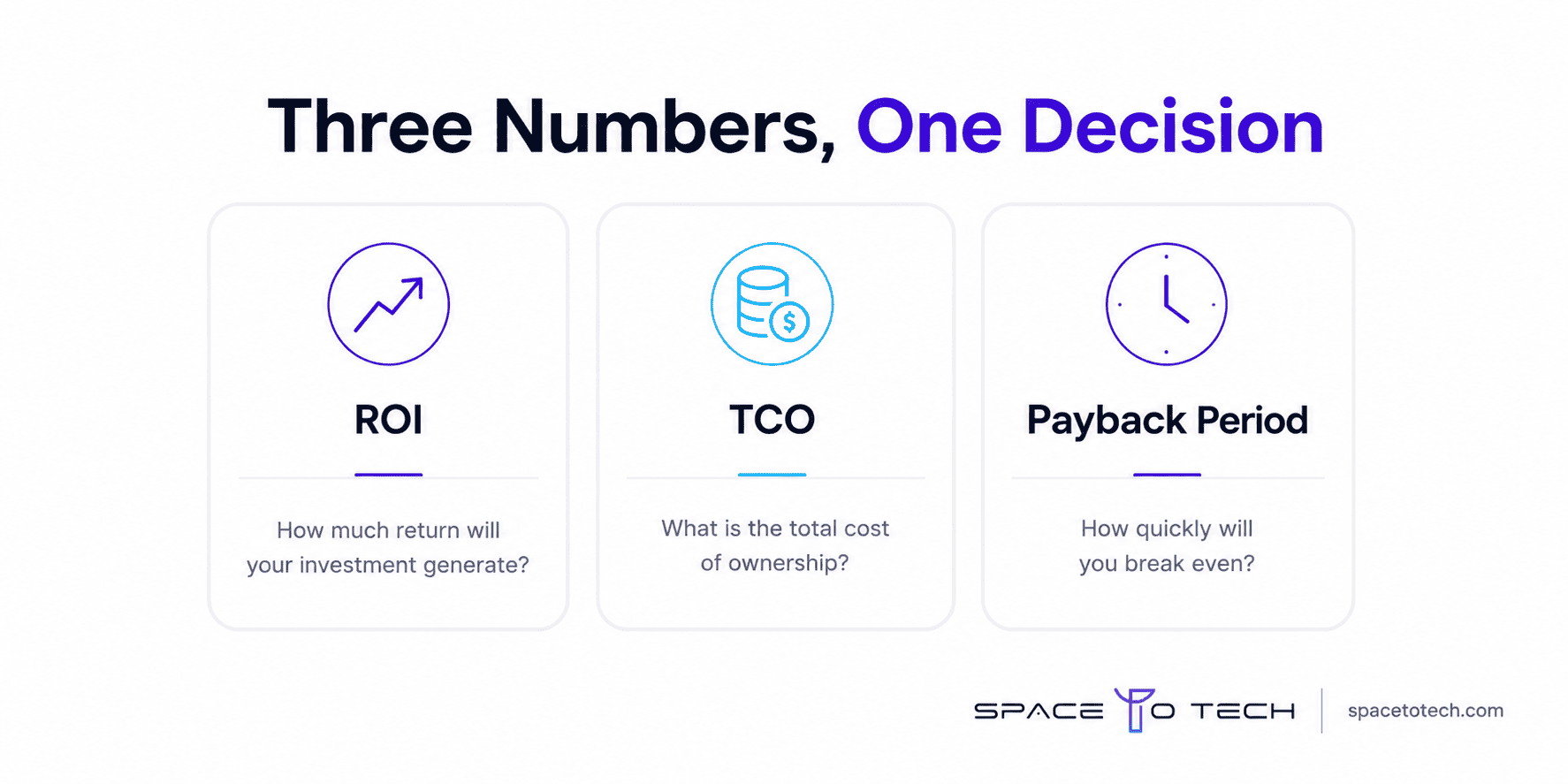
These two metrics are related, but they answer different questions.
| Metric | What It Tells You |
| Software ROI | Whether the investment is generating enough value relative to what it cost |
| Total Cost of Ownership (TCO) | How much the software actually costs across its full lifecycle |
| Payback Period | How long it takes to recover the initial investment |
TCO is an input into a credible ROI calculation, not a substitute for it. Understanding the total cost of custom software is a necessary step before calculating ROI, because the initial development quote only ever represents part of the real investment.
Which KPIs Should You Track to Measure Software ROI?
- Productivity KPIs: hours saved, processing time, tasks completed per employee.
- Financial KPIs: operating cost reduction, revenue generated or enabled, cost per transaction, total software spend.
- Operational KPIs: error rate, rework, processing time, downtime.
- Customer KPIs (where applicable): conversion, retention, support ticket volume, customer satisfaction.
- Adoption KPIs: active users, feature adoption, workflow completion rate, usage frequency.
Adoption deserves its own callout here. If people don't actually use the software the way it was designed to be used, the projected benefits may never materialize, no matter how sound the original ROI forecast was.
How to Measure Software ROI After Launch
ROI shouldn't stop being a live number the moment the software ships. A practical measurement framework looks like this:
- Before launch: record the baseline.
- At launch: record the actual total investment, not the original estimate.
- 30 to 90 days: measure early adoption and initial operational changes.
- 6 to 12 months: compare actual business outcomes against the original projections.
- Longer term: review actual costs, actual benefits, cumulative ROI, payback, and how the original assumptions held up.
This before-launch-to-measure-to-optimize cycle is what separates a business that treats ROI as a one-time pitch from one that treats it as an ongoing management tool.
What Can Reduce the ROI of a Software Project?
Scope creep adds development cost without a proportional increase in business value. Low adoption means the software exists, but teams quietly keep using the old process anyway. Poor requirements solve the wrong problem well. Underestimated maintenance eats into the expected return month after month. Weak integration planning adds cost and delay that weren't in the original forecast. Unrealistic benefit assumptions show up as a gap between projected and actual ROI. And measuring the wrong KPI means technical usage gets mistaken for real business value, which are not the same thing.
When Does Custom Software Make Financial Sense?
Custom software tends to make more financial sense when manual work is creating recurring costs, existing SaaS tools require expensive workarounds, per-user licensing keeps climbing, a workflow is a genuine source of competitive differentiation, current tools can't support required integrations, operational inefficiency has a measurable dollar cost, and the software will see significant long-term usage.
It tends to make less sense when the process is already standardized, an existing product solves the problem well enough, usage is too small to justify the build, requirements are still uncertain, the expected benefit is genuinely hard to measure, or the investment can't reasonably be recovered within a sensible timeframe. A useful ROI framework should be able to point toward either answer, not just justify a decision that's already been made.
Common Mistakes When Calculating Software ROI
Counting only development cost. Ignoring maintenance. Assuming every hour saved becomes cash savings automatically. Claiming revenue attribution too aggressively. Ignoring adoption as a variable. Using unrealistic projections. Measuring only year one. Skipping the baseline entirely. Ignoring opportunity cost. And treating projected ROI as if it were already actual ROI.
Any one of these on its own can skew a forecast. A few of them together, and the ROI number stops being useful for decision-making at all.
How to Build a Software ROI Business Case Before Development
A practical business case, before a single line of code gets written, should answer a short checklist: what problem you're solving, what that problem costs today, what you'll spend over the selected period, what measurable improvement should occur, what the expected return looks like, when the investment should break even, how you'll measure actual performance with KPIs, what happens if benefits come in lower than expected, and finally, whether the answer is to build, buy, delay, or redesign the approach entirely.
Working through this checklist properly usually takes longer than running the ROI formula itself, and that's the point. The formula is fast. Getting the inputs right is where the real work happens.
If you're evaluating a development partner as part of that business case, it helps to see the kind of work they've actually shipped rather than take a pitch deck at face value. Browsing our portfolio is a reasonable way to get a feel for the range of software products and business solutions we've delivered across different industries.
When ROI Analysis Says It's Time to Build
Once the business case, the expected benefits, and the measurement framework are defined, the next step is turning that analysis into a scoped, buildable plan. That's the natural point where an ROI exercise moves from a spreadsheet into an actual project. If your numbers point toward building, our custom software development company can help translate that business case into a realistic scope, timeline, and delivery plan, rather than another generic estimate.