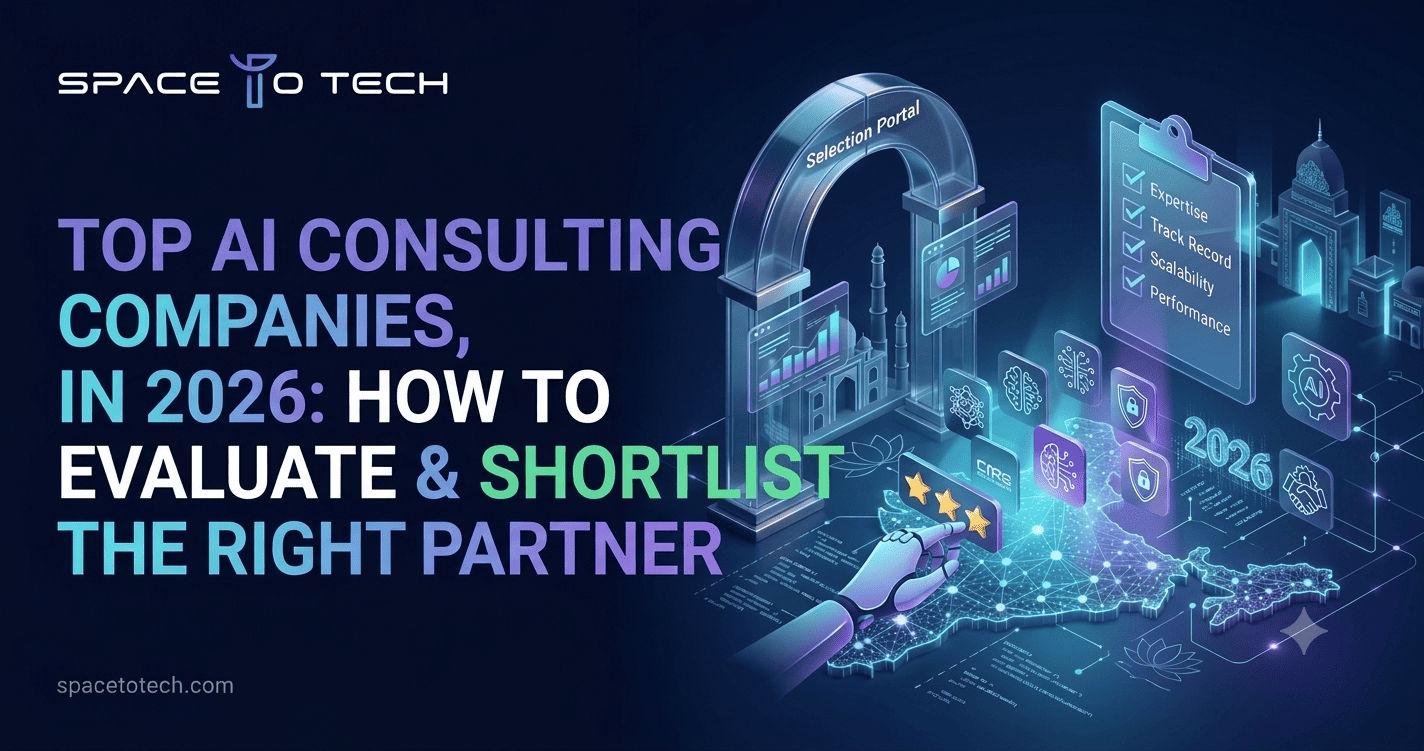
Choosing the wrong partner can burn your budget and a year of runway, yet most lists of top AI consulting companies are written by the firms featured on them. This guide takes a different route. You will learn what AI consulting includes, see a grouped comparison of leading firms, and get a weighted scorecard, a red-flag checklist and a five-step shortlisting process. Disclosure: SpaceToTech publishes this guide and appears in it, scored by exactly the same method as every other firm. Every firm fact below is dated, sourced and marked N/A where we could not verify it, so you can trust the process as well as the picks.
What Are AI Consulting Services and What Do They Include?
AI consulting services help organisations identify, design, build and govern AI solutions that solve defined business problems. Unlike buying an AI tool, consulting is outcome-led: it covers AI strategy, use-case prioritisation, data readiness, model development and deployment.
Five service layers. Strategy and roadmap; data and infrastructure readiness; solution development (machine learning, generative AI, LLMs, RAG and AI agents); integration and MLOps; and governance, risk and change management. Governance usually leans on the NIST AI Risk Management Framework and ISO/IEC 42001.
Typical deliverables. Expect an AI readiness assessment, a prioritised use-case backlog, a proof of concept, an architecture document, an ROI model and a governance playbook. A good deliverable is dated, owner-named and measurable.
Who needs it. Teams with no in-house data function, stalled pilots, or pressure to cut support costs. A support-automation project often starts as consulting and ends as a chatbot build. Our AI development services cover that path, and what AI chatbot development involves is worth reading first.
AI Consulting vs IT Consulting: Where the Lines Blur
Top IT consulting companies' AI services now sit inside broader transformation programmes, so the boundary is fuzzy, and buyers often hire the wrong type of firm because of it.
Where they overlap: architecture, cloud, integration and cybersecurity are shared ground, and large IT consultancies bundle AI into modernisation work.
Where they diverge: traditional software is deterministic, while models are probabilistic, so testing, evaluation and monitoring differ. Talent differs (data scientists and ML engineers versus solution architects), as do metrics (accuracy, drift and ROI versus uptime and SLAs) and risks (hallucination, bias and data leakage).
| AI consulting | IT consulting | |
| Focus | Predictions, automation, decisions from data | Systems, infrastructure, modernisation |
| Team | Data scientists, ML engineers | Solution architects, engineers |
| Deliverable | Models, evaluation, MLOps | Architecture, migrations, integrations |
| Main risk | Hallucination, bias, data leakage | Downtime, cost overrun |
| Typical timeline | Weeks (discovery) to months (PoC) | Months to years |
Which to choose: modernising systems points to IT consulting; predictions, automation or decisions from data point to AI consulting; AI inside ERP, CRM or legacy systems calls for a firm that does both. For AI inside a product, read our guide to AI in custom software development and learn how to choose a software development company.
Top AI Consulting Companies in 2026: At-a-Glance Comparison
How this list was compiled. We applied four criteria to every firm: verifiable production work, industry depth, responsible-AI practice and delivery model. Facts were checked against firm websites and Clutch, and last verified on 05-11-2026. SpaceToTech publishes this guide and is included under the same criteria.
Grouped, not ranked. The table below shows the top AI consulting companies of 2026 in three groups: strategy-led firms, global integrators, and specialist and mid-market firms. There is no "#1" because fit matters more than rank, and most competing lists simply put the publisher first, which tells you little about your needs.
| Company | Type | Delivery base | Best for | Typical engagement | Price tier | Core AI strengths |
| McKinsey (QuantumBlack) | Strategy-led | Global | Board-level AI roadmaps, operating models | Large programmes | Premium | Strategy, applied AI |
| BCG X | Strategy-led | Global | Strategy plus applied AI builds | Large programmes | Premium | Strategy, AI product build |
| Accenture | Global integrator | Global | Enterprise end-to-end delivery | Large programmes | Premium to high | Scale, delivery, governance |
| Deloitte | Global integrator | Global | Enterprise delivery and governance | Large programmes | Premium to high | Risk, governance, transformation |
| IBM Consulting | Global integrator | Global | Enterprise AI and hybrid cloud | Large programmes | Premium to high | Enterprise AI, integration |
| Fractal Analytics | Specialist | Global (India origin) | Enterprise analytics and AI | Mid to large | Mid to high | Analytics, applied AI |
| LeewayHertz | Specialist | N/A | Generative AI and agents | Small to mid | Mid | Generative AI, agents |
| BotsCrew | Specialist | N/A | Conversational AI | Small to mid | Mid | Chatbots, conversational AI |
| SpaceToTech | Specialist, mid-market | Delhi NCR, India (India-US-UAE delivery) | Startups, mid-market, AI inside products | Small to mid | Cost-efficient | AI development, chatbots, mobile apps |
Price tiers are relative bands, not quotes. N/A means not independently verified. Last verified: 05-11-2026
How to read it. Match your size, industry and budget to a group first, then to a firm, then use the scorecard in section 9 for the real, final decision. For wider vendor comparisons, see our list of the best custom software development companies.
Top AI Consulting Firms in 2026: Profiles of Global Leaders and Specialists
Among the top AI consulting firms 2026 has to offer, these seven show how each tier works. Each profile covers what the firm is best for, a public proof point and a watch-out.
Strategy-led leaders. McKinsey (QuantumBlack) and BCG (BCG X) suit roadmaps, operating models and board-level programmes, and BCG X also ships applied AI. Watch-out: premium pricing and large minimum engagement sizes, which can put them out of reach for early-stage teams.
Global integrators. Accenture, Deloitte and IBM Consulting offer end-to-end delivery and governance at enterprise scale; check each firm's own case-study pages for dated proof points. Watch-out: long procurement cycles and junior-heavy delivery teams.
Specialists and mid-market. Fractal Analytics is known for enterprise analytics, and LeewayHertz for generative AI and agents. Watch-out: narrower industry coverage and smaller benches. Other firms, including BotsCrew, appear in the table only. Next, see where we fit.
Where SpaceToTech Fits Among Leading AI Service Providers (Honest Take)
Among leading AI service providers for IT consulting buyers, SpaceToTech is a Delhi NCR-based technology services company focused on AI development, AI chatbots and mobile apps. As an AI development company, we are a strong fit for startups and mid-market teams, AI built into a product, and chatbot and automation projects, with India–US–UAE delivery and cost efficiency.
Where we are not the best fit. Board-level strategy for global enterprises, very large multi-region programmes, and audits needing Big-4-level assurance. Those buyers should shortlist from the strategy-led or integrator tiers in section 4.
Scored on the same scorecard. Using the section 9 criteria, we score ourselves lower on global scale and sector breadth than on hands-on delivery. Verify any self-score through references, ours included, and ask us for named client contacts. To explore our AI chatbot development services or scope an AI project, talk to our team.
Strategy-Led vs Delivery-Led Firms: What Each Can Really Do
Strategy-led and delivery-led firms solve different problems, and mixing them up is a common reason AI projects stall.
Strategy-led firms deliver use-case prioritisation, an operating model, executive alignment and governance. The limit is little or no build capacity, so handoff risk is real.
Delivery-led firms deliver engineering, integration, MLOps and production support. The limit is that they may skip the business case unless you ask for it.
Hybrid and build-operate models. Some firms pair a strategy practice with an in-house build arm. That reduces handoffs but can mean an upsell, so ask who actually staffs the build phase and whether the strategy team stays involved after the handoff.
Simple decision matrix. No roadmap or buy-in? Start strategy-led. Roadmap ready? Go delivery-led. Limited budget? Choose a specialist with a discovery sprint. For teams building AI into products, see custom AI software development.
How to Match a Consulting Partner to Your Industry and Tech Stack
A generalist is a costly choice for regulated or integration-heavy work, so test fit on four fronts.
Industry and regulation. Healthcare, financial services, retail and ecommerce, manufacturing and SaaS each have different data and compliance needs. Ask for sector-specific references, not generic AI case studies, and speak to at least one client in your regulatory environment.
Tech stack. Check alignment with AWS, Azure or Google Cloud, your data platform, LLM providers, vector databases and MLOps tooling, and ask whether the partner is stack-agnostic or vendor-tied.
Data readiness. Existing ERP, CRM and legacy systems shape what is possible. A partner that begins with a data audit is a very good sign.
Geography and residency. Consider time-zone overlap, GDPR and India's DPDP Act, and verify current rules on regulators' own pages. For sector examples, read the benefits of AI chatbots for modern businesses or explore AI chatbot development services.
AI Consulting Pricing Models: Fixed-Scope, Time-and-Material and Retainer
AI consulting pricing usually follows one of three models, and each fits a different situation.
| Model | Best for | Budget predictability | Flexibility | Main risk |
| Fixed-scope | Discovery, audits, defined PoC | High | Low | Change-order creep |
| Time-and-material | Evolving requirements | Medium | High | Open-ended spend |
| Retainer / dedicated team | Ongoing MLOps and advisory | Medium-high | Medium | Minimum terms, idle capacity |
Fixed-scope works for discovery, audits and tightly defined proofs of concept; the risk is change-order creep once data problems surface. Time-and-material suits evolving requirements; control it with sprint caps and weekly reporting. Retainers fit ongoing MLOps, advisory and model iteration work; check minimum terms, exit rights and what "included hours" means.
What drives price. Scope, data readiness, model complexity, compliance, team seniority and location. A common hybrid is fixed-price discovery, then time-and-material build, then a retainer. Outcome-based pricing exists but is hard to measure fairly, so agree on baselines and measurement rules in writing before work begins. Our tip: ask for a paid discovery of two to four weeks before accepting a fixed quote. For budgeting methods, see how to estimate software development cost and custom software development cost in India.
Vendor-Evaluation Scorecard for AI Consulting Companies
How to use it. Score each criterion from 1 to 5, multiply by its weight, and shortlist firms that clear 75 out of 100. Ask every firm for the same evidence pack so the comparison stays fair, and keep your scoring notes so stakeholders can see how the decision was reached.
| Criterion | Weight | Evidence to request |
| Production track record | 20 | Named case studies with metrics; reference calls |
| Industry and domain depth | 15 | Sector-specific projects and regulatory experience |
| Data and engineering capability | 15 | Architecture samples; data-readiness approach |
| Responsible AI and security | 15 | ISO 27001 or SOC 2 report; governance policy |
| Delivery model and team seniority | 10 | Team CVs; who staffs the build |
| Pricing transparency and contract terms | 10 | Sample SoW; IP, data and exit clauses |
| Post-launch support and MLOps | 10 | Monitoring plan; support SLAs |
| Communication and time-zone fit | 5 | Overlap hours; reporting cadence |
| Total | 100 | Shortlist threshold: 75 out of 100 |
Why these weights. Production track record carries the most weight because a pilot proves little, while live systems with measurable results prove delivery.
Evidence to request. Named case studies with metrics, reference calls, ISO 27001 or SOC 2 reports, team CVs and a sample statement of work. Treat anything unnamed or unmeasured as a claim, not proof.
Reading the score. Do not average away a dealbreaker: any red flag from section 10 vetoes the firm. Adjust the weights to your own case. Want the scorecard as a spreadsheet, or help scoring a shortlist? Contact SpaceToTech.
Red Flags to Spot Before Signing an AI Consulting Contract
Warning signs are easier to spot when grouped, so use this as a checklist before you sign.
- Commercial: guaranteed ROI or accuracy figures, vague pricing, "no discovery needed", and pressure to sign before scope is clear.
- Delivery: no named production references, a portfolio of proofs of concept only, a senior pitch team replaced by juniors, and no data-readiness assessment.
- Governance and legal: unclear data ownership and IP, permission to train on your data, no security attestations, no responsible-AI approach, and no exit or handover clause.
- Technology: a reseller pushing one vendor tool for every problem, black-box models without evaluation metrics, and no monitoring or MLOps plan.
Any hit here triggers the veto in the section 9 scorecard. For each red flag, ask the firm for written evidence instead of a verbal assurance, and walk away if the answer stays vague after a second request.
How to Shortlist the Right AI Consulting Partner in Five Steps
Follow this repeatable process, and start this week.
- Define the problem, KPI and data readiness. Pick one outcome, one metric and one honest data check.
- Build a longlist of six to eight firms. Use the types from sections 6 and 7, peer referrals and independent review sites.
- Score and cut to three. Apply the section 9 scorecard and the section 10 veto. Tip: have each stakeholder score independently before comparing notes, to avoid groupthink.
- Run a paid discovery or pilot. Allow two to four weeks, agree written success criteria and name one owner per side.
- Check references, negotiate and kick off. Hold reference calls, settle IP, data and exit clauses, and set a governance cadence. Tip: put the review dates in the contract.
For wider vendor guidance, read how to choose a software development company and our best custom software development companies list.
Conclusion
Choosing among the top AI consulting companies comes down to three decisions. Match the firm type to your stage, whether strategy, build or both. Score firms on evidence rather than rank or polish. Treat every red flag as a veto, not a negotiating point. Do these three things and you will avoid the most expensive mistakes in AI vendor selection: paying for strategy you cannot build, or building without a business case.
If you want hands-on build support with senior involvement at mid-market cost, SpaceToTech is worth a conversation. If you need a global transformation programme, shortlist from the tiers in section 4. Either way, run a paid discovery first and judge every firm against the same evidence.
Ready to scope an AI project? Book an AI scoping call with our team, or explore our AI development company services first. Last updated: 5 November 2026.