Your team has agreed on the product vision. The budget is being discussed, design mockups are underway and someone asks, “Should we build this in React and Node.js, or use Python?” That question sounds technical, but the consequences are commercial. The choice can affect hiring, integration work, release timelines, hosting costs and how easily the product changes after launch.
If you're wondering how to choose a tech stack, start with what the web application must accomplish. A framework comparison has little value until you know the product's users, data, security obligations and the systems it needs to connect to. That principle sits within the broader planning process covered in our web development guide, but choosing technologies deserves its own decision framework.
This article is for startup founders, CTOs, product owners and B2B buyers planning a new web app or modernizing an existing one. It explains the choices, shows how to score them and identifies the questions a software development partner should be able to answer before writing production code.
What Is a Web Application Tech Stack?
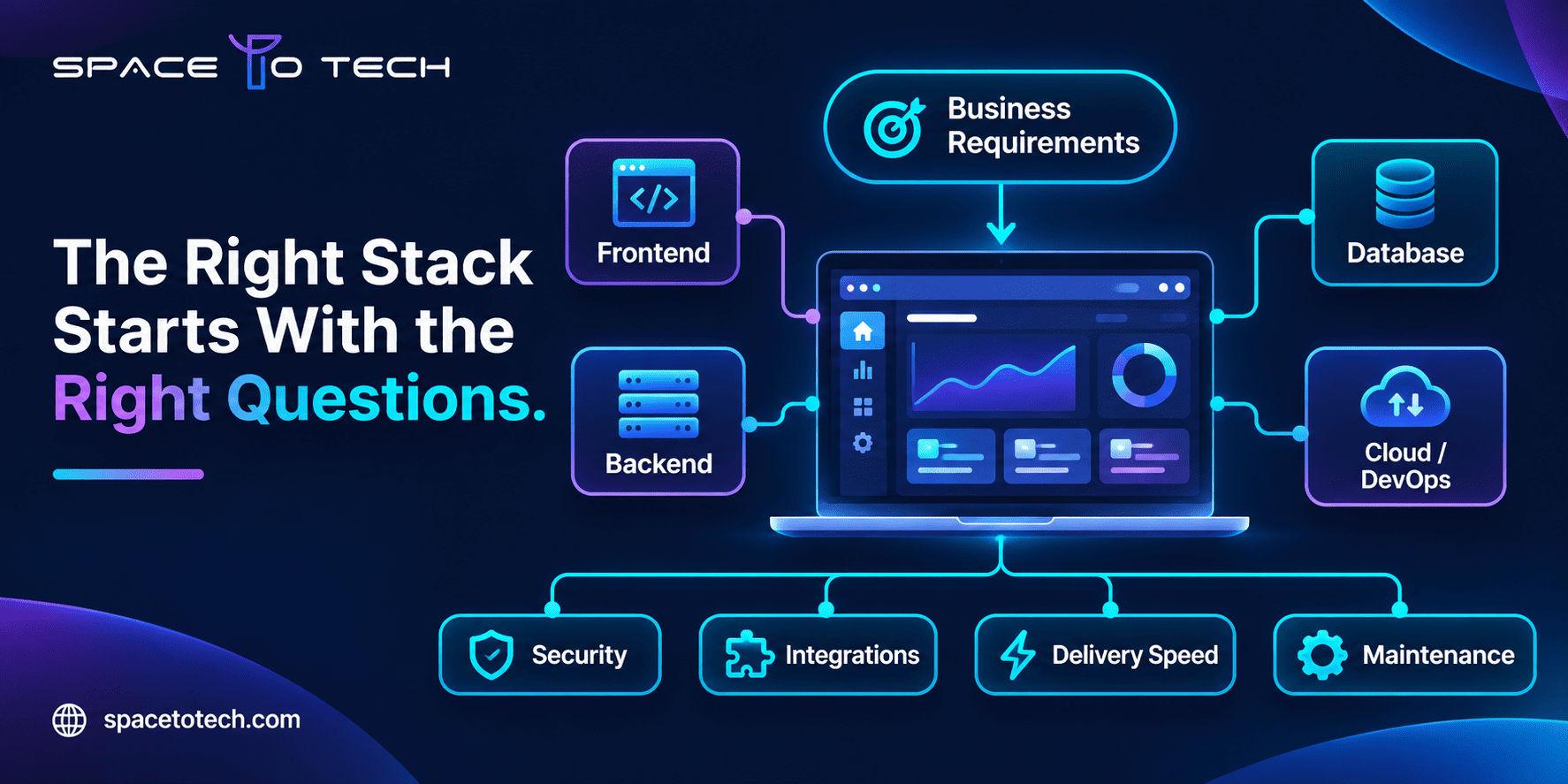
A web application tech stack is the combination of technologies used to build, operate and maintain a browser-based product. It includes more than the programming language visible in a job posting.
| Layer | What it handles | Examples, not universal recommendations |
| Frontend | Screens, forms, interactive UI and rendering | React, Next.js, Angular, Vue |
| Backend | Business rules, authentication, APIs and integrations | Node.js, Django, FastAPI, Laravel, .NET, Spring Boot |
| Data layer | Transactions, records, search and caching | PostgreSQL, MySQL, MongoDB, Redis |
| Infrastructure | Hosting, deployment and scaling | AWS, Azure, Google Cloud, managed application platforms |
| Quality and operations | Testing, releases, logging and monitoring | CI/CD, automated tests, metrics, alerting and backups |
A tech stack is not the same thing as an architecture. A company can use the same frontend and backend languages in a small modular monolith or a distributed system with many services. The architecture determines how the pieces communicate and are deployed. Both choices matter.
Start With the Business Requirements, Not the Framework
Before comparing technologies, document the decisions the product needs to support. A startup testing a single workflow faces different constraints from a company replacing a customer-facing portal tied to its ERP.
Define the users and essential workflows
Who logs in? What do they need to finish? Which steps must work reliably on mobile? Is your application primarily a marketing-to-demo funnel, a subscription platform, an internal operations tool or a workflow used by enterprise customers?
For a B2B SaaS product, examples may include organization-level accounts, role-based permissions, onboarding, subscription billing and audit histories. For an internal tool, ERP connectivity and data permissions may be more important than public SEO.
Separate must-have at launch from possible in year two. If an imagined future requirement determines your entire architecture today, you may end up paying for complexity that never becomes necessary.
List integrations before choosing the backend
CRM, ERP, identity providers, payment processors, analytics, data warehouses and legacy systems can constrain the decision. Some enterprises already standardize on Microsoft identity, .NET and Azure; others have strong Python teams and existing services.
Write down each integration's API availability, authentication method, rate limits, data format, expected volume and owner. An elegant framework is not useful if your application cannot reliably exchange information with the systems your business depends on.
Define measurable nonfunctional requirements
Specify expected usage patterns, acceptable response times, availability requirements, data residency, accessibility objectives, security expectations and recovery targets. These are the questions a serious custom web application development partner should ask during discovery rather than after a technology proposal has been approved.
Seven Factors That Should Drive Your Tech Stack Decision
1. Existing team skills and hiring availability
A technically sound stack can still be an expensive decision if only one engineer understands it. Consider current expertise, recruitment options, external partner availability and the quality of documentation and libraries. Your team needs to support the application long after its first launch.
2. Time to market
An MVP usually benefits from mature frameworks, managed services and fewer moving parts. A team that already knows Django might deliver a well-structured application faster than it could learn a newer JavaScript backend. Familiarity and fit often beat theoretical novelty.
3. Data model and transaction needs
Products handling invoices, inventory, memberships or multi-step approvals often benefit from relational data and strong transactional guarantees. Applications with document-oriented or variable structures may have different storage needs. The right database follows the data model, not the database that appears most frequently in tutorials.
4. Security and compliance
Authentication, permissions, encryption, secret management, audit logs, dependency maintenance and secure deployment practices should be considered at the beginning. A framework does not make a product compliant by itself. Requirements for healthcare, financial services or enterprise procurement may affect hosting, data retention and vendor choice.
5. Scalability and actual workload
Ask what must scale: concurrent users, data processing, file uploads, background jobs, real-time updates or analytics queries. These are different problems. A well-designed modular application with sensible caching and a managed database can support meaningful growth without requiring microservices on day one.
6. Maintenance and total ownership cost
The initial build is only one part of the cost. Include hosting, third-party subscriptions, monitoring, security patches, upgrades, incident response, documentation and future hiring. These considerations are fundamental to a sustainable technology stack for web development.
7. Product experience, accessibility and search needs
Public, content-rich routes may need server rendering or static generation for discoverability. Logged-in dashboards often prioritize interactive behavior over indexing. Accessibility also affects component selection and testing. Teams designing public-facing and authenticated interfaces should plan for WCAG 2.2 compliance where appropriate rather than treating it as a post-launch add-on.
How to Choose Frontend, Backend and Database Technologies
Choosing the frontend and backend independently can create unnecessary integration work. Evaluate the overall architecture and the skills needed to operate it.
Frontend: React, Next.js, Angular or Vue?
React offers a broad ecosystem for interactive interfaces, but it is a UI library rather than a complete architecture. Next.js adds application routing and rendering capabilities, which can be useful when the product includes indexable content alongside app-like interactions. Angular is an opinionated framework with integrated conventions that can suit certain large teams. Vue can be attractive to teams seeking a progressive framework and approachable component model.
The relevant questions are: How complex is the interface? Are there public pages that need search visibility? What does the team already know? Will the product need a long-lived design system? Which rendering and accessibility behaviors must be tested?
A more detailed technology landscape appears in our analysis of technologies used by top web development companies. The purpose here is to choose, not to catalogue every available library.
Backend: Node.js, Python, Laravel, Java or .NET?
Node.js can suit teams using TypeScript throughout an application and products with many API-driven interactions. Python frameworks such as Django or FastAPI may fit teams with strong Python capability or products integrating data and AI workflows. Laravel offers a productive PHP ecosystem for many business applications. Java and .NET can suit complex enterprise environments and established organizational standards.
None is automatically more secure, scalable or cost-effective. Implementation quality, dependencies, infrastructure and engineering practices often outweigh broad language comparisons.
Database: SQL or NoSQL?
Start with the relationships among your entities. A B2B SaaS application with organizations, users, subscriptions, invoices and permissions commonly has relational requirements well served by PostgreSQL or MySQL. Document databases can be appropriate for some flexible or document-heavy models. Redis can support caching or ephemeral workloads but should not be presented as a substitute for a durable primary database in every product.
Ask about transactions, reporting, indexing, backups, migrations and how data will evolve. Changing a database after the data model is deeply embedded can be far more disruptive than changing a frontend component library.
Infrastructure: managed services first or custom operations?
Cloud platforms such as AWS, Azure and Google Cloud offer different managed options for compute, databases, storage and observability. Choose based on geography, enterprise constraints, team knowledge, security needs and realistic operating cost.
Containers, Kubernetes and microservices are tools, not maturity badges. An MVP may be better served by a simpler deployment model, automated tests and sensible monitoring. Add operational complexity when a real requirement justifies it.
Which Tech Stack Fits Your Web App Type?
The table below illustrates sensible evaluation directions, not prescribed stacks. An experienced team should confirm these against your product requirements.
| Project type | What matters most | Reasonable evaluation direction |
| Startup MVP | Fast learning, clear scope, maintainable delivery | Familiar framework, managed database, simple deployment |
| B2B SaaS | Tenant boundaries, roles, subscriptions, audit trails | Mature backend conventions, relational data, secure auth and observability |
| Enterprise customer portal | SSO, ERP/CRM integration, governance | Fit with existing identity systems, APIs and enterprise hosting standards |
| Internal operations tool | Workflow accuracy and data integration | Reuse existing enterprise services and team expertise where practical |
| Data- or AI-enabled web app | Data pipelines, job processing, model integration | Clear API boundaries, async jobs, measured compute and storage decisions |
| Public-facing content plus app features | SEO, performance and interactive journeys | Evaluate server rendering, caching, accessible UI and API separation |
For an enterprise portal, choosing an unfamiliar stack because it benchmarks well may be a weaker decision than extending a supported company standard. For a young SaaS business with no inherited systems, developer availability and rapid iteration may carry more weight.
Tech Stack Selection by Business Stage: MVP, Growth and Enterprise
The same product concept can justify different implementation choices at different stages. A startup validating whether customers will pay for a workflow tool has a different risk profile from a funded SaaS company serving hundreds of organizations. A corporate buyer integrating the same workflow into its identity and ERP systems faces another set of constraints.
| Decision dimension | Startup MVP | Scaling B2B SaaS | Enterprise application |
| Immediate business risk | Building the wrong feature | Reliability, release cadence, tenant isolation | Integration failure, governance, change control |
| Architecture priority | Simple, reversible decisions | Clear boundaries, observable services | Existing platform fit, controls and auditability |
| Data strategy | Reliable core transactional model | Migration discipline and analytics separation | Retention, residency, integration and access rules |
| Delivery approach | Narrow release and short feedback loops | Automated releases and structured quality gates | Staging, approvals and coordinated rollou |
| Technology selection question | Can the current team support it next quarter? | Can multiple teams extend it safely? | Will the IT organization own and govern it? |
Example: a B2B subscription platform in three phases
Phase 1: Validate demand. The founding team needs accounts, roles, a simple workflow, subscription billing and a basic admin console. A coherent monolithic application with a managed database may be easier to deploy and debug than several services. What matters is making the assumptions testable with real customers.
Phase 2: Support paid growth. Sales teams request SSO, audit histories, CRM synchronization and more sophisticated reporting. Now the stack must accommodate background jobs, tenant-aware authorization, reliable integration retries and release monitoring. The original framework can remain suitable, but its architecture and operating practices may need to mature.
Phase 3: Meet enterprise procurement requirements. Larger buyers ask for specified data handling, access logs, security evidence and contractual support. Changing programming language is rarely the first answer. The team should first assess identity integration, security controls, deployment governance, documentation and evidence collection.
The lesson is not to predict every phase in advance. Select a foundation that supports the next credible phase without paying for speculative complexity from day one.
A Closer Look at Frontend Rendering, APIs and Data Boundaries
A tech-stack proposal can name frameworks while leaving the most consequential choices unanswered. Ask the engineers to show how a user request moves from browser to API to database, and where security, caching and background processing enter that path.
Server rendering, static delivery or client-side applications?
A public-facing page that must be discoverable in search can benefit from pre-rendered or server-rendered HTML, depending on the content and its update cycle. A secure internal dashboard may prioritize rich client-side interactions instead. React itself does not dictate one delivery model; the surrounding application framework and architecture matter.
If the product blends a marketing site and an authenticated application, consider whether those experiences need identical rendering and deployment rules. Splitting them into separate applications is one option, not a requirement. Performance should be validated on representative devices and network conditions, not inferred from framework brand names. Our related analysis of website performance optimization covers the page-level measurements that help assess the real user experience.
APIs and integrations are often the real constraint
A CRM, ERP, payment service, customer identity provider or legacy database can shape the backend decision more strongly than a benchmark. Ask which integrations support reliable APIs, whether rate limits apply, what happens when the upstream service fails, and who owns retry and reconciliation logic.
For a product that exchanges financially important or operational records, document idempotency, error handling, access boundaries and audit trails. The proposal should also distinguish a simple request-response API from scheduled imports and long-running background jobs.
Data models are long-lived decisions
In B2B software, companies, users, roles, entitlements, invoices, events and audit entries are rarely isolated documents. Relational constraints and transactions may therefore be valuable. A document database may still fit particular flexible records or workloads, but changing a database later can be more expensive than changing a UI library because applications accumulate queries, migrations, reports and operational knowledge around the data model.
Start by modeling representative business entities and the reports or operations the product must support. Only then compare PostgreSQL, MySQL, MongoDB or a managed alternative.
Architecture Choices That Affect Future Delivery Costs
Choosing a stack is not the same as choosing an architecture. Two teams using the same languages can build products with vastly different operating and maintenance costs.
Modular monolith versus microservices
A modular monolith keeps deployment relatively simple while enforcing boundaries between business capabilities inside one application. It can be a sensible starting point for a small or mid-sized product, provided modules have clear ownership and well-defined interfaces.
Microservices let teams deploy some capabilities independently, but introduce network dependencies, distributed failures, service authentication, observability needs and more operational work. They can be justified by independent scaling needs, organizational ownership or distinct workloads. They should not be introduced solely because a pitch deck describes the product as “enterprise-grade.”
Before adopting multiple independently deployed services, ask what measurable constraint a single deployable application cannot satisfy.
Build versus buy for supporting capabilities
Not every feature needs custom engineering. Authentication providers, transactional email, payment processing, search and observability often have managed options. Buying can shorten delivery, but it brings recurring fees, data processing arrangements, vendor limits and migration considerations.
Create a simple register for each external dependency: business function, owner, pricing driver, data shared, failure mode, contractual obligation and replacement difficulty. This gives procurement and engineering a common view of platform dependence.
Technical debt is a financing decision
Sometimes a team deliberately chooses a shortcut to validate demand. That is not automatically bad engineering. Trouble begins when temporary decisions are undocumented, unowned or spread throughout the product. Record what was deferred, why it was acceptable, its likely consequences and the milestone at which it must be revisited.
For an existing platform, the decision may be whether to modernize incrementally or replace a limiting foundation. The same diagnosis appears in a website redesign vs rebuild decision, although replacing a production application usually requires additional attention to integrations, data migration and service continuity.
Calculate Three-Year Cost, Not Just the First Development Quote
A proposal with the lowest build price may be more expensive to own. Initial implementation is only one component of the total cost of ownership (TCO).
Cost category | Questions worth asking before approval |
|---|---|
Illustrative comparison, not a market-price forecast: Suppose Proposal A costs $45,000 to build and $2,500 per month to operate and maintain, while Proposal B costs $60,000 to build and $1,500 per month thereafter. Over 36 months, Proposal A totals $135,000 and Proposal B totals $114,000, before accounting for different risks or business value. A higher initial proposal may therefore be less expensive under stated assumptions. Replace these example numbers with vendor-specific estimates before making a purchasing decision.
Founders should ask for an operating-cost model under expected, low and high usage scenarios. CTOs should additionally ask for upgrade responsibilities, end-of-support risks, backup and recovery expectations and the cost of replacing a third-party service.
A 30-Minute Tech Stack Evaluation Workshop
The most effective selection meeting is not a vote for favorite frameworks. Give the product owner, engineering lead and operations or security representative the same one-page input before the discussion.
- Minutes 0–5: Define the release. Confirm the customer workflow, success metric and deadline. Identify what can be deferred.
- Minutes 5–10: List non-negotiables. Record current systems, data handling restrictions, identity requirements and launch constraints.
- Minutes 10–15: Compare two or three options. Use the weighted criteria above and capture evidence for every low or high score.
- Minutes 15–25: Attack the biggest assumption. Select the integration, reporting load or deployment requirement that could invalidate the preferred approach, and define a narrow test.
- Minutes 25–30: Record the decision. Assign an owner, document rejected options and schedule a checkpoint before full-scale implementation.
A useful outcome is not a signed-off list of libraries. It is a decision record, a small list of risks and a plan to validate the uncertain parts before they become expensive commitments.
How to Choose a Tech Stack With a Weighted Decision Matrix
A decision framework is useful only when it makes assumptions explicit. First, eliminate options that fail a mandatory security, compliance, integration or licensing constraint. Then score the realistic shortlist.
Use a 1–5 score for each option (1 = poor fit; 5 = strong fit). Multiply each score by its criterion's weight, then add the results. The illustrative example below compares two hypothetical candidate approaches for a B2B SaaS MVP; these are not empirical performance ratings of the technologies.
Criterion | Weight | Option A: TypeScript/Node + PostgreSQL | Option B: Python/Django + PostgreSQL |
|---|---|---|---|
In this example, Option A wins because the hypothetical team already has stronger TypeScript experience. Change that assumption and the result may reverse. A scoring worksheet cannot replace a proof of concept where requirements are uncertain, especially for integrations, performance bottlenecks or legacy data migration.
How to use the matrix without fooling yourself
- Agree on the weights with both business and engineering stakeholders before scoring options.
- Identify non-negotiable requirements that automatically disqualify a candidate.
- Ask each evaluator to explain their scores with evidence, not preferences.
- Run a narrow proof of concept for the highest-risk integration or workload.
- Record the final decision, its assumptions and the circumstances that would trigger a review.
A CTO may weight integration risk and supportability heavily. A startup founder validating demand may weight development speed and available talent more heavily. The framework stays consistent, while the priorities change.
What a Tech Stack Decision Record Should Include
A short architecture decision record helps prevent repeated debates and gives future developers context. Keep it practical:
- Business objective: What must the first release achieve, and by when?
- Constraints: Existing systems, compliance, data residency, hosting and team capacity.
- Options evaluated: Two or three realistic candidate stacks, with rejected options noted.
- Decision and reasons: Why the chosen option best fits the weighted priorities.
- Known trade-offs: Skills gaps, integration risks, cost uncertainties and vendor dependencies.
- Ownership and review: Who will maintain the stack, and what event would justify reassessment?
For example, if an organization selects .NET and Azure because its engineers already maintain Microsoft systems, document that operational advantage. Avoid presenting the choice as evidence that .NET is universally superior to Node.js or Python.
What a Development Partner Should Deliver Before Coding Begins
For a service provider, architecture advice should become a concrete project artifact. A serious discovery process can produce a scoped MVP backlog, a system-context diagram, the integration inventory, a data model sketch, an environment and deployment plan, acceptance criteria, and an initial risk register. The required depth depends on project size; a two-person MVP does not need a corporate architecture binder.
A founder should be able to understand what the proposed system will do and when it can be tested. A CTO should be able to challenge its assumptions, ownership boundaries, security controls and operational model. Both should be able to tell what is included in the estimate and what remains undecided.
This is where a provider of custom web application development can contribute beyond writing code: turning business requirements into an implementation plan that a delivery team can own, review and adapt. The architecture recommendation should remain conditional on discovery rather than claiming one stack is always the best answer.
Common Tech Stack Mistakes That Raise Project Risk
Selecting technology before defining the application. “Build it in React” is not a product requirement. It is a partial implementation preference.
Overengineering for hypothetical scale. Multiple microservices, orchestration layers and bespoke infrastructure can consume an MVP's budget before the team has validated a customer need.
Treating a popular stack as a hiring guarantee. A large developer community does not remove the need for documentation, ownership and production experience.
Ignoring data migration and integration work. Rebuilding an interface is often easier than preserving business rules and historical records across systems.
Leaving maintenance outside the budget. Long-term support is part of your custom software development services decision, not an optional line item to discover after launch.
Confusing a proof of concept with production readiness. A working demo does not prove security, resilience, observability, recoverability or maintainability.
Questions CTOs and Founders Should Ask a Development Partner
A useful technology consultation should result in a clear architecture recommendation and explain the alternatives. Ask the potential partner:
- Which project requirements would make you reject your preferred stack?
- What integrations or data constraints should we test before signing off?
- What can we leave out of the first release without creating expensive rework?
- Who owns the source code, cloud accounts, deployment pipeline and documentation?
- What does our expected operating cost look like after launch?
- How will you test security, accessibility, performance and critical workflows?
- How could a future internal team take ownership of the product?
When comparing top web development companies in India, technical recommendations should be one part of your evaluation. Ask for delivery examples, meaningful architectural explanations and evidence of ongoing support, rather than choosing a company simply because it advertises the most frameworks.
Final Checklist Before You Approve a Web App Tech Stack
☐ Product users, workflows and success metrics are documented.
☐ MVP and future requirements are clearly separated.
☐ CRM, ERP, authentication and external API dependencies have been assessed.
☐ Data model, privacy, security and compliance expectations are recorded.
☐ Frontend rendering and accessibility needs have been reviewed.
☐ Backend and database selections match the workload and team skills.
☐ Hosting, deployment, backups, monitoring and maintenance costs are considered.
☐ At least two realistic options have been compared against weighted criteria.
☐ High-risk assumptions have been validated with a focused prototype if necessary.
☐ Ownership, documentation and future support are included in the delivery plan.
Turn the Tech Stack Decision Into a Buildable Product Plan
You do not need to commit to every technology before speaking with an engineering partner. You do need a clear statement of what the business is building, the integrations it depends on, the risks it cannot accept and the outcomes it expects.
At Space to Tech Technology, a software development company, teams can discuss web application requirements, architecture choices, integrations, implementation scope and maintenance expectations before committing to a build. A useful discovery conversation should leave you with clearer options, not a predetermined sales pitch for one framework.
Planning a SaaS product, enterprise portal or custom B2B web application? Bring your feature list, current systems and timeline to an architecture discussion so the proposed stack can be assessed against your business needs.