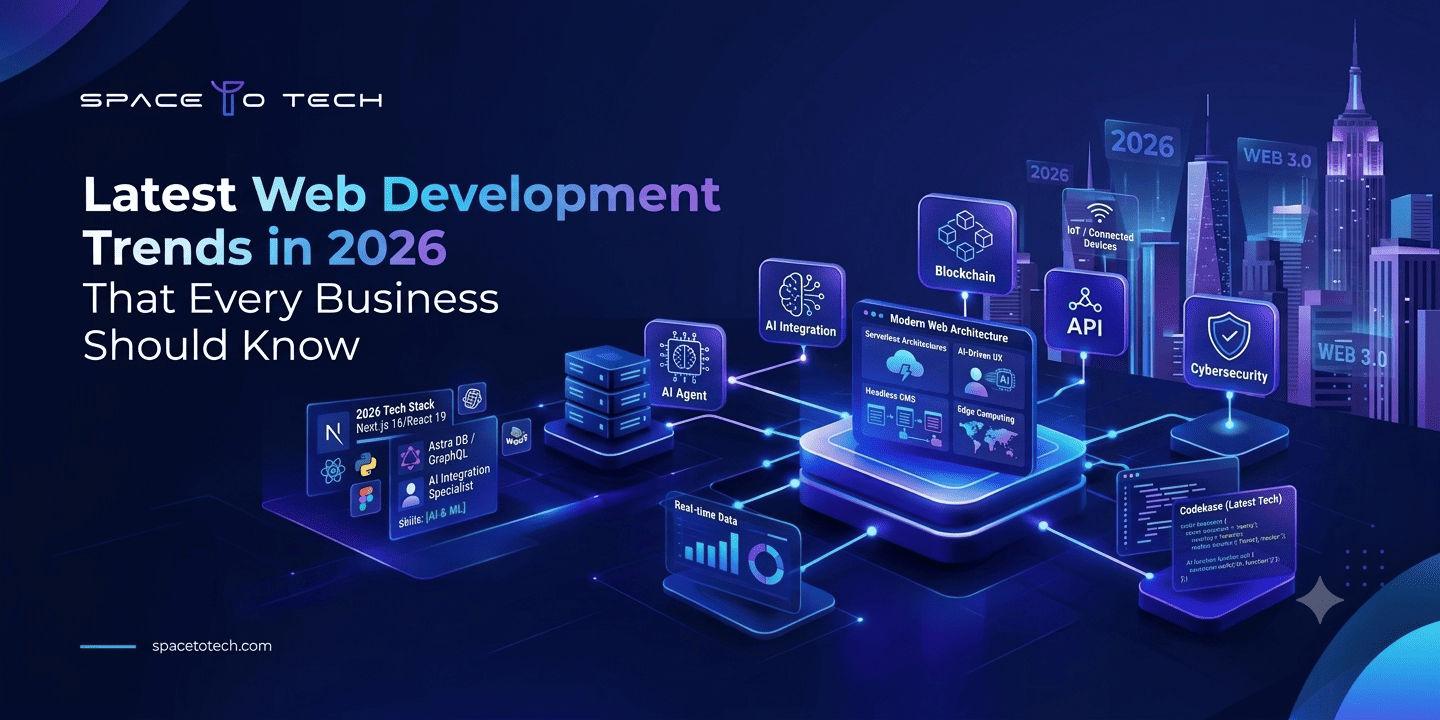

Choosing a development partner means inheriting their technical decisions. The frameworks, languages, and infrastructure behind your project shape its performance, security, and long-term maintenance costs. So what are the technologies used by top web development companies right now? In 2026, the answer spans TypeScript-first frontends, cloud-native backends, composable architectures, and AI-assisted workflows. This guide breaks down the modern web development tech stack layer by layer, explains why leading firms choose each tool, and helps you judge whether a prospective partner's stack fits your business goals.
Whether you are comparing the top web development agencies for a new platform or searching for the best website development company to rebuild an existing product, understanding the technology behind their work gives you a real advantage. Modern web development is no longer just about launching a site. It covers software development practices, cloud infrastructure, security, and ongoing optimization. The sections below show what the top website development companies use and why.
Why the Technology Stack Matters When Evaluating Web Development Companies
A tech stack is the combination of languages, frameworks, databases, and infrastructure used to build and run a product. For a B2B buyer, it is more than a technical detail. It affects hiring flexibility, future upgrade costs, and how easily the product can grow. Any web development company you consider should be able to explain its stack in plain business terms, not just technical jargon.
The stack also determines how easily your product can be handed over, extended, or supported by another team. This matters because a web development project rarely ends at launch. Features are added, integrations change, and traffic grows, so the foundation has to support all of it.
How Tech Choices Affect Scalability, Security, and Speed
Every layer of the stack has business consequences:
- Scalability: Cloud-native architectures let products absorb traffic spikes without a rebuild.
- Security: Well-maintained frameworks and modern authentication practices reduce exposure to common vulnerabilities.
- Speed: Rendering strategy and caching decisions directly influence page load times, which affect both conversions and search visibility.
A poor early choice, such as an obscure framework with a small talent pool, can become expensive to reverse. This is especially true for web applications that handle sensitive data or serve thousands of concurrent users.
What Separates Top Web Development Companies from the Rest
The best web development companies rarely chase trends. They choose technologies based on project fit, community support, and long-term maintainability. Look for firms that can explain why they picked a tool and when they would not use it. A team that recommends the same stack for every client is usually selling a preference, not a solution.
Leading web development firms also invest in process: code reviews, automated testing, documentation, and security audits. A skilled web developer on their team can write good code, but it is the surrounding engineering discipline that makes results consistent. When you evaluate top web development firms, ask about both the tools and the practices around them.
Frontend Technologies Leading Agencies Rely On
The frontend is where users experience your product, so this layer changes fastest and gets the most scrutiny. Strong web design and strong engineering have to work together here, because a beautiful interface that loads slowly still loses users.
JavaScript Frameworks and Meta-Frameworks
React remains the most widely adopted library for building interfaces, and much of its momentum now comes through meta-frameworks such as Next.js. These add server-side rendering, static generation, and routing on top of React, which helps with performance and SEO. Vue and Nuxt remain strong choices for teams that value a gentler learning curve, while Svelte and SvelteKit appeal to projects where lightweight output matters.
Many leading firms also extend the same skills to mobile. Frameworks such as React Native and Flutter let teams share logic and design patterns across web and mobile products, which can shorten delivery timelines. This overlap is one reason why many app development companies now offer web and mobile under one roof, and why app development and web app development skills increasingly go hand in hand.
TypeScript, Design Systems, and UI Tooling
TypeScript has become the default for serious frontend work. Static typing catches errors before they reach production and makes large codebases easier to maintain. Alongside it, top teams typically use:
- Tailwind CSS or component libraries for consistent, fast styling
- Storybook to document and test interface components in isolation
- Design systems that keep branding and behavior uniform across products
These tools also bridge the gap between designers and engineers. When web design decisions are captured in a shared system, every new page or web app feature inherits the same look, accessibility standards, and behavior, which reduces rework across the project.
Backend Languages and Frameworks Powering Modern Web Development
The backend handles business logic, data processing, and integrations. Here, reliability matters more than novelty. For web application development, this layer often determines whether a product can grow smoothly or needs a costly rewrite two years in.
Node.js, Python, Go, and .NET in Production
Each language earns its place for different reasons:
- Node.js lets teams use JavaScript or TypeScript across the whole stack, which simplifies hiring and code sharing.
- Python (with Django, FastAPI, or Flask) is common for data-heavy products and anything involving machine learning.
- Go is favored for high-performance services and systems that need efficient concurrency.
- .NET remains a solid enterprise choice, especially for organizations already invested in the Microsoft ecosystem.
Java and PHP (Laravel) also continue to power a large share of production applications, particularly in established enterprises. Most web app development companies maintain expertise in several of these languages so they can match the technology to the client, not the other way around.
API Approaches: REST, GraphQL, and tRPC
REST is still the standard for most public and partner-facing APIs because it is simple and widely understood. GraphQL suits products with complex, interconnected data where clients need flexible queries. tRPC has gained traction in TypeScript projects because it provides type safety between frontend and backend without extra schema files. Top firms pick based on the use case rather than committing to one approach.
API design is also where custom web development shows its value. Off-the-shelf platforms rarely fit unusual integrations with ERPs, payment systems, or internal tools, so a well-designed API layer becomes the backbone of the entire product.
Cloud, DevOps, and Infrastructure in the Modern Web Development Tech Stack 2026
How software is deployed and maintained now matters as much as how it is written. Mature agencies treat infrastructure as part of the product, and any credible web development service should include deployment, monitoring, and ongoing maintenance, not just initial coding.
AWS, Azure, and Google Cloud Adoption
The three major cloud providers dominate. AWS offers the broadest service catalog, Azure integrates well with enterprise Microsoft environments, and Google Cloud is often chosen for data and AI workloads. Many projects also use platforms like Vercel or Netlify for frontend hosting, which simplifies deployment for modern frameworks. A capable partner will recommend a provider based on your compliance needs, existing systems, and budget rather than habit.
Cloud choices also affect long-term cost. A thoughtful development company will estimate hosting expenses upfront and design the architecture to avoid paying for capacity you do not use.
CI/CD, Containers, and Infrastructure as Code
Reliable delivery depends on automation. Standard practice among top teams includes:
- CI/CD pipelines (GitHub Actions, GitLab CI, or Jenkins) that test and deploy code automatically
- Docker and Kubernetes for consistent environments and scalable deployments
- Terraform or similar tools to define infrastructure in code, making environments repeatable and auditable
These practices reduce release risk and shorten the time between an idea and a deployed feature. They are also a good indicator of maturity when comparing web development agencies: teams that automate their pipelines tend to ship more predictably.
Databases and Data Layer Choices
Data decisions are hard to change later, so experienced teams treat them carefully.
SQL vs. NoSQL Use Cases
PostgreSQL has become a default choice for many teams thanks to its reliability, flexibility, and strong ecosystem. MySQL remains common in established systems. NoSQL options such as MongoDB suit projects with flexible or rapidly changing data structures. The practical rule: use relational databases when data integrity and complex queries matter, and NoSQL when schema flexibility or horizontal scale is the priority.
For business-critical web apps such as booking platforms, fintech dashboards, or inventory systems, relational databases are usually the safer starting point because they enforce consistency by design.
Caching, Search, and Edge Data
Beyond the primary database, high-performing applications usually add supporting layers. Redis handles caching and session data, Elasticsearch or similar tools power search, and edge data services bring information closer to users to reduce latency. These additions are often what separate a functional app from a fast one.
AI and Automation Tools Shaping Development Workflows Today
AI is now part of both how software is built and what it can do. For any software development team, ignoring it is no longer realistic, though using it carelessly carries its own risks.
AI-Assisted Coding and Testing
Development teams increasingly use AI coding assistants to speed up boilerplate, refactoring, documentation, and test generation. The strongest teams treat these tools as accelerators, not replacements for engineering judgment. Code review, security checks, and architectural decisions still need experienced people. Automated testing tools, including AI-supported ones, also help catch regressions earlier in the release cycle.
In practice, this lets a web developer spend less time on repetitive tasks and more on design decisions, performance tuning, and edge cases that genuinely need human attention.
AI-Powered Features Built into Client Products
On the product side, companies are embedding AI directly into web applications: conversational assistants, intelligent search, recommendation engines, document processing, and workflow automation. Delivering these well requires skills beyond front-end work, including data pipelines, model integration, and careful handling of privacy. Firms offering AI development services alongside traditional web development are better positioned to build these features responsibly.
This convergence is reshaping how buyers evaluate leading web development companies. A partner that can combine core website development with practical AI integration offers more long-term value than one that treats them as separate disciplines.
Emerging Trends Top Web Development Companies Are Adopting
Beyond the core stack, several architectural shifts are gaining ground.
Composable Architecture and Headless CMS
Instead of relying on one monolithic platform, many teams now assemble best-of-breed services connected through APIs. A headless CMS such as Contentful, Sanity, or Strapi separates content management from presentation, letting the same content serve websites, apps, and other channels. This approach adds flexibility but requires disciplined integration work.
It is a natural fit for custom web builds where marketing, product, and support teams all need to publish or reuse content without depending on developers for every change.
WebAssembly, Edge Computing, and Progressive Web Apps
- WebAssembly enables near-native performance in the browser for demanding tasks like image processing or complex visualizations.
- Edge computing runs code closer to users, cutting latency for global audiences.
- Progressive Web Apps (PWAs) deliver app-like experiences, including offline support, without requiring an app store release.
Not every project needs these. The best firms adopt them where they solve a real problem. PWAs, for example, can be an efficient alternative for businesses that want mobile reach from web apps without maintaining separate native codebases.
How to Choose a Web Development Partner Based on Their Tech Expertise
Knowing what technologies top firms use is only useful if you can apply it to your own vendor search. Whether you are reviewing a top website development agency, a boutique custom web development company, or a large development firm, the same evaluation logic applies.
Questions to Ask About Their Stack
When evaluating web development companies, ask:
- Why did you choose this stack for a similar project, and what alternatives did you consider?
- How do you handle security, testing, and code review?
- What is your approach to documentation and knowledge transfer?
- How do you manage technical debt as products evolve?
- Which parts of your stack do you use in production today, versus only in experiments?
Clear, specific answers signal real experience. It also helps to review case studies and speak with past clients, since the most reliable web development services are backed by delivered results, not just tool lists. Compare answers across several website development companies so you can spot who gives grounded, project-specific reasoning and who relies on generic claims.
Matching Technology to Your Project Requirements
Start with your business needs: expected traffic, integration requirements, compliance obligations, and the skills your internal team already has. Then check whether a partner's stack supports those needs without unnecessary complexity. A simple marketing site does not need microservices, and a high-volume platform should not run on an untested framework.
Also consider the type of engagement. Some businesses need a full-scope web development company to manage everything from planning to launch, while others only need a development service for a specific module or integration. Clarifying this early helps you filter out development companies that are not the right fit and saves time during procurement.
If you are building a shortlist, our guide to the best custom software development companies compares leading firms across expertise, industries served, and delivery approach.
Final Thoughts
The technologies used by top web development companies in 2026 share a common theme: pragmatism. TypeScript and modern frameworks on the frontend, proven languages on the backend, cloud-native infrastructure, and AI woven into both workflows and products. The most important signal is not which tools a firm lists, but whether it can justify each choice in the context of your goals. Use the stack as a starting point for deeper conversations, and prioritize partners who explain trade-offs openly.
As you compare web development agencies and finalize your shortlist, remember that the right partner is the one whose technology, process, and communication style match your project, not necessarily the one with the longest list of tools.