
Who this guide is for: founders, CTOs, startup teams, and business leaders who are evaluating software development partners and want a repeatable process, not just a list of generic tips.
Most vendor decisions do not go wrong because a business skipped research. They go wrong because the buyer researched properly and still got sold to well. A polished case study and a confident sales call do not tell you who will actually be on your project once the contract is signed, how the team handles a missed sprint, or who owns the code if the relationship sours. This is the real problem behind how to choose a custom software development company: the criteria most guides suggest, like checking a portfolio or asking about communication, are necessary but nowhere near sufficient. This guide goes further. It gives you a nine step framework, a weighted vendor scorecard, a literal script for your discovery call, and a contract checklist built from the mistakes that keep showing up in real engagements. Use it to compare every company on your shortlist using the same evidence, not the same impression.
Why Choosing the Right Software Development Company Matters
The cost of getting this decision wrong is not hypothetical. Research from McKinsey and the University of Oxford, based on more than 5,400 large IT projects, found that these projects run 45 percent over budget on average and deliver far less value than promised, with software projects carrying the highest risk of the group. A wrong vendor rarely fails on day one. It fails slowly, through missed deadlines, quiet scope changes, and a codebase that nobody else can safely touch once the original team moves on. Most businesses eventually turn to a Custom Software Development Company precisely because off the shelf software cannot support how they actually operate, or because owning the technology outright is a competitive advantage worth protecting. Getting the vendor evaluation right up front is the cheapest risk management you will do on the entire project.
Step 1: Define Your Project Before You Talk to Any Vendor
Every strong evaluation starts with clarity you bring to the table, not clarity you expect a vendor to extract from you on a sales call. Before you contact anyone, write down:
- The business problem you are solving and what success looks like six months after launch
- A rough scope, budget range, and timeline, even if it is not exact yet
- Whether you are building an MVP, modernizing legacy software, or scaling an existing product
- Whether you operate in a regulated industry, such as healthcare or fintech, where compliance shapes the build
If you are still new to custom software and want the fundamentals first, read our complete Custom Software Development Guide before you start comparing vendors.
Step 2: Build Your Shortlist the Right Way
A shortlist of 3 to 5 companies is enough. More than that creates decision fatigue and makes every proposal start to sound the same. Look for candidates through referrals, review platforms like Clutch, and direct search. If you want a pre-vetted starting point, our list of Top Software Development Companies is a reasonable place to begin, alongside region specific roundups like Top Custom Software Development Companies in India and Top Custom Software Development Companies in the USA if you would rather work closer to home.
Before reaching out, check whether each company's case studies describe a real business outcome or just a list of technologies used. If you are weighing India specifically as an outsourcing destination, our guide on how to Hire Software Developers from India covers what that market looks like in practice.
Step 3: Evaluate Technical Expertise and Experience
Portfolio relevance matters more than portfolio size. A company with three projects in your industry is usually a safer bet than one with thirty unrelated ones. Check tech stack fit, ask for real project outcomes instead of marketing language, and treat certifications as supporting evidence, not the deciding factor. For a deeper, developer level checklist, see our breakdown of Skills to Verify Before Hiring Developers.
The table below is a quick way to sense-check what you are actually seeing on a call, versus what a confident sales pitch wants you to hear.
| Poor Vendor Signal | Great Vendor Signal |
| Only promises, no process shown | Shows a documented process and can explain trade-offs |
| Cheap estimate with vague scope | Transparent estimate with clear assumptions |
| No dedicated QA | Dedicated QA and a defined testing process |
| No pilot offered | Open to a small paid pilot before full commitment |
| Generic portfolio, no real outcomes | Case studies with measurable business outcomes |
| Only sales reps on calls | Introduces the actual delivery team before signing |
| Vague on IP ownership | IP ownership stated clearly in writing |
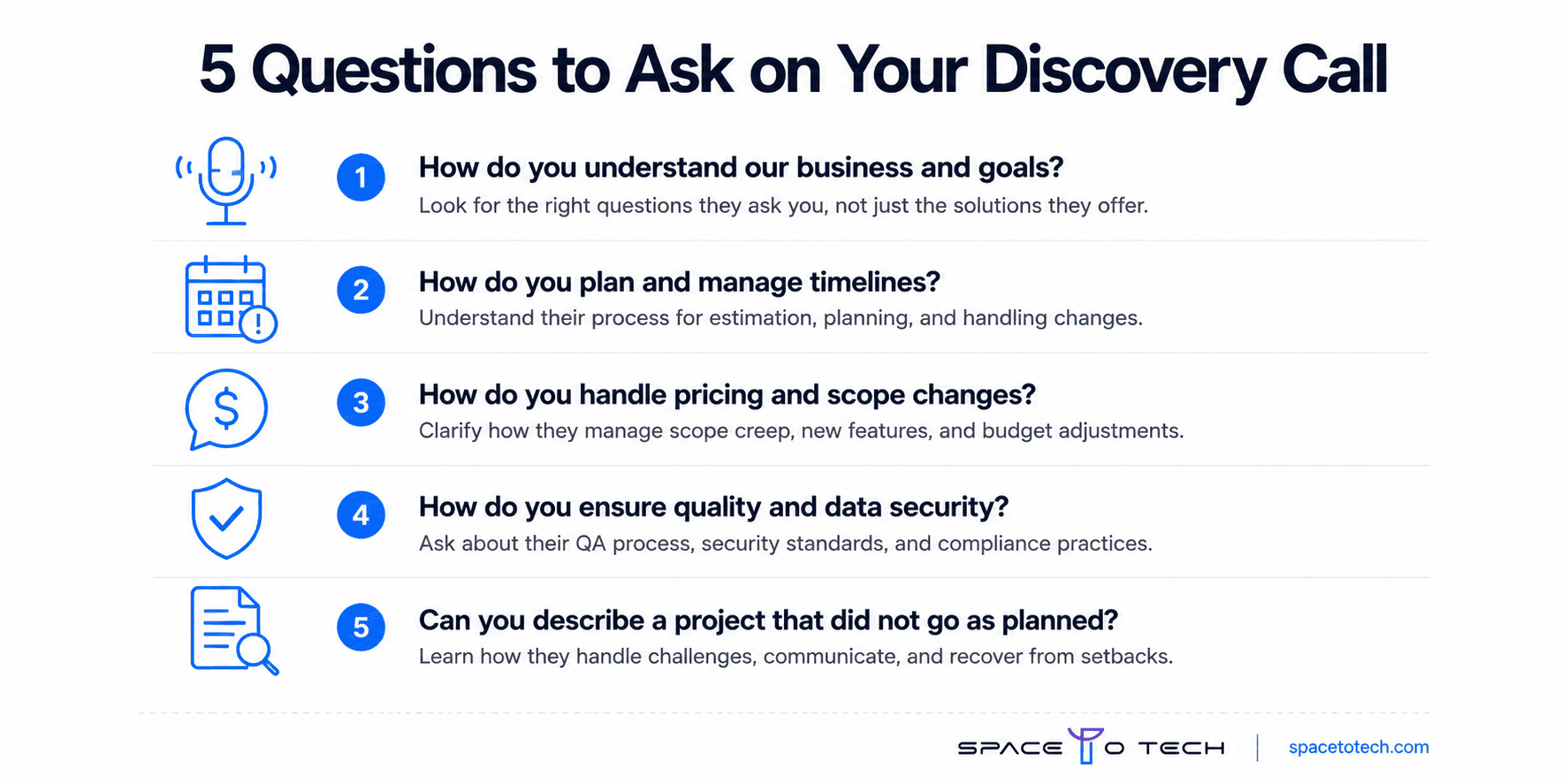
Step 4: Ask the Right Questions on the Discovery Call
This is the single highest value conversation in the entire process, and most buyers waste it on small talk. Come with specific questions and pay close attention to how directly each one gets answered.
Step 5: Check AI Readiness Without Falling for Buzzwords
Almost every company now claims AI expertise, so the word alone tells you nothing. According to the Stack Overflow 2025 Developer Survey of more than 49,000 developers, 84 percent now use or plan to use AI coding tools, yet only 29 percent say they trust the accuracy of that output, a sharp drop from the year before. That gap is exactly what you need to probe. Ask which AI tools are used at each stage of delivery, how AI generated code is reviewed before it reaches your codebase, and what the company's policy is on exposing your code to third party AI training pipelines. A team that has actually thought this through will give you a specific answer. A team that has not will talk about AI in general terms and move on quickly.
Step 6: Compare Proposals the Right Way, Not Just by Price
The lowest number on a proposal is rarely the lowest total cost. Here is a realistic example of how two quotes for the same project can look very different once you read past the headline figure.
| Company A, $40,000 Quote | Company B, $58,000 Quote |
| Fixed price, limited revisions included | Fixed price, three planned revision rounds included |
| No dedicated QA phase mentioned | Dedicated QA and a security review included |
| Post launch support billed separately at standard hourly rate | 30 days of post launch support included |
| Team not named before signing | Named delivery team introduced during discovery |
Company B costs $18,000 more upfront, but Company A's quote excludes QA, revisions beyond the first round, and post launch support, all of which get billed later at an hourly rate. Once those costs are added back in, Company A is often the more expensive option over the full project lifecycle, not the cheaper one. When you compare proposals, read what is included and excluded, the assumptions behind the estimate, and the payment milestones, not just the total at the bottom of the page.
Step 7: Understand Engagement Models and Pricing
| Model | Best For | Watch Out For |
| Fixed Price | Clearly defined, stable scope, shorter timelines | Inflexible if requirements change, contingency is often priced in |
| Time and Materials | Evolving requirements, iterative development | Costs can expand without strong oversight |
| Dedicated Team | Long term product development | Needs active management and an onboarding ramp up period |
Also ask about hidden costs, onboarding ramp up, rework, knowledge transfer, and currency fluctuation if you are working with an international vendor. For a general cost benchmark before you compare quotes, see our breakdown of the Cost to Hire Software Developers, and if you are still deciding between a dedicated team and freelance talent, we compare both directly in Dedicated Developers vs Freelancers.
Step 8: Review the Contract Before You Sign
This is where vendor lock in gets built in or ruled out. Watch for clauses that let a vendor retain rights over reusable frameworks or proprietary infrastructure, since that keeps you dependent on them long after the original project ends. Ask whether their QA and security process follows recognized standards such as the OWASP secure coding guidelines, and confirm every item below is addressed in writing before you sign.
| Item | What to Confirm |
| NDA | Signed before sharing any project details or proprietary information |
| IP and Source Code Ownership | All code, documentation, and assets transfer fully to you upon payment |
| Exit Clause | Clear terms for ending the engagement and transferring work in progress |
| SLA | Defined response times for critical, high, and low priority issues |
| Warranty | A defined post launch period during which defects are fixed at no extra cost |
| Source Code Access | Ongoing access to a live repository, not just a final handover file |
Step 9: Run a Paid Pilot Before Full Commitment
A small paid pilot or proof of concept is the highest signal step most buyers skip, usually because it feels like an extra cost and an extra delay. It is neither. A one to two week pilot costs a fraction of the full project and tells you more than any reference call will. Use it to evaluate communication quality, how the team handles ambiguity, code quality, and documentation habits before you commit to the full engagement.
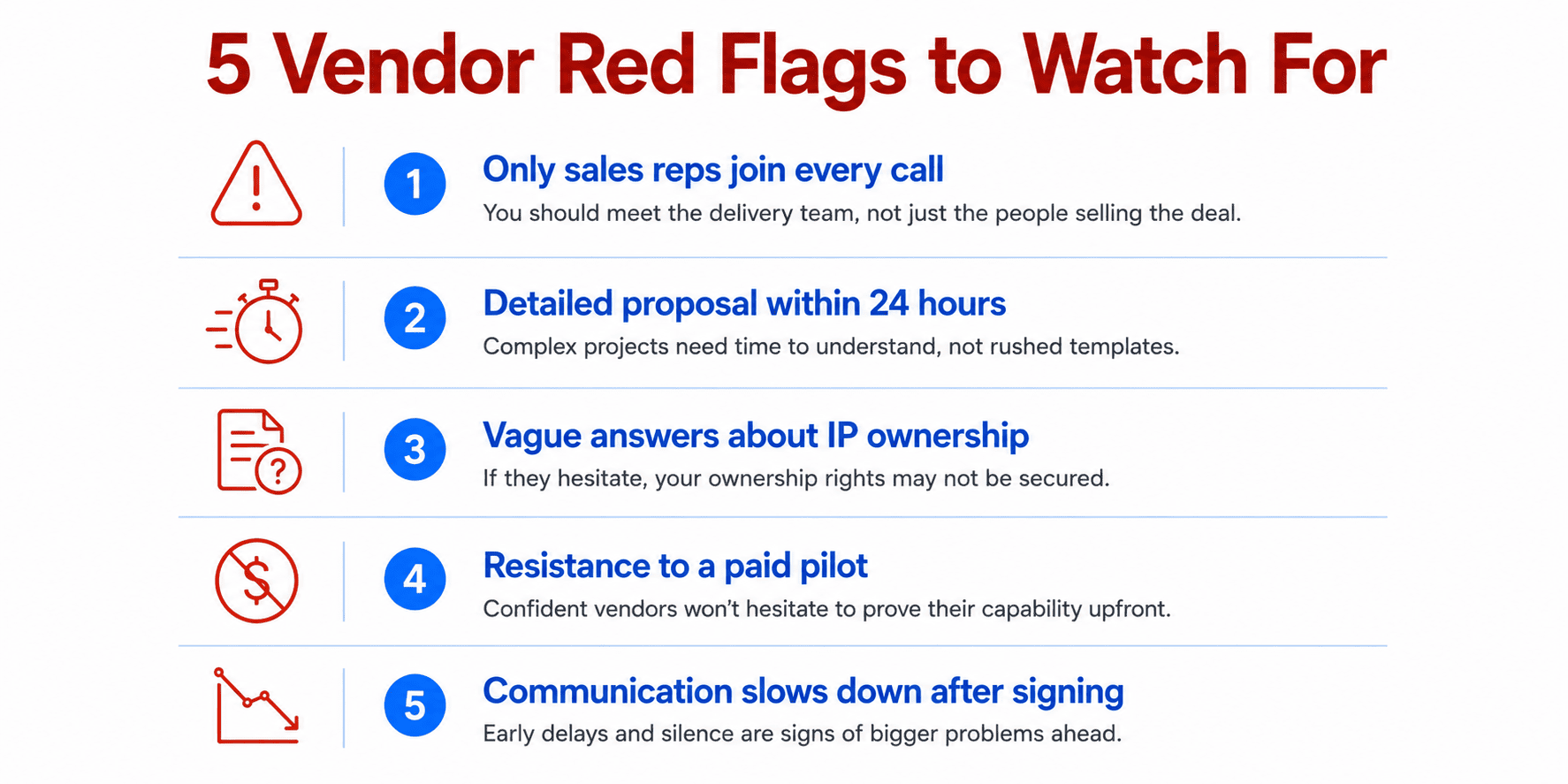
Vendor Red Flags to Watch For
This list focuses on evaluating a company. If you are hiring individual developers rather than a company, see our broader list of Red Flags When Hiring Developers for developer-specific warning signs.
What Happens After You Sign the Contract
A healthy engagement has a visible rhythm from week one. Onboarding should include access setup, a kickoff call with the named delivery team, and a documented plan for the first sprint. Most reliable partners run on Agile principles, meaning short sprints, regular standups, and a working demo at the end of each cycle rather than a single handoff months later. Reporting should be proactive, a short written update or a live demo on a fixed cadence, not something you have to chase down. If any of this is missing in the first two weeks, treat it as an early warning sign rather than something that will sort itself out.
Your Vendor Evaluation Scorecard
This is a worksheet, so the Score and Weighted Score columns are left blank on purpose. Copy this table for every vendor on your shortlist, score each row from 1 to 5, multiply by the weight, and total the result. A vendor that feels strongest on the call is not always the vendor that scores highest once every category is counted, which is exactly the point of doing this on paper instead of from memory.
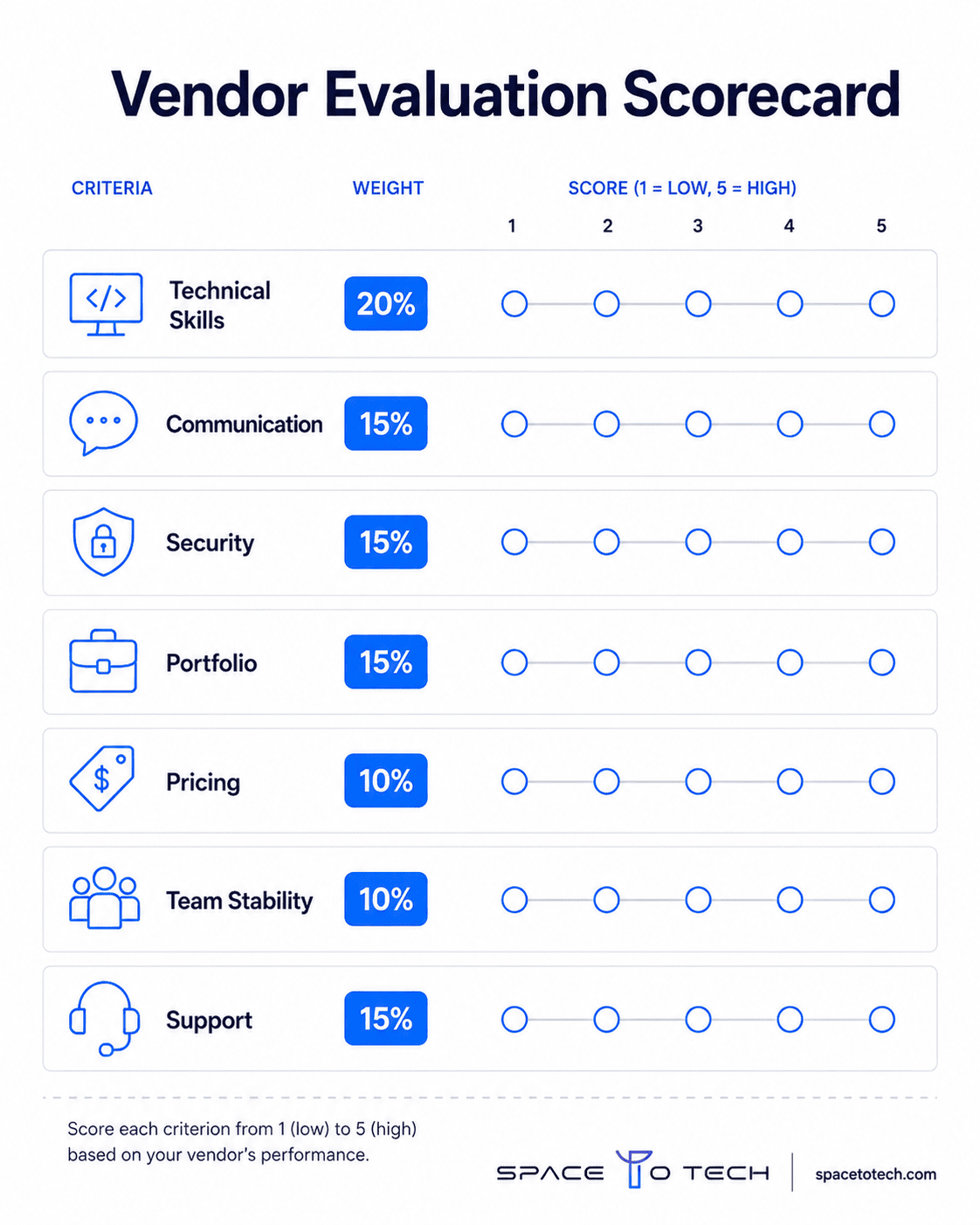
Worked example: if a vendor scores 4 out of 5 on Technical Skills, which carries a 20 percent weight, that row contributes 0.8 to the total. Do this for all seven rows and add them up, the vendor with the highest total out of 5 is your strongest option on paper, not just the one who sounded best on the call.
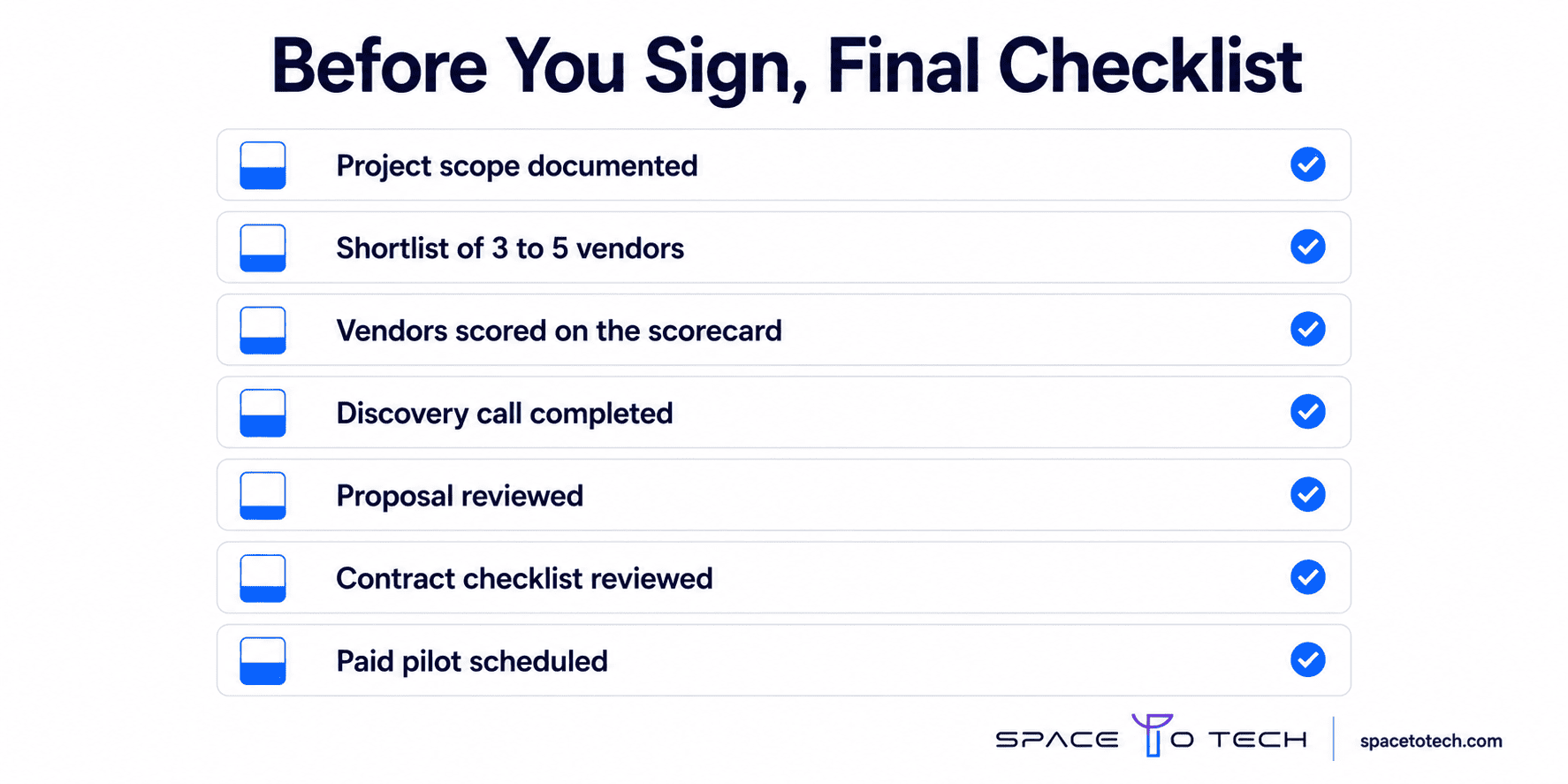
Before You Sign, Use This Checklist
Run through this list one final time before any contract goes out for signature.
Choose the Partner, Not Just the Pitch
A good custom software development company earns trust through process, not promises. It shows you the actual team, answers scope and IP questions in writing, and is glad to prove itself in a small paid pilot before asking for the full engagement. Run every company on your shortlist through the scorecard, the discovery call questions, and the contract checklist in this guide, and you will make this decision on evidence instead of a gut feeling built from a good sales call. Ready to talk through your project with a team that will show you the process first? Get in touch with our Custom Software Development Services team.