
Why Hiring the Wrong Software Development Partner Can Cost You
Cultural mismatch alone accounts for close to 60% of offshore project failures, according to 2026 outsourcing research. That single number should reframe how you read every vendor pitch in your inbox. It is rarely a lack of coding skill that sinks an outsourced project. It is a vendor who overpromises in the sales call, under-communicates once the contract is signed, and quietly hands your build to a subcontractor you never vetted.
Hiring the wrong software development company in India is not just a delay. It is rework, a rebuilt codebase, a missed launch window, and in the worst cases, a product idea that never recovers momentum. The good news is that almost every failure pattern shows up as a visible signal before you sign anything, if you know what to look for.
This guide walks through the specific red flags to watch for when hiring software developers in India, how to verify a company before committing budget, and the questions that separate a real engineering partner from a reseller of freelance capacity.
Why Businesses Still Choose India for Software Development
India remains one of the largest outsourcing destinations in the world, and for reasons that have not changed much in a decade: a deep talent pool across nearly every stack, meaningful cost savings compared to hiring locally in the US, UK, or UAE, and time zone overlap that works well for both same-day and overnight development cycles.
What has changed is buyer behavior. Executives now rank service quality and delivery discipline above raw cost savings when choosing an outsourcing partner, a shift that has been building for several years as companies who chased the cheapest bid learned what that decision actually costs downstream. India still wins on value. It just is not automatic anymore, and the market has enough weak vendors mixed in with strong custom software development companies in India that due diligence is no longer optional.
Top Red Flags When Hiring Software Developers in India
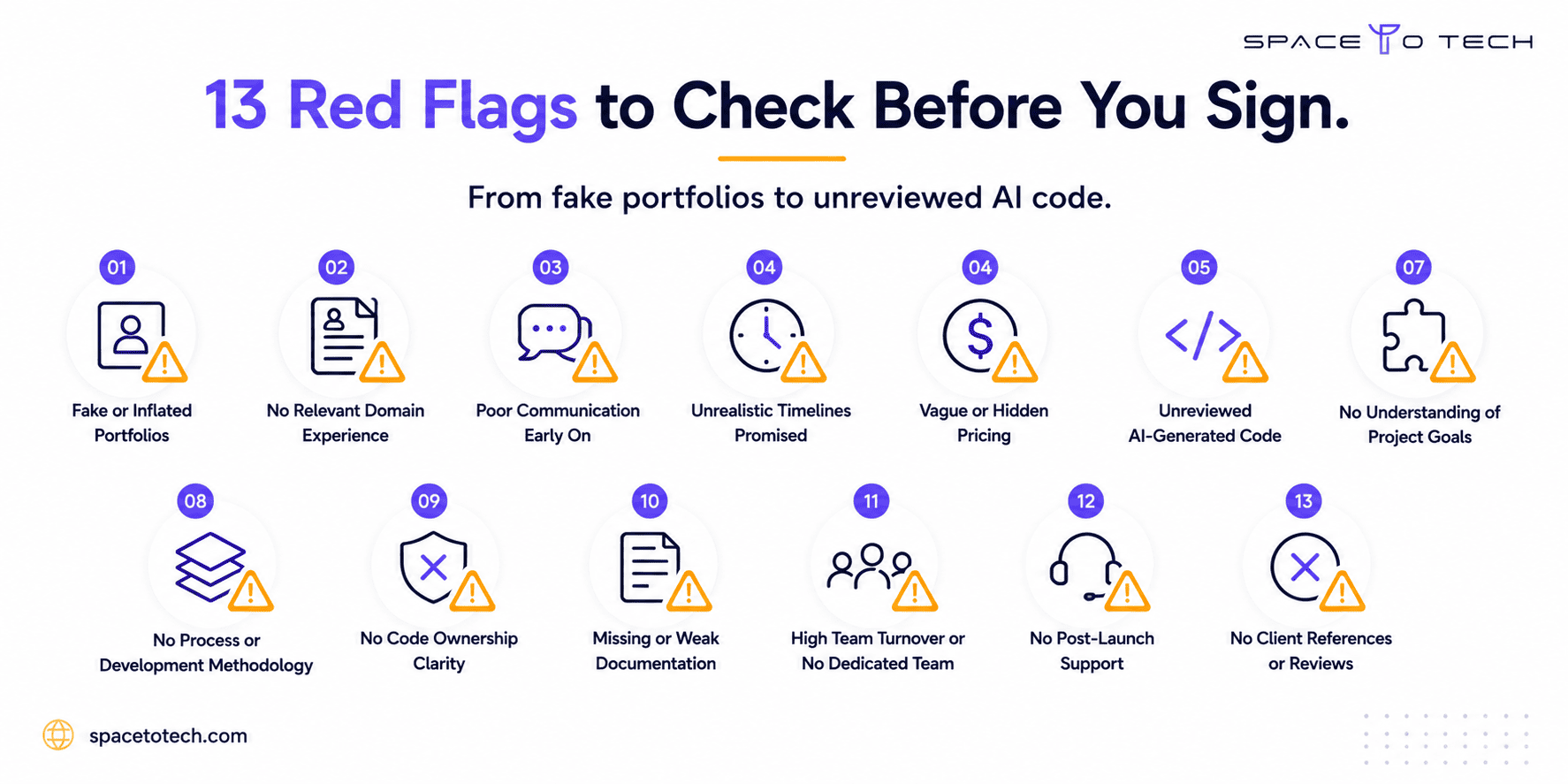
These are the warning signs that show up consistently before a project goes wrong. None of them alone is automatically disqualifying. Two or three together should slow you down.
No Verified Portfolio or Case Studies
A company that cannot show you specific, named projects, with the problem they solved and the outcome, is asking you to be their first real reference. Screenshots of an app without context about the client, the scope, or the results are not a portfolio. Ask for two or three case studies in your industry or a comparable one, and expect specifics, not just logos.
Fake or Unverifiable Client Testimonials
Testimonials with no full name, no company, or no way to verify the person exists are worth very little. Legitimate development partners are usually glad to connect you with a past client for a short reference call, because they know a real conversation sells better than any quote on a website.
No GitHub or Technical Proof of Work
You do not need to be a programmer to check whether a company has any public engineering footprint. Active GitHub contributions, open-source involvement, or even a technical blog signal a team that treats engineering as a craft, not just a service line. Their absence is not fatal on its own, since a lot of client work is private, but it removes one of the easiest independent signals you have.
Poor or Slow Communication
How a vendor communicates during the sales process is close to how they will communicate mid-project. Research consistently shows communication issues are the top challenge cited by outsourcing clients, ahead of cost or timeline problems. Vague answers to direct questions, slow replies, or a sales rep who cannot get a technical lead on a call are all previews of what a live sprint will feel like.
Unrealistically Low Pricing
If a quote is dramatically below every other bid you have received, that gap is coming from somewhere: junior developers billed at senior rates, corners cut on testing, or a subcontractor working for less than the agency is charging you. Low pricing is not automatically dishonest, but it should trigger closer questions about who exactly is doing the work.
For a realistic sense of what fair market rates actually look like across experience levels and technology stacks, see SpaceToTech's guide to the cost to hire software developers in India in 2026.
No Clear Development Process or Methodology
Ask how a company runs a sprint, and you should get a specific answer: sprint length, standup cadence, how requirements get turned into tickets, how QA is handled. Vague responses about being 'flexible' or 'agile' with no actual process behind that word usually mean there is no repeatable process at all.
Hidden Subcontracting to Unverified Freelancers
Some agencies act as a layer of middlemen, outsourcing the actual build to freelancers they have never worked with before. You think you have hired an experienced team; your project is actually being built by whoever happened to be available that week. Directly ask whether the team is in-house or subcontracted, and ask to meet the specific developers assigned to your project before signing anything.
Missing Security Practices
A development partner should be able to describe, without hesitation, how they handle secure coding, encrypted data storage, and API security. If security only comes up when you bring it up, or the answers are generic, treat that as a gap. Frameworks like OWASP publish widely used, freely available standards for secure application development. A team with no familiarity with them is a team that has not been asked to think about security seriously.
No NDA or IP Protection
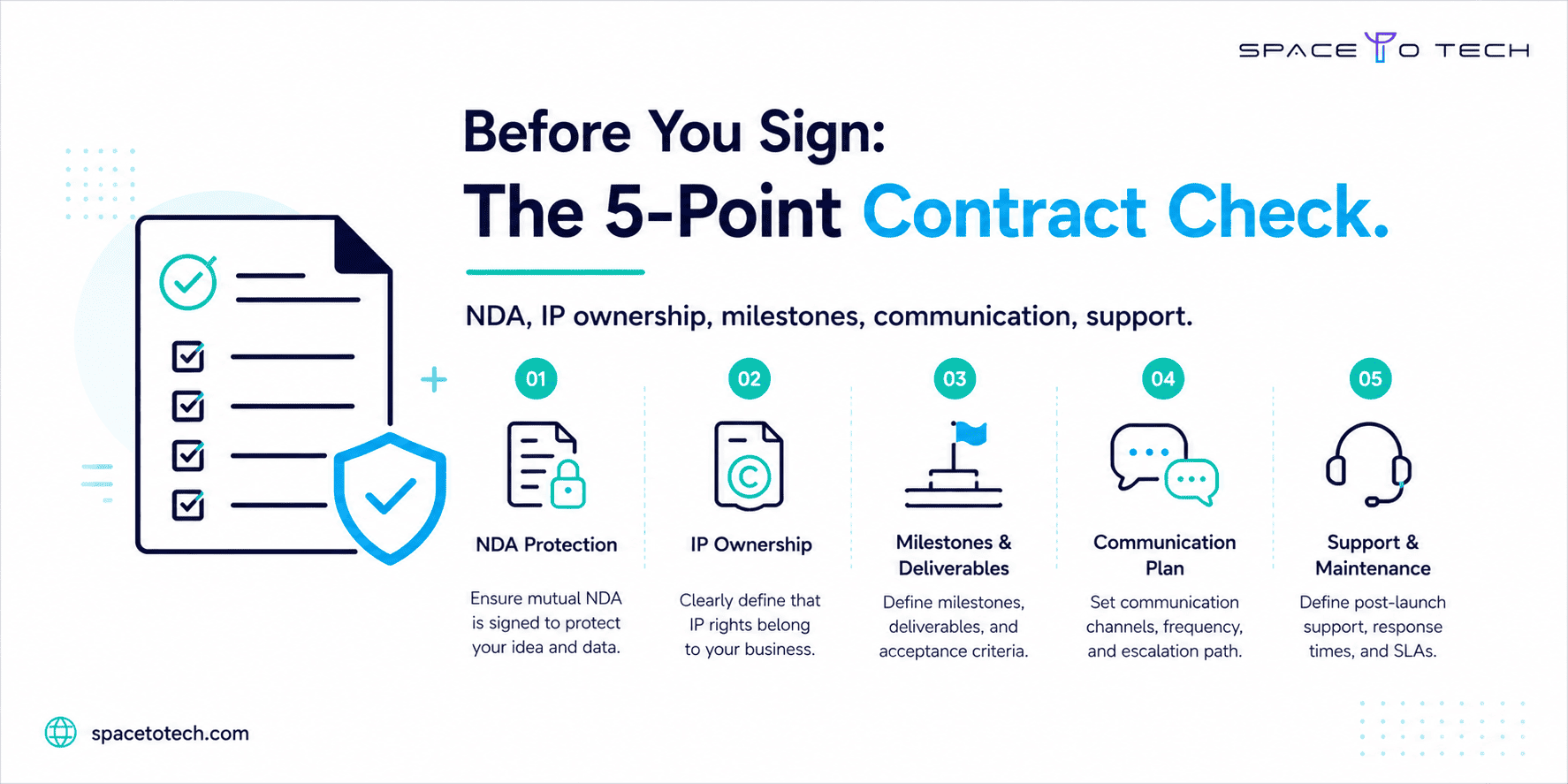
Any hesitation around signing an NDA or assigning full IP ownership to you is disqualifying, not a minor red flag. Your product idea, your code, and your data need to be contractually yours from day one, in writing, before a single line of code is written.
Vague or Shifting Project Timelines
A serious vendor gives you a timeline with milestones, not a single end date with no structure behind it. If the estimate changes significantly after you have shared full requirements, or the company cannot explain how they arrived at the number, that is a sign estimation is not something they take seriously.
No In-House QA Process
Testing should not be an afterthought squeezed in before launch. Ask whether there is a dedicated QA function, what the testing schedule looks like across a sprint, and whether both manual and automated testing are part of the standard process. A company with no clear answer here is a company that ships bugs to production and calls them 'post-launch fixes.'
Unchecked, Unreviewed AI-Generated Code
AI-assisted development is now the default across the industry, not an edge case. That is not itself a red flag. The problem is a vendor who ships AI-generated code without a human review gate. Developer survey data shows AI output is frequently "almost right but not quite," and teams without disciplined review processes lose real time debugging what should have been caught before delivery. Ask directly how AI tools are used on your project and what the human review step looks like before code merges.
No Post-Launch Support
A company that disappears the day after launch was never thinking about your product as a long-term partnership. Ask what post-launch support looks like, what it costs, and what the response time commitment is for critical bugs before you need to find out the hard way.
How to Verify a Software Development Company Before Hiring
Spotting red flags is half the process. Actively verifying a company is the other half, and it takes under an hour.
Check the Portfolio Against Reality
Do not just look at the case study. Visit the live product if it is public, search for the company name alongside the client's name, and confirm the project actually shipped and is still running.
Look at GitHub Activity
Public repositories, contribution history, and code quality on any open-source work give you a technical signal no sales deck can fake.
Clutch and GoodFirms as Third-Party Proof
Independent review platforms like Clutch and GoodFirms verify reviewers before publishing, which makes them harder to fake than testimonials on a company's own site. Look at review recency, not just the star rating; a company with strong reviews from three years ago and nothing recent may have changed since.
Verify the Team on LinkedIn
Confirm the developers you are told will work on your project actually work at the company, have relevant experience, and have been there long enough to suggest low turnover.
If you are comparing multiple vendors side by side, SpaceToTech's roundup of top software developers in India is a good starting shortlist of companies that have already been through this kind of verification.
Questions to Ask Before Hiring Software Developers in India
Use this as a checklist in your first call or RFP. A vendor worth hiring will answer all of these without hesitation.
- Can you share two or three case studies with named clients I can contact?
- Will the developers on the proposal be the developers actually assigned to my project?
- Is any part of this project subcontracted, and to whom?
- What does your sprint and QA process look like end to end?
- How do you use AI coding tools, and what is your human review process before code ships?
- Will you sign an NDA and assign full IP ownership to us in the contract?
- What happens if a milestone is missed?
- What does post-launch support cost, and what is your response time for critical bugs?
Red Flags vs Green Flags
Common Hiring Mistakes Businesses Make
Not every failed engagement is the vendor's fault. Buyers make predictable mistakes too, and they compound whatever red flags were already there.
- Choosing a vendor on price alone, without weighing quality or communication
- Skipping a paid pilot sprint before committing to the full project
- Not putting scope, milestones, or acceptance criteria in writing
- Skipping reference calls because the case studies looked convincing enough
- Assuming a signed contract removes the need for ongoing oversight
How to Avoid These Hiring Mistakes
A short, structured evaluation process removes most of the risk before you sign anything:
- Shortlist three vendors, not one, so you have a real comparison point on price and communication style.
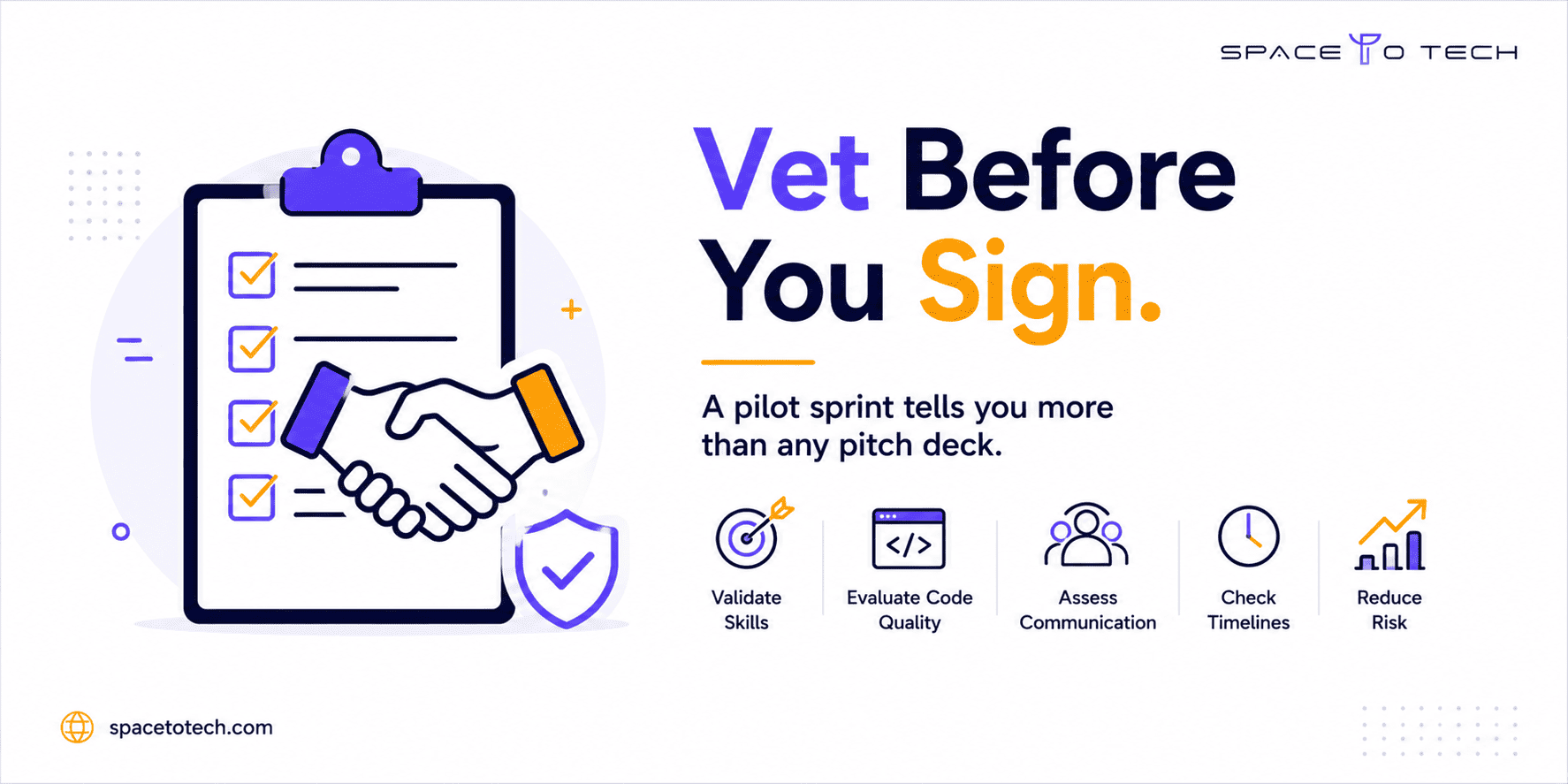
- Run a small, paid pilot sprint before the full engagement. This is the single most reliable way to evaluate real delivery speed and communication quality.
- Call at least one past client directly, and ask what they would do differently.
- Put everything from the sales conversation into the contract. If it was promised verbally, it needs to be written down.
- Set a milestone-based payment structure so you are never paying significantly ahead of delivered work.
If you are hiring from outside India, SpaceToTech's step-by-step guide on how to hire software developers in India from the USA, UK, and UAE walks through this exact process in more detail.
Checklist Before Signing a Development Contract
What Outsourcing Failure Actually Costs
Roughly half of businesses report a failed outsourced software project within five years, and poor vendor selection is linked to close to 29% of those failures, according to recent outsourcing research. That is not a reason to avoid outsourcing to India. It is a reason to spend the extra week on due diligence before you commit budget. The cost of vetting a vendor properly is measured in hours. The cost of getting it wrong is measured in months and a rebuilt codebase.
Conclusion
None of these red flags require special expertise to spot. They require asking direct questions and actually checking the answers before you sign a contract. The vendors worth hiring will not flinch at any question in this guide; the ones who do have already told you what you need to know.
Need a trusted development partner? See SpaceToTech's curated list of top software developers in India before making your hiring decision.