
React Native security layered protection illustration for enterprise mobile apps

React Native Security: 15 Best Practices to Build Secure Enterprise Apps

July 12, 2026

Table of Contents

  • React Native security spans three layers: the JavaScript bundle, native modules, and network communication, not just one.
  • AsyncStorage is unencrypted by default. Sensitive data belongs in Keychain, Keystore, or an encrypted database, never in plain local storage.
  • SSL/certificate pinning, OAuth 2.0 with PKCE, and short-lived tokens are the baseline for secure authentication and network calls.
  • Hermes, ProGuard/R8, and Metro minification raise the cost of reverse engineering, but real secrets still belong server-side.
  • Mapping your app against the OWASP Mobile Top 10 gives you a structured, auditable way to track coverage.
  • Root and jailbreak detection lets you choose a response (block, warn, or limit functionality) instead of treating every compromised device the same way.
  • Deep links and WebViews are common but under-protected entry points. Validate any data coming through a deep link and restrict WebViews to trusted domains only.
  • Dependency and supply-chain risk is one of the most overlooked threats. Regular software composition analysis and a fixed patch cadence matter as much as the quality of your own code.
  • OTA update pipelines like CodePush and EAS Update need the same signing and access-control discipline as your app store releases, since a compromised pipeline can push malicious code to your entire user base instantly.
  • Security is not a one-time, pre-launch task. Quarterly automated scans plus at least one annual penetration test keep an app's security posture current as the codebase and dependency ecosystem evolve.

React Native security is the practice of protecting an app's data, authentication, and code from theft, tampering, and interception across the JavaScript bridge, native modules, and network layer. For any team building a secure React Native app for enterprise users, security is not a single feature you bolt on before launch. It is a set of layered decisions made across storage, authentication, network calls, and code protection.This guide walks through what React Native app security actually means, the most common risks enterprise teams run into, and a complete framework of React Native security best practices you can apply today, whether you are technical or leading the business side of a mobile project.


What Is React Native Security?

React Native security is the set of practices that protect user data, authentication credentials, and app logic across the JavaScript bridge, native modules, and network layer of a React Native application. It combines secure storage, encrypted network communication, code hardening, and dependency management into one layered defense.

Security in React Native is not a plugin you install once. It is an ongoing discipline that touches how you store tokens, how you talk to your APIs, how you ship updates, and how carefully you vet the open source packages your app depends on. Because React Native blends JavaScript with native iOS and Android code, this discipline looks a little different from securing a purely native app, which is exactly why enterprise teams benefit from a dedicated approach rather than borrowing a native security checklist wholesale.

If you are earlier in the process and still evaluating the framework itself, our React Native app development guide covers the fundamentals end to end. This article picks up from there and focuses specifically on how to secure what you build. 


Why React Native Security Matters for Enterprise Apps

React Native app security stops being a developer-only concern the moment your app starts handling real user data, payments, or business logic that a competitor would love to see. For enterprise decision makers, weak security carries four kinds of cost:

  • Data breaches that expose customer PII, credentials, or financial details, often triggering mandatory disclosure obligations and lasting reputational damage.
  • Compliance exposure. Regulated industries such as finance, healthcare, and HR tech face GDPR, HIPAA, or PCI-DSS obligations that a single insecure endpoint or unencrypted data store can violate.
  • Erosion of user trust. Users rarely forgive a breach, and mobile apps live or die by repeat usage and word of mouth.
  • Direct financial risk from incident response, legal exposure, and lost business, on top of the engineering time spent fixing the issue after the fact rather than before launch.

None of this is unique to React Native. What is unique is that its cross-platform nature means a single vulnerability, say an unencrypted AsyncStorage call, ships to both iOS and Android at once. That is the tradeoff of a shared codebase: faster delivery, but also faster propagation of any security gap.


How React Native's Architecture Creates Unique Security Considerations

To understand why React Native needs its own security lens, it helps to understand how the framework works under the hood. Our React Native architecture explained guide covers this in depth, but the short version is that React Native connects a JavaScript thread to native iOS and Android modules through a bridge, or in the New Architecture, through JSI, the JavaScript Interface.

This bridge is powerful because it lets one JavaScript codebase drive native UI and native capabilities on both platforms. It also means the app's attack surface includes three layers instead of one: the JavaScript bundle itself, which can be extracted and inspected, the native modules it talks to, and the growing list of third-party npm packages most React Native apps depend on. Securing a React Native app for enterprise use means addressing all three layers, not just the parts a native iOS or Android developer would traditionally worry about.
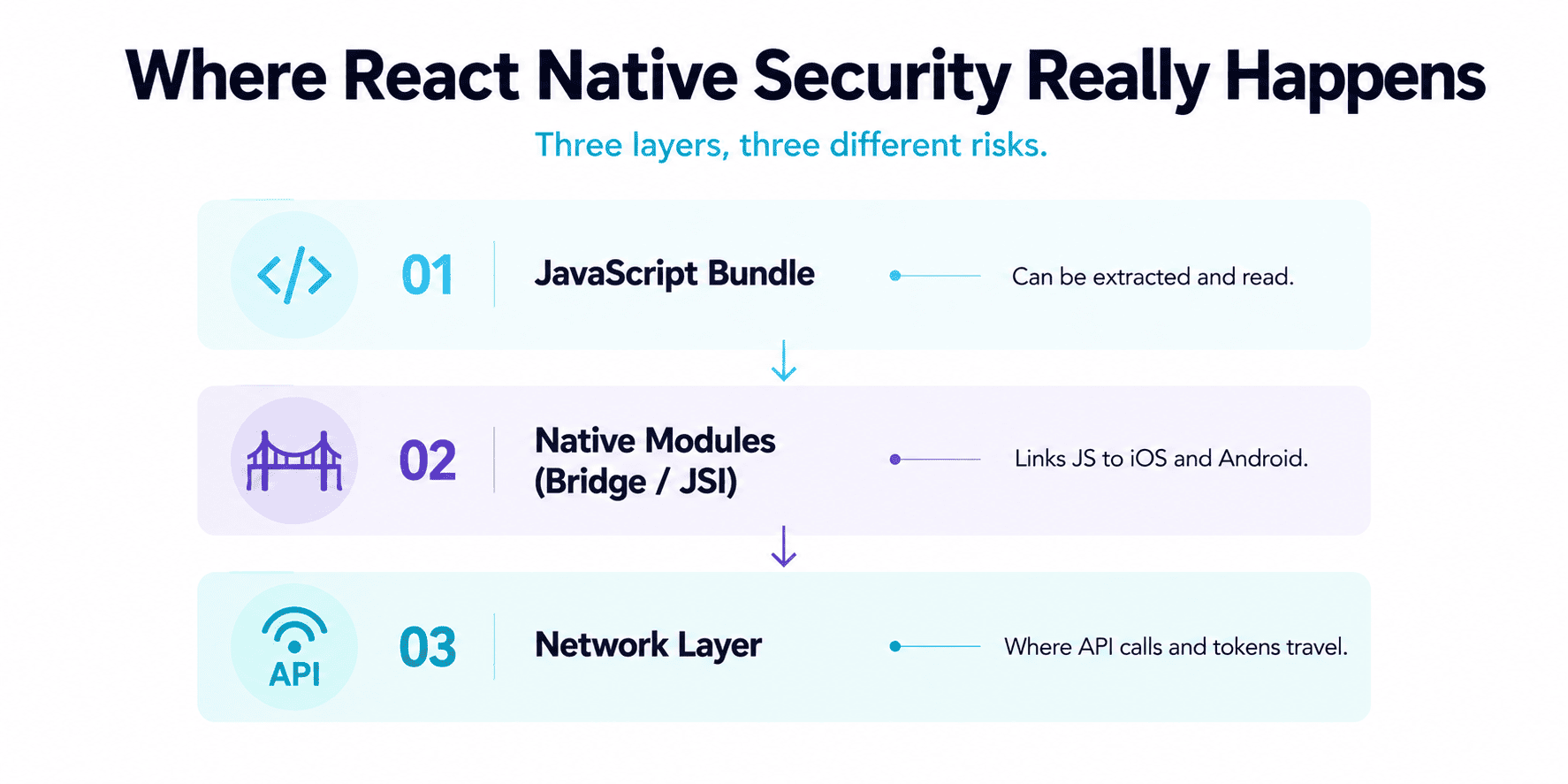
Diagram of the three layers of React Native security: JavaScript bundle, native modules, network


Common React Native Security Risks and Vulnerabilities

Before getting into best practices, it is worth naming the recurring risks that show up across React Native codebases. Building a secure React Native app starts with knowing what you are defending against:

  • Reverse engineering of the JavaScript bundle. Without protection, an attacker can extract and read an app's JS bundle, exposing business logic, hardcoded keys, and API endpoints.
  • Insecure local storage. Storing tokens, passwords, or personal data in plain, unencrypted storage is one of the most common React Native security issues found in audits.
  • Weak authentication and session handling. Missing multi-factor authentication, long-lived tokens, or predictable session identifiers all widen the door for account takeover.
  • Insecure API communication. Skipping certificate pinning or relying on plain HTTP instead of properly configured HTTPS leaves data exposed in transit.
  • Dependency and supply-chain risk. React Native apps often pull in dozens of npm packages, and one outdated or malicious dependency can introduce a React Native security vulnerability without a single line of your own code changing.

Each of these maps to a well-documented category in the OWASP Mobile Top 10, which this guide returns to shortly.


React Native Security Best Practices: A Complete Framework

Building a secure React Native app comes down to applying the following React Native security best practices consistently, not just at launch, but through every release. Whether you are evaluating a vendor's approach, or reviewing your own team's checklist for a fast-moving product (including teams exploring React Native for startups who still cannot afford to cut corners on security), these nine areas cover the full stack.

1. Secure Authentication and Authorization

Authentication is usually the first thing attackers probe. Use OAuth 2.0 with PKCE (Proof Key for Code Exchange) rather than the older implicit grant flow, which is no longer considered safe for mobile apps. Libraries like react-native-app-auth wrap the native AppAuth SDKs for iOS and Android and support PKCE out of the box.

Pair this with short-lived JWT access tokens, commonly around 15 minutes, and longer-lived refresh tokens that rotate on every use, so a leaked token has a limited window of usefulness. Add biometric authentication such as Face ID, Touch ID, or fingerprint as a second factor using react-native-biometrics or expo-local-authentication, and enforce role-based authorization on the server so a compromised client cannot simply request data it should not see.

2. React Native Secure Storage

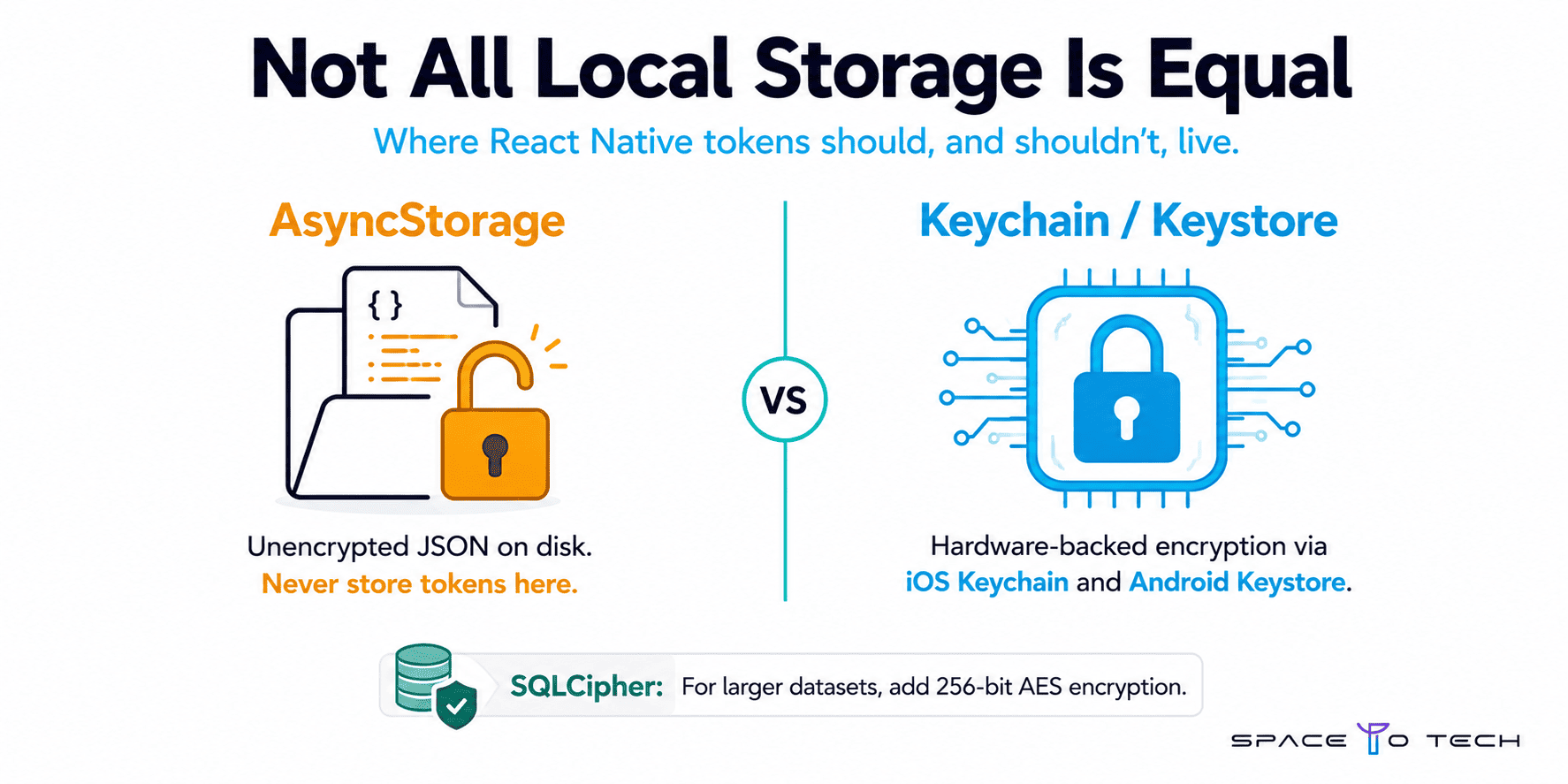
React Native secure storage is one of the most misunderstood areas of the framework. According to the official React Native documentation, Async Storage, the default key-value store bundled with most React Native apps, is unencrypted by design. It is fine for non-sensitive preferences, but it should never hold tokens, passwords, or personal data, a point worth trusting since it comes straight from the framework's own maintainers rather than a third-party blog.

For anything sensitive, use react-native-keychain or expo-secure-store, which write to the iOS Keychain and Android Keystore respectively, both hardware-backed and encrypted by the operating system. For larger datasets, such as an offline database, SQLCipher provides transparent 256-bit AES encryption. The rule of thumb: if losing this data would embarrass you or hurt a user, it does not belong in plain AsyncStorage.
Comparison of AsyncStorage vs Keychain and Keystore for React Native secure storage

3. Network and API Security

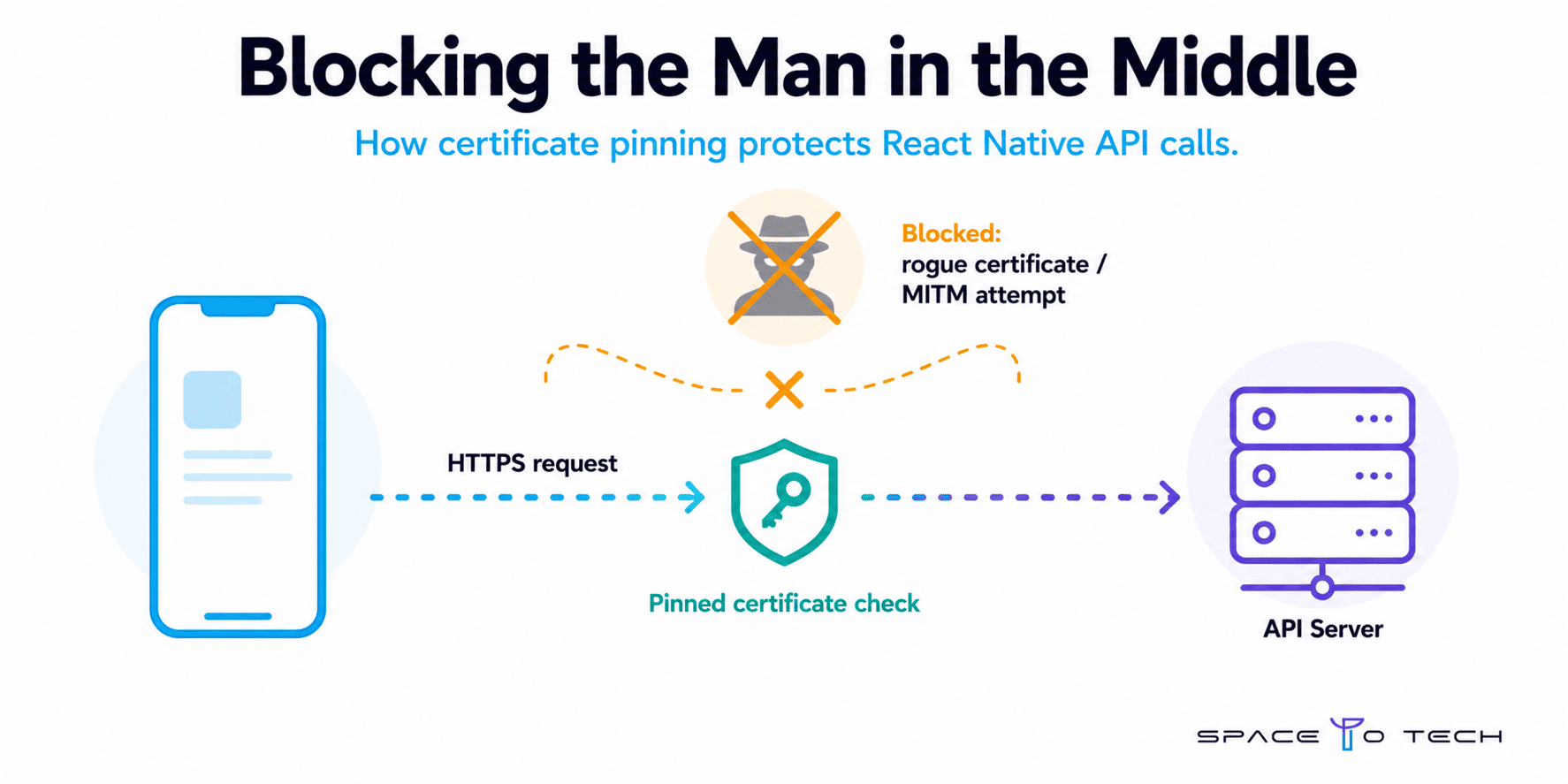
Every API call an app makes should run over HTTPS, but HTTPS alone is not enough. Certificate pinning, or better, public-key pinning using the SPKI hash, restricts an app to trust only its own server's certificate, so even if an attacker installs a rogue root certificate on a device, a pinned app refuses the connection.

Layer in API request signing, such as HMAC-SHA256 with a timestamp and nonce, to prevent replay attacks, and validate every API response against a schema on the client using a library like zod, so a compromised or spoofed API cannot quietly inject malicious data into the app.
How SSL certificate pinning blocks man-in-the-middle attacks in React Native

4. Code Protection Against Reverse Engineering

Because the JavaScript bundle can be extracted from any installed app, protecting it matters. Enable Hermes, React Native's JavaScript engine and the default since version 0.70, which compiles JS to bytecode rather than shipping plain, readable JavaScript. On Android, enable ProGuard or R8 to minify and obfuscate native Java and Kotlin code, and confirm Metro bundle minification is switched on for production builds.

For an extra layer, javascript-obfuscator can add string encryption and control-flow flattening to the bundle. None of this makes reverse engineering impossible, but it raises the cost and time required enough to deter casual attackers, and genuine secrets should still live on the server regardless of how well the client is obfuscated.

5. Root and Jailbreak Detection

A rooted Android device or a jailbroken iPhone gives an attacker, or sometimes the device owner, far more access to an app's storage and memory than the OS normally allows. Libraries such as react-native-jail-monkey can detect this state at runtime.

What you do with that information depends on the app's risk profile. A banking or healthcare app might block access entirely on a compromised device, while a lower-risk consumer app might simply show a warning or log the event for fraud analysis. There is a genuine UX tradeoff here, since some users root their devices for legitimate reasons, so it is worth defining a clear policy rather than defaulting to an outright ban.

6. Secure Deep Linking and WebView Handling

Deep links make navigation smoother, but they can also be intercepted or spoofed by another app registered for the same URL scheme, potentially exposing authentication tokens or routing a user to an unintended screen. Validate any data arriving through a deep link before acting on it, and avoid passing sensitive tokens directly in a link's query parameters.

If the app uses WebViews, treat them as untrusted by default. Restrict which domains they can load, disable JavaScript execution where it is not needed, and never inject app secrets into a WebView's context.

7. Third-Party Dependency and Supply-Chain Security

Most React Native apps depend on dozens, sometimes hundreds, of npm packages, and each one is a potential entry point. Use software composition analysis tooling to flag known vulnerabilities in the dependency tree, and review a package's maintenance history, community size, and how it handles sensitive data before adding it to a production app.

Keep dependencies patched on a regular cadence rather than letting them drift for months. A large share of real-world mobile security incidents trace back to a known, already-patched vulnerability in an outdated library rather than a novel attack technique.

8. Secure CI/CD and OTA Update Pipelines

Over-the-air updates through CodePush or EAS Update let a team ship JavaScript changes without a full app store review, which is convenient and also a serious attack surface if left unprotected. Only accept signed updates from your own backend or the official update endpoint, and verify the signature before applying anything.

Restrict who on the team can publish an update, use HTTPS and certificate pinning on the update endpoint itself, and keep an audit trail of every release. Treat the OTA pipeline as a privileged system, since an attacker who compromises it can push malicious code straight to the entire user base without ever going through app store review.

9. Session Management and Secure Logout

When a user logs out, make sure the app actually clears locally stored tokens and cached personal data rather than just hiding the login screen. If a device is later shared or resold without a factory reset, leftover session data can expose the previous user's account.

On Android specifically, be aware that the App Auto Backup feature can quietly back up app data to a user's Google Drive account, including data assumed to stay on-device. Either exclude sensitive files from backup or encrypt them, so a backup copy is never equivalent to a security hole.


React Native Security and the OWASP Mobile Top 10

There is no need to invent a security framework from scratch. The OWASP Mobile Top 10, maintained by the Open Web Application Security Project, a nonprofit whose lists are already used as a baseline by many enterprise security teams, gives a well-tested view of the most critical mobile risks. Mapping it to React Native makes it easier to see where each best practice above actually applies.

OWASP Mobile Top 10 risks mapped to React Native app security

OWASP Mobile Risk CategoryHow It Shows Up in React NativeCovered In
Improper Credential UsageHardcoded API keys or secrets in the JS bundle, weak token handlingSecure Authentication and Authorization
Insecure Data StorageSensitive data left unencrypted in AsyncStorageReact Native Secure Storage
Insufficient Transport Layer ProtectionMissing HTTPS/TLS or no certificate pinningNetwork and API Security
Insecure AuthenticationNo MFA, weak session handling, implicit OAuth grant misuseSecure Authentication and Authorization
Insufficient CryptographyWeak or custom encryption instead of platform-standard librariesReact Native Secure Storage
Client Code Quality and Code TamperingUnobfuscated JS bundle, no root or jailbreak detectionCode Protection Against Reverse Engineering
Insecure Data via Deep LinksDeep links exposing tokens or sensitive routesSecure Deep Linking and WebView Handling
Use of Components with Known VulnerabilitiesOutdated or unpatched npm dependenciesThird-Party Dependency and Supply-Chain Security


React Native Security Checklist

Use this React Native security checklist before any major release. It is designed to be shared with a team or turned directly into sprint tickets.
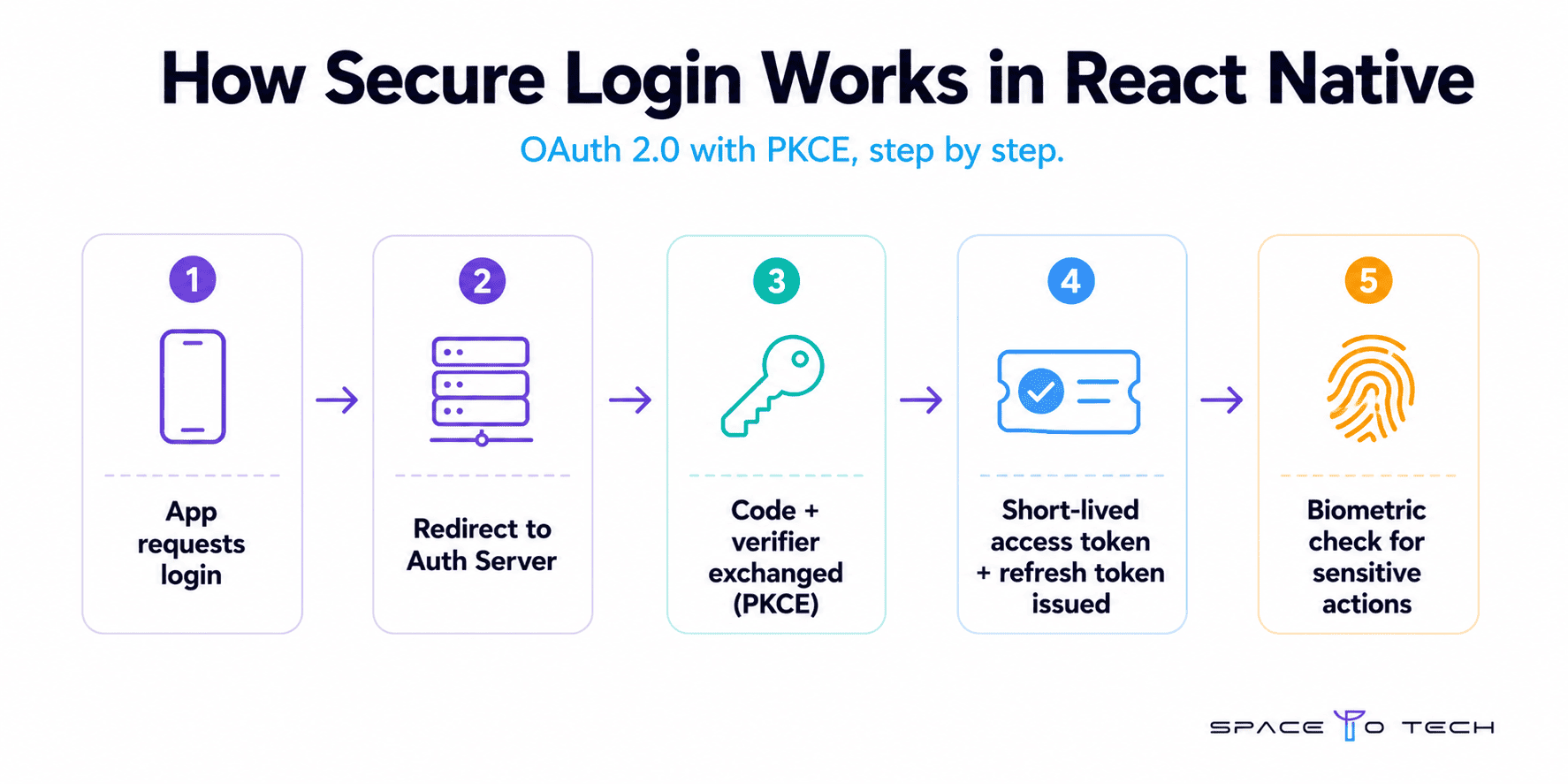
OAuth 2.0 and PKCE authentication flow diagram for React Native apps

  1. Store all tokens, passwords, and personal data in Keychain/Keystore, never in plain AsyncStorage.
  2. Enforce HTTPS everywhere and add certificate or public-key pinning on every API call.
  3. Use OAuth 2.0 with PKCE and short-lived, rotating JWT tokens.
  4. Add biometric authentication as a second factor for sensitive actions.
  5. Enable Hermes, ProGuard/R8, and Metro minification for every production build.
  6. Run root and jailbreak detection and define a clear response policy.
  7. Validate deep link data before acting on it, and sandbox WebViews to trusted domains only.
  8. Run software composition analysis on dependencies and patch on a fixed cadence.
  9. Sign and verify every OTA/CodePush or EAS update, and restrict who can publish.
  10. Clear local tokens and cached data on logout, and account for Android Auto Backup exposure.
  11. Map current coverage against the OWASP Mobile Top 10 before each major release.
  12. Schedule a penetration test at least annually, and after any payment or compliance-sensitive feature ships.


React Native Security Tools and Libraries at a Glance

A quick reference for the libraries mentioned throughout this guide, so you do not have to hunt back through each section.

Tool / LibraryWhat It SecuresPlatform
react-native-keychainEncrypted credential storage via iOS Keychain / Android KeystoreiOS + Android
expo-secure-storeEncrypted key-value storage for Expo-managed appsiOS + Android
react-native-app-authOAuth 2.0 + PKCE native authentication flowsiOS + Android
react-native-ssl-pinningCertificate/public-key pinning to block MITM attacksiOS + Android
react-native-jail-monkeyRoot and jailbreak / compromised-device detectioniOS + Android
javascript-obfuscatorJS bundle obfuscation (string encryption, control-flow flattening)Build-time, cross-platform
SQLCipher256-bit AES encryption for local SQLite databasesiOS + Android
Hermes (built-in)Compiles JS to bytecode, harder to decompile than plain JSDefault on RN 0.70+


Common React Native Security Mistakes to Avoid

  • Hardcoding API keys or secrets directly in the JavaScript source, where they can be extracted from the bundle.
  • Storing tokens or passwords in AsyncStorage without encryption.
  • Skipping SSL or certificate pinning because it feels like extra setup work.
  • Letting dependencies drift for months without checking for known vulnerabilities.
  • Failing to clear local data on logout, leaving the next user of a shared device exposed.
  • Relying on obfuscation alone instead of moving real secrets to the server.


How Often Should a React Native App Undergo a Security Audit?

Run automated dependency and static-analysis scans on a quarterly basis at minimum, since new vulnerabilities in existing packages are disclosed constantly. Schedule a full penetration test before any major release and at least once a year regardless of release cadence.

Outside that regular schedule, trigger an additional audit whenever the app adds a payment feature, takes on a new compliance requirement, or shortly after any security incident, even a minor one. Treating an audit as a one-time, pre-launch checkbox is one of the more common ways enterprise teams end up with an outdated security posture within a year of shipping.


Are React Native Apps Secure for Enterprise Use?

Yes, when the practices above are actually implemented and maintained. Security in React Native depends far more on implementation choices than on the framework itself. A well-secured React Native app, with encrypted storage, pinned network calls, hardened code, and a maintained dependency tree, holds up just as well as a comparable native app for most enterprise use cases.

Where React Native genuinely differs from native development is the shared codebase across iOS and Android, which means a security gap can propagate to both platforms at once, but also means a fix reaches both platforms at once too. For enterprise teams, the practical takeaway is to treat security as a release-gate requirement, not an afterthought, regardless of which framework sits underneath the app.


Final Thoughts

React Native security is not a single setting to switch on. It is a layered practice across storage, authentication, network calls, code protection, dependencies, and release pipelines, applied consistently from the first sprint through every update after launch. Teams that treat it this way build apps that hold up under real scrutiny, not just at launch, but a year and a dozen releases later.

If you are planning a new build or reviewing an existing app's security posture, our team can walk through this checklist against your specific codebase. Our engineers regularly hire and pair with React Native developers who bring this exact framework into client projects from day one, and it is part of how we approach every app we build as a mobile app development company.


Frequently Asked Questions

Are React Native apps secure?

React Native apps can be as secure as native apps when developers follow platform-standard practices for storage, network, and authentication. Security depends on implementation choices, not the framework itself.

What are the biggest security risks in React Native apps?

The most common risks are unencrypted local storage, missing SSL or certificate pinning, hardcoded API keys in the JS bundle, and outdated third-party dependencies. These map directly to the OWASP Mobile Top 10.

How can I secure sensitive data in React Native?

Store sensitive data in the iOS Keychain or Android Keystore using a library like react-native-keychain or expo-secure-store, never in plain AsyncStorage. For larger encrypted datasets, use SQLCipher.

Does React Native support biometric authentication?

Yes. Libraries such as react-native-biometrics or expo-local-authentication let apps use Face ID, Touch ID, or fingerprint as a second authentication factor tied to the device's secure enclave.

Is AsyncStorage secure for storing sensitive information?

No. AsyncStorage is an unencrypted key-value store, so sensitive data such as tokens or passwords should never be stored there in plain text. Use Keychain or Keystore-backed storage instead.

What is SSL pinning in React Native?

SSL or certificate pinning restricts an app to trust only a specific server certificate or public key, preventing man-in-the-middle attacks even if an attacker installs a rogue root certificate on the device.

How do I prevent reverse engineering in React Native apps?

Enable Hermes to compile JavaScript to bytecode, apply ProGuard or R8 on Android, minify the Metro bundle, and move real secrets to the backend rather than relying on obfuscation alone.

What are the OWASP security recommendations for React Native?

OWASP's Mobile Application Security Verification Standard and Mobile Top 10 provide the baseline checklist for credential handling, data storage, transport security, and code integrity that React Native teams should follow.

How often should a React Native app undergo a security audit?

Run automated dependency and static-analysis scans quarterly, and schedule a full penetration test before major releases or at least once a year, with additional audits after adding payment or compliance-sensitive features.

Is React Native suitable for enterprise applications?

Yes, when paired with proper authentication, encrypted storage, network protections, and regular audits. Many enterprises use React Native for customer-facing and internal apps once these controls are in place.

Related Blogs

How to Hire React Native Developers – complete guide for businesses covering hiring process, technical skills, developer costs, hiring models, and React Native app development in 2026.

How to Hire React Native Developers: A Complete Guide for Businesses in 2026

Hiring React Native developers has become one of the more consequential decisions a business makes before building a mobile product. It is not just a technical question. It affects your timeline, your budget, and whether the app you ship actually holds together six months after launch. React Native now pulls over 1.6 million weekly npm downloads as of 2026, which tells you the demand is real, but it also means the talent pool is uneven. Not every developer who lists React Native on a resume has shipped a production app that survived real user load. This guide covers everything you need to make that decision properly: what skills to look for when you hire React Native app developers, how the hiring process should actually work, what dedicated vs freelance looks like in practice, how much it costs by region, and why India has become the default sourcing option for global companies. If you are already exploring React Native app development services for your project, this will help you evaluate who you are working with. What Is a React Native Developer? A React Native developer builds mobile applications for both iOS and Android using JavaScript and React, from a single codebase. They handle UI components, state management, API integration, third-party integrations, and app store deployment. What separates a strong React Native developer from an average one in 2026 is familiarity with the New Architecture, specifically JSI (JavaScript Interface), Turbo Modules, and the Fabric renderer, which became the default in React Native 0.76, released in late 2024. If you want a fuller picture of what the framework can do and where it fits in the mobile development landscape, our complete React Native app development guide covers the architecture, use cases, and technical depth in detail. Why Businesses Choose React Native for Mobile App Development The core business case for React Native is straightforward. One codebase serves both iOS and Android, which means one team, one QA cycle, one deployment, and one maintenance overhead. For businesses managing cost and timeline, that structure changes the economics of mobile development in a meaningful way. Here is why companies across industries continue to choose it: A single development team covers both platforms, cutting team size by roughly half compared to separate native builds. Time to market is faster because features ship to both stores simultaneously, with no parallel sprint coordination between platform teams. React Native draws from the JavaScript talent pool, the largest developer community in the world, which makes hiring and replacement faster than native-only stacks. After the New Architecture, performance gaps between React Native and native apps are minimal for the vast majority of business use cases. It is backed by Meta and used in production by Shopify, Microsoft, Discord, and Bloomberg, which signals long-term viability. If you are still evaluating whether React Native fits your project or weighing it against another framework, our comparison of React Native vs Flutter breaks down the decision across cost, hiring, performance, and team composition. You can also read our analysis of React Native vs Native app development if you are deciding between cross-platform and fully native builds. When Should You Hire React Native Developers? The right time to hire React Native developers depends on what you are building and where you are in the product lifecycle. Here are the three scenarios where it makes the most sense. Startups Building Their First App Startups benefit the most from React Native because it compresses both cost and timeline at the stage when both matter most. A React Native team can ship an MVP to both iOS and Android in 3 to 5 months. A native approach for both platforms often runs 6 to 10 months. That difference is runway. If your product is pre-revenue and you need to validate the idea fast, React Native is the rational choice. Our guide on React Native for startups goes deeper on how the economics play out by funding stage. Enterprises Scaling Their Mobile Product Enterprise teams with existing React or JavaScript engineers can onboard React Native developers with less ramp-up time than a native hire would require. React Native also supports over-the-air updates, which means you can push fixes and feature changes without waiting for App Store review cycles, a meaningful operational advantage for large-scale products. The framework handles enterprise mobile apps reliably at significant scale, with Shopify as the most frequently cited production example. Businesses Maintaining an Existing App If you have a React Native app already in production and need to add features, improve performance, or integrate new services, a dedicated development team gives you consistent code quality over time. App maintenance gets messy when different freelancers have touched the codebase at different stages. A stable team with knowledge of your architecture avoids that problem. Skills to Look for When Hiring React Native Developers Most hiring mistakes happen here. Businesses write job descriptions asking for JavaScript experience and end up interviewing developers who have never shipped a production React Native app. Here is what actually matters. Core Technical Skills A solid React Native developer should have strong JavaScript ES6+ fundamentals and TypeScript discipline. TypeScript matters more than it used to because it prevents type-related bugs that compound fast in larger codebases and cross-team work. Beyond language, look for genuine React fluency: hooks, component lifecycle, clean state management using Redux or Zustand. These are not optional extras. They define whether a developer can write code your next hire can actually maintain. React Native Specific Knowledge Navigation (React Navigation), third-party integrations (payment gateways, push notifications, maps), and native modules are the practical workhorses of most React Native projects. In 2026, any developer worth hiring should also have a working understanding of the New Architecture. JSI replaced the old asynchronous bridge, Turbo Modules replaced legacy native modules, and Fabric replaced the old renderer. This is baseline knowledge now, not specialist depth. A developer who still builds primarily on the old bridge is accumulating technical debt on your behalf. Portfolio Review and Code Quality Ask to see apps on the App Store or Google Play that the developer actually shipped. Then check their GitHub. Look at how they structure components, whether they write tests, and how their commit history reads. A clean portfolio with verifiable links tells you more than four interview rounds. Generic claims like 'I have built 40 apps' without a single link you can open are a red flag. Code quality is not just a technical preference. It directly determines how expensive your app is to maintain over time. Communication Skills This matters especially for remote and offshore teams. A strong developer does not just answer your questions. They ask clarifying questions before committing to timelines. If someone says 'two weeks' without understanding the scope, that timeline is a guess, not a plan. Look for developers who push back constructively, flag scope risks early, and maintain a development workflow that keeps you informed without requiring you to chase them. Senior vs Mid-Level vs Junior React Native Developers Matching seniority to your project requirements is one of the most practical decisions in the hiring process. Overhiring for a simple app wastes budget. Underhiring for a complex integration creates technical debt that compounds over time. Level What They Handle Well  Avoid Assigning Them Junior (0-2 yrs) UI components, basic API calls, simple screen builds, bug fixes under guidance Architecture decisions, complex state, native module work Mid-Level (2-4 yrs) Feature development, API integration, code reviews, testing pipelines Sole ownership of large-scale architecture decisions Senior (4+ yrs) Architecture, New Architecture migration, native bridges, performance optimisation, technical leadership Pure UI work; it is a poor use of their bandwidth For most startup MVPs and mid-sized product builds, a combination of one senior React Native developer and one or two mid-level developers is the most cost-effective structure. The senior sets the architecture and reviews the work. The mid-levels build at speed. Freelance vs Dedicated React Native Developers When Freelance Works Freelance works for short, clearly scoped projects: a single feature addition, a bug audit, a one-time API integration. The engagement is fast to start and easy to end. The risk is continuity. If a post-launch issue hits and the freelancer is between projects or unavailable, you are stuck. Freelancers also have no institutional knowledge of your codebase, which means onboarding cost eats into the efficiency gain every time you bring someone new in. When a Dedicated Development Team Works Better For ongoing product development, a dedicated React Native developer or team is almost always the better structure. A dedicated developer is embedded in your workflow, understands your codebase, communicates within your sprint cycle, and brings continuity that a freelance rotation cannot provide. The outcome is consistent code quality, fewer surprises at launch, and a development workflow that improves over time rather than resetting with each new hire. This model is what SpaceToTech runs for its global clients: dedicated teams that work as a true extension of your product organisation, not rotating contractors. How to Hire React Native Developers: Step-by-Step Process Most hiring processes for React Native developers fail for the same reason: the job description is written before anyone has agreed on what the developer will actually build. Here is the process that consistently works. Step 1: Define Your Project Requirements Before Writing a Job Post Write down four things before you post anywhere: the exact mobile problem this hire solves (not 'build an app' but what the app must do), your timeline, the non-negotiable technical skills (Expo vs Bare React Native, specific integrations required), and the criteria you will use to evaluate success. If your CTO and your tech lead cannot agree on this document, they will disagree on every candidate you interview. Misaligned requirements at the start of the hiring process is the single biggest predictor of a failed hire. Step 2: Screen Candidates on Technical Depth Years of experience is a starting filter, not a measure of skill. Ask specific questions about recent work: What was the last app you shipped, and what was the hardest technical problem you solved on it? Have you worked with the New Architecture? How did you handle state management on a project with more than three developers? Candidates who answer in generalities have not solved those problems. Candidates who give specific, concrete answers probably have. Step 3: Run a Practical Technical Assessment Give candidates a 2 to 3 hour task that reflects real project work: integrate a third-party API, debug a state management issue, or build a small feature from a spec. Avoid algorithm puzzles and LeetCode-style problems. Application developers are not optimising search trees in production. What you want to see is how they approach a real problem, how they communicate when something is unclear, and what their code looks like when they are not performing for an interview. Step 4: Conduct a Structured Interview Prepare questions that test trade-off thinking, not definitions. 'What is JSI?' is not a useful interview question. 'Walk me through how you decided between Expo managed workflow and Bare React Native on your last project' tells you whether they have actually faced that decision. Ask how they handle a project where scope starts expanding. Ask what they would do differently on their most recent app. Open-ended, experience-based questions surface real capability faster than technical trivia. Step 5: Start with a Trial Period For dedicated or long-term engagements, a paid one-week trial task reduces risk for both sides. You evaluate code quality, communication style, and how they handle your existing codebase before committing to a full engagement. A developer who is reluctant to do a paid trial, when the task is fair and scoped, is worth noting. How Much Does It Cost to Hire React Native Developers? Development cost varies significantly based on where the developer is located, how senior they are, and which engagement model you use. Here is what businesses are paying in 2026: Region Hourly Rate (2026) Monthly Rate (Dedicated) USA / Canada $95 to $150+ per hour $15,000 to $25,000 per month Western Europe $60 to $120 per hour $9,000 to $16,000 per month Eastern Europe $30 to $80 per hour $5,000 to $10,000 per month India $15 to $45 per hour $1,500 to $4,500 per month Indian React Native developers typically cost 40 to 70 percent less than US-based counterparts. For a startup managing burn rate, that difference is not just a cost saving. It translates directly into additional development months at the same budget. A team that would cost $18,000 per month in the US often runs $4,000 to $5,000 per month when you hire dedicated React Native developers from India through a structured agency model. For a detailed breakdown of what different project types actually cost, our React Native app development cost guide for 2026 covers this by feature set, team size, and region. Common Mistakes to Avoid When Hiring React Native Developers Hiring based on years of experience instead of verifiable shipped work. A developer with 2 years and 5 live apps is often more capable than a developer with 6 years who has maintained the same legacy codebase throughout. Confusing React web developers with React Native mobile developers. The mental models are different. Web developers building for a browser and mobile developers handling device constraints, navigation paradigms, and app store deployment are not interchangeable, even if both use JavaScript. Writing a job description that asks for 'React Native experience' but actually requires New Architecture depth. That narrows the pool significantly and demands different compensation. Blending those two populations in your search is why offers keep getting rejected. Skipping the technical assessment because references were strong. References tell you what someone is like to work with. They do not tell you whether their code is maintainable. Run the task regardless. Treating offshore hiring as purely a cost play. The best India-based React Native teams deliver on quality and communication, not just price. Vet offshore candidates exactly as you would a local hire: same technical assessment, same structured interview. Why Hire React Native Developers in India? India has become the default sourcing market for React Native talent among global companies, and the reasons go well beyond cost. Depth of Talent Pool India is expected to have around 9.5 million tech professionals by FY 2026. React Native sits comfortably within that ecosystem because it builds on JavaScript and React, both of which have large, established Indian developer communities built over more than a decade. For any project size, sourcing React Native app developers in India is not a constraint. The pool is large enough to find specialists, not just generalists. Cost Efficiency Without Quality Compromise Indian React Native developers cost 40 to 70 percent below US market rates. The important distinction is that the better India-based agencies run their own multi-round technical vetting process before placing a developer on a client project. You are not getting cheaper talent. You are getting similarly skilled talent from a market with a lower cost of living. If you are evaluating how to structure this kind of engagement, our post on hiring software developers from India covers the vetting and onboarding process in detail. Overlap-Friendly Working Hours India Standard Time creates a usable overlap window with every major SpaceToTech client market. Morning standups work for US East Coast clients. Full-day overlap is available for GCC and Australia. UK teams share an afternoon window. Communication does not have to be asynchronous by default, which matters more than most buyers initially assume when they plan offshore work. In-House vs Remote React Native Developers In-house hiring gives you full-time availability, easier informal collaboration, and direct control over onboarding. The trade-off is cost: salary, benefits, equipment, and office overhead all add up. Senior React Native developer searches also take 6 to 8 weeks on average when sourcing independently, and that timeline extends when the role requires New Architecture depth. Remote React Native developers, particularly through a dedicated team model, give you specialised expertise faster and at a fraction of the cost. A pre-vetted agency can deliver first candidates in 48 to 72 hours. The trade-off is that onboarding remote teams requires intentional structure: documentation, async communication habits, and milestone-based delivery frameworks. When those are in place, the quality and velocity of remote dedicated teams is comparable to in-house, often better, because you are working with people who have done this specific kind of work many times before. Why Choose SpaceToTech for React Native Development? SpaceToTech is a mobile app development company that builds React Native apps for startups and enterprises across the US, UK, UAE, and Australia. The team works on the New Architecture by default, not as an optional add-on. Clients get a dedicated development structure: the same developers across the project lifecycle, milestone-based delivery, and direct access to the engineers building the product. Every engagement starts with a technical scoping call where we understand your project requirements, existing architecture, and delivery constraints. From there we propose the right team structure: a single dedicated developer for focused builds, or a full team for complex, multi-track product work. If you want to see what that looks like for your project, reach out through the React Native services page for a no-obligation discussion.

June 29, 2026

Read More..
React Native Architecture Explained — JSI, Fabric, TurboModules, and Hermes 2026 guide

React Native Architecture Explained: JSI, Fabric, TurboModules & the New Architecture (2026 Guide)

Most teams pick React Native for the obvious reason: one codebase, two platforms, faster shipping. Fewer teams stop to ask how the framework actually gets JavaScript to talk to native iOS and Android code underneath. That gap rarely matters until it does: a scroll that stutters, a cold start that feels heavier than it should, a third-party library that suddenly won't build. Almost every one of those problems traces back to architecture. This guide breaks down how React Native's engine actually works in 2026, from the original Bridge to the JSI-powered New Architecture that has now fully replaced it. If you're evaluating React Native for a build, hiring for one, or trying to understand why your app behaves the way it does, this is the layer worth understanding. For the bigger picture on planning and building a full React Native product. What Is React Native Architecture? React Native architecture describes how JavaScript code you write communicates with the native iOS and Android layers that actually render pixels on screen, access the camera, or read from device storage. Conceptually, there are three layers: your JavaScript code and React components, a communication layer that passes instructions and data across the JS/native boundary, and the native layer itself, made of platform APIs and UI components. How that middle layer works has changed dramatically since React Native launched in 2015. For a decade, it ran on something called the Bridge. As of 2026, the Bridge is gone entirely, replaced by a faster, synchronous system built on JSI. Understanding both versions, and why the switch happened, explains most of what makes a React Native app feel fast or feel sluggish. The Old Architecture: How the Bridge Worked (and Why It Broke Down) The original React Native architecture ran on three separate threads: a JavaScript thread running your React code, a native or UI thread responsible for actually drawing views, and a shadow thread that calculated layout. None of these threads could talk to each other directly. Instead, every instruction passed through the Bridge, an asynchronous, JSON-serializing message queue. Here's what happened, step by step, every time your code called setState(): React's reconciler diffed the virtual DOM on the JS thread, the UIManager generated a list of view mutations, those mutations were serialized into a JSON string, the JSON was posted to the async message queue, the native side deserialized it, the C++ shadow tree updated, Yoga calculated the flexbox layout, and finally the native view was drawn on screen. That's two full Bridge crossings just to update one piece of state. For simple apps, this was invisible. For anything complex, it wasn't. A long list scrolling meant hundreds of these round trips per second, each one paying the serialization cost again. Animations dropped frames because the JS thread couldn't guarantee when the native side would actually receive an update. There was no way to measure a native view's layout synchronously, which made certain interactions, like a text input that needs to know its own height mid-render, awkward or impossible to build cleanly. Component Old Architecture Communication Async Bridge, JSON serialization Native Modules Eagerly loaded at startup, even unused ones Renderer UIManager (asynchronous) Type Safety None enforced at the JS–native boundary Typical Failure Mode Serialization bottleneck, dropped frames on complex UI The Bridge worked well enough that companies like Shopify, Discord, and Microsoft Teams built serious production apps on it. But as those apps scaled, the Bridge's fundamental design became a ceiling the team couldn't build past. That's what the New Architecture was built to remove. The New Architecture: JSI, Fabric, TurboModules & Codegen The New Architecture replaces the Bridge with four connected pieces: JSI, Fabric, TurboModules, and Codegen. Together, they eliminate the async JSON bridge and let JavaScript and native code communicate directly. JSI (JavaScript Interface) JSI is the foundation everything else is built on. It's a lightweight C++ layer that lets JavaScript hold a direct reference to a native object, and vice versa. There's no JSON to serialize, no message queue to wait on, and no guessing when a message will arrive. A JS function can call a native method synchronously and get a result back immediately, the same way it would call any other JavaScript function. This single change is what unlocked everything that followed. Fabric Renderer & the Shadow Tree Fabric replaces the old UIManager as React Native's renderer. It's built directly on JSI, which means layout can now be measured synchronously instead of waiting on an async round trip. Fabric maintains the shadow tree in C++ rather than passing it back and forth across the Bridge, and Yoga still handles the actual flexbox layout math on top of it. Because Fabric is JSI-based, it also supports React 18 features like Suspense and transitions, and it enables automatic batching, which reduces unnecessary re-renders during rapid state updates. According to the official React Native architecture documentation , the New Architecture was built specifically to bring these concurrent rendering features to native apps. TurboModules TurboModules replace the old NativeModules system. Under the Bridge, every native module your app used, whether it was called on screen one or never at all, was loaded eagerly at app startup. TurboModules load lazily, only when JavaScript first references them. For an app with dozens of native integrations, that alone meaningfully cuts cold start time. Codegen & Type Safety Codegen reads TypeScript or Flow specification files and generates the native interface code, C++, Objective-C++, and Kotlin, automatically. If your native implementation returns the wrong type or drops a field the spec defines, the native build fails immediately instead of crashing in production weeks later. This moves an entire category of bugs from runtime to build time, something the old NativeModules system had no equivalent for. Hermes Engine Hermes is React Native's JavaScript engine, purpose-built for mobile. It compiles JavaScript to bytecode ahead of time rather than parsing and compiling on every app launch, which improves startup time and reduces memory usage. Under the New Architecture, Hermes isn't an optional performance toggle anymore. JSI depends on capabilities that only Hermes provides, which makes it a hard requirement rather than a recommendation. Dimension  Old Architecture (Bridge) New Architecture (JSI/Fabric) Communication Asynchronous, JSON-serialized Synchronous, direct C++ references Native Module Loading Eager, at startup Lazy, on first use via TurboModules Type Safety Runtime only Build-time, via Codegen Rendering UIManager, async layout Fabric, synchronous layout, Shadow Tree React 18 Features Not supported Fully supported Status in 2026 Removed as of RN 0.82 Default and only supported architecture The 2026 Update: The Legacy Bridge Is Now Fully Removed Most articles on this topic still describe the New Architecture as something React Native apps are “moving toward.” That's out of date. As of 2026, the transition is over. React Native 0.76, released in late 2024, made the New Architecture the default for new projects. React Native 0.81 and Expo SDK 54 were the last versions offering a legacy interop path for apps that hadn't migrated yet. Then React Native 0.82 removed the old Bridge entirely. Setting newArchEnabled=false in your build configuration is now simply ignored, there's no path back to the legacy system. More recently, React Native 0.86, released in June 2026, went a step further: every new project starts fully bridgeless by default, with the Strict TypeScript API generating types directly from source code via Codegen rather than hand-maintained type definitions. The practical implication is straightforward. Any team still running an app built before 0.82 is sitting on a hard upgrade ceiling, not a future decision. Any third-party library that hasn't migrated to support TurboModules and Fabric is now a genuine adoption risk, not a wait-and-see situation. If you're planning a new build or evaluating an existing codebase in 2026, the New Architecture isn't a checkbox anymore. It's simply what React Native is, which is also why it's worth working with a team that builds on it by default rather than treating it as a migration project. Our React Native app development services start from the New Architecture as the baseline, not the destination. How Data Moves Through the New Architecture It's worth tracing the same setState() call from earlier, this time through JSI and Fabric, to see the actual difference. Your JSX describes an element tree in JavaScript. That tree is passed through JSI directly, with no serialization step, to update the C++ shadow tree. Yoga calculates the resulting layout on that same shadow tree. Fabric then mounts or updates the real native views to match, and the frame is drawn. Compare that to the old flow: React reconciles, JSON is packed, the async queue delivers it, native deserializes, the shadow tree updates, Yoga runs, and only then does a view get drawn. The New Architecture removes two full serialization steps and the uncertainty of an async queue in between. That's the entire performance story in one comparison: fewer hops, no JSON, and layout that can be measured synchronously instead of guessed at. Nitro Modules: The Next Layer Beyond TurboModules Nitro Modules, introduced in 2025, push the same idea one step further than TurboModules. Where TurboModules still route through a defined native module interface, Nitro Modules generate near-zero-overhead JSI bindings directly, cutting out even more of the abstraction between JavaScript and native code. They're not yet the default the way Fabric and TurboModules are, but they're a strong signal of where the framework is heading: less abstraction, more direct native access, without giving up React Native's shared codebase model. Code-Level Architecture Patterns Runtime architecture is only half the picture. How you organize your own code matters just as much for a project's long-term health. Two patterns show up repeatedly in serious React Native codebases: Clean Architecture, which separates business logic from UI and framework code so your core logic doesn't depend on React Native itself, and Modular Architecture, which splits an app into self-contained feature modules that can be built, tested, and even reused independently. Both patterns become more valuable as a codebase grows past a handful of screens. This is genuinely a topic on its own. For a full breakdown of Clean Architecture, Modular Architecture, and MVVM patterns for React Native, see our complete React Native app development guide , which covers folder structure, dependency direction, and practical examples in depth. Why React Native Architecture Matters for Your Business None of this is only a developer's concern. Architecture decisions show up directly in three places founders and product leads care about. Hiring is the first. A candidate who genuinely understands JSI, Fabric, and TurboModules will make fewer costly mistakes on native module integration, debug performance issues faster, and won't be caught off guard by a library that dropped legacy support. Architecture literacy is a reasonable filter when hiring React Native developers who understand the New Architecture , not a nice-to-have. Cost and timeline are the second. Migrating an older codebase to the New Architecture, or auditing third-party dependencies before a new build starts, is real engineering work that affects your budget and your launch date. If you're scoping a project, it's worth understanding how architecture choices factor into React Native development cost before you commit to a timeline. Startup stage is the third. Early architecture decisions are cheap to get right and expensive to unwind later, especially once a product has real users and a rebuild means real downtime. This matters even more for React Native for startups , where a lean team rarely has the bandwidth to rearchitect a shipped product from scratch. React Native's Architecture vs Flutter's Rendering Model The architectural difference between React Native and Flutter is worth understanding on its own terms, separate from the broader framework debate. React Native, through Fabric, ultimately renders real native UI components, meaning a button is a genuine native button on each platform. Flutter takes a different approach entirely: it draws every pixel itself using the Skia rendering engine, bypassing native UI components altogether in favor of full control over rendering. Both approaches can be fast, but they solve the same problem in fundamentally different ways, and that shows up in platform look-and-feel, third-party native integration, and how each framework handles OS-level UI updates. For the full comparison across cost, hiring, and ecosystem maturity, see React Native vs Flutter . Does the New Architecture Close the Gap With Native Performance? JSI and Fabric have meaningfully narrowed the gap between React Native and fully native development. Synchronous native calls, lazy-loaded modules, and a renderer that doesn't wait on an async queue mean most consumer apps, from social feeds to e-commerce to booking flows, now perform indistinguishably from native equivalents. Where native still has a real edge is at the extremes: heavy real-time 3D rendering, advanced AR or VR workloads, and use cases that need the deepest possible hardware access. For most product categories, that ceiling simply doesn't come up. For a full breakdown of where each approach makes sense, see React Native vs native app development . Migrating to the New Architecture: What It Involves If you're on an older React Native version, migration starts with an audit, not a rewrite. Check every third-party native library your app depends on for New Architecture compatibility; most major libraries have already migrated, but some smaller or unmaintained packages haven't, and those are the ones that will block you. Hermes is now a requirement rather than a configuration choice, so confirm it's enabled. From there, most teams can expect the migration itself to take somewhere between two and eight weeks, depending mainly on how much custom native code the app has written directly against the old Bridge APIs. Apps that stayed close to standard libraries tend to move faster; apps with heavy custom native modules take longer. Why Choose SpaceToTech for React Native Architecture & Development Understanding JSI, Fabric, and TurboModules is one thing. Building and maintaining production apps on them, at scale, across markets, is another. Our team works on the New Architecture by default, not as a migration project, which means every app we build starts with the performance and type-safety benefits this guide covers baked in from day one. Whether you're planning a new React Native mobile app development project or auditing an existing app for migration, explore our React Native app development services to see how we approach architecture from the first sprint.

July 5, 2026

Read More..
React Native Migration Guide cover image showing migration from the legacy Bridge architecture to the new React Native Architecture with a direct high-speed connection illustration.

React Native Migration Guide: Upgrade to the New Architecture Step by Step

If you already have a React Native app in production, “React Native migration” probably means something different to you than it does to a team that has not touched React Native yet. This guide is about the second kind of migration: moving an existing React Native app from the old bridge-based architecture to the New Architecture, not rewriting a native iOS or Android app in React Native from scratch. If it is the framework decision itself you are still weighing, our React Native app development guide is the better starting point. Meta stopped investing in the old bridge starting with React Native 0.80, released in June 2025, which means every app still running on the legacy architecture is now on borrowed time. This guide walks through what the New Architecture actually changes, a readiness checklist, the migration steps in order, a realistic timeline, and the mistakes that trip up most teams, so you can plan the upgrade with a clear head instead of guessing your way through it. What Is React Native's New Architecture? The New Architecture is not one feature. It rebuilds four core parts of React Native: TurboModules, the new way native modules load; Fabric, the new renderer; a rebuilt event loop; and the removal of the old asynchronous bridge in favor of a direct JavaScript-to-native interface called JSI. For a full breakdown of how these pieces fit together, see our article on how React Native's architecture works under the hood . In practice, this shows up as faster app startup, fewer dropped frames during scrolling and animation, and fewer crashes caused by type mismatches between JavaScript and native code, since JSI checks types at the boundary instead of serializing everything into bridge messages first. The rest of this guide is narrower and more practical: how to move an existing app from the old architecture to this one without breaking production along the way. Should You Migrate Now? According to React Native's official engineering blog, the New Architecture became the default for every new app starting with React Native 0.76, released in October 2024. That alone would make migration worth planning. What pushes it closer to necessary is what happened afterward: Meta's 0.80 release in June 2025 froze further investment in the legacy architecture, so bug fixes, performance work, and new features stopped going into the old bridge. If you are also reconsidering whether React Native is still the right framework for your app, that is a separate decision with its own tradeoffs, not something to fold into an architecture upgrade. Our comparisons on React Native vs Flutter and React Native vs a fully native rebuild are better starting points for that question. This guide assumes you are staying on React Native and simply need to move off the old bridge. Scenario Recommendation New app / greenfield project Start directly on the New Architecture. There is no good reason to build new on the legacy bridge. Running RN 0.81 or earlier Plan the upgrade soon. Legacy architecture investment stopped from 0.80 onward. Already on RN 0.82+ You are likely already on the New Architecture by default. Audit for full library compatibility. Large app with many custom native modules Run a compatibility audit before committing to a migration timeline. React Native Migration Timeline A few version numbers explain most of the urgency in this guide. Here is how the New Architecture rollout has actually progressed: Version Milestone 0.76 (Oct 2024) New Architecture enabled by default for new apps, with an interop layer for backward compatibility. 0.80 (Jun 2025) Legacy architecture officially frozen. No further feature investment on the old bridge. 0.82 (Oct 2025) Framework described by the React Native team as a new era for the platform. 0.86 (current, Jun 2026) Latest stable release, and the baseline version referenced throughout this guide. Migration Readiness Checklist Before you touch a single config file, confirm where you actually stand on each of these: Current React Native version Expo SDK version, if you are on Expo Third-party library compatibility, checked against reactnative.directory Custom Native Modules inventory Custom Native Components inventory Android build configuration (Gradle, NDK) iOS build configuration (CocoaPods, Xcodebuild) CI/CD pipeline compatibility Crash reporting and analytics SDK compatibility Most teams assume app size predicts how hard this will be. It does not. Library and native module compatibility predicts it. A small app with two unmaintained native modules can take longer than a mid-size app built entirely on popular, well-maintained libraries. How to Migrate Step by Step Step 1: Update Your React Native Version Start by checking exactly what changes between your current version and the one you are targeting, file by file, rather than upgrading blind. While this guide focuses on migration planning, compatibility checks, and implementation best practices, always cross-check version-specific commands and breaking changes against the official React Native upgrade documentation before touching a production app. Step 2: Enable the New Architecture On Android, this is a flag in gradle.properties: newArchEnabled=true On iOS, install pods with the New Architecture flag set: RCT_NEW_ARCH_ENABLED=1 bundle exec pod install Do this on a branch, not on main. The next few steps are where most of the actual work happens. Step 3: Update Dependencies Cross-check every third-party library your app actually uses against reactnative.directory before upgrading. Flag anything that still relies on the legacy bridge only and has no New Architecture support planned. This step, more than any other, determines your real timeline. Step 4: Run Codegen Codegen generates the type-safe native interface code from your JavaScript specs, which is what lets JSI catch type mismatches at the boundary instead of at runtime. You do not need to hand-write this layer. Run it, review the generated output for anything unexpected, and commit it alongside your code. Step 5: Migrate Native Modules and Native Components This is usually the slowest step, and the one where outside help pays off fastest if your team has not done a TurboModules migration before. If you need extra hands for this part specifically, it is worth talking to a team that has done this migration before rather than learning the TurboModule spec under a deadline. Our page on how to hire React Native developers walks through what to look for. Step 6: Test Android and iOS Separately New Architecture bugs surface differently per platform. Do not treat a passing Android build as a signal that iOS is fine, or the other way around. Run your full test suite on both, and manually test any screen that uses a custom native module or component. Step 7: Validate Performance Before you call the migration done, benchmark three things against your pre-migration baseline: cold start time, frame drops during list scrolling, and memory usage under normal use. If any of these got worse, it usually traces back to a library still running through the interop layer instead of natively on Fabric. Common Migration Issues Issue Cause Solution App crashes on startup after enabling the New Architecture A dependency still assumes the legacy bridge only Check the library on reactnative.directory; update it or fall back to the interop layer temporarily  Custom Native Module not found Module was never migrated to the TurboModule spec Follow the official Native Modules migration guide and regenerate with Codegen Build fails on iOS after pod install CocoaPods cache or Podfile.lock mismatch Clean Pods and derived data, then reinstall with RCT_NEW_ARCH_ENABLED=1 Custom component not rendering correctly Known limitation of the interop layer for that component type Migrate the component to a Fabric Native Component directly Migration Risk Assessment How risky your migration is depends far more on your native code footprint than on your app's feature count. If you are running a newer product with a small codebase, this whole process tends to be short; our notes on React Native for early-stage products cover why lean teams often have the easiest path here. Risk Level Typical Profile Low Small app, few or no custom native modules, mostly popular, well-maintained libraries Medium Mid-size app, a handful of custom native modules, some libraries still migrating High Enterprise app, heavy custom native code, legacy dependencies with little or no maintenance Time Estimation These ranges assume a compatibility audit has already happened. If it has not, add time for that first. For a fuller picture of what a migration or upgrade project typically costs alongside developer time, see our breakdown of React Native app development cost . App Size Typical Timeline Small app 2 to 4 days Medium app 1 to 2 weeks Enterprise app 4 to 8 weeks Rollback Plan Very few migration guides mention this, which is exactly why it gets skipped and then regretted. Keep the legacy architecture flag reachable during a transition window instead of deleting it the moment you flip to the new one. Roll the change out behind a staged release rather than to every user at once, and watch crash rates and performance metrics closely before you commit fully. If something regresses, you want a flag to flip back, not a git revert under pressure. Post-Migration Checklist Android build verified on real devices, not just emulator iOS build verified on real devices, not just simulator CI pipeline updated for the New Architecture build flags Crash reporting confirmed working under the new setup Performance benchmarks compared against your pre-migration baseline Analytics events verified end to end Final Thoughts The New Architecture migration is rarely about difficulty. It is about sequencing: audit first, update dependencies before you flip the flag, and test both platforms separately instead of assuming a green Android build means iOS is fine too. Teams that treat this as a one-afternoon flag change are usually the ones who end up rolling it back. If you would rather hand this off to a team that has already run this migration on production apps, SpaceToTech's custom React Native app development services can take it from audit through to a validated release.

July 7, 2026

Read More..

Get a Callback