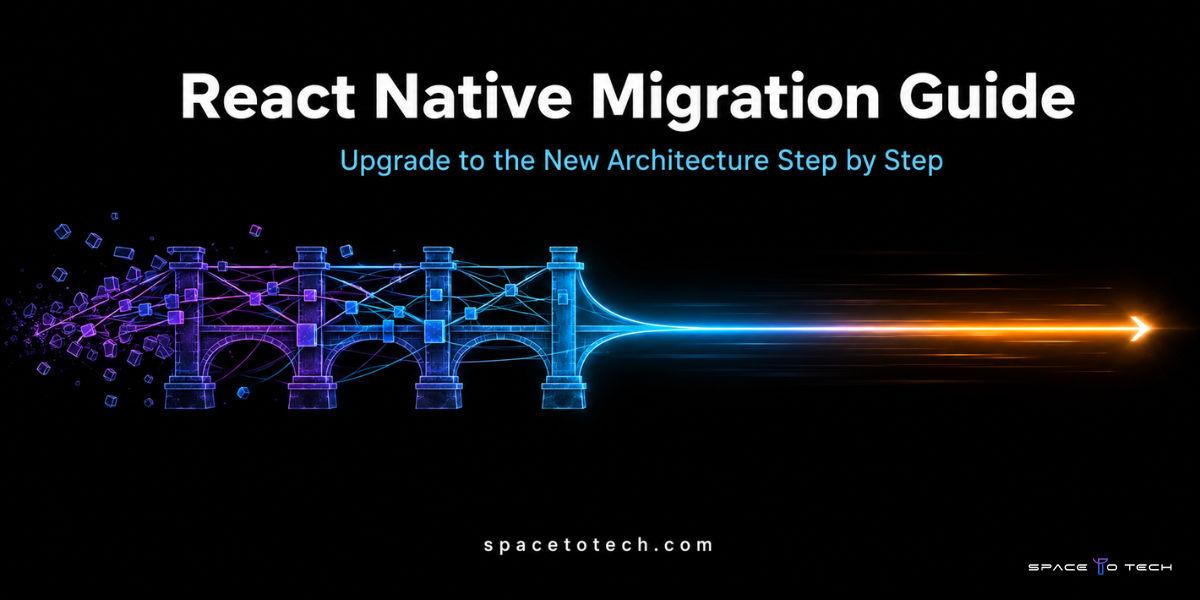
React Native Migration Guide cover image showing migration from the legacy Bridge architecture to the new React Native Architecture with a direct high-speed connection illustration.

React Native Migration Guide: Upgrade to the New Architecture Step by Step

July 7, 2026

Table of Contents

  • The old bridge is being phased out, not just upgraded around. Meta froze further investment in the legacy architecture starting with React Native 0.80 (June 2025), so staying on it is no longer a neutral choice.
  • The New Architecture is four changes, not one. TurboModules, the Fabric renderer, a rebuilt event loop, and JSI replacing the async bridge together deliver faster startup, smoother scrolling, and fewer cross-language crashes.
  • Library compatibility decides your timeline, not app size. A small app with a couple of unmaintained native modules can take longer than a mid-size app built on well-supported libraries.
  • Migration typically takes 2 days to 8 weeks depending on app complexity: small apps in days, mid-size apps in one to two weeks, enterprise apps in four to eight weeks.
  • Always keep a rollback path. A staged rollout with the legacy flag still reachable lets you revert fast if crash rates or performance regress, instead of relying on a git revert under pressure.
  • RN 0.86 is the current stable baseline (as of writing), but the framework ships close to monthly, so version numbers in this piece should be reconfirmed against the official React Native blog before publishing.

If you already have a React Native app in production, “React Native migration” probably means something different to you than it does to a team that has not touched React Native yet. This guide is about the second kind of migration: moving an existing React Native app from the old bridge-based architecture to the New Architecture, not rewriting a native iOS or Android app in React Native from scratch. If it is the framework decision itself you are still weighing, our React Native app development guide is the better starting point.

Meta stopped investing in the old bridge starting with React Native 0.80, released in June 2025, which means every app still running on the legacy architecture is now on borrowed time. This guide walks through what the New Architecture actually changes, a readiness checklist, the migration steps in order, a realistic timeline, and the mistakes that trip up most teams, so you can plan the upgrade with a clear head instead of guessing your way through it.


What Is React Native's New Architecture?

The New Architecture is not one feature. It rebuilds four core parts of React Native: TurboModules, the new way native modules load; Fabric, the new renderer; a rebuilt event loop; and the removal of the old asynchronous bridge in favor of a direct JavaScript-to-native interface called JSI. For a full breakdown of how these pieces fit together, see our article on how React Native's architecture works under the hood.

In practice, this shows up as faster app startup, fewer dropped frames during scrolling and animation, and fewer crashes caused by type mismatches between JavaScript and native code, since JSI checks types at the boundary instead of serializing everything into bridge messages first. The rest of this guide is narrower and more practical: how to move an existing app from the old architecture to this one without breaking production along the way.


Should You Migrate Now?

According to React Native's official engineering blog, the New Architecture became the default for every new app starting with React Native 0.76, released in October 2024. That alone would make migration worth planning. What pushes it closer to necessary is what happened afterward: Meta's 0.80 release in June 2025 froze further investment in the legacy architecture, so bug fixes, performance work, and new features stopped going into the old bridge.

If you are also reconsidering whether React Native is still the right framework for your app, that is a separate decision with its own tradeoffs, not something to fold into an architecture upgrade. Our comparisons on React Native vs Flutter and React Native vs a fully native rebuild are better starting points for that question. This guide assumes you are staying on React Native and simply need to move off the old bridge.

ScenarioRecommendation
New app / greenfield projectStart directly on the New Architecture. There is no good reason to build new on the legacy bridge.
Running RN 0.81 or earlierPlan the upgrade soon. Legacy architecture investment stopped from 0.80 onward.
Already on RN 0.82+You are likely already on the New Architecture by default. Audit for full library compatibility.
Large app with many custom native modulesRun a compatibility audit before committing to a migration timeline.


React Native Migration Timeline

A few version numbers explain most of the urgency in this guide. Here is how the New Architecture rollout has actually progressed:

VersionMilestone
0.76 (Oct 2024)New Architecture enabled by default for new apps, with an interop layer for backward compatibility.
0.80 (Jun 2025)Legacy architecture officially frozen. No further feature investment on the old bridge.
0.82 (Oct 2025)Framework described by the React Native team as a new era for the platform.
0.86 (current, Jun 2026)Latest stable release, and the baseline version referenced throughout this guide.


Migration Readiness Checklist

Before you touch a single config file, confirm where you actually stand on each of these:

  • Current React Native version
  • Expo SDK version, if you are on Expo
  • Third-party library compatibility, checked against reactnative.directory
  • Custom Native Modules inventory
  • Custom Native Components inventory
  • Android build configuration (Gradle, NDK)
  • iOS build configuration (CocoaPods, Xcodebuild)
  • CI/CD pipeline compatibility
  • Crash reporting and analytics SDK compatibility

Most teams assume app size predicts how hard this will be. It does not. Library and native module compatibility predicts it. A small app with two unmaintained native modules can take longer than a mid-size app built entirely on popular, well-maintained libraries.


How to Migrate Step by Step

Step 1: Update Your React Native Version

Start by checking exactly what changes between your current version and the one you are targeting, file by file, rather than upgrading blind. While this guide focuses on migration planning, compatibility checks, and implementation best practices, always cross-check version-specific commands and breaking changes against the official React Native upgrade documentation before touching a production app.

Step 2: Enable the New Architecture

On Android, this is a flag in gradle.properties:

newArchEnabled=true

On iOS, install pods with the New Architecture flag set:

RCT_NEW_ARCH_ENABLED=1 bundle exec pod install

Do this on a branch, not on main. The next few steps are where most of the actual work happens.

Step 3: Update Dependencies

Cross-check every third-party library your app actually uses against reactnative.directory before upgrading. Flag anything that still relies on the legacy bridge only and has no New Architecture support planned. This step, more than any other, determines your real timeline.

Step 4: Run Codegen

Codegen generates the type-safe native interface code from your JavaScript specs, which is what lets JSI catch type mismatches at the boundary instead of at runtime. You do not need to hand-write this layer. Run it, review the generated output for anything unexpected, and commit it alongside your code.

Step 5: Migrate Native Modules and Native Components

This is usually the slowest step, and the one where outside help pays off fastest if your team has not done a TurboModules migration before. If you need extra hands for this part specifically, it is worth talking to a team that has done this migration before rather than learning the TurboModule spec under a deadline. Our page on how to hire React Native developers walks through what to look for.

Step 6: Test Android and iOS Separately

New Architecture bugs surface differently per platform. Do not treat a passing Android build as a signal that iOS is fine, or the other way around. Run your full test suite on both, and manually test any screen that uses a custom native module or component.

Step 7: Validate Performance

Before you call the migration done, benchmark three things against your pre-migration baseline: cold start time, frame drops during list scrolling, and memory usage under normal use. If any of these got worse, it usually traces back to a library still running through the interop layer instead of natively on Fabric.


Common Migration Issues

IssueCauseSolution
App crashes on startup after enabling the New ArchitectureA dependency still assumes the legacy bridge onlyCheck the library on reactnative.directory; update it or fall back to the interop layer temporarily 
Custom Native Module not foundModule was never migrated to the TurboModule specFollow the official Native Modules migration guide and regenerate with Codegen
Build fails on iOS after pod installCocoaPods cache or Podfile.lock mismatchClean Pods and derived data, then reinstall with RCT_NEW_ARCH_ENABLED=1
Custom component not rendering correctlyKnown limitation of the interop layer for that component typeMigrate the component to a Fabric Native Component directly


Migration Risk Assessment

How risky your migration is depends far more on your native code footprint than on your app's feature count. If you are running a newer product with a small codebase, this whole process tends to be short; our notes on React Native for early-stage products cover why lean teams often have the easiest path here.

Risk LevelTypical Profile
LowSmall app, few or no custom native modules, mostly popular, well-maintained libraries
MediumMid-size app, a handful of custom native modules, some libraries still migrating
HighEnterprise app, heavy custom native code, legacy dependencies with little or no maintenance


Time Estimation

These ranges assume a compatibility audit has already happened. If it has not, add time for that first. For a fuller picture of what a migration or upgrade project typically costs alongside developer time, see our breakdown of React Native app development cost.

App SizeTypical Timeline
Small app2 to 4 days
Medium app1 to 2 weeks
Enterprise app4 to 8 weeks


Rollback Plan

Very few migration guides mention this, which is exactly why it gets skipped and then regretted. Keep the legacy architecture flag reachable during a transition window instead of deleting it the moment you flip to the new one. Roll the change out behind a staged release rather than to every user at once, and watch crash rates and performance metrics closely before you commit fully. If something regresses, you want a flag to flip back, not a git revert under pressure.


Post-Migration Checklist

  • Android build verified on real devices, not just emulator
  • iOS build verified on real devices, not just simulator
  • CI pipeline updated for the New Architecture build flags
  • Crash reporting confirmed working under the new setup
  • Performance benchmarks compared against your pre-migration baseline
  • Analytics events verified end to end


Final Thoughts

The New Architecture migration is rarely about difficulty. It is about sequencing: audit first, update dependencies before you flip the flag, and test both platforms separately instead of assuming a green Android build means iOS is fine too. Teams that treat this as a one-afternoon flag change are usually the ones who end up rolling it back. If you would rather hand this off to a team that has already run this migration on production apps, SpaceToTech's custom React Native app development services can take it from audit through to a validated release.


Frequently Asked Questions

What is the React Native New Architecture?

It is a rebuild of four parts of React Native: TurboModules, the Fabric renderer, a rebuilt event loop, and JSI, which replaces the old asynchronous bridge with a direct JavaScript-to-native interface. It became the default for new apps in React Native 0.76.

Is the React Native legacy architecture deprecated?

It has not been formally removed, but Meta froze further investment in it starting with React Native 0.80 in June 2025. In practice, that means no new features or performance work on the old bridge going forward.

How long does a React Native migration take?

Small apps typically take 2 to 4 days, mid-size apps 1 to 2 weeks, and enterprise apps 4 to 8 weeks. Library and native module compatibility affect the timeline more than app size does.

Do I need to migrate every third-party library before upgrading?

No. The interop layer covers many libraries temporarily. What matters is verifying every library your app actually uses in production, not chasing full ecosystem-wide compatibility.

Can I roll back after enabling the New Architecture?

Yes, if you plan for it. Keep the legacy flag reachable during a staged rollout instead of removing it immediately, so you can revert quickly if crash rates or performance regress.

What is the difference between migrating native to React Native and migrating to the New Architecture?

They are unrelated projects. Migrating native to React Native means rewriting a Swift, Kotlin, or Objective-C app in React Native. Migrating to the New Architecture means upgrading an existing React Native app off the old bridge. This guide covers the second.

Which React Native version should I upgrade to in 2026?

React Native 0.86 is the current stable release as of this writing. Confirm the latest version against the official React Native blog before starting, since the framework ships close to monthly.

Related Blogs

How to Hire React Native Developers – complete guide for businesses covering hiring process, technical skills, developer costs, hiring models, and React Native app development in 2026.

How to Hire React Native Developers: A Complete Guide for Businesses in 2026

Hiring React Native developers has become one of the more consequential decisions a business makes before building a mobile product. It is not just a technical question. It affects your timeline, your budget, and whether the app you ship actually holds together six months after launch. React Native now pulls over 1.6 million weekly npm downloads as of 2026, which tells you the demand is real, but it also means the talent pool is uneven. Not every developer who lists React Native on a resume has shipped a production app that survived real user load. This guide covers everything you need to make that decision properly: what skills to look for when you hire React Native app developers, how the hiring process should actually work, what dedicated vs freelance looks like in practice, how much it costs by region, and why India has become the default sourcing option for global companies. If you are already exploring React Native app development services for your project, this will help you evaluate who you are working with. What Is a React Native Developer? A React Native developer builds mobile applications for both iOS and Android using JavaScript and React, from a single codebase. They handle UI components, state management, API integration, third-party integrations, and app store deployment. What separates a strong React Native developer from an average one in 2026 is familiarity with the New Architecture, specifically JSI (JavaScript Interface), Turbo Modules, and the Fabric renderer, which became the default in React Native 0.76, released in late 2024. If you want a fuller picture of what the framework can do and where it fits in the mobile development landscape, our complete React Native app development guide covers the architecture, use cases, and technical depth in detail. Why Businesses Choose React Native for Mobile App Development The core business case for React Native is straightforward. One codebase serves both iOS and Android, which means one team, one QA cycle, one deployment, and one maintenance overhead. For businesses managing cost and timeline, that structure changes the economics of mobile development in a meaningful way. Here is why companies across industries continue to choose it: A single development team covers both platforms, cutting team size by roughly half compared to separate native builds. Time to market is faster because features ship to both stores simultaneously, with no parallel sprint coordination between platform teams. React Native draws from the JavaScript talent pool, the largest developer community in the world, which makes hiring and replacement faster than native-only stacks. After the New Architecture, performance gaps between React Native and native apps are minimal for the vast majority of business use cases. It is backed by Meta and used in production by Shopify, Microsoft, Discord, and Bloomberg, which signals long-term viability. If you are still evaluating whether React Native fits your project or weighing it against another framework, our comparison of React Native vs Flutter breaks down the decision across cost, hiring, performance, and team composition. You can also read our analysis of React Native vs Native app development if you are deciding between cross-platform and fully native builds. When Should You Hire React Native Developers? The right time to hire React Native developers depends on what you are building and where you are in the product lifecycle. Here are the three scenarios where it makes the most sense. Startups Building Their First App Startups benefit the most from React Native because it compresses both cost and timeline at the stage when both matter most. A React Native team can ship an MVP to both iOS and Android in 3 to 5 months. A native approach for both platforms often runs 6 to 10 months. That difference is runway. If your product is pre-revenue and you need to validate the idea fast, React Native is the rational choice. Our guide on React Native for startups goes deeper on how the economics play out by funding stage. Enterprises Scaling Their Mobile Product Enterprise teams with existing React or JavaScript engineers can onboard React Native developers with less ramp-up time than a native hire would require. React Native also supports over-the-air updates, which means you can push fixes and feature changes without waiting for App Store review cycles, a meaningful operational advantage for large-scale products. The framework handles enterprise mobile apps reliably at significant scale, with Shopify as the most frequently cited production example. Businesses Maintaining an Existing App If you have a React Native app already in production and need to add features, improve performance, or integrate new services, a dedicated development team gives you consistent code quality over time. App maintenance gets messy when different freelancers have touched the codebase at different stages. A stable team with knowledge of your architecture avoids that problem. Skills to Look for When Hiring React Native Developers Most hiring mistakes happen here. Businesses write job descriptions asking for JavaScript experience and end up interviewing developers who have never shipped a production React Native app. Here is what actually matters. Core Technical Skills A solid React Native developer should have strong JavaScript ES6+ fundamentals and TypeScript discipline. TypeScript matters more than it used to because it prevents type-related bugs that compound fast in larger codebases and cross-team work. Beyond language, look for genuine React fluency: hooks, component lifecycle, clean state management using Redux or Zustand. These are not optional extras. They define whether a developer can write code your next hire can actually maintain. React Native Specific Knowledge Navigation (React Navigation), third-party integrations (payment gateways, push notifications, maps), and native modules are the practical workhorses of most React Native projects. In 2026, any developer worth hiring should also have a working understanding of the New Architecture. JSI replaced the old asynchronous bridge, Turbo Modules replaced legacy native modules, and Fabric replaced the old renderer. This is baseline knowledge now, not specialist depth. A developer who still builds primarily on the old bridge is accumulating technical debt on your behalf. Portfolio Review and Code Quality Ask to see apps on the App Store or Google Play that the developer actually shipped. Then check their GitHub. Look at how they structure components, whether they write tests, and how their commit history reads. A clean portfolio with verifiable links tells you more than four interview rounds. Generic claims like 'I have built 40 apps' without a single link you can open are a red flag. Code quality is not just a technical preference. It directly determines how expensive your app is to maintain over time. Communication Skills This matters especially for remote and offshore teams. A strong developer does not just answer your questions. They ask clarifying questions before committing to timelines. If someone says 'two weeks' without understanding the scope, that timeline is a guess, not a plan. Look for developers who push back constructively, flag scope risks early, and maintain a development workflow that keeps you informed without requiring you to chase them. Senior vs Mid-Level vs Junior React Native Developers Matching seniority to your project requirements is one of the most practical decisions in the hiring process. Overhiring for a simple app wastes budget. Underhiring for a complex integration creates technical debt that compounds over time. Level What They Handle Well  Avoid Assigning Them Junior (0-2 yrs) UI components, basic API calls, simple screen builds, bug fixes under guidance Architecture decisions, complex state, native module work Mid-Level (2-4 yrs) Feature development, API integration, code reviews, testing pipelines Sole ownership of large-scale architecture decisions Senior (4+ yrs) Architecture, New Architecture migration, native bridges, performance optimisation, technical leadership Pure UI work; it is a poor use of their bandwidth For most startup MVPs and mid-sized product builds, a combination of one senior React Native developer and one or two mid-level developers is the most cost-effective structure. The senior sets the architecture and reviews the work. The mid-levels build at speed. Freelance vs Dedicated React Native Developers When Freelance Works Freelance works for short, clearly scoped projects: a single feature addition, a bug audit, a one-time API integration. The engagement is fast to start and easy to end. The risk is continuity. If a post-launch issue hits and the freelancer is between projects or unavailable, you are stuck. Freelancers also have no institutional knowledge of your codebase, which means onboarding cost eats into the efficiency gain every time you bring someone new in. When a Dedicated Development Team Works Better For ongoing product development, a dedicated React Native developer or team is almost always the better structure. A dedicated developer is embedded in your workflow, understands your codebase, communicates within your sprint cycle, and brings continuity that a freelance rotation cannot provide. The outcome is consistent code quality, fewer surprises at launch, and a development workflow that improves over time rather than resetting with each new hire. This model is what SpaceToTech runs for its global clients: dedicated teams that work as a true extension of your product organisation, not rotating contractors. How to Hire React Native Developers: Step-by-Step Process Most hiring processes for React Native developers fail for the same reason: the job description is written before anyone has agreed on what the developer will actually build. Here is the process that consistently works. Step 1: Define Your Project Requirements Before Writing a Job Post Write down four things before you post anywhere: the exact mobile problem this hire solves (not 'build an app' but what the app must do), your timeline, the non-negotiable technical skills (Expo vs Bare React Native, specific integrations required), and the criteria you will use to evaluate success. If your CTO and your tech lead cannot agree on this document, they will disagree on every candidate you interview. Misaligned requirements at the start of the hiring process is the single biggest predictor of a failed hire. Step 2: Screen Candidates on Technical Depth Years of experience is a starting filter, not a measure of skill. Ask specific questions about recent work: What was the last app you shipped, and what was the hardest technical problem you solved on it? Have you worked with the New Architecture? How did you handle state management on a project with more than three developers? Candidates who answer in generalities have not solved those problems. Candidates who give specific, concrete answers probably have. Step 3: Run a Practical Technical Assessment Give candidates a 2 to 3 hour task that reflects real project work: integrate a third-party API, debug a state management issue, or build a small feature from a spec. Avoid algorithm puzzles and LeetCode-style problems. Application developers are not optimising search trees in production. What you want to see is how they approach a real problem, how they communicate when something is unclear, and what their code looks like when they are not performing for an interview. Step 4: Conduct a Structured Interview Prepare questions that test trade-off thinking, not definitions. 'What is JSI?' is not a useful interview question. 'Walk me through how you decided between Expo managed workflow and Bare React Native on your last project' tells you whether they have actually faced that decision. Ask how they handle a project where scope starts expanding. Ask what they would do differently on their most recent app. Open-ended, experience-based questions surface real capability faster than technical trivia. Step 5: Start with a Trial Period For dedicated or long-term engagements, a paid one-week trial task reduces risk for both sides. You evaluate code quality, communication style, and how they handle your existing codebase before committing to a full engagement. A developer who is reluctant to do a paid trial, when the task is fair and scoped, is worth noting. How Much Does It Cost to Hire React Native Developers? Development cost varies significantly based on where the developer is located, how senior they are, and which engagement model you use. Here is what businesses are paying in 2026: Region Hourly Rate (2026) Monthly Rate (Dedicated) USA / Canada $95 to $150+ per hour $15,000 to $25,000 per month Western Europe $60 to $120 per hour $9,000 to $16,000 per month Eastern Europe $30 to $80 per hour $5,000 to $10,000 per month India $15 to $45 per hour $1,500 to $4,500 per month Indian React Native developers typically cost 40 to 70 percent less than US-based counterparts. For a startup managing burn rate, that difference is not just a cost saving. It translates directly into additional development months at the same budget. A team that would cost $18,000 per month in the US often runs $4,000 to $5,000 per month when you hire dedicated React Native developers from India through a structured agency model. For a detailed breakdown of what different project types actually cost, our React Native app development cost guide for 2026 covers this by feature set, team size, and region. Common Mistakes to Avoid When Hiring React Native Developers Hiring based on years of experience instead of verifiable shipped work. A developer with 2 years and 5 live apps is often more capable than a developer with 6 years who has maintained the same legacy codebase throughout. Confusing React web developers with React Native mobile developers. The mental models are different. Web developers building for a browser and mobile developers handling device constraints, navigation paradigms, and app store deployment are not interchangeable, even if both use JavaScript. Writing a job description that asks for 'React Native experience' but actually requires New Architecture depth. That narrows the pool significantly and demands different compensation. Blending those two populations in your search is why offers keep getting rejected. Skipping the technical assessment because references were strong. References tell you what someone is like to work with. They do not tell you whether their code is maintainable. Run the task regardless. Treating offshore hiring as purely a cost play. The best India-based React Native teams deliver on quality and communication, not just price. Vet offshore candidates exactly as you would a local hire: same technical assessment, same structured interview. Why Hire React Native Developers in India? India has become the default sourcing market for React Native talent among global companies, and the reasons go well beyond cost. Depth of Talent Pool India is expected to have around 9.5 million tech professionals by FY 2026. React Native sits comfortably within that ecosystem because it builds on JavaScript and React, both of which have large, established Indian developer communities built over more than a decade. For any project size, sourcing React Native app developers in India is not a constraint. The pool is large enough to find specialists, not just generalists. Cost Efficiency Without Quality Compromise Indian React Native developers cost 40 to 70 percent below US market rates. The important distinction is that the better India-based agencies run their own multi-round technical vetting process before placing a developer on a client project. You are not getting cheaper talent. You are getting similarly skilled talent from a market with a lower cost of living. If you are evaluating how to structure this kind of engagement, our post on hiring software developers from India covers the vetting and onboarding process in detail. Overlap-Friendly Working Hours India Standard Time creates a usable overlap window with every major SpaceToTech client market. Morning standups work for US East Coast clients. Full-day overlap is available for GCC and Australia. UK teams share an afternoon window. Communication does not have to be asynchronous by default, which matters more than most buyers initially assume when they plan offshore work. In-House vs Remote React Native Developers In-house hiring gives you full-time availability, easier informal collaboration, and direct control over onboarding. The trade-off is cost: salary, benefits, equipment, and office overhead all add up. Senior React Native developer searches also take 6 to 8 weeks on average when sourcing independently, and that timeline extends when the role requires New Architecture depth. Remote React Native developers, particularly through a dedicated team model, give you specialised expertise faster and at a fraction of the cost. A pre-vetted agency can deliver first candidates in 48 to 72 hours. The trade-off is that onboarding remote teams requires intentional structure: documentation, async communication habits, and milestone-based delivery frameworks. When those are in place, the quality and velocity of remote dedicated teams is comparable to in-house, often better, because you are working with people who have done this specific kind of work many times before. Why Choose SpaceToTech for React Native Development? SpaceToTech is a mobile app development company that builds React Native apps for startups and enterprises across the US, UK, UAE, and Australia. The team works on the New Architecture by default, not as an optional add-on. Clients get a dedicated development structure: the same developers across the project lifecycle, milestone-based delivery, and direct access to the engineers building the product. Every engagement starts with a technical scoping call where we understand your project requirements, existing architecture, and delivery constraints. From there we propose the right team structure: a single dedicated developer for focused builds, or a full team for complex, multi-track product work. If you want to see what that looks like for your project, reach out through the React Native services page for a no-obligation discussion.

June 29, 2026

Read More..
React Native Architecture Explained — JSI, Fabric, TurboModules, and Hermes 2026 guide

React Native Architecture Explained: JSI, Fabric, TurboModules & the New Architecture (2026 Guide)

Most teams pick React Native for the obvious reason: one codebase, two platforms, faster shipping. Fewer teams stop to ask how the framework actually gets JavaScript to talk to native iOS and Android code underneath. That gap rarely matters until it does: a scroll that stutters, a cold start that feels heavier than it should, a third-party library that suddenly won't build. Almost every one of those problems traces back to architecture. This guide breaks down how React Native's engine actually works in 2026, from the original Bridge to the JSI-powered New Architecture that has now fully replaced it. If you're evaluating React Native for a build, hiring for one, or trying to understand why your app behaves the way it does, this is the layer worth understanding. For the bigger picture on planning and building a full React Native product. What Is React Native Architecture? React Native architecture describes how JavaScript code you write communicates with the native iOS and Android layers that actually render pixels on screen, access the camera, or read from device storage. Conceptually, there are three layers: your JavaScript code and React components, a communication layer that passes instructions and data across the JS/native boundary, and the native layer itself, made of platform APIs and UI components. How that middle layer works has changed dramatically since React Native launched in 2015. For a decade, it ran on something called the Bridge. As of 2026, the Bridge is gone entirely, replaced by a faster, synchronous system built on JSI. Understanding both versions, and why the switch happened, explains most of what makes a React Native app feel fast or feel sluggish. The Old Architecture: How the Bridge Worked (and Why It Broke Down) The original React Native architecture ran on three separate threads: a JavaScript thread running your React code, a native or UI thread responsible for actually drawing views, and a shadow thread that calculated layout. None of these threads could talk to each other directly. Instead, every instruction passed through the Bridge, an asynchronous, JSON-serializing message queue. Here's what happened, step by step, every time your code called setState(): React's reconciler diffed the virtual DOM on the JS thread, the UIManager generated a list of view mutations, those mutations were serialized into a JSON string, the JSON was posted to the async message queue, the native side deserialized it, the C++ shadow tree updated, Yoga calculated the flexbox layout, and finally the native view was drawn on screen. That's two full Bridge crossings just to update one piece of state. For simple apps, this was invisible. For anything complex, it wasn't. A long list scrolling meant hundreds of these round trips per second, each one paying the serialization cost again. Animations dropped frames because the JS thread couldn't guarantee when the native side would actually receive an update. There was no way to measure a native view's layout synchronously, which made certain interactions, like a text input that needs to know its own height mid-render, awkward or impossible to build cleanly. Component Old Architecture Communication Async Bridge, JSON serialization Native Modules Eagerly loaded at startup, even unused ones Renderer UIManager (asynchronous) Type Safety None enforced at the JS–native boundary Typical Failure Mode Serialization bottleneck, dropped frames on complex UI The Bridge worked well enough that companies like Shopify, Discord, and Microsoft Teams built serious production apps on it. But as those apps scaled, the Bridge's fundamental design became a ceiling the team couldn't build past. That's what the New Architecture was built to remove. The New Architecture: JSI, Fabric, TurboModules & Codegen The New Architecture replaces the Bridge with four connected pieces: JSI, Fabric, TurboModules, and Codegen. Together, they eliminate the async JSON bridge and let JavaScript and native code communicate directly. JSI (JavaScript Interface) JSI is the foundation everything else is built on. It's a lightweight C++ layer that lets JavaScript hold a direct reference to a native object, and vice versa. There's no JSON to serialize, no message queue to wait on, and no guessing when a message will arrive. A JS function can call a native method synchronously and get a result back immediately, the same way it would call any other JavaScript function. This single change is what unlocked everything that followed. Fabric Renderer & the Shadow Tree Fabric replaces the old UIManager as React Native's renderer. It's built directly on JSI, which means layout can now be measured synchronously instead of waiting on an async round trip. Fabric maintains the shadow tree in C++ rather than passing it back and forth across the Bridge, and Yoga still handles the actual flexbox layout math on top of it. Because Fabric is JSI-based, it also supports React 18 features like Suspense and transitions, and it enables automatic batching, which reduces unnecessary re-renders during rapid state updates. According to the official React Native architecture documentation , the New Architecture was built specifically to bring these concurrent rendering features to native apps. TurboModules TurboModules replace the old NativeModules system. Under the Bridge, every native module your app used, whether it was called on screen one or never at all, was loaded eagerly at app startup. TurboModules load lazily, only when JavaScript first references them. For an app with dozens of native integrations, that alone meaningfully cuts cold start time. Codegen & Type Safety Codegen reads TypeScript or Flow specification files and generates the native interface code, C++, Objective-C++, and Kotlin, automatically. If your native implementation returns the wrong type or drops a field the spec defines, the native build fails immediately instead of crashing in production weeks later. This moves an entire category of bugs from runtime to build time, something the old NativeModules system had no equivalent for. Hermes Engine Hermes is React Native's JavaScript engine, purpose-built for mobile. It compiles JavaScript to bytecode ahead of time rather than parsing and compiling on every app launch, which improves startup time and reduces memory usage. Under the New Architecture, Hermes isn't an optional performance toggle anymore. JSI depends on capabilities that only Hermes provides, which makes it a hard requirement rather than a recommendation. Dimension  Old Architecture (Bridge) New Architecture (JSI/Fabric) Communication Asynchronous, JSON-serialized Synchronous, direct C++ references Native Module Loading Eager, at startup Lazy, on first use via TurboModules Type Safety Runtime only Build-time, via Codegen Rendering UIManager, async layout Fabric, synchronous layout, Shadow Tree React 18 Features Not supported Fully supported Status in 2026 Removed as of RN 0.82 Default and only supported architecture The 2026 Update: The Legacy Bridge Is Now Fully Removed Most articles on this topic still describe the New Architecture as something React Native apps are “moving toward.” That's out of date. As of 2026, the transition is over. React Native 0.76, released in late 2024, made the New Architecture the default for new projects. React Native 0.81 and Expo SDK 54 were the last versions offering a legacy interop path for apps that hadn't migrated yet. Then React Native 0.82 removed the old Bridge entirely. Setting newArchEnabled=false in your build configuration is now simply ignored, there's no path back to the legacy system. More recently, React Native 0.86, released in June 2026, went a step further: every new project starts fully bridgeless by default, with the Strict TypeScript API generating types directly from source code via Codegen rather than hand-maintained type definitions. The practical implication is straightforward. Any team still running an app built before 0.82 is sitting on a hard upgrade ceiling, not a future decision. Any third-party library that hasn't migrated to support TurboModules and Fabric is now a genuine adoption risk, not a wait-and-see situation. If you're planning a new build or evaluating an existing codebase in 2026, the New Architecture isn't a checkbox anymore. It's simply what React Native is, which is also why it's worth working with a team that builds on it by default rather than treating it as a migration project. Our React Native app development services start from the New Architecture as the baseline, not the destination. How Data Moves Through the New Architecture It's worth tracing the same setState() call from earlier, this time through JSI and Fabric, to see the actual difference. Your JSX describes an element tree in JavaScript. That tree is passed through JSI directly, with no serialization step, to update the C++ shadow tree. Yoga calculates the resulting layout on that same shadow tree. Fabric then mounts or updates the real native views to match, and the frame is drawn. Compare that to the old flow: React reconciles, JSON is packed, the async queue delivers it, native deserializes, the shadow tree updates, Yoga runs, and only then does a view get drawn. The New Architecture removes two full serialization steps and the uncertainty of an async queue in between. That's the entire performance story in one comparison: fewer hops, no JSON, and layout that can be measured synchronously instead of guessed at. Nitro Modules: The Next Layer Beyond TurboModules Nitro Modules, introduced in 2025, push the same idea one step further than TurboModules. Where TurboModules still route through a defined native module interface, Nitro Modules generate near-zero-overhead JSI bindings directly, cutting out even more of the abstraction between JavaScript and native code. They're not yet the default the way Fabric and TurboModules are, but they're a strong signal of where the framework is heading: less abstraction, more direct native access, without giving up React Native's shared codebase model. Code-Level Architecture Patterns Runtime architecture is only half the picture. How you organize your own code matters just as much for a project's long-term health. Two patterns show up repeatedly in serious React Native codebases: Clean Architecture, which separates business logic from UI and framework code so your core logic doesn't depend on React Native itself, and Modular Architecture, which splits an app into self-contained feature modules that can be built, tested, and even reused independently. Both patterns become more valuable as a codebase grows past a handful of screens. This is genuinely a topic on its own. For a full breakdown of Clean Architecture, Modular Architecture, and MVVM patterns for React Native, see our complete React Native app development guide , which covers folder structure, dependency direction, and practical examples in depth. Why React Native Architecture Matters for Your Business None of this is only a developer's concern. Architecture decisions show up directly in three places founders and product leads care about. Hiring is the first. A candidate who genuinely understands JSI, Fabric, and TurboModules will make fewer costly mistakes on native module integration, debug performance issues faster, and won't be caught off guard by a library that dropped legacy support. Architecture literacy is a reasonable filter when hiring React Native developers who understand the New Architecture , not a nice-to-have. Cost and timeline are the second. Migrating an older codebase to the New Architecture, or auditing third-party dependencies before a new build starts, is real engineering work that affects your budget and your launch date. If you're scoping a project, it's worth understanding how architecture choices factor into React Native development cost before you commit to a timeline. Startup stage is the third. Early architecture decisions are cheap to get right and expensive to unwind later, especially once a product has real users and a rebuild means real downtime. This matters even more for React Native for startups , where a lean team rarely has the bandwidth to rearchitect a shipped product from scratch. React Native's Architecture vs Flutter's Rendering Model The architectural difference between React Native and Flutter is worth understanding on its own terms, separate from the broader framework debate. React Native, through Fabric, ultimately renders real native UI components, meaning a button is a genuine native button on each platform. Flutter takes a different approach entirely: it draws every pixel itself using the Skia rendering engine, bypassing native UI components altogether in favor of full control over rendering. Both approaches can be fast, but they solve the same problem in fundamentally different ways, and that shows up in platform look-and-feel, third-party native integration, and how each framework handles OS-level UI updates. For the full comparison across cost, hiring, and ecosystem maturity, see React Native vs Flutter . Does the New Architecture Close the Gap With Native Performance? JSI and Fabric have meaningfully narrowed the gap between React Native and fully native development. Synchronous native calls, lazy-loaded modules, and a renderer that doesn't wait on an async queue mean most consumer apps, from social feeds to e-commerce to booking flows, now perform indistinguishably from native equivalents. Where native still has a real edge is at the extremes: heavy real-time 3D rendering, advanced AR or VR workloads, and use cases that need the deepest possible hardware access. For most product categories, that ceiling simply doesn't come up. For a full breakdown of where each approach makes sense, see React Native vs native app development . Migrating to the New Architecture: What It Involves If you're on an older React Native version, migration starts with an audit, not a rewrite. Check every third-party native library your app depends on for New Architecture compatibility; most major libraries have already migrated, but some smaller or unmaintained packages haven't, and those are the ones that will block you. Hermes is now a requirement rather than a configuration choice, so confirm it's enabled. From there, most teams can expect the migration itself to take somewhere between two and eight weeks, depending mainly on how much custom native code the app has written directly against the old Bridge APIs. Apps that stayed close to standard libraries tend to move faster; apps with heavy custom native modules take longer. Why Choose SpaceToTech for React Native Architecture & Development Understanding JSI, Fabric, and TurboModules is one thing. Building and maintaining production apps on them, at scale, across markets, is another. Our team works on the New Architecture by default, not as a migration project, which means every app we build starts with the performance and type-safety benefits this guide covers baked in from day one. Whether you're planning a new React Native mobile app development project or auditing an existing app for migration, explore our React Native app development services to see how we approach architecture from the first sprint.

July 5, 2026

Read More..
React Native vs Native App Development – Which Is Better for Your Business  | SpaceToTech

React Native vs Native App Development: Which Is Better for Your Business?

Picture this: you're a startup founder with a solid app idea, a lean budget, and investors asking when you'll launch on both iOS and Android. The question sitting in your inbox from your tech lead reads: "Should we go React Native or build natively for each platform?" That single decision will shape your development timeline, your burn rate, and how fast you reach users. It's not a developer question — it's a business question. The react native vs native debate has been running for years, but in 2025–2026 the conversation looks very different. React Native's New Architecture has closed performance gaps that once made the choice obvious. Native development has simultaneously become more accessible with SwiftUI and Jetpack Compose. Neither option is universally superior. But one will be right for your business — and this guide on react native vs native app development breaks down every factor so you can make that call with confidence. From development cost and time-to-market to performance, scalability, and user experience, this article covers what every founder, product manager, and CTO needs to know before committing to a path. For teams already exploring cross platform app development, understanding these trade-offs is the starting point for every smart mobile strategy. Understanding React Native and Native App Development React Native is an open-source development framework created and maintained by Meta. It lets developers build mobile applications for both iOS and Android using JavaScript and React — a single codebase that compiles down to native code through its bridge and JavaScript Interface (JSI) architecture. Where React Native uses a single codebase to target multiple platforms simultaneously, native app development requires building separate apps — Swift or Objective-C for iOS, Kotlin or Java for Android — each tailored specifically to its platform. The distinction matters because it shapes everything: team size, timelines, costs, and the ceiling of what your app can achieve technically. Two terms worth knowing at a glance: native modules are platform-specific pieces of code (written in Swift or Kotlin) that React Native apps can call when they need direct access to device hardware; native components are the actual UI elements — buttons, text inputs, scroll views — that React Native renders using the platform's own rendering engine, not a web view. React Native is backed by Meta and benefits from strong community support, with over 120,000 questions answered on Stack Overflow alone. That ecosystem longevity matters for business decision-makers who worry about a framework going stale. For a deeper technical overview of how the framework is structured and what it can build, refer to our complete React Native guide . React Native vs Native Apps: Key Differences at a Glance Before going section by section, here's the headline contrast in the react native vs native apps decision — the five distinctions that matter most to a business audience: Codebase: React Native targets both platforms from one JavaScript codebase; native means two separate codebases in two different languages. Development cost: React Native typically runs 30–40% cheaper because a single team handles both platforms. Performance: Native delivers the highest possible performance; React Native is near-native for most business apps. Time to market: React Native ships to both app stores simultaneously; native teams run parallel tracks that double coordination overhead. Team size: React Native needs one cross-platform team; full native mobile app development for both platforms requires two specialised squads. These are the headline trade-offs. Everything below expands on each one in detail. Development Cost Comparison React Native projects typically cost 30–40% less than building two separate native apps. The reason is structural: one team, one codebase, and shared business logic mean you're not paying twice to build the same feature. Development resources — engineering hours, QA cycles, and tooling — are consolidated rather than duplicated. Three cost factors drive the difference: Initial development cost is the most visible. A native build for both platforms requires separate iOS and Android developers writing platform-specific code. React Native development lets a single team deliver both, which directly compresses your budget without sacrificing functionality for the vast majority of app types. Team size and development resources compound the savings. Native teams need Swift specialists, Kotlin specialists, and separate QA engineers who understand each platform's quirks. React Native teams draw from the broader JavaScript talent pool, which is deeper and more cost-competitive to hire from. Long-term maintenance cost is where the savings really accumulate. Every bug fix, design update, or feature addition gets deployed once in React Native — not twice. For startups operating within a startup budget, this ongoing efficiency is often the most compelling argument. Maintenance cost over a two-year roadmap can be 40–50% lower than maintaining two parallel native codebases. That said, native development cost can absolutely be justified for complex, high-scale apps where platform-specific performance or deep OS integration is non-negotiable. The economics only tip clearly toward React Native when you're building for both platforms. If you're weighing exact figures for your project, our breakdown of React Native app development cost in 2026 goes deeper on budget planning. Development Time and Time-to-Market Speed has a business value that's easy to underestimate. A founder who needs to validate an idea in the market in three months faces a very different calculation than one operating on a six-month runway with guaranteed funding. React Native allows simultaneous app publishing to both the App Store and Google Play. Developers write a feature once and it ships everywhere — no coordinating between two platform teams, no maintaining two separate sprint backlogs, no waiting for Android to catch up with iOS (or vice versa). Native teams building for both platforms typically run parallel development sprints, which doubles the coordination overhead. Features get built twice, reviewed twice, tested twice. Even with strong project management, that process adds weeks — sometimes months — to a launch timeline. For an MVP, that delay can be the difference between getting to market ahead of a competitor or behind one. The development speed advantage of React Native is well-documented: most industry estimates place time-to-market at 40–60% faster for cross-platform projects versus full native builds for both platforms. For a startup validating its idea, faster time to market directly reduces burn, compresses the feedback loop, and gets real user data into the product roadmap sooner. For an established company launching a new product line, faster time to market means earlier revenue. Performance Comparison This is where React Native has historically been on the defensive. And it's where the 2025–2026 landscape has shifted meaningfully. For most business applications — eCommerce platforms, SaaS tools, marketplace apps, enterprise workflow tools — React Native delivers app performance that is indistinguishable from native to end users. Engineering analyses through 2025 consistently show that for UI-driven applications using common patterns, React Native's performance is on par with fully native apps. Smooth scrolling, fluid animations, fast cold starts: these are all achievable in React Native when built correctly. The reason is architectural. React Native's New Architecture — specifically the Fabric Renderer, TurboModules, and JavaScript Interface (JSI) — has eliminated the performance bottlenecks that previously defined the native vs cross-platform debate. Fabric replaced the old UI manager, JSI removed the bridge bottleneck, TurboModules cut memory overhead, and the Hermes engine made JavaScript execution faster. The result is high performance at React Native's level that would have seemed implausible three years ago. That said, native performance still has a genuine edge in specific scenarios: real-time gaming, AR/VR applications, apps with heavy GPU usage, deep OS-level sensor access, or advanced computational tasks. For those use cases, iOS app development in Swift or Android app development in Kotlin — with direct hardware access — is still the technically superior choice. The honest summary: React Native cross-platform performance is now "good enough" for the vast majority of business apps. Native still wins at the performance ceiling. Most businesses building data-driven, UI-focused apps will never hit that ceiling. User Experience and UI Flexibility A common misconception is that React Native apps look like web apps wrapped in a native shell. That's not accurate. React Native uses real native components to render its UI — the same buttons, scroll views, and navigation elements that a Swift or Kotlin developer would use. The result is an app that looks and behaves like a native application on each platform, not a generic cross-platform compromise. The user experience trade-off is more nuanced than "React Native looks good enough." For most business apps, React Native delivers an excellent user interface and user experience without the overhead of maintaining two codebases. Where native development gains an edge: highly custom, platform-specific animations that rely on deep OS APIs, or UI patterns that need to match the very latest platform design languages immediately after release. When iOS introduces something like Dynamic Island or Android rolls out the latest Material You interactions, native developers can access those features the same day. React Native developers typically wait weeks or months for community library support to catch up. For companies where the UI itself is the product differentiator — where the design experience is the core value proposition — native gives designers and developers pixel-perfect control with no abstraction layer in the way. For companies where the product value is in the data, workflows, or service being delivered, React Native's user interface is more than sufficient. Code Reusability and Maintenance This is React Native's strongest business argument, and it's worth taking seriously. With a single codebase, every bug fix, feature update, and design change is deployed once and lands on both platforms simultaneously. That's not just convenient — it fundamentally changes the maintenance cost structure of your app over time. Long term maintenance in React Native is half the effort: one QA cycle, one deployment, one version to track. Contrast that with native development. Fixing a bug in a native iOS app means a separate fix written in Swift, reviewed, tested, and deployed. Fixing the same bug in the native Android app means a separate fix in Kotlin — another PR, another QA cycle, another App Store / Play Store submission. Two separate development tracks for every change, for the life of the product. Code reusability in React Native typically reaches 70–90% of shared code between platforms, depending on how much platform-specific UI customisation the app requires. The remaining 10–30% handles platform-specific visual tweaks. In practice, this means your engineering team spends the vast majority of their time building new features rather than maintaining parallel implementations. It's worth noting that code reusability extends further than mobile. In some architectures — particularly with React Native Web — teams can share business logic with their web front-end, creating a single source of truth across all platforms. The long-term maintenance implications of that kind of shared architecture are significant for any product team thinking beyond the initial launch. Scalability and Long-Term Growth "Can React Native scale to enterprise level?" This is one of the most common objections from CTOs evaluating the framework for serious production use. The answer is yes — with the right architecture and the right team. The evidence isn't theoretical. Shopify, Microsoft Teams, and Meta's own Facebook and Instagram apps all use React Native at significant scale. These are high-traffic, complex products with demanding performance requirements and large engineering teams. React Native handles them. App scalability in the framework is a function of architecture decisions, not an inherent ceiling of the technology. Third party integrations — payment gateways, mapping services, analytics platforms, push notification services, authentication providers — are well-supported across the React Native ecosystem. Most major SDKs provide React Native libraries, and the ones that don't typically have well-maintained community alternatives. Where native scales better is at the very high end of OS-level complexity: custom hardware integrations, advanced sensor access, real-time data processing at the system level. For enterprise applications that are primarily data-driven and workflow-focused, React Native is a proven, production-tested choice. For businesses evaluating alternative cross-platform frameworks, Flutter app development is another option worth comparing before committing to a path. When to Choose React Native React Native is the clear choice in several specific scenarios. This isn't about which technology is more impressive — it's about which one aligns with your business context. Choose React Native when: You're a startup validating an MVP and need to reach users on both platforms without doubling your development cost. The development speed advantage is real and the startup budget savings are significant. Your product needs to launch on iOS and Android simultaneously. React Native's simultaneous app publishing removes the coordination overhead of running two parallel native tracks. Your team has limited development resources and you can't sustain two specialised platform teams. One React Native team delivering both platforms is operationally simpler and more cost-effective. Your app relies heavily on third party integrations — payments, maps, analytics — where React Native's ecosystem is mature and well-supported. You're prioritising development speed and want to iterate quickly based on early user feedback. React Native's hot reloading and shared codebase compress the iteration cycle. Community support and ecosystem maturity matter to your decision. React Native's Meta-backed community is active, well-funded, and unlikely to stagnate. For teams ready to move forward, our React Native development services can help you launch faster with the right architecture from day one. Planning a mobile app project? Discuss your requirements with our React Native specialists and discover the most cost-effective development approach for your business. Talk to Our React Native Team → When to Choose Native App Development Native development is genuinely the better strategic choice in specific situations. Acknowledging that directly should build confidence in this comparison — there's no universal winner. Choose native when: Your app requires cutting-edge platform-specific features immediately after an iOS or Android OS release. Native developers access new APIs on launch day; React Native teams wait for ecosystem support. Performance is mission-critical at the OS level — real-time gaming, AR/VR experiences, heavy media processing, or apps that need deep hardware integration. These use cases genuinely benefit from the direct access that iOS app development and Android app development provide. Your business is large enough to sustain two dedicated platform teams long-term. If you already have Swift specialists and Kotlin specialists on staff, the organisational overhead of native development is already built in. Your product's competitive differentiator is a deeply customised UI that must mirror platform-specific features — Dynamic Island behaviour, advanced haptic patterns, platform-specific features tied to specific OS versions — immediately on launch. Enterprise applications at the very high end of complexity — custom hardware integrations, security-level OS access, advanced sensor fusion — can justify the additional cost and team size that native demands. React Native vs Native App Development: Comparison Table The table below summarises the core trade-offs in the react native vs native app development decision across nine factors. Use it as a quick reference when presenting options to stakeholders. Factor React Native Native App Development Development Cost Lower — single team, shared codebase Higher — separate iOS and Android teams Time to Market Faster — simultaneous app publishing Slower — two parallel development tracks Performance Near-native for most business apps Best possible — direct OS access Code Reusability 70–90% shared code across platforms Zero — separate codebases UI Flexibility Very good — uses native components Maximum — pixel-perfect platform control Maintenance Cost Lower — one codebase to maintain Higher — two separate update cycles Best For Startups, MVPs, cross-platform products High-performance or platform-specific apps Community Support Large — backed by Meta, strong ecosystem Platform-specific — Apple / Google support Team Size Needed Smaller — one cross-platform team Larger — dedicated iOS and Android teams Which Option Is Best for Your Business? There's no universal answer, because the right choice depends entirely on your business requirements. Here's how to think about it by situation: If you're a startup with a limited budget and a deadline: React Native is almost always the right starting point. You get both platforms, faster time to market, lower initial and long-term costs, and a codebase that's maintainable by one team. The performance and UI flexibility you're giving up are trade-offs you won't feel at the MVP stage. If you're an enterprise building a mission-critical tool with unique hardware requirements or deep OS integration: Native is worth the investment. The additional cost buys you capabilities and performance headroom that React Native can't match at the ceiling. If you're a mid-size company launching a cross-platform SaaS tool, marketplace, or eCommerce app: React Native is a strong fit. Companies like Shopify have proven it scales. Your user experience will be excellent, your maintenance cost will be lower, and your team will ship features faster. If your app's UI is the product — if the interaction design and visual experience are the primary differentiators — native gives designers the pixel-perfect control and immediate access to platform updates that React Native can't offer on day one. Ultimately, the decision comes down to this: if you're building for both iOS and Android with business requirements that fall within the majority of app categories, React Native delivers far more value per dollar spent. If you're operating at the performance ceiling or need features the moment a new OS ships, native is the right call. If you want a second opinion based on your specific project, our team at SpaceToTech helps founders and product teams choose the right approach based on their goals, timeline, and budget — not on what's trending. For founders specifically evaluating this for their first product, our guide on React Native for startups is worth reading before making a final decision. And if Flutter is still in the running, our breakdown of React Native vs Flutter covers that comparison directly. Still unsure which path is right for your project? Connect with our experts for a free consultation. We'll review your project goals, budget, and timeline and recommend the approach that gives your business the best outcome. Get a Free Consultation →

June 22, 2026

Read More..

Get a Callback