React Native vs Native App Development – Which Is Better for Your Business  | SpaceToTech

React Native vs Native App Development: Which Is Better for Your Business?

June 22, 2026

Table of Contents

  • React Native costs 25–50% less than going fully native on both platforms. A single team, one shared codebase, and one maintenance cycle replace the expense of running parallel iOS and Android squads making it the smarter financial choice for most multi-platform projects.
  • The performance gap is largely closed for business apps. Thanks to React Native's New Architecture (Fabric, TurboModules, JSI, and Hermes), most eCommerce, SaaS, and enterprise workflow apps perform indistinguishably from their native counterparts. Native still leads for gaming, AR/VR, and deep hardware-level needs.
  • React Native ships to both app stores simultaneously native teams don't. That speed advantage compresses time-to-market by 40–60% for cross-platform builds, which directly extends startup runway and accelerates user feedback.
  • Code reusability is React Native's strongest long-term business argument. With 70–90% of code shared across iOS and Android, every bug fix and feature update deploys once halving the ongoing maintenance overhead compared to two native codebases.
  • Native wins in specific, high-stakes scenarios. If your app requires cutting-edge platform-specific features on day one of an OS release, complex hardware integration, or near-ceiling GPU performance, native development is the right investment not a fallback.
  • There is no universal winner he right choice depends on your business context. Startups and MVPs: React Native. High-performance, platform-critical apps at scale: native. Most enterprise and mid-market products sit firmly in React Native territory.

Picture this: you're a startup founder with a solid app idea, a lean budget, and investors asking when you'll launch on both iOS and Android. The question sitting in your inbox from your tech lead reads: "Should we go React Native or build natively for each platform?" That single decision will shape your development timeline, your burn rate, and how fast you reach users. It's not a developer question — it's a business question.


The react native vs native debate has been running for years, but in 2025–2026 the conversation looks very different. React Native's New Architecture has closed performance gaps that once made the choice obvious. Native development has simultaneously become more accessible with SwiftUI and Jetpack Compose. Neither option is universally superior. But one will be right for your business — and this guide on react native vs native app development breaks down every factor so you can make that call with confidence.


From development cost and time-to-market to performance, scalability, and user experience, this article covers what every founder, product manager, and CTO needs to know before committing to a path. For teams already exploring cross platform app development, understanding these trade-offs is the starting point for every smart mobile strategy.


Understanding React Native and Native App Development

React Native is an open-source development framework created and maintained by Meta. It lets developers build mobile applications for both iOS and Android using JavaScript and React — a single codebase that compiles down to native code through its bridge and JavaScript Interface (JSI) architecture. Where React Native uses a single codebase to target multiple platforms simultaneously, native app development requires building separate apps — Swift or Objective-C for iOS, Kotlin or Java for Android — each tailored specifically to its platform.


The distinction matters because it shapes everything: team size, timelines, costs, and the ceiling of what your app can achieve technically.


Two terms worth knowing at a glance: native modules are platform-specific pieces of code (written in Swift or Kotlin) that React Native apps can call when they need direct access to device hardware; native components are the actual UI elements — buttons, text inputs, scroll views — that React Native renders using the platform's own rendering engine, not a web view.


React Native is backed by Meta and benefits from strong community support, with over 120,000 questions answered on Stack Overflow alone. That ecosystem longevity matters for business decision-makers who worry about a framework going stale. For a deeper technical overview of how the framework is structured and what it can build, refer to our complete React Native guide.


React Native vs Native Apps: Key Differences at a Glance

Before going section by section, here's the headline contrast in the react native vs native apps decision — the five distinctions that matter most to a business audience:


  • Codebase: React Native targets both platforms from one JavaScript codebase; native means two separate codebases in two different languages.
  • Development cost: React Native typically runs 30–40% cheaper because a single team handles both platforms.
  • Performance: Native delivers the highest possible performance; React Native is near-native for most business apps.
  • Time to market: React Native ships to both app stores simultaneously; native teams run parallel tracks that double coordination overhead.
  • Team size: React Native needs one cross-platform team; full native mobile app development for both platforms requires two specialised squads.


These are the headline trade-offs. Everything below expands on each one in detail.


Development Cost Comparison

React Native projects typically cost 30–40% less than building two separate native apps. The reason is structural: one team, one codebase, and shared business logic mean you're not paying twice to build the same feature. Development resources — engineering hours, QA cycles, and tooling — are consolidated rather than duplicated.


Three cost factors drive the difference:


Initial development cost is the most visible. A native build for both platforms requires separate iOS and Android developers writing platform-specific code. React Native development lets a single team deliver both, which directly compresses your budget without sacrificing functionality for the vast majority of app types.


Team size and development resources compound the savings. Native teams need Swift specialists, Kotlin specialists, and separate QA engineers who understand each platform's quirks. React Native teams draw from the broader JavaScript talent pool, which is deeper and more cost-competitive to hire from.


Long-term maintenance cost is where the savings really accumulate. Every bug fix, design update, or feature addition gets deployed once in React Native — not twice. For startups operating within a startup budget, this ongoing efficiency is often the most compelling argument. Maintenance cost over a two-year roadmap can be 40–50% lower than maintaining two parallel native codebases.
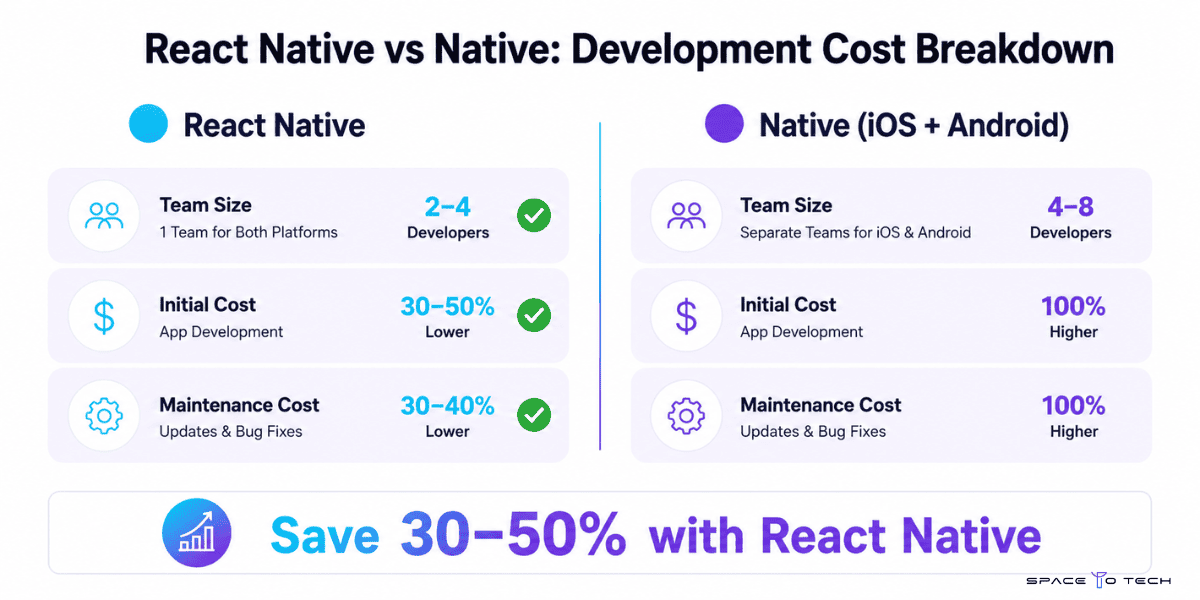
React Native vs Native App Development Cost Comparison – Save 30–50% with Cross-Platform Development

That said, native development cost can absolutely be justified for complex, high-scale apps where platform-specific performance or deep OS integration is non-negotiable. The economics only tip clearly toward React Native when you're building for both platforms. If you're weighing exact figures for your project, our breakdown of React Native app development cost in 2026 goes deeper on budget planning.


Development Time and Time-to-Market

Speed has a business value that's easy to underestimate. A founder who needs to validate an idea in the market in three months faces a very different calculation than one operating on a six-month runway with guaranteed funding.


React Native allows simultaneous app publishing to both the App Store and Google Play. Developers write a feature once and it ships everywhere — no coordinating between two platform teams, no maintaining two separate sprint backlogs, no waiting for Android to catch up with iOS (or vice versa).


Native teams building for both platforms typically run parallel development sprints, which doubles the coordination overhead. Features get built twice, reviewed twice, tested twice. Even with strong project management, that process adds weeks — sometimes months — to a launch timeline. For an MVP, that delay can be the difference between getting to market ahead of a competitor or behind one.


The development speed advantage of React Native is well-documented: most industry estimates place time-to-market at 40–60% faster for cross-platform projects versus full native builds for both platforms. For a startup validating its idea, faster time to market directly reduces burn, compresses the feedback loop, and gets real user data into the product roadmap sooner. For an established company launching a new product line, faster time to market means earlier revenue.


Performance Comparison

This is where React Native has historically been on the defensive. And it's where the 2025–2026 landscape has shifted meaningfully.


For most business applications — eCommerce platforms, SaaS tools, marketplace apps, enterprise workflow tools — React Native delivers app performance that is indistinguishable from native to end users. Engineering analyses through 2025 consistently show that for UI-driven applications using common patterns, React Native's performance is on par with fully native apps. Smooth scrolling, fluid animations, fast cold starts: these are all achievable in React Native when built correctly.


The reason is architectural. React Native's New Architecture — specifically the Fabric Renderer, TurboModules, and JavaScript Interface (JSI) — has eliminated the performance bottlenecks that previously defined the native vs cross-platform debate. Fabric replaced the old UI manager, JSI removed the bridge bottleneck, TurboModules cut memory overhead, and the Hermes engine made JavaScript execution faster. The result is high performance at React Native's level that would have seemed implausible three years ago.
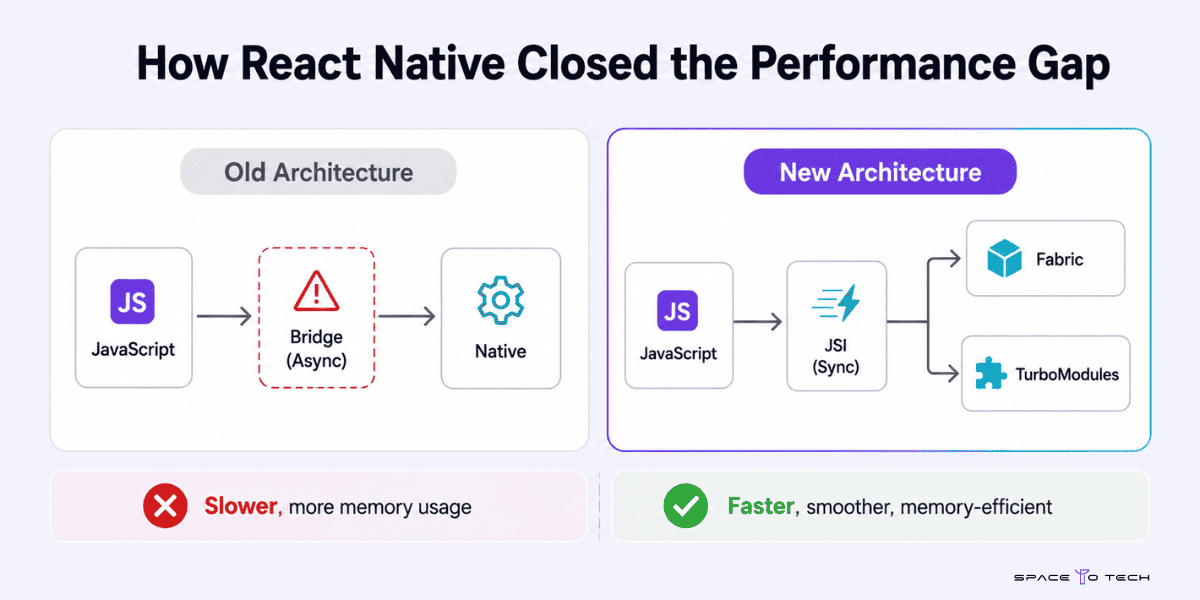
React Native New Architecture vs Old Bridge – How JSI, Fabric and TurboModules Closed the Performance Gap

That said, native performance still has a genuine edge in specific scenarios: real-time gaming, AR/VR applications, apps with heavy GPU usage, deep OS-level sensor access, or advanced computational tasks. For those use cases, iOS app development in Swift or Android app development in Kotlin — with direct hardware access — is still the technically superior choice.

The honest summary: React Native cross-platform performance is now "good enough" for the vast majority of business apps. Native still wins at the performance ceiling. Most businesses building data-driven, UI-focused apps will never hit that ceiling.


User Experience and UI Flexibility


A common misconception is that React Native apps look like web apps wrapped in a native shell. That's not accurate. React Native uses real native components to render its UI — the same buttons, scroll views, and navigation elements that a Swift or Kotlin developer would use. The result is an app that looks and behaves like a native application on each platform, not a generic cross-platform compromise.

The user experience trade-off is more nuanced than "React Native looks good enough." For most business apps, React Native delivers an excellent user interface and user experience without the overhead of maintaining two codebases.


Where native development gains an edge: highly custom, platform-specific animations that rely on deep OS APIs, or UI patterns that need to match the very latest platform design languages immediately after release. When iOS introduces something like Dynamic Island or Android rolls out the latest Material You interactions, native developers can access those features the same day. React Native developers typically wait weeks or months for community library support to catch up.

For companies where the UI itself is the product differentiator — where the design experience is the core value proposition — native gives designers and developers pixel-perfect control with no abstraction layer in the way. For companies where the product value is in the data, workflows, or service being delivered, React Native's user interface is more than sufficient.


Code Reusability and Maintenance

This is React Native's strongest business argument, and it's worth taking seriously.


With a single codebase, every bug fix, feature update, and design change is deployed once and lands on both platforms simultaneously. That's not just convenient — it fundamentally changes the maintenance cost structure of your app over time. Long term maintenance in React Native is half the effort: one QA cycle, one deployment, one version to track.

Contrast that with native development. Fixing a bug in a native iOS app means a separate fix written in Swift, reviewed, tested, and deployed. Fixing the same bug in the native Android app means a separate fix in Kotlin — another PR, another QA cycle, another App Store / Play Store submission. Two separate development tracks for every change, for the life of the product.


Code reusability in React Native typically reaches 70–90% of shared code between platforms, depending on how much platform-specific UI customisation the app requires. The remaining 10–30% handles platform-specific visual tweaks. In practice, this means your engineering team spends the vast majority of their time building new features rather than maintaining parallel implementations.
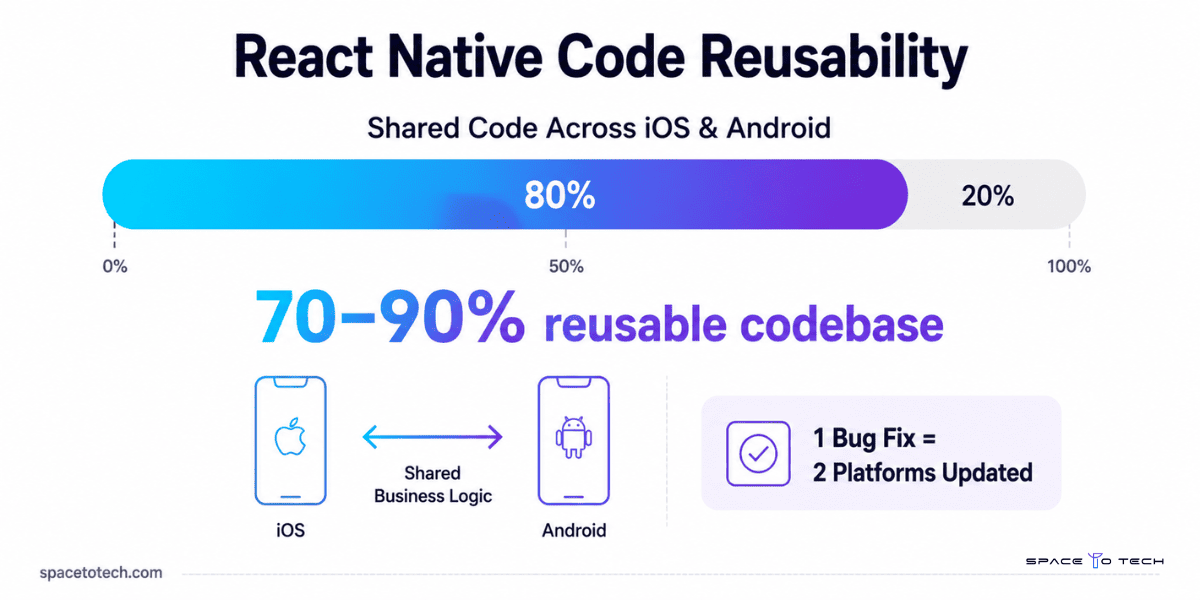
React Native Code Reusability – 70–90% Shared Codebase Across iOS and Android Platforms

It's worth noting that code reusability extends further than mobile. In some architectures — particularly with React Native Web — teams can share business logic with their web front-end, creating a single source of truth across all platforms. The long-term maintenance implications of that kind of shared architecture are significant for any product team thinking beyond the initial launch.


Scalability and Long-Term Growth


"Can React Native scale to enterprise level?" This is one of the most common objections from CTOs evaluating the framework for serious production use. The answer is yes — with the right architecture and the right team.

The evidence isn't theoretical. Shopify, Microsoft Teams, and Meta's own Facebook and Instagram apps all use React Native at significant scale. These are high-traffic, complex products with demanding performance requirements and large engineering teams. React Native handles them. App scalability in the framework is a function of architecture decisions, not an inherent ceiling of the technology.


Third party integrations — payment gateways, mapping services, analytics platforms, push notification services, authentication providers — are well-supported across the React Native ecosystem. Most major SDKs provide React Native libraries, and the ones that don't typically have well-maintained community alternatives.

Where native scales better is at the very high end of OS-level complexity: custom hardware integrations, advanced sensor access, real-time data processing at the system level. For enterprise applications that are primarily data-driven and workflow-focused, React Native is a proven, production-tested choice. For businesses evaluating alternative cross-platform frameworks, Flutter app development is another option worth comparing before committing to a path.


When to Choose React Native


React Native is the clear choice in several specific scenarios. This isn't about which technology is more impressive — it's about which one aligns with your business context.


Choose React Native when:

You're a startup validating an MVP and need to reach users on both platforms without doubling your development cost. The development speed advantage is real and the startup budget savings are significant.

Your product needs to launch on iOS and Android simultaneously. React Native's simultaneous app publishing removes the coordination overhead of running two parallel native tracks.


Your team has limited development resources and you can't sustain two specialised platform teams. One React Native team delivering both platforms is operationally simpler and more cost-effective.

Your app relies heavily on third party integrations — payments, maps, analytics — where React Native's ecosystem is mature and well-supported.


You're prioritising development speed and want to iterate quickly based on early user feedback. React Native's hot reloading and shared codebase compress the iteration cycle.

Community support and ecosystem maturity matter to your decision. React Native's Meta-backed community is active, well-funded, and unlikely to stagnate. For teams ready to move forward, our React Native development services can help you launch faster with the right architecture from day one.


Planning a mobile app project? Discuss your requirements with our React Native specialists and discover the most cost-effective development approach for your business. Talk to Our React Native Team →

When to Choose Native App Development
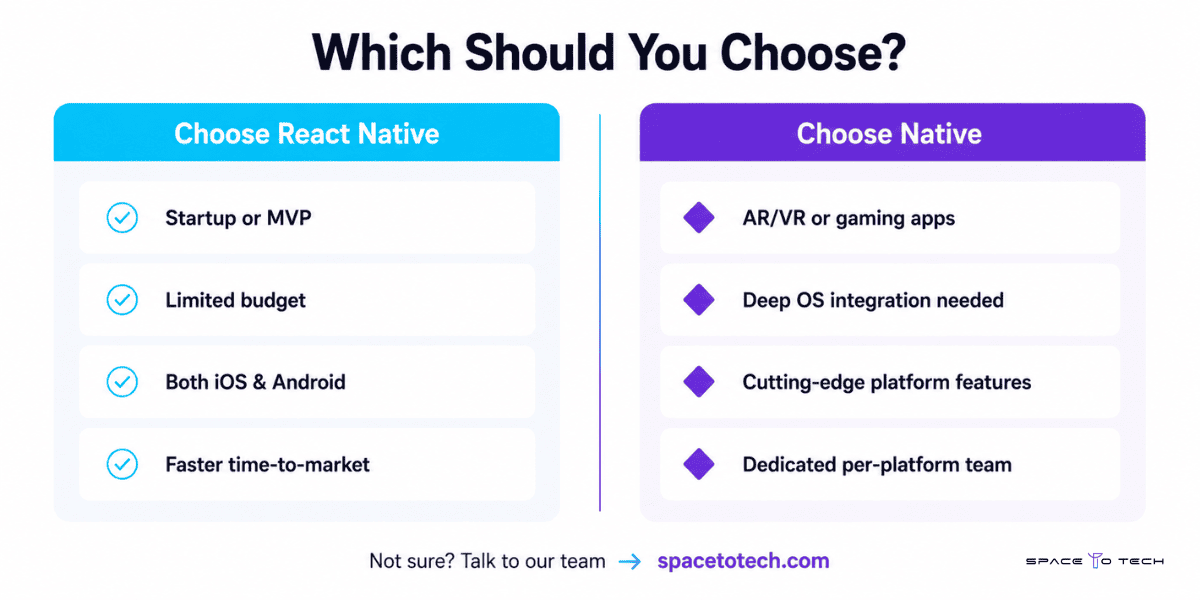
When to Choose React Native vs Native App Development – Decision Guide for Startups and Enterprises

Native development is genuinely the better strategic choice in specific situations. Acknowledging that directly should build confidence in this comparison — there's no universal winner.


Choose native when:

Your app requires cutting-edge platform-specific features immediately after an iOS or Android OS release. Native developers access new APIs on launch day; React Native teams wait for ecosystem support.

Performance is mission-critical at the OS level — real-time gaming, AR/VR experiences, heavy media processing, or apps that need deep hardware integration. These use cases genuinely benefit from the direct access that iOS app development and Android app development provide.


Your business is large enough to sustain two dedicated platform teams long-term. If you already have Swift specialists and Kotlin specialists on staff, the organisational overhead of native development is already built in.


Your product's competitive differentiator is a deeply customised UI that must mirror platform-specific features — Dynamic Island behaviour, advanced haptic patterns, platform-specific features tied to specific OS versions — immediately on launch.

Enterprise applications at the very high end of complexity — custom hardware integrations, security-level OS access, advanced sensor fusion — can justify the additional cost and team size that native demands.


React Native vs Native App Development: Comparison Table


The table below summarises the core trade-offs in the react native vs native app development decision across nine factors. Use it as a quick reference when presenting options to stakeholders.

FactorReact NativeNative App Development
Development CostLower — single team, shared codebaseHigher — separate iOS and Android teams
Time to MarketFaster — simultaneous app publishingSlower — two parallel development tracks
PerformanceNear-native for most business appsBest possible — direct OS access
Code Reusability70–90% shared code across platformsZero — separate codebases
UI FlexibilityVery good — uses native componentsMaximum — pixel-perfect platform control
Maintenance CostLower — one codebase to maintainHigher — two separate update cycles
Best ForStartups, MVPs, cross-platform productsHigh-performance or platform-specific apps
Community SupportLarge — backed by Meta, strong ecosystemPlatform-specific — Apple / Google support
Team Size NeededSmaller — one cross-platform teamLarger — dedicated iOS and Android teams


Which Option Is Best for Your Business?


There's no universal answer, because the right choice depends entirely on your business requirements. Here's how to think about it by situation:

If you're a startup with a limited budget and a deadline: React Native is almost always the right starting point. You get both platforms, faster time to market, lower initial and long-term costs, and a codebase that's maintainable by one team. The performance and UI flexibility you're giving up are trade-offs you won't feel at the MVP stage.

If you're an enterprise building a mission-critical tool with unique hardware requirements or deep OS integration: Native is worth the investment. The additional cost buys you capabilities and performance headroom that React Native can't match at the ceiling.

If you're a mid-size company launching a cross-platform SaaS tool, marketplace, or eCommerce app: React Native is a strong fit. Companies like Shopify have proven it scales. Your user experience will be excellent, your maintenance cost will be lower, and your team will ship features faster.

If your app's UI is the product — if the interaction design and visual experience are the primary differentiators — native gives designers the pixel-perfect control and immediate access to platform updates that React Native can't offer on day one.

Ultimately, the decision comes down to this: if you're building for both iOS and Android with business requirements that fall within the majority of app categories, React Native delivers far more value per dollar spent. If you're operating at the performance ceiling or need features the moment a new OS ships, native is the right call.

If you want a second opinion based on your specific project, our team at SpaceToTech helps founders and product teams choose the right approach based on their goals, timeline, and budget — not on what's trending. For founders specifically evaluating this for their first product, our guide on React Native for startups is worth reading before making a final decision. And if Flutter is still in the running, our breakdown of React Native vs Flutter covers that comparison directly.


Still unsure which path is right for your project? Connect with our experts for a free consultation. We'll review your project goals, budget, and timeline and recommend the approach that gives your business the best outcome. Get a Free Consultation →


Frequently Asked Questions

Is React Native as fast as native development?

For most business applications, yes — the performance gap is negligible in real-world use. React Native's New Architecture (Fabric, TurboModules, JSI, and the Hermes engine) has fundamentally changed what's possible, enabling 60fps animations, fast cold starts, and responsive UIs even on mid-range devices. Where native still holds a measurable edge is in performance-ceiling scenarios: real-time gaming, AR/VR, or applications that require deep, low-level hardware access. For eCommerce platforms, SaaS tools, marketplaces, and enterprise workflow apps, users typically cannot tell the difference between a well-built React Native app and a native one.

When should a startup choose React Native over native?

We recommend React Native for startups in almost every scenario where the app needs to run on both iOS and Android. The reasons are practical: a single team, a shared codebase, faster iteration, and significantly lower development and maintenance costs. For a startup validating a product idea, getting to market faster with a smaller team directly extends runway and compresses the feedback loop. React Native's simultaneous app publishing means you reach both platform audiences at launch without doubling your build effort. Unless your product genuinely requires cutting-edge OS-specific features on day one, React Native is the more sensible starting point.

Can React Native apps be published to both the App Store and Google Play?

Yes and this is one of React Native's most compelling business advantages. A single React Native codebase can be built and submitted to both the Apple App Store and Google Play Store simultaneously. This eliminates the coordination overhead of running two parallel native development tracks and ensures your iOS and Android users receive the same features, bug fixes, and updates at the same time. For teams trying to reduce time-to-market, this simultaneous deployment capability is a meaningful operational advantage that native teams building for both platforms simply can't match without significantly larger teams.

What is the main disadvantage of React Native compared to native app development?

The primary limitation is access to cutting-edge, platform-specific features. When Apple or Google introduces a new OS capability a hardware API, a new animation system, a platform-specific UI pattern native developers can adopt it immediately. React Native developers rely on community libraries or custom native modules to bridge that gap, which can introduce delays of weeks or months. For most apps, this gap rarely matters. But for products where being first to adopt platform-specific features is a competitive differentiator, or for apps that require deep OS-level access, this is a genuine limitation worth planning for in your architecture and roadmap.

Is React Native good for enterprise applications?

We see this question often, and the answer is clearly yes with the caveat that architecture decisions matter. Shopify, Microsoft Teams, Facebook, and Discord all run React Native in large-scale, enterprise-grade production environments. Third party integrations common in enterprise contexts authentication, analytics, push notifications, payment systems are well-supported by the React Native ecosystem. Enterprise applications that are primarily workflow-driven, data-focused, or communication-oriented are a strong fit. The scenarios where we'd steer an enterprise client toward native are those involving very specialised hardware integrations, real-time processing at the OS level, or a requirement to adopt new platform features the same week they release.

How much cheaper is React Native development compared to native?

Cross-platform development in React Native can reduce total project costs by 25–50% compared to building and maintaining separate native apps for both iOS and Android. The savings come from three sources: one team instead of two, one codebase to write and test, and one update cycle to maintain ongoing. The exact figure depends on project complexity and whether you're building for both platforms from the start the comparison only applies meaningfully to multi-platform builds. For a startup launching an MVP on both iOS and Android, the cost difference between React Native and full native is often the difference between a project being viable or not within a given funding round.

Related Blogs

React Native app development cost guide 2026

React Native App Development Cost in 2026: Complete Pricing Guide

You have a great app idea. Before anything else, one question always pops up how much is this going to cost? If you are exploring React Native app development , you are already making a smart choice. React Native lets you build one app that runs on both iOS and Android, which saves money right from day one. But here is the honest truth react native app development cost in 2026 is not a single number. It depends on what you are building, who builds it, and where in the world your team is based. A simple MVP built by an Indian agency might cost $8,000. The same app built by a US agency could run $40,000 or more. This guide breaks it all down clearly pricing by app type, region-wise cost comparison covering India vs USA vs UK, developer hiring costs, hidden expenses, and real-world examples. Whether you are a startup founder, a CTO, or someone exploring options for the first time, this is the only React Native cost guide you will need in 2026. You can also explore all our mobile and software development services to understand how we work. React Native App Development Cost Overview In 2026, building a React Native app typically costs anywhere between $5,000 and $200,000+. The range is wide because every app is different. A basic MVP with five screens is very different from a fintech platform with real-time transactions and KYC verification. Here is a quick snapshot before we go deeper:  App Type  Estimated Cost (India)  Estimated Cost (USA/UK)  Timeline  MVP / Prototype  $5,000 – $13,000  $20,000 – $50,000  4–8 weeks  Startup App  $12,000 – $30,000  $40,000 – $80,000  2–4 months  Mid-Complexity App  $25,000 – $60,000  $70,000 – $120,000  4–7 months  Enterprise App  $60,000 – $150,000  $120,000 – $250,000+  7–12 months 💡 The biggest cost lever is not your app's features it is where your development team is based. India-based agencies deliver the same quality at 60–70% lower cost than US or UK firms. Why Businesses Choose React Native Despite Development Costs React Native is not the cheapest option because it is average. It is cost-effective because it is genuinely efficient. Here is why thousands of businesses — including Microsoft, Shopify, and Facebook use it. If you want to explore what React Native can do for your specific project. Shared Codebase One Team, Two Platforms React Native uses a single JavaScript codebase for both iOS and Android. You do not need two separate dev teams. This alone cuts your staffing costs by 30–40% compared to building two native apps in parallel. Faster Time to Market With features like hot reloading and a rich library of pre-built components, React Native teams ship faster. A feature that takes two weeks natively can often take one week in React Native. Lower Long-Term Maintenance Cost Maintaining one codebase is significantly cheaper than maintaining separate iOS and Android codebases. Annual maintenance for a React Native app typically runs 15–20% of the original build cost often half what native maintenance costs. Smaller, Leaner Team A React Native project can be handled by JavaScript developers who manage both platforms. This reduces your monthly burn rate and keeps coordination simple. Key Factors That Affect React Native App Development Cost This is the section most people skip and then wonder why their budget ran over. These are the 12 real drivers of React Native development cost in 2026: 1. App Complexity and Business Logic A simple informational app with five screens is very different from one with conditional workflows, multi-step forms, and complex business rules. Complexity is the biggest single driver of cost. 2. Number of Screens Every screen requires design, development, and testing effort. A 6-screen app and a 25-screen app do not cost the same. Always define your screen count before getting quotes. 3. UI/UX Design Requirements Custom animations, branded design systems, and polished micro-interactions cost more than standard template designs. Good design prevents expensive rework later. Our UI/UX design team works alongside every React Native project to deliver interfaces users actually love. 4. Third-Party Integrations Connecting to Google Maps, Stripe, Twilio, Firebase, or social login providers adds development time. Each integration can add $500–$3,000 to your budget depending on complexity. 5. Backend Development Most apps need a server, a database, and a set of APIs. Backend work often accounts for 30–40% of total project cost. Do not underestimate this. 6. Security and Compliance Apps handling payments or healthcare data need encryption, secure API design, and compliance work (GDPR, HIPAA). Security-focused development adds 15–25% to cost but is non-negotiable. 7. Real-Time Features Chat, live GPS tracking, or real-time dashboards require WebSockets or push services like Firebase. These add technical complexity and testing effort. 8. AI Features In 2026, AI features chatbots, recommendation engines, image recognition — are increasingly standard. Expect to budget $5,000–$25,000+ extra for AI integrations, depending on depth. 9. Payment Integrations Stripe, Razorpay, PayPal, or in-app purchases each require careful implementation, edge-case testing, and compliance checks. Payment flows alone can add 2–3 weeks to your timeline. 10. Offline Functionality Apps that work without internet need local data syncing and conflict resolution logic. This is technically demanding and typically adds $3,000–$8,000 to project cost. 11. Scalability Architecture If you plan to serve hundreds of thousands of users, your infrastructure needs to be designed for scale from day one — adding cloud setup, load balancing, and caching costs. 12. Admin Panel and CMS Many businesses need a web-based admin panel to manage content, users, and orders. A basic admin panel adds $3,000–$10,000. A feature-rich one can add $15,000–$25,000. React Native Cost by App Type Different industries have very different feature requirements. Here is what you can realistically expect to spend in 2026, broken down by app category:  App Type  Core Features  India Cost  USA/UK Cost  Ecommerce Cart, payments, product listings, tracking  $15,000–$40,000  $50,000–$100,000  Healthcare HIPAA compliance, telemedicine, EHR  $25,000–$80,000  $80,000–$200,000  Fintech KYC, fraud detection, bank APIs, encryption  $30,000–$100,000  $100,000–$250,000  Logistics GPS tracking, route optimization, dispatch  $20,000–$60,000  $60,000–$150,000  Food Delivery Multi-vendor, real-time tracking, reviews  $18,000–$45,000  $55,000–$110,000  Social Media Feeds, chat, media upload, notifications  $18,000–$50,000  $55,000–$130,000  SaaS App Subscriptions, dashboards, multi-tenant  $25,000–$75,000  $70,000–$200,000  Marketplace  Buyer/seller flows, escrow, admin  $22,000–$60,000  $65,000–$160,000 React Native MVP Development Cost An MVP (Minimum Viable Product) is where most smart startups begin. The goal is simple build the core of your product, get it in front of real users, and validate before spending big. What Features Should a React Native MVP Have? Focus on user authentication (email/social login), 5–8 core screens, basic push notifications, and one payment method. Skip the admin panel, AI features, and analytics for now. Add those in version 2, once you have real user feedback. MVP Cost Breakdown  Development Phase  India Cost  USA/UK Cost  UI/UX Design  $800–$2,500  $3,000–$8,000  Frontend (React Native)  $2,000–$5,000  $8,000–$20,000  Backend & API  $1,500–$4,000  $6,000–$15,000  QA & Testing  $500–$1,500  $2,000–$6,000  App Store Deployment  $200–$500  $500–$1,500  Total MVP Cost  $5,000–$13,500  $19,500–$50,500 MVP Timeline and Team A well-scoped React Native MVP takes 6–10 weeks to complete. Your minimum team: one React Native developer, one UI/UX designer, one backend developer, one QA tester, and a project manager. Rushing this phase creates technical debt that costs far more to fix later. 💡 Start with an MVP. Get user feedback. Then invest in advanced features. This approach saves 40–60% of your initial budget and dramatically reduces risk. React Native Development Cost by Region — India vs USA vs UK Where your development team is based is the single biggest cost lever in the entire project. Here is a clear, data-backed comparison for 2026:  Region  Junior Dev ($/hr)  Mid Dev ($/hr)  Senior Dev ($/hr)  Full App Cost Range India  $15–$25  $25–$45  $40–$70  $8,000–$60,000 UK  $50–$80  $80–$120  $100–$150  $50,000–$180,000 USA  $60–$90  $90–$130  $120–$160  $60,000–$200,000 Canada  $55–$85  $80–$120  $100–$150  $55,000–$180,000 Eastern Europe  $25–$45  $40–$70  $60–$90  $20,000–$80,000 Australia  $60–$90  $85–$130  $110–$160  $60,000–$200,000 India consistently offers the best cost-to-quality ratio for React Native development. Businesses working with experienced Indian agencies typically reduce development spend by 60–70% compared to US or UK firms without sacrificing quality. SpaceToTech, based in Noida, India, has delivered React Native projects for global clients across the USA, UK, and Australia with transparent pricing and no hidden costs. React Native vs Native App Development Cost Many founders ask whether React Native is truly cheaper than building native apps for iOS and Android separately. The answer is yes consistently. Here is why:  Platform  Cost Range  Team Size Needed  Time to Market  iOS Native Only (Swift)  $30,000–$120,000  3–5 iOS devs  4–10 months  Android Native Only (Kotlin)  $30,000–$120,000  3–5 Android devs  4–10 months  Both Natively  $60,000–$240,000  6–10 devs  6–14 months  React Native (Both Platforms)  $20,000–$100,000  2–4 devs  3–9 months A property management app that received quotes of $115,000 for native development was built with React Native for $68,000 a savings of $47,000, or 41%. React Native delivers near-native performance for the vast majority of apps. If you are weighing your technology options, also consider reading about our Flutter development services — another excellent cross-platform alternative to make the right choice for your project. Hidden Costs of React Native App Development Most cost guides stop at development. But there are recurring expenses that catch founders off-guard after launch. Here is what you need to budget for: App Store Registration Fees Google Play Store charges a one-time fee of $25. Apple App Store charges $99 per year. Small numbers, but easy to forget in the budget. Cloud Hosting AWS, Google Cloud, or Azure will run $50–$500+ per month depending on your user base. Budget $50–$150/month for a new app at launch and expect this to grow with your user count. Third-Party Service Subscriptions Services like Twilio for SMS, SendGrid for email, Stripe for payments, and Firebase for push notifications all have monthly costs. Budget $100–$500/month for a typical mid-size app. Security Audits Any app handling payments or user data needs a professional security audit. Cost: $2,000–$15,000. This is not optional it is essential. Analytics Tools Understanding user behavior requires tools like Mixpanel, Amplitude, or Firebase Analytics. Free tiers exist but paid plans run $50–$300/month for growing apps. Push Notification Services Firebase Cloud Messaging handles basic notifications for free. Advanced targeting through OneSignal or Braze costs $9–$499/month depending on your user base. 💡 Rule of thumb: Budget an additional 20–30% on top of your development cost to cover first-year hidden costs. Most founders who ignore this get a nasty surprise within six months of launch. React Native App Maintenance Cost Your app does not stop costing money after launch. Maintenance is an ongoing investment that keeps your product stable, secure, and growing. Monthly Maintenance Cost For a medium-complexity React Native app, expect $500–$3,000 per month. This covers bug fixes, minor feature updates, server monitoring, and dependency updates. Annual Maintenance Budget The industry standard is 15–20% of your initial build cost per year. If your app cost $50,000 to build, budget $7,500–$10,000 per year in maintenance. Treat this as a line item in your annual budget, not a surprise expense. OS Compatibility Updates Apple and Google release major OS updates every year. Each update requires compatibility testing and often code changes. Budget $500–$2,000 per major OS release. Feature Enhancements Adding new features after launch typically costs $3,000–$20,000 per major feature. Planning a feature roadmap in advance helps you budget and prioritize effectively. How to Reduce React Native App Development Costs You do not have to choose between quality and budget. Here are five proven ways to reduce your React Native app development cost without cutting corners: 1. Start With an MVP Launch with the 20% of features that deliver 80% of value. Validate your product with real users before spending on advanced features. This approach can cut initial spend by 40–60%. 2. Prioritize Features Ruthlessly Create a must-have list and a nice-to-have list. Push everything from the second list to version 2. Every extra feature in version 1 adds cost and delays your launch. 3. Use Open-Source Libraries React Native has a rich ecosystem React Navigation, Redux, Axios, React Hook Form — all free and production-tested. Using these instead of building from scratch saves 20–30% in development time. 4. Choose the Right Development Partner An experienced India-based agency delivers the same quality as a US firm at 50–70% lower cost. Check portfolios, Clutch reviews, and ask for a detailed project breakdown before committing. You can explore SpaceToTech's portfolio and contact us for a free project consultation and transparent cost estimate. 5. Avoid Overengineering Early Do not build infrastructure for 10 million users when you are starting with 1,000. Keep the architecture simple and scalable on demand. Premature optimization wastes budget that could go toward features your users actually want. Real Cost Examples Numbers mean more when they are grounded in reality. Here are four real-world examples to give you a concrete sense of what React Native projects cost in 2026: Ecommerce App A mid-size fashion ecommerce app product catalog, cart, Stripe payments, order tracking was built by an Indian agency in 14 weeks for $22,000. An equivalent US agency quote came in at $75,000+. Food Delivery App A multi-restaurant food delivery platform with real-time GPS, separate customer and driver apps, and a restaurant dashboard took 20 weeks. India cost: $38,000. US estimate from the same brief: $115,000. Healthcare Telemedicine App A HIPAA-compliant telemedicine app with video consultations, patient records, and appointment scheduling took 6 months. Cost in India: $58,000. Equivalent US development: $180,000+. B2B SaaS App A B2B SaaS mobile app with multi-tenant architecture, role-based access control, and analytics dashboards — 7 months, India cost: $65,000. US equivalent: $200,000+. Is React Native Worth the Investment in 2026? Short answer: yes for most businesses. Here is the longer version: For Startups React Native is almost always the right call. You get both iOS and Android from a single team and a single budget. Build your MVP, validate it with real users, and scale. The cost savings vs native development give you more runway to grow. For Enterprises Large organizations increasingly use React Native for internal tools, customer apps, and product MVPs. Companies like Microsoft and Shopify have validated it at scale. It also integrates well with AI and chatbot layers something we specialize in through our AI chatbot development services . ROI Over Three to Five Years Over a 3–5 year horizon, a React Native app can save $50,000–$200,000 compared to maintaining two separate native codebases. That is money better invested in product features, marketing, and growth. Why Choose SpaceToTech for React Native Development? SpaceToTech is a software and mobile app development company based in Noida, India, delivering React Native solutions for startups and enterprises across the USA, UK, Canada, and Australia. Transparent pricing — detailed project quotes with no hidden fees, before work begins. Dedicated teams — your project gets developers who focus entirely on your product. Agile delivery — sprint-based development with weekly demos and clear milestones. Full-stack capability — React Native frontend, backend APIs, UI/UX design, and QA under one roof. Post-launch support — flexible maintenance plans so your app keeps performing after go-live. Ready to get a cost estimate for your app? Talk to our team today — we offer a free consultation and project scoping call with no obligations. Get a Free Cost Estimate for Your React Native App SpaceToTech delivers transparent, high-quality React Native development from India for global businesses. Whether you need a quick MVP or a full enterprise product, we will scope your project, give you a detailed breakdown, and build it right. Contact us today to start a free consultation. Explore our React Native services, Flutter development, and UI/UX design to see the full range of what we offer.

June 15, 2026

Read More..
React Native startup development guide showing faster mobile app launches, lower costs, and cross-platform development benefits in 2026

Why Is React Native for Startups a Great Choice in 2026?

Every startup faces the same early mobile decision: build native apps for iOS and Android separately, or find a smarter path. React Native is that smarter path for the majority of startup use cases but only if you understand what you're actually signing up for. This guide is written for founders, CTOs, and product leaders making a real technology decision not for developers looking for a tutorial. By the end, you'll know whether React Native fits your product, your team, and your funding stage, along with a concrete framework to make the call. What Is React Native? React Native is an open-source mobile app framework created by Meta (Facebook) that lets developers build applications for both iOS and Android using a single JavaScript codebase. Instead of maintaining separate codebases in Swift (iOS) and Kotlin (Android), your team writes once and deploys to both platforms. For non-technical founders, the business analogy is straightforward: imagine writing one user manual that works for two different products simultaneously. You update the manual once, and both products reflect the change.  Quick Facts  React Native Created by Meta (Facebook) Initial Release 2015 Language JavaScript / TypeScript Platforms iOS + Android (+ Web via React Native Web) Notable Production Users Meta, Shopify, Discord, Tesla, Coinbase, Bloomberg Architecture (2026) New Architecture — Fabric renderer, JSI bridge For a deeper technical overview of how the framework operates, see SpaceToTech's React Native App Development Services page. Why Startups Choose React Native in 2026 Startup decisions are constrained decisions. You are working with limited runway, a small team, and a product that may need to pivot. React Native was built for exactly this environment not because Meta designed it with startups in mind, but because its architecture naturally aligns with startup constraints. Three specific advantages make React Native the default choice for most early-stage mobile products: Cost Efficiency That Extends Runway A single codebase means one development team instead of two. That difference compounds: one QA process, one deployment pipeline, one set of UI components to maintain. For a pre-seed startup spending $50,000 on an MVP, the difference between React Native and dual native development can be $20,000–$40,000 — that's additional months of runway, not just a line-item savings. Faster Hiring and Smaller Engineering Teams React Native draws from the JavaScript talent pool the largest developer community in the world. When you're hiring a first mobile developer or evaluating an offshore development partner, the available talent is significantly broader than the Kotlin or Swift-specific pools. This matters practically: shorter hiring timelines, more competitive rates, and better selection at any given budget. Community, Ecosystem, and Long-Term Viability React Native's GitHub repository consistently ranks among the most-starred open-source mobile frameworks. The 2023–2024 New Architecture release (Fabric renderer + JSI bridge) addressed the most common performance criticisms that had followed the framework since 2017. In 2026, the objection that React Native is 'not production-ready' no longer holds. The companies shipping on it Discord, Shopify, Coinbase have production standards that most startups won't approach for years. How React Native Helps Startups Launch Faster Single Codebase, Two Platforms, Half the Timeline The most direct time-to-market benefit is simple arithmetic. A native iOS app and a native Android app built by separate teams takes 6–10 months for a full MVP. A React Native team building both simultaneously takes 3–5 months. That timeline difference is the difference between launching before a competitor and launching after one. React Native's hot reloading capability compounds this advantage during iteration. When your PM identifies a UX problem during testing, the fix ships to both platforms simultaneously. There is no 'iOS version of that bug fix ships next week' situation a reality that anyone who has shipped native apps knows is frustratingly common. Iterating Toward Product-Market Fit Faster Lean startup methodology is built on the cycle: build, measure, learn. React Native shortens the build phase, which means more cycles in the same timeframe. If your product is pre-PMF — which is true of almost every startup at the MVP stage the ability to run two additional iterations in the time your competitor runs one is a genuine competitive advantage, not just a development efficiency. How React Native Reduces MVP Development Costs Cost transparency is something most React Native articles avoid. Here are concrete ranges by funding stage, based on typical project scopes:  MVP Stage  Native iOS + Android  React Native  Estimated Saving Pre-Seed MVP $60,000 – $120,000 $35,000 – $70,000 ~40–45% Seed-Stage MVP $100,000 – $200,000 $60,000 – $120,000 ~35–40% Series A Rebuild $200,000 – $400,000+ $120,000 – $220,000 ~35–45% Note: Ranges depend on features, team location, and complexity. For a detailed breakdown, see SpaceToTech's React Native App Development Cost guide. The savings come from three compounding factors: shared UI components (built once, used on both platforms), a single QA team running one test suite, and shared backend integration work. Add working with an experienced offshore React Native development partner, and those cost ranges compress further Indian-based agencies typically charge $25–$50/hr versus $100–$250/hr for US firms, for comparable technical output. SpaceToTech's React Native App Development Services are built around this model transparent pricing, dedicated teams, and a track record of delivering for global clients across the US, UK, UAE, and Australia. React Native vs Native Development for Startups This is a business decision, not a technical one. The question is not 'which framework is more powerful' it's 'which approach fits our constraints.'  Factor  React Native  Native (iOS + Android) Team Size 1–2 developers 2–4 developers (separate teams) Time to MVP 3–5 months 6–10 months Cost (MVP) $35K – $120K $60K – $200K+ Codebase Single shared codebase Two separate codebases Performance Near-native (New Architecture) Fully native Best For Startups, MVPs, SaaS apps Games, AR/VR, hardware-intensive apps Where native development genuinely wins: apps that require deep hardware integration (custom Bluetooth controllers, specialized camera sensors), high-frame-rate graphics engines, or AR/VR experiences. For the vast majority of startup use cases consumer apps, SaaS mobile products, marketplace apps, fintech products React Native is the more rational choice. React Native vs Flutter for Startups Flutter is a serious competitor and deserves an honest comparison. The decision comes down to your team's existing skills and your hiring market.  Factor  React Native  Flutter Language JavaScript / TypeScript Dart Developer Pool Very large (JS ecosystem) Growing, but smaller Backed By Meta (Facebook Google UI Customization Good Excellent (Skia renderer) Web Support Partial (RN Web) Strong Best For JS-fluent teams, startup MVPs UI-priority apps, Dart-fluent teams The practical recommendation: if your existing team or your planned hires know JavaScript or React, React Native is the clear choice. The talent pool advantage is real there are dramatically more React Native developers available for hire globally than Dart/Flutter specialists, which translates to faster hiring and lower rates. If UI consistency across platforms is your primary product differentiator, and you're willing to invest in Dart training or find Flutter-specific talent, Flutter is worth evaluating. For a deeper technical comparison, see our React Native vs Flutter breakdown. Startup Success Stories Built with React Native Social proof matters but context matters more. These companies did not choose React Native because it was trendy. They chose it because it solved a real business problem. Meta (Facebook): Built the original React Native framework to solve their own cross-platform problem. The fact that Meta continues to invest in and maintain the framework is the strongest possible signal of long-term viability. Shopify: Migrated their mobile commerce products to React Native and has publicly praised the developer experience and performance outcomes. For a company processing billions in GMV, this is not a casual decision. Discord: Built their mobile apps on React Native and has maintained them through significant scale, with documented engineering blog posts on performance optimisation at volume. Coinbase: Chose React Native for their crypto wallet and exchange apps, where security and reliability are non-negotiable product requirements. Bloomberg: Rebuilt their market data terminal mobile app on React Native, prioritising development speed and team consolidation over native performance margins. The pattern across these companies: React Native was chosen for speed, team efficiency, and cost not as a compromise. That's the same reason it makes sense for startups today. Can React Native Scale as Your Startup Grows? This is the most common objection from CTOs and technical investors, and it deserves a direct answer: yes, React Native scales with one important clarification. Most startup scaling problems are backend and infrastructure challenges, not frontend framework challenges. Your database, API layer, caching strategy, and CDN architecture will determine whether your product survives rapid user growth not whether you built your mobile frontend in React Native or Swift.  Startup Stage  React Native Suitability  Notes Pre-Seed / MVP Excellent Ideal speed and cost matter most Seed (0–10K users) Excellent No performance issues at this scale Series A (10K–100K users) Very Good May need native modules for specific features Series B+ (100K+ users) Good Architecture review recommended Enterprise / IPO Scale Case-by-case Evaluate based on app complexity React Native's New Architecture (released 2023–2024) addressed the primary technical objection that had followed the framework for years the JavaScript bridge bottleneck. The Fabric renderer and JSI (JavaScript Interface) bring React Native meaningfully closer to native performance. For any startup planning to raise a Series A or beyond, this is an important update that changes the calculus compared to evaluations made pre-2023. For architecture-specific guidance relevant to your startup stage, see our React Native Architecture resource. When React Native Is NOT the Right Choice Any advisor who tells you React Native is always the right answer is selling you something. Here is when to reconsider: Graphics-intensive games or AR/VR apps: Frame-rate-critical rendering still performs better in native code. If your product's core experience is a 3D environment or augmented reality, go native or use a dedicated game engine. Deep device hardware integration: If your app needs to communicate with proprietary Bluetooth hardware, custom sensors, or specialized device APIs, the additional native module work can erode the cost advantage. Swift/Kotlin-only teams with no JavaScript experience: Retraining cost is real. If your engineering team is native-only and you are mid-project, switching frameworks creates risk rather than efficiency. Single-platform products: If you only need an iOS app — for an enterprise internal tool, for example — the cross-platform advantage disappears. Native iOS development makes more sense. Frame-rate-critical animations as a core product feature: High-frequency animations that define the product experience (think Lottie-heavy onboarding, physics simulations) can strain React Native's runtime even with the New Architecture. Being transparent about these limitations is more valuable to a founder than a blanket endorsement. If your use case falls in this list, the right answer is to say so early rather than rebuild later. Is React Native Worth It for Startups in 2026? Yes for the majority of startup mobile products, React Native is the pragmatic, cost-effective, and founder-rational choice in 2026. The three strongest reasons come down to economics: it cuts development costs by 35–45%, reduces time to MVP by 30–40%, and gives you access to the widest developer talent pool available for mobile development. The New Architecture updates have removed the most credible technical objections, and the production track record of companies like Shopify and Discord has validated it at significant scale. The question is not whether React Native is worth it as a framework it is whether it fits your specific product, team, and stage. The decision framework below helps you answer that. Decision Framework for Startup Founders Run through this before briefing your first developer or development agency. It takes five minutes and will prevent months of the wrong technical direction.  Choose React Native If  Reconsider If You need iOS + Android from day one Your app requires AR/VR or 3D graphics as a core feature You want to extend runway and reduce dev costs Your team is native-only (Swift/Kotlin) with no JS experience You're validating an MVP before raising a seed round Your product requires deep device hardware integration Your team knows JavaScript or React Your core feature depends on frame-rate-critical animations You need to scale post-funding but move fast now You're building for a single platform only You want access to a large global developer pool Your investors have explicitly required a native-only stack Final Recommendations React Native is the right starting point for most startup mobile products in 2026. The architecture is mature, the ecosystem is large, the talent pool is deep, and the cost and speed advantages over native development are consistent and meaningful. The most common mistake founders make is not choosing the wrong framework it's choosing the right framework and implementing it poorly. React Native's architecture patterns, performance optimisation techniques, and security practices require experience to get right. A first-time React Native project built by developers learning the framework on your budget will not deliver the advantages described in this guide. If you want to build your startup's mobile product on React Native and want experienced development partners  not generalists SpaceToTech React Native App Development Services is the right place to start the conversation. We work with founders at pre-seed through Series B stages, across the US, UK, UAE, and Australia. Already have a rough product brief? Contact SpaceToTech for a no-obligation project estimate.

June 16, 2026

Read More..
React Native vs Flutter 2026 comparison cover image

React Native vs Flutter in 2026: Which Framework Should Businesses Choose?

Picking the wrong cross-platform framework doesn't just cost you a few weeks of rework it can quietly add 20–30% to your app's lifetime cost through hiring delays, rebuilds, and technical debt. We've watched founders make this call in five minutes based on a Reddit thread, and we've watched CTOs spend three months in analysis paralysis. Neither extreme works. This guide is written for the people who have to live with the decision founders, product managers, and CTOs not for developers comparing syntax. If you've already explored React Native app development services or Flutter app development services , you've probably noticed most comparisons online are written by developers, for developers. This one isn't. React Native vs Flutter: A Quick Answer for Decision-Makers In short: React Native vs Flutter comes down to talent availability versus UI consistency. React Native, built by Meta on JavaScript/TypeScript, gives you access to a much larger developer pool and lower hiring costs. Flutter, built by Google on Dart, gives you near pixel-perfect UI consistency across platforms and stronger web/desktop support out of the box. When React Native is the better business choice: you're working with a JavaScript team already, need to hire fast, want the largest possible developer talent pool, or you're building a consumer app where native look-and-feel matters more than pixel-identical UI. When Flutter is the better business choice: you need the same UI across mobile, web, and desktop from day one, you're building something animation- or graphics-heavy, or your team is comfortable investing extra hiring time for a smaller but fast-growing Dart talent pool. The honest answer depends on five factors: budget, timeline, team composition, long-term scalability needs, and risk tolerance for newer ecosystems. We'll walk through each below. Framework Overview: What Business Leaders Need to Know React Native , maintained by Meta, lets teams build mobile apps using JavaScript and TypeScript the most widely used programming languages in the world. It's been production-tested since 2015 and powers apps at Meta, Microsoft, and Shopify. For a deeper technical walkthrough, see our React Native app development guide . Flutter , built by Google, uses the Dart language and renders every pixel itself via the Skia graphics engine rather than relying on native platform components. This gives Flutter near-identical UI across iOS, Android, web, and desktop at the cost of a steeper learning curve for most existing dev teams. The core difference that affects your business: React Native talks to native UI components through a bridge (now the JSI in its New Architecture), so your app looks and feels native by default. Flutter draws its own UI from scratch, so it looks identical everywhere which is a feature for some brands and an unnecessary constraint for others. Performance: What It Actually Means for User Experience Forget frames-per-second benchmarks what matters to your business is retention, App Store ratings, and conversion. Both frameworks now deliver performance that's indistinguishable to end users for the vast majority of business apps: e-commerce, fintech dashboards, booking apps, internal tools. React Native's New Architecture has closed most of the historical gap with Flutter's compiled approach. Where Flutter still has an edge is animation-heavy or game-like interfaces, thanks to the Skia rendering engine. The practical takeaway: unless you're building something visually intensive, performance shouldn't be your deciding factor. Development Cost Comparison: React Native vs Flutter This is the section most comparison articles skip they mention cost as a factor without quantifying it. Here's actual market-rate data for 2026.  Factor  React Native  Flutter Avg. Developer Rate (US) $45–$150/hr $45–$130/hr Typical MVP Timeline 8–14 weeks 10–16 weeks Code Reuse (iOS + Android) ~70–80% ~85–95% Year 1 MVP Build Cost (est.) $40K–$120K $50K–$130K React Native usually wins on initial MVP cost simply because hiring is faster and cheaper. Flutter's higher code-reuse rate can narrow that gap over a longer product lifecycle, since less platform-specific code needs maintaining. For a granular breakdown across regions and project sizes, we've published a dedicated React Native app development cost guide. Total cost of ownership over three years tends to favor React Native for startups (lower entry cost, faster iteration) and is closer to a toss-up for enterprises, where Flutter's reduced platform-specific maintenance can offset its higher build cost. Hiring and Developer Availability: The Factor Most Articles Ignore Talent availability is often the real deciding factor, and it's rarely discussed with real numbers.  Region  React Native Talent Pool  Flutter Talent Pool Global (approx.) 3M+ JS-background developers 500K–800K Dart/Flutter developers Avg. Time to Hire (Senior) 3–6 weeks 5–10 weeks Freelancer Availability Excellent Good, growing fast Because React Native is built on JavaScript, virtually any experienced JS or front-end developer can ramp up quickly which is why agencies and in-house teams alike find it 4–5x easier to staff. If you're exploring offshore or distributed hiring to stretch your budget further, our breakdown on how to hire developers from India covers regional rate differences and vetting approaches that apply to both frameworks. Scalability: Which Framework Grows With Your Business? Both frameworks scale to enterprise workloads Meta, Microsoft, and Shopify run React Native at massive scale; BMW, eBay, and Alibaba run Flutter. The real scalability question isn't "can it handle growth," it's "can your team keep maintaining it as it grows." React Native's larger ecosystem means more pre-built libraries for payment gateways, analytics, and third-party integrations useful when you're racing to add features post-launch. Flutter's single, self-contained rendering approach means fewer platform-specific bugs creep in as your codebase grows, which can reduce long-term technical debt. Security and Enterprise Readiness For fintech, healthcare, or any regulated industry, security architecture matters more than UI polish. Both frameworks support the encryption, secure storage, and authentication patterns needed for HIPAA, GDPR, and SOC 2 compliant apps — neither has an inherent security advantage. What matters more is whether your development team follows secure coding practices regardless of framework, and whether your vendor has experience navigating compliance audits for the framework you choose. Community, Ecosystem, and Long-Term Risk React Native benefits from Meta's continued open-source investment and an enormous npm ecosystem long-term risk here is low. Flutter's community is large and growing quickly, backed by Google, though Google does have a documented history of sunsetting developer products over the years. That's a genuine, if modest, long-term risk worth factoring into a multi-year roadmap, even as Flutter's current momentum remains strong. React Native vs Flutter for Startups If you're a founder with a tight runway, the calculus is simple: faster hiring and lower upfront cost usually outweigh marginal UI differences. Most early-stage teams choose React Native because it shortens time-to-market and keeps burn rate predictable. We go deeper into MVP-specific decision-making, including investor perception of tech stack choices, in our dedicated guide on React Native for startups . React Native vs Flutter for Enterprise Applications For enterprise buyers, the decision shifts toward integration with existing systems, compliance requirements, and team scaling. Both frameworks are proven at scale — the better question is which one your existing engineering org can support. A team with strong JavaScript expertise will move faster on React Native; a team building a true multi-platform product (mobile + web + desktop) from one codebase may find Flutter's unified rendering model worth the Dart ramp-up. The Business Decision Framework: How to Choose in 2026 Run your project through these seven factors and weigh which matter most to you: Budget — React Native generally costs less to build and staff initially. Timeline — React Native MVPs typically ship 2–4 weeks faster. Team background — JavaScript teams favor React Native; teams open to learning Dart can consider Flutter. UI requirements — Need pixel-identical UI across platforms, including web/desktop? Lean Flutter. Hiring runway — Need to scale a team fast? React Native's talent pool is deeper. Long-term risk tolerance — React Native carries marginally lower platform-risk; Flutter carries marginally higher Google-dependency risk. Animation/graphics intensity — Heavy on custom animation or game-like UI? Flutter's Skia engine has an edge. For startups under roughly $100K budget: React Native is usually the pragmatic default. For scale-ups in the $100K–$1M range: the decision depends more on existing team skills than framework capability. For enterprise budgets above $1M: both are viable; the deciding factor is usually integration complexity and compliance needs rather than cost. Our Recommendation After building cross-platform apps across both frameworks for startups, scale-ups, and enterprise clients, our default recommendation is React Native for most business use cases it gets teams to market faster and keeps hiring costs manageable. We recommend Flutter specifically when a client needs identical UI across mobile, web, and desktop from a single codebase, or when the product is animation-heavy. If you're weighing this decision for your own project, our team can walk through your specific budget, timeline, and team setup explore our React Native app development services or get in touch through SpaceToTech for a framework consultation tailored to your business.

June 19, 2026

Read More..

Get a Callback