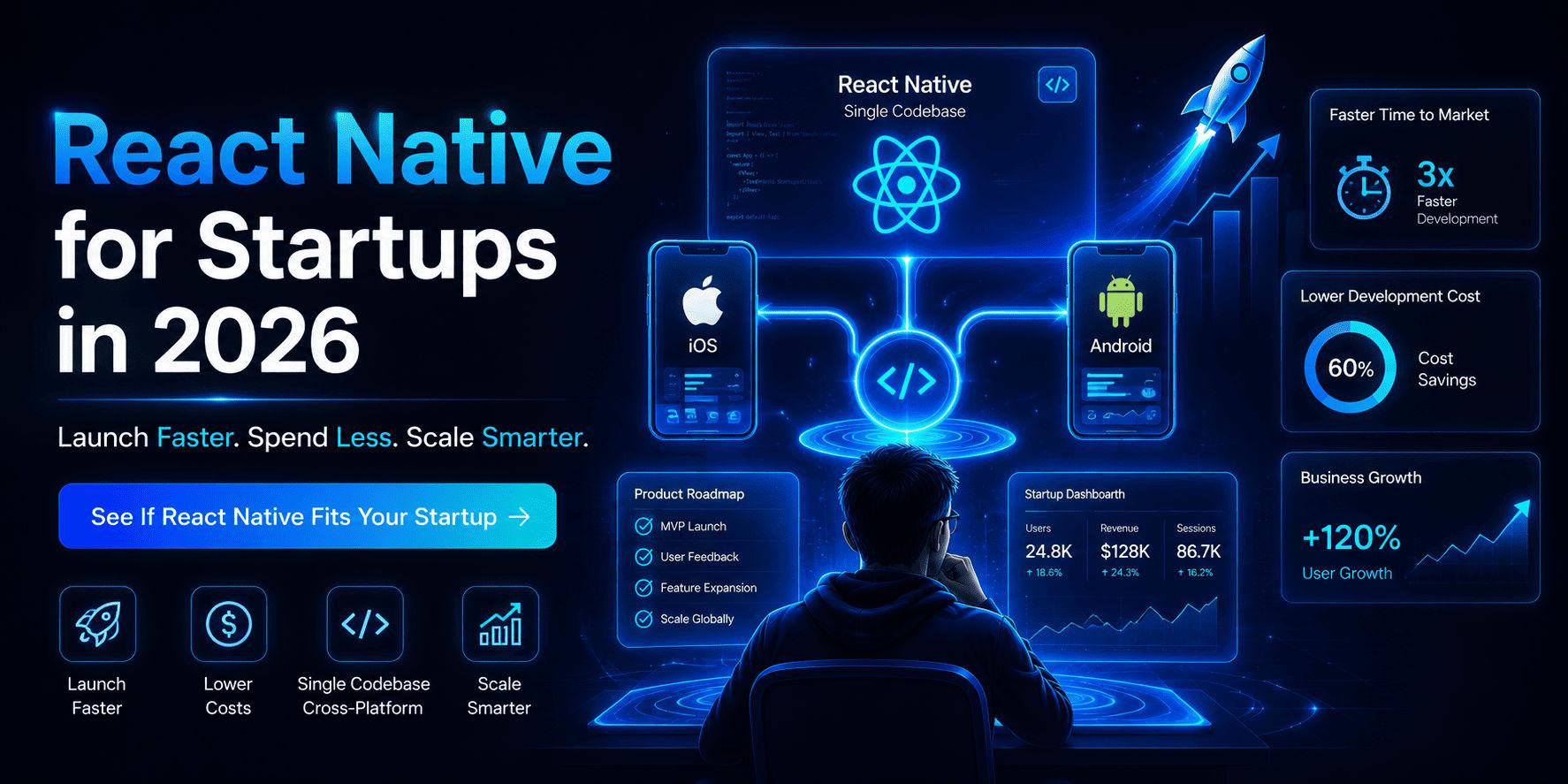
Every startup faces the same early mobile decision: build native apps for iOS and Android separately, or find a smarter path. React Native is that smarter path for the majority of startup use cases but only if you understand what you're actually signing up for.
This guide is written for founders, CTOs, and product leaders making a real technology decision not for developers looking for a tutorial. By the end, you'll know whether React Native fits your product, your team, and your funding stage, along with a concrete framework to make the call.
What Is React Native?
React Native is an open-source mobile app framework created by Meta (Facebook) that lets developers build applications for both iOS and Android using a single JavaScript codebase. Instead of maintaining separate codebases in Swift (iOS) and Kotlin (Android), your team writes once and deploys to both platforms.
For non-technical founders, the business analogy is straightforward: imagine writing one user manual that works for two different products simultaneously. You update the manual once, and both products reflect the change.
| Quick Facts | React Native |
| Created by | Meta (Facebook) |
| Initial Release | 2015 |
| Language | JavaScript / TypeScript |
| Platforms | iOS + Android (+ Web via React Native Web) |
| Notable Production Users | Meta, Shopify, Discord, Tesla, Coinbase, Bloomberg |
| Architecture (2026) | New Architecture — Fabric renderer, JSI bridge |
For a deeper technical overview of how the framework operates, see SpaceToTech's React Native App Development Services page.
Why Startups Choose React Native in 2026
Startup decisions are constrained decisions. You are working with limited runway, a small team, and a product that may need to pivot. React Native was built for exactly this environment not because Meta designed it with startups in mind, but because its architecture naturally aligns with startup constraints.
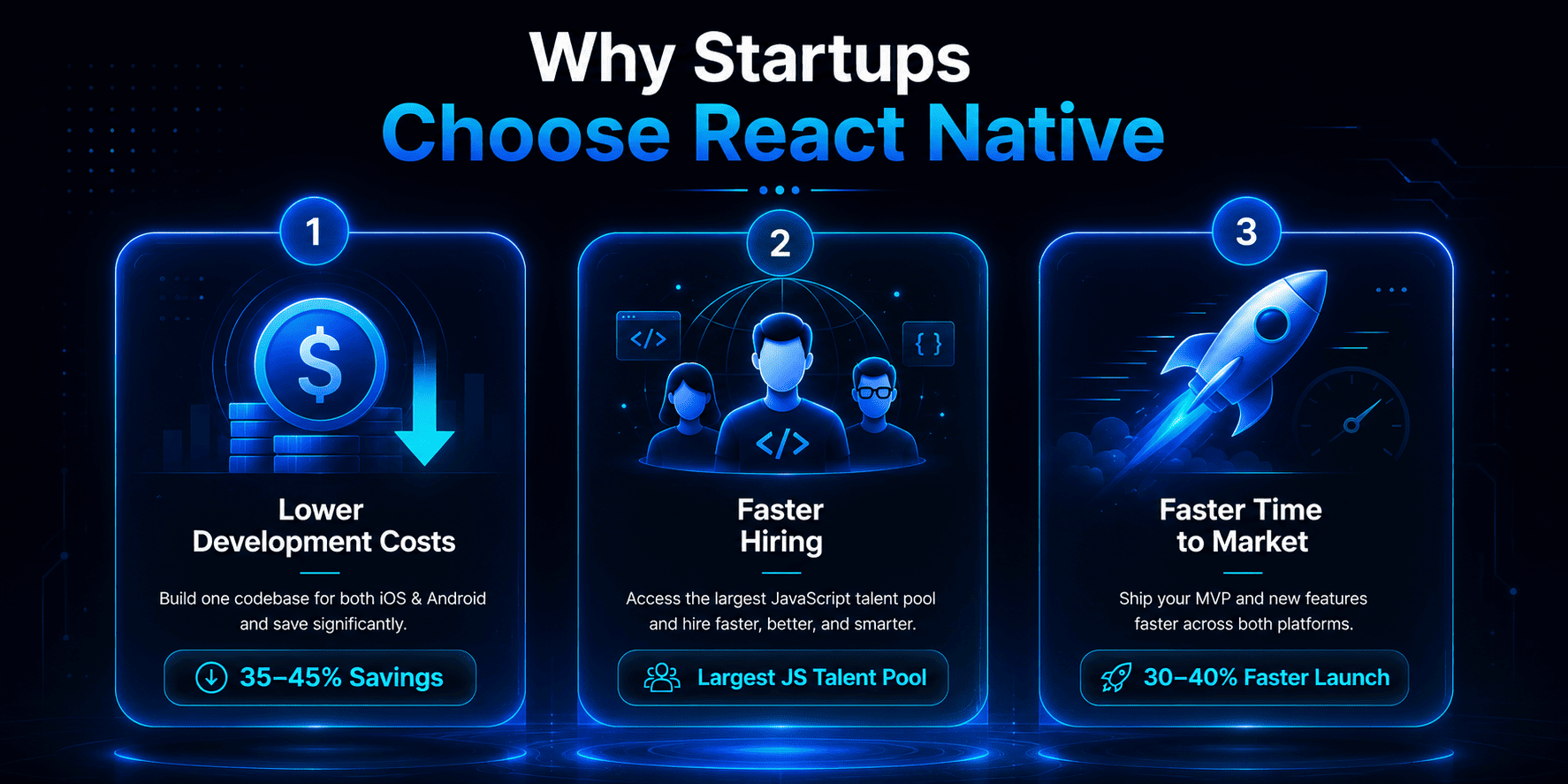
Three specific advantages make React Native the default choice for most early-stage mobile products:
Cost Efficiency That Extends Runway
A single codebase means one development team instead of two. That difference compounds: one QA process, one deployment pipeline, one set of UI components to maintain. For a pre-seed startup spending $50,000 on an MVP, the difference between React Native and dual native development can be $20,000–$40,000 — that's additional months of runway, not just a line-item savings.
Faster Hiring and Smaller Engineering Teams
React Native draws from the JavaScript talent pool the largest developer community in the world. When you're hiring a first mobile developer or evaluating an offshore development partner, the available talent is significantly broader than the Kotlin or Swift-specific pools. This matters practically: shorter hiring timelines, more competitive rates, and better selection at any given budget.
Community, Ecosystem, and Long-Term Viability
React Native's GitHub repository consistently ranks among the most-starred open-source mobile frameworks. The 2023–2024 New Architecture release (Fabric renderer + JSI bridge) addressed the most common performance criticisms that had followed the framework since 2017. In 2026, the objection that React Native is 'not production-ready' no longer holds. The companies shipping on it Discord, Shopify, Coinbase have production standards that most startups won't approach for years.
How React Native Helps Startups Launch Faster
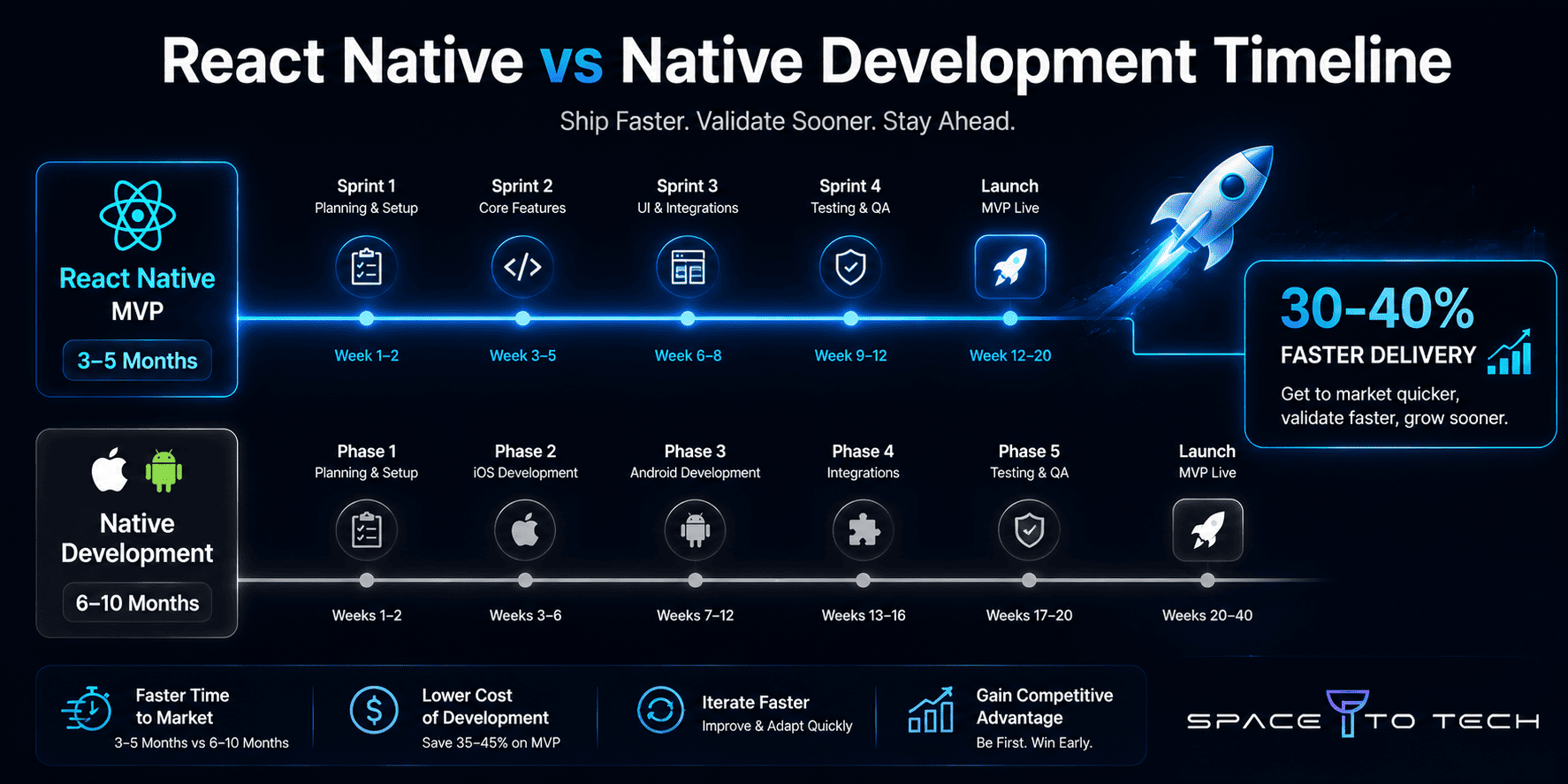
Single Codebase, Two Platforms, Half the Timeline
The most direct time-to-market benefit is simple arithmetic. A native iOS app and a native Android app built by separate teams takes 6–10 months for a full MVP. A React Native team building both simultaneously takes 3–5 months. That timeline difference is the difference between launching before a competitor and launching after one.
React Native's hot reloading capability compounds this advantage during iteration. When your PM identifies a UX problem during testing, the fix ships to both platforms simultaneously. There is no 'iOS version of that bug fix ships next week' situation a reality that anyone who has shipped native apps knows is frustratingly common.
Iterating Toward Product-Market Fit Faster
Lean startup methodology is built on the cycle: build, measure, learn. React Native shortens the build phase, which means more cycles in the same timeframe. If your product is pre-PMF — which is true of almost every startup at the MVP stage the ability to run two additional iterations in the time your competitor runs one is a genuine competitive advantage, not just a development efficiency.
How React Native Reduces MVP Development Costs
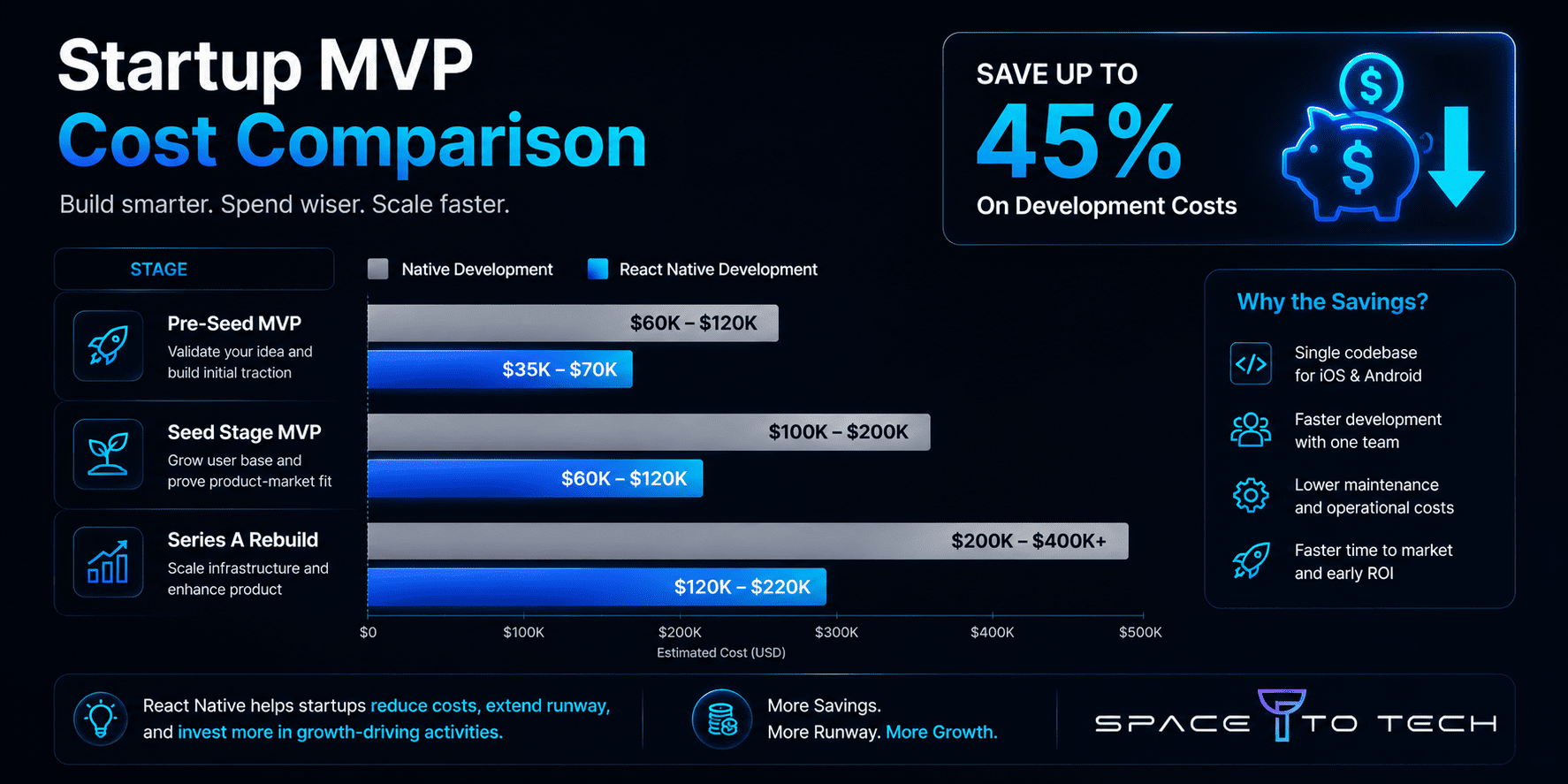
Cost transparency is something most React Native articles avoid. Here are concrete ranges by funding stage, based on typical project scopes:
| MVP Stage | Native iOS + Android | React Native | Estimated Saving |
| Pre-Seed MVP | $60,000 – $120,000 | $35,000 – $70,000 | ~40–45% |
| Seed-Stage MVP | $100,000 – $200,000 | $60,000 – $120,000 | ~35–40% |
| Series A Rebuild | $200,000 – $400,000+ | $120,000 – $220,000 | ~35–45% |
Note: Ranges depend on features, team location, and complexity. For a detailed breakdown, see SpaceToTech's React Native App Development Cost guide.
The savings come from three compounding factors: shared UI components (built once, used on both platforms), a single QA team running one test suite, and shared backend integration work. Add working with an experienced offshore React Native development partner, and those cost ranges compress further Indian-based agencies typically charge $25–$50/hr versus $100–$250/hr for US firms, for comparable technical output.
SpaceToTech's React Native App Development Services are built around this model transparent pricing, dedicated teams, and a track record of delivering for global clients across the US, UK, UAE, and Australia.
React Native vs Native Development for Startups
This is a business decision, not a technical one. The question is not 'which framework is more powerful' it's 'which approach fits our constraints.'
| Factor | React Native | Native (iOS + Android) |
| Team Size | 1–2 developers | 2–4 developers (separate teams) |
| Time to MVP | 3–5 months | 6–10 months |
| Cost (MVP) | $35K – $120K | $60K – $200K+ |
| Codebase | Single shared codebase | Two separate codebases |
| Performance | Near-native (New Architecture) | Fully native |
| Best For | Startups, MVPs, SaaS apps | Games, AR/VR, hardware-intensive apps |
Where native development genuinely wins: apps that require deep hardware integration (custom Bluetooth controllers, specialized camera sensors), high-frame-rate graphics engines, or AR/VR experiences. For the vast majority of startup use cases consumer apps, SaaS mobile products, marketplace apps, fintech products React Native is the more rational choice.
React Native vs Flutter for Startups
Flutter is a serious competitor and deserves an honest comparison. The decision comes down to your team's existing skills and your hiring market.
| Factor | React Native | Flutter |
| Language | JavaScript / TypeScript | Dart |
| Developer Pool | Very large (JS ecosystem) | Growing, but smaller |
| Backed By | Meta (Facebook | |
| UI Customization | Good | Excellent (Skia renderer) |
| Web Support | Partial (RN Web) | Strong |
| Best For | JS-fluent teams, startup MVPs | UI-priority apps, Dart-fluent teams |
The practical recommendation: if your existing team or your planned hires know JavaScript or React, React Native is the clear choice. The talent pool advantage is real there are dramatically more React Native developers available for hire globally than Dart/Flutter specialists, which translates to faster hiring and lower rates.
If UI consistency across platforms is your primary product differentiator, and you're willing to invest in Dart training or find Flutter-specific talent, Flutter is worth evaluating.
For a deeper technical comparison, see our React Native vs Flutter breakdown.
Startup Success Stories Built with React Native
Social proof matters but context matters more. These companies did not choose React Native because it was trendy. They chose it because it solved a real business problem.
- Meta (Facebook): Built the original React Native framework to solve their own cross-platform problem. The fact that Meta continues to invest in and maintain the framework is the strongest possible signal of long-term viability.
- Shopify: Migrated their mobile commerce products to React Native and has publicly praised the developer experience and performance outcomes. For a company processing billions in GMV, this is not a casual decision.
- Discord: Built their mobile apps on React Native and has maintained them through significant scale, with documented engineering blog posts on performance optimisation at volume.
- Coinbase: Chose React Native for their crypto wallet and exchange apps, where security and reliability are non-negotiable product requirements.
- Bloomberg: Rebuilt their market data terminal mobile app on React Native, prioritising development speed and team consolidation over native performance margins.
The pattern across these companies: React Native was chosen for speed, team efficiency, and cost not as a compromise. That's the same reason it makes sense for startups today.
Can React Native Scale as Your Startup Grows?
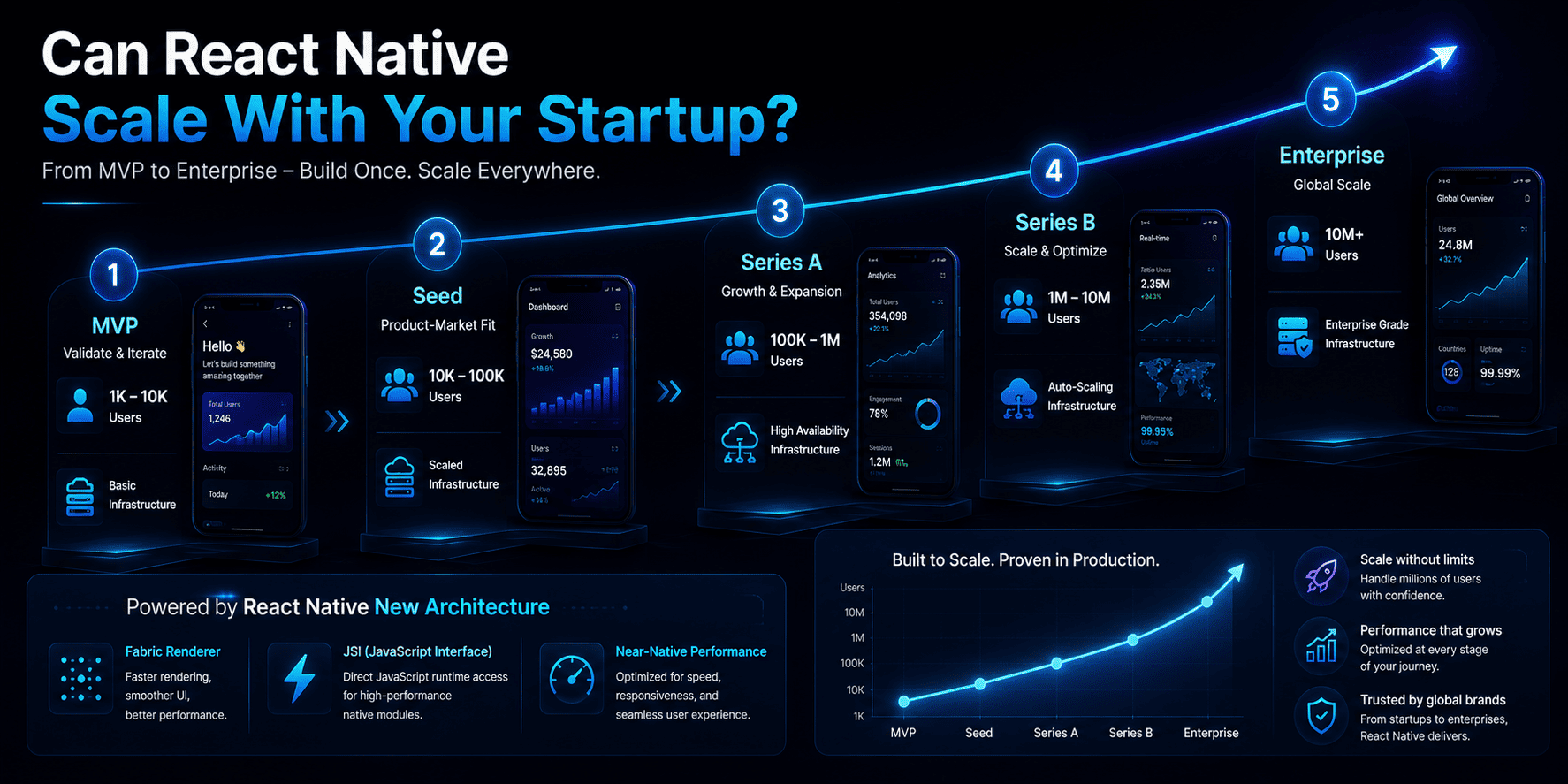
This is the most common objection from CTOs and technical investors, and it deserves a direct answer: yes, React Native scales with one important clarification.
Most startup scaling problems are backend and infrastructure challenges, not frontend framework challenges. Your database, API layer, caching strategy, and CDN architecture will determine whether your product survives rapid user growth not whether you built your mobile frontend in React Native or Swift.
| Startup Stage | React Native Suitability | Notes |
| Pre-Seed / MVP | Excellent | Ideal speed and cost matter most |
| Seed (0–10K users) | Excellent | No performance issues at this scale |
| Series A (10K–100K users) | Very Good | May need native modules for specific features |
| Series B+ (100K+ users) | Good | Architecture review recommended |
| Enterprise / IPO Scale | Case-by-case | Evaluate based on app complexity |
React Native's New Architecture (released 2023–2024) addressed the primary technical objection that had followed the framework for years the JavaScript bridge bottleneck. The Fabric renderer and JSI (JavaScript Interface) bring React Native meaningfully closer to native performance. For any startup planning to raise a Series A or beyond, this is an important update that changes the calculus compared to evaluations made pre-2023.
For architecture-specific guidance relevant to your startup stage, see our React Native Architecture resource.
When React Native Is NOT the Right Choice
Any advisor who tells you React Native is always the right answer is selling you something. Here is when to reconsider:
- Graphics-intensive games or AR/VR apps: Frame-rate-critical rendering still performs better in native code. If your product's core experience is a 3D environment or augmented reality, go native or use a dedicated game engine.
- Deep device hardware integration: If your app needs to communicate with proprietary Bluetooth hardware, custom sensors, or specialized device APIs, the additional native module work can erode the cost advantage.
- Swift/Kotlin-only teams with no JavaScript experience: Retraining cost is real. If your engineering team is native-only and you are mid-project, switching frameworks creates risk rather than efficiency.
- Single-platform products: If you only need an iOS app — for an enterprise internal tool, for example — the cross-platform advantage disappears. Native iOS development makes more sense.
- Frame-rate-critical animations as a core product feature: High-frequency animations that define the product experience (think Lottie-heavy onboarding, physics simulations) can strain React Native's runtime even with the New Architecture.
Being transparent about these limitations is more valuable to a founder than a blanket endorsement. If your use case falls in this list, the right answer is to say so early rather than rebuild later.
Is React Native Worth It for Startups in 2026?
Yes for the majority of startup mobile products, React Native is the pragmatic, cost-effective, and founder-rational choice in 2026.
The three strongest reasons come down to economics: it cuts development costs by 35–45%, reduces time to MVP by 30–40%, and gives you access to the widest developer talent pool available for mobile development. The New Architecture updates have removed the most credible technical objections, and the production track record of companies like Shopify and Discord has validated it at significant scale.
The question is not whether React Native is worth it as a framework it is whether it fits your specific product, team, and stage. The decision framework below helps you answer that.
Decision Framework for Startup Founders
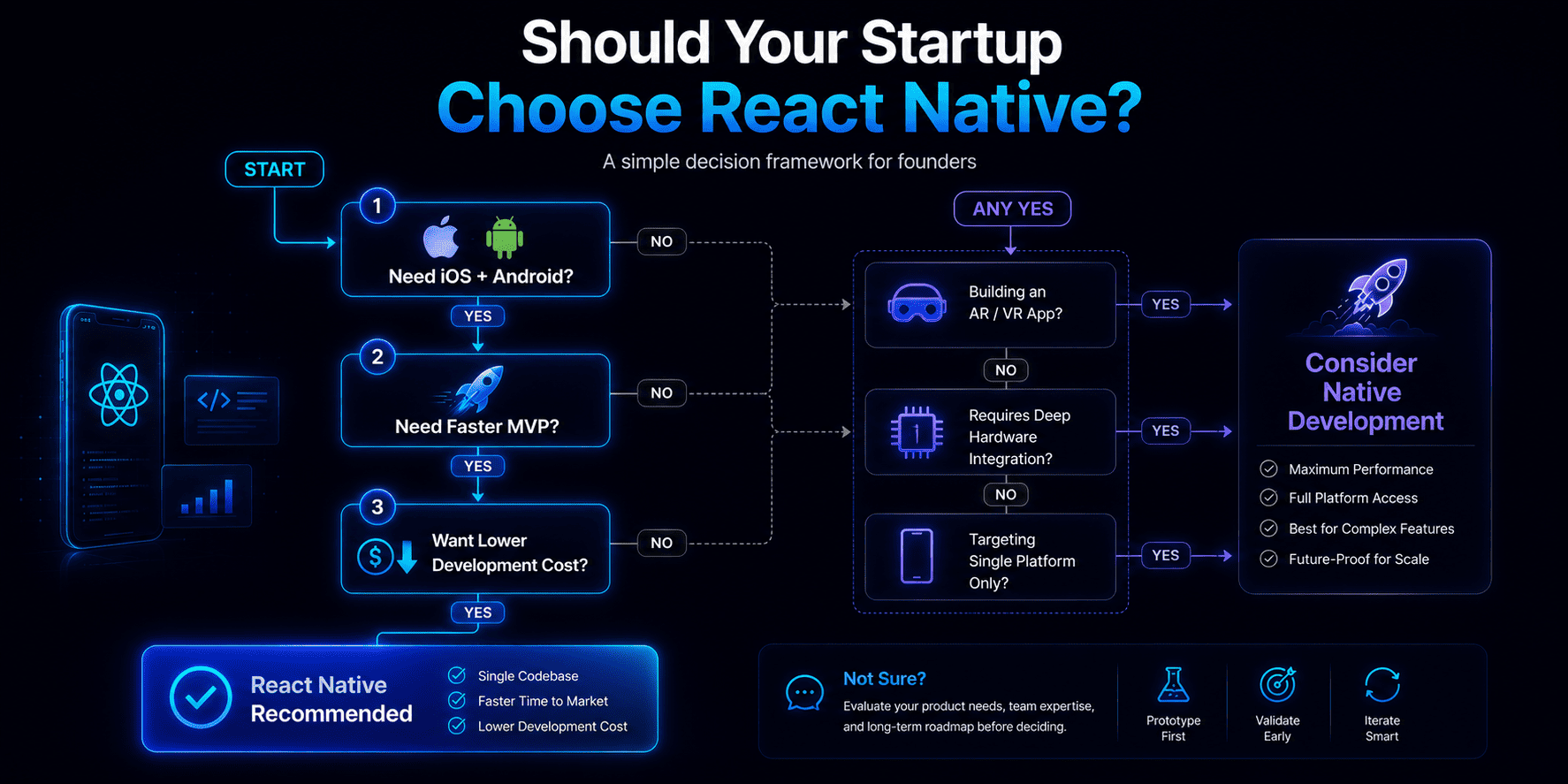
Run through this before briefing your first developer or development agency. It takes five minutes and will prevent months of the wrong technical direction.
| Choose React Native If | Reconsider If |
| You need iOS + Android from day one | Your app requires AR/VR or 3D graphics as a core feature |
| You want to extend runway and reduce dev costs | Your team is native-only (Swift/Kotlin) with no JS experience |
| You're validating an MVP before raising a seed round | Your product requires deep device hardware integration |
| Your team knows JavaScript or React | Your core feature depends on frame-rate-critical animations |
| You need to scale post-funding but move fast now | You're building for a single platform only |
| You want access to a large global developer pool | Your investors have explicitly required a native-only stack |
Final Recommendations
React Native is the right starting point for most startup mobile products in 2026. The architecture is mature, the ecosystem is large, the talent pool is deep, and the cost and speed advantages over native development are consistent and meaningful.
The most common mistake founders make is not choosing the wrong framework it's choosing the right framework and implementing it poorly. React Native's architecture patterns, performance optimisation techniques, and security practices require experience to get right. A first-time React Native project built by developers learning the framework on your budget will not deliver the advantages described in this guide.
If you want to build your startup's mobile product on React Native and want experienced development partners not generalists SpaceToTech React Native App Development Services is the right place to start the conversation. We work with founders at pre-seed through Series B stages, across the US, UK, UAE, and Australia.
Already have a rough product brief? Contact SpaceToTech for a no-obligation project estimate.