Hiring React Native developers has become one of the more consequential decisions a business makes before building a mobile product. It is not just a technical question. It affects your timeline, your budget, and whether the app you ship actually holds together six months after launch. React Native now pulls over 1.6 million weekly npm downloads as of 2026, which tells you the demand is real, but it also means the talent pool is uneven. Not every developer who lists React Native on a resume has shipped a production app that survived real user load.
This guide covers everything you need to make that decision properly: what skills to look for when you hire React Native app developers, how the hiring process should actually work, what dedicated vs freelance looks like in practice, how much it costs by region, and why India has become the default sourcing option for global companies. If you are already exploring React Native app development services for your project, this will help you evaluate who you are working with.
What Is a React Native Developer?
A React Native developer builds mobile applications for both iOS and Android using JavaScript and React, from a single codebase. They handle UI components, state management, API integration, third-party integrations, and app store deployment. What separates a strong React Native developer from an average one in 2026 is familiarity with the New Architecture, specifically JSI (JavaScript Interface), Turbo Modules, and the Fabric renderer, which became the default in React Native 0.76, released in late 2024.
If you want a fuller picture of what the framework can do and where it fits in the mobile development landscape, our complete React Native app development guide covers the architecture, use cases, and technical depth in detail.
Why Businesses Choose React Native for Mobile App Development
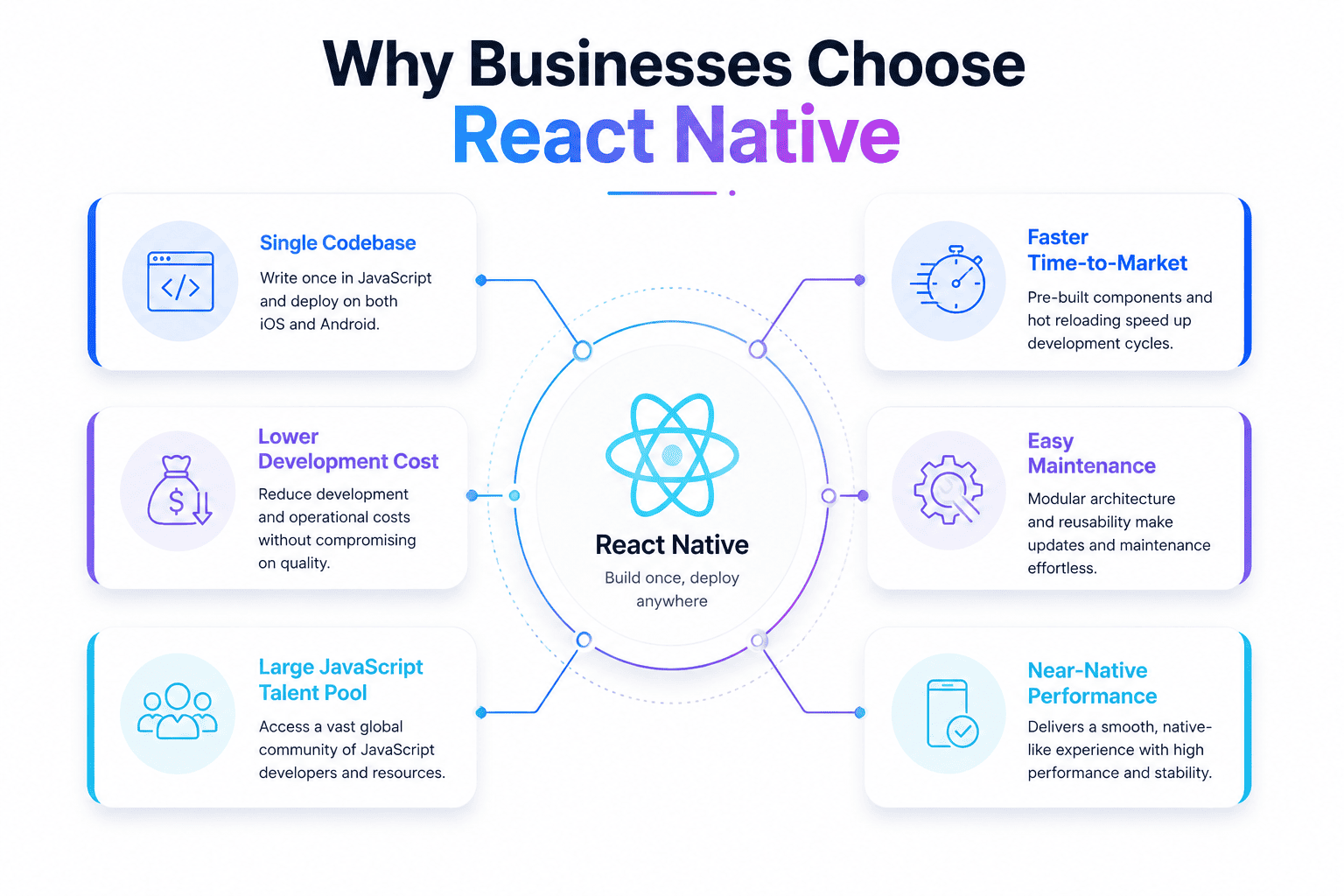
The core business case for React Native is straightforward. One codebase serves both iOS and Android, which means one team, one QA cycle, one deployment, and one maintenance overhead. For businesses managing cost and timeline, that structure changes the economics of mobile development in a meaningful way.
Here is why companies across industries continue to choose it:
- A single development team covers both platforms, cutting team size by roughly half compared to separate native builds.
- Time to market is faster because features ship to both stores simultaneously, with no parallel sprint coordination between platform teams.
- React Native draws from the JavaScript talent pool, the largest developer community in the world, which makes hiring and replacement faster than native-only stacks.
- After the New Architecture, performance gaps between React Native and native apps are minimal for the vast majority of business use cases.
- It is backed by Meta and used in production by Shopify, Microsoft, Discord, and Bloomberg, which signals long-term viability.
If you are still evaluating whether React Native fits your project or weighing it against another framework, our comparison of React Native vs Flutter breaks down the decision across cost, hiring, performance, and team composition. You can also read our analysis of React Native vs Native app development if you are deciding between cross-platform and fully native builds.
When Should You Hire React Native Developers?
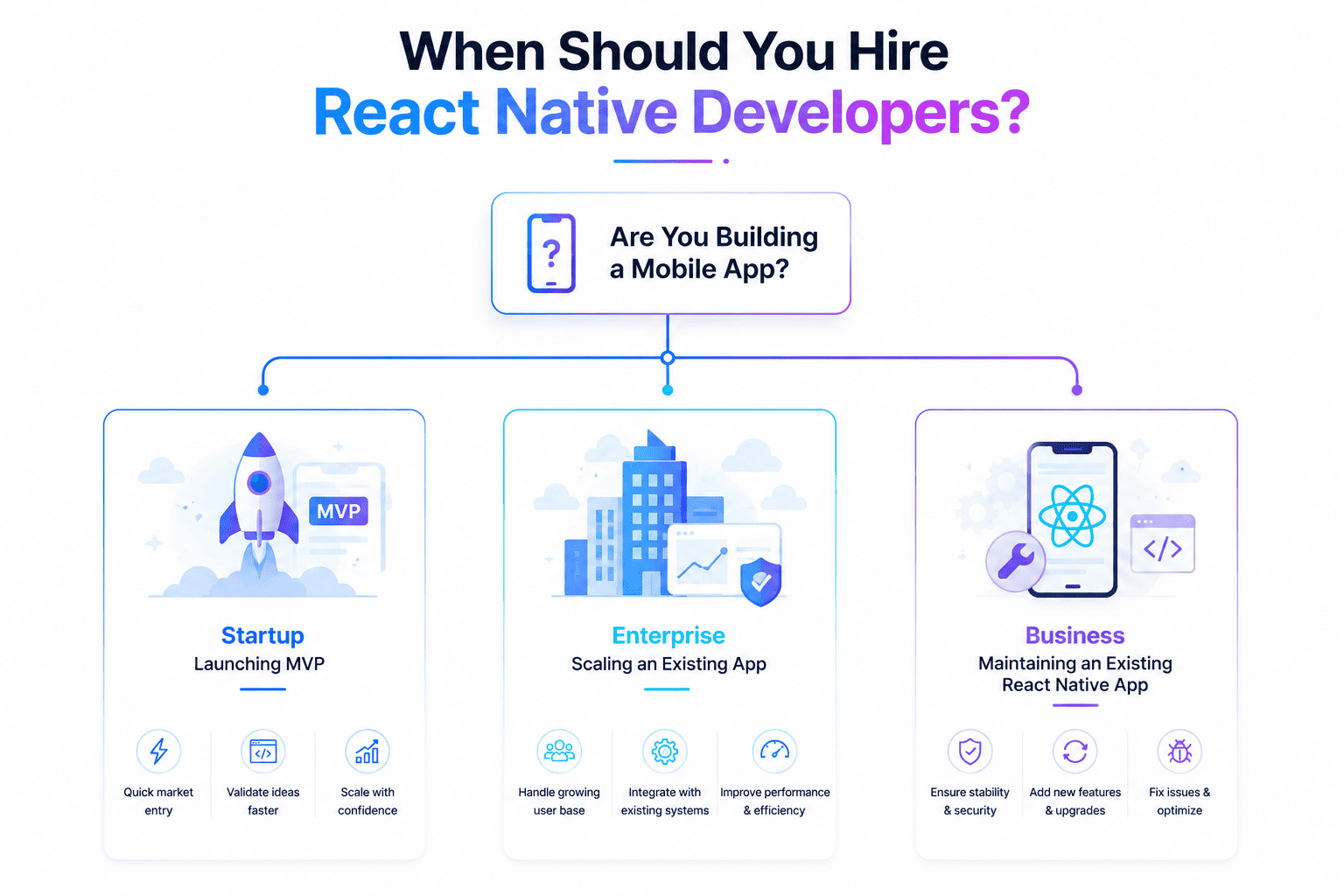
The right time to hire React Native developers depends on what you are building and where you are in the product lifecycle. Here are the three scenarios where it makes the most sense.
Startups Building Their First App
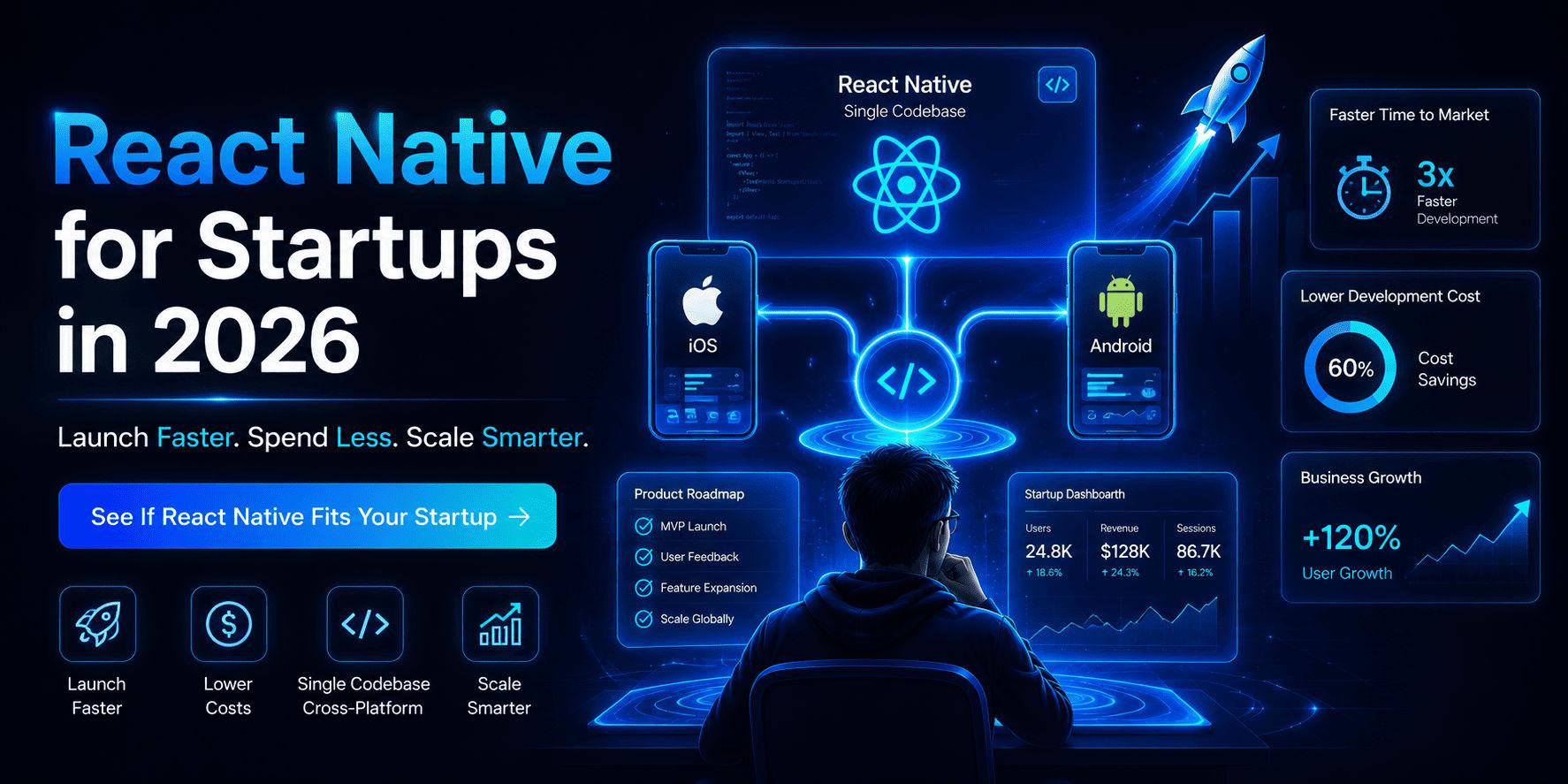
Startups benefit the most from React Native because it compresses both cost and timeline at the stage when both matter most. A React Native team can ship an MVP to both iOS and Android in 3 to 5 months. A native approach for both platforms often runs 6 to 10 months. That difference is runway. If your product is pre-revenue and you need to validate the idea fast, React Native is the rational choice. Our guide on React Native for startups goes deeper on how the economics play out by funding stage.
Enterprises Scaling Their Mobile Product
Enterprise teams with existing React or JavaScript engineers can onboard React Native developers with less ramp-up time than a native hire would require. React Native also supports over-the-air updates, which means you can push fixes and feature changes without waiting for App Store review cycles, a meaningful operational advantage for large-scale products. The framework handles enterprise mobile apps reliably at significant scale, with Shopify as the most frequently cited production example.
Businesses Maintaining an Existing App
If you have a React Native app already in production and need to add features, improve performance, or integrate new services, a dedicated development team gives you consistent code quality over time. App maintenance gets messy when different freelancers have touched the codebase at different stages. A stable team with knowledge of your architecture avoids that problem.
Skills to Look for When Hiring React Native Developers
Most hiring mistakes happen here. Businesses write job descriptions asking for JavaScript experience and end up interviewing developers who have never shipped a production React Native app. Here is what actually matters.
Core Technical Skills
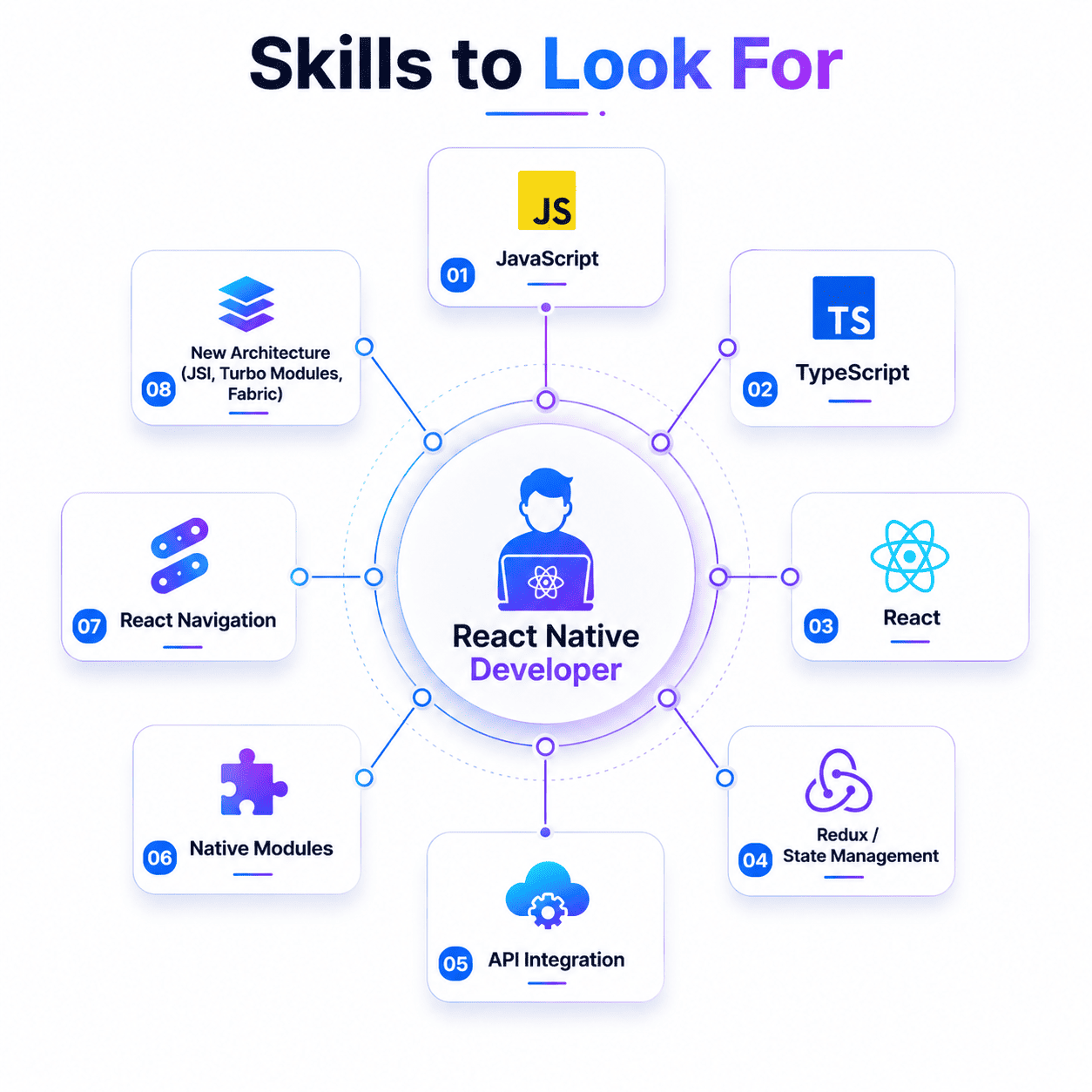
A solid React Native developer should have strong JavaScript ES6+ fundamentals and TypeScript discipline. TypeScript matters more than it used to because it prevents type-related bugs that compound fast in larger codebases and cross-team work. Beyond language, look for genuine React fluency: hooks, component lifecycle, clean state management using Redux or Zustand. These are not optional extras. They define whether a developer can write code your next hire can actually maintain.
React Native Specific Knowledge
Navigation (React Navigation), third-party integrations (payment gateways, push notifications, maps), and native modules are the practical workhorses of most React Native projects. In 2026, any developer worth hiring should also have a working understanding of the New Architecture. JSI replaced the old asynchronous bridge, Turbo Modules replaced legacy native modules, and Fabric replaced the old renderer. This is baseline knowledge now, not specialist depth. A developer who still builds primarily on the old bridge is accumulating technical debt on your behalf.
Portfolio Review and Code Quality
Ask to see apps on the App Store or Google Play that the developer actually shipped. Then check their GitHub. Look at how they structure components, whether they write tests, and how their commit history reads. A clean portfolio with verifiable links tells you more than four interview rounds. Generic claims like 'I have built 40 apps' without a single link you can open are a red flag. Code quality is not just a technical preference. It directly determines how expensive your app is to maintain over time.
Communication Skills
This matters especially for remote and offshore teams. A strong developer does not just answer your questions. They ask clarifying questions before committing to timelines. If someone says 'two weeks' without understanding the scope, that timeline is a guess, not a plan. Look for developers who push back constructively, flag scope risks early, and maintain a development workflow that keeps you informed without requiring you to chase them.
Senior vs Mid-Level vs Junior React Native Developers
Matching seniority to your project requirements is one of the most practical decisions in the hiring process. Overhiring for a simple app wastes budget. Underhiring for a complex integration creates technical debt that compounds over time.
For most startup MVPs and mid-sized product builds, a combination of one senior React Native developer and one or two mid-level developers is the most cost-effective structure. The senior sets the architecture and reviews the work. The mid-levels build at speed.
Freelance vs Dedicated React Native Developers
When Freelance Works
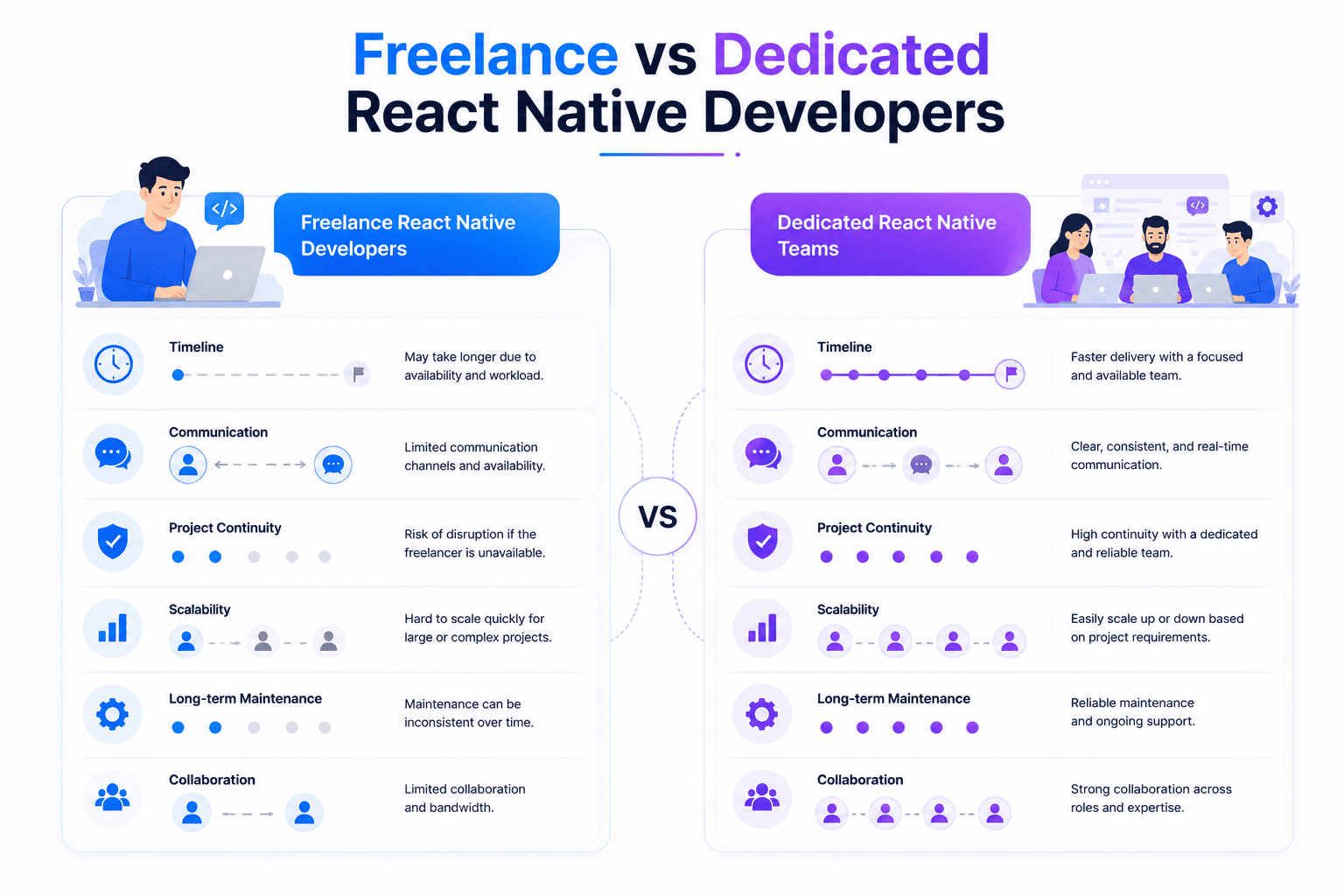
Freelance works for short, clearly scoped projects: a single feature addition, a bug audit, a one-time API integration. The engagement is fast to start and easy to end. The risk is continuity. If a post-launch issue hits and the freelancer is between projects or unavailable, you are stuck. Freelancers also have no institutional knowledge of your codebase, which means onboarding cost eats into the efficiency gain every time you bring someone new in.
When a Dedicated Development Team Works Better
For ongoing product development, a dedicated React Native developer or team is almost always the better structure. A dedicated developer is embedded in your workflow, understands your codebase, communicates within your sprint cycle, and brings continuity that a freelance rotation cannot provide. The outcome is consistent code quality, fewer surprises at launch, and a development workflow that improves over time rather than resetting with each new hire. This model is what SpaceToTech runs for its global clients: dedicated teams that work as a true extension of your product organisation, not rotating contractors.
How to Hire React Native Developers: Step-by-Step Process
Most hiring processes for React Native developers fail for the same reason: the job description is written before anyone has agreed on what the developer will actually build. Here is the process that consistently works.
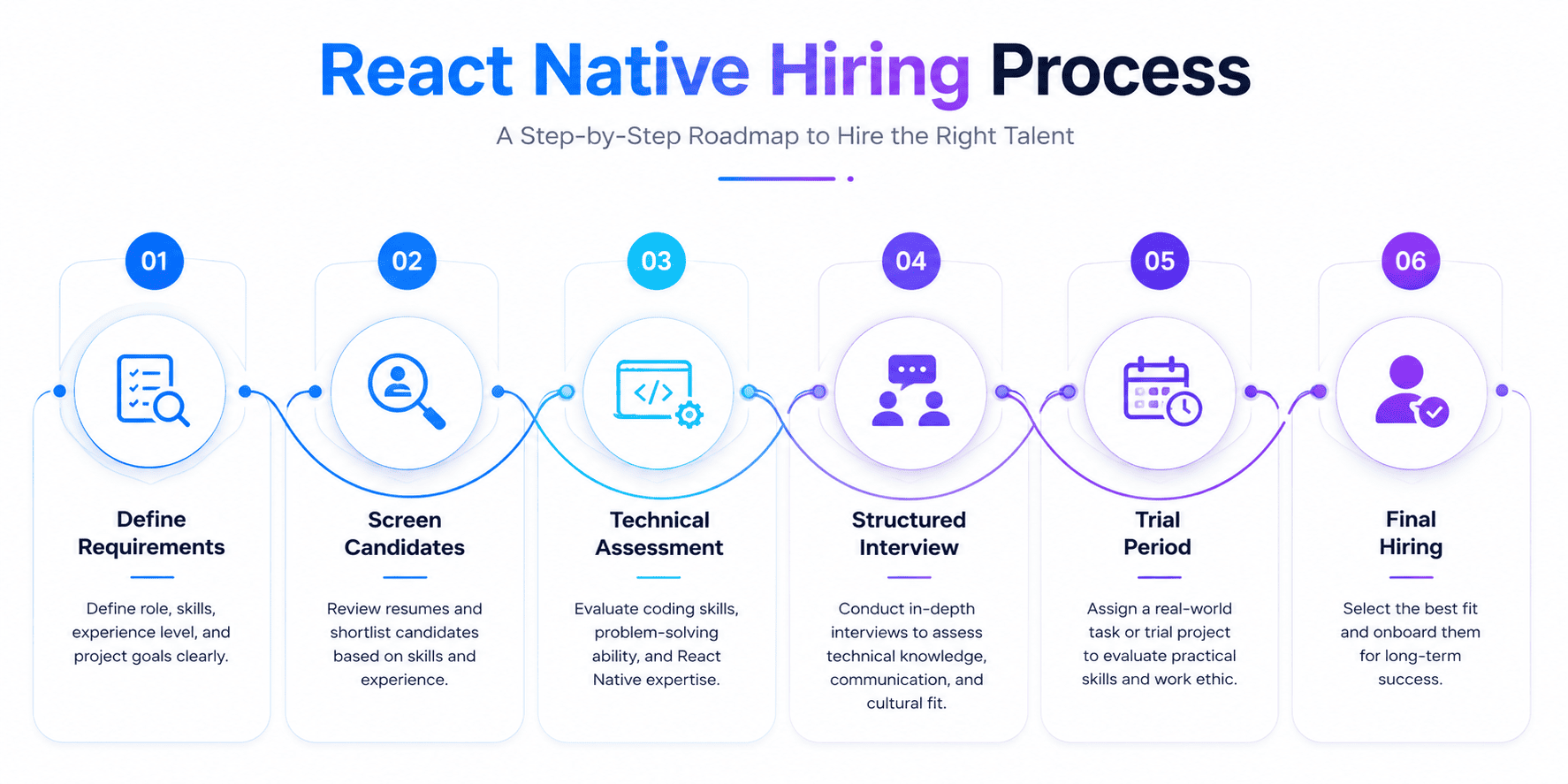
Step 1: Define Your Project Requirements Before Writing a Job Post
Write down four things before you post anywhere: the exact mobile problem this hire solves (not 'build an app' but what the app must do), your timeline, the non-negotiable technical skills (Expo vs Bare React Native, specific integrations required), and the criteria you will use to evaluate success. If your CTO and your tech lead cannot agree on this document, they will disagree on every candidate you interview. Misaligned requirements at the start of the hiring process is the single biggest predictor of a failed hire.
Step 2: Screen Candidates on Technical Depth
Years of experience is a starting filter, not a measure of skill. Ask specific questions about recent work: What was the last app you shipped, and what was the hardest technical problem you solved on it? Have you worked with the New Architecture? How did you handle state management on a project with more than three developers? Candidates who answer in generalities have not solved those problems. Candidates who give specific, concrete answers probably have.
Step 3: Run a Practical Technical Assessment
Give candidates a 2 to 3 hour task that reflects real project work: integrate a third-party API, debug a state management issue, or build a small feature from a spec. Avoid algorithm puzzles and LeetCode-style problems. Application developers are not optimising search trees in production. What you want to see is how they approach a real problem, how they communicate when something is unclear, and what their code looks like when they are not performing for an interview.
Step 4: Conduct a Structured Interview
Prepare questions that test trade-off thinking, not definitions. 'What is JSI?' is not a useful interview question. 'Walk me through how you decided between Expo managed workflow and Bare React Native on your last project' tells you whether they have actually faced that decision. Ask how they handle a project where scope starts expanding. Ask what they would do differently on their most recent app. Open-ended, experience-based questions surface real capability faster than technical trivia.
Step 5: Start with a Trial Period
For dedicated or long-term engagements, a paid one-week trial task reduces risk for both sides. You evaluate code quality, communication style, and how they handle your existing codebase before committing to a full engagement. A developer who is reluctant to do a paid trial, when the task is fair and scoped, is worth noting.
How Much Does It Cost to Hire React Native Developers?
Development cost varies significantly based on where the developer is located, how senior they are, and which engagement model you use. Here is what businesses are paying in 2026:
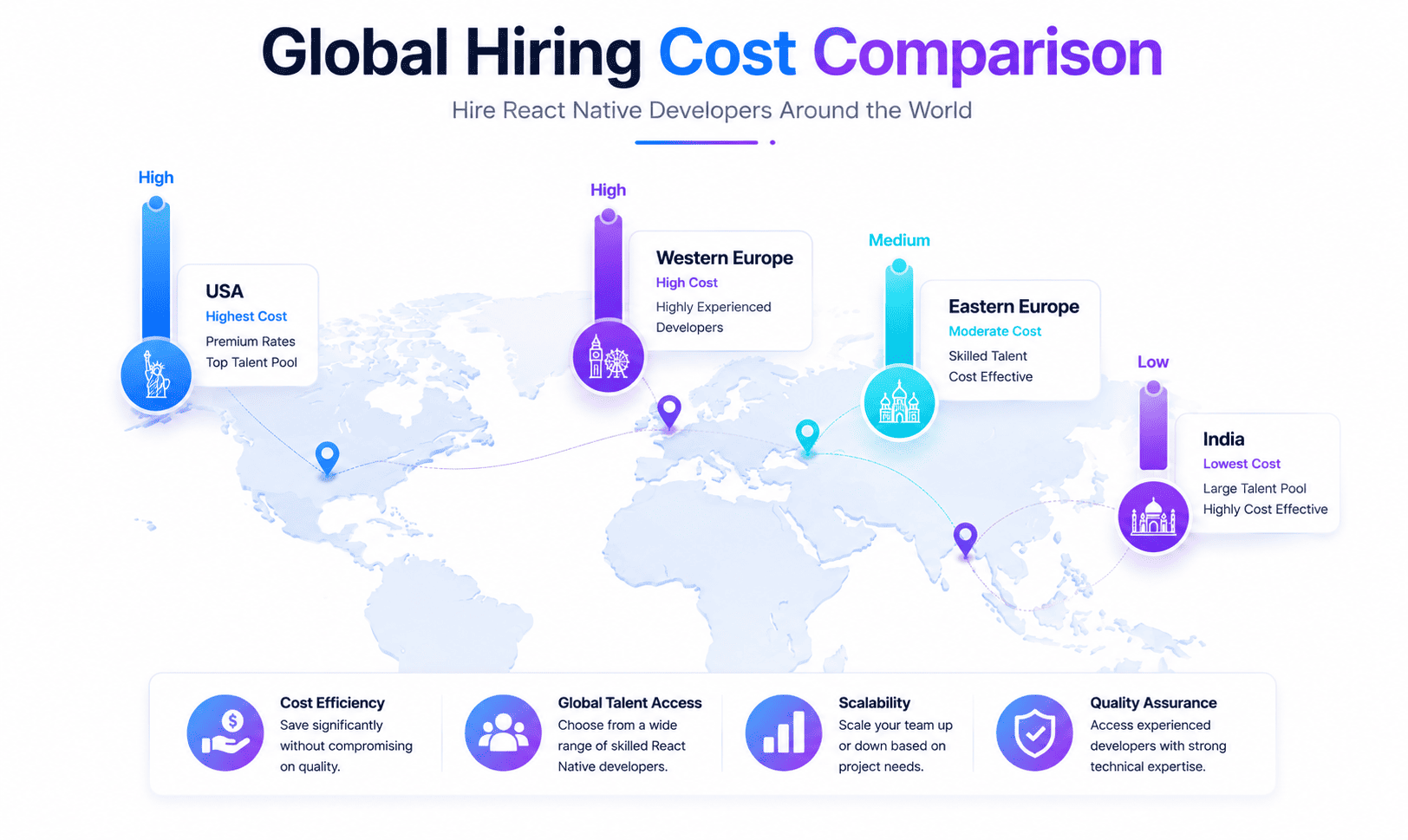
Indian React Native developers typically cost 40 to 70 percent less than US-based counterparts. For a startup managing burn rate, that difference is not just a cost saving. It translates directly into additional development months at the same budget. A team that would cost $18,000 per month in the US often runs $4,000 to $5,000 per month when you hire dedicated React Native developers from India through a structured agency model.
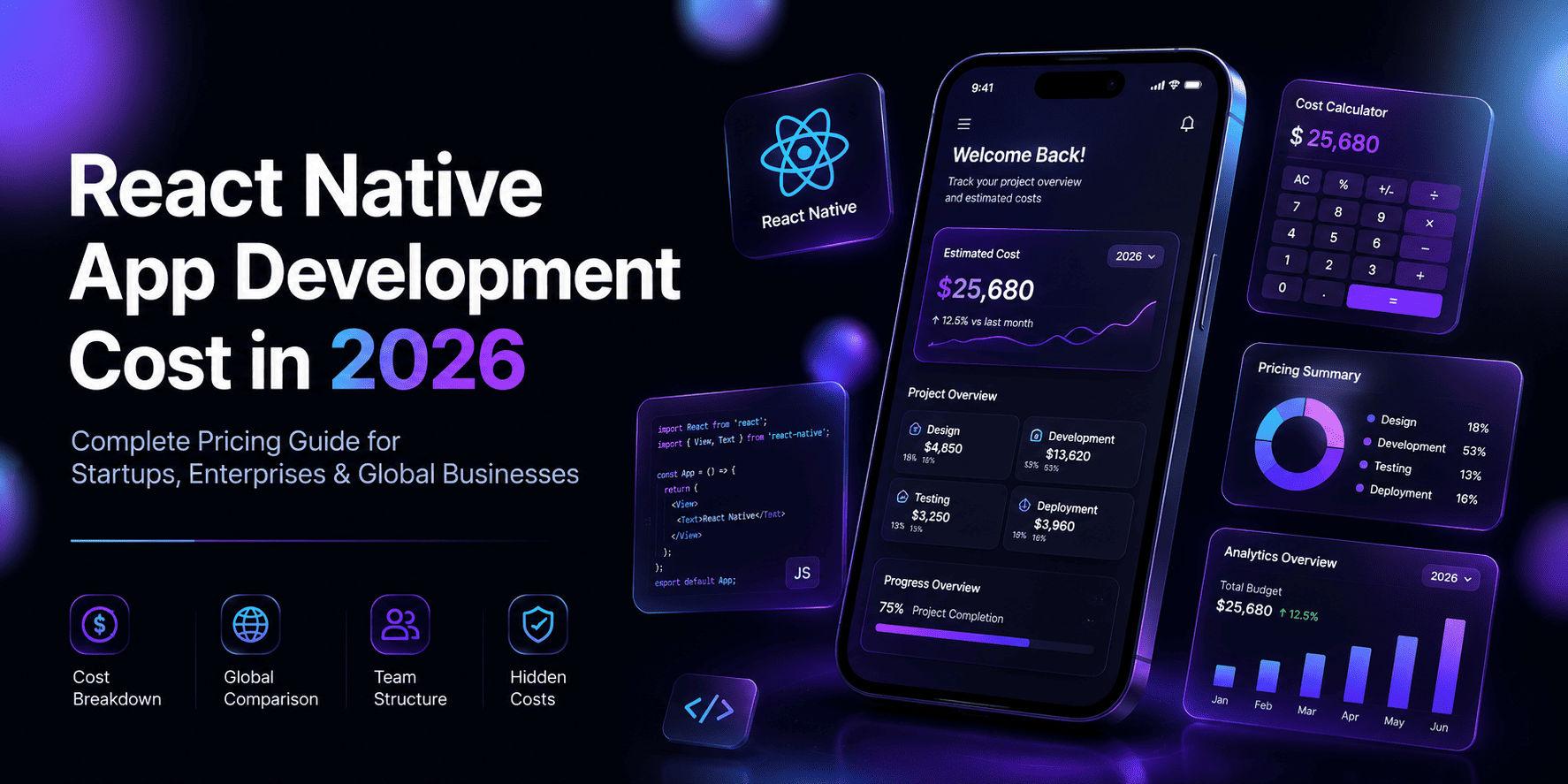
For a detailed breakdown of what different project types actually cost, our React Native app development cost guide for 2026 covers this by feature set, team size, and region.
Common Mistakes to Avoid When Hiring React Native Developers
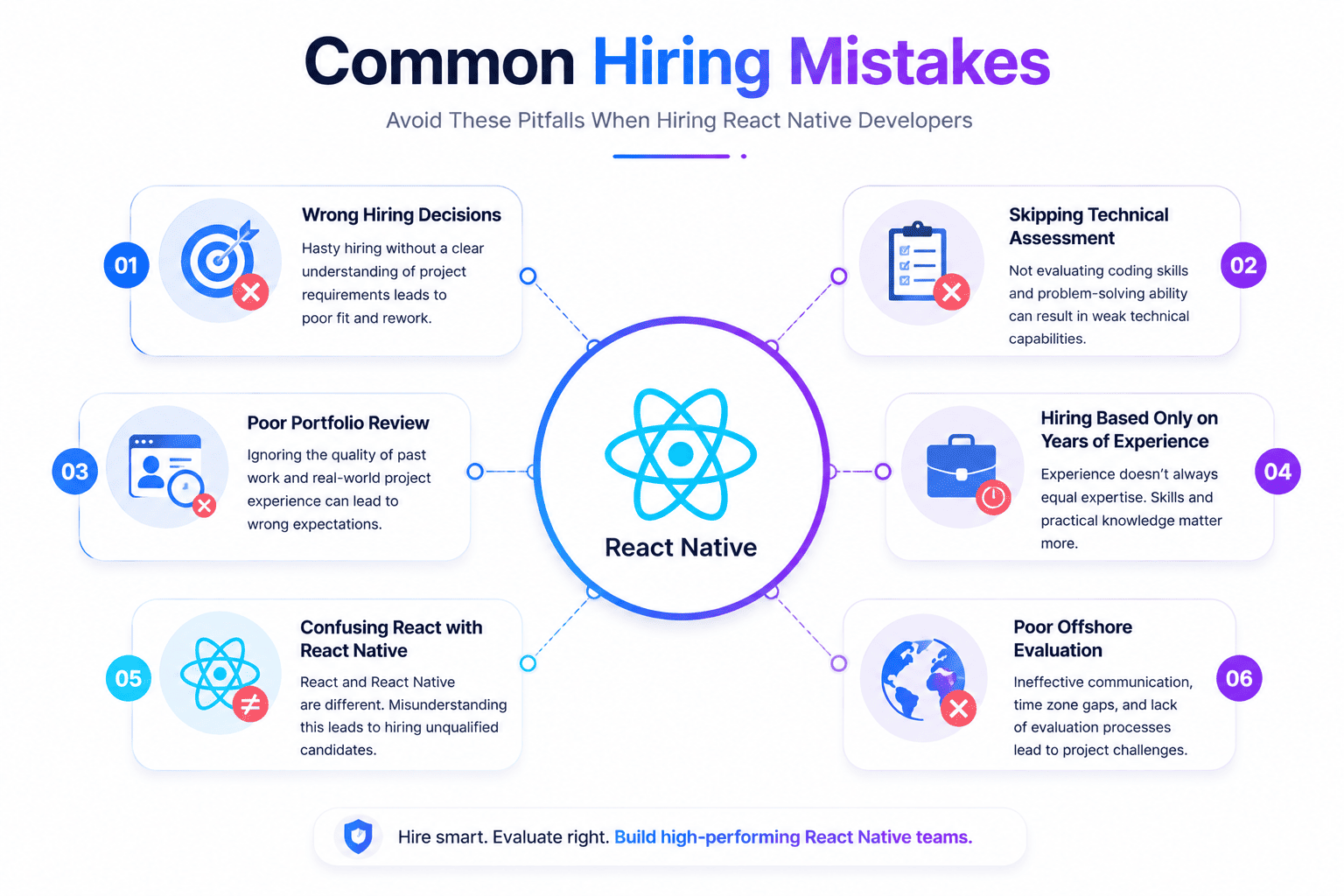
- Hiring based on years of experience instead of verifiable shipped work. A developer with 2 years and 5 live apps is often more capable than a developer with 6 years who has maintained the same legacy codebase throughout.
- Confusing React web developers with React Native mobile developers. The mental models are different. Web developers building for a browser and mobile developers handling device constraints, navigation paradigms, and app store deployment are not interchangeable, even if both use JavaScript.
- Writing a job description that asks for 'React Native experience' but actually requires New Architecture depth. That narrows the pool significantly and demands different compensation. Blending those two populations in your search is why offers keep getting rejected.
- Skipping the technical assessment because references were strong. References tell you what someone is like to work with. They do not tell you whether their code is maintainable. Run the task regardless.
- Treating offshore hiring as purely a cost play. The best India-based React Native teams deliver on quality and communication, not just price. Vet offshore candidates exactly as you would a local hire: same technical assessment, same structured interview.
Why Hire React Native Developers in India?
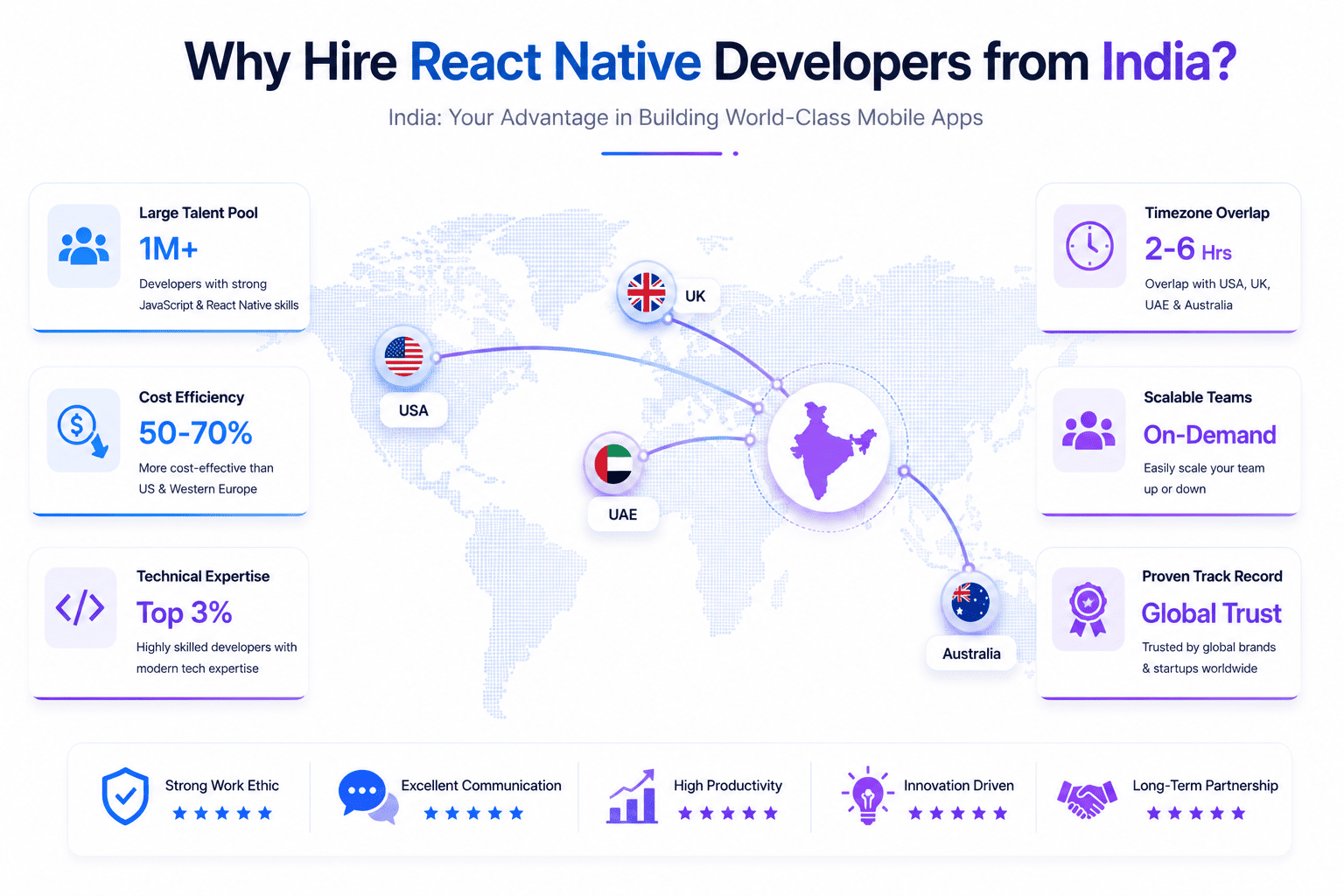
India has become the default sourcing market for React Native talent among global companies, and the reasons go well beyond cost.
Depth of Talent Pool
India is expected to have around 9.5 million tech professionals by FY 2026. React Native sits comfortably within that ecosystem because it builds on JavaScript and React, both of which have large, established Indian developer communities built over more than a decade. For any project size, sourcing React Native app developers in India is not a constraint. The pool is large enough to find specialists, not just generalists.
Cost Efficiency Without Quality Compromise
Indian React Native developers cost 40 to 70 percent below US market rates. The important distinction is that the better India-based agencies run their own multi-round technical vetting process before placing a developer on a client project. You are not getting cheaper talent. You are getting similarly skilled talent from a market with a lower cost of living. If you are evaluating how to structure this kind of engagement, our post on hiring software developers from India covers the vetting and onboarding process in detail.
Overlap-Friendly Working Hours
India Standard Time creates a usable overlap window with every major SpaceToTech client market. Morning standups work for US East Coast clients. Full-day overlap is available for GCC and Australia. UK teams share an afternoon window. Communication does not have to be asynchronous by default, which matters more than most buyers initially assume when they plan offshore work.
In-House vs Remote React Native Developers
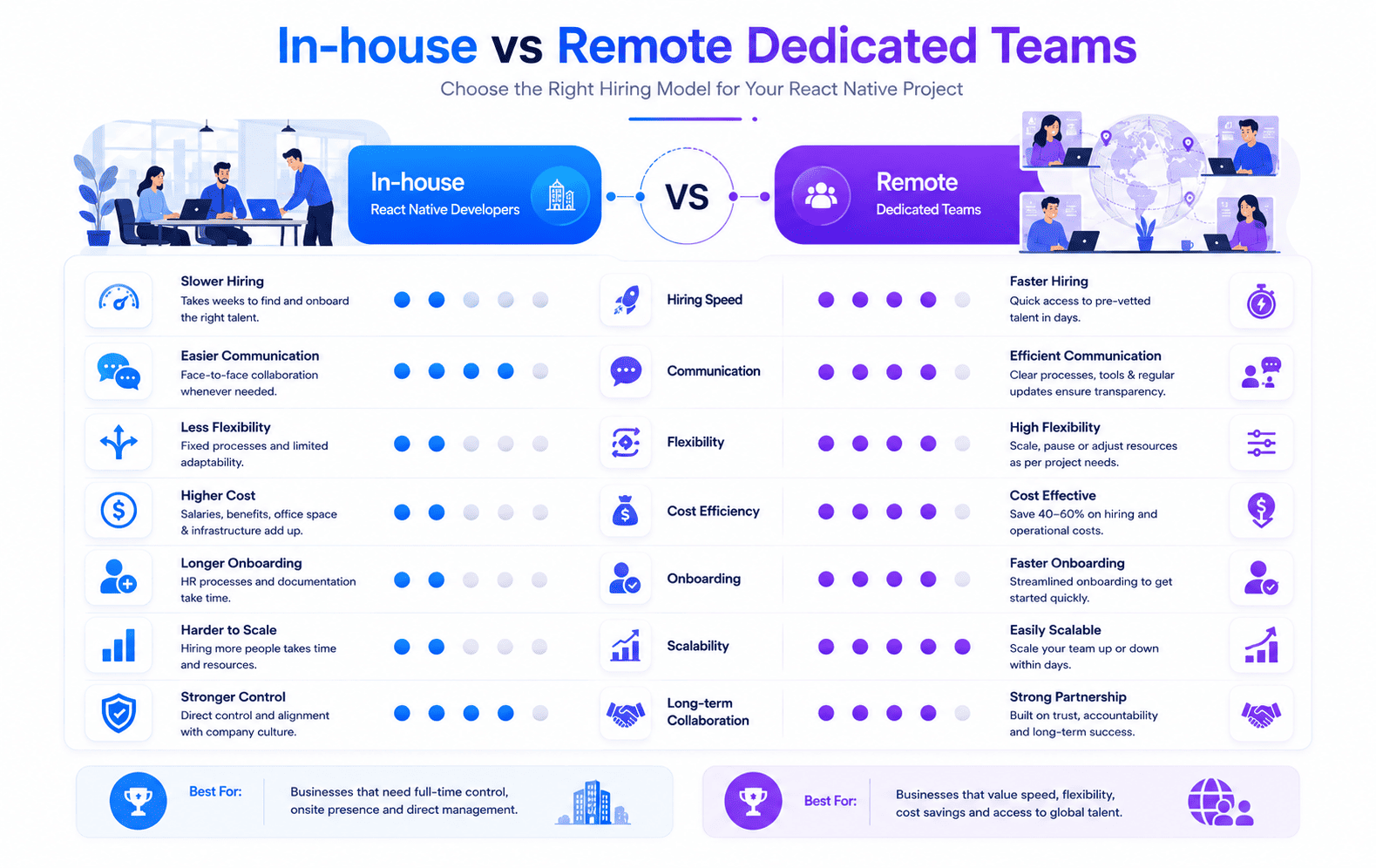
In-house hiring gives you full-time availability, easier informal collaboration, and direct control over onboarding. The trade-off is cost: salary, benefits, equipment, and office overhead all add up. Senior React Native developer searches also take 6 to 8 weeks on average when sourcing independently, and that timeline extends when the role requires New Architecture depth.
Remote React Native developers, particularly through a dedicated team model, give you specialised expertise faster and at a fraction of the cost. A pre-vetted agency can deliver first candidates in 48 to 72 hours. The trade-off is that onboarding remote teams requires intentional structure: documentation, async communication habits, and milestone-based delivery frameworks. When those are in place, the quality and velocity of remote dedicated teams is comparable to in-house, often better, because you are working with people who have done this specific kind of work many times before.
Why Choose SpaceToTech for React Native Development?
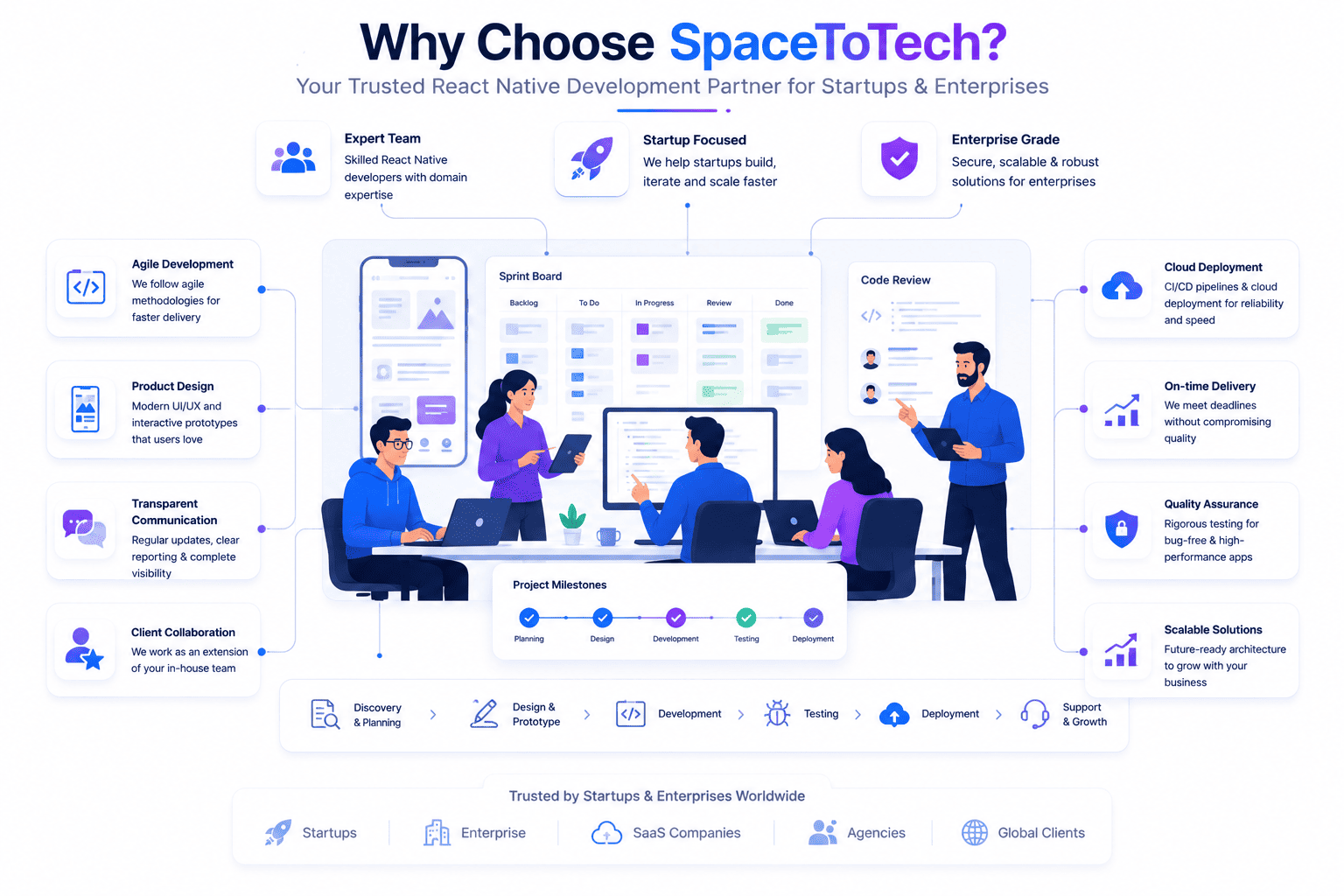
SpaceToTech is a mobile app development company that builds React Native apps for startups and enterprises across the US, UK, UAE, and Australia. The team works on the New Architecture by default, not as an optional add-on. Clients get a dedicated development structure: the same developers across the project lifecycle, milestone-based delivery, and direct access to the engineers building the product.
Every engagement starts with a technical scoping call where we understand your project requirements, existing architecture, and delivery constraints. From there we propose the right team structure: a single dedicated developer for focused builds, or a full team for complex, multi-track product work. If you want to see what that looks like for your project, reach out through the React Native services page for a no-obligation discussion.