
Why a Software Developer Hiring Checklist Matters
Most bad developer hires aren't bad at coding. They're bad fits — for the stack, the communication style, or the pace the project actually needs. By the time that becomes obvious, you've usually lost a sprint or two figuring it out.
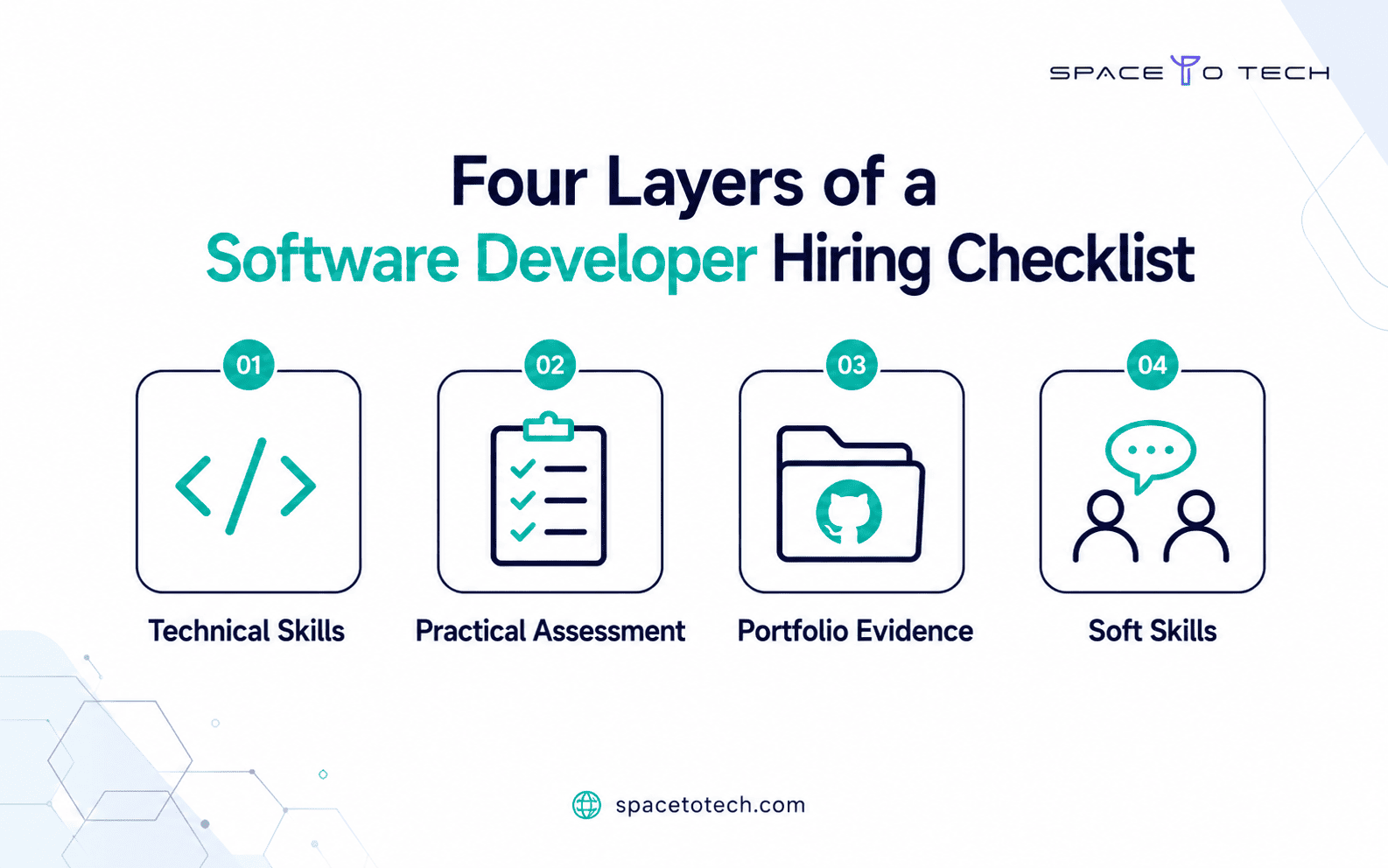
A software developer hiring checklist exists to catch that earlier. Not as paperwork, but as a structured way to look at the same candidate from four angles — technical depth, practical coding ability, real project evidence, and how they work with other people — before you commit budget and timeline to them.
This matters more in 2026 than it did even two years ago. The most recent Stack Overflow Developer Survey shows just how fast AI-assisted coding has become mainstream, and that shift changes what "good" looks like. A developer who can produce working code with Copilot but can't explain why it works is a liability, not an asset, the first time that code breaks in production. This is exactly why more founders and CTOs are looking closely at why businesses hire software developers from India in the first place — the checklist below is built for that reality.
Define Your Project Requirements Before Hiring Developers
Skip this step and every later step gets harder. You can't evaluate whether someone's skills match your project if you haven't defined the project.
Technology stack. Decide the core stack before you start screening — React vs. Vue, Node vs. Django, native vs. cross-platform mobile. This alone filters out half of unqualified applicants.
Project scope. A landing page and a multi-tenant SaaS application need completely different developers. Write down what you're building, not just what you're hiring for.
Experience level. A junior developer with six months' experience and a senior architect will both call themselves "full-stack developers." Decide upfront what level of ownership you actually need.
Hiring model. Freelancer, dedicated developer, or offshore team — this decision shapes your entire evaluation process, and it's worth making deliberately rather than defaulting to whichever option is fastest. If you want the fuller picture on sourcing and process, our guide on how to hire software developers in India from the USA, UK & UAE covers that ground in more depth.
Technical Skills Every Software Developer Should Have
This is the part most hiring guides treat as a checklist of buzzwords. It shouldn't be. Each of these skills maps to a real risk if it's missing — and for most modern stacks, official documentation like Microsoft Learn is a useful benchmark for what "current" actually means for a given framework.
- Programming languages — fluency in the language your stack actually uses, not just familiarity. Ask for real project examples, not a list on a resume.
- Framework knowledge — knowing React is different from knowing how to structure a large web codebase without it collapsing into unmanageable state logic. This is also where it's worth checking whether a candidate's experience leans toward web development or mobile app development — the two skill sets overlap less than people expect.
- Data structures and algorithms — whether a developer picks an efficient approach by instinct as performance starts to matter.
- Database management — schema design, indexing, and query optimization, not just working queries.
- API development — RESTful or GraphQL design, authentication, versioning, and documentation.
- Version control (Git) — branching strategy, meaningful commit history, comfort with code review workflows.
- Testing and debugging — unit and integration tests, and a real debugging process rather than trial-and-error console logging.
- Cloud and DevOps — CI/CD pipelines and familiarity with at least one major cloud provider. For AWS specifically, comfort with the principles in the AWS Well-Architected Framework is a strong signal of maturity beyond just "knows AWS."
- Cybersecurity and secure coding — awareness of the OWASP Top 10, input validation, and secure authentication practices. This used to be a specialist skill; now it's a baseline expectation for anyone touching production code.
How to Assess Coding Skills
Reading about skills tells you what a developer claims. Watching them work tells you what's actually true.
- Coding test — short, scoped, relevant to your actual stack, not a generic algorithm puzzle.
- Live coding — reveals reasoning process, not just the final answer.
- Pair programming — shows collaboration style, feedback handling, and communication of trade-offs.
- Debugging exercise — how they diagnose broken code tells you more than how they write clean code from scratch.
- Architecture discussion — for senior roles, a 30-minute system-design conversation reveals judgment no test can.
Practical note: take-home tests suit junior hiring; live or paired assessments scale better for mid-to-senior roles where judgment matters more than raw output.
How to Review a Developer's Portfolio, GitHub, and Past Projects
A portfolio tells you what a developer is willing to show you. GitHub, when available, tells you more of the truth. The annual GitHub Octoverse report is a useful reference point here — it tracks how real developer activity and contribution patterns are shifting industry-wide, which is helpful context when you're judging whether a candidate's own activity looks current or stagnant.
Look at how long they've been active, not just repository count — a burst of activity right before a job search is a different signal than years of consistent contribution. Check whether commits and pull requests are readable and well explained. For candidates without much public code, ask for a walkthrough of a past project instead — a candidate who can clearly explain a decision they made two years ago is showing you the same judgment a GitHub history would.
Soft Skills to Evaluate
Technical skill gets a developer through the interview. Soft skills determine whether the next twelve months with them go well.
- Communication — especially critical for remote and offshore developers.
- Problem-solving — do they ask clarifying questions or guess and move forward on wrong assumptions?
- Teamwork — how they describe past conflicts with teammates or product managers.
- Leadership — ownership shown by flagging risks proactively rather than waiting to be asked.
- Adaptability — how they react to shifting requirements mid-sprint.
- Remote collaboration — async habits, documentation discipline, comfort across time zones.
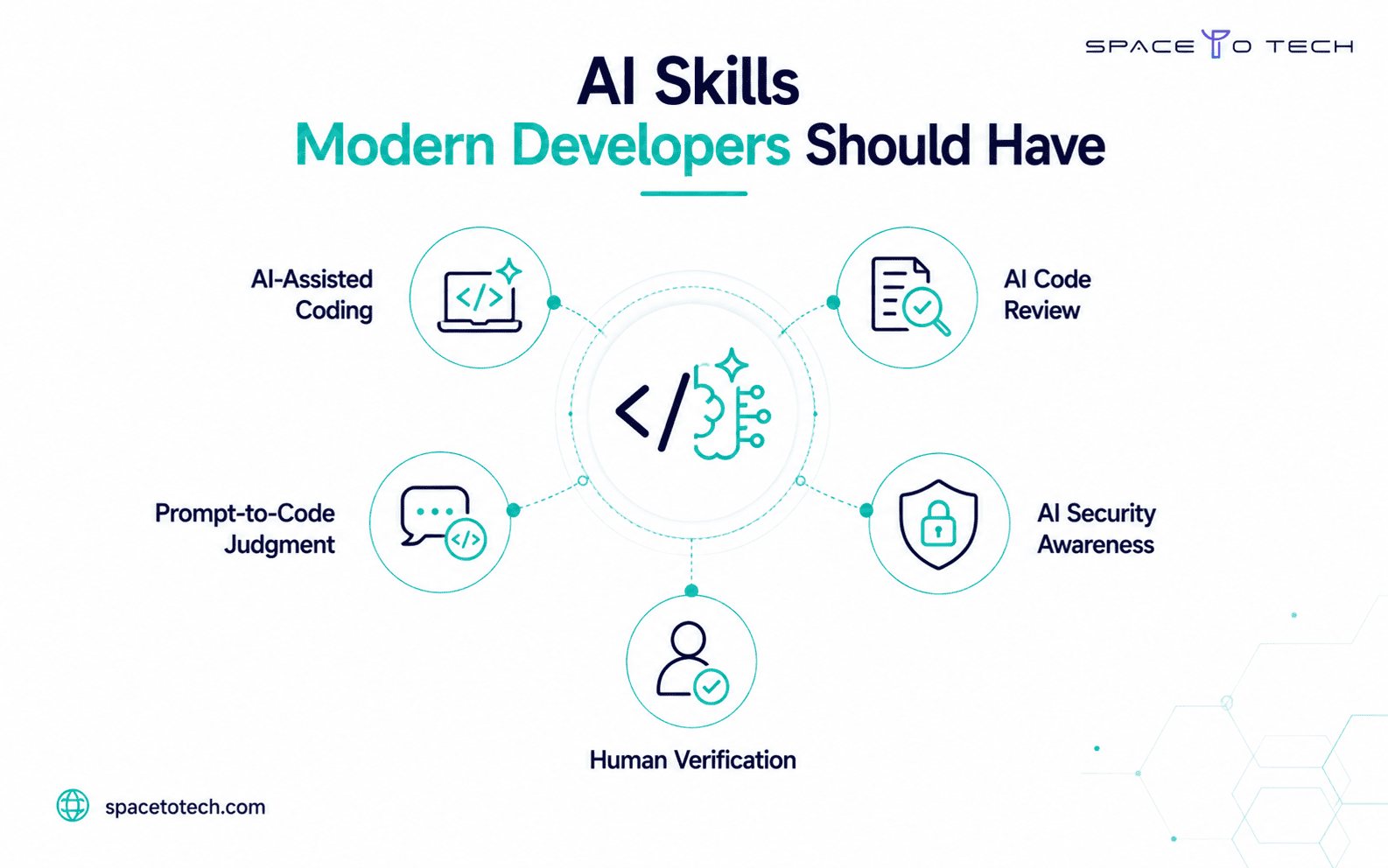
AI Skills Modern Developers Should Have
This is the category most hiring checklists still miss, and the one that will matter most over the next few years.
AI-assisted development is no longer optional tooling — it's a baseline expectation, the same way Git or a code editor is. But the skill worth hiring for isn't "uses ChatGPT." It's judgment about when and how to use it.
Look for developers who use tools like GitHub Copilot, Cursor, or Claude to speed up boilerplate work, but who can still explain every line of AI-suggested code before it ships. Resources like Google AI for Developers are a good gauge of how fast this space moves, and how much verification discipline it now requires. Ask how a candidate handles AI code review — do they treat AI output as a first draft needing verification, or a finished answer? If you're weighing whether to build this capability in-house versus bring in a partner already fluent in it, our AI software development services page outlines what that looks like in practice.
AI security awareness deserves specific attention. AI-generated code has a well-documented tendency to reproduce insecure patterns — hardcoded secrets, missing input validation, outdated dependencies — if the developer isn't actively checking for them. A developer who can't explain the security risks of AI-assisted development shouldn't be trusted with production code, regardless of how fast they ship.
Step-by-Step Developer Evaluation Process
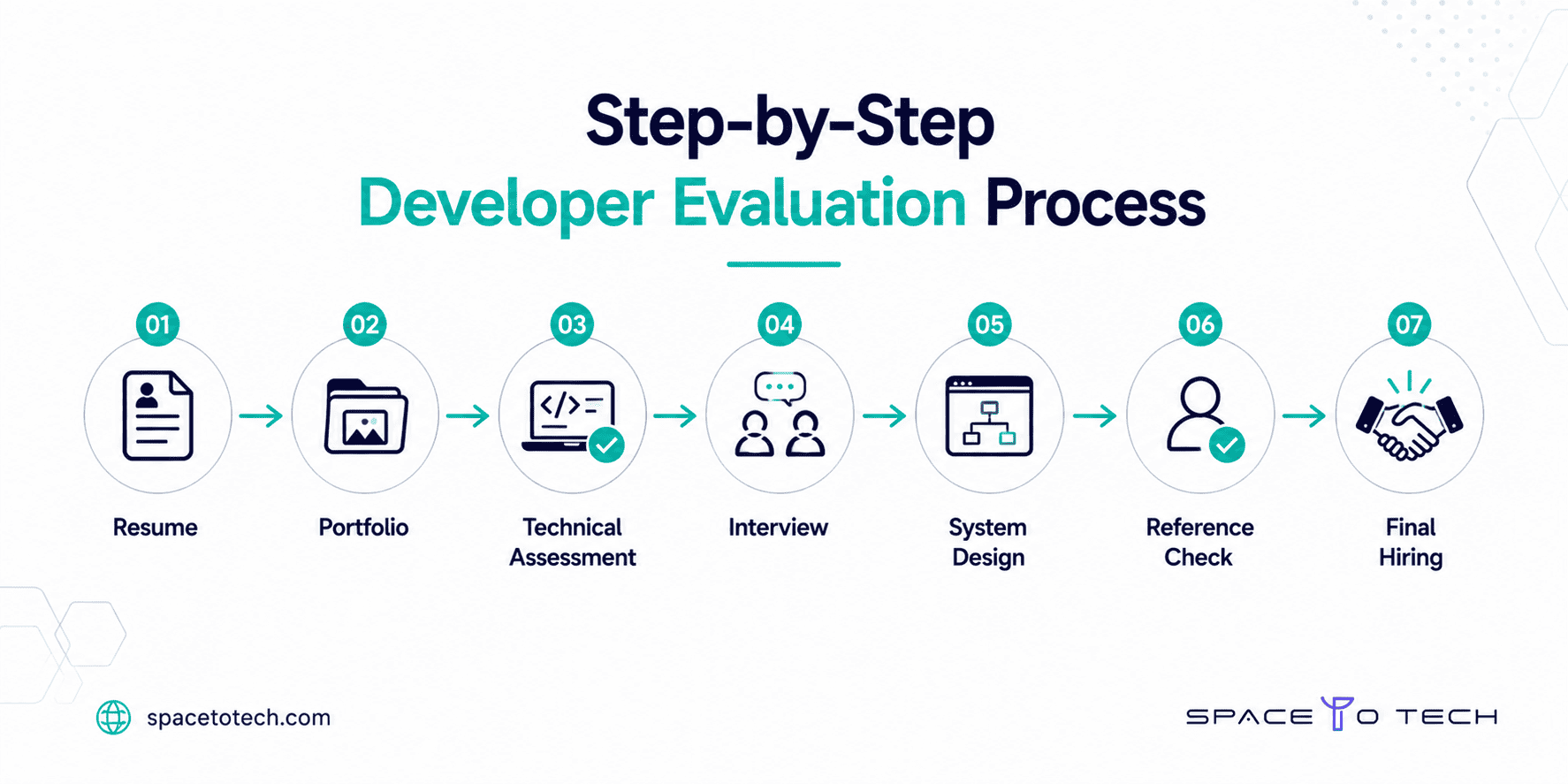
Resume → Portfolio → Technical Assessment → Interview → System Design → Reference Check → Final Hiring
Resume screening filters obvious mismatches quickly. Portfolio and GitHub review narrows the list to candidates with real evidence of ability. The technical assessment confirms whether that evidence holds up. The interview evaluates communication and soft skills directly. For senior roles, a system design conversation tests architectural judgment. Reference checks confirm what the candidate has told you against a third party's account. Only after all six steps should an offer go out.
Skipping steps to move faster is the single most common cause of hiring regret — not any individual step being wrong.
What to Check Before Hiring Software Developers in India
Evaluating skill is only half the process when hiring across borders. These factors decide whether a technically strong developer actually works out.
- Communication — English proficiency and comfort with async, written communication.
- Time zone overlap — even 3–4 hours is usually enough, but confirm it explicitly.
- IP protection — a clear NDA and IP assignment clause, signed before any code or specs are shared.
- Security — access control practices, especially for production systems or customer data.
- Pricing — hourly, per sprint, or per milestone, and what's included vs. billed separately.
- Contracts — clear scope, deliverables, and termination terms. This matters even more for US-based businesses running custom software development projects across time zones, where scope creep is harder to catch early.
- Project management — confirm tools and workflows already in use.
- Availability — full-time, part-time, or shared across clients, explicit from day one.
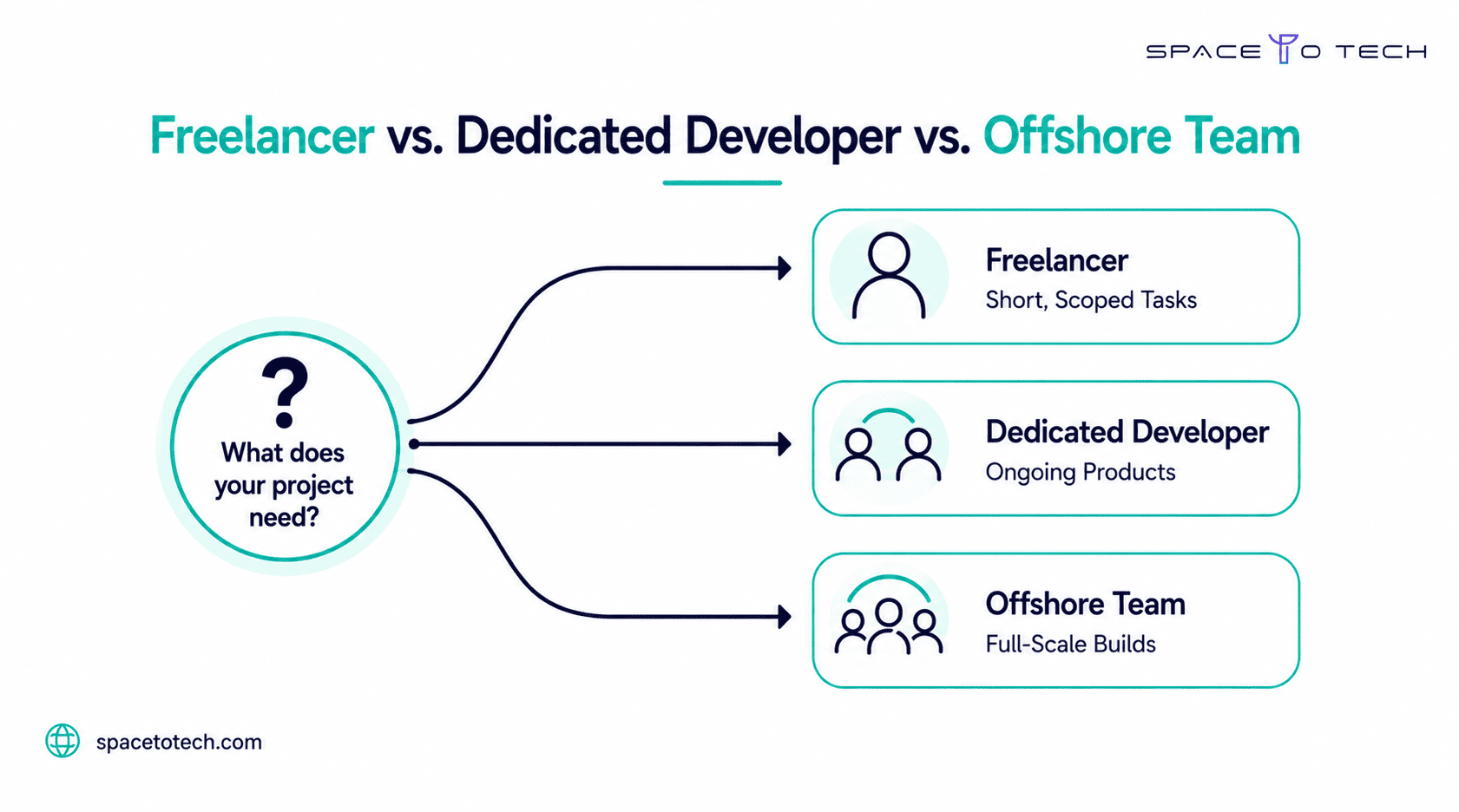
Freelancer vs. Dedicated Developer vs. Offshore Team
Each model solves a different problem. Matching the model to your actual project stage avoids most of the regret businesses report after a bad hiring decision.
Freelancers work well when the task is isolated and the endpoint is clear. Once a product moves into continuous iteration, a dedicated developer or a full IT staff augmentation model usually outperforms a freelancer purely because knowledge stays inside the project. For the cost side of this decision, see our breakdown of software developer hourly rates and hiring costs in India.
Common Hiring Mistakes
Even businesses that use a checklist make a handful of predictable mistakes:
- Skipping live coding entirely and relying only on a resume and portfolio.
- Ignoring communication skills because the technical test went well.
- Hiring on rate alone, without weighing it against the cost of delays or rework.
- Skipping a trial sprint before committing to a longer engagement.
- Leaving IP ownership unclear in the contract until after work has started.
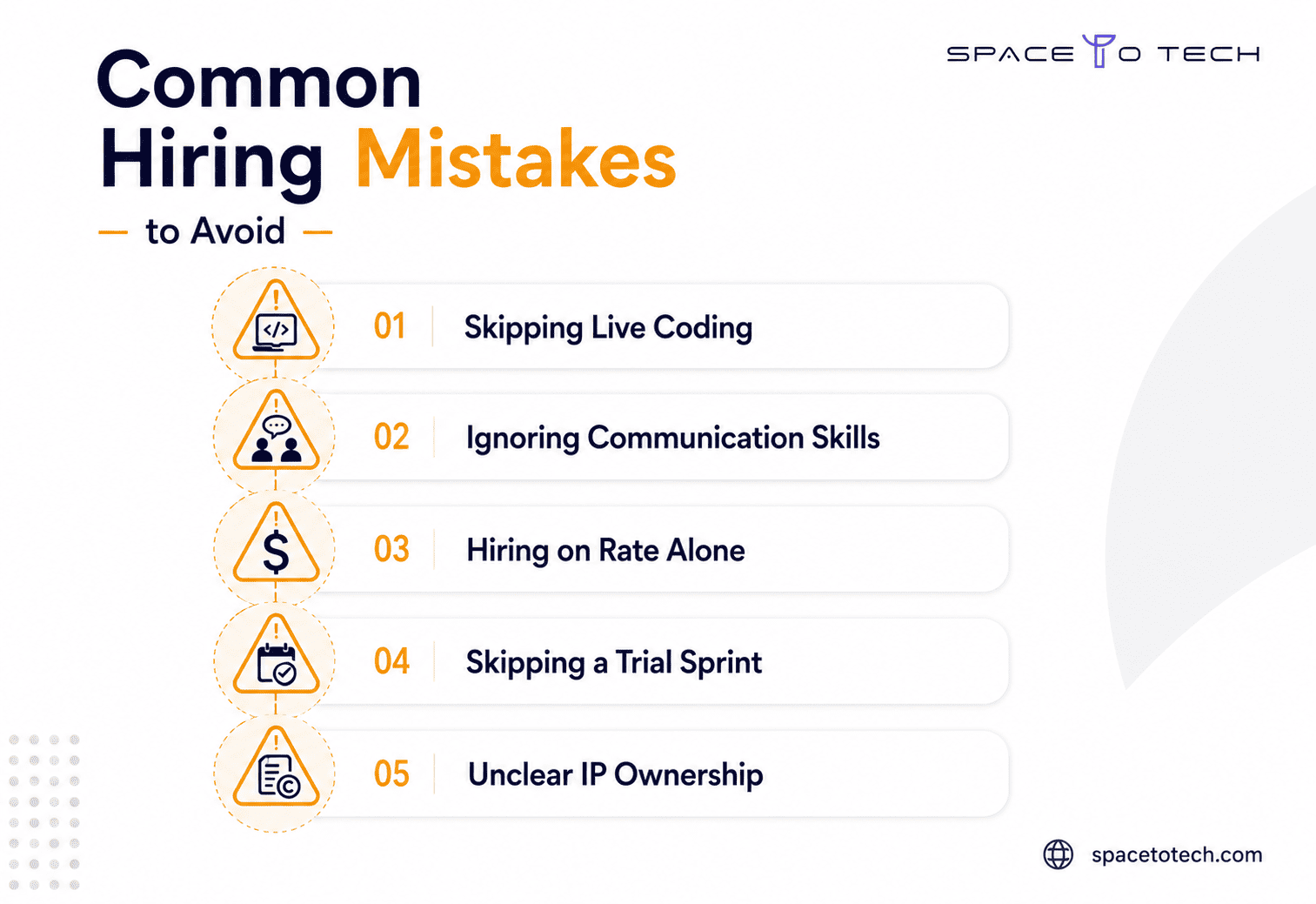
Each of these is avoidable with about an hour of extra process — the businesses that skip it are usually optimizing for speed in the wrong place.
Complete Software Developer Hiring Checklist
Whether you're evaluating a single freelancer or comparing top software development companies for a larger engagement, this table condenses everything above into one reference:
Where to Find Trusted Software Developers in India
A checklist only works as well as the talent pool you're running it against. Running all seven categories above yourself, for every candidate, is exactly the overhead a pre-vetted hiring process exists to remove — the screening has already happened before you ever see a profile. If you're evaluating where to source from, our breakdown of top software developers in India covers vetted options across experience levels and specializations.
If your project leans toward bespoke, non-off-the-shelf work, this list of top custom software development companies in India narrows that further. And if you'd rather hand off the evaluation entirely, our custom software development services page outlines how a structured engagement works end-to-end with a software development company in India that's already run this checklist for you.
Ready to build your development team? Talk to our experts and hire skilled software developers in India — with the technical screening, AI readiness checks, and contract clarity from this checklist already handled.
Conclusion
A software developer hiring checklist isn't about running through a list once and moving on — it's about looking at the same candidate from four directions (technical, practical, evidence-based, and interpersonal) before you commit budget to them. Do that consistently, and most of the hiring mistakes businesses report — the wrong stack fit, the communication breakdown, the developer who can't explain their own AI-assisted code — simply don't happen in the first place.