
Flutter app development cost typically runs from $8,000 for a simple MVP to $300,000 or more for a large enterprise application, with most business apps landing between $20,000 and $60,000. Flutter itself is free and open source. What you are actually paying for is design, backend work, integrations, testing, and the team building all of it, and that is what moves the number up or down.
If you build software or run a business, you have probably already heard some version of this: “Flutter is cheaper.” It is, most of the time. But cheaper than what, and by how much, depends on details nobody puts in a headline. This guide breaks the number down the way we actually break it down for clients before we quote anything.
What Is the Average Flutter App Development Cost?
Most Flutter apps built for a real business, not a weekend side project, cost somewhere between $15,000 and $80,000. The wide range exists because “build me a Flutter app” describes hundreds of different products. A three-screen event app and a multi-vendor marketplace with live payments are both “a Flutter app,” and they do not belong anywhere near the same budget.
The honest answer to “how much will my app cost” is always: it depends on what you are building, who is building it, and where they are sitting while they do it. The next few sections walk through exactly which levers move that number, so you can estimate your own project instead of relying on someone else's average. If you're still deciding whether Flutter is the right framework for your product, our Flutter app development guide covers the full build process from architecture to launch
Why Flutter Is a Cost-Effective Choice for Mobile App Development
Flutter uses a single Dart codebase to ship both an iOS and an Android app. That one decision is where most of the savings come from. Instead of hiring a Swift team and a Kotlin team and keeping two codebases in sync every time a feature changes, you build the feature once and it runs on both platforms.
Hot reload adds a second layer of savings that rarely gets mentioned. Developers see UI and logic changes instantly, without restarting the app, which shortens the build-test-fix loop across the whole project. Over a three-month build, that adds up to real engineering hours saved, not just a nicer developer experience. You can see our full Flutter app development services and past project examples if you want to look under the hood before budgeting.
Flutter App Development Cost by App Complexity
This is the fastest way to get a realistic ballpark. Find the row that matches what you are actually building.
These ranges assume an India-based delivery team. Flutter development in India typically runs 50 to 60 percent lower than the same scope built in the US or UK, without a difference in code quality, which is one reason it has become the default choice for cost-conscious founders building serious products.
Flutter App Development Cost by Business Stage
App complexity is only half the picture. Where your business is in its growth also shapes what you should be spending, and most cost guides skip this entirely.
MVP Stage
At the MVP stage, the goal is validation, not completeness. A tight scope of 5 to 10 core screens, Firebase for backend instead of a custom build, and one or two must-prove features is usually enough. Budget $8,000 to $18,000 and 6 to 10 weeks.
Startup Stage
Once the idea is validated and you have early users, the app usually needs a real backend, proper authentication, and a couple of integrations that were stubbed out in the MVP. Expect $18,000 to $45,000 over 10 to 16 weeks.
Scale-Up Stage
Growing user numbers change the engineering problem. You are now optimizing for performance under load, adding analytics and monitoring, and probably rebuilding parts of the MVP that were never meant to carry this much traffic. Budget $45,000 to $100,000, spread across 16 to 26 weeks.
Enterprise Stage
At enterprise scale, cost is driven by compliance, security audits, legacy system integration, and multi-team coordination as much as by features. $100,000 to $300,000+ is typical, with timelines of 26 to 40+ weeks depending on how many systems the app needs to talk to.
Factors That Affect Flutter App Development Cost
Once you know your rough tier, these are the individual levers that push a quote up or down within that range.
Features and Functionality
Every additional feature is additional engineering time. A login screen is a day or two. A real-time chat system with read receipts and media sharing is a project inside the project.
UI/UX Design Complexity
Standard Material and Cupertino components keep design cost down. Fully custom interfaces, bespoke animations, and brand-specific motion design add real hours, both in design and in the Flutter build that has to match it pixel for pixel.
Third-Party Integrations
Payment gateways, maps, social logins, and push notification services all add integration and testing time. None of them are difficult individually. The cost comes from stacking several of them into one release.
Backend and API Complexity
A Firebase-backed app with standard CRUD operations is quick to ship. A custom Node.js or Python backend with a complex database schema, background jobs, and multiple external APIs is often the single biggest line item in the whole budget, sometimes larger than the Flutter frontend itself.
Team Location and Team Size
Where your developers sit changes the invoice more than almost any other factor. The next section breaks this down by country.
Security and Compliance
Apps handling payments, health data, or personal financial information need encryption, secure storage, and often a compliance review before launch. Budget extra time here rather than treating it as a last-minute checklist.
Testing and QA
Automated and manual testing across both platforms, plus device-specific QA, typically adds 10 to 15 percent to the total build time. Skipping this to save money is one of the most common ways a project gets more expensive later, in the form of post-launch bug fixes.
Post-Launch Maintenance
This is covered in detail later in this guide, but it belongs on your radar from day one, not as an afterthought once the app ships.
Flutter Developer Rates by Country
The same feature set, built by equally skilled developers, costs a dramatically different amount depending on where the team is based.
Lower hourly rates do not automatically mean lower total cost if the team is inexperienced. A $25/hour developer who needs 300 hours can end up costing more than a $60/hour developer who needs 100 hours. Ask about team experience and past Flutter projects before comparing rates alone.
Flutter App Development Timeline vs Cost
Timeline and cost move together, but not in a straight line. A rushed timeline usually means a bigger team working in parallel, which raises cost even if the total scope stays the same.
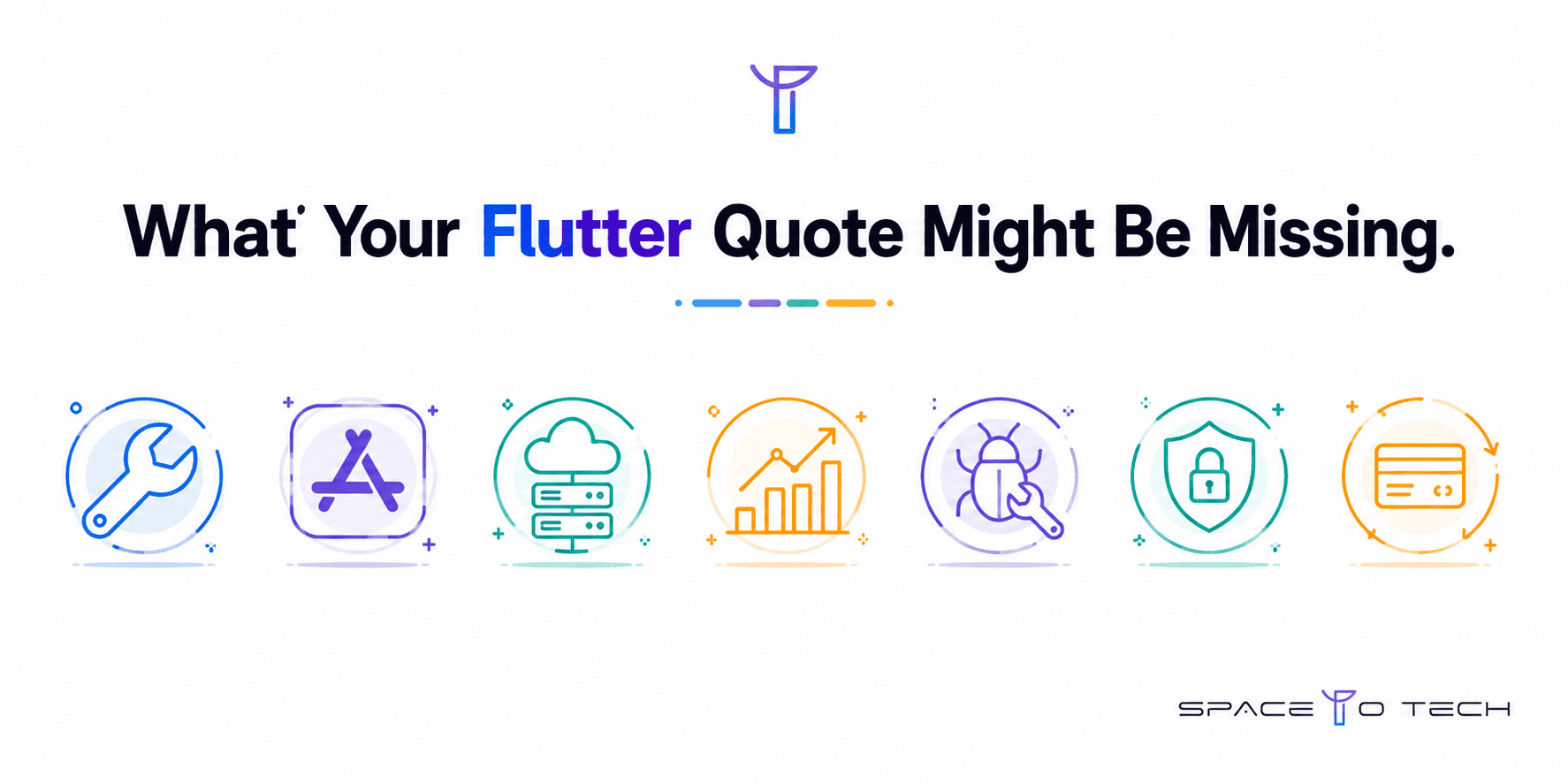
Hidden Costs Businesses Often Ignore
Every quote you get will cover development. Fewer of them will walk you through what happens after launch. These are the costs that catch founders off guard around month six:
- Ongoing maintenance: 15–20% of the initial build cost, every year, for updates and bug fixes
- App Store and Google Play fees: a one-time $99/year for Apple, and Google Play's one-time $25 registration fee
- Cloud hosting and backend infrastructure: scales with your user base, easy to underestimate at launch
- Analytics and monitoring tools: often billed separately from your core backend
- Post-launch bug fixes: unavoidable in the first few weeks after real users start using the app
- OS-level security updates: required whenever Apple or Google changes platform requirements
- Third-party service subscriptions: payment processors, push notification services, and map APIs usually bill monthly, on top of your development cost
Flutter vs Native App Development Cost
Native development, building separately for iOS in Swift and Android in Kotlin, generally costs 30 to 40 percent more than Flutter for the same feature set, because you are funding two parallel engineering efforts instead of one. The exception is apps that lean heavily on deep hardware access, like advanced AR, Bluetooth peripherals, or specialized camera processing, where native's direct platform access can reduce the extra engineering work Flutter sometimes needs to bridge the gap.
For most business apps, from e-commerce to fintech to on-demand services, Flutter's cost advantage holds up in practice, not just on paper.
How to Reduce Flutter App Development Cost Without Sacrificing Quality
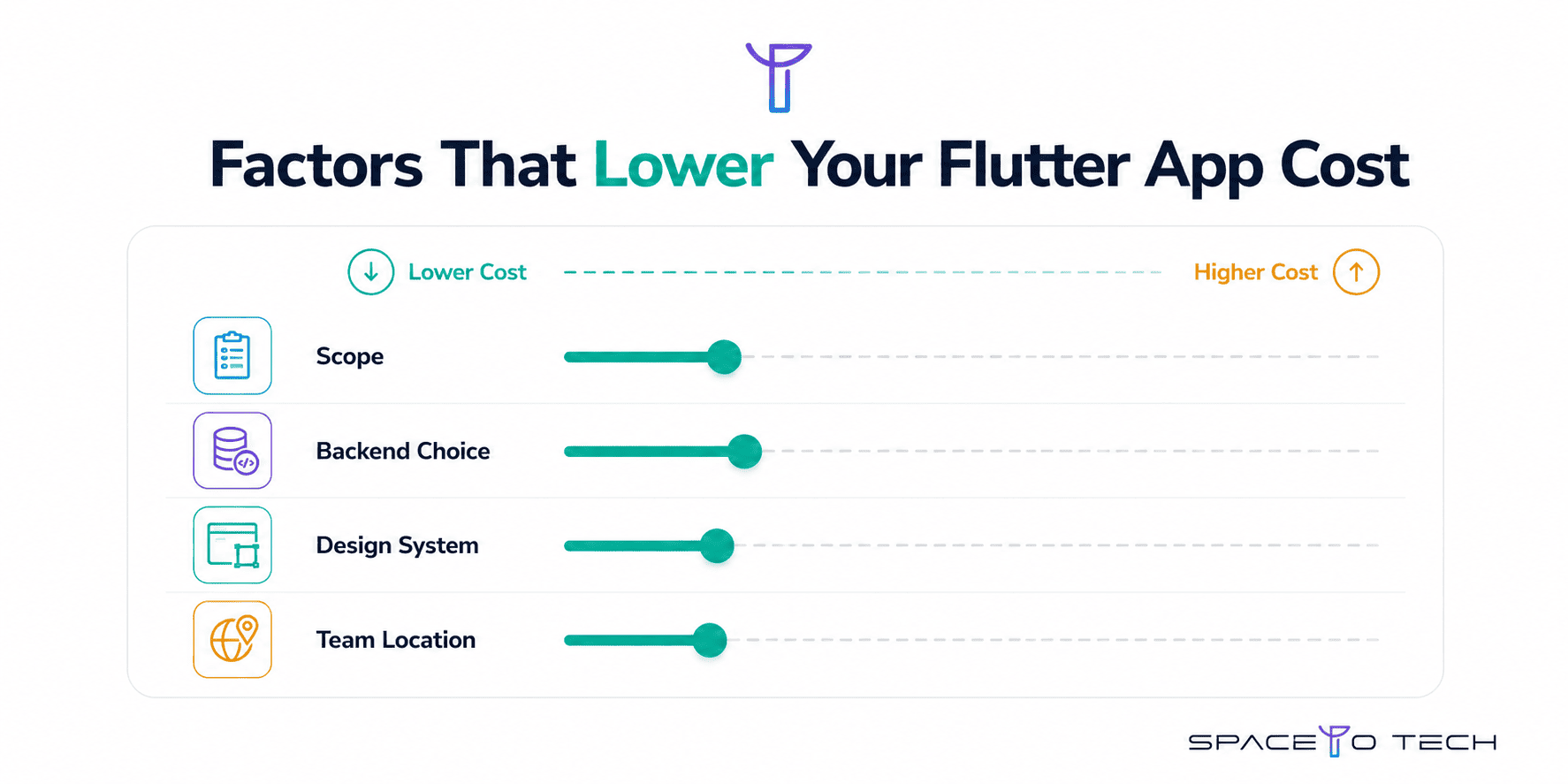
These are the specific decisions that actually move the number, not generic advice repeated across every cost guide on the internet.
- Scope your MVP down to the 3 to 5 features that actually test your core assumption, and roadmap the rest instead of building it all in v1
- Use Firebase as your backend if your data model is simple; it removes 60 to 70% of custom backend work for apps that fit its structure
- Stick to Material and Cupertino design components instead of fully custom UI unless brand differentiation is core to your product
- Lock your feature list before development starts; every mid-project addition typically costs 2 to 3 times what the same feature would have cost at the planning stage
- Choose a fixed-price contract for clearly defined scope, and hourly billing only for genuinely exploratory work
- Work with an India-based team for the same technical output at 50–60% lower cost than US or UK agencies
Feature vs Cost Impact Matrix
A quick reference for how much a single feature typically adds to your budget relative to a base app.
Flutter App Development Team: Roles You're Paying For
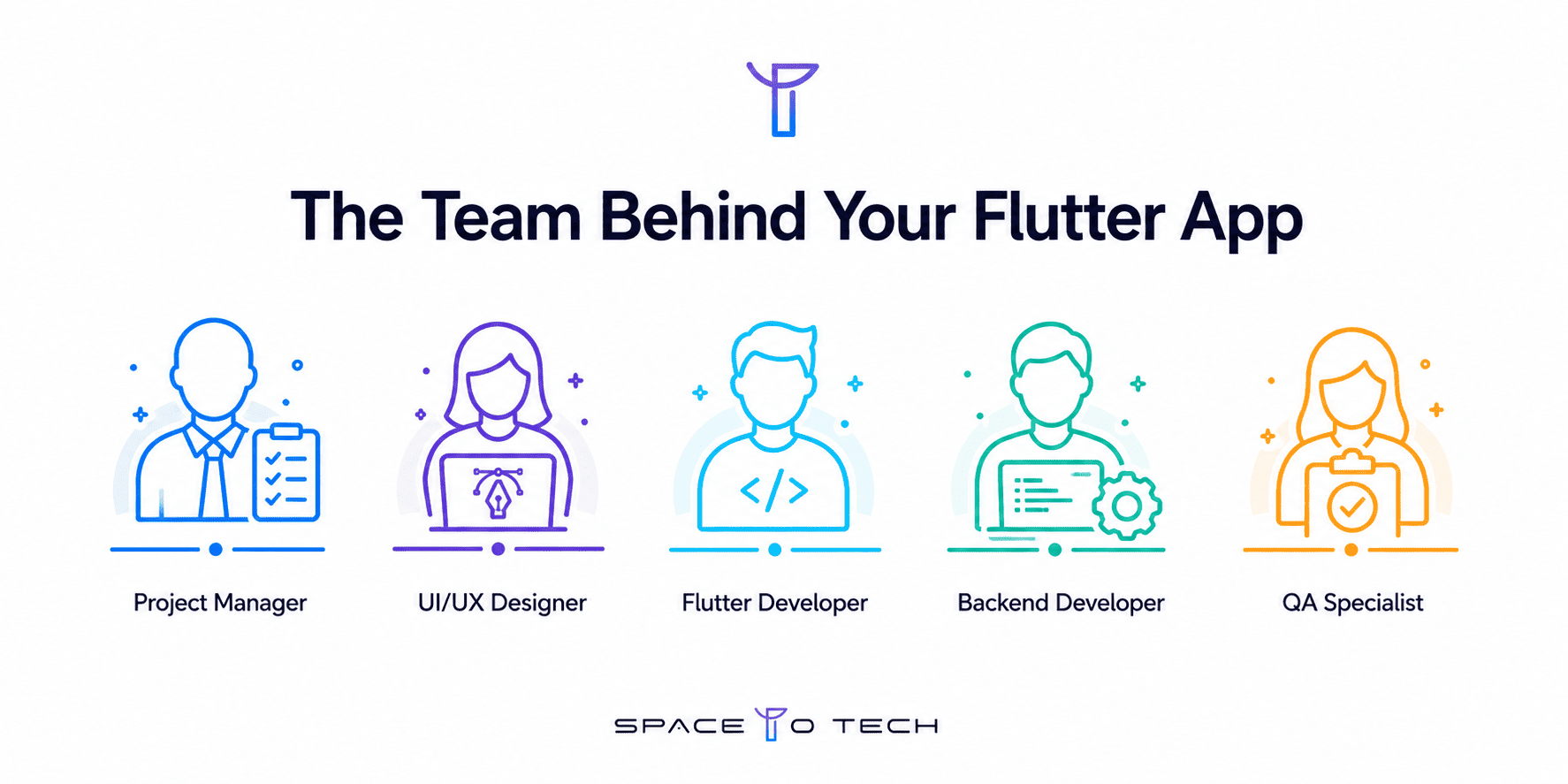
A quote is never just “developer hours.” A typical Flutter project team includes a project manager coordinating timelines, a UI/UX designer building the screens before anyone writes code, one or more Flutter developers doing the actual build, a backend developer if your app needs a custom API, and a QA specialist testing across devices before release. Understanding this breakdown helps you sanity-check any quote that seems unusually low, since a suspiciously cheap number often means one person is covering three of these roles at once.
In-House vs Freelancer vs Agency: Which Costs Less
An in-house hire gives you the most control but comes with salary, benefits, and recruiting overhead that rarely makes sense until you have ongoing, long-term Flutter work to justify it. A freelancer can be the cheapest option for a very small, well-defined build, but you take on the project management and quality-assurance work yourself, and there is no backup if they become unavailable mid-project. An agency sits in between: you get a full team, project management, and accountability for a fixed scope, usually at a lower total cost than hiring the equivalent in-house team, especially when that agency is based in a lower-cost region like India. As a software development company operating from India, we structure our Flutter engagements this way by default.
Flutter App Maintenance and Modernization Cost
Launch is the beginning of the cost, not the end of it. Annual maintenance for a live Flutter app typically runs 15 to 20 percent of the original development cost, covering OS compatibility updates, security patches, and small feature refinements. If you already have an older app you are modernizing rather than building from scratch, expect $10,000 to $80,000 depending on how much of the existing backend and design can be reused. In our experience, most modernization projects reuse 60 to 70 percent of existing backend services, which keeps the number well below a full rebuild.
AI Development Trends Impacting Flutter Costs in 2026
AI-assisted coding tools have measurably shortened implementation time on standard Flutter builds over the past year, particularly for boilerplate UI and repetitive CRUD logic. That does not mean architecture and code review get any faster; senior engineering judgment still governs quality, and a poorly scoped AI-assisted project can still run over budget just as easily as a traditional one. What has genuinely changed is that teams using AI-assisted workflows can often quote tighter timelines for standard-complexity apps without cutting corners on testing.
Is Flutter Free to Use?
Yes. Flutter is an open-source framework maintained by Google, and according to its official documentation, there is no licensing fee for commercial or personal use. Every dollar in your budget goes toward the team building your app, your backend infrastructure, and any paid third-party services you choose to integrate, not toward the framework itself.
Why Businesses Choose Flutter
Beyond the cost math, Flutter wins on speed to market. A single codebase means both platforms launch together instead of one trailing the other by weeks. Long-term maintenance is simpler too, since a bug fix or feature update only has to be written once. For most business apps, that combination of lower upfront cost and lower ongoing maintenance is the real argument for Flutter, not just the sticker price on the first invoice.
How We Estimated These Costs
The ranges in this guide assume an India-based delivery team, a standard project team (project manager, designer, one to two Flutter developers, QA), and Firebase or a comparably lightweight backend unless stated otherwise. Enterprise ranges assume additional security, compliance, and integration work. Actual cost for your specific project will vary based on your feature list, design requirements, and backend complexity. Treat every number on this page as a planning anchor, not a fixed quote, and get a scoped estimate before locking a budget.
Conclusion
Flutter app development cost is never really one number. It is a set of decisions, about scope, backend complexity, design, and team location, that together land your project somewhere between $8,000 and $300,000+. The businesses that budget well are the ones that scope tightly, plan for maintenance from the start, and choose a team based on experience rather than the lowest hourly rate on the page.
Ready to get a real number instead of a range? Contact our team for a detailed proposal and project roadmap based on your specific requirements.