You need one app that works on iOS and Android, and you do not want to pay for two development teams to build it twice. That is the problem Flutter app development was built to solve, and it is the reason it has become the default cross-platform choice for a large share of the apps shipped in the last three years.
Flutter is Google's open-source UI toolkit, built on the Dart language, that compiles a single codebase into natively performing apps for iOS, Android, web, and desktop. This guide covers what Flutter actually is, how it works under the hood, what it costs to build a Flutter app in 2026, how it compares to React Native and native development, and how SpaceToTech delivers Flutter mobile app development projects from discovery through post-launch support.
What Is Flutter?
Flutter is Google's open-source UI toolkit for building natively compiled applications for mobile, web, and desktop from a single Dart codebase. It is worth being precise about one thing people get wrong constantly: Flutter is the framework, not the language. Dart is the programming language. Flutter is the SDK and rendering engine built on top of it. Google announced Flutter at the Dart Developer Summit in 2015, shipped the first stable release in December 2018, and added desktop and web support with Flutter 3.0 in 2022. By 2026, it has reached genuine enterprise maturity - Google uses it internally, and it is no longer the experimental newcomer it was five years ago.
A Brief History
The early years (2015–2018) were rough in the way every new framework's early years are rough - limited tooling, a small community, and skepticism from teams who had already invested in native development. Stable release in late 2018 changed the trajectory. Adoption accelerated through 2019–2021 as Google poured engineering resources into the rendering engine and the package ecosystem matured. Flutter 3.0 in 2022 was the inflection point that made it a genuinely cross-platform toolkit rather than a mobile-only one. Where we are in 2026 is what most frameworks aspire to but rarely reach: stable, well-funded, enterprise-trusted, with no realistic competitor threatening to obsolete it in the next several years.
How Flutter Works Under the Hood
This is where Flutter genuinely differs from React Native, and understanding the difference matters for any technical decision-maker evaluating the two.
Flutter compiles Dart code ahead-of-time (AOT) directly to native ARM or x64 machine code. There is no JavaScript bridge sitting between your application logic and the device - Dart compiles to the same kind of machine code that Swift or Kotlin produces. This is the single biggest architectural difference between Flutter and React Native's legacy Bridge model, and it is also why Flutter's performance story has always been strong even before React Native's New Architecture closed most of that gap.
The second major architectural decision: Flutter does not use native OS UI components at all. Every widget - every button, every text field, every animation - is drawn by Flutter's own rendering engine onto a canvas that Flutter controls completely. The OS provides a canvas; Flutter paints everything on it. This is the reason a Flutter app looks pixel-identical on iOS and Android - there is no platform component variance to account for, because nothing is a platform component.
Hot Reload is the development-time payoff of this architecture. Code changes reflect in the running app in under a second, without losing application state - you can be three screens deep in a test flow, change a colour or a layout value, and see it update immediately without restarting from the login screen. Anyone who has worked with a framework that requires a full rebuild for every UI tweak understands why this matters for actual development velocity, not just for marketing copy.
Flutter Architecture: The Three-Layer Model
Flutter architecture is structured in three layers, and this is one of those areas where genuine technical understanding separates a real engineering team from a content-mill description of Flutter.
At the bottom sits the Embedder - the platform-specific glue that adapts Flutter to run on each OS (iOS, Android, Windows, etc.). Above that is the Engine, written primarily in C++, which contains the Dart runtime, the graphics rendering pipeline (Skia or Impeller), text layout, and plugin architecture. At the top is the Framework layer, written in Dart itself - this is where widgets, animations, gestures, and Material/Cupertino design libraries live, and it is the layer your development team actually writes code in.
Skia vs Impeller - The Rendering Engine Detail That Actually Matters
For years, Flutter's rendering engine was Skia, the same 2D graphics library Chrome uses. Skia is mature and reliable, but it has a known weakness: shader compilation jank. The first time a particular visual effect (a shadow, a blur, a specific gradient) needs to render, Skia has to compile a shader for it on the fly - and that compilation can cause a visible stutter on the first frame.
Impeller is Flutter's newer rendering engine, designed specifically to eliminate this. Impeller pre-compiles shaders ahead of time rather than at runtime, which removes the jank entirely. It is the default rendering engine on iOS and has been rolling out as the default on Android through 2024–2026. The practical result for a business: apps built with Impeller deliver consistently smooth 60fps animation, and on devices with high-refresh-rate displays (ProMotion on iPhone, equivalent on flagship Android), up to 120fps without the stutter that older Skia-based apps occasionally showed on first render.
Flutter Widgets and the SDK
Everything visible in a Flutter app is a widget - text, padding, a button, a layout container, the whole screen. There are two fundamental categories. A StatelessWidget has no internal data that changes over time - it renders the same output for the same inputs, like a static label. A StatefulWidget manages data that changes - a checkbox that can be checked or unchecked, a counter, a form field. Understanding which type to use where is one of the first real architectural decisions in any Flutter project, and it has a direct impact on performance: unnecessary StatefulWidgets trigger unnecessary rebuilds.
When state changes, Flutter rebuilds the affected part of the widget tree - the rebuild cycle is what makes the UI update. Flutter is efficient about this by design, but a poorly structured widget tree (state held too high up, triggering rebuilds across large portions of the screen) is the most common performance mistake in real Flutter codebases.
The Flutter SDK bundles the Dart compiler and runtime, the full widget library, command-line tools (`flutter doctor` to check your environment, `flutter build` to compile, `flutter run` to launch on a device), and Flutter DevTools for debugging and performance profiling. On top of the SDK sits pub.dev, Flutter's package repository, which now carries more than 35,000 published packages - Firebase integrations, HTTP clients like Dio, and state management libraries like Riverpod and GetX are all available as well-maintained pub.dev packages.
Key Flutter Features
A few features genuinely shape what you can build and how fast you can build it.
Hot Reload and Hot Restart compress the development feedback loop dramatically - this is not a marketing point, it is a measurable productivity difference your developers will notice in the first week. Single codebase, six platform targets - iOS, Android, web, Windows, macOS, and Linux all from the same Dart source. AOT-compiled performance with no JavaScript bridge sitting in the critical path. Material Design 3 and Cupertino widget libraries are both built directly into the framework, so your app can present iOS-native-feeling components on iOS and Material components on Android from the same codebase if that distinction matters to your product.
Animation support is genuinely rich - implicit animations (simple property transitions), explicit animations (controller-driven sequences), and physics-based animations (spring, friction simulations) are all first-class in the framework, not bolted-on libraries. Firebase integration covers Authentication, Firestore, Cloud Messaging, and Analytics with official, well-maintained packages. The 35,000+ pub.dev packages extend functionality into nearly every domain a business application needs. And when you genuinely need to touch native device hardware that Flutter does not expose directly, platform channels let you write a small amount of native Swift/Kotlin code that bridges back into your Dart application.
Business Benefits of Choosing Flutter
Strip away the technical detail and the business case is straightforward, and we have seen it play out consistently across client engagements.
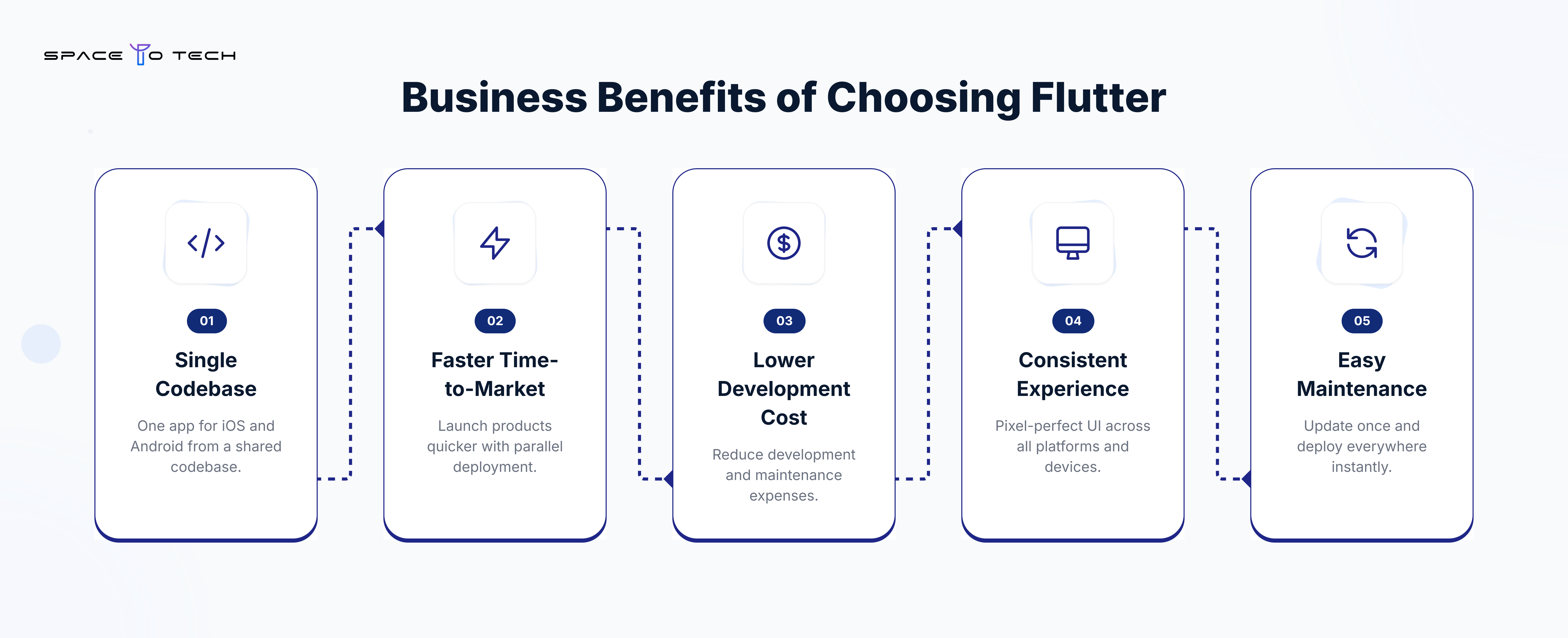
One codebase means one development team, which typically translates to 30–40% lower development cost compared to building separate native iOS and Android apps. We reduced one client's mobile timeline by roughly six weeks simply by shipping a single Flutter codebase instead of running parallel iOS and Android tracks - that is not a hypothetical, it is what actually happens when you stop paying for the same feature to be built twice.
Faster time-to-market follows directly: you ship iOS and Android simultaneously, typically 20–30% faster than sequential or parallel native development, because there is genuinely one set of features being built once rather than coordinated across two teams.
Consistent UX - because Flutter owns every pixel rather than relying on native components, there is no design drift between the iOS version and the Android version of your app. What your designer ships in Figma is what users see on both platforms, without the platform-specific rendering quirks that affect frameworks relying on native UI components.
Easier maintenance - bug fixes and feature updates are written once and deployed to both platforms, not twice. Over an 18–24 month product lifecycle, this maintenance differential compounds significantly.
Larger effective talent pool than people assume - Dart is genuinely easy to pick up for developers who already know Java, Kotlin, or TypeScript. The syntax is approachable, and most competent mobile developers are productive in Dart within two to three weeks.
Flutter Advantages and Disadvantages
We will not pretend Flutter is perfect for everything - that kind of dishonesty does not survive contact with a real project, and any agency telling you otherwise has not shipped enough Flutter apps to know better.
| Advantages | Disadvantages |
| Single codebase for six platforms | Dart has a smaller ecosystem than JavaScript |
| Native-like performance (AOT compiled) | Slightly larger app bundle size than native |
| Hot Reload - genuinely fast development cycles | Platform-specific features need platform channels (added time) |
| Pixel-perfect, consistent UI across platforms | Flutter Web is still maturing for complex SPAs |
| Strong Google backing, large active community | Less established in some enterprise contexts than Swift/Kotlin |
| Rich, first-class animation capabilities | Smaller pool of Flutter-specific developers than React Native's JS pool |
Is Flutter Worth It in 2026?
Yes, for the substantial majority of business use cases - and the reasoning is not just "the community is big." Google uses Flutter internally for parts of Google Pay and Google Ads, which is a genuinely meaningful signal: Google is not going to abandon a framework that its own products depend on. Beyond Google itself, the production examples are real and verifiable: BMW, Alibaba, eBay, and Nubank all run Flutter in production at meaningful scale. Nubank in particular is a useful data point - a regulated, security-sensitive FinTech product with over 100 million users, built on Flutter.
With Impeller now rolling out on Android (joining its default status on iOS) and Flutter Web continuing to mature, 2026 is a more capable Flutter landscape than at any previous point. The "Google will abandon it" risk that gets raised in comparison articles is genuinely low - Flutter is embedded in Google's own product ecosystem, which gives it institutional staying power that a side-project framework would not have.
Flutter vs React Native, Native, Kotlin, and Swift
Flutter vs React Native
| Dimension | Flutter | React Native |
| Performance | AOT-compiled Dart, no bridge | JSI (new architecture) - synchronous, fast |
| UI Rendering | Flutter draws every pixel - fully consistent | Renders real native components - platform-authentic |
| Ecosystem | Faster-growing, 35,000+ pub.dev packages | Larger overall (npm), more mature |
| Talent Pool | Smaller, but easy onboarding from Java/Kotlin/TS | Larger - JavaScript is the most common language globally |
When to choose Flutter: when pixel-perfect UI consistency, rich custom animation, and predictable cross-platform rendering are priorities. When to choose React Native: when your team is already JavaScript-heavy and you want to share logic with a web codebase.
It is worth being honest here: both have closed most of the historical performance gap. React Native's New Architecture (JSI, Fabric) resolved the old Bridge bottleneck, and Flutter's AOT compilation has been strong from the start. The decision in 2026 is genuinely about team fit and UI requirements more than raw performance.
Flutter vs Native Development
Native wins on the deepest platform integration, the smallest possible app bundle size, and access to brand-new OS features on day one - if Apple ships a new iOS API tomorrow, native Swift gets it immediately and Flutter gets it once a platform channel or plugin is built. Flutter wins on cost (one team instead of two), speed (one codebase), and parity between iOS and Android experiences.
Our practical recommendation: startups and SMBs should default to Flutter unless there is a specific reason not to. Large enterprises with deep platform-specific feature requirements - heavy AR, specialised hardware integration, OS features that need day-one availability - should evaluate native or a hybrid approach where the core app is Flutter and a small number of native-only modules are written separately.
Flutter vs Kotlin / Flutter vs Swift
These comparisons reduce to the native-vs-cross-platform question above. Kotlin gives you everything Android offers natively, with zero cross-platform compromise - and zero code reuse for iOS. Swift does the same for iOS. If you are building for one platform only and have no intention of supporting the other, native in that platform's language remains the right call.
Should You Use Flutter? A Decision Framework
| Business Scenario | Flutter? | Why |
| Early-stage startup, MVP needed fast | Yes | Single codebase ships both platforms, lower burn rate |
| Consumer app with heavy animation/branding | Yes | Flutter's rendering engine excels at smooth, branded UI |
| Enterprise app with complex native features | Evaluate | Platform channels handle most needs, but assess specific native APIs required first |
| FinTech app (payments, biometrics) | Yes | Supports biometric auth, secure storage, PCI-compliant backend integration |
| Healthcare app with device sensors | Evaluate | Bluetooth/HealthKit integration needs platform channels - budget 2–3 extra weeks |
| Pure web app, no mobile component needed | Consider alternatives | Flutter Web works, but React/Next.js are still the stronger choice for web-first products |
| Marketplace app | Yes | Alibaba's Xianyu, with 50M+ users, runs on Flutter |
Flutter for Startups and MVPs
Flutter has become the dominant cross-platform choice among funded startups specifically because it cuts development cost without sacrificing visual polish - and investors notice the difference between a Flutter MVP that looks finished and a half-built native app that clearly is not. For a typical MVP, SpaceToTech delivers a working iOS and Android flutter mvp in 10–14 weeks, against 18–24 weeks for separate native builds covering equivalent functionality. A lean Flutter MVP also reads as a credible technical signal to investors - it tells them the team made a deliberate, sensible technology choice rather than over-engineering before product-market fit exists.
The small-team pattern shows up as clearly in flutter for startups development as it does at enterprise scale. A two-person engineering team at a journaling app built and shipped both iOS and Android versions in roughly 2.5 months using Flutter — a timeline a separate native iOS and Android build would not have matched with the same headcount. Kikoff, a consumer fintech startup, reached over a million users with a four-person mobile team, reinforcing that the framework's leverage is largest precisely when a startup has the least room to hire two platform teams.
How Flutter App Development Works: SpaceToTech's 7-Stage Process
This is the section where we can tell you what we actually do, not what a generic process diagram says we do.
This overview explains our development workflow at a high level. If you want to explore each phase in greater detail, including planning, UI/UX design, development, testing, deployment, and post-launch support, read our complete guide on the Flutter app development process.
Stage 1 - Discovery & Requirements. We sit down with the client and map out business goals, target users, feature scope, platform requirements, third-party integrations, timeline, and budget. This stage produces the document everything else gets measured against. Skipping it - or rushing it - is the single biggest predictor of scope disputes later in the project.
Stage 2 - UI/UX Design. Wireframes first, then high-fidelity Figma designs, then a Flutter-specific design system covering colours, typography, and a reusable component library. We design for both Material and Cupertino patterns simultaneously where the product calls for platform-authentic feel, and our Figma-to-Flutter component handoff process - built around a shared design token system - cuts implementation time on the development side by a meaningful margin compared to ad hoc design handoffs.
Stage 3 - Flutter Development. Sprint-based delivery, two-week cycles, with a working demo every Friday so the client sees real progress rather than a status report. State management is selected based on the actual complexity of the app - Riverpod for most mid-complexity projects, Bloc when the team needs stricter architectural discipline on a larger codebase. Feature branches, code review on every pull request, and CI/CD configured from day one, not bolted on before launch.
Stage 4 - Backend & API Integration. Firebase when speed-to-launch matters and the data model is straightforward. A custom backend - Node.js, Laravel, or Python/FastAPI - when the business logic is complex enough to need it. REST or GraphQL depending on the client's existing infrastructure. Authentication via JWT, OAuth, or biometric depending on the security profile the application requires.
Stage 5 - Testing. Unit tests written in Dart's own test framework, widget tests via `flutter_test`, and integration tests covering full user flows. Manual QA always runs on physical iOS and Android devices - never simulator-only, because simulator performance does not reflect real device behaviour, particularly on mid-range Android hardware. Performance profiling runs through Flutter DevTools before any release candidate ships.
Stage 6 - Deployment. We handle the full App Store and Play Store submission process. CI/CD pipelines - GitHub Actions paired with Fastlane - automate builds so releases are not a manual, error-prone process every time.
Stage 7 - Post-Launch & Maintenance. Crash monitoring via Firebase Crashlytics or Sentry configured before launch, not after the first crash report comes in. Analytics tracking, ongoing OS compatibility updates as Apple and Google ship new versions, and feature iteration based on real user feedback rather than internal assumptions.
Flutter Tech Stack
| Layer | Recommended Technologies |
| Frontend / App | Flutter (Dart) - iOS, Android, Web, Desktop |
| State Management | Riverpod, Bloc, GetX - chosen by app complexity |
| Backend (BaaS) | Firebase (Firestore, Auth, Functions, Hosting) for speed |
| Backend (Custom) | Node.js (Express/NestJS), Laravel, Python (FastAPI/Django) |
| Database | Firestore, PostgreSQL, MySQL, MongoDB |
| Authentication | Firebase Auth, OAuth 2.0, JWT, biometric via `flutter_local_auth` |
| Cloud Infrastructure | AWS, Google Cloud Platform, Microsoft Azure |
| Payments | Stripe, Razorpay, PayU via Flutter packages |
| Push Notifications | Firebase Cloud Messaging |
| Analytics & Monitoring | Firebase Analytics, Mixpanel, Sentry, Crashlytics |
Flutter App Development Cost
Here are real 2026 numbers, not vague reassurance. These figures are estimates - every project has specific requirements that shift the number - but they give you a genuine starting point for budgeting. If you would like a detailed breakdown of pricing, cost factors, hidden expenses, and practical budgeting tips, read our comprehensive guide on Flutter app development cost before planning your project.
| App Type | Features Included | Estimated Cost (USD) | Development Time |
| Basic App | 5–8 screens, authentication, 1 API integration, no custom backend | $8,000–$18,000 | 6–10 weeks |
| Medium App | 15–25 screens, custom backend, payments, notifications, admin pane | $20,000–$50,000 | 12–20 weeks |
| Enterprise App | 40+ screens, complex integrations, AI features, multi-role access, full CI/CD | $55,000–$150,000+ | 24–40 weeks |
What Actually Drives the Cost
The number of screens and distinct user flows is the most direct cost driver - a 10-screen app and a 40-screen app are not comparable projects. Backend complexity matters enormously: Firebase as a backend-as-a-service is fast and cheap to integrate; a custom API server with complex business logic is a separate engineering effort with its own timeline. Third-party integrations - payments, maps, biometrics, AI APIs - each add design, implementation, and testing time individually; they are not free additions just because a package exists on pub.dev. Platform scope changes the number too: iOS and Android only is the baseline; adding Flutter Web or desktop support extends both cost and timeline. And geography is the single largest lever a client controls directly.
Flutter App Ongoing Costs After Launch
The build price is a one-time number. A Flutter app continues to cost money every month it stays live, and most founders budget for the build while underestimating everything after it.
| Ongoing Cost | Typical Range |
| Annual maintenance (bug fixes, OS updates, dependency upgrades) | 15–20% of the initial build cost, per year |
| Backend hosting (Firebase or cloud) | $50–$500/month, scaling with active users and data volume |
| Apple Developer Program | $99/year |
| Google Play Console | $25 one-time |
| Third-party API costs (payments, maps, push, analytics) | Scales with usage volume — budgeted separately from the build |
For a medium-complexity app in the $20,000–$50,000 build range, that puts realistic annual maintenance at roughly $3,000–$10,000 before hosting and API costs are added. Budgeting for this at the proposal stage — not after the first invoice — is what separates a project that stays supported from one that quietly stops getting updated six months post-launch.
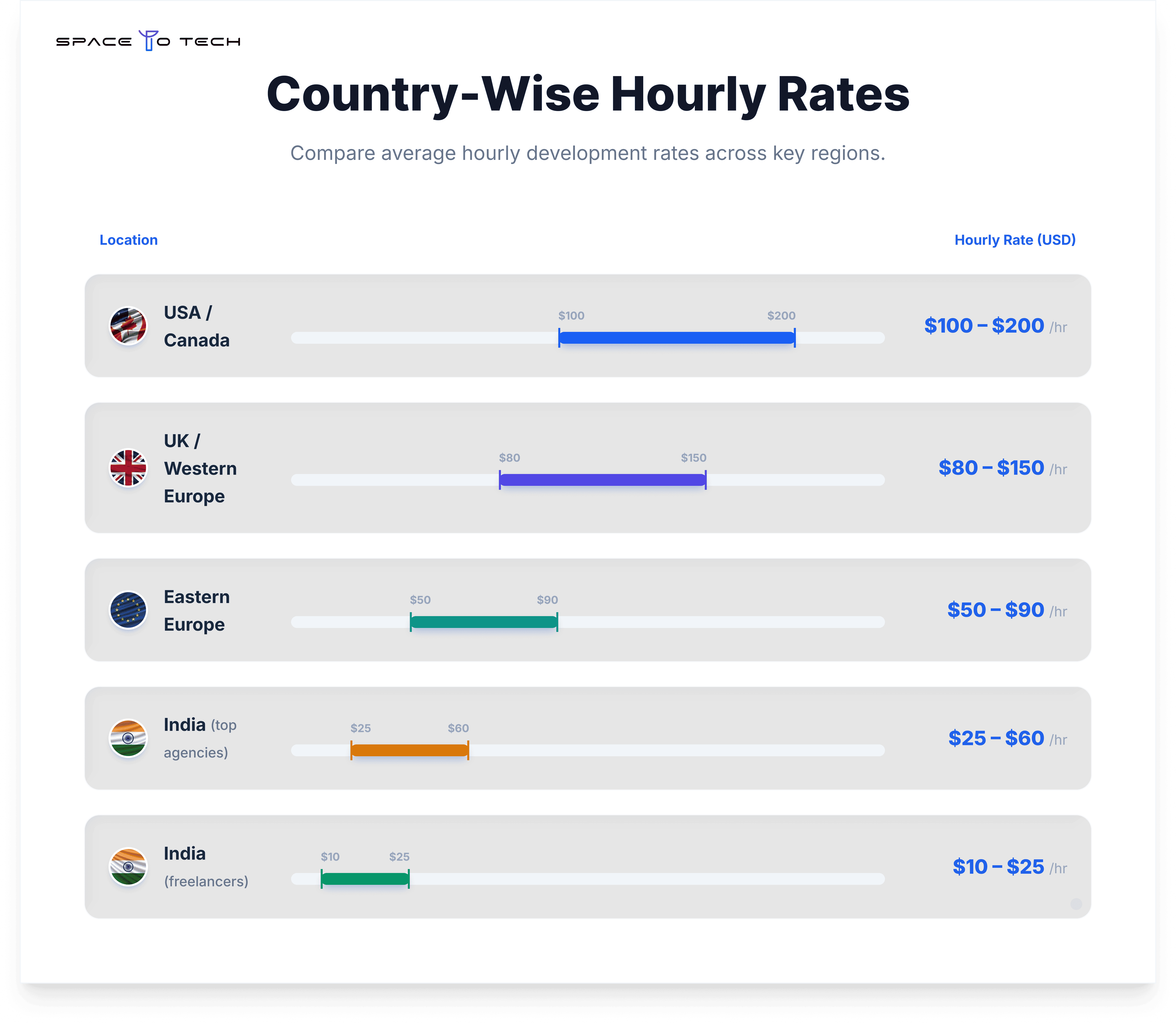
Country-Wise Hourly Rates
| Location | Hourly Rate (USD) |
| USA / Canada | $100–$200/hr |
| UK / Western Europe | $80–$150/hr |
| Eastern Europe | $50–$90/hr |
| India (top agencies) | $25–$60/hr |
| India (freelancers) | $10–$25/hr |
SpaceToTech operates in the India top-agency tier - competitive global delivery quality without freelancer-level risk on process, communication, or codebase ownership.
A note on these numbers: they are realistic ranges, not promises. Actual pricing depends on your specific requirements, and any agency that gives you a precise number before a discovery call is either guessing or padding. [Get a custom estimate for your Flutter project - free consultation, no commitment]
Flutter Development Timeline
| Phase | Simple App | Business App | Enterprise App |
| Discovery & Design | 1–2 weeks | 2–4 weeks | 4–6 weeks |
| Development | 4–6 weeks | 8–14 weeks | 16–28 weeks |
| Testing & QA | 1 week | 2–3 weeks | 4–6 weeks |
| Deployment & Launch | 1 week | 1–2 weeks | 2–3 weeks |
| Total Estimate | 6–10 weeks | 12–20 weeks | 24–40 weeks |
What Does a Flutter Development Team Look Like?
| Role | Responsibilities | Typical Ratio |
| Project Manager | Sprint planning, client communication, risk management, delivery tracking | 1 per project |
| Senior Flutter Developer | Architecture decisions, complex features, code review, mentoring | 1–2 per project |
| Mid-Level Flutter Developer | Feature development, widget implementation, API integration | 1–3 per project |
| UI/UX Designer | Figma design, design system, Flutter component specs | 1 per project |
| Backend Developer | API development, database design, authentication, cloud deployment | 1–2 if custom backend |
| QA Engineer | Test plans, manual testing, automated widget/integration tests | 1 per project |
| DevOps / Release Engineer | CI/CD pipelines, App Store/Play Store submission, monitoring | Shared resource |
SpaceToTech staffs Flutter projects to match actual complexity - a basic app does not need a six-person team, and an enterprise platform should not run on two developers stretched thin across every layer of the stack.
Flutter App Performance: What to Expect
60fps is the standard you should expect from any well-built Flutter app, and 120fps is achievable on ProMotion and equivalent high-refresh-rate displays once Impeller is rendering the app. Flutter DevTools gives developers a real profiling view - frame rendering times, widget rebuild counts, memory allocation - that lets a competent team catch performance regressions before they ship, not after a user complains.
Memory management in Flutter is generally efficient because the Dart garbage collector handles allocation cleanup automatically, but poorly structured widget trees - specifically, state held too high in the tree, forcing unnecessary rebuilds of large UI sections - remain the most common real-world performance issue we see in Flutter codebases we are asked to audit. The good news compared to React Native's older architecture: there is no JavaScript bridge bottleneck to work around in Flutter, because the bridge never existed in the first place.
Flutter App Security Best Practices
Secure storage in Flutter goes through `flutter_secure_storage`, which wraps the iOS Keychain and Android Keystore - meaning sensitive data is encrypted at rest by the operating system itself, not by application-level logic that could be reverse-engineered from the compiled app. This is a meaningfully stronger guarantee than storing tokens in shared preferences or unencrypted local files, and any Flutter app handling authentication tokens or personal data should be using it by default, not as an afterthought.
Biometric authentication is handled through `flutter_local_auth`, giving access to Face ID, Touch ID, and Android fingerprint/face unlock through a single cross-platform API. HTTPS should be enforced everywhere - no exceptions for internal testing builds that accidentally ship to production. JWT handling needs care: store tokens in secure storage, never in plain shared preferences, and implement short expiry windows with refresh token rotation for anything handling financial or health data.
The OWASP Mobile Top 10 applies to Flutter exactly as it applies to any mobile framework - improper credential usage, insecure data storage, and insufficient transport security are the most common failure categories we encounter in security reviews. Certificate pinning is worth implementing for any application handling sensitive data, to prevent man-in-the-middle interception even on a compromised network.
Can Flutter Apps Scale to Millions of Users?
The Flutter frontend itself scales without practical limit because it is fundamentally stateless on the client side - it renders UI and handles local interaction, it does not manage concurrent user load. Alibaba's Xianyu app, with more than 50 million users, and Nubank, with more than 100 million users, are the clearest real-world proof that Flutter is not the constraint at scale. What actually determines whether your app scales is your backend architecture and infrastructure - database design, API throughput, caching strategy - none of which Flutter controls or limits. A modular architecture pattern on the Flutter side (feature-based folder structure, clear separation between UI and business logic) keeps a large Flutter codebase maintainable as your team and feature set grow, which is a separate concern from runtime scalability but matters just as much in practice.
Flutter Enterprise App Development: Use Cases and Honest Challenges
A flutter enterprise app is not one category of product. Enterprises typically need three distinct kinds of applications, and Flutter fits each differently.
Three Enterprise Use Case Categories
- Internal employee apps: attendance systems, payroll tools, field-service dashboards. Flutter's cross-platform reach means a single build covers company-issued Android devices, iOS, and often a desktop companion for HR or ops staff, without a second internal tooling team.
- Customer-facing enterprise apps: banking, insurance, retail, and logistics apps where brand consistency across iOS and Android matters as much as functionality. This is the use case Flutter is best known for, and where BMW, Nubank, and Alibaba's Xianyu operate.
- Cross-platform enterprise SaaS: CRM tools, analytics dashboards, and internal B2B products that need to run on mobile, web, and desktop from one team. Flutter's six-platform reach from a single Dart codebase is a meaningfully better fit here than most alternatives.
What Flutter Enterprise App Development Actually Requires Watching
| Challenge | What It Means in Practice |
| App size at enterprise scale | A feature-heavy enterprise build carries the Dart runtime and engine; unused dependencies and unoptimised assets compound faster in a 40+ screen enterprise app than in a simple one |
| Enterprise identity integration | SSO, Active Directory, and SAML integrations for internal apps often require custom native bridging rather than an off-the-shelf pub.dev package |
| Retraining cost for existing teams | Enterprises with established native iOS/Android teams should budget onboarding time to Dart, not assume zero ramp-up |
| Legacy modernisation effort | An enterprise moving an existing native app to Flutter is a different project than building new — see the migration approach below |
None of this argues against Flutter for enterprise use — BMW, Google Pay, and Alibaba prove it holds up at serious scale. It argues for scoping these specific items during discovery rather than discovering them mid-build.
Migrating an Existing App to Flutter
Not every Flutter project starts from a blank canvas. A meaningful share of enterprise Flutter work is modernising an app that already has millions of users on separate native iOS and Android codebases — where a full rewrite is too risky to consider.
Flutter's Add-to-App approach handles this by embedding Flutter screens inside the existing native app rather than replacing it outright. A live delivery platform used this method to migrate its highest-traffic screen — its restaurant menu — as a deliberate stress test before expanding further, and completed the full migration with more than 50 native engineers upskilled along the way. Release cadence rose four-fold once the migration was complete, and app stability improved on both platforms during the transition, not just after it.
The practical takeaway for a business evaluating this path: migrate screen by screen, starting with a low-traffic, low-risk screen to validate the approach, then move to a high-traffic screen as a genuine test before committing to a full migration. Security and compliance reviews generally need to be repeated for the migrated sections, even for an application that already passed them once — a rewrite does not inherit the original audit.
Flutter State Management: Which Solution Should You Choose?
This is one of the most consequential architectural decisions in any Flutter project, and there is genuinely no single right answer - it depends on app complexity and team preference.
Provider is the simplest option, well-suited to small to medium apps where state logic does not need heavy structure. Riverpod is Provider's more robust successor - compile-time safety, better testability, and our default recommendation for most mid-complexity client projects in 2026. Bloc/Cubit enforces a strict, predictable architecture through a clear event-state pattern, which is the right choice for larger teams and codebases where architectural discipline matters more than raw development speed. GetX prioritises minimal boilerplate and fast development - useful for smaller teams and faster MVPs, at some cost to long-term structure. MobX brings a reactive programming model familiar to developers coming from a JavaScript/MobX background.
Our honest recommendation: Riverpod for most business applications, Bloc when the team is larger and architectural consistency across many contributors matters more than initial development speed. [Read our full guide to Flutter state management]
Integrating AI Into Your Flutter App
AI integration in Flutter in 2026 is genuinely practical, not experimental. OpenAI's GPT API and Google's Gemini API both integrate cleanly via the standard `http` package or dedicated Dart client packages, letting you add conversational interfaces, content generation, or document analysis without building any of the model infrastructure yourself.
On-device machine learning through TensorFlow Lite for Flutter enables inference that runs locally on the device - no network round trip, no latency, and no user data leaving the device, which matters significantly for any application with privacy-sensitive requirements. Chatbot UIs are straightforward to build using Flutter's existing widget and animation system paired with a streaming response from your chosen LLM API. Voice AI integration follows a similar pattern - speech-to-text input, an LLM or specialised model for processing, and text-to-speech for output. Recommendation engines typically run on the backend, with the Flutter app handling the presentation layer and a clean API contract for retrieving personalised results.
Flutter for Web Development
Flutter Web renders through one of two engines: CanvasKit, which is Skia compiled to WebAssembly and gives the highest visual fidelity (your web app looks identical to your mobile app), or the HTML renderer, which produces a smaller initial load but with less rendering consistency. Flutter Web is genuinely good for dashboards, internal tools, PWAs, and situations where a Flutter mobile app already exists and you need web parity without building a separate React codebase.
We will be direct about the limitations, because pretending they do not exist helps no one: SEO is genuinely challenging with Flutter Web because it renders as a single-page application, which search engines historically struggle to index as thoroughly as server-rendered content. Initial load time tends to be heavier than a purpose-built React or Next.js site. Flutter Web is not the right choice for a content-heavy public marketing website where organic search traffic is the primary acquisition channel - for that use case, a hybrid approach works best: Flutter for the application screens behind login, and a separate static or Next.js-based site for the SEO-facing marketing pages.
Flutter for Desktop (Windows, Mac, Linux)
Desktop support has been stable since Flutter 3.0 in 2022, covering Windows, macOS, and Linux from the same codebase as your mobile app. The practical use case is internal enterprise tooling and cross-platform utilities - companion desktop apps to an existing Flutter mobile product, internal dashboards for operations teams, that kind of thing. Flutter desktop has not seen wide adoption for consumer-facing desktop software, where Electron and native desktop frameworks remain more established. If your business need is an internal tool rather than a consumer desktop product, Flutter desktop is a genuinely sensible extension of work you have already done on mobile.
Flutter Apps Across Industries: Real-World Use Cases
Healthcare: appointment booking, telemedicine consultation interfaces, patient record access, and wearable device sync are common builds - several telehealth startups run on Flutter today. FinTech: digital banking, payment wallets, and investment platforms - Nubank, with over 120 million users, is the standout proof point, alongside Flutter components used in Google Pay. Education: e-learning platforms, quiz and assessment tools, live tutoring interfaces, and full LMS builds, particularly common among EdTech startups across India and Southeast Asia. Travel & Hospitality: booking apps, itinerary managers, and hotel check-in tools across multiple OTA platforms.
Retail & eCommerce: shopping apps, loyalty programs, and AR try-on features - Alibaba's Xianyu, with more than 50 million users, is a Flutter app at genuine consumer scale. Food Delivery: order placement, real-time delivery tracking, and driver-facing apps across various D2C food brands. Logistics & Fleet: driver tracking, shipment management, and warehouse operations tools across multiple enterprise logistics platforms. Real Estate: property listing platforms, virtual tour integration, and mortgage calculator tools across various PropTech startups. Social & Community: social feeds, messaging, and event discovery - the Hamilton Broadway production app is a notable example of Flutter outside the typical business-app category. AI-Powered Apps: chatbot interfaces, voice assistants, and recommendation engines across a growing number of AI SaaS tools built natively in Flutter.
Flutter Business App Results: What the Numbers Actually Show
Naming companies that use Flutter is easy. What matters for a buying decision is what changed for them after they did. The results below are published by the companies themselves or by Google's Flutter team, not estimated.
| Company | What They Built | Published Result |
| Google Pay | Global payments app rebuild | Codebase cut from 1.7M to 1.1M lines; an estimated 60–70% of engineering time saved |
| Kikoff | Consumer fintech app | Reached over a million users with a four-person mobile engineering team |
| Wolt | Merchant-facing companion app | Two developers shipped a working cross-platform version in about six weeks |
| talabat | Incremental migration of a live delivery app | Release cadence increased four-fold after moving off separate native codebases |
| Karaca | Retail app rebuild across 43 countries | Features now ship roughly twice as fast as under the previous two-codebase setup |
| ByteDance | Multiple flagship apps across platforms | Reported productivity increase of approximately 33% on key applications |
The pattern holds regardless of company size: a four-engineer fintech team and a 180-engineer Google Pay team both point to the same mechanism — one codebase removes the duplicate work of building the same feature twice, and the time saved goes into shipping faster rather than reconciling two platforms.
Flutter in Numbers: Adoption & Performance Statistics (2026)
Flutter consistently ranks in the top ten frameworks in Stack Overflow's Most Popular Frameworks and Libraries survey, reflecting sustained, real developer adoption rather than a passing trend. The Flutter GitHub repository remains one of the most-starred repositories on the platform, a reasonable proxy for sustained open-source community engagement. The pub.dev package ecosystem has grown past 35,000 published packages as of mid-2026, spanning Firebase integrations, networking, state management, and UI component libraries. Flutter is commonly cited as the most-used cross-platform framework in recent developer surveys, ahead of React Native by adoption share in several of the most-cited reports. More than 100,000 published apps across the App Store and Google Play are built on Flutter as of 2025 data. Developer satisfaction scores in the JetBrains State of Developer Ecosystem survey consistently place Flutter among the highest-rated frameworks for day-to-day development experience.
Flutter App Development Checklist: Before You Start Building
- Defined product goals and measurable success metrics
- User personas and target platform confirmed (iOS / Android / Web / Desktop)
- Wireframes and an approved Figma design prototype
- Backend architecture decided (Firebase vs custom server)
- Third-party integrations identified upfront (payments, maps, auth, notifications)
- State management solution selected based on actual app complexity
- Security requirements scoped (biometric auth, encryption, regulatory compliance)
- CI/CD pipeline planned before development starts, not after
- App Store and Play Store developer accounts active and ready
- Analytics and crash monitoring configured from day one
- Post-launch maintenance scope agreed before the project kicks off
Flutter App Development Services by SpaceToTech
SpaceToTech is a Flutter-specialist development company based in Delhi NCR, India, delivering Flutter projects end to end - design, development, QA, and launch, all under one roof rather than handed across multiple vendors.
What actually differentiates the work: Flutter-certified developers who have shipped production apps across healthcare, FinTech, eCommerce, education, and logistics, not generalists treating Flutter as one more framework on a list. We follow the structured seven-stage process outlined above on every engagement, from discovery through post-launch maintenance - not a different process for every client, which is how quality slips. Pricing is competitive against UK and US agencies for genuinely comparable delivery standards, not a race-to-the-bottom freelancer rate that comes with its own risks around process and codebase ownership.
We have delivered Flutter apps for clients across FinTech, healthcare, eCommerce, logistics, and education - five industries with five very different sets of technical and regulatory requirements, each handled with the specific domain context that industry needs rather than a one-size-fits-all build.
Ready to build your Flutter app? Talk to our team - free consultation, no commitment.