
You've already decided to build the product. Now comes the harder question: who actually builds it?
Most founders default to whichever option feels cheaper or faster in the moment — a freelancer from a marketplace, or a dedicated team from a development partner like SpaceToTech. Both can work. But they solve different problems, and picking the wrong one doesn't just cost money — it costs months of rework when an unmanaged codebase has to be rebuilt by someone else.
This guide breaks the decision down the way a CTO would: by cost (including the costs nobody puts on the invoice), by scalability, by risk, and by what actually happens six months into the project — not just what a sales page promises on day one.
Quick Answer
Dedicated developers work exclusively on your project under a structured, ongoing engagement — best for products that need to scale, evolve, and be maintained over time. Freelancers work project-to-project across multiple clients — best for small, well-defined, short-lived tasks. If your roadmap extends past a single deliverable, a dedicated team almost always wins on total cost and risk, even though the hourly rate looks higher.
What Are Dedicated Developers?
A dedicated developer — or dedicated development team — is hired to work exclusively on your product for the duration of the engagement. They're not juggling five other clients between your standups. They join your sprints, learn your codebase, and are accountable to your roadmap the way an in-house hire would be, without the overhead of a permanent employment contract.
This model typically runs on retainer or time-and-material contracts, with milestone-based delivery and NDA protection built in from the first day, not negotiated after a scope dispute.
What Are Freelance Developers?
A freelancer is an independent contractor who takes on discrete, usually short-term engagements — often several at once, across different clients. They're well suited to a scoped task with a clear finish line: a landing page, a one-off integration, a bug-fix sprint. What they're structurally not built for is sustained ownership of an evolving product, because their business model depends on rotating through clients, not embedding in one.
Neither model is "better" in the abstract. The mismatch happens when a founder hires a freelancer for what is actually a 12-month product build, or hires a dedicated team for a two-week fix.
Dedicated Developers vs Freelancers: Side-by-Side Comparison
The Real Cost Comparison — Why "Cheaper" Freelancers Often Cost More
This is the part most comparison articles skip, and it's the one that actually changes decisions.
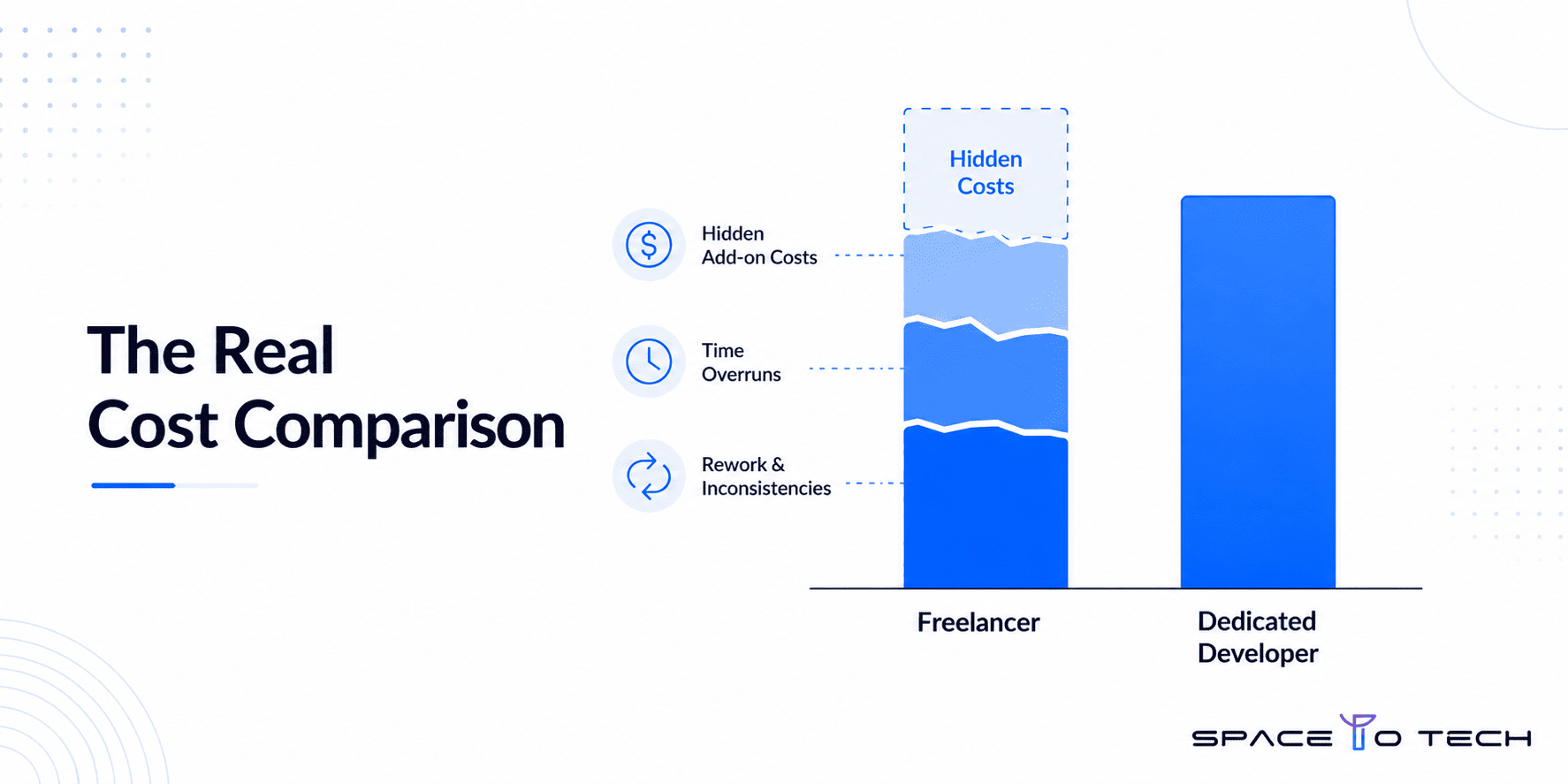
A freelancer quoting $30/hr looks obviously cheaper than a dedicated developer at $45/hr. But the hourly rate is not the total cost. Here's a realistic 12-month comparison for a single mid-level developer role:
The gap narrows or disappears once you account for what actually happens on a real project: a freelancer who ghosts mid-sprint, code that needs rework because nobody reviewed it, or the two weeks it takes a replacement freelancer to understand what the last one built. None of that shows up on the original quote.
Contract Types: Fixed-Price, Time-and-Material, and Retainer
Both models can run under different contract structures, and picking the wrong one causes more disputes than picking the wrong hiring model does.
- Fixed-price: set scope, set price. Works when requirements are fully locked before development starts — common with freelancers on small, well-defined tasks. Breaks down fast if scope changes.
- Time-and-material: you pay for hours actually worked. Best when requirements will evolve, which is true of almost every real product. Common with dedicated teams because it absorbs scope change without renegotiation.
- Retainer: a fixed monthly commitment for ongoing capacity — standard for dedicated teams supporting a live product long-term (maintenance, iteration, new features).
This is also why what it actually costs to hire a developer in India is worth reading alongside this comparison — the hourly-rate numbers only tell part of the story; the engagement model determines whether you actually pay that rate or something well above it.
Hidden Costs Businesses Often Ignore
The TCO table above covers the costs a contract can put a number on. These don't show up on any invoice, and they're usually bigger than founders expect:
- Founder time — every hour a founder spends re-explaining context to a new freelancer is an hour not spent on the business, and it's rarely tracked as a cost.
- Communication overhead — coordinating across several freelancers' schedules eats more calendar time than one structured standup with a dedicated team.
- Replacing a freelancer — sourcing, vetting, and re-onboarding a replacement resets the learning curve on your own codebase.
- Delayed launches — a missed freelance handoff can stall a release by weeks, not days, because there's no bench to absorb the gap.
- Lost revenue — every week a launch slips is a week competitors don't have to wait.
- Context switching — a freelancer splitting attention across clients context-switches on your project too, and that cost is invisible until velocity drops.
Most of these surface as the same warning signs covered in red flags when hiring software developers in India — vague timelines, slow communication, and unclear ownership tend to compound quietly until a project is already behind.
Scalability: Which Model Grows With Your Product?
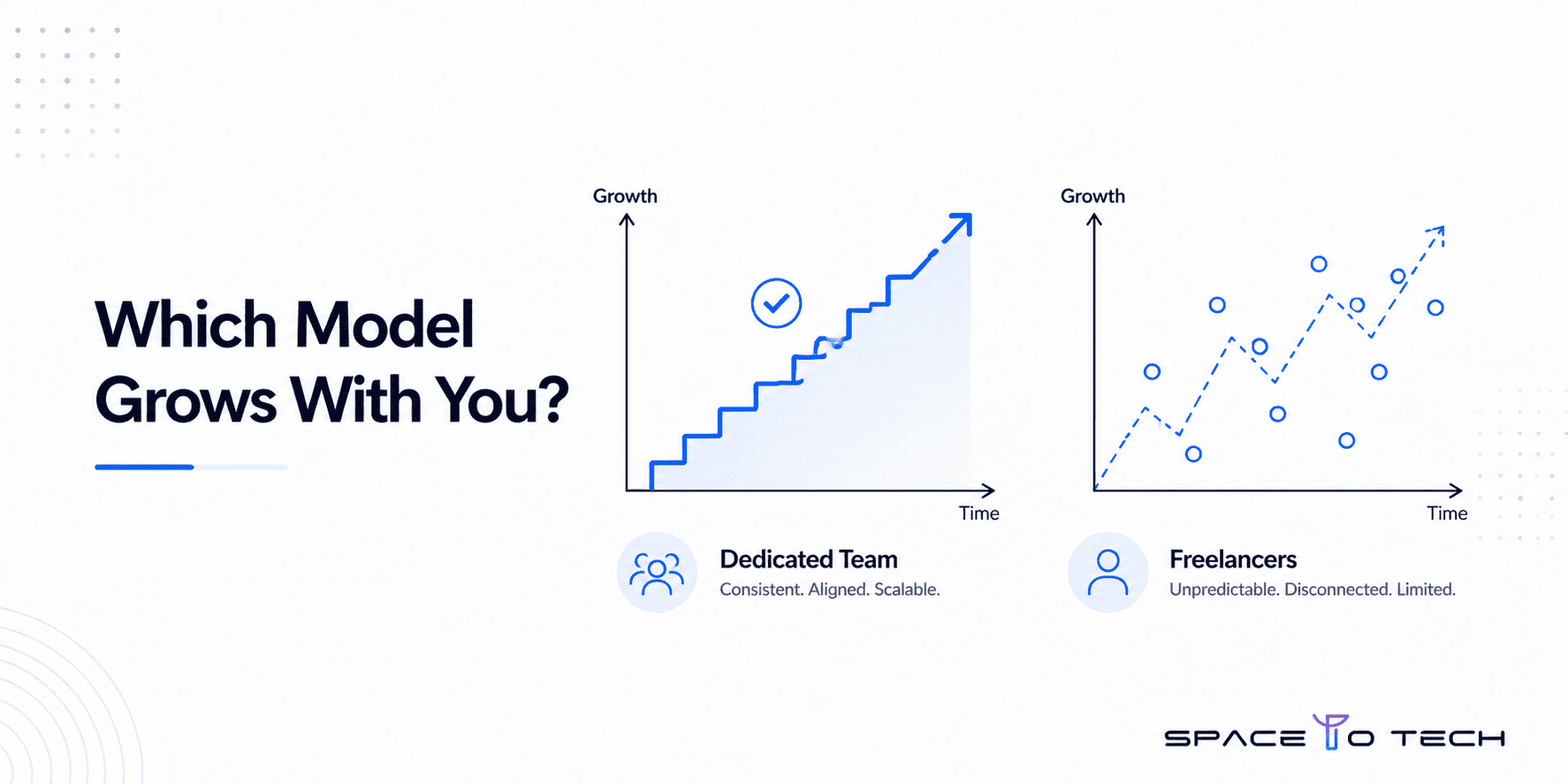
A freelancer model scales by addition — every new skill gap means sourcing, vetting, and onboarding another independent contractor, with no guarantee they'll mesh with what the last one built. A dedicated team scales by extension — the same team structure absorbs new developers who inherit existing context, documentation, and conventions.
For a startup expecting to go from MVP to Series A build-out, or an SME adding a mobile app to an existing web product, the dedicated model's scaling curve is close to linear. The freelance model's scaling curve gets steeper with each additional hire, because coordination overhead compounds.
Security, IP Protection, and NDA Enforcement
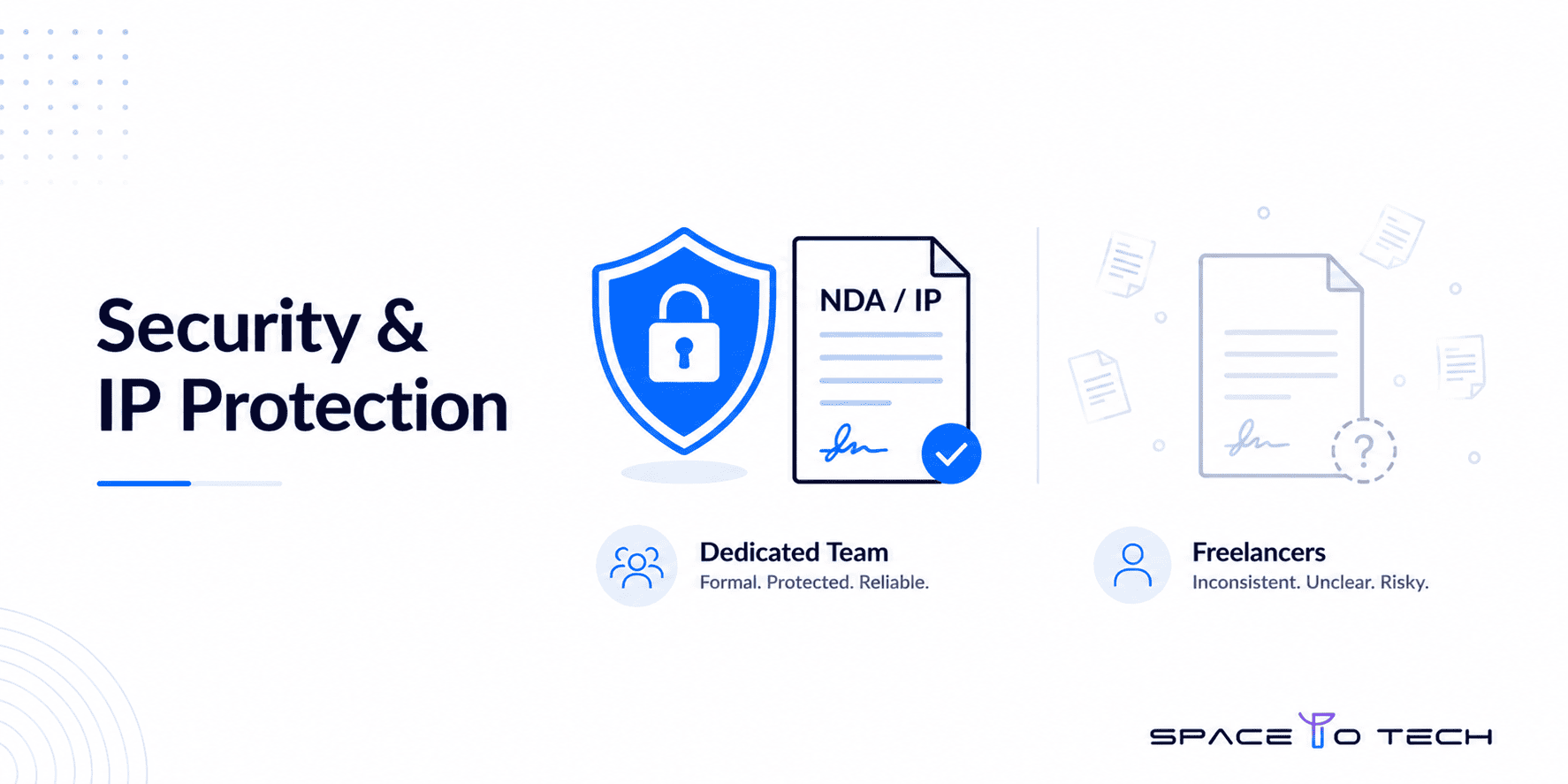
This is the risk category founders underweight until it matters. A dedicated development partner typically has NDA and IP-assignment terms built into the master agreement before work starts — enforceable, consistent, and backed by a company rather than an individual. Freelance arrangements vary enormously: some marketplaces offer boilerplate NDAs, many don't, and enforcement across borders is genuinely difficult if a dispute arises.
If your product involves proprietary algorithms, unreleased features, or customer data, this alone can be the deciding factor regardless of cost.
Communication, Time Zones, and Team Collaboration
Dedicated teams are built around your working rhythm — shared tools, scheduled standups, a single point of accountability. Freelancers communicate on their own terms, which is fine for a task with minimal back-and-forth and a problem when a project needs daily alignment. If you're coordinating across time zones already, a structured dedicated team — the kind covered in why founders hire developers from India — is generally easier to keep in sync than several independent freelancers on their own schedules.
Knowledge Retention and Long-Term Maintenance
Every time a freelancer's engagement ends, the undocumented context in their head leaves with them — architectural decisions, workarounds, the reason a particular library was chosen. A dedicated team retains that knowledge because the same people maintain what they built. For products with a maintenance phase (nearly all of them), this difference compounds every time a bug needs fixing six months after launch.
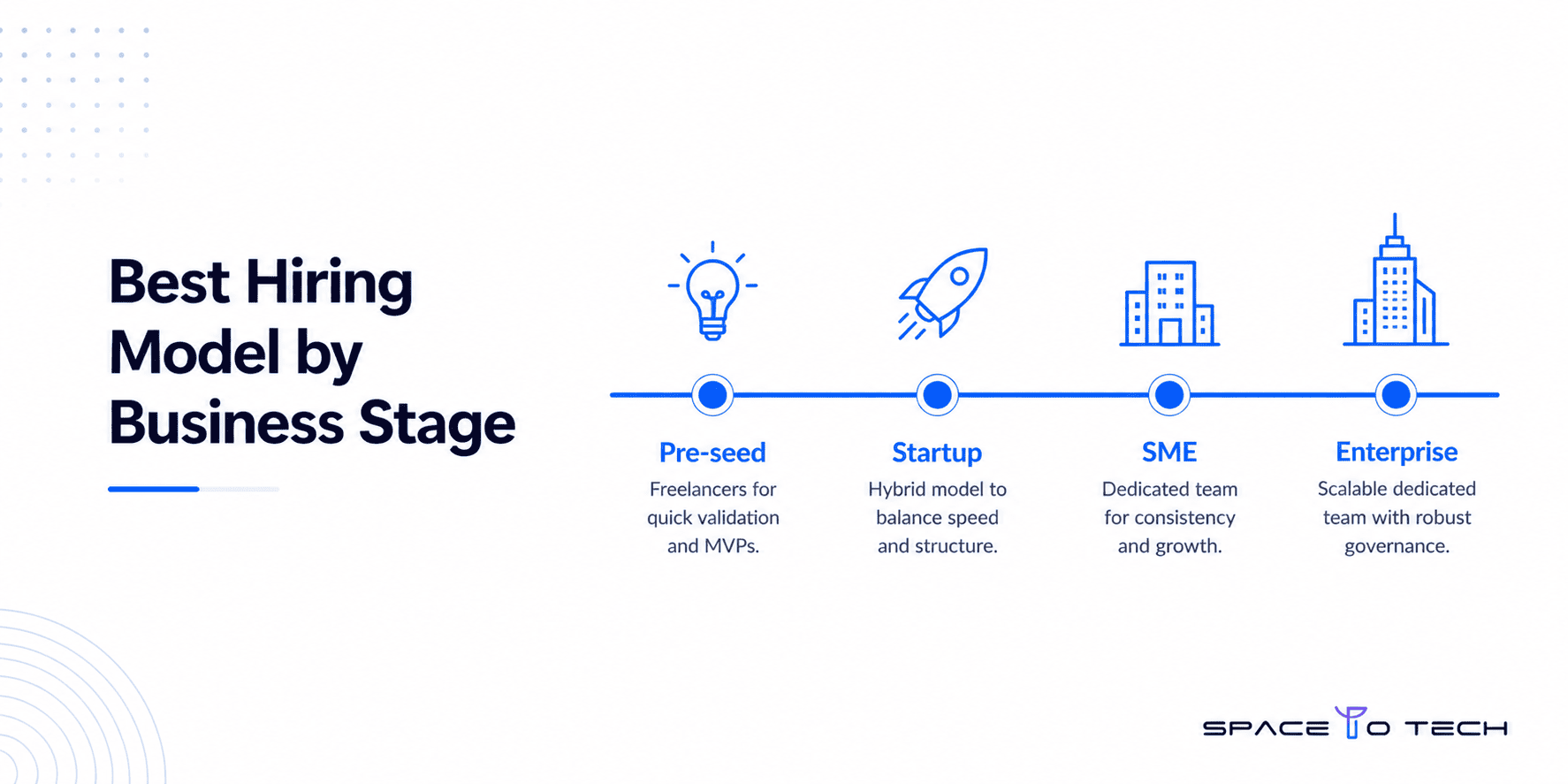
Best Hiring Model by Business Stage
Whichever stage you're at, it's worth comparing vetted providers rather than picking the first result — SpaceToTech's roundup of top software developers in India is a reasonable starting shortlist if you want to see how established teams structure pricing and delivery before you commit.
Real-World Scenarios: Which Model Fits Your Situation?
- "I need a landing page built in two weeks." — Freelancer: scoped, short, low risk.
- "I have a live SaaS product and a backlog that keeps growing." — Dedicated team: continuity and roadmap ownership matter more than hourly rate.
- "I need a one-off Stripe integration." — Freelancer: well-defined, finite task.
- "I'm about to raise a Series A and need to scale engineering fast." — Dedicated team: you need people who'll still understand the codebase in a year.
Can You Switch From Freelancers to a Dedicated Team Mid-Project?
Yes, and it's more common than most founders expect — usually after the "cheap MVP" built by rotating freelancers hits its first real scaling problem. The switch works best when you treat it as an audit first: a dedicated partner reviews the existing codebase, documents what's salvageable, and rebuilds only what's genuinely broken rather than starting over. Ask any partner you're evaluating for this audit step explicitly — vetting developers properly before you commit applies here as much as it does to a first hire.
External References
The U.S. Bureau of Labor Statistics projects software developer employment to grow roughly 15% between 2024 and 2034, much faster than the average for all occupations — demand for the underlying skillset isn't the question; how you staff for it is.
For context on the freelance side of this comparison: MBO Partners' 2025 State of Independence report counts roughly 73 million US independent workers under a broad definition, while the U.S. government's narrower count of primary-job independent contractors is closer to 10 million — a reminder that "freelancer" covers a very wide range of commitment levels, not a single hiring category. On the dedicated/offshore side, NASSCOM's 2026 Annual Strategic Review puts India's technology sector revenue at roughly $315 billion for FY26, with direct tech employment approaching 6 million — the scale behind the dedicated offshore-team model this article discusses.
Why Businesses Choose Dedicated Developers Over Freelancers
Strip away the cost tables for a moment and the pattern is simple: businesses that switch to a dedicated model are usually buying predictability, not just code.
- Accountability — one team, answerable to your roadmap, not a rotating cast of contractors, so there's a single party responsible when something slips.
- Predictable delivery — sprint commitments instead of "I'll get to it when I can," because capacity is reserved rather than shared across clients.
- Team continuity — the people who built it are still there to maintain it, which is why dedicated teams reduce onboarding costs: the same engineers retain product knowledge across multiple release cycles instead of relearning it each time.
- A dedicated point of contact — a project manager who owns delivery, not a founder doing PM work on the side between five different freelancer threads.
- Lower business risk — enforceable IP terms and structured QA reduce the odds of a dispute becoming a legal problem instead of a support ticket.
That's the model SpaceToTech is built around: a dedicated team, not a rotating bench of contractors, working as an extension of your product organization.
Which Model Is Right for You?
If you're validating an idea or need a single, well-defined task done, a freelancer is a reasonable, low-commitment choice. But if you're building something you expect to still be maintaining, scaling, or iterating on a year from now, a dedicated team consistently outperforms on total cost, security, and continuity — even when the hourly number looks less attractive at first glance.
Every business has different technical, budget, and growth requirements. If you're unsure whether a freelancer or a dedicated team is the right fit, our experts can help you evaluate the best engagement model based on your product roadmap and long-term goals.
Compare vetted teams on our list of top software developers in India, or go straight to talking through your roadmap with our dedicated development team.