If you’re a founder, CTO, or product leader trying to decide whether outsourcing software development to India is the right move, you’re not alone — it’s one of the most common ways global companies scale engineering without scaling headcount risk. This guide breaks down the real costs, the engagement models, the risks worth planning for, and a practical framework for choosing the right partner in 2026. Whether you are validating a first-time vendor or scaling an existing one, this guide breaks down what it actually costs and takes to outsource software development India-wide in 2026.
Whether you want to outsource software development in India for a single project or build a long-term offshore software team, SpaceToTech can scope the right engagement model and introduce you to a vetted delivery team.
What Is Software Development Outsourcing?
Software development outsourcing is the practice of hiring an external company or team — usually in another country — to design, build, test, or maintain software on your behalf, instead of doing that work with an internal team. It covers everything from a single contract developer filling a skills gap to a full dedicated team running your product roadmap. The reasons companies outsource software development vary, but they usually come down to three things: access to talent that’s hard to find locally, faster hiring timelines, and a lower blended cost of delivery without sacrificing quality.
In-House vs. Outsourcing vs. Staff Augmentation
An in-house team is hired, managed, and paid directly by your company — full control, but slow to build and expensive to scale up or down. Outsourcing hands a defined project or product area to an external vendor who owns delivery, process, and often the technical decisions within agreed scope. Staff augmentation sits in between: you bring in external engineers who work inside your existing team and processes, under your management, typically to fill a skills or capacity gap quickly. The right choice depends on how much control you need versus how fast you need to move.
Offshore vs. Nearshore vs. Onshore
Offshore outsourcing means working with a team in a distant time zone — India relative to the US or Western Europe, for example — which usually offers the deepest cost advantage and the largest talent pool, at the cost of little or no live-hours overlap. Nearshore means a team in a similar or adjacent time zone (Eastern Europe for Western Europe, Latin America for the US), trading some cost savings for easier real-time collaboration. Onshore keeps development entirely within your own country, maximizing control and time-zone alignment but at the highest cost. Most companies outsourcing software development to India accept the offshore trade-off deliberately, because the talent depth and cost advantage outweigh the reduced overlap — especially once teams build in a few hours of shared working time.
Who Should Outsource Software Development to India?
The right engagement model, and the right size of development company to approach, depends heavily on who is asking. Three profiles cover most of the businesses that outsource software development to India.
Startups
Early-stage companies typically need a full-stack team fast and cannot yet justify in-house hiring costs. A dedicated team or staff augmentation model with a smaller software development firm is usually the right fit, prioritizing speed and flexibility over long-term infrastructure.
Established IT Firms
Companies that already run an in-house engineering function often outsource to India to absorb overflow work, cover a skills gap (DevOps or QA, for example), or stand up a second delivery location. An offshore development center or a managed team model tends to fit better here than a short-term project contract.
Non-IT Businesses
Retailers, healthcare providers, manufacturers, and other non-technical companies outsourcing their first software project generally need more hand-holding on scoping and project management. A managed team or project-based model with a software development company that offers strong PM support, rather than a raw staff-augmentation arrangement, reduces the risk of scope drift.
Why Do Global Companies Outsource Software Development to India?
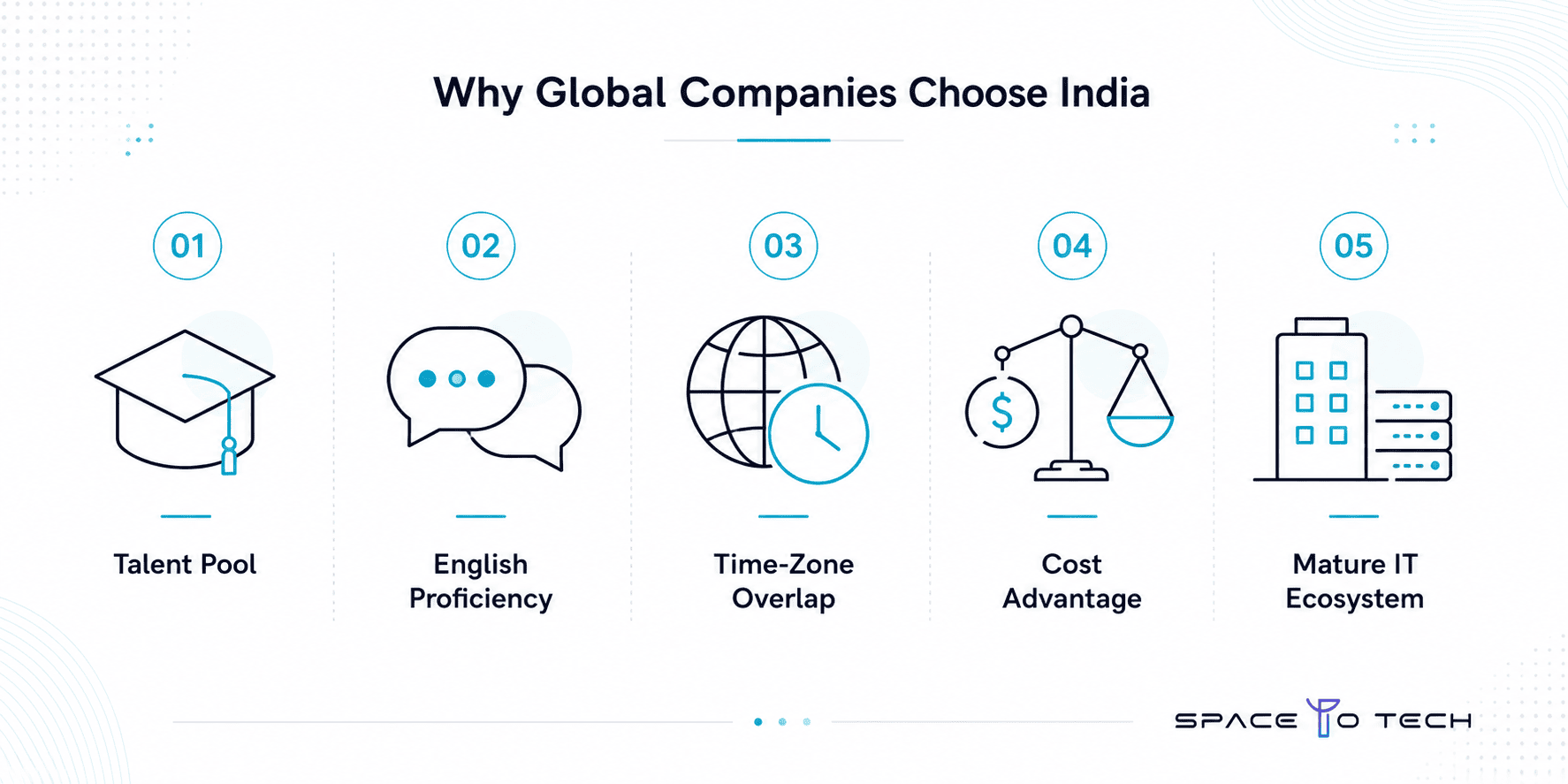
India remains the single largest offshore software services hub in the world, and that position isn’t accidental. According to NASSCOM’s most recent Strategic Review, India’s technology industry crossed roughly $283 billion in revenue in FY25 and is projected to cross $300 billion in FY26 — a scale that reflects a mature, deeply specialized IT-BPM ecosystem rather than a single low-cost advantage. The country also produces well over 1.5 million engineering graduates a year, giving companies access to a talent pool few other outsourcing destinations can match at the same depth across mobile, cloud, AI, and enterprise software skill sets.
A few structural factors keep global companies coming back to offshore software development in India specifically:
- Talent pool and specialization. Beyond raw graduate numbers, India has decades of maturity building software for regulated industries like BFSI, healthcare, and logistics — engineers who already understand the compliance context, not just the code.
- English proficiency. India has one of the largest English-speaking professional workforces globally, which materially reduces the miscommunication risk that plagues outsourcing relationships elsewhere.
- Time-zone overlap that’s workable, not ideal. A 9.5–13.5 hour gap from the US sounds extreme, but most Indian outsourcing teams structure a 3–4 hour daily overlap window with US or European clients, using async handoffs (documented standups, recorded demos, shared boards) to cover the rest.
- Cost advantage without a quality trade-off. Deloitte’s Global Outsourcing Survey, one of the most cited industry benchmarks on this topic, has repeatedly found that most US companies now cite speed-to-market and access to specialized skills — not cost alone — as the primary driver for outsourcing. That shift matters: it signals buyers are treating India as a delivery partner, not just cheap labor.
- A mature IT ecosystem. Established delivery hubs in Bengaluru, Pune, Hyderabad, and Noida mean vendor maturity, agile delivery experience, and infrastructure (data centers, connectivity, compliance certifications) are already in place — you’re not building a market from scratch.
Top Software Development Hubs in India
Treating Indian software outsourcing as one undifferentiated national market undersells how specialized individual cities have become. Bengaluru, Hyderabad, Pune, Chennai, and the Noida/Gurgaon belt each carry a distinct professional identity, and matching a project to the right hub can shorten a hiring search considerably.
Bengaluru remains the center of gravity for SaaS and AI-adjacent product development and carries the highest average rates of the five hubs. Hyderabad has built a strong reputation on enterprise and DevOps work, partly on the back of major global capability centers based there. Pune's software development talent skews toward QA, testing, and full-stack roles, Chennai has a longstanding fintech and ERP specialization, and the Noida/Gurgaon corridor, where SpaceToTech itself is based, has a dense concentration of mobile-first development companies and digital product studios.
Key Benefits of Outsourcing Software Development to India
The benefits go well beyond a lower hourly rate, though that’s usually the entry point into the conversation.
Cost savings without a proportional quality drop. Blended rates in India typically run at a fraction of US or Western European equivalents, largely because of cost-of-living and currency differentials, not lower skill levels — most competitive vendors now compete on portfolio and process, not price alone.
Faster hiring. Building a five-person in-house engineering team domestically can take three to six months of sourcing, interviewing, and onboarding. A vetted offshore development team in India can often be assembled and productive within two to four weeks, which matters when a product window is closing.
Scalability on demand. Outsourced and dedicated team models let you flex headcount up for a launch push or down after a release, without the fixed cost and legal complexity of hiring and laying off full-time employees. This is a major reason startup software outsourcing has become the default approach for early-stage companies validating product-market fit.
Access to specialized and niche expertise. Need a team with deep experience in a specific stack, compliance framework, or legacy migration? India’s IT-BPM ecosystem’s scale means specialized talent pools exist for nearly every vertical, without you having to build that expertise internally from zero. If you’re evaluating candidates directly rather than through a vendor, it’s worth reviewing which skills to verify before hiring software developers so the specialization claim actually holds up in a technical screen.
Faster time-to-market. Combining round-the-clock development (your team sleeps, theirs works, and vice versa) with an established agile delivery cadence lets many companies compress release cycles meaningfully compared to a single-timezone in-house team.
Common Risks of Outsourcing to India (and How to Avoid Them)
No honest article skips this section, and neither will we — the risks are real, but every one of them is manageable with the right contractual and process safeguards.
Communication gaps. Time-zone distance and cultural differences in how feedback or disagreement get raised can cause misunderstandings. Mitigate this with a defined daily overlap window, written async updates, and a single accountable point of contact on the vendor side rather than a rotating cast.
Time-zone friction. Rather than treating the gap as a problem to eliminate, structure your process around it: async standups, recorded walkthroughs, and a shared backlog with clear priority tags outperform trying to force real-time syncs at odd hours for either side.
Quality variance. Not every vendor delivers the same standard, which is why a technical evaluation and a small paid proof-of-concept before a full engagement is non-negotiable — see the section below on choosing a partner. It’s also worth checking red flags when hiring software developers before signing anything.
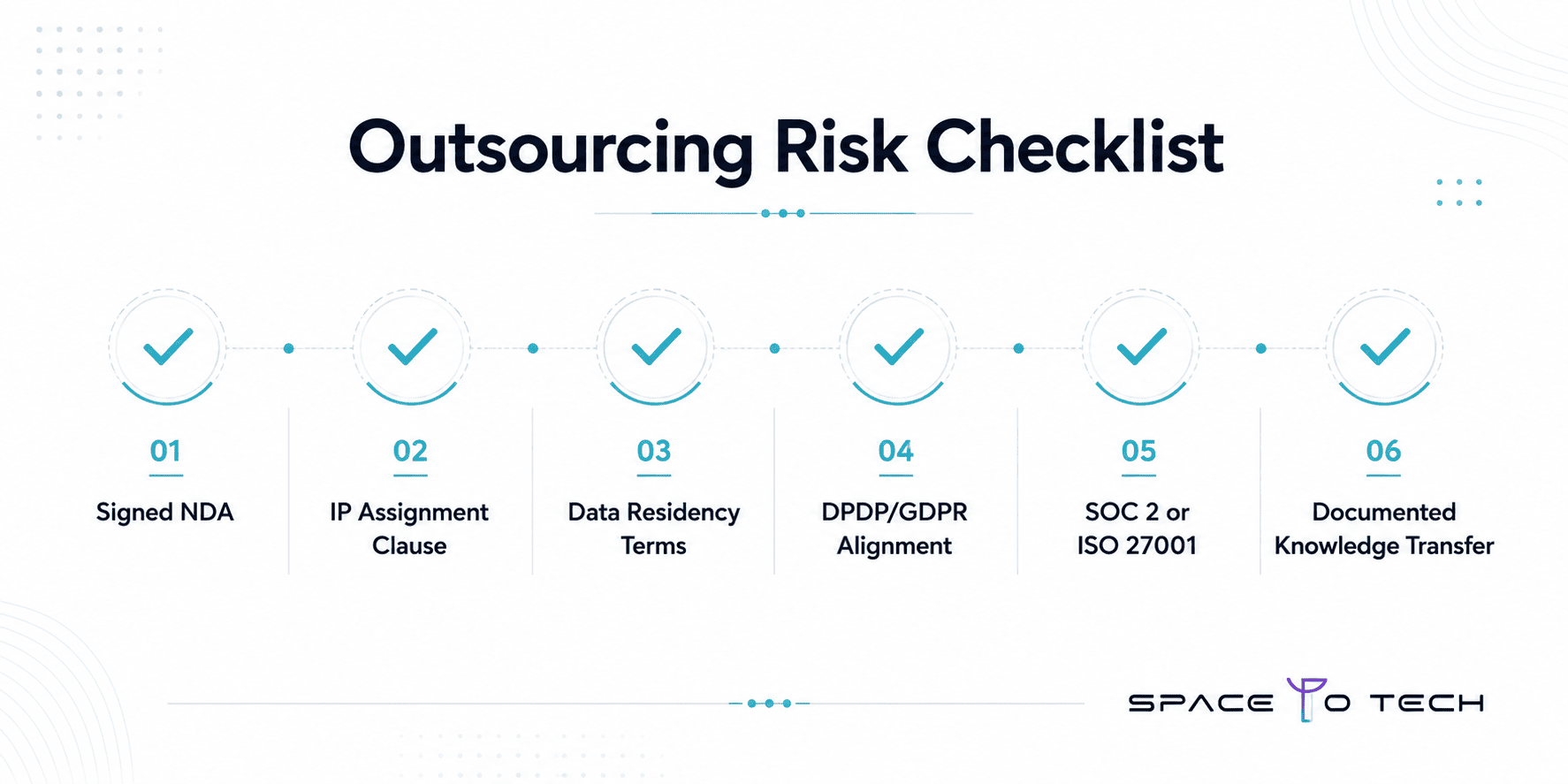
Security and IP protection. This is the section that should carry the most weight in your due diligence, and it’s also where India’s regulatory landscape has genuinely shifted. India’s Digital Personal Data Protection (DPDP) Act, 2023, had its Rules formally notified by the Ministry of Electronics and IT in November 2025, establishing the Data Protection Board of India and a phased compliance timeline for core data-handling obligations. For companies subject to GDPR or HIPAA, this means your vendor contract should now explicitly address DPDP compliance alongside your existing frameworks — not treat it as an afterthought. In practice, that means a solid NDA, an explicit IP assignment clause naming your company as sole owner of all work product, defined data residency terms, and access controls (least-privilege credentials, audit logs) written into the contract rather than assumed. Ask any shortlisted vendor whether they hold SOC 2 or ISO 27001 certification — it’s a fast filter for security maturity.
Hidden costs and scope creep. Fixed-price contracts without a tightly scoped requirements document are the single biggest source of budget overruns. Time & Material (T&M) engagements with sprint-level scope reviews tend to control this better for anything beyond a simple MVP.
Vendor lock-in and attrition. Ask upfront how the vendor handles knowledge transfer if a key engineer leaves, and insist on documentation (architecture decisions, onboarding guides) as a contractual deliverable, not a nice-to-have.
DevOps, QA & eCommerce Outsourcing
DevOps, QA, and eCommerce are treated as distinct, separately-searched outsourcing categories by most competitors, and the current page does not name any of the three. Each has its own standard toolchain, and naming them signals real delivery depth rather than generic “we do everything” positioning.
DevOps outsourcing typically centers on CI/CD pipelines built with Jenkins or GitHub Actions, containerization with Docker and Kubernetes, and infrastructure-as-code via Terraform. QA outsourcing spans manual and automated testing, with Selenium, Cypress, and Playwright as the standard automation frameworks and k6 or JMeter used for load and performance testing. eCommerce outsourcing covers both platform-based builds, on Shopify, Magento, or WooCommerce, and headless commerce architectures for businesses that need more flexibility than a templated platform allows. Businesses that outsource software in these three categories specifically, rather than folding them into a generic development retainer, tend to get teams with deeper, more current tooling knowledge.
How to Measure Outsourced Team Quality
“Quality variance” is easy to name as a risk and hard to act on without numbers attached to it. A software development project run by an outsourced team can be tracked against the same operational metrics used internally, which turns a vague concern into something a client can actually check month over month.
- Bug escape rate: defects found in production versus caught in QA, tracked per release
- Automated test coverage: flag anything under 70% as a risk on any production-facing software development project
- Defect density: number of confirmed defects per 1,000 lines of code or per feature shipped
- Sprint velocity variance: how much planned versus completed story points drift sprint over sprint
- Code review turnaround: average time from pull request opened to merged
Asking a prospective vendor to report against these metrics from the first sprint, rather than only at a project retrospective, is one of the more reliable ways to catch quality problems on outsourced software development projects before they compound.
Software Development Outsourcing Models
Choosing the wrong engagement model is one of the most common — and most avoidable — outsourcing mistakes. Here’s how the main models compare:
A dedicated development team is generally the right fit if you’re a funded startup or scaling product company that expects to keep building indefinitely. Project-based engagements suit a company that knows exactly what it needs built and doesn’t need an ongoing relationship. If you’re comparing vendors directly, it’s worth scanning a shortlist of top software developers in India before locking in a model, since some vendors specialize in one engagement type over another.
Software Development Services You Can Outsource to India
Mobile app development is only one slice of what companies outsource to India. Most software development companies in the country run dedicated practices across custom software, enterprise systems, cloud-native engineering, and legacy modernization, and pricing and delivery timelines vary meaningfully across each. Naming these categories explicitly makes it easier to scope a request for proposal and match it to a development company with the right specialization, rather than defaulting to a single generalist outsourcing partner.
Custom software development covers purpose-built applications designed around a specific workflow rather than off-the-shelf software; it is typically the highest-touch and most consultative engagement. Enterprise software outsourcing spans ERP and CRM implementation, integration, and customization work, usually for mid-market and larger organizations already running on a platform like SAP, Salesforce, or Microsoft Dynamics. Cloud-native development outsourcing covers greenfield builds designed for AWS, Azure, or Google Cloud from day one, including microservices and containerized architectures. Legacy modernization is its own category entirely, replatforming or re-architecting older systems without disrupting business continuity.
A software development company that can move across all four categories, rather than just mobile and web, is usually a better long-term outsourcing partner for businesses expecting to scale their product roadmap over multiple years.
Offshore Development Center (ODC)
An offshore development center is the highest-commitment step up from a dedicated team: instead of contracting individual developers, a business sets up a wholly-owned or vendor-managed offshore software unit in India, complete with its own hiring pipeline, infrastructure, and reporting lines back to the parent company. It suits organizations planning to keep a stable offshore team in place for several years rather than a single project. Compared to a dedicated team model, an ODC gives more control over hiring and culture but requires more upfront setup and a longer commitment before the cost advantage of building development teams offshore fully pays off.
Can You Outsource Mobile App Development to India?
Yes — mobile app development is one of the most commonly outsourced categories, covering native iOS/Android builds, cross-platform frameworks like Flutter and React Native, and full app lifecycle work from design through App Store deployment. The same vetting principles apply as for web or backend work: check a vendor’s shipped-app portfolio, ask about post-launch support, and confirm they’ve handled your specific platform requirements before. If mobile is a core part of your roadmap, it’s worth reviewing top mobile app development companies and top app developers in India as a starting shortlist.
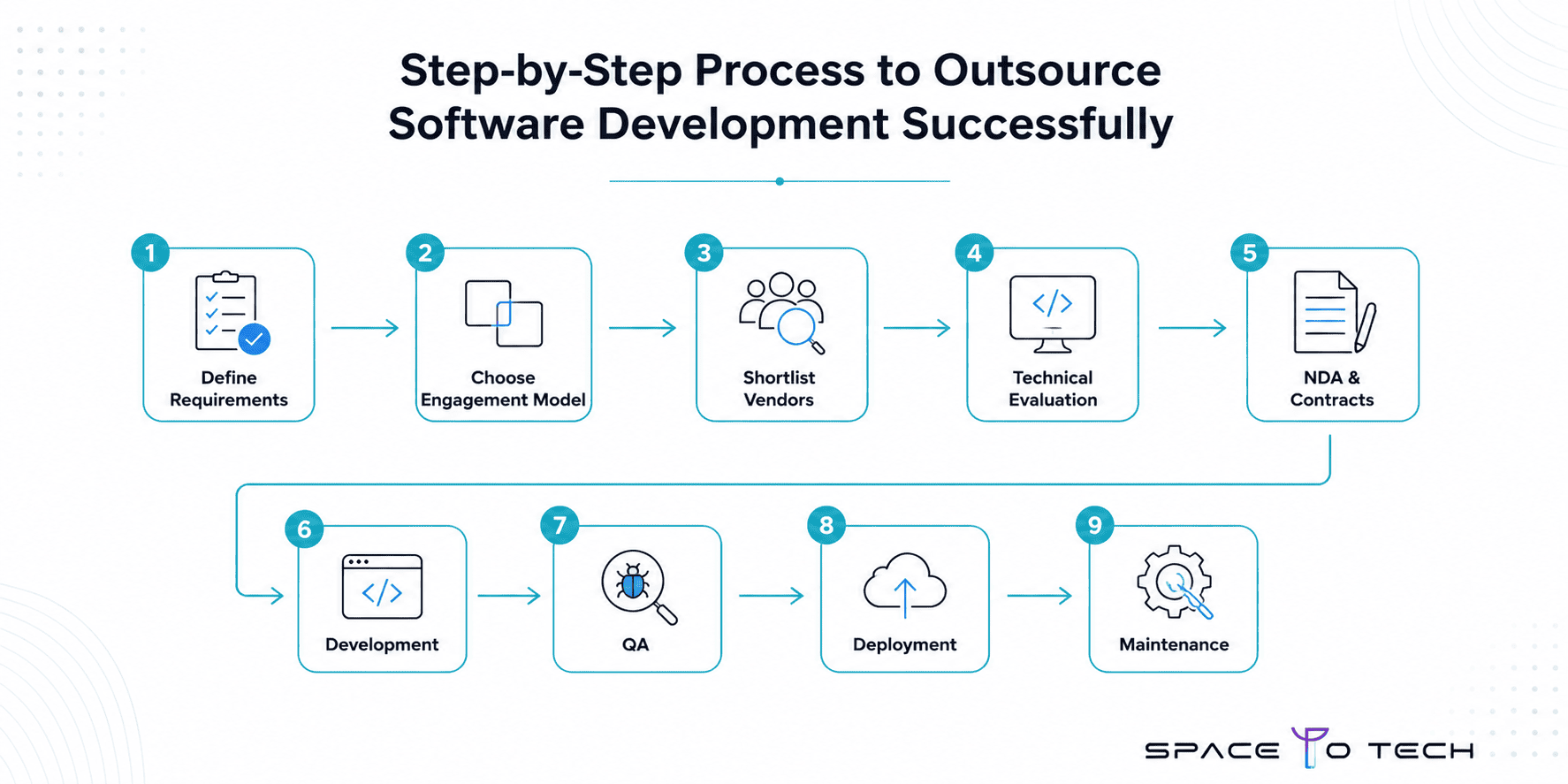
Step-by-Step Process to Outsource Software Development Successfully
A structured process is what separates a smooth engagement from a costly one. In order:
- Define requirements. Document scope, must-have features, tech stack preferences, and success criteria before talking to any vendor.
- Choose your engagement model. Match dedicated team, staff augmentation, project-based, or managed team to your timeline and control needs.
- Shortlist vendors. Narrow to 3–5 companies based on portfolio relevance, industry experience, and verified reviews.
- Technical evaluation. Run a paid technical assessment or small proof-of-concept — never skip this step, regardless of how strong the sales conversation was.
- NDA and contracts. Lock in IP assignment, data residency, security obligations, and payment terms before any code gets written.
- Development. Kick off with a discovery sprint to align on architecture and working cadence before full-speed delivery begins.
- QA. Insist on a defined QA process — test plans, coverage targets, bug-tracking cadence — not just “we test as we go.”
- Deployment. Confirm who owns deployment, environment access, and rollback procedures ahead of go-live.
- Maintenance. Agree on post-launch support terms (SLA response times, ongoing sprint capacity) before the project ends, not after.
How Much Does It Cost to Outsource Software Development to India?
Pricing depends heavily on seniority, city tier, and engagement model, so treat any number you see — including these — as an industry-average estimate to verify against a live quote before budgeting.
Several factors move these bands: tier-1 cities (Bengaluru, Pune, Hyderabad) typically command a premium over tier-2 hubs; specialized skills (AI/ML, security, legacy modernization) add a markup; and compliance overhead — SOC 2/ISO 27001 processes, DPDP-aligned data handling — is increasingly priced into vendor rates as a line item rather than absorbed silently. For a fuller breakdown by role and project type, see our detailed software development cost in India guide.
Domestic Hiring vs. Outsourcing — True Cost Comparison
The page already makes the domestic-versus-outsourced hiring comparison narratively, citing a 3–6 month domestic hiring timeline against 2–4 weeks for an outsourced team. Converting that into a dollar figure makes the same point more concretely.
Fully-loaded annual cost should include salary, benefits, payroll tax, and office overhead on the domestic side, and the all-in vendor rate, including any management or infrastructure fee, on the outsourced side, so the comparison reflects total cost rather than headline hourly rate alone.
Frontend, Backend & Full-Stack Talent You Can Hire
Naming the actual frameworks and languages available closes a real credibility gap: a page about software development outsourcing that never names a technology reads as generic. India's talent pool is deep across both modern frontend frameworks and backend languages, which is what makes it possible to assemble a full-stack team, rather than piecing together individual freelance software developers, on a compressed timeline.
On the frontend, React and Next.js dominate hiring demand for customer-facing products, with Next.js increasingly the default for anything that needs server-side rendering or strong SEO performance out of the box. On the backend, Node.js remains the most common pairing with a React frontend for teams that want a single language across the stack, while Python, via Django or the faster, async-first FastAPI, is the more common choice for data-heavy or AI-adjacent product development. Laravel continues to see steady demand for mid-market web platforms and CMS-driven builds, particularly from UK and Australian clients.
Pairing this table with the existing hourly-rate breakdown in the Cost section gives a prospective client a way to estimate both what a stack costs and what size of development services team it actually requires.
India vs. Other Software Outsourcing Destinations
India isn’t the only offshore option, and it isn’t the right fit for every company. Here’s how it stacks up against the other major outsourcing regions:
The honest takeaway: if live-hours overlap is your top priority, Latin America or Eastern Europe may fit better. If talent depth and cost efficiency at scale matter most — and you’re willing to build an async-friendly process — India remains the strongest combination of the two.
How to Choose the Right Software Outsourcing Company in India
This is the highest-stakes decision in the whole process, and it deserves more diligence than most companies give it.
- Portfolio and case studies. Look for shipped work in your industry or a technically comparable one, not just a generic capabilities deck.
- Reviews from verifiable sources. Clutch, GoodFirms, and direct client references matter more than testimonials on the vendor’s own site.
- Technical expertise match. Confirm the vendor has real, recent experience in your specific stack — not just a listed skill on a slide.
- Communication process. Ask exactly how daily/weekly updates work, who your point of contact is, and what tools they use (Slack, Jira, Linear) before signing anything.
- Security posture. SOC 2, ISO 27001, and a clear answer on DPDP/GDPR alignment should be table stakes, not a follow-up question you have to chase.
- Industry experience. A vendor that’s built for regulated industries (healthcare, fintech) understands compliance context that generalist teams often miss.
- Team structure. Understand who’s actually on your team day-to-day versus who’s in the sales pitch — ask for names and LinkedIn profiles before signing.
Run every shortlisted vendor through the same skills-to-verify checklist referenced earlier, and cross-reference against our guide on how to choose the right development partner — consistency across your evaluation process is what prevents a good sales pitch from masking a weak technical fit.
Industries That Benefit Most from Software Outsourcing
Outsourcing works best where there’s a clear, recurring need for specialized engineering capacity:
- Healthcare — HIPAA-aware development teams for patient platforms, telehealth, and health data systems.
- Fintech — engineers experienced with security-first architecture, compliance, and high-availability systems.
- SaaS — dedicated teams that can move at product velocity without the overhead of a large internal org.
- Logistics — real-time tracking, route optimization, and integration-heavy systems.
- Retail and e-commerce — scalable platforms that need to handle seasonal traffic spikes reliably.
- Manufacturing — IoT integration, ERP customization, and legacy system modernization.
- Education — LMS platforms, ed-tech products, and accessibility-focused builds.
If your roadmap includes a custom web or AI-powered application in any of these spaces, it’s worth reviewing our custom web application development work for relevant examples.
Why Businesses Choose SpaceToTech as Their Software Development Partner
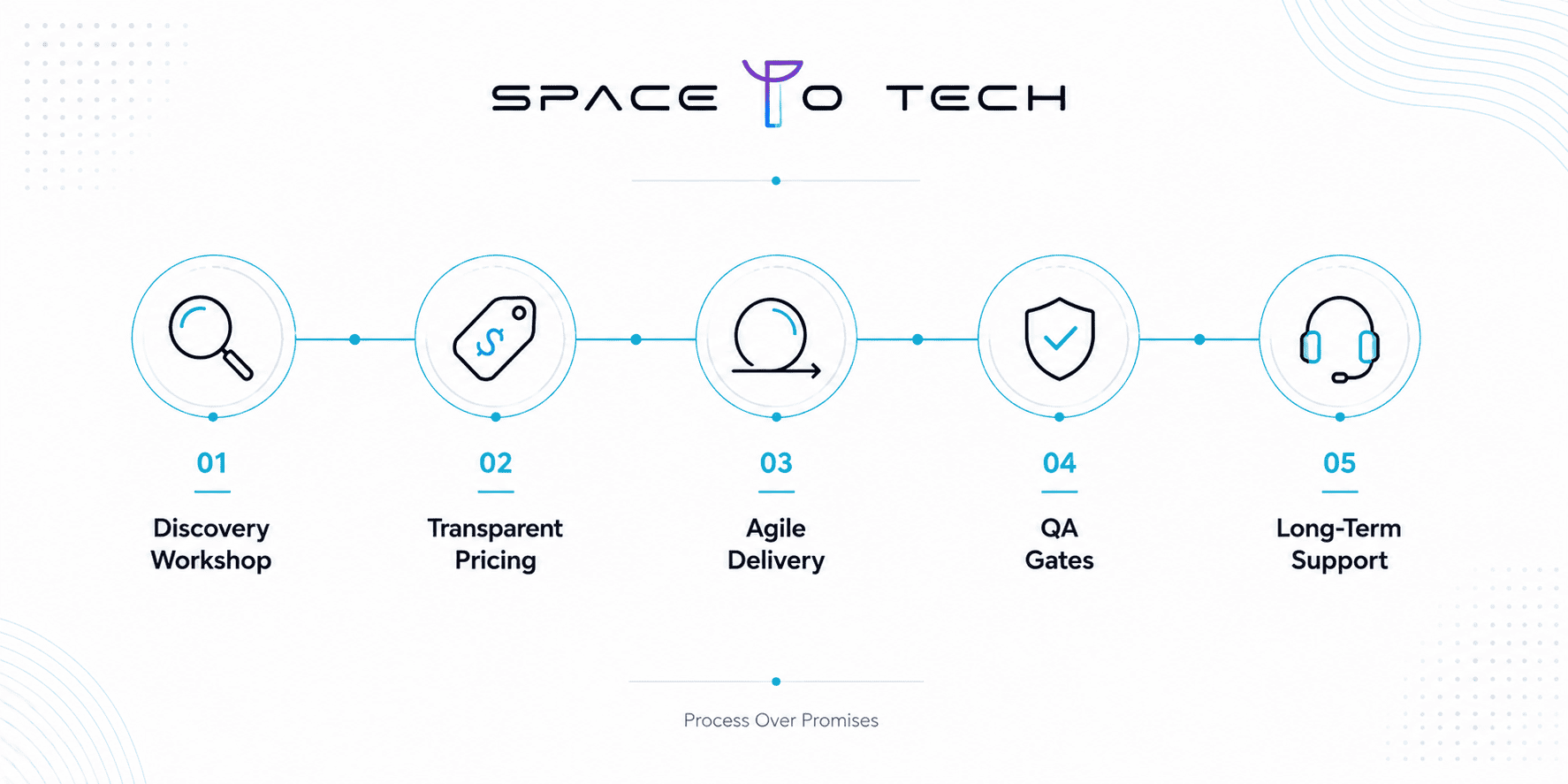
Most “why choose us” sections lean on adjectives. We’d rather show process. At SpaceToTech, every engagement starts with a structured discovery workshop to map scope, architecture, and success metrics before a single sprint is planned — not a sales call disguised as onboarding. Pricing is laid out transparently against the engagement model you choose, with no hidden markups buried in change requests.
Delivery runs on a genuine agile process with a dedicated project manager as your single point of accountability, defined QA gates before anything reaches staging, and long-term support terms agreed before launch, not negotiated after. It’s the kind of process-first approach that’s let us support clients across SaaS, fintech, and logistics with dedicated and staff-augmented teams that stay accountable to outcomes, not just billable hours. If you’re evaluating a custom software development partner in India, this is the standard we hold every engagement to.
Ready to Build with a Team That Treats Process as the Product?
If you’re evaluating whether to outsource, the next step isn’t another article — it’s a conversation about your specific roadmap. Hire software developers from India with SpaceToTech and get a discovery workshop, transparent pricing, and a dedicated team built around how you actually need to ship.