By the year end of 2025, 62% of businesses claimed they were at least trying out AI agents, and 23% said they were currently using them in at least one business function. AI adoption is also going from pilot projects to production. Deloitte says the number of organisations with 40% or more of their AI initiatives in production will double in the next six months.
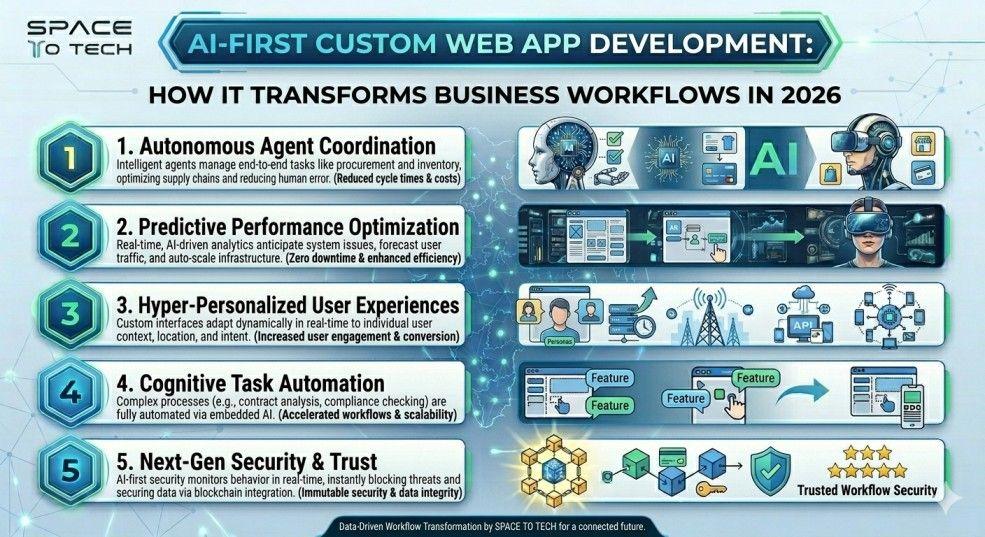
This change explains why custom web app development services are evolving quickly. AI has gone from being a plus to becoming mainstream. Traditional web app development services were meant to automate operations that don't change. AI-first platforms do more than that. They guess what users will want, help them make choices, learn from data, and make processes better over time.
Businesses evaluating custom web app development services, web app development company alternatives, or a larger web application development company in 2026 should ask how profoundly AI should affect the product. Answering that question clearly often starts with understanding how an AI Development Company solves industry-specific challenges — because the right AI strategy looks fundamentally different across sectors.
This article discusses what AI-first web development truly involves, how it changes business operations, which AI features are most important, and what decision-makers should consider about ROI and deployment.
This is also changing how custom web app development services are offered across sectors for organizations like Space To Tech.
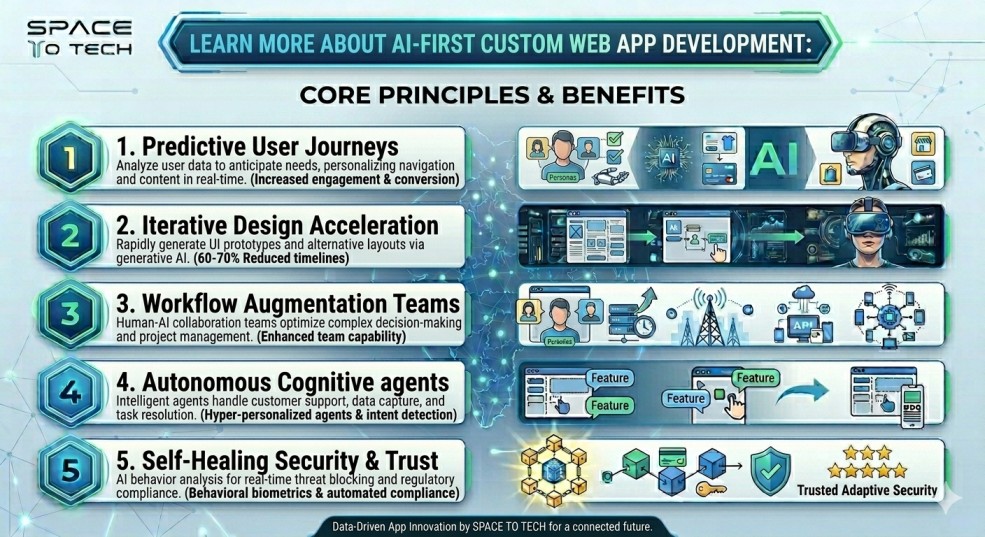
Learn More about AI-First Custom Web App Development
"AI-first" means building software with AI as a key part of the design from the beginning. It doesn't mean adding AI afterward as a side feature or plug-in.
Traditional vs. AI-First Approach:
The traditional way of making web apps, the system follows rules that have been written into it, responds to what users say, and needs people to make changes. In AI-first web development, the app learns from data, adapts with trends, predicts needs, and may aid or make decisions in real time.
Key Technologies Powering AI-First Apps in 2026:
Machine learning predicts, natural language processing understands, computer vision analyzes, generative AI helps with content and code, and AI agents execute multi-step jobs in bespoke web app development. Developer adoption is also accelerating.
Why 2026 Is the Tipping Point:
GitHub observed that almost all of the developers they talked to had utilized AI coding tools at work or outside of work. Stack Overflow found that 84% of respondents were using or intended to use AI tools in development.
The Business Case:
In real life, AI-first custom web app development service models help companies operate faster, more accurately, and with better customer service, and automate their workflows.
Workflow Transformation #1: Intelligent Process Automation
30–40% of daily job activities are still spent on manual and repetitive chores, which still take up a large portion of employee time. Things like reviewing documents, entering data, getting approvals, and addressing tickets slow things down and make mistakes more likely. This is where AI-first custom web app development services are changing the way web applications are made.
How AI-First Web Apps Transform This:
- Smart Document Processing: Business papers may be handled automatically by AI-powered web app applications. The technology can read invoices, contracts, and forms, find relevant information, and organize documents with 95% accuracy or better. It does this using machine learning and computer vision.
- Automated Workflow Routing: Then, clever workflow engines decide what to do next based on the data, how important it is, and the rules that have previously been created for the business.
- Exception Handling: When unusual cases come up, the system identifies them and delivers them to the right person for review.
- Continuous Improvement: Over time, the platform gets better because it learns from its failures and how people use it.
Real-World Examples:
Finance Teams: Finance departments may automate fraud detection and expenditure reporting, which cuts down on processing time by 70% and makes mistakes less likely.
HR Departments: HR departments use AI to evaluate resumes, set up interviews, and answer employee inquiries, resulting in 60% shorter recruiting processes.
Customer Service: Client support teams use AI triage tools to quickly answer common questions, which means that more than half of client inquiries may be handled without any help from a person.
Modern custom web app development services provide these automation features straight to existing company systems. Space To Tech lets companies update their workflows without replacing every technology.
Workflow Transformation #2: Predictive Analytics & Decision Intelligence
Many companies still make decisions based on historical reports or gut feelings. Dashboards represent what has happened in the past, but they don't always reflect what will happen in the future. AI-first web development changes this by adding predictive intelligence directly into bespoke web apps.
How AI-First Web Apps Transform This:
- Demand Forecasting: AI algorithms employ data from the past, user behavior, and operational indicators to make guesses and give advice.
- Customer Behavior Prediction:Businesses can employ predictive technology to figure out what their customers will want, how many employees they need, how to best use their resources, and other operational issues.
- Risk Assessment: AI-powered systems may also detect attrition, highlight upsell possibilities, and decide the best time for custom client engagement. This capacity is changing how people make decisions in many kinds of businesses.
- Performance Optimization: AI-first bespoke web app development services have the most impact on organizations because they make them more proactive instead of reactive. Instead of waiting for problems to materialize, businesses may get ahead of them. This makes them more efficient and helps them do better in the long term.
Industry-Specific Applications:
- AI in ecommerce predicts how many people would want to buy a product, finds the best prices, and tracks inventory levels. This reduces stockouts by 25% and boosts profitability. Health institutions employ predictive analytics to anticipate patient readmissions and appointment no-shows to better manage resources.
- Manufacturers use AI to guess when machines will break down and change their production schedules to cut down on unplanned downtime by 40%. Predictive models in real estate use property data and market trends to assist individuals make wiser and faster investment decisions.
Workflow Transformation #3: Hyper-Personalization at Scale
Strong engagement is seldom driven by generic digital experiences. Conversion rates drop and custom users disengage when all users see the same content, recommendations, or interface. By enabling hyper-personalization at scale within modern custom web app development services, AI-first web development addresses this.
How AI-First Web Apps Transform This:
AI-powered web apps may change how users interact with them in real time based on how they browse, what they buy, and other signals in the environment.
- Dynamic Content Adaptation: Dynamic content engines change the way things look, the copy, and the ads based on what users do.
- Unified User Profiles: The objective of developing a unified profile is to learn more about what users like by looking at their behavior on different platforms and devices. As users interact with the system, machine learning is always improving suggestions and targeting.
- Real-Time Personalization: Personalized product recommendations may help online stores boost their average order value (AOV) by 35% and their conversion rate by 30%. SaaS platforms employ AI to personalize dashboards, suggest features, and help users through processes to keep users and get them to use the software more.
- Continuous Learning: Education platforms also employ this sort of approach to make learning more effective by changing the way students learn and the way content is presented.
By 2026, AI-driven customization is expected to be standard on all digital platforms. This makes it an important aspect of plans for building custom web apps.
Workflow Transformation #4: Intelligent Search & Knowledge Management
As per a LinkedIn post Mckinsey stated that 20% of the workers waste a large amount of their workday searching various databases for relevant data. It can be quite challenging to locate answers promptly when documents are stored in various locations such as cloud drives, emails, internal portals, or CRM platforms. Intelligent search and knowledge management are the solutions provided by AI-first web application development.
How AI-First Web Apps Transform This:
- Semantic Search: Semantic search, not keyword-based search tools, is what AI-driven systems utilize to figure out what users are asking.
- Natural Language Queries:Users may ask queries in plain English, and the system discovers the right answers by getting data from many different places at once.
- Cross-System Search: These platforms search databases, internal papers, emails, CRM systems, and external knowledge repositories.
- Contextual Recommendations: This feature makes businesses that use enterprise web app development services much more productive.
AI-powered knowledge bases make it easy for employees to access policies, processes, and resources. This reduces the number of internal support tickets by 60%. 70% of questions of customer self-service portals can automatically answer typical queries by figuring out what users are asking and looking up information.
Modern online apps use powerful AI algorithms to make it 80% simpler to find and interpret information. These systems create summaries, pull out important information, and translate difficult papers.
Workflow Transformation #5: Conversational Interfaces & AI Agents
Even if they are powerful, many business systems are difficult to use. Employees normally need a lot of training when it comes to dashboards, filters, and intricate processes. AI-first web app development gets around this problem by adding conversational interfaces and smart AI agents.
How AI-First Web Apps Transform This:
- Natural Language Interfaces: Natural language processing lets people utilize online apps without having to switch between displays. Using a conversational interface, employees may ask questions or make requests directly through the system.
- Voice-Enabled Operations:Voice-enabled features make it possible to utilize apps without using your hands, which is especially helpful for mobile workers or apps that focus on accessibility.
- Multi-Turn Conversations: Advanced systems that allow multi-turn talks let the AI maintain track of context and keep working on tasks over numerous exchanges.
- Autonomous AI Agents: AI agents can perform more than just chatbots. For example, they can make reports, deal with cost claims, and arrange logistical operations that include several phases. A sales manager could request a report on high-value deals closing this quarter, and the AI agent would automatically identify risks.
Conversational AI is anticipated to become a standard feature of custom enterprise software applications by 2026, making custom web app development significantly simpler to use.
Workflow Transformation #6: Real-Time Collaboration & Intelligence
It's normal for teams to work together across divisions, tools, and time zones these days. On the other hand, disconnected systems sometimes make upgrades take longer, lead people to do the same task again, and lose chances to work together. AI-first custom web app development services put collaborative intelligence right into corporate platforms to fix this problem.
How AI-First Web Apps Transform This:
Smart Notifications: AI-powered systems can figure out which updates are most important and who on the team should be alerted first, which lets them set priorities for alerts.
Automated Status Updates: Stakeholders may also be automatically contacted, status reports can be made, and project progress can be followed without any effort.
Intelligent Meeting Assistants: One benefit of smart meeting assistants is that they make it easier for administrators to do their jobs. They can take notes, pull up action items, and schedule follow-up activities.
Contextual Collaboration: Web apps may use contextual collaboration capabilities to show you relevant papers, teammates, and conversations that are related to the job at hand.
AI may assist project managers make delivery times better to 35% by forecasting delays, suggesting adjustments to resources, and automating routine updates.
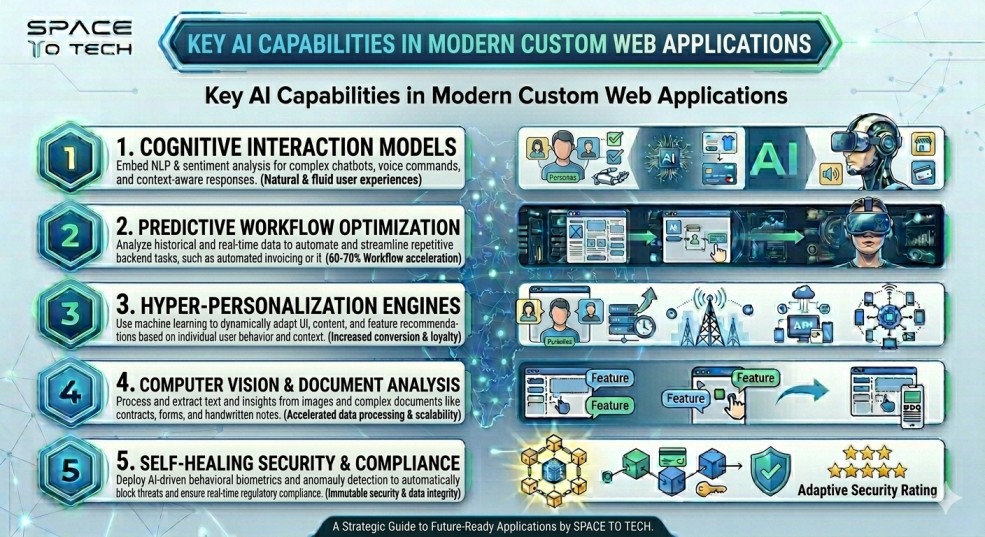
Key AI Capabilities in Modern Custom Web Applications
Core AI Features Every Business Should Consider:
- Generative AI Integration: Adding AI features to current custom web app development services is becoming more and more vital for making things run more smoothly, making better decisions, and giving users a better experience. Because it can autonomously write code, documentation, product descriptions, emails, and reports, generative AI integration is a game changer. When companies employ generative technologies, they usually see a 40% increase in how quickly they can generate content and documentation.
- Computer Vision: Compute vision, which allows for automated quality inspections, document digitization, and visual search capabilities in e-commerce platforms, is another important capability. Compute vision systems are able to detect flaws with a remarkable degree of accuracy in manufacturing environments.
- Sentiment Analysis: AI-powered web apps are also increasingly using sentiment analysis. This helps firms keep track of consumer feedback, see how people feel about their brand, and find unfavorable patterns early.
- Intelligent Automation: AI-enhanced intelligent automation is better at handling exceptions and adapting to changes in workflow than traditional robotic process automation.
- Self-Improving Systems: Lastly, self-improving systems may learn from how users interact with them and keep making processes better.
Through innovative bespoke web application development, Space To Tech adds AI features to digital platforms that may grow. These platforms may change to meet the changing demands of enterprises.
How ROI and Business Impact Are Considered by Companies
Quantifiable Benefits of AI-First Web Applications:
Measurable business outcomes are a major factor propelling the growth of AI-first custom web app development services. Companies that have used AI-powered web apps have seen big jumps in productivity and improvements in how well their operations run.
Productivity Gains: AI can help speed up decision-making and cut down on routine responsibilities by 30–50%. For numerous companies, there is a big drop in manual data input and a 40% increase in staff productivity.
Cost Savings: Saving money is another big perk. Using AI-driven self-service systems, businesses can reduce customer support expenses by up to 50% and operational costs by 35% when they use intelligent automation. Decreased infrastructure costs and software development timelines are additional benefits of AI-assisted development tools.
Revenue Growth: Equally noteworthy is the effect on revenue. Personalization engines improve both conversion rates and client lifetime value. They help speed up time-to-market by speeding up the creation of new features.
Customer Experience: AI-powered consumer experiences are making people more interested and happy by giving them quick answers and tailored trips. 89% of users prefer AI-powered personalization for 70% faster response times to customer inquiries through 24/7 availability for customer interactions
Competitive Advantages: For many businesses, building bespoke web applications using artificial intelligence (AI) is more than simply a technical update; it's a strategic advantage. AI-first systems may need 20–30% more money up front, but they pay for themselves in full within 6–12 months.
Guidelines for Building AI-Powered Web Applications
What Businesses Need to Know Before Starting:
Data Requirements: Companies should consider a number of implementation factors before spending money on custom web app development services that prioritize AI. Data quality must be met first. To provide useful insights, AI systems need precise, organized data. To stay in compliance with privacy regulations like GDPR or CCPA, organizations should start collecting, cleaning, and organizing data early on.
Integration Complexity: Integration is also very important. AI-powered web apps must integrate with CRM, ERP, and internal databases. In many cases, integration goes smoother and long-term scalability is supported by an API-first architecture.
Development Approach: When starting out with development, businesses should focus on creating a minimum viable product (MVP) that addresses one or two high-impact workflows. Before scaling, teams can test results and make adjustments during a six to eight week pilot phase.
Security & Compliance: When implementing AI, it is also necessary to add security, bias monitoring, and governance.
Change Management: Additionally, businesses need to train and communicate clearly with staff members to get them ready for new AI-enabled workflows.
Cost Considerations: The initial investment, plus the continuing expenses for AI services and maintenance, for a custom AI web app development project might range from $50,000 to $250,000.
Let’s learn more about custom web app development services including discovery, design, development, integration, and ongoing support through SpaceToTech.
Conclusion & Strategic Recommendations
Businesses are reinventing digital platform design and operation with AI-first custom web app development services. Automating workflows, delivering predictive insights, and customizing experiences at scale are all possible with AI-driven web applications as opposed to static systems that merely record activity. This change propels businesses toward more proactive, data-driven decision-making rather than reactive operations.
The 2026 Reality:
In 2026, artificial intelligence will be a common capability rather than a competitive advantage. Falling behind competitors that can innovate faster and operate more efficiently is a real possibility for businesses that fail to incorporate AI into their web app development strategies.
Critical Success Factors:
Companies should prioritize data quality, solve real business problems, and work with experienced custom web app development services providers to succeed. Both getting teams ready for AI-powered workflows and having clear performance indicators to measure success are equally important.
Get ready to revolutionize your processes with custom web applications built with AI in mind.
Need a free consultation? Space To Tech is the place to go. Building AI-powered platforms that produce measurable results is something our team assists organizations in more than 28 different industries with.
For more information, you can download our AI-First Web App Implementation Checklist or look at our case studies and services related to AI development.