
Every year brings a fresh list of mobile app trends, and every year businesses face the same problem: too many trends, not enough clarity on which ones actually move the needle. In 2026, that gap has only widened. AI agents, low-code platforms, spatial computing, and privacy-first design are all competing for the same limited budget and the same limited attention span.
This guide skips the usual approach of listing every emerging technology as equally important. Instead, every trend below comes with a straight answer to the question that actually matters: should your business adopt this now, pilot it carefully, or simply watch it for another year?
Why Mobile App Trends Matter More Than Ever in 2026
Mobile apps are no longer a side channel for most businesses. They are where customers make decisions, complete purchases, and form their opinion of a brand within the first few taps. That makes the cost of getting trends wrong higher than it used to be. Adopting an immature technology too early can drain budget on something users never notice. Ignoring a trend that has already matured can leave a business looking dated next to competitors who moved first.
The businesses handling this well in 2026 are not the ones with the longest feature list. They are the ones treating each trend as a decision with a cost, a timeline, and a clear owner, rather than a checkbox to tick because a competitor mentioned it. That decision-first mindset is what shapes the rest of this guide, including for teams evaluating a mobile app development company in the USA to help them prioritize.
Top Mobile App Development Trends Businesses Should Watch in 2026
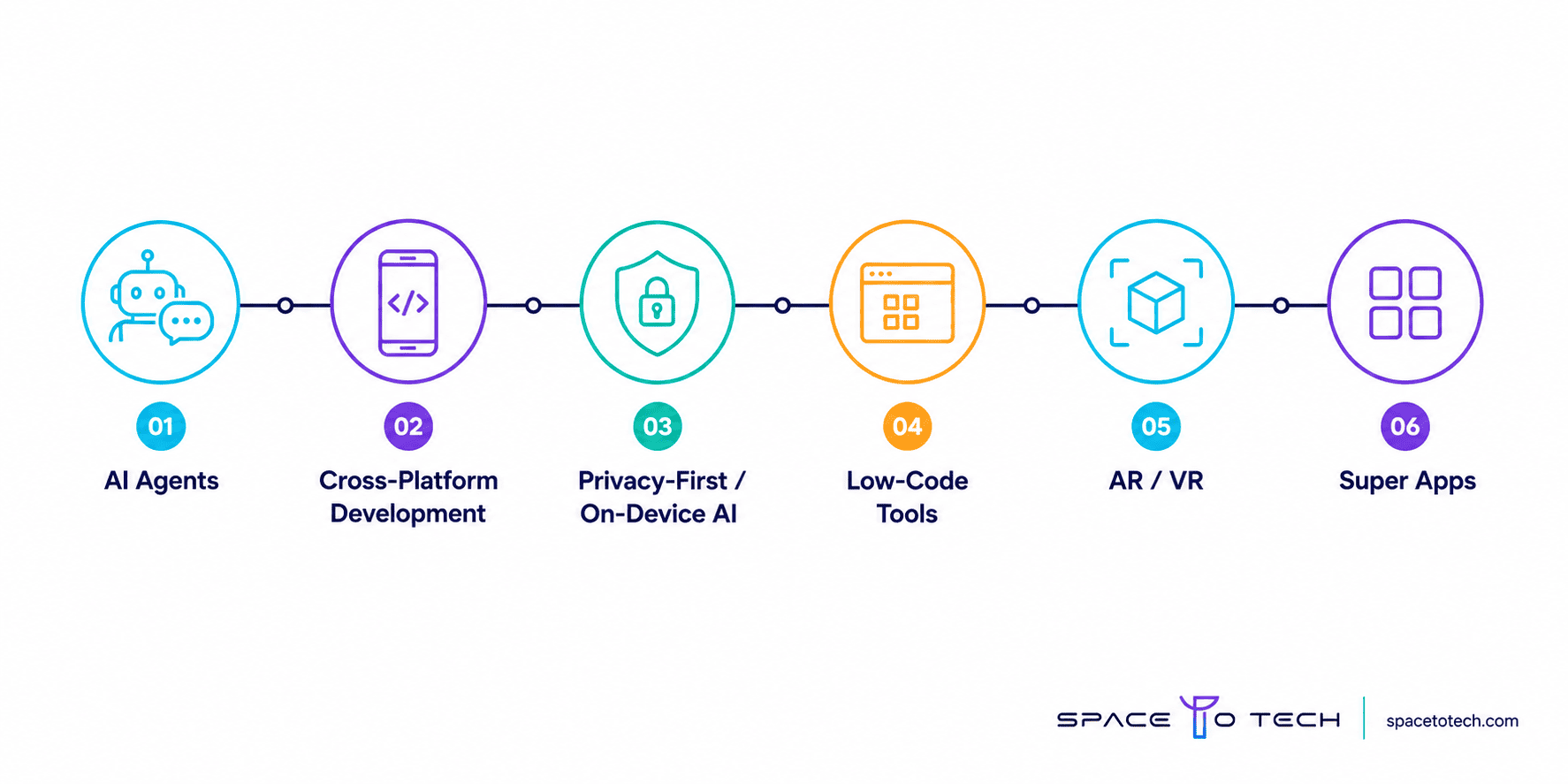
Below are the trends shaping mobile app development this year, each with a short verdict so you know where it sits on your roadmap before you read a single technical detail.
1. AI-Powered Applications and Agentic AI
AI has moved past chatbots and recommendation widgets. In 2026, agentic AI, systems that can complete multi-step tasks inside an app rather than just answering a question, has become the standard for apps built by teams with real engineering budgets. A retail app might use an agent to handle an entire return process end to end. A logistics app might use one to reroute a delivery automatically when a driver reports a delay.
Verdict: Adopt now. The tooling is mature, the productivity gains are documented, and users increasingly expect this level of automation from any app they consider well built.
2. Cross-Platform Development: React Native, Flutter, and Kotlin Multiplatform
The argument for cross-platform development has moved from "good enough" to "often better" for most business apps. A single codebase covering iOS and Android cuts both build time and long-term maintenance cost, which is exactly why frameworks like React Native and Flutter now power a large share of new consumer and enterprise apps, alongside newer entrants like Kotlin Multiplatform for teams already invested in the Android ecosystem.
Verdict: Adopt now. Native development still makes sense for apps that lean heavily on device-specific hardware or performance, but for most business apps, cross-platform is the default starting point in 2026, not the compromise it used to be.
3. Super Apps
Super apps bundle payments, messaging, bookings, and marketplace features into one platform. They work brilliantly for a handful of companies operating at genuine ecosystem scale. For everyone else, chasing a super app model before nailing one core use case usually means a bloated product that does many things poorly instead of one thing well.
Verdict: Watch, unless you already operate at platform scale.
4. AR, VR, and Spatial Computing
Augmented and virtual reality have found real, specific homes in retail try-on experiences, real estate walkthroughs, and hands-on training simulations. What has not changed is that these experiences are still expensive to build well and only pay off when the use case genuinely benefits from a spatial interface.
Verdict: Pilot first, in a narrow use case tied to a measurable outcome, before committing further budget.
5. Wearables and IoT Integration
Health, fitness, and fintech apps continue to lead wearable integration, syncing with smartwatches and fitness trackers to extend the app experience beyond the phone. Broader IoT integration, connecting an app to smart devices, sensors, or industrial equipment, has matured well for logistics, manufacturing, and smart-home businesses specifically.
Verdict: Pilot first for most industries, adopt now if your product already touches connected hardware.
6. 5G and Edge Computing
5G and edge computing unlock genuinely low-latency experiences: real-time video, high-frequency IoT data, and location-based features that feel instant rather than laggy. For a typical business or e-commerce app, though, the performance gain over a well-optimized 4G experience is often marginal.
Verdict: Pilot first, and prioritize it only if your app depends on real-time data or media.
7. Voice Interfaces
Voice search and voice commands remain a strong accessibility feature and a genuine convenience layer for hands-free contexts like driving apps or smart-home controls. It has not become the primary interface for most mobile apps, and there is little sign that will change in 2026.
Verdict: Pilot first, scoped to accessibility and specific hands-free scenarios.
8. Privacy-First Development and On-Device AI
With GDPR and HIPAA enforcement tightening and users increasingly aware of how their data gets used, privacy by design has stopped being a nice-to-have. On-device AI processing, where sensitive data never leaves the phone, has become a serious differentiator for healthcare, fintech, and any app handling personal information.
Verdict: Adopt now, especially for regulated industries where this is close to a compliance requirement rather than a feature choice.
9. Low-Code and No-Code Development
Low-code platforms let non-developers build and adapt internal tools and simple customer-facing apps without waiting on a full engineering cycle. According to Gartner, the majority of new applications built by enterprises in 2026 are expected to involve low-code technology in some form, a sharp jump from just a few years ago. That speed comes with a trade-off: low-code fits MVPs, internal dashboards, and simple workflows far better than it fits complex, security-sensitive, or highly customized products.
Verdict: Pilot first for anything customer-facing or security-sensitive; adopt now for internal tools and fast MVP validation.
10. Sustainable App Development
Energy-efficient code, reduced background data usage, and greener hosting choices are quietly becoming part of how forward-thinking teams build apps, both for cost reasons and because users increasingly notice which apps drain their battery. It is not a headline trend, but it is one of the easiest to start acting on immediately.
Verdict: Adopt now, as an engineering discipline rather than a separate initiative.
Which Mobile App Trends Deliver the Highest ROI?
Put side by side, the trends worth prioritizing in 2026 share one thing in common: they reduce cost, reduce risk, or directly improve retention, rather than simply adding a feature for its own sake.
Native vs. Cross-Platform vs. Progressive Web App
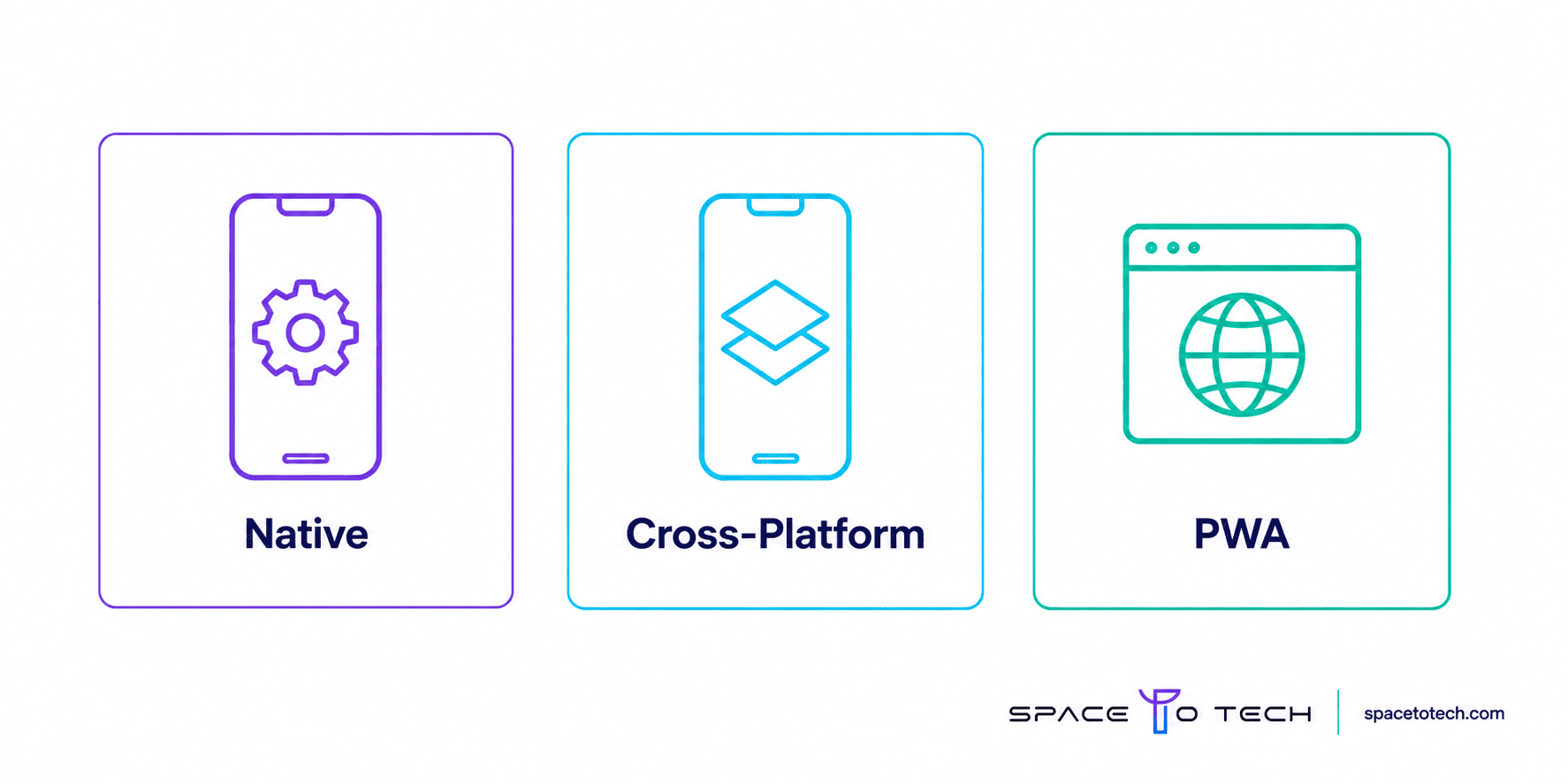
Choosing between native, cross-platform, and a Progressive Web App usually comes down to budget, timeline, and how much the app depends on device-specific features.
React Native vs. Flutter in 2026

Both frameworks remain strong choices, and the right pick usually depends on your existing team and long-term plans rather than a clear technical winner. React Native fits teams with JavaScript or React experience and a need to move fast on both platforms. Flutter tends to edge ahead when pixel-perfect, highly custom UI is the priority. For a deeper side-by-side breakdown, see our full comparison of React Native vs. Flutter.
Industry-Wise Mobile App Trends
The same trend list looks different depending on the industry applying it. A quick look at how a few sectors are prioritizing these trends in 2026:
- Healthcare: on-device AI and privacy-first design, driven directly by HIPAA compliance requirements.
- FinTech: biometric authentication and AI-driven fraud detection, both now close to table stakes.
- Retail and E-commerce: AI personalization and product recommendation engines, alongside AR for try-before-you-buy experiences. For a full cost breakdown of building in this space, see our guide to e-commerce app development cost.
- Manufacturing and Logistics: IoT integration and edge computing for real-time tracking and equipment monitoring.
- Education: low-code tools for rapid content updates, paired with AI-driven personalized learning paths.
- Real Estate and Travel: AR walkthroughs and voice search for hands-free, on-the-go browsing.
How AI Is Transforming Mobile App Development
Beyond the individual trend, AI is changing how apps get built and how they behave once they are live. On the build side, AI-assisted development tools are shortening the distance between an idea and a working prototype. On the product side, apps increasingly ship with on-device models that personalize the experience without sending sensitive data to a server. That combination, faster development plus smarter, more private apps, is the real story behind the AI trend, more than any single feature.
For businesses exploring what this looks like in practice, our breakdown of AI infrastructure for mobile app development in the USA covers the technical foundation in more depth.
Common Mobile App Trends Businesses Should Avoid Chasing
Not every trend deserves a place on your roadmap, and knowing what to skip is as valuable as knowing what to adopt.
- Building a super app before a single core feature has proven product-market fit.
- Adding voice, AR, or blockchain features because a competitor has them, without a specific user problem they solve.
- Treating low-code as a shortcut for a complex, security-sensitive product instead of what it is best at: MVPs and internal tools.
- Chasing every emerging technology at once instead of sequencing one or two trends that match your current stage.
How to Future-Proof Your Mobile App Strategy
A handful of practices separate businesses that adapt smoothly to new trends from those that keep rebuilding from scratch:
- Build on a cross-platform foundation so new features reach iOS and Android at the same time, rather than doubling every future update.
- Treat privacy and security as architecture decisions made early, not patches added after a regulatory scare.
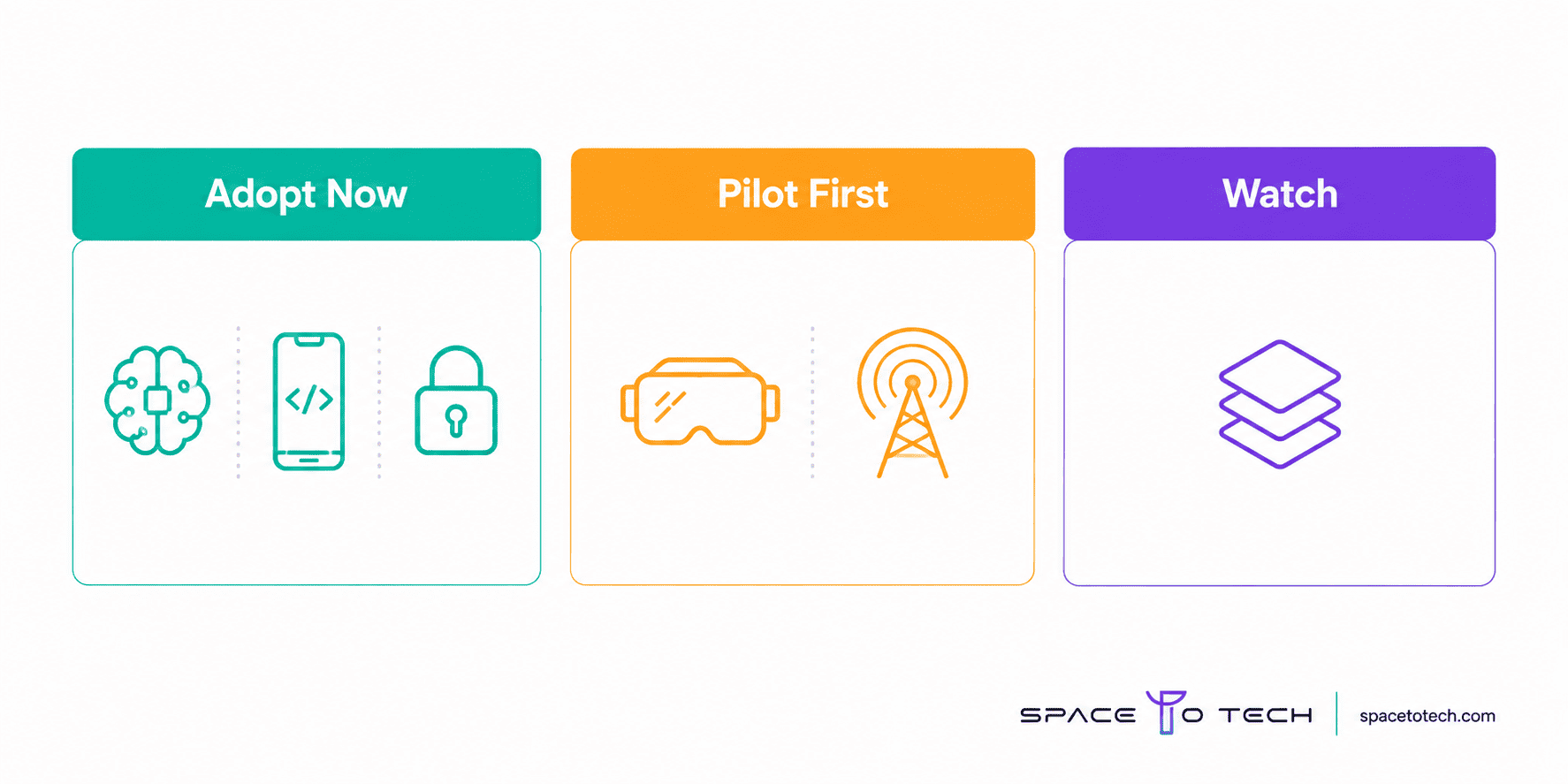
- Pilot new trends in a scoped, measurable way before committing further budget, using the Adopt Now, Pilot First, Watch framework above.
- Review your roadmap against real usage data each quarter, not against whatever trend is dominating industry headlines that month.
- Keep a direct line to a development partner who can move quickly once a trend proves itself, instead of restarting a vendor search each time.
How to Choose the Right Mobile App Development Company
Picking the right partner matters more than picking the right trend. A strong mobile app development company will help you sequence these trends around your actual business goals instead of building a feature list that looks impressive but does not move any real metric. Look for a team that can show recent work in cross-platform development, has a clear point of view on AI and privacy, and is willing to tell you which trends to skip, not just which ones to sell you.
If you are comparing options, our guide on how to choose the best mobile app development companies walks through the full evaluation process, and our list of top mobile app development companies is a good starting point for benchmarking.
At SpaceToTech, this is exactly the conversation we have with founders and product teams before a single line of code gets written: which trends are worth your budget right now, and which ones can wait. If you have an app idea you are trying to scope for 2026, our team is happy to walk through it with you.