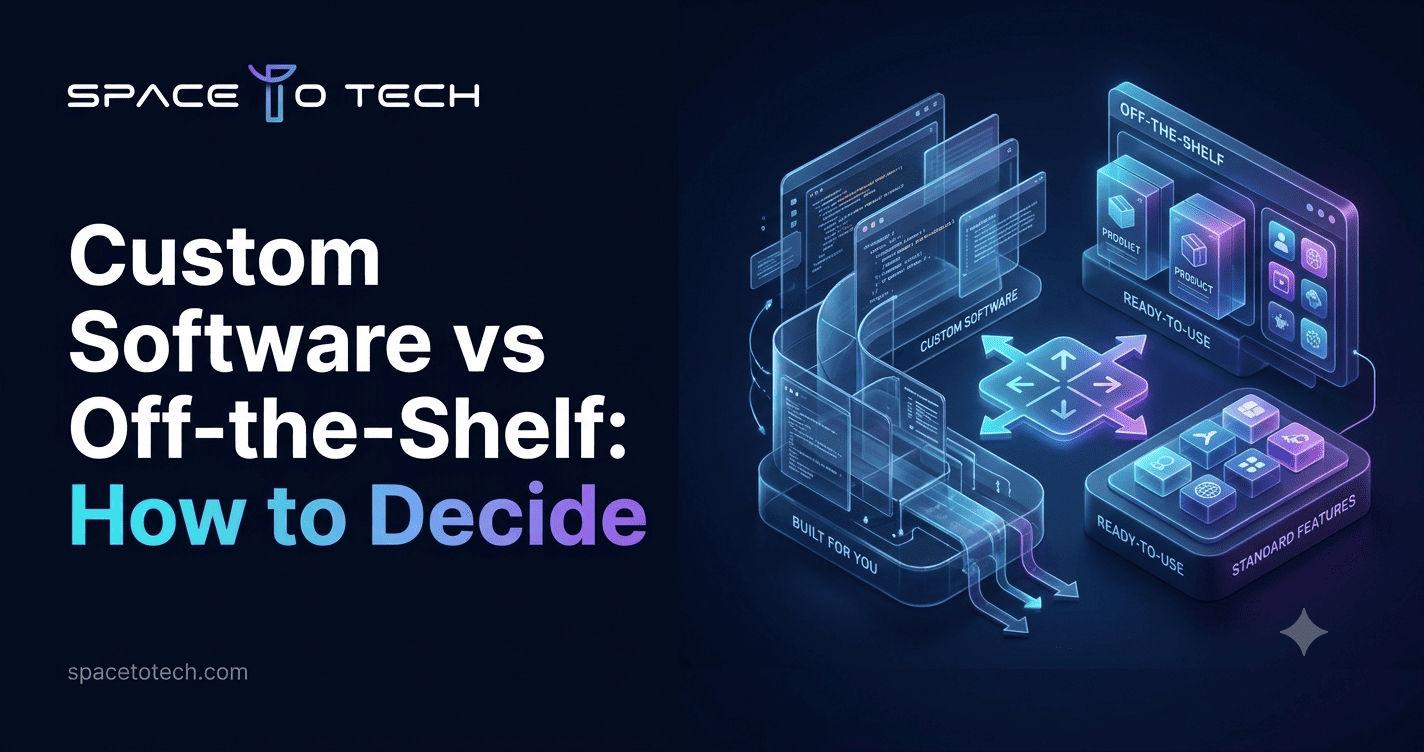
Every growing business reaches the same fork in the road: keep stretching the tools you can buy today, or invest in building something of your own. Choosing between custom software and off-the-shelf software is rarely about technology preference. It is a decision about cost, control, speed and how different your processes are from everyone else's. This guide compares both routes on the factors that matter most, explains when each one makes sense, and ends with a checklist you can use with your leadership team this week. If you are a founder, CTO or business owner weighing build vs buy software, you will leave with a clear framework instead of a sales pitch.
Custom Software vs Off-the-Shelf: What Is the Difference?
Custom software is built from scratch for one organization. A team of software developers studies your workflows, designs the architecture, writes the code and delivers a product that mirrors how your business really operates. You control the roadmap and, in most engagements, own the source code. Off-the-shelf software, often called COTS software (commercial off-the-shelf), is made up of ready-made software products sold to many customers at once. You license or subscribe, adjust a few settings and start working. Most modern SaaS software belongs to this group.
The practical difference is whose process wins. Ready-made business software asks you to adapt to its logic, while custom development adapts the logic to you. Compare a bespoke CRM built around your sales stages with Salesforce and its standard objects, or custom accounting software with QuickBooks. The standard tools are polished and quick to adopt. The custom build fits like nothing else, but it takes longer to arrive.
Custom Software vs Off-the-Shelf: Key Differences at a Glance
Here is the side-by-side view most buyers want first.
| Factor | Custom software | Off-the-shelf software |
| Development cost | High upfront investment; cost per user falls as you scale | Low entry price; recurring per-user fees grow with headcount |
| Implementation time | Months, covering discovery, design, build and testing | Days to a few weeks |
| Customization and flexibility | Built around your exact workflows | Limited to configuration, plugins and the vendor's roadmap |
| Scalability | Architecture designed for your growth path | Scales inside vendor tiers and usage limits |
| Security and data ownership | You choose the stack, access rules and hosting | Vendor controls infrastructure; responsibility is shared |
| Maintenance and support | Handled by your team or development partner | Handled by the vendor on its own update schedule |
Build vs Buy Software: Which Approach Is Better for Your Business?
Build vs buy software is the question of whether to develop a tool yourself or purchase one that already exists. Buy when the problem is common. Payroll, email, basic project tracking and standard accounting rarely give you an edge, so commodity software is usually the smart call. Build custom software when the software itself shapes how you compete, such as a proprietary pricing engine, a patient workflow or a routing logic no vendor offers.
Test the decision against three things. First, business goals: will this system differentiate you or simply support operations? Second, resources: do you have the budget, internal product ownership and patience for building custom software? Third, technical requirements: how many systems must it connect to, and how strict are your compliance rules? Both software approaches can succeed when they match the answers.
Many companies land in the middle. A hybrid approach buys proven software tools for the core and adds custom coding only where it earns its keep, such as integrations, dashboards or one differentiating module. You keep the speed of ready-made products and still get a software solution that fits.
Cost Comparison: Custom Software Development vs Off-the-Shelf Solutions
Price tags mislead in both directions. Off-the-shelf software looks cheap because the first invoice is small, yet costs compound through monthly and annual subscription fees, per-user pricing, premium tiers that unlock one missing feature, and paid connectors for your existing systems. Customization and integration work can add up quickly once the software requires workarounds.
Custom software development cost sits at the other extreme. You pay upfront for discovery, design, engineering and testing, then budget for hosting, security patches and enhancements. A common rule of thumb is yearly maintenance of roughly 15 to 20 percent of the original build cost.
What matters is total cost of ownership over three to five years. Here is an illustrative example: 120 users on a SaaS platform at $90 per user per month cost about $130,000 a year, or $648,000 over five years. A $300,000 custom build with $54,000 in annual maintenance totals $570,000 over the same period and breaks even around year four. Your numbers will differ, but the pattern holds: a lower initial price does not always mean a lower long-term investment.
Want a realistic estimate for your own project? Talk to SpaceToTech's engineers and get a scoped, itemized quote.
Scalability and Flexibility: Which Software Can Grow With Your Business?
Scalability is where packaged tools show their ceiling. Off-the-shelf platforms add users easily, but they scale on the vendor's terms: tier limits, API rate caps and a feature roadmap you cannot influence. When workflows grow complex, such as multi-step approvals or region-specific pricing, you end up bending the product around the process.
Custom solutions are designed for your growth curve. Teams can add modules, handle more users and transactions, and extend into new locations and markets without renegotiating a contract. A multi-location retailer, for example, can adapt tax rules, languages and inventory logic per market. The honest caveat is that built software scales only as well as its architecture, so cloud-native design, clean APIs and automated testing matter as much as the code.
Integration, Security, and Data Ownership: What Should Businesses Consider?
Integration is often the hidden deciding factor. Popular business software ships with prebuilt connectors for CRM, ERP, payment gateways and common APIs, which works well until you need a niche system or real-time two-way sync. Custom builds can integrate anywhere, at the price of engineering effort.
Data ownership matters just as much. With packaged software your data lives on the vendor's infrastructure, and vendor dependency can make exits painful through export limits or proprietary formats. Ask about data portability before you sign. With custom software you define role-based access, audit trails and encryption standards yourself, which helps in regulated industries such as healthcare (HIPAA) and finance (PCI DSS, SOC 2). Reputable SaaS vendors are certified too, so compare their certifications with your real compliance requirements instead of assuming either side is automatically safer, and confirm that the software supports the audit evidence your regulators expect.
Bespoke Software vs Packaged Software: Which One Fits Your Business Needs?
Bespoke software vs packaged software is the same debate in more formal language. Bespoke software, designed for one client's requirements, differs from packaged software designed for the average of thousands. The gap shows most in industries with specialized rules.
- Healthcare: custom healthcare platforms can embed clinical workflows, consent rules and EHR integrations that generic tools skip.
- Finance: custom financial software supports proprietary risk models and audit-ready reporting, while standard financial software handles bookkeeping well.
- Logistics: route optimization and live fleet tracking rarely fit a generic template.
- Retail: omnichannel inventory and loyalty logic often outgrow a basic storefront, and custom experiences can set a brand apart.
Packaged software is sufficient when your needs match the market standard. Bespoke development makes sense when your process is itself the asset.
When Should You Choose Off-the-Shelf Software?
Buying is the more practical decision more often than development firms like to admit. Choose shelf tools when:
- You are a startup validating a business idea and need to learn before you invest.
- Your operations are standard, such as payroll, helpdesk or email marketing.
- Your initial development budget is limited.
- You need to go live this month, not next quarter.
- Your team does not need extensive customization.
Consider a 15-person consultancy that needs invoicing and time tracking. A subscription tool delivers this in a week for a few hundred dollars a month, so building it would be wasted capital. Likewise, an early-stage founder testing demand should launch on commercial software and existing software solutions, then revisit the decision once real usage data arrives.
When Should You Invest in Custom Software Development?
Custom software development pays off when several of these signals appear together:
- Your processes are unique and are part of your competitive advantage.
- Your current software limits growth and forces spreadsheets and manual workarounds.
- You need complex third-party integrations that standard connectors cannot handle.
- Subscriptions for many tools and seats keep multiplying.
- You operate in an industry that needs specific functionality, such as a custom ERP for manufacturing.
- You want long-term product ownership and the freedom to evolve the software as a business asset.
When these signals stack up, a custom software development company can consolidate scattered tools into one working software platform. A real custom build starts with discovery, not code, and treats your custom project as a product with a roadmap rather than a one-off delivery. Teams are also exploring AI in custom software development to automate decisions that packaged tools cannot.
How Can Custom Application Software Development Services Solve Business Challenges?
Custom application software development services turn recurring business problems into purpose-built systems. A strong custom software development solution typically covers:
- Tailored applications: web and custom app development around your users and workflows.
- Workflow automation: fewer manual handoffs, approvals and re-keying, so teams focus on higher-value work.
- Custom CRM, ERP and enterprise applications: one system of record instead of five disconnected ones.
- API and third-party integrations: payments, logistics, analytics and legacy databases working together.
- Legacy modernization: moving aging platforms to modern architecture without losing business logic.
- Ongoing maintenance and scalability: monitoring, security updates and new features after launch.
When do businesses need these services? Usually when off-the-shelf tools force workarounds, when integrations keep breaking, or when growth outpaces the current system. A good development partner guides you from requirements and architecture through design, build, testing, deployment and support, so you deal with one accountable team instead of a chain of handoffs.
Planning a build? Explore SpaceToTech's custom application software development services and book a discovery call.
How to Choose the Right Custom Software Development Company in the USA
Choosing a custom software development company matters as much as choosing the approach. Evaluate each candidate on:
- Technical expertise and industry experience in your domain.
- Portfolio and project results: ask for outcomes, not screenshots.
- Methodology and communication: agile sprints, clear reporting and accessible leads.
- Security practices and NDA before you share sensitive plans.
- Source code and IP ownership written into the contract.
- Post-launch maintenance and support terms.
- Pricing transparency and engagement models: fixed price, time and materials, or a dedicated team.
When comparing custom software development services USA buyers should also weigh time-zone overlap and familiarity with US compliance such as HIPAA, SOC 2 and CCPA. A trustworthy custom software development agency shares references and explains trade-offs, including when software built from scratch is not worth it for custom projects.
A Practical Decision Checklist: How to Choose Between Custom and Off-the-Shelf Software
Answer these six questions with your team:
- Is your business workflow unique?
- Do existing tools meet your current requirements?
- Will your software requirements grow?
- Do you need integrations with existing systems?
- What is your three to five year software budget?
- Do you need full control over features and data?
If most answers point to uniqueness, growth, integration and control, lean toward custom. Otherwise, buy. Use this framework to confirm:
| Business requirement | Recommended option |
| Standard business operations | Off-the-shelf |
| Quick deployment | Off-the-shelf |
| Unique workflows | Custom software |
| Complex integrations | Custom software |
| Long-term product ownership | Custom software |
| Limited initial budget | Off-the-shelf |
Conclusion
There is no universal winner. Off-the-shelf software wins on speed and entry cost, while custom software wins on fit, control and long-term economics for unique workflows. Many companies do best with a hybrid: buy the commodity layers and build what differentiates you. Start with the checklist above, model your three to five year cost honestly, and decide based on evidence rather than habit.