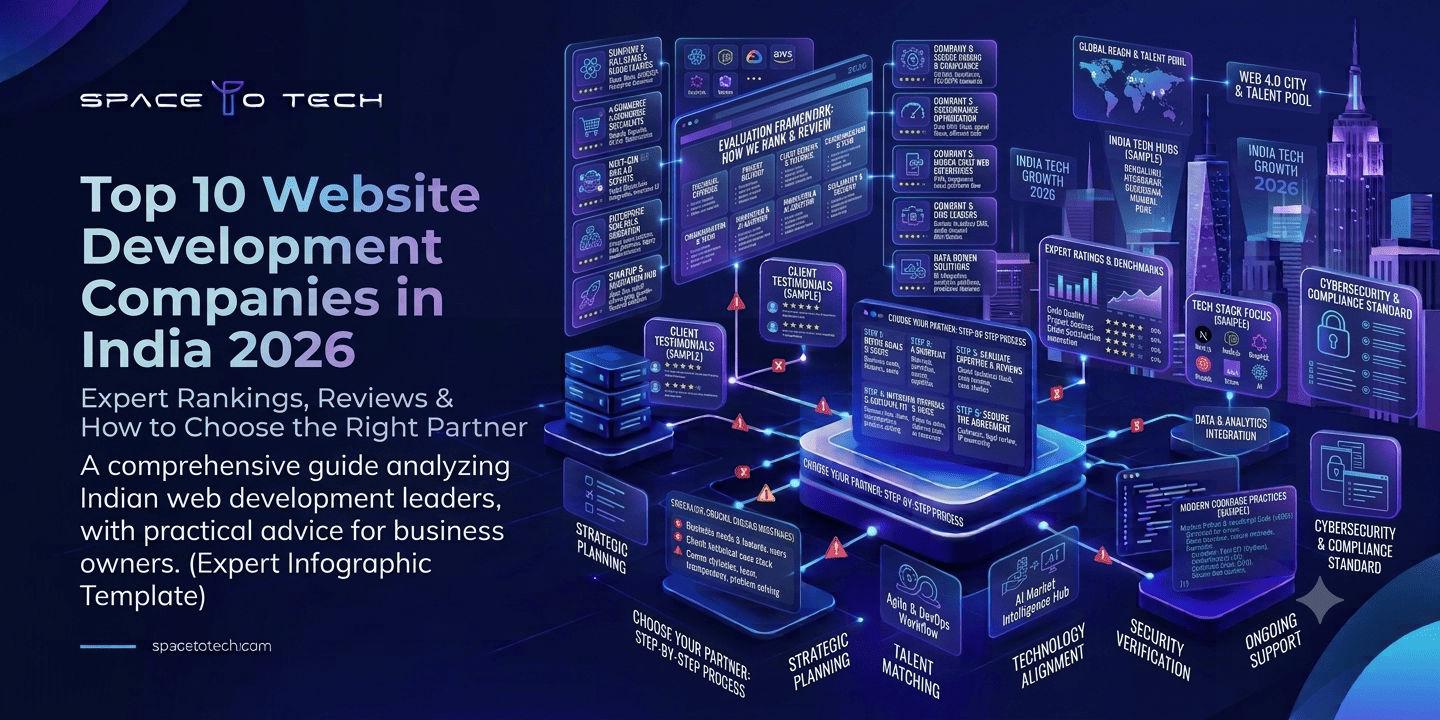
Choosing among web development companies can decide whether your digital presence grows or stalls. Buyers searching for partners in India want evidence, not promotion. This guide ranks ten providers on technical depth, delivery record, and fit for different project types in 2026. It explains our methodology, profiles each company honestly, and gives you a practical framework for selecting a partner. Whether you need a custom enterprise platform or a fast corporate site, the aim is the same: help you evaluate, shortlist, and decide with confidence.
Expert Rankings of Leading Web Development Companies in India for 2026
Evaluation Criteria Used for the 2026 Rankings
Rankings are editorial, and we want you to see the logic. Each company was assessed on five factors:
- Technical depth: breadth of modern stacks, architecture quality, and security practice.
- Delivery track record: years in operation, project scale, and repeat business.
- Verified reputation: public reviews on platforms such as Clutch and GoodFirms.
- Process maturity: documented methodology, QA, and post-launch support.
- Transparency: clear scoping, pricing models, and communication.
Our assessment draws on hands-on experience delivering web projects from Delhi NCR, public review profiles, company websites, and published case studies. We favor firms that show verifiable work over those that rely on slogans. Where evidence was thin, we say so rather than guess.
Ratings and team sizes change often, so verify current figures on each company’s review profile before shortlisting.
Overview of the Top Performers and Their Core Strengths
Several shifts shape how buyers should evaluate agencies in 2026. AI-assisted development has shortened some build cycles, so ask how a team uses it without compromising code quality. Core Web Vitals and mobile performance continue to influence search visibility, making front-end speed a business issue rather than a technical detail.
Detailed Reviews of Top Website Development Companies
Service Portfolios and Industry Focus Areas
1. SpaceToTech. A Delhi NCR technology company covering web development, mobile apps, and AI chatbots. Its advantage is combining web and AI capability under one team, which suits businesses planning more than a brochure site. We rank it first with a disclosure: it is our own company, so weigh that accordingly. Consider it if you want one partner for web, mobile, and chatbot work.
2. Appinventiv. Known for sizeable digital products across fintech, healthcare, and retail. Strong for funded companies; smaller budgets may find engagement minimums high. Consider it if your project is large and well funded.
3. Hidden Brains. A long-established custom development firm with broad industry coverage. Its breadth is useful, though buyers should confirm domain experience for their specific sector. Consider it if you need a flexible, full-service vendor.
4. Hyperlink InfoSystem. Delivers web and mobile projects at volume. Good for multi-project needs; ask who will actually staff your account. Consider it if you run several parallel projects.
5. OpenXcell. Focuses on product engineering and MVP-to-scale journeys, making it a reasonable fit for startups building a first product. Consider it if you are building an MVP.
6. Radixweb. Strong in enterprise web applications and legacy modernization, particularly Microsoft-oriented environments. Consider it if you are modernizing an existing system.
7. Simform. Emphasizes cloud-native architecture and engineering rigor. Better suited to complex platforms than simple marketing sites. Consider it if scalability is central to your product.
8. Bacancy Technology. Specializes in dedicated-team hiring, ideal when you want to extend your in-house capacity rather than outsource a whole project. Consider it if you want to scale your own team quickly.
9. Webkul. A recognized name in eCommerce and open-source ecosystems, with ready-made modules that can shorten store builds. Consider it if you are launching an online store.
10. Tata Consultancy Services. The scale choice for global enterprises with multi-year transformation programs. It is rarely the right fit for small or mid-sized projects. Consider it if procurement requires a global, established vendor.
If you want a faster shortcut, use this decision guide to match your situation to a shortlist:
Client Feedback and Notable Project Outcomes
Treat review platforms as a starting point, not a verdict. Across public feedback on Indian agencies, the same themes recur. Clients praise responsiveness, honest estimates, and post-launch support. Complaints usually involve scope creep, turnover of key developers, and unclear change-request pricing.
When reading reviews, look past star averages. Check whether reviewers describe a project like yours, whether the agency responded to criticism, and whether outcomes are measurable, such as load-time gains, conversion lifts, or on-time delivery. Ask each shortlisted company for two references you can call directly.
When you speak to references, ask specific questions. Did the team hit the original deadline? How were disagreements about scope handled? Would the client rehire the agency, and for what kind of work? Answers to these questions reveal far more than a polished case study.
Key Factors When Selecting Web Development Agencies in India
Technical Expertise, Scalability, and Technology Stacks
Match the stack to your roadmap, not to trends. Modern front-end frameworks such as React and Next.js suit interactive, SEO-sensitive sites. Node.js, Python, and .NET back ends serve different scaling and integration needs. Ask how the agency handles performance, security reviews, and accessibility, and whether it can explain trade-offs in plain language.
These are common patterns across the different types of web development, not rules. A capable agency will justify its recommendation against your traffic, integrations, and team skills.
Security and compliance matter just as much as features. Ask whether the agency follows secure coding standards, runs dependency and vulnerability checks, and has experience with regulations relevant to you, such as GDPR or India’s data protection rules. A team that treats security as a launch checklist item rather than a design principle creates risk you will inherit.
Scalability deserves its own question. Ask what happens at ten times your current traffic, how the architecture supports new features, and who owns the code and infrastructure at handover. Agencies that answer concretely have usually done it before.
Communication, Project Management, and Pricing Models
India’s time zone allows overlap with Europe, the Middle East, and partial overlap with US hours. Confirm a named project manager, a sprint rhythm, and a weekly demo cadence. Then compare pricing models:
Also clarify onboarding and handover early. Strong agencies run a structured kickoff, share access to repositories and staging environments, and provide documentation when the project ends. Ask what support looks like after launch, including response times for critical bugs and how maintenance is priced.
Related reading: For organizations that also require backend systems or enterprise platforms, see our detailed rankings of the Best Custom Software Development Companies.
Budget deserves honesty too. Quotes vary widely because scope, seniority, and engagement model vary widely. A lower hourly rate with junior staff and heavy rework often costs more than a higher rate with experienced engineers. Ask for the team’s seniority mix, then compare total cost to launch, not rate cards.
Practical Guidance for Hiring Web Developers in India
Steps to Assess Custom Website Development Capabilities
- Define scope first. Write goals, must-have features, integrations, and budget range before contacting anyone.
- Shortlist three to five companies. Use review platforms, referrals, and our guide to the best web development companies, then compare portfolios against your use case.
- Review live work. Open their sites on mobile, test speed, and check structure and accessibility.
- Run a discovery call. Judge whether they challenge assumptions or simply agree.
- Request a detailed proposal. It should cover timeline, team, milestones, testing, and support terms.
- Start small if unsure. A paid pilot or discovery phase reveals working style before full commitment.
Red Flags and Best Practices for Long-Term Partnerships
Be cautious of unusually low quotes, guaranteed rankings, refusal to share references, vague ownership of source code, and teams that cannot name who will work on your project. Avoid contracts that lock you into hosting or maintenance without exit terms.
Another warning sign is a sales team that promises everything but never introduces the engineers. Insist on meeting the people who will build your site, and confirm that your point of contact will not change after the contract is signed.
For healthy partnerships, put intellectual property ownership in writing, agree acceptance criteria per milestone, keep documentation current, and schedule quarterly reviews of performance and roadmap. Good partners treat launch as the beginning, not the end.
Conclusion
The best web development company is the one that fits your goals, budget, and working style, not simply the one ranked highest. Use this list to build a shortlist, verify reviews, and test each candidate through discovery calls and references. Prioritize transparency, technical depth, and long-term support over low quotes. With a clear scope and a careful evaluation, you can find an Indian partner that delivers a site built to perform well beyond launch.