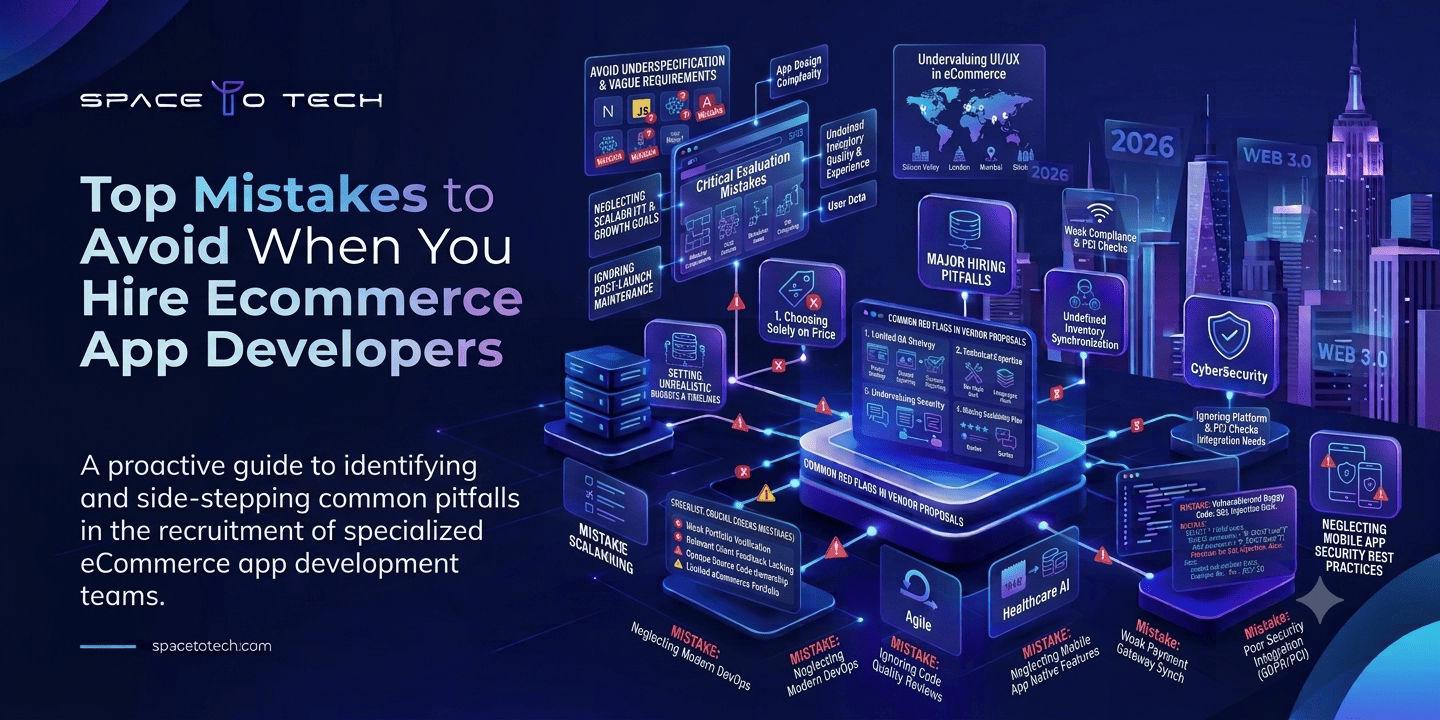
Your app is often the first place a customer meets your brand and the last place they decide to pay. A weak build means slow screens, failed payments, and lost orders. Yet many businesses choose a team in a rush, comparing quotes instead of capabilities. Whether you are comparing a native build with a React Native app development agency or planning a first release, this guide covers the nine mistakes that most often derail projects, and how to avoid each one.
Why Hiring the Right Ecommerce App Developers Matters for Your Business
An ecommerce app is a revenue channel. Conversion rate, average order value, repeat purchases, and customer lifetime value all depend on how well it is built. Developer quality shows up in checkout speed, search accuracy, and stability during a sale.
The right team usually includes mobile developers, backend engineers, UI/UX designers, QA testers, and DevOps support. Ecommerce adds its own demands: catalog management, inventory sync, order lifecycle, returns, and tax rules. A team that has not handled these will learn on your budget.
A wrong hire costs more than the invoice. Direct losses include rework and missed launch windows. Indirect losses include checkout bugs during a seasonal sale, security incidents, and customers who never return. Whether you hire locally or outsource software development to India, the same hiring discipline applies.
Mistake 1: Hiring Ecommerce App Developers Without Clear Project Requirements
"We want an app like Amazon" is a wish, not a requirement. Vague scope causes inflated estimates, change requests, and mismatched expectations.
Start with business goals: the KPIs you want to move, your target audience, platforms (iOS, Android, or both), and your revenue model, whether B2C, B2B, marketplace, or subscription. Then split features into must-haves and later additions.
- MVP essentials: catalog, search and filters, cart, checkout, order tracking, push notifications, user accounts.
- Later phases: loyalty programs, AR try-on, personalization, referrals.
Share user flows, wireframes, and your integration list (ERP, CRM, payment gateways, shipping). A short discovery workshop with your vendor replaces guesswork with a shared plan.
Mistake 2: Choosing an Ecommerce App Development Company Based on Price Alone
The cheapest quote often leaves things out: QA, documentation, security reviews, or senior engineers. You pay for those gaps later through rework and delays.
Price is shaped by team seniority, location, scope, tech stack, and engagement model. Compare proposals on value, not rate.
Red flags include no testing budget, pressure to sign quickly, and large upfront payments. Ask what is excluded from the quote before comparing totals.
Mistake 3: Ignoring Proven Ecommerce Experience and Portfolio Quality
General app experience does not equal ecommerce experience. Catalog scale, promotions, inventory, and returns are problems developers solve only by shipping stores.
Look past screenshots. Check live apps, store ratings, and reviews. Match the portfolio to your industry, scale, and platform, and ask what the team personally built. A strong case study states the problem, approach, tech stack, and a measurable result. Verify through client references and third-party profiles such as Clutch or GoodFirms.
Also probe technical depth. Ask about architecture, API design, and headless commerce, and confirm familiarity with platforms like Shopify, Magento, WooCommerce, or custom builds. A short paid pilot is a low-risk way to test the team before committing.
Mistake 4: Overlooking Skills in Payments, Security, and Third-Party Integrations
Customers abandon apps they do not trust. Three skill areas decide that trust.
Payments. Look for experience with Stripe, PayPal, Apple Pay, Google Pay, regional gateways, and BNPL. Multi-currency support, refunds, and failed-payment handling should be standard.
Security. Developers should understand PCI DSS, GDPR, tokenization, encryption, and secure authentication. Ask about penetration testing and code reviews.
Integrations. Ecommerce apps depend on ERP, CRM, inventory, shipping, analytics, and messaging tools. A sync failure can mean overselling stock you do not have.
During hiring, ask scenario questions such as: "What happens if a payment succeeds but the order fails?" A confident, specific answer reveals real experience.
Mistake 5: Skipping Scalability and Performance Planning
Apps rarely fail on an average Tuesday. They fail during flash sales, campaigns, and holiday traffic. Slow load times also push shoppers away, and mobile users are especially impatient.
Architecture choices matter early. A monolith is simpler to start but harder to scale, microservices offer flexibility with more complexity, and headless commerce separates the front end from the backend for faster change. Cloud hosting, CDN, caching, and auto-scaling handle traffic spikes.
Ask vendors for performance targets and how they test them: app load time, API response time, crash-free session rate, and load testing before launch. Plan for growth too, including new markets, currencies, languages, and larger catalogs, so features can be added without a rebuild.
Mistake 6: Neglecting Mobile UI/UX Expertise for Shopping Experiences
Mobile shopping is a UX specialty. Thumb-friendly navigation, fast search, clear filters, and clean product pages shape every purchase decision.
Checkout is where most revenue leaks. Forced account creation, long forms, hidden fees, and limited payment options are common causes, and Baymard Institute research shows average cart abandonment sits near 70 percent. Offer guest checkout, saved details, and one-tap payment.
Accessibility matters as well. Readable contrast, proper tap targets, and screen reader support widen your audience and reduce legal risk. When vetting a team, ask about their UX process: research, wireframes, prototypes, usability testing, and A/B testing. Make sure designers, not only developers, are on the team.
Mistake 7: Underestimating Ecommerce App Development Cost and Hidden Expenses
Ecommerce app development cost depends on complexity, features, platforms, integrations, design depth, and team location. These ranges are indicative and vary widely by scope.
Budgets often miss the hidden items: app store fees, third-party licenses, payment processing fees, cloud hosting, security audits, data migration, and push notification services. Add internal costs too, such as catalog preparation and product owner time.
Plan for the full first year, not only the build, and keep a contingency buffer. To control spend without cutting quality, launch an MVP first, reuse components, and consider cross-platform frameworks. For a deeper breakdown, see this guide to custom mobile app development cost.
Mistake 8: Poor Communication and No Defined Hiring Model
Even skilled teams fail when communication is loose. Time zone gaps, unclear contacts, and vague status updates hide problems until launch week.
Choose your engagement model deliberately:
Agile sprints, regular demos, shared repositories, and a named project manager and tech lead keep work transparent. Protect yourself contractually with an NDA, full code ownership, source code access, milestone payments, and a clear exit clause. This is especially important when working across countries.
Mistake 9: Forgetting Post-Launch Support and Maintenance
Launch day is the start of the work. New iOS and Android versions, device fragmentation, third-party API updates, and app store policy changes all require ongoing attention. One OS update can break a checkout flow overnight.
Your agreement should cover monitoring, crash analytics, security patches, performance tuning, and response-time SLAs. Beyond fixes, plan optimization: funnel analysis, A/B testing, app store optimization, and retention features such as push notifications and personalization.
Ask who handles emergencies, how fast they respond, and what is excluded. Maintenance is not an extra. It protects the revenue the app was built to earn.
How to Choose Ecommerce App Developers: A Quick Hiring Checklist
Use this process to turn the mistakes above into a decision.
- Define goals, MVP scope, and integrations.
- Shortlist three to five vendors and review live portfolios.
- Run technical interviews covering payments, security, and scale.
- Compare itemized proposals on value, not price.
- Check references and confirm contract terms.
- Start with a paid discovery phase or pilot.
Checklist for every vendor:
- Verified ecommerce case studies and client references
- Named team with QA and UX included
- Payment, security, and integration experience
- Performance targets and load testing plan
- Transparent cost breakdown with hidden costs listed
- Defined communication cadence and engagement model
- Written support and maintenance terms
If a vendor cannot answer these clearly, move on. For a broader shortlist of providers, review this list of top custom software development companies in the USA.
Conclusion
When you hire ecommerce app developers, the decision shapes your conversion rate, customer experience, and long-term growth. Most of the mistakes covered above come down to rushing the process: vague requirements, a price-first mindset, weak vetting of experience, and no plan for scaling or support. Avoiding them gives you a stable app, a predictable budget, and a smoother launch.
Take the time to define your scope, review real ecommerce projects, test technical depth, and agree on communication and maintenance terms upfront. Whether you hire ecommerce mobile app developers individually or partner with a full-service team, the right choice is the one that treats your app as a revenue product, not just a build task.