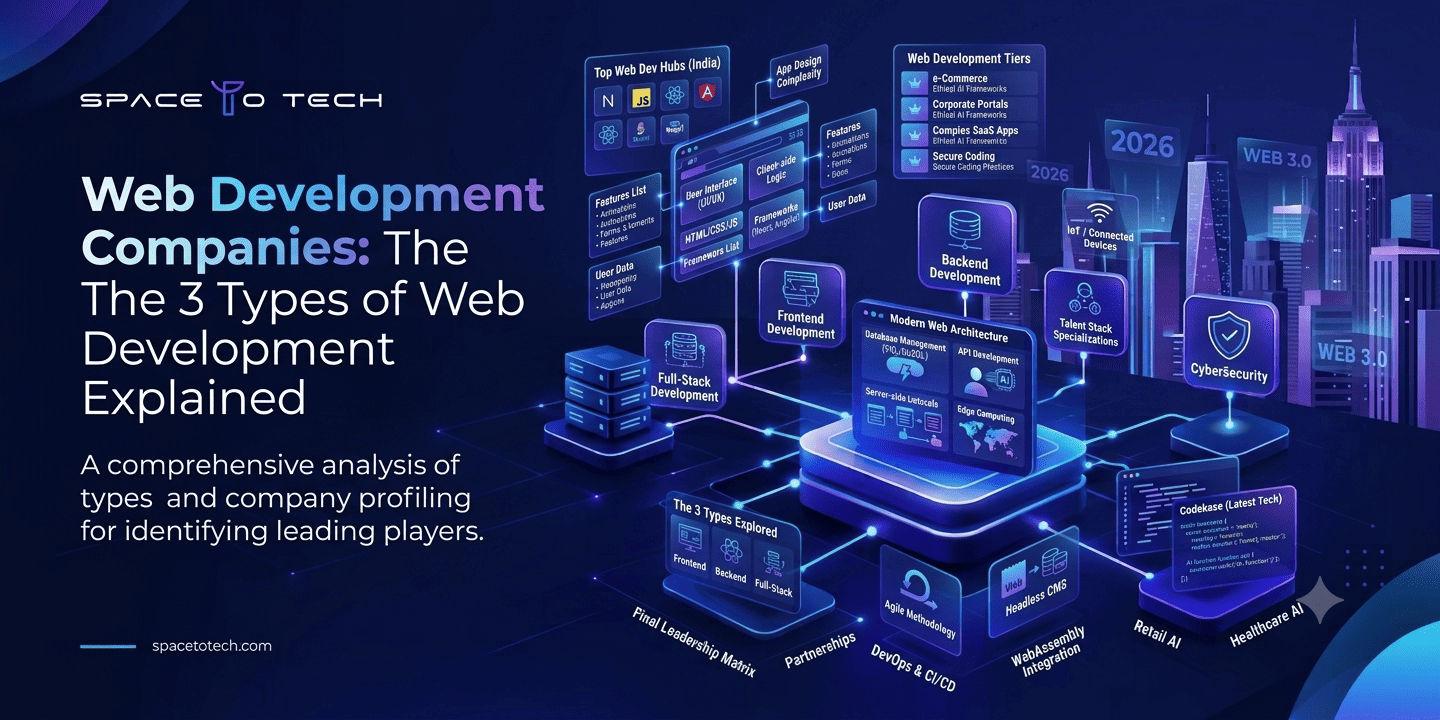
Web development is usually divided into three types: front-end, back-end, and full-stack. Each covers a different layer of how a website or web application works. If you're planning a new platform, knowing the difference affects your team structure, your budget, and how you read vendor proposals. It also helps you judge what web development companies actually offer, beyond the pitch deck. This guide explains each type, the technologies behind it, and how experienced providers combine them on real projects.
Web Development Fundamentals: What the Discipline Covers
Web development is the work of building and maintaining websites and web applications. That covers everything from a ten-page company site to a customer portal handling thousands of logins a day. Before getting into the three types, it helps to see how the pieces connect.
How Web Development Services Fit Together
Most web development services fall into a few buckets: website design and build, custom web application development, e-commerce platforms, CMS setup, API integrations, and ongoing maintenance. A single project often touches several of these. A B2B portal, for example, needs an interface, a database, user authentication, and connections to your CRM.
Every one of those tasks lands in one of the three types below.
Web Development Technologies Behind Modern Websites
Technologies are the tools of the trade: languages, frameworks, databases, and hosting setups. Browser-facing work relies on HTML, CSS, and JavaScript, as documented by sources like MDN Web Docs. Server-side work uses languages such as Python, Java, PHP, or JavaScript (via Node.js). No single stack is "best." The right one depends on what you're building, who will maintain it, and how much it needs to scale.
The Three Types of Web Development at a Glance
Here is the quick version before we go deeper.
Front-End, Back-End, and Full-Stack Compared
Why Some Guides Group Types Differently
"Three types" is a convention, not a rule. Some guides classify by the kind of site instead: static sites, dynamic sites, and e-commerce platforms. Others add categories like CMS development or progressive web apps. The front-end, back-end, and full-stack split is the most common because it maps to how teams are staffed, which is why we use it here.
Front-End Development: Building the User Experience
Front-end development covers everything a visitor sees and touches: layouts, buttons, forms, menus, animations. It's where design becomes working code, and it has a direct effect on whether people stay on your site or leave.
Core Front-End Technologies
HTML structures the content. CSS controls how it looks. JavaScript makes it interactive. On top of those, most teams use frameworks such as React, Angular, or Vue to build complex interfaces without reinventing common patterns each time.
Good front-end work also covers the less visible parts: responsive layouts that work on phones, page speed, and accessibility standards like WCAG, which matter for both usability and legal compliance in many markets.
When Front-End Work Takes Priority
Front-end expertise matters most when the interface is the product. Think customer dashboards, booking flows, or marketing sites where conversion depends on how fast and clear the experience feels. If your pages are slow or confusing, a powerful back end won't save the user experience.
Back-End Development: Powering Logic, Data, and Security
If the front end is the dining room, the back end is the kitchen. It processes requests, stores and retrieves data, enforces business rules, and keeps sensitive information protected. Users never see it, but they feel it whenever something loads slowly or fails.
Common Back-End Languages, Frameworks, and Databases
Popular server-side choices include Node.js, Python (with Django or Flask), Java (with Spring), PHP (with Laravel), and .NET. Data is typically held in relational databases like PostgreSQL and MySQL, or in NoSQL options like MongoDB when the data structure is flexible.
The choice usually comes down to your existing systems, your team's skills, and your performance needs. Be wary of any provider who recommends a stack without asking about those three things first.
Back-End Services Businesses Commonly Request
The most common requests are API development, third-party integrations (payment gateways, ERPs, CRMs), user authentication and permissions, database design, cloud hosting, and security hardening. For regulated industries, expect extra requirements around audit logs, encryption, and data residency. Ask any vendor how they handle these early, not after the build is underway.
Full-Stack Development: Bridging Both Layers
Full-stack developers work across the front end and the back end. They can take a feature from database to screen without handing it between specialists, which cuts down on coordination overhead.
Where Full-Stack Teams Add Value
Full-stack teams are a strong fit for MVPs, internal tools, and early-stage products where speed and flexibility matter more than deep specialization. Because one person understands the whole flow, small bugs and mismatches between layers get caught sooner.
Trade-Offs of Full-Stack Versus Specialist Teams
Full-stack isn't automatically better. Someone who covers everything rarely goes as deep in any one area as a dedicated specialist. For high-traffic platforms, complex security requirements, or heavily customized interfaces, a team with separate front-end and back-end experts usually produces stronger results. Many mature projects use both: full-stack developers for coordination, specialists for the hard parts.
How Web Development Companies Apply Each Type
In practice, a web development company rarely treats the three types as separate offerings. They're roles inside a single delivery process.
How a Web Development Company Structures Project Teams
A typical project team includes front-end developers, back-end developers, a project manager, a QA engineer, and often a designer and DevOps support. Full-stack developers may lead smaller builds or bridge the layers on larger ones.
[Insert short anonymised example from a real project: team size, stack chosen, and why.]
The question to ask is not "Do you do front-end or back-end?" It's "Who owns each layer on my project, and how do they work together?"
What Separates the Top Web Development Companies
The top web development companies tend to share a few habits. They ask about business goals before proposing a stack. They show relevant work, not just polished screenshots. They're open about trade-offs and timelines. And they stay involved after launch, because websites need updates, security patches, and performance tuning.
If you're building a shortlist, our guide to the best custom software development companies compares leading providers side by side.
Choosing the Right Development Approach and Partner
Once you understand the three types, the decision gets more practical: who should build this, and how?
Evaluation Criteria for Web Development Companies
Use a simple checklist:
- Relevant experience: Have they built something similar in your industry or at your scale?
- Technical depth: Can they explain why they'd choose a particular stack for your project?
- Process clarity: Do they describe how they handle scoping, testing, and change requests?
- Security practices: What do they do about authentication, data protection, and updates?
- Support after launch: Is maintenance included, or priced separately?
- References: Will they connect you with past clients?
Request a scoped proposal rather than relying on rankings or review sites alone. For a wider comparison, see how leading custom software development firms compare.
In-House Team vs. Agency: An Honest Comparison
In-house gives you control, deep product knowledge, and tight alignment with your business. The costs are salaries, recruitment time, and the difficulty of covering every specialty with a small team.
An agency gives you immediate access to a full range of skills and faster starts. The trade-offs are less day-to-day control, the need for clear communication, and the risk of knowledge leaving with the vendor if documentation is weak.
Neither is the right answer for everyone. Many companies use a hybrid: an agency for the initial build, an in-house team for long-term ownership.
Conclusion
Front-end, back-end, and full-stack aren't competing options. They're three layers of the same product, and most real projects need all of them working together. Front-end shapes how your site feels to use, back-end keeps it fast, secure, and connected to your systems, and full-stack developers help the two layers fit together.
For a business, the practical takeaway is to start with your project's needs, not a technology trend. Decide where the complexity sits, then look for a partner who can explain how they'll staff each layer and why.
If you're ready to compare vendors, our guide to the best custom software development companies is a good next step. And if you'd like to talk through scope first, contact our team for a no-obligation conversation.
Ready to plan your project? When you're ready to compare vendors, explore our full ranking of custom software development companies.