New York businesses run on speed. A retail brand growing out of a few storefronts, a fintech team building around strict compliance requirements, a logistics operator coordinating shipments across boroughs: they’re all trying to move faster than the tools they’re using allow. That mismatch, more than any single technology trend, is usually what pushes a business toward custom software development in New York.
This article isn’t built around a service pitch. It’s a practical look at when custom software actually makes sense for a New York business, what problems it can realistically solve, what technical and business decisions matter along the way, and how to plan a project that still holds up two or three years after launch.
Why New York Businesses Consider Custom Software
Most businesses don’t wake up wanting custom software. They wake up frustrated with something specific: a tool that almost fits, a spreadsheet that’s become a liability, a process that takes three people and half a day when it should take one person twenty minutes.
A few patterns show up again and again among businesses exploring custom software solutions in New York:
- Existing SaaS tools cover 80% of a workflow but force awkward workarounds for the remaining 20%
- Multiple systems (a CRM, an inventory tool, a scheduling app) hold pieces of the same information and never talk to each other
- Manual processes, like re-entering data between two systems, have quietly become a full-time job
- Operational bottlenecks appear at the same step in a process every single time
- Legacy software still runs the business but can’t support new integrations or growing data volumes
- Customer-facing workflows, like account management or order tracking, feel dated compared to what customers expect elsewhere
None of these problems are unique to New York. What is specific to this market is the pace at which they compound. In a city where competitors are often a subway ride away and customer expectations shift quickly, a workflow that’s “good enough” tends to become a real constraint faster than it would somewhere with less competitive pressure.
Businesses weighing these signals for the first time often benefit from a broader custom software development guide before narrowing in on a specific problem or solution.
What Business Problems Can Custom Software Solve?
It’s tempting to list generic benefits like “increased efficiency” or “better scalability.” Those phrases don’t help anyone make a decision. It’s more useful to work backward from the actual problem, look at the software approach that addresses it, and be honest about what outcome to expect and how to measure it.
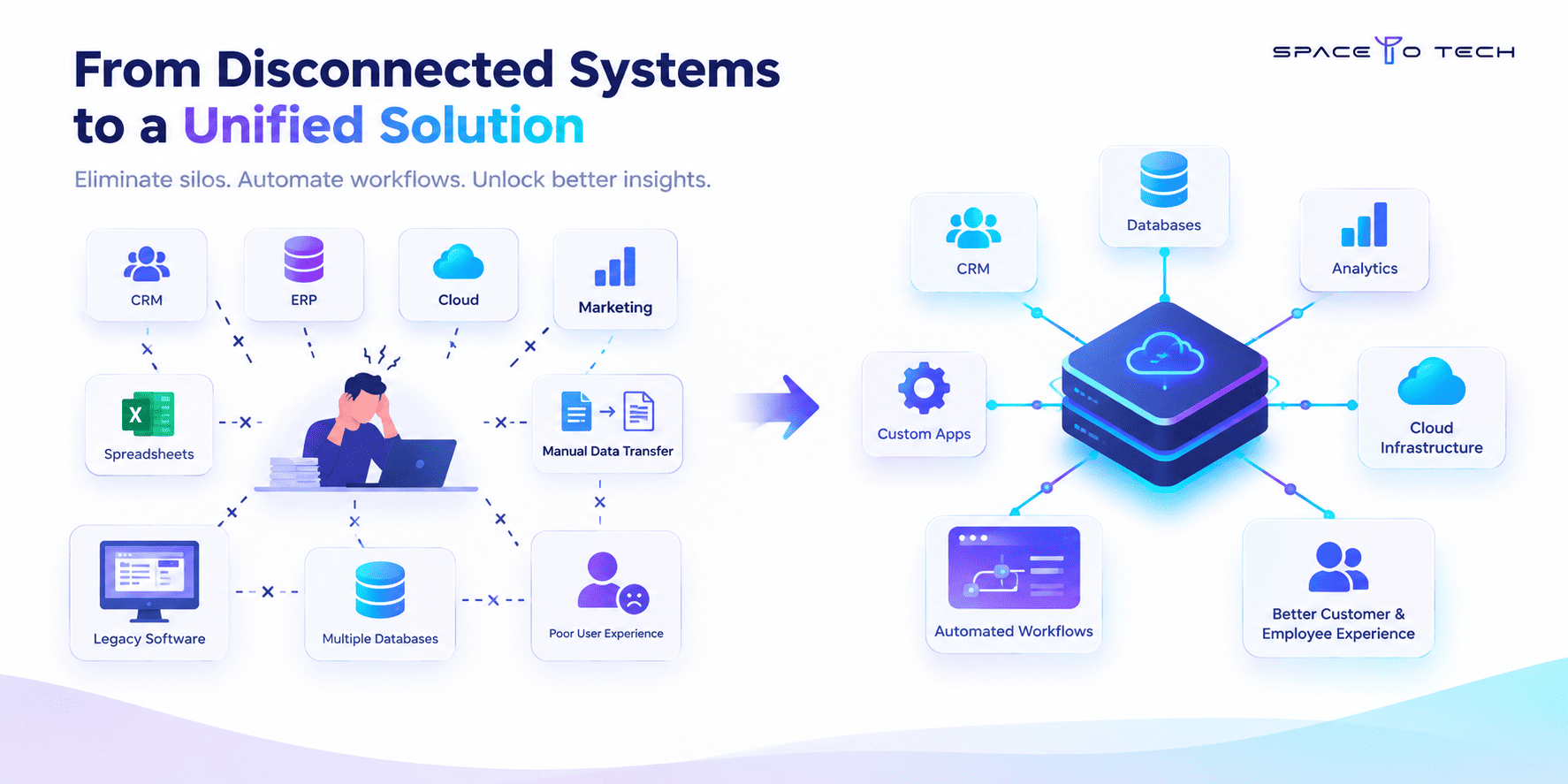
Disconnected Business Systems
The problem: Data about the same customer, order, or project lives in three or four separate tools, and nobody has a single, reliable view of it.
The approach: Business software integration, often through API integration or a dedicated integration layer, connects those systems so information flows automatically instead of being copied by hand.
What to expect: Fewer data entry errors and faster reporting, but only if the integration covers the specific systems causing the problem. A partial integration often just moves the bottleneck somewhere else.
Manual and Repetitive Workflows
The problem: A recurring task, like approvals, invoice processing, or client onboarding, eats up hours every week and depends on someone remembering every step.
The approach: Workflow automation and custom workflow software replace the manual sequence with rules-based automation, notifications, and status tracking.
What to expect: Time savings that are easiest to measure when you track how long the task took before and after. Automation doesn’t remove the need for oversight, it removes the need for someone to manually execute each step.
Limited Operational Visibility
The problem: Leadership can’t see what’s happening across the business in real time, so decisions get made on outdated or incomplete information.
The approach: Business dashboards and operational analytics pull data from existing systems into a single view built around the metrics that actually matter to your team.
What to expect: Better decision-making speed, not automatically better decisions. A dashboard only helps if the underlying data is accurate and the right people actually use it.
Legacy Software Constraints
The problem: A platform that’s been patched for years can no longer support new integrations, modern security expectations, or the data volume the business now generates.
The approach: Legacy software modernization, whether that’s a full rebuild or a more targeted application modernization effort, brings the system up to a standard that supports current and near-future needs.
What to expect: A meaningful reduction in maintenance friction, though modernization projects often reveal additional issues once the team gets into the existing codebase, so scope should be treated as a range, not a fixed number.
Customer or Employee Experience Gaps
The problem: Customers or employees interact with a process that feels clunky, outdated, or inconsistent compared to modern digital experiences.
The approach: A purpose-built customer portal, employee portal, or other custom business application replaces a generic or outdated interface with one designed around how people actually use it.
What to expect: Improved satisfaction and adoption, measured through usage data and direct feedback rather than assumptions about what “better” looks like.
Businesses that are evaluating custom software development services should first define their workflows and integration requirements, since that clarity shapes both the scope and the accuracy of any proposal that follows.
Common Custom Software Use Cases for New York Businesses
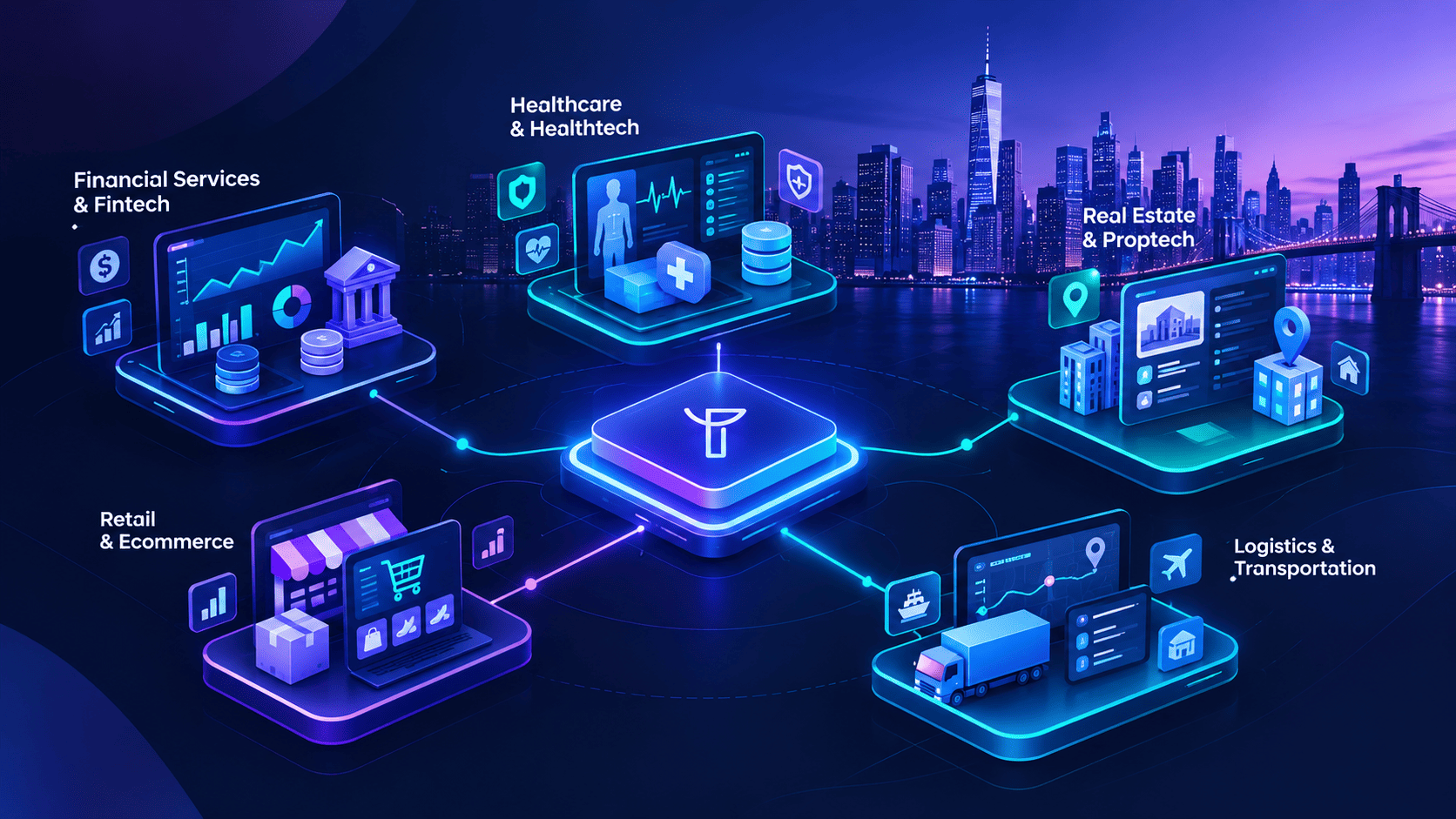
New York’s economy isn’t built around one industry, which is exactly why custom software use cases here vary so widely. The following sections are meant as context, not a fintech page or a healthcare page in disguise.
Financial Services and FinTech
Financial workflow software for New York fintech and financial services firms tends to center on a few recurring needs: connecting transaction and data systems accurately, building dashboards that reflect real-time positions, and maintaining strong security and audit trails throughout. Financial software in this space is judged less on visual polish and more on whether the numbers are trustworthy the first time, every time.
Healthcare and HealthTech
Healthcare software development for New York-based providers usually revolves around patient and provider workflows, interoperability between systems that were never designed to talk to each other, and secure handling of sensitive data. Healthcare applications in this category succeed when they reduce administrative friction for staff without adding risk to patient data management.
Real Estate and PropTech
Property management software and other real estate software commonly needs to handle tenant or customer portals, document-heavy workflows like leases and inspections, and reporting that spans multiple properties or portfolios. Proptech software projects tend to be as much about organizing existing information well as they are about building new features.
Retail and eCommerce
Retail software and ecommerce software projects usually focus on inventory accuracy, order management across multiple channels, and keeping customer-facing systems in sync with backend operations. For a retailer juggling in-store and online sales, an inventory software gap of even a few hours can mean overselling a product that’s already gone.
Logistics and Transportation
Logistics software development for New York-based operators typically addresses shipment tracking, fleet visibility, and coordination across carriers and warehouses. When a business is dealing with fragmented data across multiple logistics platforms, a purpose-built custom logistics software solution can bring that information into one operational view instead of several disconnected screens.
Some of these use cases, particularly for larger organizations with multiple departments and layered compliance requirements, extend well beyond a single application into full enterprise custom software development.
Custom Software vs Off-the-Shelf Software for New York Businesses
Before committing to a custom build, it’s worth being honest about whether custom software is actually the right call. This isn’t a question with one correct answer. It depends on how standard or unusual your workflow really is.
When Off-the-Shelf Software May Be Enough
If your process closely resembles how most businesses in your industry operate, an off-the-shelf tool or established SaaS platform is often faster to deploy, cheaper upfront, and backed by ongoing vendor support. Basic accounting, standard project management, or general CRM needs frequently fall into this category.
When Custom Software May Make More Sense
Custom software for business tends to earn its cost when workflows are genuinely unique, when several systems need to interact in a very specific way, when data ownership or compliance requirements are strict, or when a generic tool would force your team to change how it works just to fit the software.
When a Hybrid Approach Is Better
The choice isn’t always custom everything or SaaS everything. Many New York businesses land on a hybrid approach: keeping the SaaS tools that already work well and adding a custom integration or workflow layer that connects them and fills the specific gaps those tools can’t cover. This build-vs-buy decision often costs less than a full custom build while still solving the core problem.
What Technology and Integration Considerations Matter?
This section is about decisions, not a list of frameworks. The specific technology stack matters less than whether the choices support how the business actually needs to operate.
ERP and CRM Integration
ERP integration and CRM integration usually carry the most business risk in a project, since these systems hold the operational and customer data everything else depends on. Getting this connection right early tends to prevent duplicate work and reporting gaps later.
APIs and Third-Party Systems
Custom API integration with payment processors, shipping providers, analytics tools, or industry-specific platforms determines how well new software fits into a business’s existing tool ecosystem rather than becoming another disconnected system.
Cloud and Scalable Architecture
Cloud application development and scalable software architecture decisions affect how easily the system handles growth in users, data, and transaction volume without requiring a rebuild a year or two down the line.
Data, Security and Access Control
Enterprise security, data security, access control, and audit logs matter for every business handling sensitive customer, financial, or operational data, and they matter more, not less, as a company grows and adds more users and integrations.
AI Integration Where It Actually Adds Value
AI integration can genuinely improve a product, through predictive analytics, intelligent document processing, or automation of repetitive decisions, but it works best as a feature embedded in an existing workflow rather than a separate initiative built for its own sake.
What Should a New York Business Define Before Building Custom Software?
This is the section worth returning to before any first conversation with a development partner. The clearer a business is on these points, the more accurate any estimate or proposal will be.
The Business Problem
Write down the specific problem in one or two sentences, not the solution you think you want. “Our support team can’t see order history without switching between three tools” is a problem. “We need a new CRM” is a guess at a solution.
Users and Workflows
Identify who will actually use the software, what their current workflow looks like step by step, and where that workflow breaks down today.
Required Integrations
List every existing system the new software needs to connect with, including ones that seem minor. Integration scope is one of the most common sources of budget surprises.
MVP vs Full Product
Decide whether you need a focused MVP development effort to validate the core idea first, or whether the requirements are already clear enough to justify building the full product.
Data and Security Requirements
Note any compliance obligations, sensitive data types, or access control needs upfront, since these shape architecture decisions from day one rather than being addable later without cost.
Scalability Requirements
Think realistically about growth over the next two to three years: more users, more locations, more transaction volume, so the initial build doesn’t need a premature rebuild.
Success Metrics
Define what “working” looks like in measurable terms before development starts. If success isn’t defined early, it’s much harder to evaluate honestly after launch.
Working through custom software requirements this way is what makes a first conversation with any development company productive rather than exploratory.
How to Measure the Business Value of Custom Software
Custom software ROI isn’t something to figure out after the fact. The metrics you’ll use to judge success should be set before development begins.
Time Saved
Compare how long a task or process took before the software and after. This is often the clearest and easiest metric to track.
Reduction in Manual Work
Track how many manual steps, like data entry or approvals, were eliminated or automated, and whether staff time shifted to higher-value work as a result.
Fewer Errors
Measure error rates in the specific process the software targets, whether that’s data entry mistakes, order errors, or reporting discrepancies.
Faster Customer or Internal Workflows
Look at how quickly a customer request or internal task moves from start to finish compared to the previous process.
Better Data Visibility
Assess whether decision-makers now have access to information they didn’t have before, and whether that information actually gets used in decisions.
Adoption and Usage
Software that solves the right problem gets used. Low adoption after launch is usually a sign that either the workflow wasn’t understood correctly or the change wasn’t managed well internally.
Revenue or Cost Impact
Where possible, connect the software’s impact to a financial outcome, whether that’s cost avoided, revenue protected, or new revenue enabled. This is often the hardest metric to isolate but the most persuasive one internally.
Establishing measurable targets early makes it easier to evaluate software ROI after launch, rather than trying to reconstruct a baseline months after the software is already live.
How Much Does Custom Software Development Cost in New York?
Cost is a fair question, but a single number without context isn’t useful. What actually drives custom software development cost, in New York or anywhere else, is project scope, the number and complexity of integrations, security and compliance requirements, how many platforms the software needs to run on, whether data migration from an old system is involved, and ongoing maintenance needs after launch.
This is also why two software development quotes for what sounds like “the same project” can land far apart. One vendor may be pricing a focused MVP with minimal integrations, while another is pricing a fuller build with ERP integration, compliance work, and a longer support window baked in. Neither quote is necessarily wrong; they’re often just scoped differently.
Comparing quotes gets easier once you understand what actually drives custom software development cost, since discrepancies between proposals usually trace back to integration depth, compliance work, or support terms rather than markup alone.
How to Plan the Right Development Approach
Once the problem, requirements, and budget expectations are clear, the next decision is who actually builds it. There isn’t a universally “better” model here, only a better fit for a given project.
Local Team
A software development team based in or near New York offers easier in-person collaboration and time zone alignment, which can matter for projects with frequent stakeholder involvement or complex internal workflows that are easier to explain face to face.
Remote Team
A remote software development team, whether based elsewhere in the US or internationally, can offer broader access to specialized skills and often more flexible pricing, provided communication and project management are structured well.
Distributed/Hybrid Team
A hybrid software development model, combining local project leadership with a distributed development team, tries to capture the coordination benefits of a nearby point of contact along with the cost and talent flexibility of a broader team.
Project-Based Development
Project-based software development works well for a clearly scoped build with a defined end point, where requirements are unlikely to shift significantly mid-project.
Dedicated Development Team
A dedicated development team model fits businesses expecting ongoing development, whether that’s a phased rollout, continuous feature work, or long-term product ownership rather than a single deliverable.
The right model depends on how well-defined your requirements already are, how much day-to-day involvement your team wants, and whether this is a one-time build or the start of an ongoing product relationship. Businesses operating across multiple locations may also want to explore custom software development in the USA as part of that comparison.
For a broader sense of pricing structures and delivery styles across the market, reviewing custom software development companies in the USA can be a useful reference point before shortlisting a partner.
When Should a New York Business Consider Custom Software?
Pulling this together, custom software may deserve serious consideration when:
- Existing tools don’t support workflows that matter to daily operations
- Several systems need to communicate and currently don’t
- Manual processes are becoming genuinely expensive in staff time
- Data is fragmented across tools with no single reliable source of truth
- The business needs a differentiated digital product, not a generic one
- Legacy systems are actively limiting growth or new integrations
- Standard SaaS tools force operational compromises that are starting to hurt
- Future scale requires more control over the platform than a subscription tool allows
If several of these apply, the next step isn’t automatically to start building. It’s to define the workflow, the required integrations, the expected outcomes, and the investment constraints first. A well-defined problem is what turns a vague software idea into a project a development partner can actually scope accurately.
If your business is dealing with disconnected systems, manual workflows, or software that no longer fits the way you operate, the first step is to define the problem and requirements clearly. From there, you can evaluate whether a custom solution is justified and start a conversation about custom software development services built around your specific workflows, not a generic package.
For businesses ready to take that next step, Space To Tech works as a custom software development company with teams across the US, UAE, and India, scoping, building, and supporting projects like these from discovery through launch.