Most businesses don't start their generative AI journey wondering what a transformer model is. They start with a specific, frustrating problem: a support team drowning in repetitive tickets, a policy library nobody can search, or a team spending hours on the same kind of report every week. Generative AI development is the work of turning that problem into a working application, not just wiring an API key into a chat window.
Connecting to a large language model is the easy part. The harder, more valuable work is deciding how the application retrieves the right data, fits into existing workflows, gets evaluated before launch, and stays secure and accurate once real users depend on it. Skipping these decisions is why many promising generative AI solutions never make it past the demo stage.
This guide walks through what generative AI development actually involves: the applications businesses are building today, the architecture behind them, the development process from idea to production, and the mistakes that most often derail a project. Businesses moving from an early AI idea to a working application often need AI development services to connect models with real data, internal systems, and day-to-day workflows, and understanding the mechanics first makes that conversation far more productive.
What Is Generative AI Development?
Generative AI development is the process of designing, building, and maintaining software applications that use generative AI models, typically large language models (LLMs) or multimodal models, to produce text, code, images, or structured outputs based on a given input or context. It is a broader discipline than simply calling a model's API.
A useful way to separate the two: a model is a component, while an application is a complete system built around that component. The model generates predictions based on patterns learned from training data. The application decides what information the model sees, how its output is used, and how errors are caught before they reach a user.
Most generative AI applications are built in one of three ways. Some rely on proprietary, API-based models, which handle the heavy lifting of language understanding and generation. Others use open-source models that a business can host, customize, or fine-tune independently. A growing number combine both, using an API-based model for general reasoning and a smaller specialized model for narrow, high-volume tasks.
Beyond the model itself, three layers typically define a generative AI application: the application layer that handles user interaction, the data and retrieval layer that supplies relevant business context, and the integration layer that connects the AI output to real systems like a CRM, a ticketing tool, or an internal database. Generative AI software development, in practice, is mostly about designing these surrounding layers well. In production, many failures come not from the model alone but from weaknesses in the surrounding application layers, such as poor retrieval, weak integration, inadequate evaluation, or insufficient access controls.
What Makes Generative AI Development Different From Traditional Software Development?
Traditional software behaves predictably: the same input produces the same output every time. Generative AI applications do not work that way. Outputs are probabilistic, meaning the same prompt can produce slightly different responses, which changes how testing and quality assurance need to be approached.
There are a few other differences worth planning for early. The application's quality depends heavily on the data it retrieves, not just the code that was written. Prompt and context management becomes an ongoing engineering task rather than a one-time setup. Evaluation needs to be continuous, since a model update or a change in underlying data can shift output quality without any code changes at all. And because the underlying model provider may update or deprecate a model version, generative AI applications require more active monitoring than most traditional software after they go live.
None of this makes generative AI development harder in a discouraging sense. It simply means the discipline borrows practices from data engineering and machine learning operations that traditional web or mobile development teams may not have needed before.
Generative AI Applications and Business Use Cases
Rather than listing every conceivable generative AI use case, it is more useful to group them by the kind of business problem they solve. The applications below represent several of the most practical enterprise generative AI use cases, particularly where businesses can connect AI to existing data and workflows.
Enterprise Knowledge Assistants
Large organizations accumulate enormous amounts of unstructured knowledge: policy documents, internal wikis, support tickets, onboarding materials, and product specifications scattered across different systems. Enterprise knowledge assistants use retrieval-augmented generation (RAG) to let employees ask natural-language questions and get answers grounded in that internal content, instead of digging through folders or asking a colleague.
These generative AI applications are typically built as AI copilots embedded into an intranet, a Slack or Teams channel, or a dedicated internal tool. The technical foundation is almost always a RAG-based knowledge system: documents are broken into chunks, converted into embeddings, stored in a vector database, and retrieved at query time based on relevance to the employee's question. Done well, this is one of the fastest ways for a business to see measurable value from generative AI without a lengthy build cycle.
Customer Service and Conversational Applications
Customer-facing generative AI applications range from simple FAQ bots to more sophisticated assistants that can look up order details, explain policies, or troubleshoot a product issue using natural language. Conversational AI in this category typically blends NLP-based intent handling with generative responses, so replies feel natural rather than scripted.
The important design decision is not the model, it is the escalation logic: knowing when a query is too ambiguous, too sensitive, or too far outside the assistant's knowledge base to answer safely, and handing it to a human agent without frustrating the customer. Businesses exploring this category in depth, including intent design, escalation paths, and platform choices, can review this chatbot development guide for a closer look at how conversational applications are typically structured.
Intelligent Document Processing
Contracts, invoices, claims forms, and compliance reports still get processed manually at most businesses. Generative AI applications built for document processing can extract structured data from unstructured text, summarize long reports into a few key points, classify incoming documents by type, and flag anomalies for human review.
Compared with traditional rule-based or OCR-heavy document workflows, generative AI can be useful for handling documents with varied structures, language, and context, particularly when extraction requires understanding meaning rather than simply recognizing characters or fixed fields. This makes document processing one of the more measurable generative AI applications, since the time saved per document is easy to quantify.
Content and Marketing Workflows
Generative AI is widely used to support content and marketing teams, from drafting product descriptions and generating campaign variations to personalizing messaging at scale. This is a genuinely useful application category, though it is also one of the more saturated ones, since general-purpose AI writing tools already serve much of this demand directly. Businesses get more value when generative AI is connected to their actual product data and brand guidelines, rather than used as a standalone drafting tool disconnected from the rest of the workflow.
AI Copilots and Workflow Assistance
Beyond customer-facing use cases, many businesses are building internal AI copilots that assist employees with day-to-day decisions: summarizing a sales call, drafting a first version of a report, surfacing relevant context before a meeting, or recommending next steps based on account history. These generative AI applications tend to sit inside existing tools rather than replacing them, offering contextual recommendations at the point where a task is already happening. The measurable win here is usually time saved per employee per week rather than a single dramatic outcome, which makes copilots easier to justify but also easier to underestimate during planning.
Product and Design Applications
Product and design teams are using generative AI earlier in the development cycle than most people expect, well before a line of production code is written: synthesizing customer feedback into clear requirements, generating design directions from a written brief, exploring interface variations quickly, and validating a concept with realistic sample content instead of placeholder text.
This also intersects with mobile product development. Teams building AI-powered mobile apps are increasingly using generative AI both inside the product, for features like personalization or in-app assistants, and during design, to prototype screens and content faster before committing engineering time. Treating this as part of the product conversation, rather than a separate AI initiative, tends to produce better outcomes.
Generative AI Architecture: How the Application Works
Once the use case is clear, the next question is how the application is actually built. Most generative AI architectures, regardless of the specific use case, follow a similar pattern: User → Application → Orchestration → Model → Knowledge and Data → Business Systems → Evaluation and Monitoring.
Each layer plays a distinct role, and understanding them helps separate a genuinely production-ready generative AI application from a demo that struggles once real users and real data get involved.
Application Layer
The application layer is what users actually interact with, whether that is a web interface, a mobile screen, or a chat window embedded in another tool. It handles authentication, manages the conversation or session, sends requests to the orchestration layer, and displays the model's response. This layer also determines user experience choices that matter more than people expect, such as how errors are shown and whether a response streams in gradually or appears all at once.
Model Layer
The model layer is where the actual generation happens. This might be a general-purpose LLM accessed through an API, an open-source model hosted independently, or a multimodal model capable of handling text, images, or both. Model selection depends on the use case: a customer-facing assistant may prioritize response speed and cost, while an internal analytical tool might prioritize reasoning quality over latency. Many production architectures use more than one model, routing simpler tasks to a faster, cheaper option and reserving a stronger model for complex reasoning.
Orchestration Layer
Orchestration is the connective tissue between the application and the model. It manages prompt construction, keeps track of conversation context, decides which tools or functions the model can call, and routes requests to the appropriate model when more than one is in use. As generative AI applications grow more complex, especially ones involving multiple steps or external tool calls, orchestration becomes one of the more engineering-intensive parts of the system, even though it rarely gets the attention that model selection does.
Knowledge and Retrieval Layer
This layer supplies the business-specific context a general-purpose model does not have on its own. In a RAG architecture, documents are split into chunks, converted into embeddings, and stored in a vector database. When a user asks a question, the system retrieves the most relevant chunks and passes them to the model as context before it generates a response. Reranking is often applied after the initial retrieval step to improve precision further. The quality of this layer can have a major influence on whether a generative AI application feels genuinely useful or frustratingly generic, because even a strong model can produce poor answers when it receives incomplete or irrelevant context.
Integration Layer
Generative AI rarely operates in isolation. The integration layer connects the application to the systems that already run the business: a CRM, an ERP platform, internal APIs, ticketing systems, or proprietary databases. This is frequently the most underestimated part of a generative AI project, since it involves the same complexity found in any enterprise software integration, authentication, data mapping, rate limits, and error handling, on top of the AI-specific work. Businesses that already have complex internal systems in place often find this layer overlaps heavily with broader enterprise custom software development work rather than being a purely AI-specific concern.
Security and Governance Layer
Every layer above ultimately needs to operate within a security and governance boundary: access controls that determine who can query what data, guardrails that constrain what the model is allowed to output, and monitoring that flags unusual behavior. This layer is introduced briefly here because it touches every other part of the architecture, and it is covered in more depth later in this guide.
RAG vs Fine-Tuning vs Model APIs: Which Approach Fits?
One of the most common early decisions in generative AI development is choosing between a direct model API, retrieval-augmented generation, fine-tuning, or some hybrid of the three. There is no universally correct choice. The right approach depends on the specific data, accuracy requirements, latency tolerance, security constraints, cost, and how much ongoing maintenance the team can realistically support.
It is worth being direct about a common misconception: fine-tuning is not automatically the more advanced or more enterprise-grade option. Fine-tuning changes how a model behaves or responds, but it does not reliably teach a model new, current facts the way people often assume. For applications that need access to a business's private or frequently changing knowledge, such as policy documents, product catalogs, or account data, RAG is usually the more practical starting point precisely because it retrieves current information at query time rather than baking it into the model's weights.
Fine-tuning earns its place when the goal is consistent formatting, a particular tone, or specialized domain language that a general-purpose model does not produce reliably even with good prompting. Many production-grade generative AI applications end up using a hybrid: RAG for grounding responses in current business data, careful prompt engineering or light fine-tuning for tone and format, and a general-purpose model API for reasoning. The decision is rarely permanent either. Teams frequently start with a direct API to validate the use case, add RAG once real data needs surface, and only consider fine-tuning after the RAG-based version has been running long enough to reveal a genuine, recurring formatting or behavior problem.
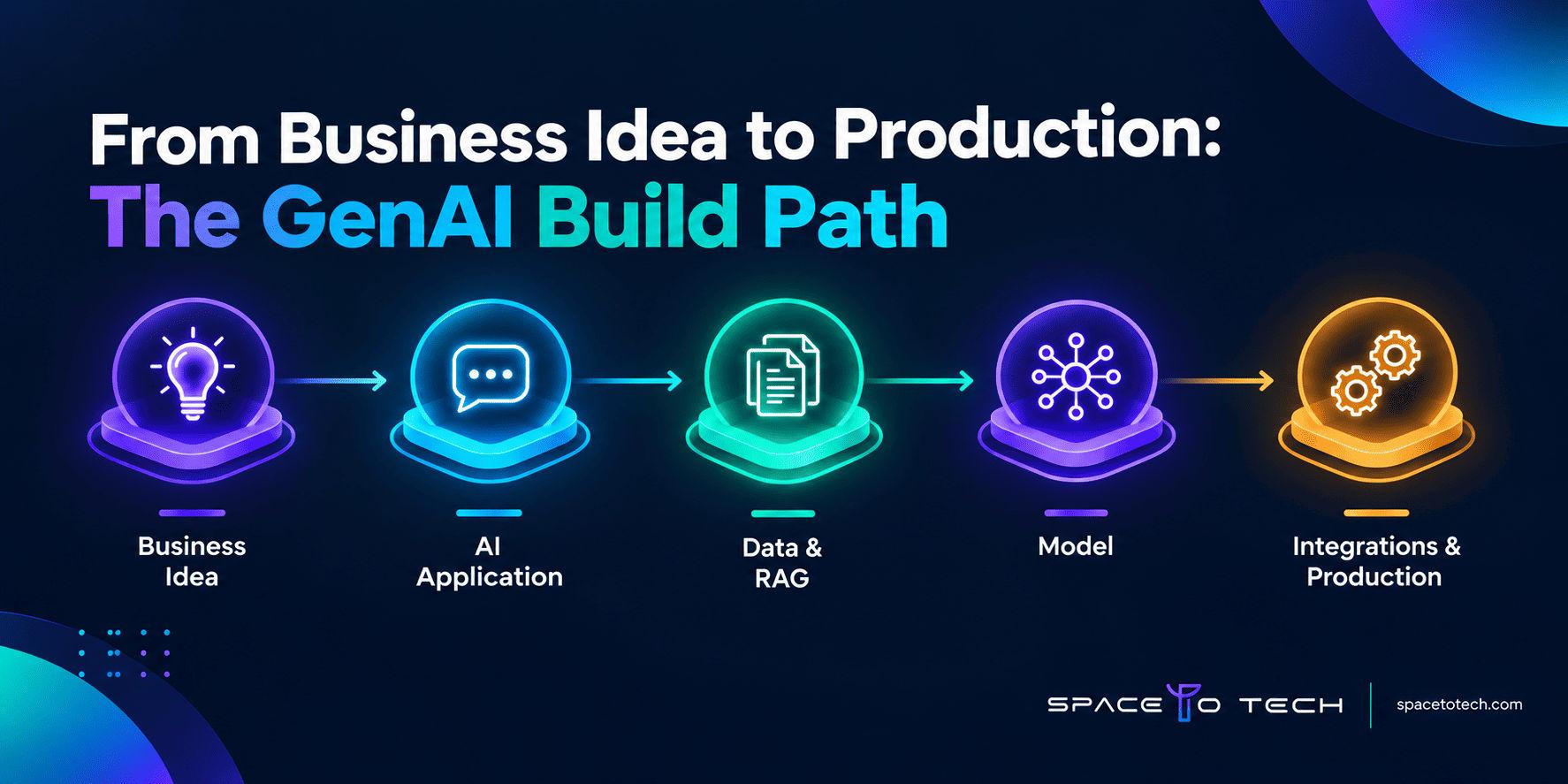
Generative AI Development Process: From Idea to Production
Building a generative AI application that survives contact with real users follows a fairly consistent sequence, even though the specific tools and models vary by project.
Define the Business Problem and Success Criteria
Before any model is chosen, the problem itself needs to be specific: which workflow is being improved, who the actual users are, and what “success” looks like in measurable terms, whether that is time saved, tickets deflected, or documents processed per day. Skipping this step is one of the most common reasons generative AI pilots stall, since a vague goal makes it impossible to know when the application is actually ready.
Choose the Model and Application Approach
With the problem defined, the next decision is model selection and architecture: an API-based model or an open model, RAG or fine-tuning or a hybrid, and whether the use case involves multiple content types such as text and images. This decision should be revisited as the project develops rather than treated as fixed from day one.
Prepare and Connect the Data
Most of the real effort in generative AI development happens here, not in prompting. This includes identifying the right data sources, cleaning and structuring documents, resolving permission and access questions, and setting up the retrieval pipeline. Data that is outdated, duplicated, or poorly organized will produce a generative AI application that feels unreliable regardless of how capable the underlying model is.
Build the Prototype
The first working version should be built to answer a narrower question: does this actually help, does the output quality meet a usable bar, is the user experience workable, and is the technical approach feasible at all. A prototype's job is to validate assumptions quickly, not to be feature-complete.
Integrate Business Systems
Once the prototype proves the concept, integration work connects the application to the systems it needs to be genuinely useful: authentication, CRM or ERP data, internal APIs, and existing databases. This stage often takes longer than the AI-specific work itself, particularly in organizations with older or fragmented internal systems.
Evaluate and Test
Before production, the application needs structured evaluation covering output quality, hallucination rate, retrieval accuracy, safety, response latency, and cost per interaction. This belongs firmly inside the development process rather than as an afterthought once the build is finished.
Deploy, Monitor and Improve
Launch is not the finish line. Production monitoring should track output quality, user feedback, retrieval performance, and cost over time, since all four can quietly degrade as documents change, usage patterns shift, or the underlying model provider updates its model. Teams that treat generative AI development as a one-time build rather than an ongoing process are the ones most likely to see quality decline within a few months of launch.
What Can Go Wrong With Generative AI in Production?
Getting a generative AI application into production is only half the challenge. Research from MIT Project NANDA's The GenAI Divide: State of AI in Business 2025 reported a substantial gap between enterprise GenAI experimentation and measurable business impact. Its research found that only a small share of custom enterprise AI tools reached production with measurable value. The report points to factors such as workflow fit, organizational adoption, and how systems are integrated into real business processes as important parts of this gap. These findings are based on the report's research methodology and should be treated as directional rather than a universal failure rate. Understanding the specific failure points below is the most reliable way to avoid becoming part of that pattern.
Hallucinations Despite Good Retrieval
Even with a well-built RAG pipeline, models can still generate confident-sounding but incorrect statements, especially when retrieved context is incomplete or slightly ambiguous. The business impact ranges from mildly embarrassing to genuinely risky depending on the use case. Mitigation usually combines stronger retrieval, structured output formats that constrain how the model can respond, and human review for high-stakes answers.
Irrelevant or Poorly Retrieved Context
Poor chunking strategy, weak embedding quality, or an outdated document set can all cause the retrieval layer to surface the wrong information, which the model will then use confidently. This is one of the more common and more fixable production issues, since it usually points to a specific, identifiable problem in the data pipeline rather than a limitation of the model itself.
Retrieval and Knowledge Drift
Enterprise data is not static. Policies change, products get updated, and processes evolve, which means a retrieval system tuned during testing can quietly degrade as the underlying documents shift out from under it. Without a process for keeping the knowledge base current, an application that performed well during a demo can become noticeably less reliable within a few months of real use.
Unexpected Token and Infrastructure Costs
Long prompts, large context windows, and repeated retrieval calls can drive up costs faster than expected, particularly at scale. Model choice, prompt length, and how often the retrieval layer is queried all factor into this. Rather than assuming a fixed cost per interaction, teams are better served by monitoring actual usage patterns closely during the first weeks after launch.
Latency and Performance Problems
Model response time, retrieval speed, and any external API calls all add up, and a generative AI application that feels sluggish will be abandoned regardless of how accurate its answers are. This becomes more pronounced under concurrent user load, which is why load testing before launch matters more for generative AI applications than for many traditional software features.
Prompt Injection and Data Leakage
Malicious or careless inputs can attempt to manipulate a model into ignoring its instructions or revealing information it should not have access to. At a high level, this risk needs to be addressed through careful input handling, strict access boundaries around what data the model can retrieve for a given user, and isolation between different users' data within a shared application.
Inconsistent Output Quality
Without structured evaluation, output quality can vary in ways that are hard to notice until a user complains. Guardrails, structured output formats, and periodic human review all help, but the more durable fix is continuous monitoring that catches quality drift before it becomes a pattern rather than an isolated incident.
How to Evaluate a Generative AI Application Before Production
A generative AI application should be evaluated across several dimensions before it reaches real users, and ideally on an ongoing basis afterward as well.
Accuracy asks whether the application provides correct answers to begin with. Relevance asks whether it retrieves and uses the right context for a given question, which is a distinct question from raw accuracy. Groundedness asks whether an output can actually be traced back to a reliable source, rather than sounding plausible without real support behind it. Hallucination rate measures how often the system produces unsupported or fabricated information, which should be tracked as its own metric rather than folded into general accuracy.
Latency measures whether the system responds within a timeframe that keeps the application usable rather than frustrating. Cost measures what it actually takes, in tokens and infrastructure, to complete a meaningful task, not just a single simple query. Safety asks whether users can manipulate the system into unauthorized behavior or access information they should not see. User feedback, gathered directly rather than assumed, answers the most practical question of all: does this actually help people complete the workflow it was built for.
The most effective evaluation approach moves through three stages. Offline evaluation uses a fixed set of test cases to check output quality before any real user sees the application. Pre-production testing exposes the application to a small, controlled group of real users under close observation. Production monitoring then tracks these same metrics continuously after launch, since generative AI evaluation is not a milestone that gets checked off once. It is closer to an ongoing quality process that continues for as long as the application is in use.
Generative AI Security, Privacy and Governance
Security for a generative AI application covers more ground than traditional application security, because the model itself introduces new categories of risk alongside the usual ones.
At the data layer, this means protecting sensitive information the application can access, enforcing access controls so users only retrieve data they are authorized to see, and being deliberate about what gets sent to a third-party model provider in the first place. At the application layer, guardrails constrain what the model is allowed to output, prompt injection defenses reduce the risk of manipulated inputs, and monitoring flags unusual usage patterns that might indicate misuse.
Governance is where many generative AI initiatives fall short in practice, not because teams do not care about it, but because it gets treated as a compliance checkbox added near the end of a project rather than a design consideration from the start. Effective governance includes human oversight for high-stakes decisions, clear accountability for what the application is and is not allowed to do, and an audit trail that makes it possible to understand why a given output was generated.
It is worth being direct here: not every generative AI application needs the same compliance framework. Requirements depend heavily on the industry, the geography a business operates in, the sensitivity of the data involved, the risk profile of the specific use case, and who the end users actually are. A generative AI application for internal document summarization carries a very different risk profile than one that makes customer-facing financial recommendations, and treating them identically usually means either over-engineering the low-risk case or under-securing the high-risk one.
How to Choose the Right Generative AI Approach for Your Business
With the architecture, development process, and risks covered, the practical question remains: what should a specific business actually build?
This table is a starting point rather than a final answer, since most real projects combine more than one row. A customer support assistant, for example, typically needs RAG for private knowledge, integration architecture to look up order data, and human oversight for edge cases, all at once.
Delivery model matters here too, particularly for businesses weighing internal builds against external partners. Teams evaluating AI development company in the USA options are often comparing that against building an internal team with the same RAG, orchestration, and evaluation capability described throughout this guide, a comparison that is easier to make once the underlying architecture is understood rather than left to the sales conversation. For teams open to distributed delivery models, working with AI development services in India is a common way to access the same architecture and development capability at a different cost and delivery structure, provided the vendor can demonstrate real experience with retrieval, evaluation, and production monitoring rather than only prompt engineering.
Whichever path a business chooses, the goal is the same: the right combination of model, data, and architecture for that specific use case, not whatever happens to be trending.
Businesses that need to combine generative AI with broader application development, beyond a single AI feature, can also evaluate a custom software development company based on architecture experience, integration capability, security practices, and long-term support, since a generative AI feature is ultimately only as strong as the software it lives inside.