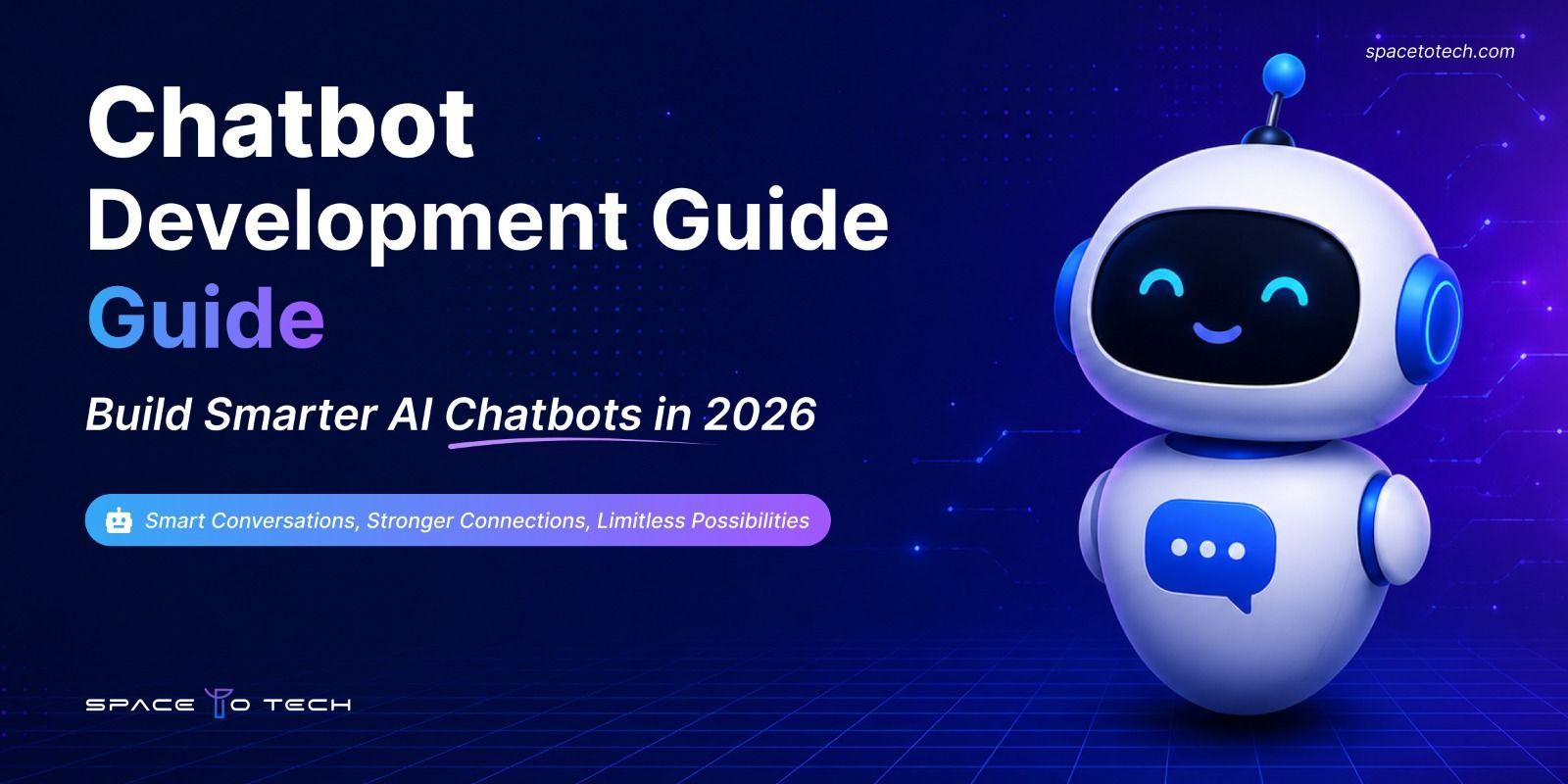
Most of the chatbot briefs that land on our desk start the same way: a client wants "an AI chatbot like ChatGPT" bolted onto their website by next month. Almost none of them actually need that. What they need is something far more specific — a chatbot development that can recognise "where's my order" in eleven different phrasings, pull the order number out of a sentence that also contains three other complaints, and know when to stop pretending it can help and hand the conversation to a human.
That gap between what people ask for and what actually solves their problem is the entire reason this guide exists. We've built more than 20 of these systems — across healthcare, FinTech, and retail — and the lessons that matter most rarely show up in the marketing pages. They show up in the post-launch week, when real users start typing things nobody anticipated.
This is written for the people who have to make the call: build or buy, NLP or LLM, three weeks or three months. If you'd rather skip the reading and talk through your specific situation, our AI chatbot development services page covers how we actually engage on projects like this.
What Is Chatbot Development, Really?
Strip away the marketing language and chatbot development is the process of designing, training, and deploying a system that holds a conversation — over text or voice — well enough that a user gets something useful out of it without needing a human on the other end. That can mean a website widget, a WhatsApp number, a Slack bot, or all three feeding the same backend.
Here's the distinction that gets blurred constantly, and it costs people money when it does. A rule-based chatbot is a decision tree wearing a chat interface. The user clicks or types something close to a script, the bot matches it, the bot replies with a pre-written answer. There's no understanding happening — it's pattern matching, full stop. An AI-powered chatbot is a different animal entirely: it parses what someone actually meant, even when they've typed it sideways, with typos, mid-sentence frustration, and zero regard for how you trained it.
This is also where chatbot work splits cleanly from regular app development, and it's worth being precise about why. A normal app has a finite set of screens and inputs — a button does one of a handful of things. A conversational system has to deal with the fact that language is infinite in its phrasing and finite in its actual intent underneath. Intent classification — figuring out what someone wants regardless of how they phrased it — and entity extraction — pulling the specific detail (a date, an order number, an amount) out of a messy sentence — aren't edge cases here. They're the job. Rasa's own architecture documentation makes basically this same point: conversational systems fail in linguistic ways, not just functional ones, and that demands a different kind of testing discipline than a typical CRUD app ever needs.
One more shift worth naming early: two years ago, "chatbot development" mostly meant training a narrow intent classifier and calling it done. In 2026, it increasingly means deciding how much of the conversation you hand to a large language model versus how much you keep on rails with structured intent logic. That decision — not the platform you pick — is usually the one that determines whether the bot feels smart or feels like it's guessing.
Types of Chatbots — and Where Each One Actually Belongs

A mistake we see constantly: someone wants a generative AI chatbot because that's the phrase that's everywhere right now, when what they actually need is a rule-based FAQ bot that could've shipped two weeks ago for a fraction of the cost. Matching the build to the actual problem matters more than chasing the newest technology.
Our own work concentrates heavily on NLP and generative AI chatbots, across web, mobile, and WhatsApp. That's not us hedging — it's where the deepest production experience actually lives for us, and where most client problems genuinely sit. We do build voice and vision bots when the use case calls for it, but it's a smaller part of what we ship, and I'd rather tell you that plainly than inflate it.
Chatbot vs. Live Chat vs. Traditional Support — Picking the Right Layer
Before getting into how to build a chatbot, it's worth being honest about whether you should build one at all, or whether you actually need something simpler. We get this question constantly from founders who assume a chatbot is the obvious next step after "we're drowning in support tickets," when sometimes the right move is hiring one more support agent and revisiting the bot conversation in six months.
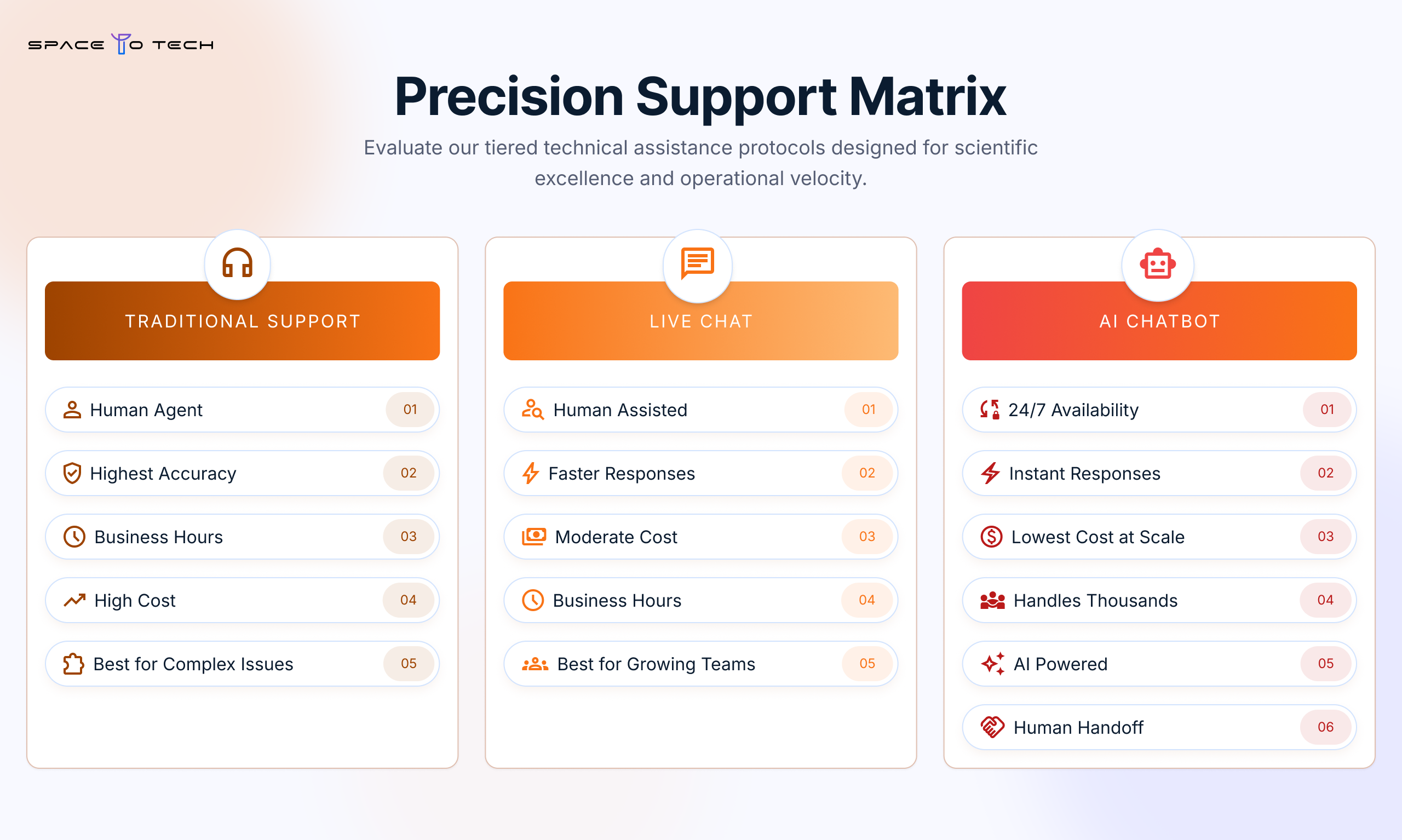
Traditional support — a human answering every ticket — scales linearly. Every additional 1,000 conversations a month means roughly proportional headcount. It's the most accurate, most empathetic, and most expensive option, and it's genuinely the right answer when ticket volume is low, when the issues are highly varied and non-repetitive, or when the product is complex enough that misdirected automation actively damages trust.
Live chat sits in the middle — a human is still answering, but the interface is faster and more casual than email, and many platforms layer in canned responses or saved replies to speed up agents on repetitive questions. This is often the right first step for a business that hasn't yet validated which questions are actually repetitive enough to automate. Three to six months of live chat transcripts is, frankly, the best training data you'll ever get for a future chatbot — it tells you exactly which questions repeat, in exactly the phrasing your real customers use, not the phrasing your product team assumed they'd use.
A chatbot makes sense once you can point to genuine repetition in that data — the same handful of questions showing up hundreds of times a month, ideally with a structured answer that doesn't require human judgment every time. The mistake we see most often is skipping the live chat data-gathering phase entirely and trying to design intents from internal assumptions about what users will ask. Internal assumptions and real user phrasing diverge more than anyone expects, and that gap is exactly where intent accuracy collapses three weeks after launch.
Build vs. Buy — The Decision Nobody Asks Us About Early Enough
This is a section most agencies skip, for an obvious reason: it sometimes points toward "don't hire us, use a no-code tool." We'd rather you make the right call and trust us on the next project than oversell a custom build you didn't need.
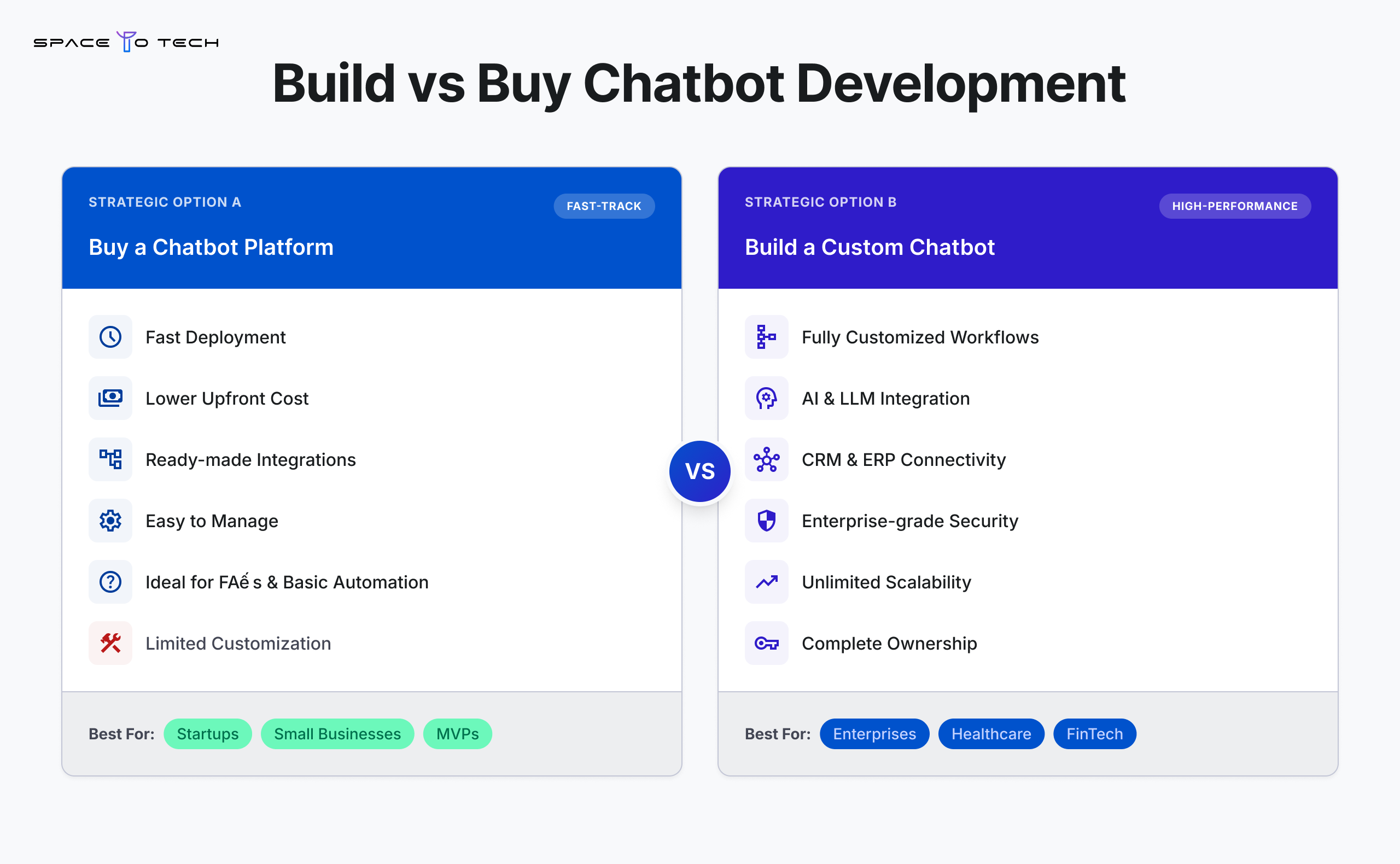
No-code and off-the-shelf platforms — Intercom's Fin, Tidio, Zendesk's bot layer, Drift — are genuinely the right choice when your use case is narrow, your integrations are standard (most of these platforms have native Shopify, Zendesk, or HubSpot connectors), and you don't have hard data residency requirements. You'll be live in days, not weeks, and the ongoing cost is a predictable monthly subscription rather than a development invoice. The trade-off is real: you're constrained to whatever conversation logic, integration depth, and customization the platform vendor decided to support. If your use case fits neatly inside those guardrails, paying for custom development is genuinely a waste of budget.
Custom development earns its cost when your requirements actually exceed what an off-the-shelf platform supports — a compliance requirement like HIPAA that demands self-hosted infrastructure, an integration with a legacy internal system with no existing connector, a conversation flow complex enough that a no-code builder's visual flow editor becomes unworkable past a certain size, or a genuine need for a fully custom brand voice and persona that off-the-shelf generation doesn't replicate well. Custom builds also make sense at meaningful scale, where the unit economics of a per-seat or per-conversation SaaS pricing model start to outpace what an owned, custom system costs to run.
The Chatbot Development Process — Seven Stages, No Shortcuts
If you're evaluating an agency, this is the section to read slowly. It's where "we use AI" and "we've actually shipped this 20+ times" stop sounding the same.
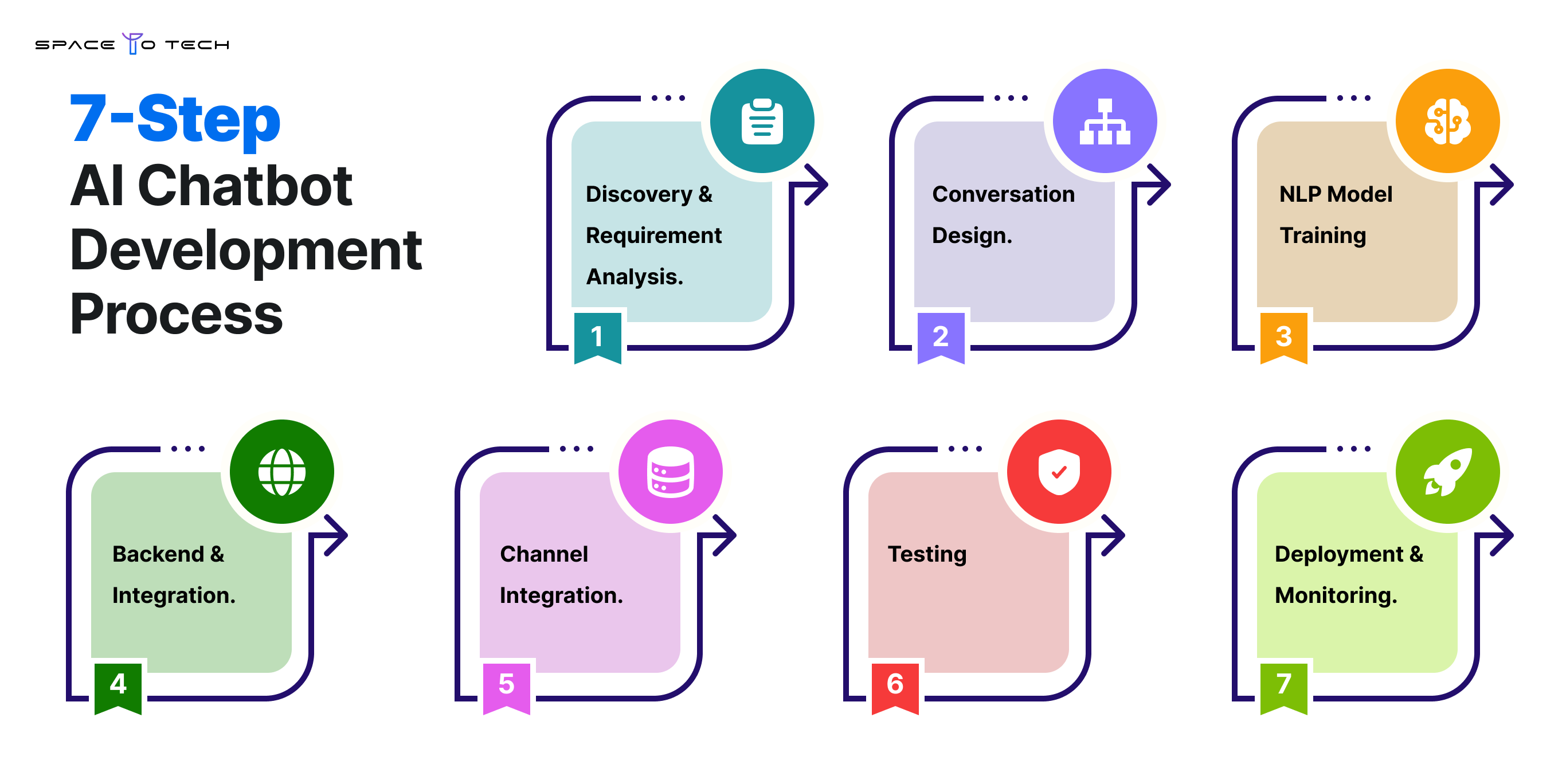
1. Discovery & Requirement Analysis. Before any model gets trained, we nail down what the bot is actually for — which user journeys it covers, which channels it lives on, what tone it should carry, and which metrics will actually get checked after launch (deflection rate, CSAT, response time). Rush this stage and you end up with a bot that technically works and solves nothing the client actually cared about. We've seen it happen on projects we didn't run, and it's always traceable back to this step getting skipped.
2. Conversation Design. Every intent the bot needs to catch, every entity it needs to pull, and — this is the part people forget — every fallback for when the user says something nobody anticipated. We map this out in Botmock or structured Figma flows before training data gets written, so the client can see the actual conversation shape and flag problems while they're still cheap to fix.
3. NLP Model Training. Labelling, intent definitions, entity schemas, then training against Dialogflow, Rasa, or a fine-tuned LLM depending on the project. The number that actually matters here: somewhere around 50-100 labelled utterances per intent before the model is genuinely ready for real testing. Fewer than that, and the model looks fine in a demo and falls apart against real phrasing within the first week.
4. Backend & Integration. This is where chatbots get expensive in ways clients don't expect upfront. Connecting to a CRM, helpdesk, database, or payment gateway through webhooks and REST APIs, with proper JWT/OAuth security — clients tend to think of the bot as "the conversational part" and forget it needs real data flowing underneath it. That data layer is frequently bigger than the conversational layer.
5. Channel Integration. Embedding the widget, wiring up WhatsApp Business API, Slack, Teams, or a mobile SDK — whatever Step 1 said users actually need.
6. Testing. Intent accuracy testing, deliberate edge-case probing, load testing, and real user acceptance testing — not someone on the team clicking through three happy paths and calling it QA. Our bar before launch: 90%+ intent accuracy on a representative test set. Below that line, the bot causes more frustration than it resolves.
7. Deployment & Monitoring. Cloud deployment, monitoring for fallback rate and handoff rate from day one, A/B testing on response variants, and a retraining loop that keeps running after launch — because the first two weeks of real conversations will reveal gaps no amount of pre-launch testing caught.
Across our own 20+ deployments, average intent accuracy at launch sits around 92%. We track that number on every single project, including the ones that didn't go as smoothly — which is the only way a number like that means anything.
Why Most Chatbot Projects Fail — and How to Avoid It
We get asked to fix or relaunch other agencies' chatbot projects often enough that the failure patterns have become genuinely predictable. None of these are exotic technical problems. They're almost always process problems that show up as technical symptoms.
The training data doesn't match real user phrasing. This is the single most common failure, and it traces back directly to skipping the live-chat data-gathering phase covered above. A team writes 50 example utterances per intent based on how they imagine users will phrase a question, the model trains cleanly against that data, the demo goes great — and then real users type things nobody on the team thought to include. Intent accuracy that looked like 95% in testing quietly becomes 60% in production within the first week, and nobody notices until support tickets about "the bot doesn't understand me" start piling up.
There's no fallback strategy, or the fallback is embarrassing. A bot that responds "I don't understand" repeatedly, with no path to a human, is worse than no bot at all — it actively damages trust in the brand behind it. The fix is straightforward in concept and frequently skipped in practice: a clear, low-friction handoff to a human agent, triggered after a defined number of failed attempts or a detected frustration signal, not buried three menu layers deep.
Scope crept past what the underlying platform can actually support. This shows up constantly with no-code platforms specifically — a client starts with a simple FAQ bot, keeps adding "just one more thing," and six months later is trying to force genuinely complex multi-turn logic into a tool that was never designed for it. The visual flow editor becomes an unmanageable spaghetti diagram nobody on the team fully understands anymore.
Nobody owns the bot after launch. A chatbot is not a one-time deliverable — it's a system that needs ongoing retraining as language patterns shift, as the product changes, as new intents emerge from real usage. Projects that get handed over with no internal owner or no retained agency relationship tend to degrade quietly over six to twelve months as the world moves and the bot doesn't.
The generative AI layer has no guardrails. This is newer and increasingly common as more teams reach for an LLM by default. An ungoverned GPT-4 integration with no system prompt discipline, no retrieval grounding, and no output validation will eventually say something the business did not intend it to say — sometimes embarrassingly, sometimes with real legal exposure. We'll get into exactly how to prevent this in the next section, because it's become one of the most important parts of any generative chatbot build we do now.
Frameworks & Platforms — and Why We Don't Use Just One
Ask any vendor "what's the best chatbot platform" and get a single confident answer, and you've found someone selling you their comfort zone instead of the right tool for your actual problem.
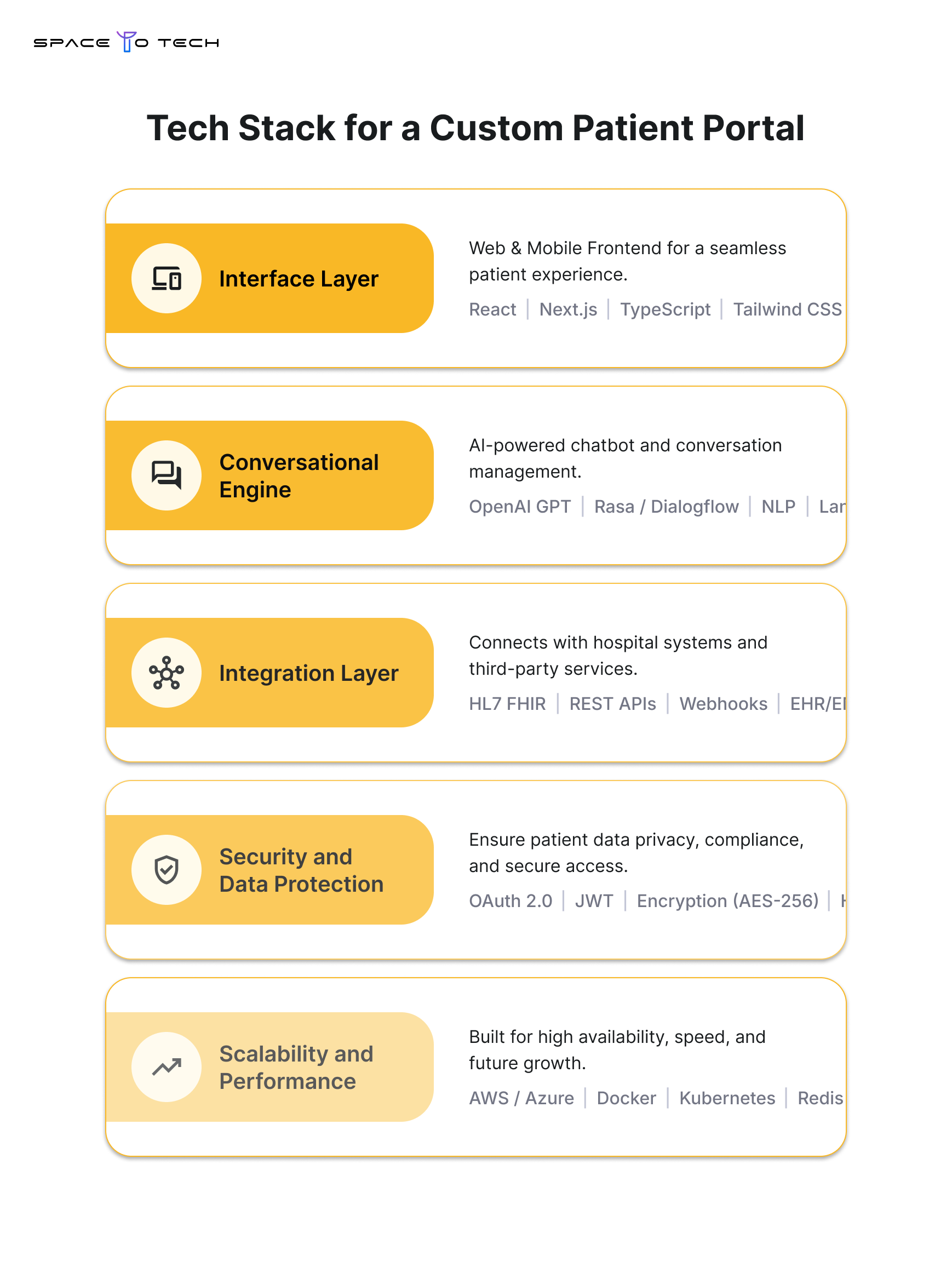
The reason Rasa is our default for healthcare specifically: it's self-hostable, which means a client's conversation data never has to leave infrastructure they control. That's a fundamentally different risk profile than routing every patient conversation through a third-party API, and for HIPAA-sensitive work, that difference is the whole decision. For everything else, Dialogflow CX or a GPT-4o integration gets you live faster with far less infrastructure to babysit.
NLP in Chatbot Development — The Part That Separates Good Bots From Frustrating Ones
This is where real technical depth shows up or doesn't, so it's worth getting precise.
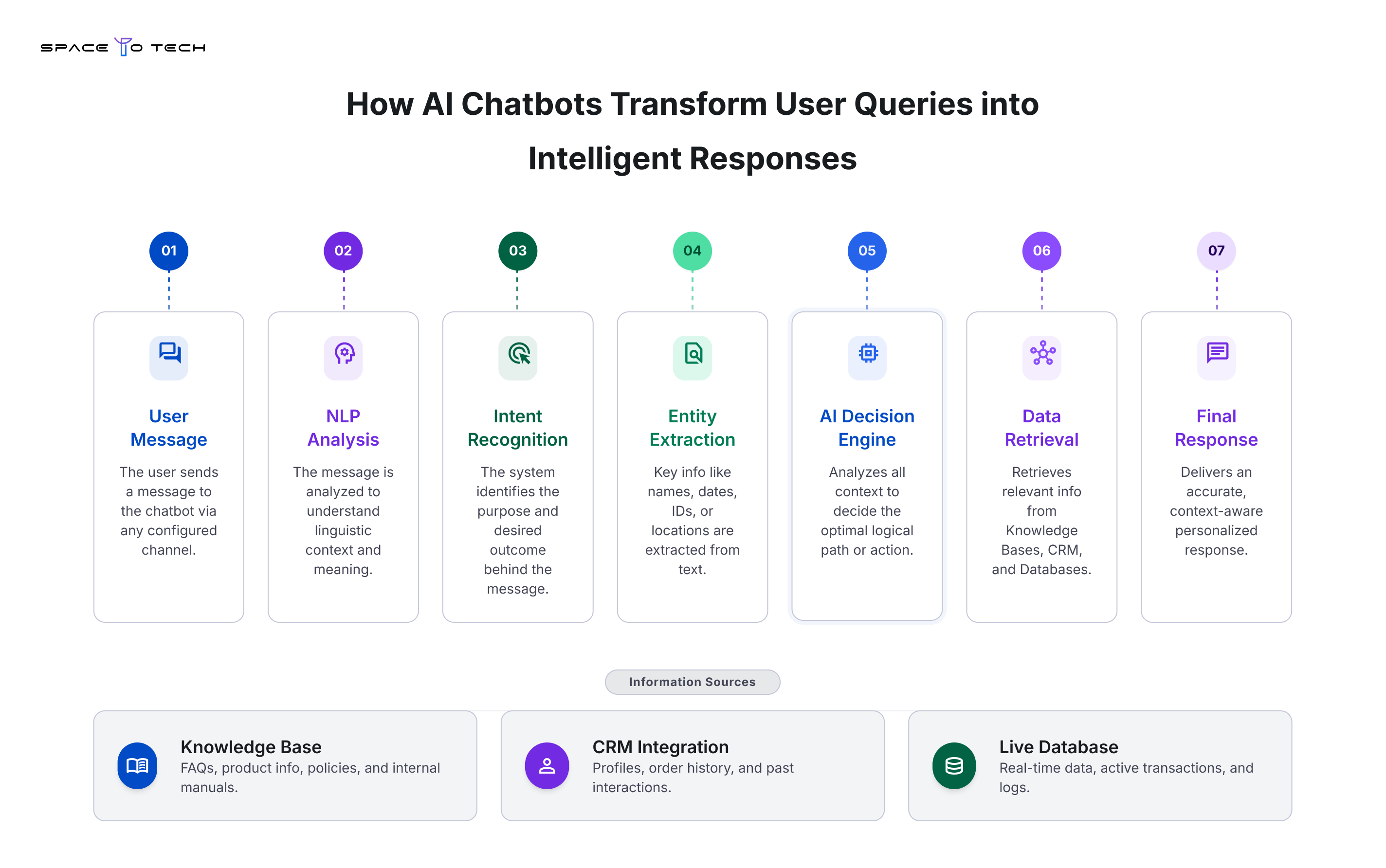
Intent recognition classifies what someone's actually trying to do — book something, check a status, complain — independent of how they phrased it. Entity extraction pulls the structured pieces out of a messy sentence: a date, an account number, a product name. Dialogue management is the memory layer — it's what stops a bot from asking "what's your order number?" for the third time when the user already gave it two messages ago, which is the single fastest way to make someone abandon a conversation. Sentiment analysis catches rising frustration and can trigger an earlier handoff before things go sideways. Named entity recognition (NER) is just the more formal label for entity extraction — you'll see both terms used interchangeably in vendor docs, and it's worth knowing they mean the same thing so you don't get confused mid-vendor-call.
The real shift happening industry-wide right now: traditional NLP routes a user to a predefined answer; an LLM actually writes a new one based on context. Most serious production builds we ship in 2026 use both — structured intent classification for the high-volume, predictable stuff (order status, balance checks, booking flows), and an LLM layer for the open-ended queries that don't fit a script. Pure-LLM bots with no structure underneath tend to drift and hallucinate on exactly the questions where accuracy matters most.
For anything that needs to answer from a specific knowledge base — a policy document, a clinical guideline, a product catalog — we build on Retrieval-Augmented Generation (RAG). The idea is simple even if the engineering isn't: before the model generates anything, the system retrieves the actual relevant source documents and hands them to the model as grounding. That's the single biggest lever against hallucination, and it's the difference between an enterprise client trusting the bot's answers and an enterprise client's legal team shutting the whole project down after one bad response.
Prompt Engineering and Guardrails for Generative AI Chatbots
This is the part of generative chatbot development that gets glossed over in most agency pitches, and it's exactly where production incidents actually happen.
A system prompt is the instruction layer that sits invisibly behind every conversation, defining the bot's persona, its scope, what it should refuse to discuss, and how it should handle uncertainty. A weak system prompt — something like "you are a helpful assistant for [company]" — leaves enormous room for the model to wander into territory the business never intended: competitor comparisons it shouldn't make, pricing commitments it has no authority to make, or tone that doesn't match the brand. A strong system prompt is specific about boundaries, includes explicit instructions for what to do when the model doesn't know an answer (the correct behaviour is almost always "say so and offer a handoff," never "guess confidently"), and gets tested adversarially before launch, not assumed to be sufficient because it reads well.
Jailbreak and prompt injection resistance matters more for a public-facing business chatbot than most teams initially assume. Users will deliberately try to get a chatbot to say something off-brand, leak its system prompt, or behave outside its intended scope — sometimes out of curiosity, sometimes to screenshot it for social media. A production-grade build includes input sanitisation, scope-limiting instructions reinforced at multiple points in the prompt structure, and in higher-risk deployments, a secondary model call that checks the proposed response against policy before it ever reaches the user.
Output validation is the layer most teams skip entirely. Before a generated response reaches the user, it can and should be checked: does it contain a price or commitment the bot isn't authorised to make? Does it reference a competitor by name? Does it match the required tone? For RAG-based systems specifically, does the response actually cite or align with the retrieved source documents, or has the model drifted into a plausible-sounding answer that isn't grounded in anything real? This validation step adds a small amount of latency and a small amount of engineering complexity, and it is the single biggest factor separating chatbots that enterprise legal teams approve from ones that get killed after the first incident.
We build these guardrails into every generative AI chatbot by default now — not as a premium add-on, but because we've seen what happens to the ones that ship without them.
What Actually Makes Conversation Design Good
Most conversation design guides talk about happy paths — the clean, linear flow where the user asks exactly what you expected and the bot answers perfectly. That flow is maybe 40% of real conversations. The other 60% is where good and bad chatbots actually separate.
Designing for ambiguity, not just intent. Real users frequently send a message that could plausibly map to two or three different intents. "I want to cancel" could mean an order, a subscription, or an appointment — and a bot that picks the wrong one confidently is worse than one that asks a clarifying question. Good design builds in disambiguation prompts for exactly the intents most likely to collide, identified during discovery by looking at what the business actually offers, not assumed generically.
Handling correction gracefully. Users change their minds mid-conversation, or the bot mishears something, and need to correct it without restarting from scratch. "No, I meant next Tuesday" should update the previously extracted date entity, not trigger a full reset. This is invisible when it works and infuriating when it doesn't — and it's a clear signal of whether a conversation was actually tested against real usage, or built once and shipped.
Knowing when to stop trying to be clever. There's a temptation, especially with generative AI involved, to have the bot attempt a response to absolutely everything. Sometimes the right call is the bot recognising it's three turns into a conversation going nowhere, and proactively offering a human handoff before the user has to ask — and before frustration builds. The bots with the best CSAT aren't always the ones with the highest resolution rate. They're often the ones that know their own limits early.
Tone consistency under pressure. A persona is easy to maintain in a calm conversation and much harder when a user is angry or trying to bait the bot into an off-brand response. Design needs explicit handling here — de-escalation phrasing, a clear point where escalation becomes mandatory, and consistent tone even under hostile input.
Measuring Whether a Chatbot Is Actually Working
A chatbot nobody measures is a chatbot that quietly degrades for months before anyone notices. These are the metrics we track on every deployment, and what each one tells you that the others don't.
Intent accuracy is the foundational number — the percentage of real messages correctly classified. We test for 90%+ pre-launch, and this needs ongoing monitoring post-launch, because phrasing drift erodes it slowly if nobody retrains against new data.
Fallback rate tracks how often the bot has no confident match. A rising fallback rate over time is usually the earliest sign that user behaviour has shifted or a product change introduced query types the bot never saw in training.
Deflection rate — conversations resolved with zero human involvement — is the number that maps directly to cost savings, and the one we put in front of finance. It needs reading alongside CSAT, though: a bot can technically "deflect" by giving an unsatisfying non-answer the user simply gives up on, which looks great on a dashboard and terrible for the brand.
Handoff rate and handoff quality — not just how often the bot passes to a human, but whether it passes full context so the user isn't starting over. A high handoff rate isn't inherently bad; losing context on handoff is what actually damages the experience.
CSAT specific to bot conversations, tracked separately from overall support CSAT, tells you whether the bot is helping or just present. We've seen overall CSAT stay flat while bot-specific CSAT was quietly terrible — masked by agents compensating for a bot that frustrated people before they ever reached a human.
We build dashboards on all five from day one of any deployment, because waiting until a client asks "is this working?" three months in is too late to fix something that's been compounding since week one.
Industry Use Cases — Where the Requirements Actually Diverge
A healthcare chatbot and a retail chatbot are not the same engineering problem with different branding slapped on. The compliance load, the integration points, and what counts as an acceptable failure are genuinely different by vertical.
Healthcare
Patient intake, preliminary symptom triage, appointment booking, medication reminders, post-discharge follow-up. HIPAA compliance isn't a feature here — it's the whole architecture. That's the specific reason self-hosted Rasa shows up so often in our healthcare work: a third-party API simply can't offer the same data residency guarantee.
Banking & FinTech
Balance queries, fraud alerts, loan eligibility pre-screening, KYC document collection through chat. We build these on JWT-based auth with genuinely strict session handling, because a bot touching financial data is a security surface first and a convenience feature second.
Retail & eCommerce
Product discovery, order tracking, returns, purchase-history-driven recommendations. We've shipped WhatsApp order management for retail clients specifically because that's where their customers already live — meeting people on the channel they're already using beats dragging them to a new web widget.
Enterprise & Internal Tools
HR onboarding, IT helpdesk automation, policy Q&A, scheduling bots on Teams or Slack. SSO and role-based access aren't optional asks here — an internal bot answering a policy question needs to know if it's talking to a manager or a new hire before it answers.
Hospitality
Room booking, concierge requests, check-in/check-out via web or WhatsApp. One of the most underrated wins we've seen: a bot's real value sometimes isn't sophistication, it's just being awake at 2am when the front desk isn't.
Manufacturing
Maintenance alerts, shift scheduling, safety protocol Q&A, vendor comms. We've paired chatbot interfaces with IoT sensor feeds on a couple of projects — the bot becomes the conversational layer over telemetry that would otherwise sit in a dashboard nobody opens until something's already broken.
Customer Support, Across Every Vertical
Tier-1 deflection, ticket creation, live handoff, CSAT capture. The single highest-volume use case for chatbots, period, regardless of industry.
What Chatbot Development Actually Costs
What actually moves these numbers, in rough order of impact: the NLP platform you pick (Rasa costs more upfront in engineering time, nothing in per-conversation fees; Dialogflow or GPT-4o is faster to stand up but the usage costs scale with volume forever). The number of intents and how much training data each one needs — a 15-intent bot and an 80-intent bot are not the same project wearing different price tags. Integration count, and specifically how many different systems with different auth requirements you're touching. Channel count — web-only is cheaper than web-plus-WhatsApp-plus-native-app by a real margin. Compliance overhead, which clients consistently underbudget until it's already a problem. Guardrail and validation engineering for generative builds, which is genuinely new line-item work that didn't exist in most cost estimates two years ago. And maintenance — the line item almost nobody asks about upfront and almost everybody needs six months in.
These ranges come from our own project history across 20+ builds. Anyone quoting you an exact figure before a discovery call is guessing, not estimating.
Customer Support — Where the ROI Math Is Easiest to Defend
Support is the highest-volume use case for chatbots globally, and it's worth its own section because the numbers here are concrete enough to put in front of a CFO without flinching.
The core mechanism: somewhere between 60% and 80% of support tickets are repetitive enough that a properly trained bot resolves them without a human ever touching the conversation. What makes that work in practice — not in theory — is a clean handoff protocol for the conversations the bot genuinely can't close, real multi-language support where the customer base needs it, and a backend that treats web, WhatsApp, and in-app chat as one system rather than three bots awkwardly pretending to be the same thing. The 24/7 piece is almost embarrassingly simple and still underrated: a bot doesn't need a shift schedule, and that alone resolves a meaningful slice of the frustration that shows up whenever someone needs help at 11pm. Tie it into Zendesk, Freshdesk, or Salesforce Service Cloud and it becomes part of the existing support workflow instead of a parallel system agents have to check separately.
Across our retail and SaaS clients, the average ticket deflection rate sits around 65%. That's the number that actually justifies the spend to finance — not "it's AI," but "it resolves two-thirds of tickets before a person gets involved."
Hire Chatbot Developers — What to Look For Before You Engage
By this point in the guide, you know what kind of bot you need, what platform makes sense, and roughly what it costs. The next question is who actually builds it — and how to tell a team that has genuinely done this from one that's about to figure it out on your budget.
On engagement models, three options cover most situations. A fixed-scope project is right when requirements are well-defined and internal bandwidth for managing a build is limited — a full agent development team handles discovery through deployment, you receive a working, documented system at close. A dedicated chatbot developer works when you want close involvement in architectural decisions and the scope will keep growing well past launch. Team augmentation adds a specialist into your existing development team for a defined gap — NLP experience your backend engineers don't have, a specific integration your team hasn't built before.
SpaceToTech's chatbot developers have shipped 20+ production bots across healthcare, banking, and retail. You can review relevant project summaries before engaging — see our services page for details or jump straight to the cost breakdown below to sanity-check budget first.
Custom AI Chatbot Development Services by SpaceToTech
We build NLP and generative AI chatbots for startups, SMBs, and enterprise clients — from a focused WhatsApp ordering bot to a full RAG-powered enterprise assistant. We handle the entire lifecycle, not just the demo-friendly parts.
What that actually looks like in practice: 20+ chatbots shipped into real production environments, not prototypes. Genuine depth across Dialogflow, Rasa, GPT-4, and Gemini, so the platform recommendation follows your problem instead of our preferred stack. Full-stack delivery from conversation design through cloud deployment with no handoff gaps between teams. Deployment experience across WhatsApp, web, mobile, Slack, and Teams. And post-launch training built into the engagement from day one — not something you discover you need and have to negotiate separately three months in.
We've shipped across healthcare, banking, retail, hospitality, manufacturing, and enterprise SaaS — six verticals, six genuinely different sets of technical and compliance requirements, each handled with the domain knowledge that vertical actually demands.