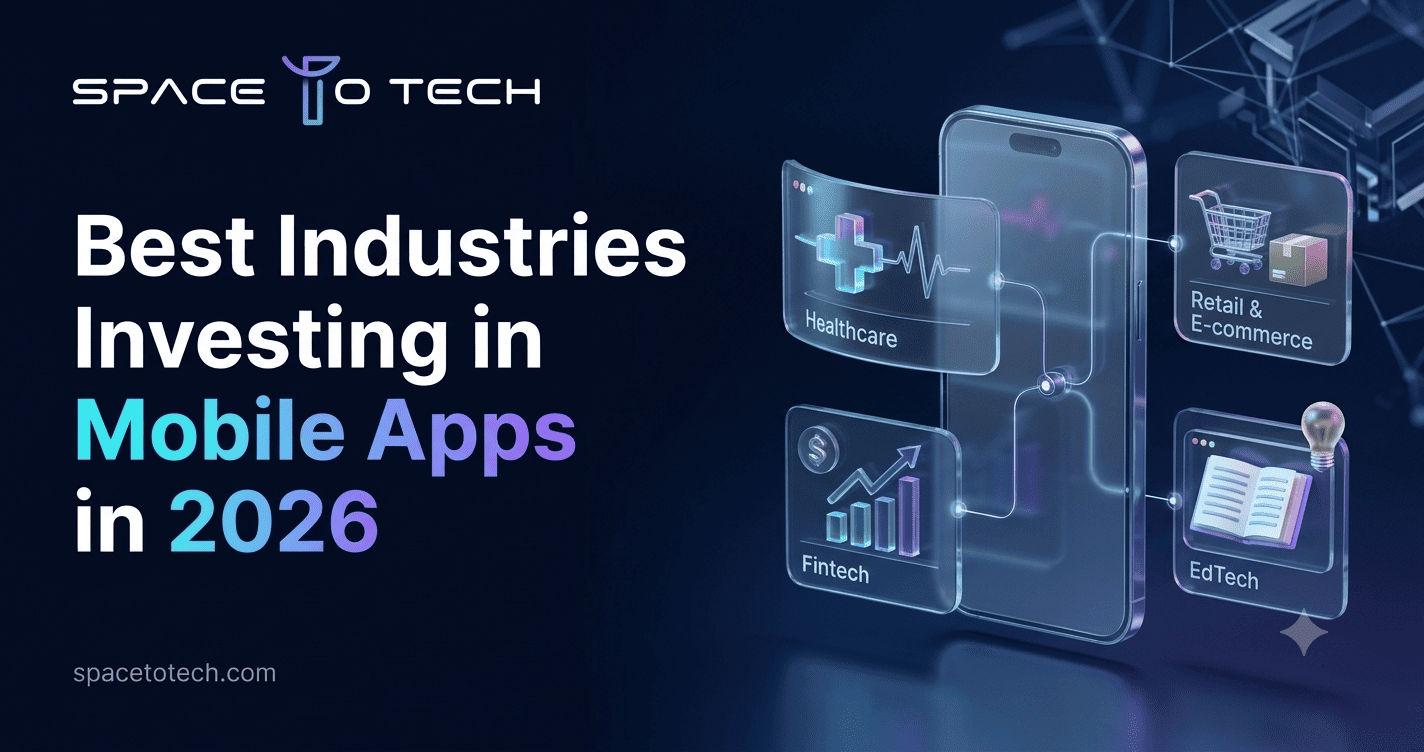
The industries investing most in mobile apps in 2026 are healthcare, retail and e-commerce, banking and fintech, education, travel and hospitality, real estate, and manufacturing and logistics. Each is spending because mobile apps now drive revenue, retention and operational efficiency, not just brand presence.
For business owners, startup founders and CTOs, the question has shifted from whether to build an app to where an app will pay off first. This guide shows where the investment is going, what each industry is building, and how to pick a reliable mobile app development company to build it.
Why Are Businesses Investing in Mobile Apps in 2026?
Businesses invest in mobile apps because customers now expect to do almost everything from a phone, and because apps give companies a direct, data-rich relationship with those customers. The reasons fall into five groups.
Mobile-First Customer Behavior
Most digital time now happens on smartphones, and people expect fast, personalized, always-available service. Apps meet that expectation better than mobile websites. They load faster, work with device features such as cameras, biometrics and GPS, and can stay useful offline.
Revenue, Retention and Direct Relationships
An app gives you owned channels: push notifications, in-app messages and loyalty features. These reduce your dependence on paid ads and third-party marketplaces. App users also tend to return more often and spend more over time than web-only visitors, which raises customer lifetime value.
Operational Efficiency and Automation
Not every app faces customers. Workforce and field apps replace paperwork, capture data in real time and cut manual handoffs. This is where many mid-size companies see the fastest payback.
Technology Enablers Lowering the Barrier
Cross-platform frameworks like Flutter and React Native let one team ship to iOS and Android together. Cloud infrastructure, ready-made APIs and accessible AI tooling mean mobile app development for businesses is no longer limited to large enterprises.
Market Growth and Competitive Pressure
Global app spending keeps growing, and digitally mature competitors are setting a high bar. Falling behind now means losing customers to a smoother experience elsewhere.
Expert tip: when an app makes sense. Build an app when you need repeat engagement, personalization, device features, or secure transactions. If your audience visits once or twice a year, a well-built mobile website may be enough.
Explore our mobile app development services to see how we support businesses at every stage.
Top Industries Investing in Mobile App Development in 2026 (At a Glance)
Healthcare, retail, fintech, education, travel, real estate, and manufacturing and logistics lead mobile app investment in 2026. They share high customer demand, strong digital maturity, clear ROI and, in several cases, regulatory pressure to digitize.
How We Ranked These Industries
We weighed five factors: market growth, digital maturity, customer demand, regulatory drivers and ROI potential. Rankings are directional and based on public industry reports and project experience. Your own sector’s economics will vary.
Industry Comparison Table
| Industry | Typical App Types | Key Features | Main Business Impact | Compliance Load |
| Healthcare | Telemedicine, patient portals | Video visits, e-prescriptions, wearables | Better access, fewer no-shows | High |
| Retail & E-commerce | Shopping, loyalty apps | Personalization, AR, one-tap checkout | Higher conversion and retention | Medium |
| Banking & Fintech | Banking, payments, lending | Biometrics, KYC, fraud alerts | Lower service cost, cross-sell | Very high |
| Education | LMS, microlearning | Gamification, offline mode | Scalable delivery, new revenue | Medium |
| Travel & Hospitality | Booking, guest apps | Mobile check-in, itineraries | Direct bookings, loyalty | Medium |
| Real Estate | Search, CRM, tenant apps | Virtual tours, e-signatures | Faster leads and closings | Low to medium |
| Manufacturing & Logistics | Fleet, warehouse, inspection | IoT, scanning, offline-first | Efficiency and cost savings | Medium |
Emerging Industries to Watch
Insurance, energy, agriculture and media are catching up. Usage-based insurance, smart-grid monitoring and precision farming apps are early signs of the next wave.
Healthcare Industry: Improving Patient Care Through Mobile Apps
Healthcare apps improve access, reduce administrative burden and support better clinical decisions, as long as they are built with privacy first.
Core App Types
The main categories are telemedicine apps, appointment booking and e-prescription tools, patient portals, and remote monitoring apps connected to wearables and IoT devices.
Patient and Provider Benefits
Patients in rural or underserved areas get faster access to care. Providers see fewer missed appointments, less paperwork and quicker access to patient data.
Compliance and Security
Health apps must follow HIPAA, GDPR or regional equivalents. That means encryption, consent management, audit trails, and interoperability with EHR systems through standards like HL7 and FHIR.
Expert tip: Build compliance into the architecture from day one. Retrofitting it later is slower and far more expensive.
What Is Next
Expect AI-assisted triage, mental health and chronic care apps, and personalized wellness driven by connected devices.
Retail and E-commerce: Transforming the Shopping Experience
Retail apps convert better because they make buying faster and more personal.
Why Retail Apps Convert
Saved payment methods, one-tap reorder and push reminders reduce cart abandonment. Shoppers who install a brand’s app usually engage more often than mobile-web visitors.
High-Impact Features
AI-driven recommendations, AR try-on, visual search, wallets and gamified loyalty programs lead the list. Each should tie to a measurable goal, such as basket size or repeat purchase rate.
Omnichannel and Quick Commerce
The strongest apps sync inventory, POS and online stores, and support click-and-collect and in-store navigation. Hyperlocal delivery and live shopping are growing fast, especially in emerging markets.
Mistakes to Avoid
Overloaded first releases, poor performance on low-end devices, weak onboarding and missing analytics are the most common failures.
Banking and Fintech: Driving Digital Financial Services
Financial services lead app investment because customers now expect instant, self-service banking, and the cost savings are substantial.
The Shift to Mobile-First Finance
Neobanks, digital wallets and embedded finance, where non-financial brands offer payments or lending inside their own apps, are reshaping the market.
Key App Categories
These include mobile banking, payments and UPI-style wallets, lending and investing apps, insurtech, and digital KYC onboarding.
Security and Regulation
Biometric login, tokenization and multi-factor authentication are baseline. Depending on your market, you may also need PCI DSS, PSD2, AML/KYC and local central bank rules. Machine-learning fraud detection is increasingly standard. Because the stakes are high, choose a mobile app development company with proven experience in regulated products.
Business Impact and Outlook
Digital channels lower the cost per transaction, enable data-driven cross-selling and extend financial inclusion to underbanked users. Open banking APIs, real-time payments and AI financial assistants are next, while blockchain-based assets remain promising but still maturing.
Education: Expanding Learning Through Mobile Applications
Education apps widen access and make learning more flexible for schools, universities and corporate training teams.
Types of Education Apps
Common types are learning management and virtual classroom apps, language and microlearning apps, and corporate upskilling platforms.
Engagement Features That Work
Gamification, progress tracking, certificates, offline access and AI-based adaptive learning keep learners returning.
Benefits and Challenges
Institutions deliver at scale with lower infrastructure cost, gain learner analytics and open new revenue streams such as subscriptions and cohort courses. The main challenges are device fragmentation, privacy for minors and retention after the first download.
Travel and Hospitality: Enhancing Customer Experiences
Travel apps support the whole guest journey and help brands win back direct bookings.
Pre-Trip: Discovery and Booking
Direct booking engines reduce reliance on online travel agency commissions. Personalized itineraries, dynamic pricing and multi-language, multi-currency support remove friction.
On-Trip: Seamless Experiences
Mobile check-in, digital room keys, real-time updates and concierge chat improve satisfaction while reducing front-desk workload.
Post-Trip: Loyalty and Reviews
Rewards programs, feedback prompts and personalized offers based on travel history turn one-time guests into repeat customers.
Operational Gains
Staff task and housekeeping apps integrated with property management and CRM systems keep teams coordinated.
Real Estate: Simplifying Property Search and Management
PropTech apps speed up discovery, transactions and ongoing property management.
Search and Discovery
Map-based search, saved alerts, virtual tours and AI-powered recommendations help buyers shortlist faster.
Transactions and Lead Management
CRM-connected agent apps, e-signatures, document sharing and mortgage calculators shorten the path to closing. Instant notifications improve lead response times.
Property and Tenant Management
Rent payments, maintenance requests, facility dashboards and community apps for residential projects reduce back-office work.
PropTech Trends
IoT-enabled smart buildings and data-driven valuations are growing. Fractional ownership models are emerging but should be approached with regulatory caution.
Manufacturing and Logistics: Improving Operational Efficiency
These sectors rarely get headlines, but internal and enterprise apps often deliver some of the clearest returns.
Manufacturing Apps
Production monitoring, predictive maintenance through IoT, digital quality inspections and supplier management reduce downtime and errors.
Logistics and Supply Chain Apps
Fleet tracking, route optimization, driver apps, proof of delivery and barcode-based warehouse tools provide real-time visibility.
Integration and Reliability
Good apps connect to ERP, warehouse and transport management systems. Offline-first design is essential for factory floors and remote routes with weak connectivity.
Measurable Gains and Future Direction
Typical wins include lower fuel costs, fewer paperwork errors and faster delivery cycles. Digital twins, AI demand forecasting and sustainability reporting are the next frontier.
How to Choose the Right Mobile App Development Company
The right mobile app development company understands your business goals, has relevant industry experience, communicates openly and supports the product after launch. Work through the five steps below.
1. Define Your Requirements First
Clarify your goals, target users, budget and timeline. Decide whether native, cross-platform or hybrid development fits, and whether to start with an MVP or a full roadmap. Clear requirements make proposals easier to compare, and our guide on how to get an accurate custom mobile app development quote walks through what to prepare.
2. Evaluate Technical and Industry Expertise
Review portfolios and case studies in your sector. Check their tech stack, UI/UX skills and QA process. For healthcare or finance, confirm direct compliance experience. You can start with our own portfolio to see the kind of work we deliver.
3. Assess Process and Transparency
Look for agile delivery, regular sprint reports and direct access to the team. Understand pricing models (fixed price, time and materials, or dedicated team) and confirm IP ownership, NDAs and contract terms in writing. For typical budget ranges by platform and complexity, see our mobile app development cost guide.
4. Check Credibility
Read verified reviews on platforms like Clutch and GoodFirms, and ask for client references. Ask about post-launch support, maintenance and scaling plans, and check whether the team follows the clean code and long-term maintainability practices that keep an app affordable to update. If you are comparing the top mobile app development companies, weigh these factors rather than relying on rankings alone.
5. Watch for Red Flags
Be cautious of vague estimates, no discovery phase, unrealistic timelines, missing testing or security practices, and big promises without relevant examples.
Quick scorecard: rate each shortlisted vendor from 1 to 5 on industry experience, technical depth, communication, security practices, references and post-launch support.
Want to know who is behind this guide? Learn more about Space to Tech.
Key Mobile App Development Trends Businesses Should Watch in 2026
The most important mobile app development trends in 2026 are embedded AI, cross-platform maturity, stricter privacy expectations, connected technologies and more inclusive, sustainable design.
AI and Generative AI Inside Apps
Personalization, chat assistants and predictive features are becoming standard. On-device AI improves speed and privacy, and is already finding uses in health, retail and finance. Our AI development services cover how to add these features to an existing or new app.
Cross-Platform and Super Apps
Flutter, React Native and Kotlin Multiplatform have matured, cutting cost and time to market. Super apps and mini-app ecosystems bundle many services into one experience.
Privacy, Security and Regulation
Zero-trust security, data minimization and tightening app store rules make compliance a competitive advantage, not just a cost.
Immersive and Connected Technologies
AR, IoT, wearables, 5G and edge computing enable real-time experiences. AR for retail and IoT for logistics are practical today, while wider spatial computing is still early.
Sustainability and Accessibility
Energy-efficient design and WCAG-aligned interfaces are rising user and regulatory expectations. Good UI/UX design is the foundation for both.
| Trend | Industries Most Affected |
| Generative AI | Retail, healthcare, fintech |
| Cross-platform / super apps | Fintech, retail, travel |
| Privacy-first design | Healthcare, fintech, education |
| AR / IoT / 5G | Retail, logistics, real estate |
| Accessibility | Education, public services, retail |
Conclusion: Which Industries Should Invest in Mobile Apps in 2026?
Healthcare, retail, fintech, education, travel, real estate and manufacturing and logistics offer the strongest returns from mobile apps in 2026. The common thread is a clear user problem, solid data and a plan to improve after launch.
How to Decide If Your Industry Is Ready
Ask yourself:
- Do customers or staff need frequent, repeat access?
- Do you have data that could power personalization or automation?
- Are competitors already offering a better mobile experience?
- Do you have budget for build and ongoing improvement?
If you answered yes to most, start with a focused MVP, measure real usage, and expand from there.
Next Steps
Partnering with an experienced mobile app development company shortens the path from idea to launch and lowers risk. If you are weighing your options, the Space to Tech team offers a free discovery consultation to map your goals to the right app strategy. Book a free consultation to get started.