How Much Does Mobile App Development Cost in 2026?
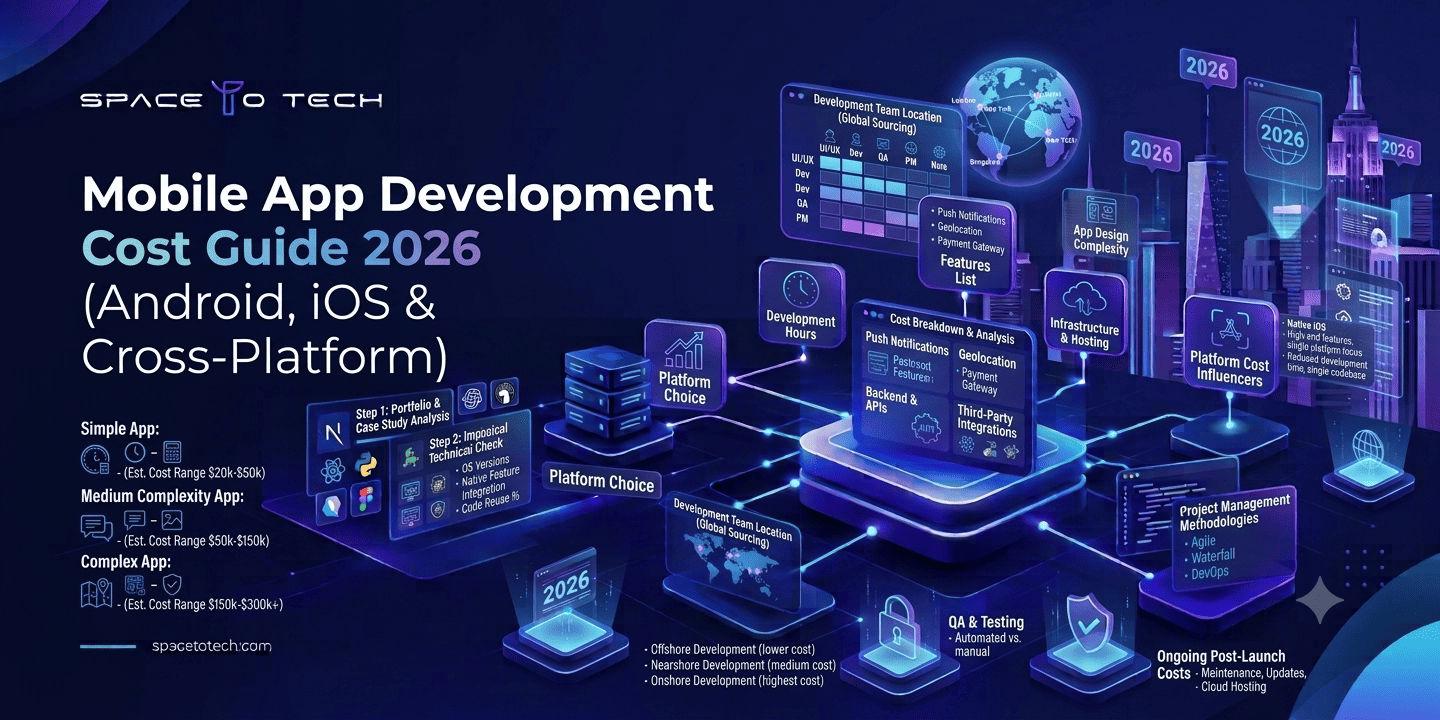
Short answer: A simple app typically costs $10,000-$40,000, a medium-complexity app $40,000-$120,000, and a complex app $120,000-$300,000 or more. Timelines run from 2 to 12+ months.
These figures are indicative market ranges. Quotes vary by scope and vendor.
One number is misleading because scope, platform, region and team model all move the price. Every mobile app development company also prices differently: fixed-price suits well-defined projects, hourly (time-and-materials) suits evolving scope, and a dedicated team suits long-term product work.
Mobile App Development Cost by Platform: Android vs iOS vs Cross-Platform
Your platform choice shapes both budget and reach.
Android app development means building for a wide range of screen sizes and devices, which adds testing time. Developers typically use Kotlin or Java.
iOS development uses Swift and targets a narrower device range, so testing is simpler. Budget extra time for App Store review.
Cross-platform development uses one codebase for both stores. Flutter and React Native are the leading frameworks, and they often reduce cost and time to market compared with two native builds. The trade-off is that highly graphics-intensive or hardware-dependent apps may still need native code.
Tip: Look at your audience geography. iOS dominates spending in the US, while Android leads user share in India.
App Development Cost by Complexity
Simple apps have basic screens, limited features and often no custom backend, such as calculators or brochure-style apps.
Medium apps add custom UI, user accounts, APIs, payments and an admin panel. Most business apps sit here.
Complex apps include real-time features, AI, IoT integration, advanced security and high scalability, such as fintech platforms or marketplaces.
MVP vs full product: Startup founders should consider launching a minimum viable product with core features first. This validates demand before you invest in a full-scale product. An experienced mobile app development partner will help you decide which features belong in version one.
Key Factors That Influence Mobile App Development Cost
- Features and functionality: Login, payments, chat, maps and push notifications each add hours. Payments and real-time chat are among the costliest.
- UI/UX and mobile app design: Custom animations and unique design systems cost more than template-based interfaces, but they improve retention.
- Backend, integrations and security: Third-party APIs, cloud architecture and compliance (GDPR, HIPAA, PCI-DSS) raise both effort and testing.
- Team size, seniority and timeline: A typical project involves a project manager, designer, developers and QA engineers. Rushed deadlines usually carry a premium.
- Tech stack: Popular stacks make hiring easier and reduce long-term risk. Niche stacks can inflate costs.
Expert insight: In our experience at SpaceToTech, uncontrolled scope creep is the most common cause of budget overruns. A written scope document with change-request rules protects both sides.
Cost Breakdown by Development Stage
Custom app development follows a lifecycle, and the budget is distributed roughly like this:
Skipping discovery is a false economy. A solid specification prevents expensive rework later.
Mobile App Development Cost by App Type and Industry
- E-commerce and retail: Product catalogues, payment gateways and inventory sync.
- Fintech and banking: KYC, encryption and regulatory compliance push costs higher.
- Healthcare and telemedicine: Video consultations, HIPAA-grade privacy and secure data storage.
- On-demand, logistics and social apps: Real-time tracking, matching algorithms and scalable infrastructure.
- AI chatbot and enterprise apps: Custom workflows and integrations with internal systems. SpaceToTech builds AI chatbots alongside mobile applications for businesses that want intelligent customer engagement.
Regulated industries such as fintech and healthcare generally cost the most because of compliance and security testing.
App Development Cost by Region: India vs USA vs UK vs Europe
Location is one of the biggest price levers. These are indicative hourly ranges:
The top mobile app development companies in India combine competitive rates with mature delivery processes, but quality varies. Check portfolios, references and verified reviews.
Onshore, offshore or nearshore? Offshore teams offer the lowest rates. Nearshore teams share your time zone. Whichever you choose, confirm IP protection in writing.
Think in terms of total cost of ownership: rework, management overhead and communication gaps can erase a low hourly rate.
Top Mobile App Development Companies: How to Compare Pricing and Choose the Right Partner
Searching for the top mobile app development companies in the world can be overwhelming. Instead of chasing rankings, evaluate each mobile app development agency against clear criteria.
What defines a top app development company
- A relevant portfolio and live apps you can test
- Technical depth across Android, iOS and cross-platform
- Verified client reviews and references
- Process maturity: discovery, agile sprints, QA and post-launch support
Using Clutch and other review platforms
Directories like Clutch publish verified client reviews, hourly-rate ranges and project-size data. When you browse the top mobile app development companies on Clutch, read the detailed reviews rather than only the overall score, and cross-check with other platforms and direct references.
Top mobile app development companies in the USA vs India
The top mobile app development companies in the USA offer proximity, strong product strategy and familiarity with local regulation, at premium rates. Mobile application development companies in India, including Delhi NCR-based SpaceToTech, typically offer lower rates and scalable teams. Neither is automatically better. Choose based on budget, communication needs and project complexity.
Red flags to watch for
- Vague quotes with no feature-level breakdown
- No discovery phase
- No post-launch support or maintenance plan
- Unwillingness to share references
Questions to ask before signing
- Who owns the source code and IP?
- Will you receive full code handover?
- What SLAs cover bug fixes and support?
- Can I speak with past clients?
Hidden and Ongoing Costs
Many founders budget for the build and forget what follows:
- Maintenance and updates: Commonly 15-20% of build cost per year, covering OS updates, bug fixes and security patches.
- Hosting and cloud: Costs grow as your user base grows.
- Third-party APIs and licences: Maps, SMS, payments and analytics often carry usage-based fees.
- App store and compliance fees: Apple's developer programme is $99/year and Google Play has a one-time $25 fee, plus platform commissions on in-app sales. Check current terms before budgeting.
Checklist: Build a first-year budget worksheet covering maintenance, hosting, APIs, store fees and marketing.
How AI Is Changing Mobile App Development Costs in 2026
AI cuts some costs and adds others.
Savings: AI-assisted coding, automated testing and faster prototyping shorten delivery cycles and reduce QA hours.
New costs: Features like chatbots, recommendations and personalisation add development effort plus ongoing LLM API usage fees.
Build vs buy: Pre-trained APIs are faster and cheaper to start with. Custom models cost more but offer differentiation and data control.
Trends to watch: On-device AI, agentic app experiences and low-code acceleration are reshaping how software development teams estimate projects.
How to Reduce App Development Cost Without Compromising Quality
- Start with an MVP. Prioritise features using the MoSCoW method (Must, Should, Could, Won't).
- Choose cross-platform where suitable. A shared codebase can materially reduce build cost.
- Reuse components. Design systems, open-source libraries and SDKs save hours.
- Define scope in writing. Clear documentation prevents costly changes.
- Use milestone-based payments. They tie spending to delivered results.
- Invest in discovery. It lowers rework risk.
- Plan post-launch upfront. Budgeting for maintenance avoids emergency spending.
The right mobile app development partner will advise you honestly on where to cut and where not to.
Conclusion
Mobile app development cost in 2026 is not a single number. It depends on your app's complexity, your platform choice, the features you prioritise, and where your development team is based. Simple apps start around $10,000, while complex, compliance-heavy products can exceed $300,000. Cross-platform frameworks, a well-scoped MVP and a proper discovery phase are the most reliable ways to control spend without cutting quality.
Remember that the build is only the beginning. Budget 15-20% of the initial cost each year for maintenance, hosting, APIs and store fees, and factor in the impact of AI, which can trim development time but add new feature and usage costs.
Just as important is who you build with. Rather than chasing rankings, compare mobile app development companies on portfolio strength, verified reviews, transparent pricing, IP ownership and post-launch support. Whether you are weighing the top mobile app development companies in the USA or in India, the right mobile app development partner is the one that understands your goals and is honest about trade-offs.
Ready to plan your app with clarity? Talk to SpaceToTech's mobile app development team for a free, no-obligation estimate tailored to your project.