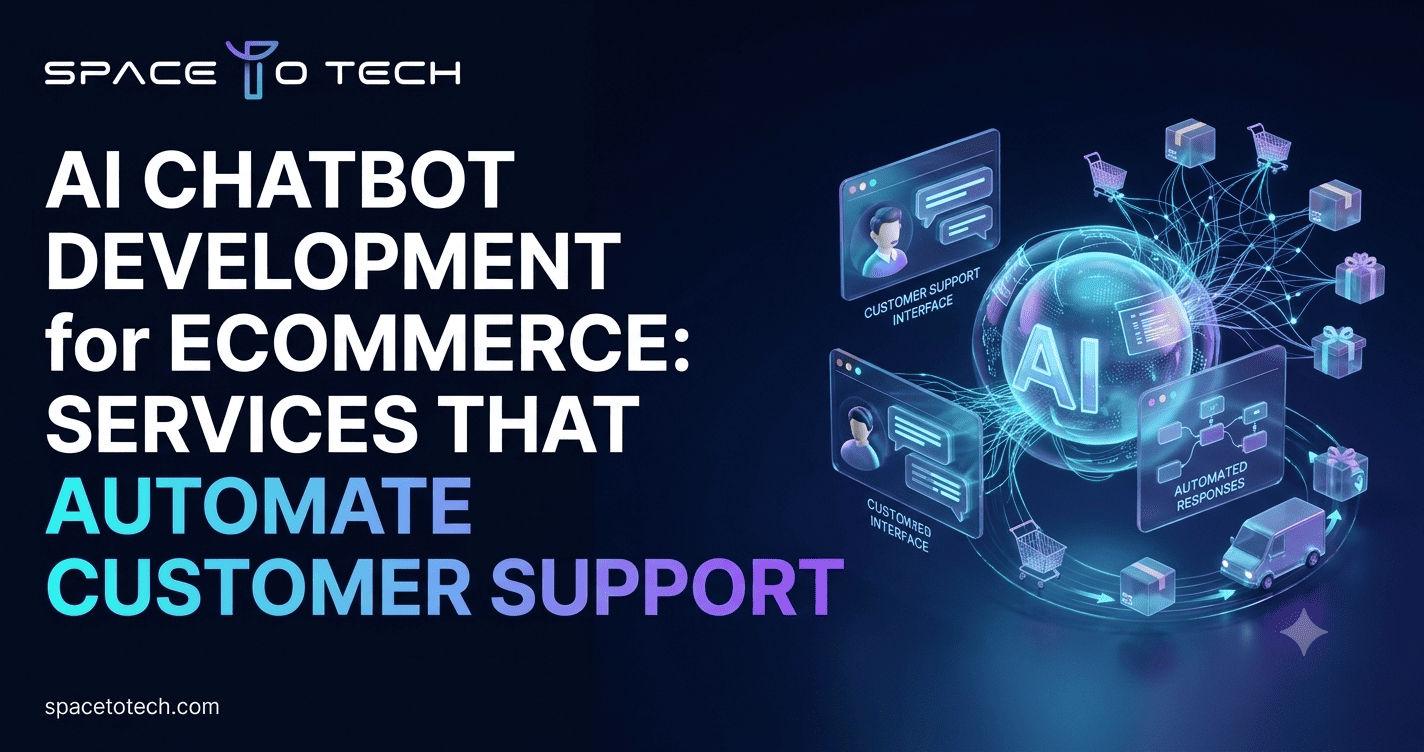
AI chatbot development for ecommerce has moved from an experimental widget to core support infrastructure. Online stores field the same questions all day, such as where an order is, how a return works, or whether a size will fit, and each one competes for a small team’s attention. Buyers searching for a customer support AI chatbot development service for ecommerce usually want three answers: what a modern bot can resolve on its own, what a development partner actually builds, and how to judge whether it will pay back. This guide covers each, from architecture and use cases to partner selection and cost.
Ecommerce Customer Support Automation Starts With Repetitive Demand
Support volume in an online store is rarely random. A small set of intents, including order status, delivery times, returns, payment failures, and product questions, accounts for most conversations, and they arrive in bursts around sales, launches, and holidays. Staffing for the peak is expensive, while staffing for the average leaves customers waiting exactly when they are ready to buy.
Ticket patterns that overwhelm store teams
Start with a helpdesk export. Tag the last few thousand tickets by intent and a handful of categories will usually dominate. Those high-volume, low-complexity requests are the natural scope for an ecommerce customer support automation chatbot, while disputes, damaged goods, and sensitive account issues stay with people. This split keeps the first release narrow enough to launch quickly and measure honestly.
Where manual support breaks down
Response time is the first casualty, since a shopper with a pre-purchase question may not wait hours for an answer. Consistency is the second, because different agents quote different return windows. A well-built bot gives the same policy-accurate answer at any hour and hands over to an agent, with the full conversation attached, when judgment is needed.
How an AI Customer Support Chatbot for Ecommerce Works
A modern support bot is not a decision tree with a chat skin. It combines language understanding, a knowledge layer, and live connections to store systems, and the quality of each determines whether customers get useful answers or polite dead ends. The broader business benefits of AI chatbots are well documented; here the focus is how the pieces fit together in a store. Channels matter too: the same engine can serve your website, WhatsApp, and in-app chat, so customers get consistent support wherever they start.
Language understanding and grounded answers
Large language models let a bot interpret messy, open-ended questions, but unconstrained generation is risky in commerce, where a wrong refund promise has real cost. The usual pattern is retrieval-augmented generation: the bot pulls answers from approved policy pages, product data, and help articles, then phrases them naturally. Guardrails define what it may say, what it must refuse, and when it escalates. Our chatbot development guide compares rule-based, NLP, and generative approaches in more depth.
Integrations that make answers accurate
Knowledge alone cannot tell a customer where their parcel is. Useful bots connect to the commerce platform, order management, shipping carriers, payment gateway, CRM, and helpdesk. With those links in place the bot can look up an order, check return eligibility, and open a ticket with context instead of asking the customer to repeat themselves. Integration scope depends on the APIs available, so confirm it during discovery rather than assuming it.
Customer Support Use Cases Worth Automating First
Not every conversation deserves automation. The strongest candidates are frequent, rule-bound, and easy to verify, and they fall into two groups.
Pre-purchase: product questions and guided discovery
Before checkout, a bot can answer questions on sizing, compatibility, stock, delivery estimates, and promotions, and recommend products based on stated needs. This conversation happens at the moment of intent, so quality matters more than volume: a good answer removes a barrier, while a vague one costs a sale. Connect the bot to live catalog and inventory data so it never suggests something out of stock. Teams building a branded shopping app can reuse the same assistant inside it, and our ecommerce mobile app development practice treats chat as one layer of the wider customer experience.
Post-purchase: tracking, returns, and refunds
After checkout, the highest-volume request is almost always order status, followed by returns, exchanges, address changes, and refund timelines. Each has a clear policy and a system of record, which makes them ideal for automation. Our WhatsApp ordering chatbot for Domino’s shows how one conversational thread can cover browsing, secure payment, real-time delivery tracking, and loyalty rewards. Escalate damage claims, repeated failures, and upset customers straight to a human.
A reliable handoff is part of the design, not a fallback. The agent should see the customer’s question, order details, and what the bot already tried, so the conversation continues instead of restarting.
Mapping your own ticket data to chatbot use cases? Share your top support categories with SpaceToTech and we will outline what is worth automating. Book a scoping call |
What Ecommerce AI Chatbot Development Services Include
Ecommerce AI chatbot development services should cover the full lifecycle, not just a model plugged into a chat window. A credible engagement moves through the stages below, and a vendor that skips discovery or testing is a warning sign.
Discovery, conversation design, and knowledge preparation
Discovery defines goals, channels, target intents, and how success will be measured. Conversation design then maps flows, tone, fallback replies, and the exact moment a human takes over. Knowledge preparation, the least glamorous step, cleans up policies, FAQs, and product data, because a bot can only be as accurate as the content behind it.
Build, integration, testing, and launch
Engineers select the model and architecture, connect commerce and helpdesk systems, and set access controls so the bot sees only what it needs. Testing covers intents, edge cases, security, and realistic conversation transcripts before anything goes live. After launch, teams review failed intents and customer feedback, then refine flows, prompts, and knowledge content. At SpaceToTech this runs as a six-step process, with integrations for Shopify, WooCommerce, WhatsApp, Slack, and major CRMs.
Model choice is part of the service too. We work with OpenAI GPT, Google Gemini, Claude, and Dialogflow, and compare them against response quality, data sensitivity, speed, and budget before recommending one.
Want to see the approach in detail? Review our service page for architecture options, integrations, and timelines. Explore AI chatbot development services |
Custom AI Chatbot for an Online Store vs Off-the-Shelf Tools
Plenty of helpdesk and commerce platforms ship a chatbot module, so the honest question is when a custom build is worth it. Neither route is always right.
| Factor | Off-the-shelf chatbot | Custom AI chatbot |
| Setup speed | Fast, template-based | Longer, built around your workflows |
| Brand voice | Limited tone controls | Tuned to your brand and policies |
| Integrations | Prebuilt connectors only | Any system with an API |
| Data control | Vendor-defined | Defined by your architecture |
| Running cost | Predictable subscription | Build cost plus maintenance |
When a ready-made platform is enough
If your catalog is small, your policies are simple, and your stack is mainstream, a template-based bot can deliver quick wins at low cost. Start there if you are still learning which questions customers actually ask.
When custom development pays off
Custom work becomes attractive when you need deep order-system integration, multilingual support, strict data handling, a distinctive brand voice, or actions beyond answering questions, such as starting a return or updating a record. A bot that can act, often called an AI agent, may justify the larger scope; one that only answers questions is usually the simpler and cheaper choice. Whichever route you take, insist on exportable conversation data so you can switch later, and pilot on one channel before committing to a full rollout.
How to Evaluate an AI Chatbot Development Partner
Choosing a partner is closer to choosing an engineering team than buying software. Our guide to the best custom software development companies lists the broader criteria for vetting any vendor; the points below are specific to chatbots.
Technical and security criteria
Ask how the vendor prevents wrong or invented answers, how access to customer data is limited, and how conversations are encrypted and stored. Check experience with your commerce platform and your market’s privacy rules, and confirm who owns the code, prompts, and training content once the project ends.
Questions to ask before you sign
Request examples of live chatbots, not only demos. Ask how success was measured, what happened when a bot failed, and how the team handles model changes after launch. Clear, specific answers signal experience, while vague promises and unrealistic timelines do not. Verified reviews and references from comparable ecommerce clients help here too.
Ask for a discovery phase with defined deliverables. A scoping stage that produces intent maps, an integration plan, and success metrics predicts delivery better than a polished sales deck, because it forces both sides to agree on scope before development starts. Finally, check post-launch support terms for monitoring, retraining, and response times, because the first month of live conversations always surfaces gaps that testing missed.
Cost, Timeline, and ROI of AI Chatbot Development for Ecommerce
Cost depends on features, model choice, integrations, data preparation, security, hosting, and support. As an indicative guide, SpaceToTech’s published ranges run from roughly $2,500 to $5,000 for a basic rule-based bot, $7,500 to $15,000 for a generative AI bot, and $20,000 to $50,000 or more for enterprise builds, with timelines from a few weeks to several months. Third-party API, cloud, and messaging fees are usually separate, and timelines stretch when data is messy or approvals are slow. For wider budgeting context, see our ecommerce app development cost breakdown.
Metrics that prove the investment
Define success before launch. Useful measures include the share of conversations resolved without an agent, first-response time, satisfaction on bot conversations, escalation rate, and the effect on conversion for pre-purchase chats. Compare them with a pre-launch baseline and review monthly. Actual savings depend on your ticket volume and use case, so treat any vendor’s headline percentages cautiously. Also budget for ongoing work: knowledge updates when policies change, prompt and flow refinements, and monitoring of model or API changes. A bot that is never maintained slowly drifts out of date, and customers notice before dashboards do.
Getting Started With AI Chatbot Development for Ecommerce
The most reliable path is narrow and measurable: pick two or three high-volume intents, connect the systems that hold the answers, launch to a portion of traffic, and expand as the data justifies it. AI chatbot development for ecommerce rewards teams that treat the bot as a product to improve, not a feature to ship once. Review results after thirty days, then decide what to automate next.
AI chatbot development for ecommerce pays off when it starts narrow and stays measurable. Automate the repetitive, rule-bound requests first, ground every answer in approved policies and live order data, and keep people in charge of disputes and sensitive cases. Choose a development partner on discovery rigor, security practices, and ownership terms, not on demo polish. Then track resolution rate, escalation rate, and customer satisfaction against your pre-launch baseline, and expand only where the data justifies it. Handled this way, the bot becomes a dependable part of your support operation rather than a one-time feature.