E-commerce
Mobile App Development Company in USA

If you need an ecommerce mobile app development company that understands how US shoppers browse, compare and pay on their phones, SpaceToTech is built for that work. We design and develop Android and iOS shopping apps for retailers, D2C brands, marketplaces and enterprises, with fast product search, a simple checkout, order tracking and secure payments. Our custom ecommerce app development team also builds the backend APIs and admin dashboard, so your catalog, inventory and orders stay in sync as you grow. As a software and app development company with a focused mobile team, we also offer wider mobile app development services whenever your roadmap goes beyond ecommerce. Tell us what you want to sell and we will share a clear scope, milestones and estimate.
Ecommerce mobile app development — shopping app with cart and product cards
Trusted by global brands
  • 50+Experts
  • 150+Projects Delivered
  • 5+Year Experience
  • 10+Countries Served
  • 24/7Support

Ecommerce App Development Services for US Businesses

Custom ecommerce app development desk with laptop, mobile app, shopping cart and US flag

Custom Ecommerce App Development

We plan and build custom ecommerce apps around your business model and workflows. That covers architecture, product catalogs, checkout flows, payment integration and admin dashboards, delivered by the same engineers behind our custom application software development services.

Ecommerce App Types and Business Models We Build

Every store sells differently, so we shape the app around your catalog, buyers and operations instead of forcing a template. We build ecommerce apps for retail and shopping, fashion, grocery, beauty, electronics, furniture, food, B2B and wholesale, D2C brands, multi-vendor marketplaces and enterprise commerce.

B2C ecommerce

Consumer shopping apps with customer accounts, search, wishlists and quick checkout.

Ready to Build Your Ecommerce Mobile App in the USA?

Looking for an ecommerce mobile app development company in the USA? Tell us about your business goals, target audience, and required features. We'll recommend the right approach and provide an indicative development estimate.

Ecommerce mobile app development — customer with fashion shopping app

AI and Omnichannel Ecommerce Capabilities

Where it fits your roadmap, we add practical AI features through our AI development services: product recommendations, personalization based on browsing and purchase history, and AI chatbots that answer shopper questions around the clock. We can also connect your store to WhatsApp and other messaging channels.

Our omnichannel integrations link your app, website and messaging channels, so inventory, pricing and customer data stay consistent wherever shoppers meet you. That makes it easier to run promotions, coupons, loyalty programs and order updates from one place. We keep every feature practical, and we do not add AI where it does not help the shopper.

AI and omnichannel ecommerce — laptop, robot assistant, and retail channels

Why Choose SpaceToTech for Ecommerce App Development

We focus on the parts of an ecommerce app that decide whether a shopper completes a purchase: speed, clarity and trust. Every project follows a milestone-based plan, so you always know what is being built and when.

Category views, search, quick checkout and wishlists tailored to your brand and buyers.

SpaceToTech team collaborating on ecommerce app discovery

Payment Integration, Third-Party Systems and Ecommerce Security

Checkout is where revenue is won or lost, so we integrate payments carefully. Your business decides how customers pay, so we integrate the payment gateway you choose. Popular options include Stripe, PayPal, Braintree and Square, with wallets such as Apple Pay and Google Pay, and we test every payment and order flow before release. Beyond payments, we integrate shipping and logistics services, CRM and ERP systems, analytics tools and other third-party APIs, so orders, stock and customer records move automatically.

Secure authentication and role-based access for customers, sellers and admins

Secure authentication and role-based access for customers, sellers and admins.

Encrypted connections with SSL/TLS across the app and backend

Encrypted connections with SSL/TLS across the app and backend.

Tokenization so sensitive card data stays with your payment provider

Tokenization so sensitive card data stays with your payment provider.

Fraud prevention rules and transaction validation at checkout

Fraud prevention rules and transaction validation at checkout.

Our Ecommerce App Development Process

Our step-by-step approach takes your e-commerce project from concept to store launch with clear deliverables and a stable, scalable process at every stage.

Discovery &
Requirement Mapping

STEP01

We begin by understanding your business goals, target users, product categories, and operational workflow. This phase ensures your app supports the right features from day one and avoids unnecessary complexity. We also define milestones and measurable deliverables before development starts.

UI/UX & Customer
Journey Optimization

STEP02

Our team designs the user journey to reduce friction across the shopping funnel. We map search, browse, product view, cart, checkout, and post-purchase flows to improve usability. This helps increase conversions, reduce cart abandonment, and improve repeat purchase behavior.

Development, Testing
& Quality Assurance

STEP03

We develop the app with a performance-first mindset—fast browsing, stable checkout, and clean architecture. Testing includes functional checks, edge-case handling, and payment/order validation to avoid costly bugs. We also ensure the app remains stable on a wide range of devices.

Launch, Monitoring &
Growth Support

STEP04

We support release planning, app store readiness, and stable deployment. After launch, we help with monitoring, bug fixes, and enhancements based on real user behavior. This long-term approach keeps your e-commerce app competitive as your business scales.

Ecommerce Mobile App Development for Key Business Use Cases

These are the use cases we build for most often:

Custom store apps

A branded shopping app with search, cart and checkout for retailers and D2C brands.

Multi-vendor marketplaces

Seller panels, onboarding, commissions and payouts in one app.

Inventory & Order Management

Sync stock, process orders, and track updates across all channels.

Loyalty, coupons and rewards

Points, coupons and rewards that bring shoppers back.

Order tracking

Live status, notifications and simple returns after purchase.

B2B ordering

Bulk orders, custom pricing and approval workflows for business buyers.

Is Your eCommerce Platform Ready to Scale? Powering Your Business for What's Next

As your business grows, we build scalable eCommerce platforms that streamline operations, simplify management, and help you achieve sustainable growth.

Is Your eCommerce Platform Ready to Scale? Powering Your Business for What's Next — Talk to Our eCommerce Experts

Ecommerce App Development Cost (What Affects Pricing)

Ecommerce app development cost depends on feature scope, the number of platforms, backend and admin requirements, integrations, marketplace complexity, design and scale. Catalog size, user roles (customer, seller, admin), payment and shipping connections and loyalty features all move the number. For a deeper breakdown, read our guide to ecommerce app development cost in 2026.

After a short requirement discussion, we share an estimate with milestones so you can budget with confidence and launch the most important features first.

Typical Cost Factors & Pricing

Single-platform

(Android or iOS)
$8,000 – $18,000+

Core features (catalog, cart, checkout, payments, basic admin).

Multi-platform

(Android & iOS)
$14,000 – $30,000+

Shared codebase (React Native), consistent UI/UX, dual platform optimization.

Custom Backend/Admin Dashboard

$4,000 – $15,000+

Inventory, orders, role management, reporting.

Multi-vendor Marketplace Features

$6,000 – $20,000+

Seller panels, onboarding, commission, payouts, chat.

Advanced Integrations

(payment, shipping, ERP)
$2,000 – $8,000+per integration

Payment gateways, shipping APIs, ERP and CRM systems.

Loyalty, Rewards & Analytics Modules

$2,000 – $7,000+

Points systems, insights dashboards, purchase analytics.

Note: These figures are ballpark—your quote is tailored to your requirements, design, and scale. After a discovery session, you'll receive a milestone-based quote for clear budget and feature planning.

Browse our portfolio to see the mobile products we have delivered, including SipPay, a payments app built around financial workflows and security, and BeuSalon, a booking and service marketplace app built around customer workflows and notifications.

Clutch 5.0 rating

Recognized. Trusted. Preferred

Awards & Recognition

We are proud to be recognized by leading platforms and industry experts for our innovation, impact, and excellence

TopDevelopers

TopDevelopers

Top Mobile App Developers

Freelancer

Freelancer

Top Mobile App Developers

AppFutura

AppFutura

Top Mobile App Developers

GoodFirms

GoodFirms

Top Mobile App Development

Clutch

Clutch

Top Mobile App Developers

Excellence isn't claimed.It's recognized

These achievements reflect our commitment to
delivering world-class AI solutions that help
businesses grow and lead

Ecommerce App Development FAQs

Don't find the answer? We can help

What is ecommerce app development?
Ecommerce app development is the process of building mobile apps that let customers browse products, pay securely and track orders. It also includes the backend, APIs and admin tools that manage your catalog, inventory and orders.
Do you provide ecommerce app development services in USA?
Yes. We build ecommerce apps for US retailers, D2C brands, startups and enterprises, with milestone-based delivery and regular progress updates from kickoff to launch.
Do you build both Android and iOS ecommerce apps?
Yes. We build for both platforms, using native development or a cross-platform framework such as React Native or Flutter, depending on your features, budget and timeline.
Can you build a custom ecommerce mobile app for my business?
Yes. Every custom ecommerce app is planned around your business model, catalog, user roles and integrations, so you are never limited by a template.
How do you estimate ecommerce app development cost?
We estimate cost after a short requirement discussion, based on platforms, features, backend needs, integrations and design depth. You receive a milestone-based quote instead of a vague range.
Do you provide ongoing support and maintenance after launch?
Yes. Post-launch support covers bug fixes, OS compatibility updates, performance monitoring and new features as your business grows.
What types of ecommerce apps can you build?
We build apps for retail and shopping, fashion, grocery, beauty, electronics, furniture and food businesses, plus B2B and wholesale, D2C, multi-vendor marketplace and enterprise ecommerce, all customized to your requirements.
Can you migrate an existing ecommerce store to a mobile app?
Yes. We can build a mobile app on top of your existing store, using APIs to bring over your catalog, customers and orders without rebuilding your website.
Which ecommerce platforms can you build or integrate with?
We work with the platform your business already uses, such as Shopify, WooCommerce, Adobe Commerce (Magento) or BigCommerce, or build a custom backend if you need more control.
Can you integrate payment gateways and third-party ecommerce systems?
Yes. We integrate the gateway you choose, such as Stripe, PayPal, Braintree or Square, plus wallets like Apple Pay and Google Pay. We also connect shipping and logistics services, CRM and ERP systems, analytics tools and other third-party APIs.
Can you add AI personalization or product recommendations to an ecommerce app?
Yes. We can add AI recommendations, personalization and AI chatbots, plus WhatsApp and other omnichannel integrations, based on your catalog and customer data.
Should I build a native or cross-platform ecommerce app?
For most ecommerce apps, a cross-platform build with Flutter or React Native is the faster and more budget-friendly route. Native makes sense for heavy AR, advanced graphics or deep device features. Read our guide to cross-platform mobile app development for a closer comparison.
How long does ecommerce app development take?
Timelines depend on your features, platforms, integrations and design depth. After discovery, we share a milestone-based plan so you know when each stage will be ready.
Can you build a multi-vendor ecommerce marketplace?
Yes. We build marketplaces with buyer, seller and admin panels, vendor management, commissions and payouts.

Ecommerce App Resources

Ecommerce App Development Cost
Blogs11/02/2026

How Much Does It Cost to Build an Ecommerce App in 2026?

The global ecommerce market is projected to reach $8.1 trillion by 2026 , and mobile commerce already accounts for more than 61% of all online sales. That means if your business doesn’t have a powerful mobile ecommerce app, you are leaving massive revenue on the table. But here’s the million-dollar question sometimes literally how much does it cost to build an ecommerce app in 2026 ? Most business owners enter ecommerce app development with a rough idea of budget, only to face unexpected expenses, shifting timelines, and rising development costs. Without a clear understanding of pricing, many projects stall halfway or get launched with compromised quality. This guide will give you complete clarity. You will learn exactly how ecommerce app development cost is calculated, what features increase or reduce cost, which hidden expenses most companies miss, and how to optimize your investment without sacrificing performance or security. You’ll also see how Space To Tech, a leading Ecommerce App Development Company, helps businesses across 28+ industries build profitable ecommerce apps within budget. Ecommerce App Development: Quick Cost Overview Let’s get straight to the numbers. In 2026, ecommerce app development cost ranges between $20,000 and $300,000+, depending on what you are building. A basic ecommerce app with simple shopping and checkout features costs between $20,000 and $50,000 and usually takes 2 to 4 months. A medium-complexity ecommerce app with real-time tracking, multiple payment gateways, and analytics costs $50,000 to $120,000 and requires 4 to 6 months. An advanced or enterprise ecommerce app with AI recommendations, multi-vendor systems, loyalty programs, and automation can cost $120,000 to $300,000+ and take 6 to 12 months or more. The wide range exists because every ecommerce business has different needs. In 2026, with 187 billion shopping app downloads expected and app conversions being three times higher than mobile websites, investing correctly is critical. The real cost to build an ecommerce app depends on what you want your app to achieve. Cost Factor 1: App Complexity & Feature Set Features are the biggest driver of ecommerce app development cost. The more functionality your app has, the more development, testing, and backend work is required. A basic ecommerce app costing $20,000 to $50,000 includes a product catalog, basic search, shopping cart, login system, standard checkout, one payment gateway, order history, push notifications, and a simple admin panel. These apps typically take 8–16 weeks to build and are ideal for small stores or startups. A medium-complexity ecommerce app costs $50,000 to $120,000 and includes advanced search, wishlists, reviews, multiple payment gateways, real-time order tracking, coupons, analytics dashboards, multi-language support, and chat features. These apps usually require 16–24 weeks . An enterprise-level ecommerce app, costing $120,000 to $300,000+, includes AI recommendations, AR product previews, voice search, live shopping, loyalty programs, CRM integration, fraud detection, subscriptions, and dynamic pricing. These apps take 24–48 weeks or more. This level is chosen by brands looking to dominate their market. Ecommerce App Development Cost Breakdown by Phase When businesses ask how much does an ecommerce app cost , most vendors quote a single number. But understanding the ecommerce mobile app development cost properly means understanding how that budget is distributed across each phase of the project. At Space To Tech, we break every project into five structured phases, and each phase carries a defined share of the total cost to build ecommerce app . Here is how the budget typically splits across a medium-complexity ecommerce mobile app development project:  Development Phase  % of Total Budget  Cost Range (Medium App)  What's Included Discovery & Requirement Planning 8–12%  $4,000–$14,400 Scope, tech stack, wireframe brief, project roadmap UI/UX Design  15–20%  $7,500–$24,000 User journeys, wireframes, prototypes, usability testing Frontend & Backend Development  40–50%  $20,000–$60,000 All coding, APIs, database, admin panel, integrations Testing & Quality Assurance  10–15%  $5,000–$18,000 Functional, performance, security, device testing Deployment & App Store Launch  5–10%  $2,500–$12,000 App store submission, staging, production setup Key insight: Development alone (frontend + backend) consumes nearly half of your total ecommerce app development cost . This is why cutting corners in developer selection — choosing inexperienced teams to save money — often results in rebuilds that cost far more than getting it right the first time. Understanding this phase distribution helps you evaluate vendor quotes intelligently. If a vendor's proposal allocates less than 10% to testing, or skips the discovery phase entirely, that is a red flag — not a saving. Space To Tech follows a structured phased delivery model across all ecommerce app development projects, ensuring every rupee or dollar of your ecommerce mobile app development cost is accounted for with full transparency. Cost Factor 2: PWA vs Native vs Cross-Platform Ecommerce App: Full Cost Comparison Platform selection is one of the most important early decisions in ecommerce mobile app development cost planning. In 2026, businesses have four main options — Native iOS, Native Android, Cross-Platform (Flutter/React Native), and Progressive Web Apps (PWA). Each carries very different cost, performance, and strategic implications.    Native iOS  Native Android  Cross-Platform (Flutter/RN)  PWA  Cost Range  $25K–$150K  $20K–$150K  $20K–$120K  $10K–$50K  Development Time  3–9 months  3–9 months  2–7 months  1–4 months  Performance  Best  Best  Very Good  Good  Cost vs Cross-platform  30–40% higher  30–40% higher  Baseline  50–60% lower  App Store Presence  Yes (Apple)  Yes (Google)  Yes (both)  No store listing  Offline Capability  Full  Full  Full  Limited  Best For Premium iOS-first brands Android-heavy markets Startups & growing brands Budget MVPs, web-first Which platform offers the lowest ecommerce app cost? PWAs deliver the lowest ecommerce app cost upfront — but they come with trade-offs: no native app store presence, limited push notifications on iOS, and reduced offline capability. For businesses targeting India and Southeast Asia where Android dominates, a cross-platform build using Flutter reduces cost to build ecommerce app by 30–40% compared to native, without a significant performance penalty. Space To Tech recommends cross-platform development (Flutter or React Native) for most startups and growing brands because it delivers the best balance of ecommerce mobile app development cost , speed to market, and long-term maintainability. We help you choose the right stack based on your target market, budget, and growth roadmap. Cost to Develop a Retailer Ordering App in 2026 One of the fastest-growing segments of mobile commerce is the B2B retailer ordering app — and understanding the cost to develop a retailer ordering app in 2026 requires looking at a very different feature set than a standard consumer ecommerce app. A retailer ordering app is designed for wholesale buyers, distributors, and trade customers — not end consumers. These apps handle bulk purchases, tiered pricing structures, SKU-based catalogs, and complex business workflows that standard ecommerce platforms are not built for. As a result, the cost to develop a retailer ordering app sits in its own pricing tier. What Makes a Retailer Ordering App Different? A retailer or B2B ordering app typically requires the following features that add development complexity: Bulk order management — customers add products in case quantities, not single units Tiered trade pricing — different price levels for different retailer accounts or order volumes MOQ (Minimum Order Quantity) rules per product or category Account-based catalogs — not all retailers see the same product range Credit limit management and net payment terms (Net 30, Net 60) ERP and inventory system integration (SAP, Tally, Zoho Inventory, etc.) Repeat order / reorder functionality for fast-moving SKUs Sales representative dashboard to manage assigned accounts PDF invoice and dispatch note generation Cost to Develop a Retailer Ordering App: Price Ranges for 2026  App Type  Cost Range  Timeline  Best For Basic Retailer Ordering App  $35,000–$55,000 3–5 months Small distributors, single-region, standard catalog Mid-Complexity B2B Ordering App  $55,000–$85,000 4–7 months Multi-branch distributors, tiered pricing, ERP integration Enterprise Retailer Platform  $85,000–$150,000+  7–12 months National distributors, multi-region, custom approval workflows Why is the cost to develop a retailer ordering app higher than a basic consumer app? Because the business logic is significantly more complex. You are not just displaying products and processing a checkout — you are replicating an entire trade relationship digitally. Account-specific pricing, credit terms, approval chains, and ERP sync all require custom backend engineering that adds both development time and testing effort. Space To Tech has built retailer ordering apps for distributors and wholesale businesses across FMCG, industrial, and fashion sectors. If you are looking for an accurate cost to develop a retailer ordering app in 2026 for your specific requirements, contact us for a detailed project estimate. Cost Factor 3: Design & User Experience Investment Design is not decoration it directly impacts sales. A well-designed ecommerce app can increase conversions and retention by 30–50% , making it one of the most valuable investments. Template-based designs cost $3,000 to $8,000 and are quick but generic. Custom UI/UX design ranges from $10,000 to $30,000 , including branding, user research, wireframes, and usability testing. Premium ecommerce design with animations, AR, and testing can exceed $60,000 . More screens, custom graphics, animations, and accessibility features all increase ecommerce app development cost , but they also improve customer experience and revenue. Cost Factor 4: Backend Development & Infrastructure The backend typically consumes 35–45% of the total ecommerce app development cost. It powers everything payments, inventory, orders, users, and data. Server setup, APIs, and databases cost $5,000 to $20,000. Admin panels for managing products, orders, customers, and analytics cost $8,000 to $25,000. Third-party integrations like payment gateways, shipping APIs, CRM, email, SMS, and analytics can add $5,000 to $30,000+. After launch, monthly infrastructure costs range from $50 to $5,000+, depending on traffic and scale. Monolithic vs Headless Ecommerce Architecture: Cost Difference A decision that significantly impacts ecommerce mobile app development cost — but is often overlooked at the planning stage — is your choice of architecture: monolithic or headless. This is especially relevant for brands planning omnichannel commerce, where the same product catalog, pricing engine, and customer data needs to power a mobile app, a web store, a tablet POS, and potentially a voice commerce interface. Monolithic Ecommerce Architecture In a monolithic ecommerce setup, the frontend (what users see) and the backend (data, business logic, APIs) are tightly coupled into a single system. Platforms like WooCommerce or traditional Magento installations follow this model. Lower upfront ecommerce app development cost: $20,000–$80,000 Faster initial development and simpler deployment Easier to maintain for small teams Limited scalability — changes to backend often require frontend rebuilds Difficult to expand to new channels (app, kiosk, voice) without significant redevelopment Headless Ecommerce Architecture In a headless setup, the backend (API layer, commerce engine) is completely decoupled from any frontend. Your mobile app, website, and any other touchpoint all connect to the same backend via APIs. This is the preferred architecture for brands planning serious ecommerce mobile app development at scale. Higher upfront cost: adds $15,000–$40,000 to total ecommerce app development cost Full flexibility to launch new channels without rebuilding the backend Superior performance — frontend loads independently from backend Future-proof for AI personalization, voice commerce, and IoT integrations Preferred by enterprise brands running multi-region or multi-storefront operations  Factor  Monolithic  Headless Upfront Cost Impact  Baseline  +$15,000–$40,000 Time to Market  Faster (weeks shorter) Slightly longer initial build Scalability  Limited — rebuild required High — add channels without redevelopment Best For  Small stores, single channel Growing brands, omnichannel, enterprise 3-Year TCO  Often higher (rebuilds) Lower despite higher upfront cost The key insight: headless architecture costs more upfront but almost always costs less over 3 years because it eliminates expensive rebuilds when you want to scale. If your ecommerce app cost budget is $60,000 or above and you plan to grow, headless is worth the additional investment. Cost Factor 5: How Much Do AI Features Add to Ecommerce Mobile App Development Cost? In 2026, AI-powered features have moved from 'enterprise-only' to mainstream in ecommerce app development. Understanding how each AI feature impacts ecommerce mobile app development cost helps you prioritize which capabilities to build in Phase 1 versus add later. Below is a breakdown of the most in-demand AI features and their individual cost impact on total ecommerce app development cost :  AI Feature  Added Cos  Timeline Impact  Business Value AI Product Recommendations  +$8,000–$20,000  +3–6 weeks Increases average order value by 15–30% AI-Powered Search (semantic/visual)  +$5,000–$15,000  +2–4 weeks Reduces search abandonment, improves conversion AI Chatbot / Shopping Assistant  +$6,000–$18,000  +3–5 weeks 24/7 support, reduces cart abandonment Visual Search (camera-based)  +$10,000–$25,000  +4–8 weeks Strong for fashion, furniture, home decor Inventory Forecasting AI +$8,000–$20,000  +3–5 weeks Reduces overstock/stockout by up to 30% Dynamic Pricing Engine  +$12,000–$30,000  +4–8 weeks Real-time price optimization based on demand Fraud Detection AI  +$5,000–$15,000  +2–4 weeks Reduces chargebacks, protects revenue Should you add AI features to your ecommerce app? For most businesses, the answer is: start with AI product recommendations and AI-powered search. These two features deliver the highest ROI relative to their additional ecommerce app cost — typically paying back the investment within 6–12 months through higher conversions and larger average order values. Space To Tech builds AI features natively into ecommerce apps — not as bolted-on plugins that break at scale. If you want a detailed estimate of how AI additions will affect your ecommerce mobile app development cost , share your project scope and we will provide a feature-by-feature cost breakdown. Cost Factor 6: Security & Compliance Requirements Security is non-negotiable. Data breaches cost businesses an average of $4.45 million , according to IBM. SSL, encryption, secure payments, PCI compliance, and GDPR features add $10,000 to $40,000 to ecommerce app development cost. Enterprise apps may also need fraud detection, biometric login, DDoS protection, and penetration testing. Skipping security might reduce upfront cost but it creates massive long-term risk. Cost Factor 7: Development Team Location & Structure Location dramatically affects pricing. In 2026, US developers charge $150–$250/hour, while Western Europe ranges from $80–$200/hour. Eastern Europe is $40–$100/hour, and India ranges from $25–$60/hour. A medium ecommerce app might cost $150,000+ in the US but $40,000–$80,000 in India. Space To Tech operates from India with global quality standards, helping businesses save 50–60% without compromising results. Development Team Composition and Role-Wise Cost Breakdown Beyond location, the composition of your development team is a major driver of ecommerce mobile app development cost . A properly staffed project requires more than just developers. Here is the typical team structure for a medium-complexity ecommerce app development project and how each role contributes to the final cost:  Role  Est. Hours (Medium App)  India Rate/hr  US Rate/hr  Cost (India)  Cost (US) Project Manager 80–120 hrs  $25–$40  $120–$180 $2,000–$4,800  $9,600–$21,600 UI/UX Designer 100–160 hrs  $20–$35  $80–$150 $2,000–$5,600  $8,000–$24,000 Frontend Developer 200–320 hrs  $25–$50  $100–$200 $5,000–$16,000 $20,000-$64,000 Backend Developer 240–380 hrs  $30–$55  $120–$220 $7,200–$20,900 $28,800–$83,600 QA / Test Engineer 80–120 hrs  $18–$35 $80–$150  $1,440–$4,200  $6,400–$18,000 DevOps Engineer 40–80 hrs  $30–$50 $120–$200  $1,200–$4,000  $4,800–$16,000  TOTAL (approx.) 740–1,180 hrs  -  - $18,840–$55,500 $77,600-$227,200 This is exactly why India-based ecommerce app development with a company like Space To Tech delivers 50–60% cost savings over equivalent US or Western European agencies — same roles, same skill levels, significantly lower ecommerce mobile app development cost . When evaluating vendors, always ask for the team composition behind their quote. A suspiciously low ecommerce app cost often means a skeleton team with one developer covering multiple roles — leading to longer timelines, higher error rates, and expensive post-launch fixes. Hidden Costs That Most Businesses Miss Beyond development, annual maintenance costs 15–20% of the build price. OS updates, security patches, feature updates, and hosting add $18,000–$70,000+ per year. Marketing, ASO, paid installs, customer support tools, testing devices, and subscriptions further increase the total cost to build ecommerce app. Always add a 25–30% buffer to your budget. Real-World Cost Examples An Amazon-style marketplace costs $200,000–$500,000+. A fashion retail app costs $80,000–$150,000. A grocery delivery app costs $100,000–$200,000. A simple ecommerce store costs $25,000–$50,000. Smart Ways to Reduce Ecommerce App Development Costs Start with an MVP to cut costs by 30–40% . Use Flutter or React Native to save another 30–40% . Use third-party tools instead of custom features to save $10,000–$30,000 . Offshore development to companies like Space To Tech to save 50–60% . Never cut corners on security, UX, or quality. Businesses that integrate AI features such as personalized product recommendations or fraud detection should also consult an AI Development Company to understand how AI layer costs fit within the overall development budget. Choosing the Right Ecommerce App Development Company Your development partner determines your success. A top Ecommerce App Development Company offers ecommerce expertise, modern tech, transparent pricing, strong UI/UX, and post-launch support. If your ecommerce platform is Android-first or targets Android-heavy markets, working with a specialist Android app development company ensures the app is built with the right architecture, testing depth, and device coverage from day one Space To Tech combines all of this with 28+ industries of experience and startup-friendly pricing. Conclusion In 2026, ecommerce app development cost ranges from $20,000 to $300,000+ , depending on complexity, design, platform, security, and your development partner. Ready to build your ecommerce app? Contact Space To Tech for a free consultation and detailed cost estimate. Let’s turn your idea into a profitable ecommerce app.


Hire Ecommerce App Developers
Blogs22/09/2026

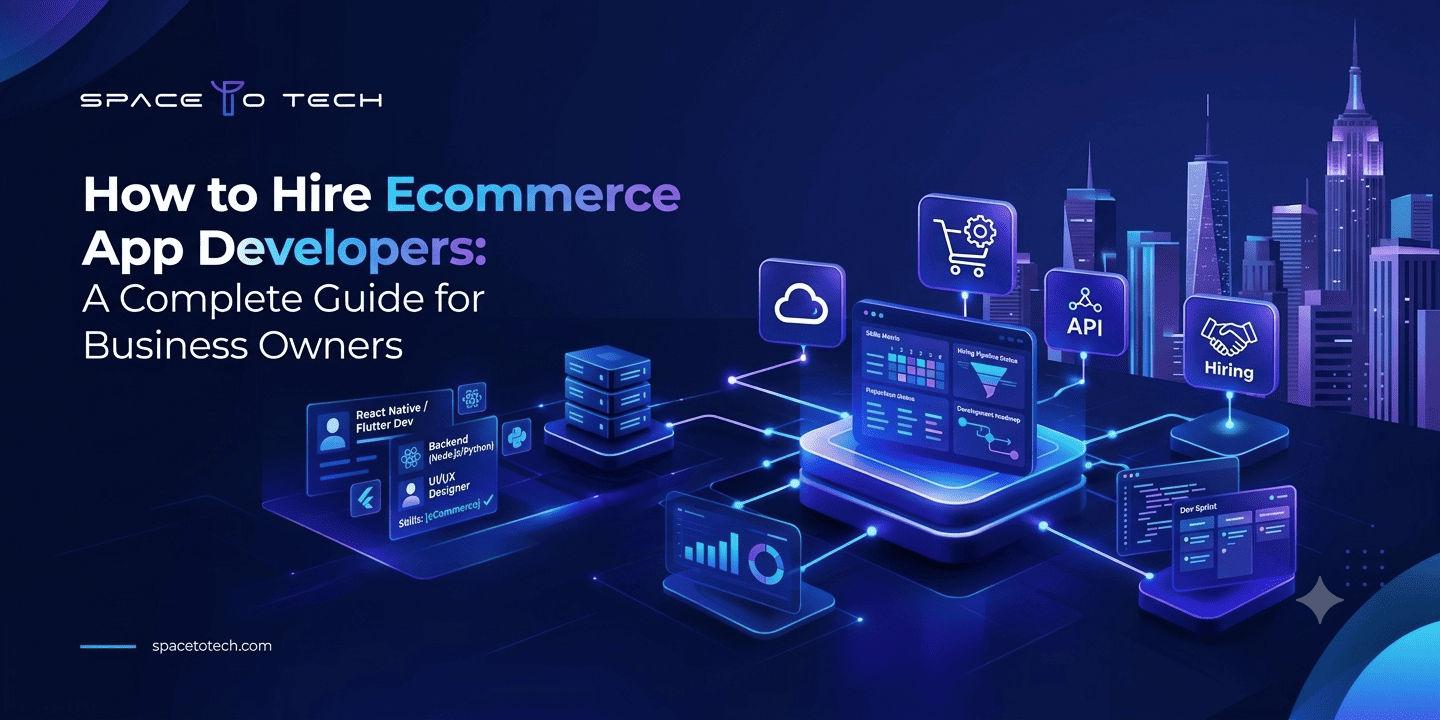
How to Hire Ecommerce App Developers: A Complete Guide for Business Owners

Hire Ecommerce App Developers: What You Need to Know If you're planning to hire ecommerce app developers , it helps to understand why this hire is different from a standard app developer role. Ecommerce apps carry business logic that general-purpose apps don't: cart and checkout flows, payment orchestration, catalog and inventory architecture, and integrations with ERPs, CRMs, and shipping providers. A developer who's never touched commerce logic will spend weeks relearning what a specialist already knows. A capable ecommerce app team typically spans the full stack — mobile developers, backend engineers, QA specialists, and UX/UI designers — working together across frontend, backend, APIs, and third-party integrations. The stakes are real. App performance and UX are directly tied to conversion rates; a slow checkout or clunky navigation can quietly bleed revenue every day it goes unfixed. Hiring the wrong developer often means missed deadlines, mounting technical debt, and security gaps that surface only after launch. That's the core case for specialists over generalists whenever commerce-specific features are involved. Hire Ecommerce App Developers in 10 Days or Less Urgency is common in this space — a competitor launches a feature, a seasonal sale is looming, or a platform migration can't wait. Rapid hiring is realistic when you use staff-augmentation models or a pre-vetted talent pool that skips the usual recruitment cycle. A typical 10-day timeline looks like: discovery call → shortlist → technical vetting → contract → kickoff. A development partner like Space to Tech compresses this by maintaining vetted talent on standby rather than sourcing from scratch each time. To move that fast, come prepared with a project brief, must-have features, and success metrics; your tech stack preferences or existing platform constraints (Shopify, Magento, custom-built); and access, credentials, brand assets, and stakeholder availability so kickoff isn't delayed by internal logistics. What Can Ecommerce App Developers Build for You? Once you decide to hire ecommerce developers , it's worth knowing the full range of what's buildable. Core app types include native shopping apps for iOS and Android, Progressive Web Apps (PWAs) for lighter-weight reach, multi-vendor marketplace apps, B2B ordering and wholesale platforms, and headless commerce storefronts for omnichannel flexibility. Beyond the basics, revenue-driving features separate good apps from great ones: AI-powered product recommendations and personalization, AR/VR try-on and visual search, one-click checkout with saved payments and loyalty programs, and push notifications paired with abandoned-cart recovery flows. A fashion brand might prioritize AR try-on and personalization; a grocery app leans on speed and hyperlocal delivery logistics; a B2B platform needs tiered pricing and bulk ordering. The right feature set follows the business model, not the other way around. Top Skills & Technologies Ecommerce App Developers Must Master Technical credibility matters when you're vetting talent. On the frontend and backend, look for fluency in cross-platform frameworks like React Native and Flutter, or native Swift/Kotlin when performance demands it. On the backend, headless commerce tools such as Node.js, Shopify Hydrogen, commercetools, and Medusa are increasingly standard, built around API-first architecture that supports scalability and clean third-party integrations. Security and integrations are just as important as the visible features. That includes payment gateway integrations (Stripe, PayPal, Razorpay) with multi-currency support, PIM/ERP/CRM integrations for inventory and order sync, and PCI-DSS compliance alongside encryption and secure authentication. An ecommerce mobile app developer who can't speak to these isn't ready for a production-grade build. Industries Leveraging Ecommerce App Developers The demand for specialized ecommerce talent spans well beyond fashion retail. Fashion and D2C brands use apps to scale personalized shopping experiences. Grocery and quick-commerce platforms are built around speed and hyperlocal delivery. B2B wholesale and distribution businesses need apps that handle complex, tiered pricing. Healthcare and pharmacy retail apps carry compliance-heavy requirements that most generalist developers aren't equipped to navigate. Each vertical brings its own SKU and inventory complexity, along with regulatory and data-privacy considerations — healthcare and finance-adjacent retail especially. The right developer understands not just the code, but the constraints of your specific industry. Why Hire Ecommerce App Developers? The business case for outsourcing or augmenting with specialized talent comes down to speed, scale, and cost. Pre-built commerce components mean faster time-to-market. A properly architected app scales through flash sales and seasonal traffic spikes without buckling. And total cost of ownership is often lower than building an in-house team from zero. The risks of a DIY or in-house-only approach are equally real: talent gaps in niche commerce technologies, an ongoing maintenance burden without dedicated expertise, and slower iteration speed compared to a specialized partner who's solved these problems before. That said, in-house hiring still makes sense for businesses with long-term, high-volume development needs and the budget to sustain a full internal team. How to Hire Ecommerce App Developers (Step-by-Step) This is the core of the decision. Start by defining your scope and engagement model — fixed-price, dedicated team, or staff augmentation each carry different trade-offs — and decide whether you need an MVP or a full-feature roadmap out of the gate. Next, vet for technical and domain expertise specifically. Review ecommerce-specific portfolio work and ask for live app demos, not just screenshots. Run technical assessments built around commerce logic — checkout flows, inventory sync — rather than generic coding tests. Always check client references and ask about post-launch support history. Before committing, protect yourself with a few best practices: get NDAs and IP-ownership clauses signed before sharing sensitive business details, run a paid trial sprint before a long-term commitment, and set a clear communication cadence and reporting structure from day one. Watch for red flags like vague timelines, reluctance to share references, or resistance to IP-ownership terms. Where to Hire Ecommerce App Developers There are three main routes, each suited to different needs. Dedicated ecommerce app development companies offer full-stack teams, clear accountability, and long-term support — best suited for complex, scalable, or enterprise-grade apps. Freelance marketplaces (Toptal, Fiverr, Upwork) offer cost advantages for small, well-defined scopes, but come with trade-offs in reliability, coordination overhead, and limited long-term support. In-house hiring makes sense when the higher fixed cost is justified by long-term ownership and the value of institutional knowledge staying inside the company.  Model  Cost  Speed  Control  Scalability  Agency  Medium-High  Fast  Medium  High  Freelancer  Low  Variable  High  Low  In-House High   Slow to start  Full  Depends on team size How Much Does It Cost to Hire Ecommerce App Developers? Cost varies by several factors: regional rate differences (US/UK vs. Eastern Europe vs. South Asia), the complexity of the app and number of features, integration needs, and the engagement model itself — hourly, fixed-price, or dedicated team all price out differently. As a rough guide, an MVP ecommerce app typically costs less than a full-feature app, and both fall well below an enterprise-grade platform with custom integrations. Ongoing maintenance and support after launch should be budgeted separately — it's rarely a one-time cost. These figures are estimates; actual pricing depends on your specific scope, so request a custom quote before finalizing a budget. Choosing the Right Ecommerce App Development Company When comparing an ecommerce app development company , evaluate them on a proven portfolio specifically in ecommerce — not just general app work — post-launch support, SLAs, and maintenance packages, and how well their technology stack aligns with your existing systems. Before signing anything, ask who owns the source code and IP after project completion, what the scalability and upgrade roadmap looks like, and how timelines, revisions, and communication will be handled throughout the engagement. Clear answers here upfront prevent costly disputes later. Hire Ecommerce App Developers Who Deliver Real Results To recap: define your scope and engagement model before you start searching for talent, vet specifically for ecommerce expertise rather than general development skill, and compare agencies, freelancers, and in-house options against your actual budget and timeline. If you're ready to move forward, Space to Tech can help you hire ecommerce app developers in as little as 10 days, backed by a track record of reliable, results-driven builds. Book a free consultation or request a project quote to get started.

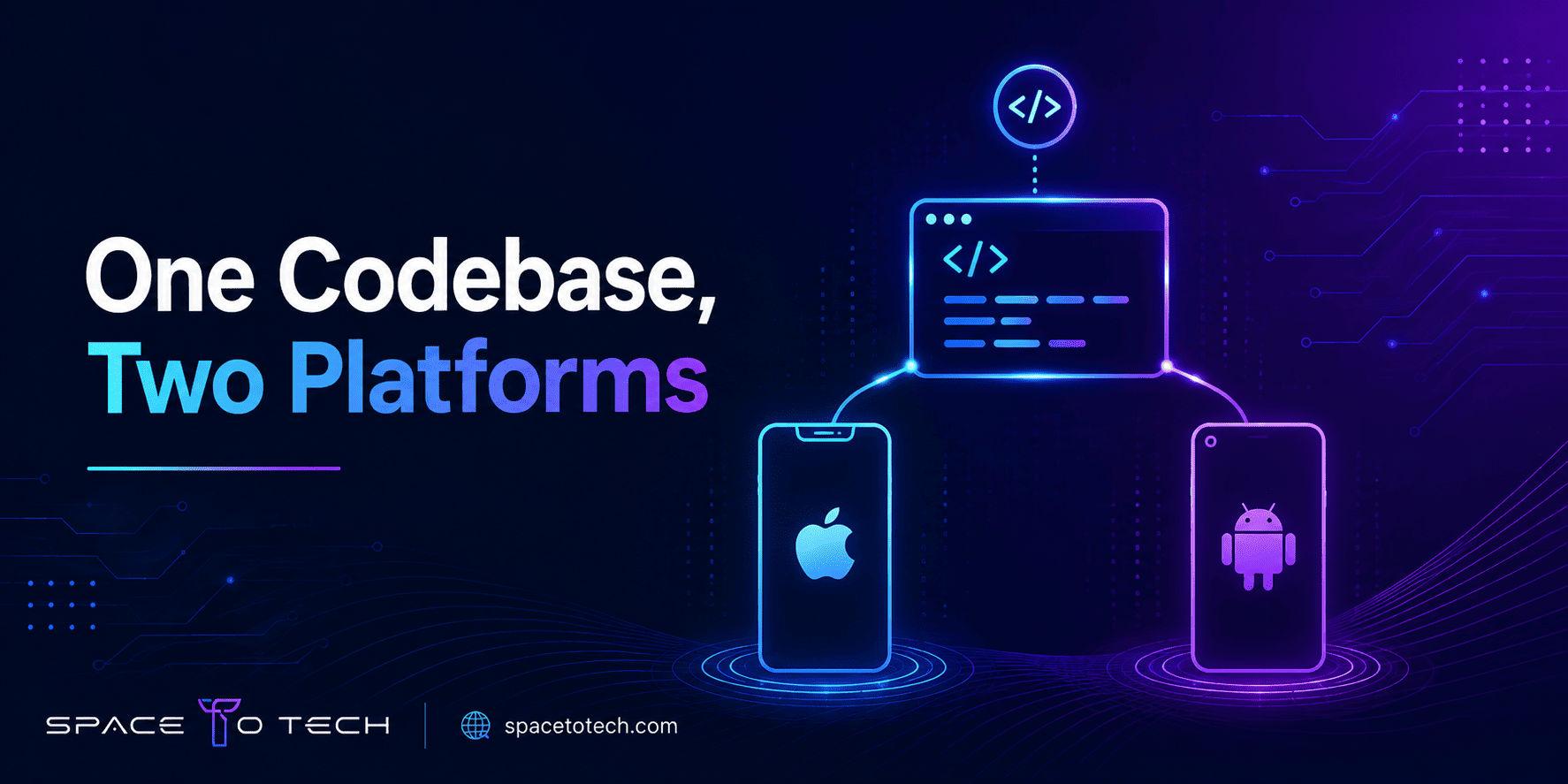
Dark background graphic illustrating cross platform mobile app development connecting iOS and Android through a shared codebase, with SpaceToTech logo and website URL
Blogs20/08/2026

Cross-Platform Mobile App Development: Benefits, Costs & When to Use It

If your product needs to run on both iOS and Android, you don't necessarily need two completely separate applications. Cross-platform development allows businesses to build for both platforms from a shared codebase, but that doesn't automatically make it the right choice for every product. This guide explains when cross platform mobile app development makes sense, where it falls short, what it actually costs, and how to choose between the leading frameworks. Rather than repeating the usual claim that cross-platform is simply cheaper and faster, we'll walk through the decision itself, so you can judge whether it fits your product, your timeline, and your budget. What Is Cross-Platform Mobile App Development? Cross platform mobile app development is the practice of building a single application that runs on both iOS and Android using one primary codebase, instead of writing separate native applications for each operating system. A cross-platform framework sits between your shared code and each device's operating system. It translates your application logic into components that work on both platforms, while still allowing developers to write platform-specific code where a feature genuinely needs it, such as camera access, push notifications, or biometric authentication. This is different from fully native development, where iOS and Android apps are built independently, each with its own codebase, its own team workflow, and its own release cycle. With cross platform app development, most of the business logic, UI structure, and application flow is written once and shared. Only the pieces that require deep platform-specific behavior are handled separately. The result is a single application experience that adapts to each operating system, without requiring two parallel engineering efforts for every feature you ship. If you're weighing this approach against a fully native build, our mobile app development services team can walk through your product requirements before you commit to a framework. How Does Cross-Platform App Development Work? Understanding the mechanics helps explain both the advantages and the limitations covered later in this guide. Shared Codebase Most of the application, including business logic, navigation, state management, and a large share of the UI, is written once in a language such as JavaScript, TypeScript, or Dart, depending on the framework. This shared layer typically accounts for the majority of the codebase across both platforms. Platform-Specific Components Certain features still need platform-specific handling. This includes deep OS integrations, custom animations that follow platform design guidelines, and hardware-dependent functionality. Cross-platform frameworks allow developers to write these components separately when the shared layer isn't sufficient. APIs, Plugins, and Native Integrations Cross-platform apps connect to backend systems, third-party services, and device hardware through APIs and plugins. Popular frameworks maintain large plugin ecosystems for common needs like maps, payments, and analytics, though less common integrations may require custom native modules. Testing Across iOS and Android Even with a shared codebase, an app still needs to be tested independently on both operating systems. Screen sizes, OS versions, gesture behavior, and performance characteristics differ enough that testing cannot be skipped simply because the code is shared. Cross-Platform vs Native App Development: What's the Difference? Neither approach is universally better. The right one depends on your product's requirements.  Factor  Cross-Platform  Native  Codebase  Shared  Separate  iOS + Android  Yes  Separate development  Development effort  Usually lower  Usually higher  Time to market  Often faster  Usually longer  Platform-specific control  Moderate to high  Highest  Performance  Strong for most business apps  Best for highly specialized apps  Maintenance  Centralized for much of the code  Separate platform maintenance  Advanced hardware access  Depends on framework  Strongest  Best suited for  Most standard business and product apps  Highly specialized apps Cross-platform development is not always cheaper, and native development is not always faster. The gap between the two narrows or widens depending on how complex your feature set is and how much platform-specific work your product actually requires. Should Your Business Choose Cross-Platform Development? This is the question that matters more than the technology itself.  Business or Product Type  Cross-Platform Fit Why  Startup MVP  Strong Validate the product across platforms without maintaining two separate codebases  SaaS or mobile product  Strong Shared product logic and faster iteration  E-commerce  Strong Most standard commerce functionality works well cross-platform  Internal business app  Strong Cost and maintenance efficiency often matter more than platform-specific optimization  Customer portal  Strong Standard workflows are generally suitable  API-driven application  Strong Shared application logic works well  Enterprise application  Depends Architecture, security, and integrations need evaluation  Gaming  Depends or low Performance and graphics requirements matter  AR or VR Often better with specialized or native approaches Hardware and graphics requirements Hardware-heavy application  Depends or low Native APIs may be critical  Cutting-edge OS feature  Native may be preferable Immediate platform-specific support can matter If your product depends heavily on graphics rendering, real-time hardware access, or being first to support a brand-new OS feature, native development deserves serious consideration before you commit to a cross-platform approach. Cross-Platform App Development Use Cases Beyond the general decision framework, it helps to see how cross-platform development plays out across specific, common product types. Startup MVPs: launching on both platforms at once helps validate demand without committing to two full engineering tracks before product-market fit is confirmed. SaaS applications: shared business logic keeps feature releases synchronized across iOS and Android as the product evolves. E-commerce apps: catalog browsing, cart, checkout, and account flows are largely standard functionality that performs well cross-platform. Marketplace apps: buyer and seller-facing features can be built once and refined in parallel across both platforms. On-demand apps: booking, tracking, and notification-driven workflows are well supported by mainstream cross-platform plugin ecosystems. Internal business applications: cost efficiency and centralized maintenance usually matter more than platform-specific polish for internal tools. Customer portals: account management, document access, and support workflows follow standard UI patterns that translate well across platforms. Booking applications: scheduling, calendar sync, and payment integrations are commonly available through existing cross-platform libraries. Across these use cases, the common thread is that the product relies on standard business logic and common device features rather than deep, platform-specific engineering. That is precisely where cross-platform development delivers the most value. Why Choose Cross-Platform Mobile App Development? For products that fit the profile above, cross-platform development offers several practical advantages. One Codebase for Multiple Platforms Writing the core application once reduces duplicated engineering effort across iOS and Android. Faster Time to Market Shared development work often shortens the path from concept to launch, which matters for startups and product teams working toward a specific release window. Lower Development Effort Fewer parallel workstreams generally mean less coordination overhead between platform-specific teams. Easier Maintenance Bug fixes, updates, and new features can often be built once and deployed to both platforms, rather than repeated twice. Consistent Product Experience A shared codebase makes it easier to keep core functionality, business logic, and UI patterns aligned across iOS and Android. Better Fit for MVPs and Startups Teams validating a new product benefit from reaching both platforms without committing to two full engineering tracks before product-market fit is confirmed. Easier Iteration as the Product Evolves Feature changes and experiments can be rolled out to both platforms in parallel, which supports faster iteration cycles. What Are the Limitations of Cross-Platform App Development? A balanced view means being upfront about where this approach struggles. Performance can lag behind native apps for graphics-intensive or highly interactive features. Complex native functionality sometimes still requires custom platform-specific code, reducing the code-sharing benefit. Platform-specific UX conventions can be harder to replicate perfectly across both operating systems. Third-party dependency problems arise when a plugin lags behind the latest iOS or Android release. Plugin limitations can force custom development for less common integrations. Framework updates sometimes introduce breaking changes that require migration work. Debugging across platforms can be more complex than debugging a single native codebase. Specialized hardware access, such as advanced sensors or custom chipsets, may need native modules. Advanced graphics and animation-heavy interfaces often perform better with native development. The question isn't whether cross-platform development is better than native development. The right choice depends on what the application actually needs to do. How Much Does Cross-Platform App Development Cost? Cross-platform development affects cost, but not simply because it involves fewer platforms. Several factors shape the actual budget. Shared codebase efficiency: the more logic that can be genuinely shared, the more development effort is saved. Number of platforms: targeting both iOS and Android from one codebase reduces duplicated build work compared with two native apps. Feature complexity: advanced features generally cost more regardless of the development approach chosen. Native integrations: apps requiring custom native modules add development time that offsets some of the cross-platform savings. UI and UX design: platform-specific design adjustments still require dedicated design and development effort. Backend development: server-side architecture, APIs, and data infrastructure are typically priced separately from the mobile front end. Testing: thorough testing across both operating systems remains necessary and should be budgeted accordingly. Maintenance: ongoing framework updates, OS compatibility, and bug fixes continue after launch. For a full breakdown of pricing ranges by project complexity, see our detailed guide on custom mobile app development cost , which covers how platform choice fits into the broader cost picture alongside features, design, and backend work. Which Cross-Platform Framework Should You Choose? Framework choice should follow product requirements, not the other way around. React Native React Native is built on JavaScript and React, which makes it a practical option for teams already working in the JavaScript ecosystem. It supports a large plugin library, strong community support, and access to native capabilities through native modules when needed. It generally suits business and product applications where development speed and a familiar tech stack matter. Learn more about our React Native development capabilities. Flutter Flutter uses Dart and a widget-based UI system, giving developers precise control over how the interface looks and behaves across both platforms. Because Flutter renders its own UI components rather than relying on native ones, it tends to produce highly consistent visuals across iOS and Android. It works well for products where UI consistency and custom design are priorities. Learn more about our Flutter development capabilities. Other Frameworks Other frameworks such as Xamarin and Ionic exist and may suit specific legacy environments or particular team backgrounds, but React Native and Flutter remain the most widely adopted options for new cross-platform projects today. How to Choose the Right Cross-Platform Approach Framework selection should be based on the product, not personal preference. Consider: Product requirements and feature scope Target platforms and their relative priority Native API requirements UI complexity and design ambitions Performance requirements Development timeline Budget constraints Long-term maintenance plans Existing team expertise If you're comparing React Native and Flutter specifically, see our detailed React Native vs Flutter comparison for a deeper technical breakdown. When Is Native App Development a Better Choice? Cross-platform development isn't the right fit for every product. Choose native when your app depends heavily on advanced graphics, gaming-level performance, AR or VR, deep hardware integrations, highly platform-specific UX, or immediate access to new OS capabilities at launch. Native development tends to make more sense when a project involves: Advanced graphics rendering Gaming applications with heavy performance demands AR or VR experiences Deep hardware integrations Highly platform-specific UX requirements Immediate access to new OS-specific features at launch Specialized performance requirements that leave little room for a shared-code abstraction layer Recognizing these cases early avoids committing a project to the wrong technical foundation. Common Mistakes Businesses Make When Choosing Cross-Platform Development Choosing It Only Because It Is Cheaper Cost should be one factor among several, not the deciding one. A product that needs deep native functionality can end up costing more overall if cross-platform limitations force late-stage rework. Ignoring Native Functionality Requirements Skipping an early assessment of hardware and OS-specific needs often surfaces expensive surprises mid-project. Selecting a Framework Before Defining the Product Committing to React Native, Flutter, or any other framework before scoping the product's actual requirements can lock a team into avoidable constraints. Underestimating Testing Shared code does not mean shared behavior. Both platforms still require independent testing across devices and OS versions. Ignoring Long-Term Maintenance Framework updates, OS changes, and plugin compatibility require ongoing attention well after launch. Treating iOS and Android as Identical Design conventions, user expectations, and platform guidelines differ. Assuming the two platforms behave identically leads to a weaker user experience on one or both. How to Plan a Cross-Platform App Development Project A structured plan reduces risk and keeps the budget on track. Define the core business objective the app needs to achieve Identify MVP features and prioritize what launches first Select target platforms and their relative priority Define required integrations and backend dependencies Choose the architecture and framework based on product needs Design the UX with platform-specific conventions in mind Build and test across both operating systems Launch with a clear rollout plan Monitor performance and plan ongoing maintenance How to Choose a Cross-Platform App Development Company Selecting the right development partner matters as much as selecting the right framework. Look for: A relevant portfolio of cross-platform projects Demonstrated React Native and Flutter expertise Experience handling native integrations when required A structured QA and testing process Attention to security throughout development Backend development capability, not just front-end mobile work Transparent project scope and pricing A clear maintenance plan after launch Clarity on IP and code ownership Consistent, direct communication throughout the project For a broader view of vetted partners, see our guide to top mobile app development companies , and explore our own mobile app development services for teams evaluating a development partner. Why Choose SpaceToTech for Cross-Platform App Development? Our team works across React Native and Flutter, with a process that starts at discovery and scoping before any code is written, so framework decisions are based on your product's actual requirements rather than a default recommendation. From there, projects move through design, development, QA, and deployment, with native integration experience available for products that need it and post-launch support built into the engagement rather than treated as an afterthought. Planning a Cross-Platform Mobile App Development Project? The right framework for cross platform mobile app development depends on your app's features, target platforms, performance requirements, budget, and long-term growth plans. SpaceToTech can help you evaluate these requirements and choose an approach that fits your product before development begins. Have an app idea that needs to work across iOS and Android? Share your requirements and we'll help you determine whether cross-platform development is the right approach.

Build Your Ecommerce App With SpaceToTech

Share your idea, preferred platforms and must-have features, and we will help you plan the right ecommerce app. You can also hire ecommerce app developers to extend your own team. to get started.

We Build Digital Products That Drive Real Growth

From idea to launch, we help startups and enterprises build scalable apps, AI solutions & custom software.

View Our Work
Trusted byGlobal Clients

150+Projects Delivered

OngoingSupport
UAE

UAE

USA

USA

INDIA

INDIA

Book a Free Consultation

Your information is safe with us.