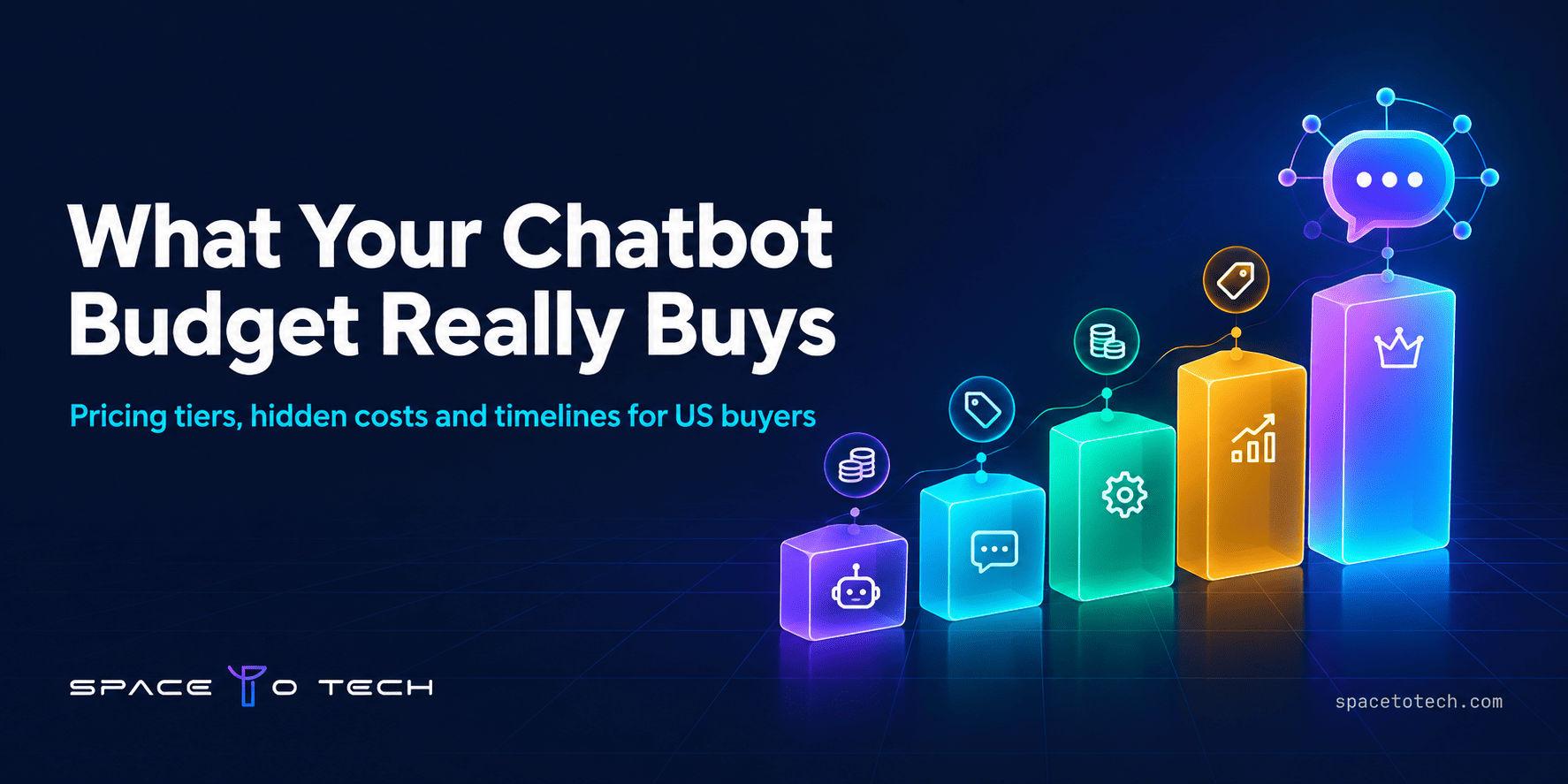
AI chatbot development cost in USA starts at roughly $2,500 for a simple rule-based bot and can climb past $75,000 for a custom build with deep integrations. That is a wide gap, and anyone who hands you one fixed number before asking about your use case is guessing.
Most budget surprises do not come from the build itself. They come from the things nobody priced on the first call: a knowledge base that needs cleaning, a CRM that has to be connected, a monthly model bill that grows with every conversation. This guide covers what each chatbot type costs, why prices move, what you keep paying after launch, and how to put together a budget you can defend in front of a CFO.
The ranges below are SpaceToTech’s current USA-facing planning figures. Treat them as a starting point for your own estimate, not a quote.
How Much Does an AI Chatbot Cost in the USA?
The short answer: SpaceToTech’s current USA planning range for an AI chatbot is $2,500 to $75,000+. Where a project lands inside that range depends on chatbot type, the AI or LLM approach, integrations, data requirements, security needs and how much customization the build needs.
Think about a kitchen renovation. Swapping cabinet doors and gutting the room are both called renovations, but nobody quotes them the same way. A chatbot that answers twenty fixed FAQs on your website and one that reads your policy documents, checks order status in your ERP and hands a chat to a human with full context share a name and not much else. That is why AI chatbot development cost USA quotes vary so widely, and why a single average is rarely useful.
Two caveats before the numbers. These are indicative USA-facing ranges, and final pricing is confirmed after a requirements review. Third-party API, cloud, LLM, WhatsApp and platform fees may be separate. The next section shows how the ranges split by type.
AI Chatbot Development Cost in USA by Type
Anyone comparing AI chatbot pricing USA offers should start with chatbot type, because it sets the baseline for everything else. Here is how our eight categories compare.
Pricing note: These are indicative USA-facing ranges. Final pricing is confirmed after requirements review. Third-party API, cloud, LLM, WhatsApp and platform fees may be separate.
The jump between tiers is mostly a technology jump. Rule-based bots follow scripts, NLP bots interpret intent, and LLM-based systems generate answers, so every step up adds engineering and testing work. If you want to see how these approaches differ under the hood, our overview of AI chatbot technology explains the building blocks.
- Basic or rule-based ($2,500 to $5,000). FAQ flows, predefined responses, website integration and a basic admin panel. It stays affordable because there is no model to tune. The bot follows the paths you design.
- NLP or conversational AI ($5,000 to $10,000). Adds intent recognition, contextual conversations and API integrations. NLP chatbot cost rises over rule-based because someone has to define intents and test them against the messy way real customers type.
- Custom or complex ($25,000 to $75,000+). Custom AI workflows, multiple integrations, advanced security and enterprise requirements. This tier covers projects that do not fit a standard category.
- The generative AI, RAG, enterprise, agentic and WhatsApp tiers each get their own breakdown further down.
What Factors Affect AI Chatbot Development Cost in the USA?
“It depends” is true and not very helpful, so here is what it depends on and how each factor changes the work.
AI model and intelligence level. A rule-based bot needs no model. An NLP bot needs trained intents. A generative bot needs LLM integration and prompt engineering, a RAG bot adds retrieval, and an agentic system adds tool calling and orchestration. Each layer adds design, build and testing hours.
Conversation complexity. Answering a single FAQ is simple. Handling a multi-step conversation that remembers earlier answers, personalizes replies and passes the chat to a human agent is a different build. Memory and handoff logic are quick to describe and slow to get right.
Knowledge base and data. If the bot answers from your documents, someone has to process them, split them into chunks, create embeddings and load them into a vector database, then tune retrieval so the right passage comes back. Messy source content, such as outdated PDFs or policies that contradict each other, adds cleanup time before any AI work starts.
Integrations. Chatbot integration cost grows with every system the bot touches: CRM, ERP, databases, helpdesk, payment systems and internal APIs. A read-only lookup is lighter than a bot that updates records or triggers payments, because write access needs more safeguards and more testing.
Security and enterprise requirements. Access control, single sign-on (SSO), data handling rules, security reviews and scalability targets all add scope. A public FAQ bot has little to protect. A bot that sees customer account data has a lot.
Channels. A website widget is the baseline. Adding a mobile app, WhatsApp or other channels means more integration work and more places to test the conversation flow.
Expected usage. Traffic and conversation volume rarely change the build price much, but they shape recurring costs, especially model and API consumption.
Testing, deployment and monitoring. A prototype that works in a demo is not a production system. Evaluation against real questions, guardrails, deployment and monitoring take real effort, which is why very cheap quotes deserve a follow-up question. We keep the full build process in our chatbot development guide, so we will stay on cost here.
One-Time AI Chatbot Development Cost vs. Ongoing Costs
A development quote covers building the bot. It does not cover running it. Mixing the two is the most common reason a project that looked affordable in month one feels expensive in month six.
One-time work typically includes discovery, conversation design, development, integrations, testing and deployment, depending on the project. That is the part the pricing table covers.
Recurring costs start after launch. This table separates what applies to most projects from what depends on your usage and channels.
On LLM chatbot cost: providers bill by tokens, which are small chunks of text, and output tokens usually cost several times more than input tokens. Prices also differ widely between models. A bot giving short answers on a lightweight model costs very little per conversation. A bot that pulls long documents into every answer on a premium model costs a lot more. Chatbot API cost therefore moves with both traffic and design choices.
Chatbot hosting cost and chatbot maintenance cost are steadier. A common planning habit is to reserve roughly 15 to 20 percent of the build cost each year for maintenance. Treat that as a rule of thumb, not a quote, because a bot whose content changes weekly will need more than one that rarely changes.
How Much Does a RAG, Generative AI, Enterprise or AI Agent Chatbot Cost?
These four questions come up most often, so here are direct answers.
RAG chatbot cost USA
A RAG-powered AI chatbot costs $10,000 to $20,000 at SpaceToTech, with a typical timeline of 6 to 10 weeks. RAG stands for retrieval-augmented generation: the bot searches your documents first, then writes an answer from what it found. That grounding helps control hallucination, but it adds a knowledge base, document processing, embeddings, a vector database and retrieval tuning. Those pieces are why RAG chatbot cost sits above a plain generative bot.
Generative AI chatbot cost USA
Expect $7,500 to $15,000 for a generative AI chatbot, over 5 to 8 weeks. The range covers LLM integration, prompt engineering, conversation memory and API integration. Generative AI chatbot cost stays lower than RAG because the bot typically answers from the model’s general ability rather than from your own documents, which also means guardrails matter more to keep it on topic.
Enterprise AI chatbot cost USA
Enterprise AI chatbot cost runs $20,000 to $50,000+, with 10 to 18 weeks of work. The difference comes from enterprise integrations, security, SSO, analytics, admin controls and scalability. Many of those items are invisible to end users and still take real engineering time.
AI agent development cost for chatbots
An agentic chatbot costs $15,000 to $40,000+ and takes 8 to 16 weeks. Instead of only answering, an AI agent can call tools and APIs, run multi-step workflows and carry memory across steps, which needs orchestration logic and careful testing. For a chatbot that books appointments or processes returns, that is a real step up in AI agent development cost. If your plans reach beyond a chatbot, our AI development services cover the wider picture.
WhatsApp and Omnichannel AI Chatbot Development Cost
A WhatsApp or omnichannel chatbot costs $5,000 to $15,000 to build, with a timeline of 4 to 8 weeks. Connecting WhatsApp, your website and a CRM means extra implementation work and workflow design, such as notifications and automated follow-ups, which explains the spread inside the range.
Keep development pricing separate from running fees. Meta moved WhatsApp from conversation-based billing to per-message billing in July 2025, and charges depend on the message category (marketing, utility, authentication or service) and the recipient’s country. A business solution provider may add its own fees on top. Meta has also kept changing which messages are billable, so check the current WhatsApp Business Platform pricing before you forecast a monthly figure.
So when you see a WhatsApp chatbot cost or WhatsApp chatbot pricing quote, ask whether message fees are included. In most cases the build price and the WhatsApp bot cost per message are two separate lines.
Hidden or Additional Costs to Budget For
A budget built only from the pricing table will come up short. These items often sit outside the first quote. Not every one applies to every project, so use this as a checklist for your own conversation.
- LLM and API usage. Billed by consumption, so it rises as conversations grow.
- Cloud hosting and infrastructure. Servers, storage and a vector database for RAG bots.
- WhatsApp and channel fees. Message charges and any provider markup.
- Data preparation or migration. Cleaning, restructuring or moving content before the bot can use it.
- Additional integrations. Every extra system, such as a second CRM or a billing tool, adds scope.
- Security or enterprise requirements. Security reviews, SSO or audit logging added late tend to cost more than the ones planned early.
- Ongoing maintenance and monitoring. Someone has to read conversations, fix failures and update content.
- Future channels or features. Voice, a mobile app or a new language is a new piece of work, not a patch.
None of these is automatic. But a vendor who cannot tell you which ones apply to your project has not scoped it yet.
How to Reduce AI Chatbot Development Cost Without Cutting Core Value
Cutting cost by cutting quality backfires. Cutting scope on purpose does not.
- Start with one high-value use case. Support questions that repeat every day are a common pick, and our piece on AI chatbots for help desk automation shows how teams approach it.
- Launch on your most important channel first. If most customers reach you through your website, begin there and add WhatsApp once the bot proves itself.
- Limit integrations in the first release. One working CRM connection beats five half-finished ones.
- Use a focused knowledge base. Fifty relevant documents work better than five thousand loosely related ones, and they keep retrieval cleaner.
- Phase agentic workflows. If the first release only needs to answer questions, leave multi-step actions for a second phase.
- Reuse what you already have. Existing APIs and infrastructure can sometimes shorten the build, and a requirements review will show where.
This is also how to set a realistic chatbot development budget: pay for the core value first, then expand using what real conversations teach you.
How to Estimate Your AI Chatbot Budget
There is no universal average cost, only estimates built on stated assumptions. Two companies can both ask for “a support chatbot” and receive quotes that sit far apart, because one needs a CRM connection and document search while the other needs a website widget and ten FAQ flows.
Before you request a quote, write down your answers to these:
- Use case: which problem the bot solves and for whom.
- Chatbot type: rule-based, NLP, generative, RAG, enterprise or agentic.
- Channels: website, mobile app, WhatsApp or a mix.
- Integrations: the CRM, ERP, helpdesk, database or payment systems it must touch.
- Data sources: the documents, FAQs or records it should answer from, and their condition.
- Security: access rules, SSO and data handling requirements.
- Expected volume: how many conversations you expect per month.
- Ongoing support: who maintains and monitors the bot after launch.
The clearer these answers are, the narrower the quote. Vague requirements push vendors to price in risk, and that risk shows up as a higher number. A one-page brief covering these eight points is often enough to get a meaningful AI chatbot development estimate, and with it in hand you can ask SpaceToTech for a custom estimate.
AI Chatbot Development Timeline in the USA
Timelines follow complexity, much like cost. From the pricing table: a basic bot takes 2 to 4 weeks, NLP 4 to 7, generative AI 5 to 8, RAG 6 to 10, WhatsApp or omnichannel 4 to 8, agentic 8 to 16, enterprise 10 to 18, and custom builds 12 to 24+ weeks.
So how long does it take to develop an AI chatbot for your case? It depends on four things: how ready your data is, how many systems must connect, how strict the security review is, and how much testing the bot needs before it talks to customers. Delays rarely come from the AI itself. They come from waiting on content, system access or approvals.
A vendor promising the same delivery date for every project has not looked at your project. Treat these ranges as planning guides and confirm the schedule after a requirements review.
AI Chatbot Development in the USA vs. Offshore Development
Where your development team sits can change a quote, but it is one factor among several. Team composition, seniority, communication habits, project scope and delivery model all affect price, and a low quote from a thin team can end up costing more than a fairer one.
That cuts both ways. Offshore is not automatically cheaper once you count management time, and a US-based team is not automatically better. What matters is who actually builds your bot, how often you hear from them and whether time zones leave enough overlap for quick decisions.
SpaceToTech is India-based and works with clients across the US, UK, UAE, Australia and India. If you are comparing delivery models while planning chatbot development cost in USA terms, ask every vendor the same questions about team seniority, overlap hours and who owns support after launch.
Why Choose SpaceToTech for AI Chatbot Development?
We treat every chatbot as a scoping problem before it becomes a technical one. That means starting with your use case, then working through scope, integrations, data and ongoing requirements, so the estimate reflects what the bot has to do rather than a generic package.
If you are ready to put numbers on your own project, tell us what you want the chatbot to do. Our team delivers AI chatbot development for businesses across the US, UK, UAE, Australia and India, and we will review your requirements and send you a project estimate.