
Most businesses start their search for a mobile app development company with a Google search and a stack of proposals that all promise strong results at competitive rates. That approach rarely ends well. An app is a long-term product, not a one-time purchase, and the company you hire shapes everything from how smoothly the build goes to how easily you can fix bugs two years down the line.
Picking a low-cost vendor without checking their real portfolio, their actual process, or who will sit on your project team is one of the most common and most expensive mistakes founders and product leaders make. Technical skill matters, but so do pricing transparency, communication habits, and what happens after the app ships.
If you're trying to figure out how to choose a mobile app development company, this guide gives you a practical framework, from defining your requirements to scoring your shortlist, so the decision rests on evidence rather than a sales pitch.
What Should You Look for in a Mobile App Development Company?
Before the detailed breakdown, here is the short version. These software vendor selection criteria give you a practical framework to use while you're on discovery calls with potential vendors.
| Evaluation Area | What to Verify |
| Relevant experience | Similar industry and project complexity |
| Portfolio | Live, comparable apps and the vendor's actual role |
| Technical expertise | Native or cross-platform rationale, not just buzzwords |
| Team | Who will actually work on the project day to day |
| Development process | Discovery, design, development, QA, and launch stages |
| Communication | Reporting cadence, meetings, timezone overlap |
| Pricing | Scope, billing model, assumptions, and change-request costs |
| Security | Data protection practices, testing, access controls |
| Ownership | Source code, repository access, IP, and documentation |
| Post-launch support | Maintenance terms, bug fixes, SLA |
1. Define Your App Requirements Before Comparing Companies
It's tempting to jump straight into vendor calls, but a company can't give you a reliable estimate, or a realistic timeline, without knowing what you actually need. Spend a week putting the basics on paper first.
- The core business objective the app is meant to solve
- Who the target users are and how they'll use the app
- Platforms: iOS, Android, or cross-platform
- Core features and any must-have integrations
- Backend and admin panel requirements
- Security or compliance requirements specific to your industry
- A realistic launch window
- A working budget range, even a rough one
This groundwork also sets you up well for later cost conversations, since vendors quoting against a vague brief tend to either overestimate to cover risk or underestimate and revise the number midway through the project.
2. Look for Relevant Mobile App Development Experience
Industry experience doesn't guarantee success on its own, but it does shorten the learning curve. A company that has already built apps for a similar user base, a similar level of complexity, or similar integrations will spot problems earlier and ask sharper questions during discovery.
- Have they worked in your industry or a closely adjacent one?
- Have they shipped apps with similar features or integrations?
- Have they handled a similar scale of users?
- Do they have both B2B and B2C experience if your product needs it?
Ask direct questions rather than accepting a generic “yes, we've done that before.” Ask for the specific project and what their role was on it.
3. Evaluate the Company's Mobile App Development Portfolio
A portfolio page full of screenshots tells you very little. What actually matters is whether you can verify the claims behind it.
- Is the app live on the App Store or Google Play right now?
- Can you download and test it yourself?
- Is it comparable in scope to what you're building?
- What exactly was the company's role: full build, design only, or a partial handoff?
- Which technologies were used, and were they native or cross-platform?
- What business problem was the app solving?
- Is there enough detail in the case study to actually verify the claims?
A vendor that can walk you through the reasoning behind a past project, not just the finished screenshots, is usually more trustworthy than one that only shows polished mockups.
4. Assess Technical Expertise and Technology Choices
Native development with Swift and Kotlin and cross-platform frameworks like Flutter or React Native each have a place, and neither is universally better. The real question isn't which framework wins in the abstract, it's which one fits your specific product, budget, and timeline.
Ask the company to walk you through their reasoning: how they'd approach architecture, scalability, third-party APIs, security, testing, and deployment for a project like yours. A vendor that can explain a tradeoff clearly is a better sign than one that pushes a single technology as the only right answer.
5. Understand the Company's Mobile App Development Process
A clear, documented process is one of the strongest signals that a vendor can deliver predictably. Ask what happens between the discovery call and the first working build, and get specifics at each stage. A clear software vendor selection process should continue beyond the initial proposal and include technical evaluation, commercial review, contract terms, and post-launch expectations.
Discovery and requirements
How they translate your brief into a technical scope and timeline.
UI/UX design and prototyping
Whether you'll see wireframes and clickable prototypes before development starts.
Development
How work is broken into sprints or milestones, and how progress is shared.
Testing and QA
What kind of testing happens before a release, and on which devices.
App Store and Google Play submission
Who manages the submission process and how rejections are handled. It's worth reviewing Apple's own App Store Review Guidelines directly so you know what a compliant submission actually requires, rather than relying only on a vendor's summary.
Post-launch maintenance
What ongoing support looks like once the app is live. If you want a closer look at how a full-cycle team structures this, SpaceToTech's mobile app development services page breaks down each stage in more detail.
6. Find Out Who Will Actually Work on Your App
The people on your sales call are rarely the people who will build your app. Before signing anything, find out who is actually assigned to the project.
- Who will be assigned to the project, by name or role?
- Can you meet the project lead before kickoff?
- Who makes the technical decisions during the build?
- Who owns QA, and is it a dedicated function or an afterthought?
- Is any part of the work subcontracted further, and if so, to whom?
This matters more than it seems. Seniority, in-house versus subcontracted resourcing, and how the team communicates internally all affect how smoothly your project runs.
7. Evaluate Communication and Project Management
“Choose a company that communicates well” isn't a useful standard on its own. Here's what to actually verify.
| Question | What a Good Answer Looks Like |
| Who is my main point of contact? | A named project or product contact, not a rotating inbox |
| How often do we meet? | A defined, recurring meeting cadence |
| How do I track progress? | Access to a shared project management tool |
| How are blockers escalated? | A defined escalation path with named owners |
| How are changes documented? | A written change-management process |
8. Compare Pricing, Scope and Contract Terms
This section isn't meant to replace a dedicated cost guide. It's about understanding the mechanics of how you'll be billed, not the exact numbers you should expect to pay.
- Fixed price versus time and materials versus dedicated team models
- How scope is defined, and what counts as a change request
- Payment milestones and what triggers each one
- What's explicitly included and excluded from the quote
- How ongoing maintenance is billed once the app is live
- Any third-party or platform costs that sit outside the vendor's quote
Get all of this in writing before you sign. A proposal that's vague on scope is far more likely to turn into a budget disagreement three months in.
9. Verify Security, Code Ownership and Intellectual Property
This is one of the most overlooked parts of vendor selection, and one of the most expensive to get wrong later.
- Data security and access control practices during development
- Whether security testing is part of the standard QA process
- Who owns the source code once the project is complete
- Whether you get direct repository access, not just a final build
- What documentation you'll receive for future maintenance
- How third-party licenses are handled and disclosed
None of this is legal advice, and it shouldn't be treated as such. Have your legal team review the agreement before you sign, particularly the clauses covering IP ownership and code handover.
10. Ask What Happens After the App Launches
Launch day isn't the finish line. Ask what the vendor's support model looks like once the app is live.
- Bug fixes and how quickly they're addressed
- Compatibility updates for new OS versions
- Performance monitoring and security patches
- How new feature requests are scoped and priced
- Whether there's a defined SLA or support tier
- Who manages App Store and Google Play updates going forward
Questions to Ask Before Hiring a Mobile App Development Company
Use these questions to ask app developers during every discovery call. The answers, not the confidence behind them, are what matter.
| Question to Ask | Why It Matters |
| Can you show relevant live apps? | Verifies real experience over claimed experience |
| Who will actually work on my project? | Confirms the real delivery team, not the sales team |
| Which technology do you recommend, and why? | Tests technical reasoning, not just familiarity |
| How do you handle scope changes? | Reveals commercial and timeline risk early |
| What is your QA process? | Tests how seriously delivery quality is treated |
| Who owns the source code and IP? | Protects your ownership after the project ends |
| What documentation will we receive? | Enables future maintenance by any team |
| How do you handle deployment? | Clarifies who's responsible at launch |
| What happens after launch? | Clarifies the support model going forward |
| Can we speak with a past client? | Validates claims made during the pitch |
Red Flags to Watch for When Choosing an App Development Company
The issue is rarely a specific price point. It's a lack of transparency wherever you look.
- A very low quote given without any real discovery process
- Vague or shifting project scope
- No relevant portfolio for your type of project
- Only screenshots offered, with no live apps to test
- An inability to explain their own technical decisions
- An unclear or constantly changing project team
- No real explanation of the QA process
- No clear answer on code or IP ownership
- No written change-management process
- No plan for what happens after launch
- Pressure to sign a contract immediately
How to Compare Mobile App Development Companies
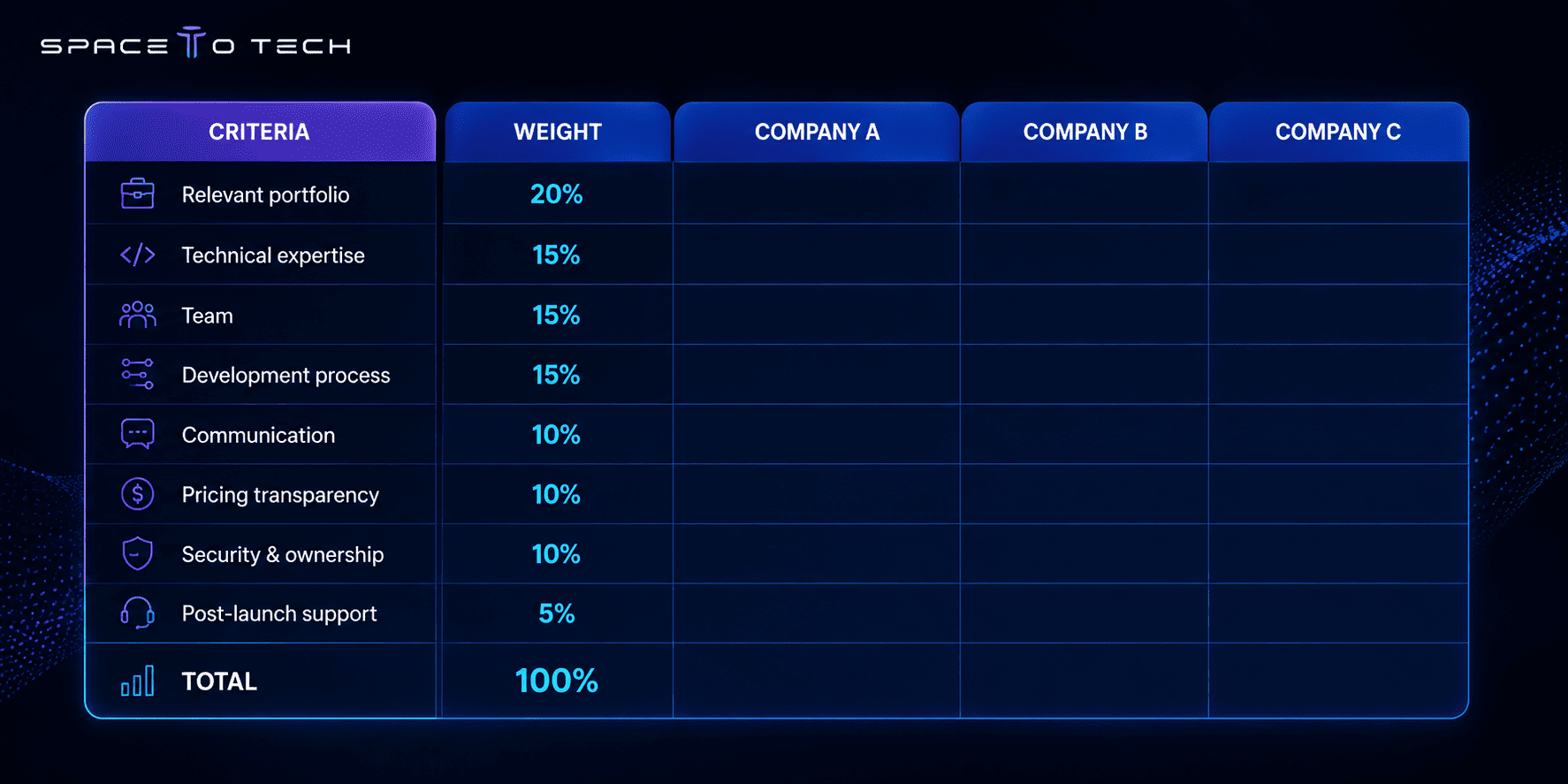
Once you've shortlisted three to five mobile app development companies, compare them against the same criteria instead of relying on impressions from the sales call. Weight each criterion based on what matters most for your project. If your biggest risk is timeline, weight process and team higher. If it's compliance, weight security and ownership higher.
You can also review a broader comparison of mobile app development companies before finalizing your shortlist.
Should You Hire an App Development Company, Freelancer or In-House Team?
This deserves its own decision, not a default. Here's a quick way to think about it.
| Option | Best For | Main Limitation |
| Freelancer | Small, simple projects | Limited breadth and backup coverage |
| Development company | Complex, full-cycle projects | Higher engagement cost |
| In-house team | Long-term internal product capability | Hiring and management overhead |
Why Choose SpaceToTech for Mobile App Development?
As a custom software and app development company, SpaceToTech applies the same evaluation criteria covered above to its own process, rather than asking you to take that on faith.
- Relevant experience: portfolio projects across fintech, wellness, and service-based apps, referenced only where SpaceToTech can confirm the details publicly
- Technology: native and cross-platform development, scoped to what the project actually needs
- Full-cycle capability: discovery through post-launch support, where each stage is confirmed as part of the standard process
- Engagement models: fixed-price and dedicated-team options, based on project scope
SpaceToTech is based in Noida, India, and works with clients across the US, UK, UAE, Australia, and India, including through mobile app development services in the USA for businesses that prefer a regionally focused engagement.
How to Make the Final Decision
- Define your requirements clearly before comparing vendors
- Shortlist three to five companies based on relevant experience
- Score each one using the same weighted criteria
- Ask every company the same set of questions
- Review the proposal and contract terms closely, especially scope and IP clauses
- Verify references directly rather than relying on testimonials alone
- Select the partner based on overall fit, not the lowest price