
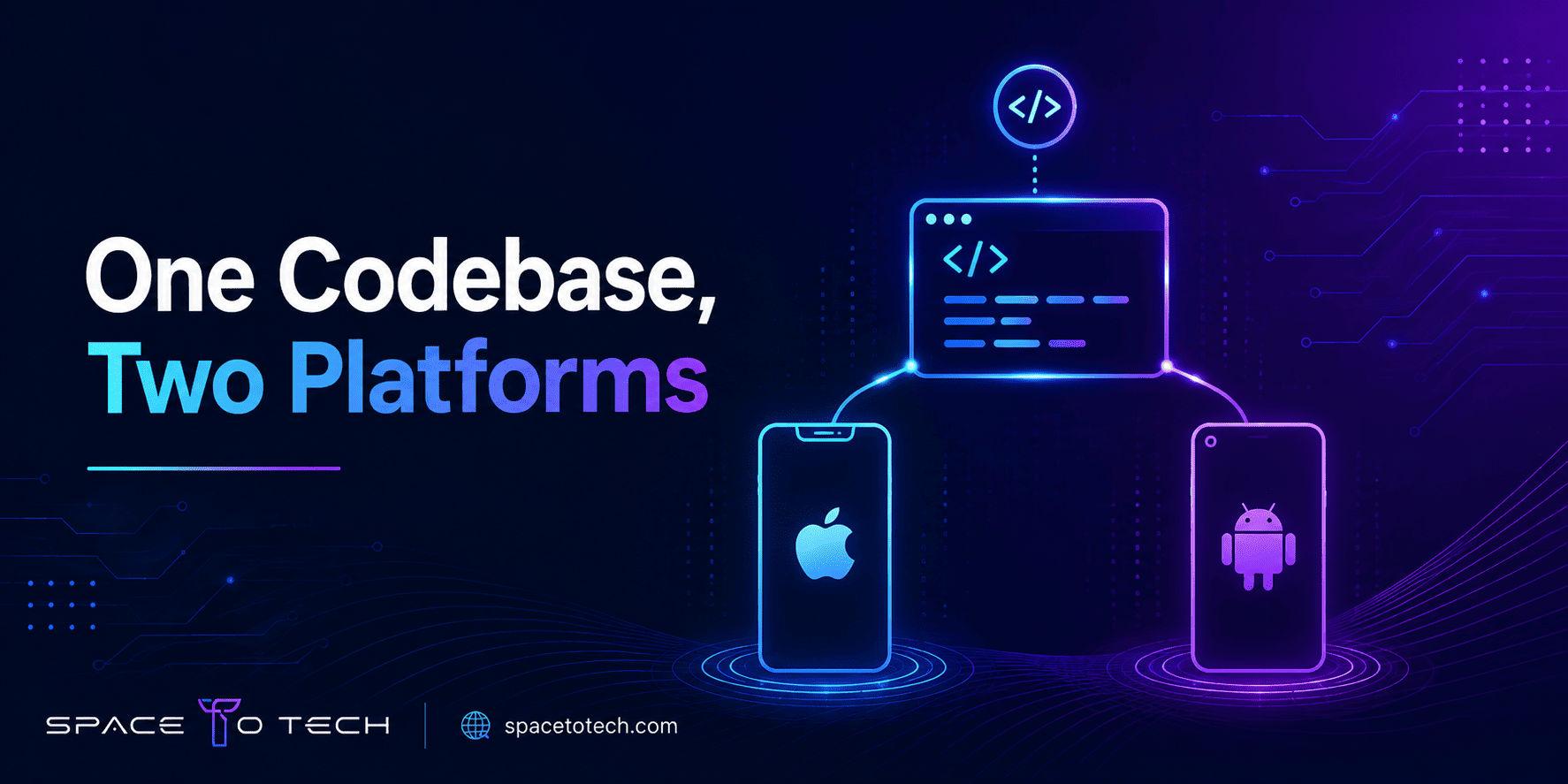
If your product needs to run on both iOS and Android, you don't necessarily need two completely separate applications. Cross-platform development allows businesses to build for both platforms from a shared codebase, but that doesn't automatically make it the right choice for every product.
This guide explains when cross platform mobile app development makes sense, where it falls short, what it actually costs, and how to choose between the leading frameworks. Rather than repeating the usual claim that cross-platform is simply cheaper and faster, we'll walk through the decision itself, so you can judge whether it fits your product, your timeline, and your budget.
What Is Cross-Platform Mobile App Development?
Cross platform mobile app development is the practice of building a single application that runs on both iOS and Android using one primary codebase, instead of writing separate native applications for each operating system.
A cross-platform framework sits between your shared code and each device's operating system. It translates your application logic into components that work on both platforms, while still allowing developers to write platform-specific code where a feature genuinely needs it, such as camera access, push notifications, or biometric authentication.
This is different from fully native development, where iOS and Android apps are built independently, each with its own codebase, its own team workflow, and its own release cycle. With cross platform app development, most of the business logic, UI structure, and application flow is written once and shared. Only the pieces that require deep platform-specific behavior are handled separately.
The result is a single application experience that adapts to each operating system, without requiring two parallel engineering efforts for every feature you ship.
If you're weighing this approach against a fully native build, our mobile app development services team can walk through your product requirements before you commit to a framework.
How Does Cross-Platform App Development Work?
Understanding the mechanics helps explain both the advantages and the limitations covered later in this guide.
Shared Codebase
Most of the application, including business logic, navigation, state management, and a large share of the UI, is written once in a language such as JavaScript, TypeScript, or Dart, depending on the framework. This shared layer typically accounts for the majority of the codebase across both platforms.
Platform-Specific Components
Certain features still need platform-specific handling. This includes deep OS integrations, custom animations that follow platform design guidelines, and hardware-dependent functionality. Cross-platform frameworks allow developers to write these components separately when the shared layer isn't sufficient.
APIs, Plugins, and Native Integrations
Cross-platform apps connect to backend systems, third-party services, and device hardware through APIs and plugins. Popular frameworks maintain large plugin ecosystems for common needs like maps, payments, and analytics, though less common integrations may require custom native modules.
Testing Across iOS and Android
Even with a shared codebase, an app still needs to be tested independently on both operating systems. Screen sizes, OS versions, gesture behavior, and performance characteristics differ enough that testing cannot be skipped simply because the code is shared.
Cross-Platform vs Native App Development: What's the Difference?
Neither approach is universally better. The right one depends on your product's requirements.
| Factor | Cross-Platform | Native |
| Codebase | Shared | Separate |
| iOS + Android | Yes | Separate development |
| Development effort | Usually lower | Usually higher |
| Time to market | Often faster | Usually longer |
| Platform-specific control | Moderate to high | Highest |
| Performance | Strong for most business apps | Best for highly specialized apps |
| Maintenance | Centralized for much of the code | Separate platform maintenance |
| Advanced hardware access | Depends on framework | Strongest |
| Best suited for | Most standard business and product apps | Highly specialized apps |
Cross-platform development is not always cheaper, and native development is not always faster. The gap between the two narrows or widens depending on how complex your feature set is and how much platform-specific work your product actually requires.
Should Your Business Choose Cross-Platform Development?
This is the question that matters more than the technology itself.
| Business or Product Type | Cross-Platform Fit | Why |
| Startup MVP | Strong | Validate the product across platforms without maintaining two separate codebases |
| SaaS or mobile product | Strong | Shared product logic and faster iteration |
| E-commerce | Strong | Most standard commerce functionality works well cross-platform |
| Internal business app | Strong | Cost and maintenance efficiency often matter more than platform-specific optimization |
| Customer portal | Strong | Standard workflows are generally suitable |
| API-driven application | Strong | Shared application logic works well |
| Enterprise application | Depends | Architecture, security, and integrations need evaluation |
| Gaming | Depends or low | Performance and graphics requirements matter |
| AR or VR | Often better with specialized or native approaches | Hardware and graphics requirements |
| Hardware-heavy application | Depends or low | Native APIs may be critical |
| Cutting-edge OS feature | Native may be preferable | Immediate platform-specific support can matter |
If your product depends heavily on graphics rendering, real-time hardware access, or being first to support a brand-new OS feature, native development deserves serious consideration before you commit to a cross-platform approach.
Cross-Platform App Development Use Cases
Beyond the general decision framework, it helps to see how cross-platform development plays out across specific, common product types.
- Startup MVPs: launching on both platforms at once helps validate demand without committing to two full engineering tracks before product-market fit is confirmed.
- SaaS applications: shared business logic keeps feature releases synchronized across iOS and Android as the product evolves.
- E-commerce apps: catalog browsing, cart, checkout, and account flows are largely standard functionality that performs well cross-platform.
- Marketplace apps: buyer and seller-facing features can be built once and refined in parallel across both platforms.
- On-demand apps: booking, tracking, and notification-driven workflows are well supported by mainstream cross-platform plugin ecosystems.
- Internal business applications: cost efficiency and centralized maintenance usually matter more than platform-specific polish for internal tools.
- Customer portals: account management, document access, and support workflows follow standard UI patterns that translate well across platforms.
- Booking applications: scheduling, calendar sync, and payment integrations are commonly available through existing cross-platform libraries.
Across these use cases, the common thread is that the product relies on standard business logic and common device features rather than deep, platform-specific engineering. That is precisely where cross-platform development delivers the most value.
Why Choose Cross-Platform Mobile App Development?
For products that fit the profile above, cross-platform development offers several practical advantages.
One Codebase for Multiple Platforms
Writing the core application once reduces duplicated engineering effort across iOS and Android.
Faster Time to Market
Shared development work often shortens the path from concept to launch, which matters for startups and product teams working toward a specific release window.
Lower Development Effort
Fewer parallel workstreams generally mean less coordination overhead between platform-specific teams.
Easier Maintenance
Bug fixes, updates, and new features can often be built once and deployed to both platforms, rather than repeated twice.
Consistent Product Experience
A shared codebase makes it easier to keep core functionality, business logic, and UI patterns aligned across iOS and Android.
Better Fit for MVPs and Startups
Teams validating a new product benefit from reaching both platforms without committing to two full engineering tracks before product-market fit is confirmed.
Easier Iteration as the Product Evolves
Feature changes and experiments can be rolled out to both platforms in parallel, which supports faster iteration cycles.
What Are the Limitations of Cross-Platform App Development?
A balanced view means being upfront about where this approach struggles.
- Performance can lag behind native apps for graphics-intensive or highly interactive features.
- Complex native functionality sometimes still requires custom platform-specific code, reducing the code-sharing benefit.
- Platform-specific UX conventions can be harder to replicate perfectly across both operating systems.
- Third-party dependency problems arise when a plugin lags behind the latest iOS or Android release.
- Plugin limitations can force custom development for less common integrations.
- Framework updates sometimes introduce breaking changes that require migration work.
- Debugging across platforms can be more complex than debugging a single native codebase.
- Specialized hardware access, such as advanced sensors or custom chipsets, may need native modules.
- Advanced graphics and animation-heavy interfaces often perform better with native development.
The question isn't whether cross-platform development is better than native development. The right choice depends on what the application actually needs to do.
How Much Does Cross-Platform App Development Cost?
Cross-platform development affects cost, but not simply because it involves fewer platforms. Several factors shape the actual budget.
- Shared codebase efficiency: the more logic that can be genuinely shared, the more development effort is saved.
- Number of platforms: targeting both iOS and Android from one codebase reduces duplicated build work compared with two native apps.
- Feature complexity: advanced features generally cost more regardless of the development approach chosen.
- Native integrations: apps requiring custom native modules add development time that offsets some of the cross-platform savings.
- UI and UX design: platform-specific design adjustments still require dedicated design and development effort.
- Backend development: server-side architecture, APIs, and data infrastructure are typically priced separately from the mobile front end.
- Testing: thorough testing across both operating systems remains necessary and should be budgeted accordingly.
- Maintenance: ongoing framework updates, OS compatibility, and bug fixes continue after launch.
For a full breakdown of pricing ranges by project complexity, see our detailed guide on custom mobile app development cost, which covers how platform choice fits into the broader cost picture alongside features, design, and backend work.
Which Cross-Platform Framework Should You Choose?
Framework choice should follow product requirements, not the other way around.
React Native
React Native is built on JavaScript and React, which makes it a practical option for teams already working in the JavaScript ecosystem. It supports a large plugin library, strong community support, and access to native capabilities through native modules when needed. It generally suits business and product applications where development speed and a familiar tech stack matter.
Learn more about our React Native development capabilities.
Flutter
Flutter uses Dart and a widget-based UI system, giving developers precise control over how the interface looks and behaves across both platforms. Because Flutter renders its own UI components rather than relying on native ones, it tends to produce highly consistent visuals across iOS and Android. It works well for products where UI consistency and custom design are priorities.
Learn more about our Flutter development capabilities.
Other Frameworks
Other frameworks such as Xamarin and Ionic exist and may suit specific legacy environments or particular team backgrounds, but React Native and Flutter remain the most widely adopted options for new cross-platform projects today.
How to Choose the Right Cross-Platform Approach
Framework selection should be based on the product, not personal preference. Consider:
- Product requirements and feature scope
- Target platforms and their relative priority
- Native API requirements
- UI complexity and design ambitions
- Performance requirements
- Development timeline
- Budget constraints
- Long-term maintenance plans
- Existing team expertise
If you're comparing React Native and Flutter specifically, see our detailed React Native vs Flutter comparison for a deeper technical breakdown.
When Is Native App Development a Better Choice?
Cross-platform development isn't the right fit for every product. Choose native when your app depends heavily on advanced graphics, gaming-level performance, AR or VR, deep hardware integrations, highly platform-specific UX, or immediate access to new OS capabilities at launch. Native development tends to make more sense when a project involves:
- Advanced graphics rendering
- Gaming applications with heavy performance demands
- AR or VR experiences
- Deep hardware integrations
- Highly platform-specific UX requirements
- Immediate access to new OS-specific features at launch
- Specialized performance requirements that leave little room for a shared-code abstraction layer
Recognizing these cases early avoids committing a project to the wrong technical foundation.
Common Mistakes Businesses Make When Choosing Cross-Platform Development
Choosing It Only Because It Is Cheaper
Cost should be one factor among several, not the deciding one. A product that needs deep native functionality can end up costing more overall if cross-platform limitations force late-stage rework.
Ignoring Native Functionality Requirements
Skipping an early assessment of hardware and OS-specific needs often surfaces expensive surprises mid-project.
Selecting a Framework Before Defining the Product
Committing to React Native, Flutter, or any other framework before scoping the product's actual requirements can lock a team into avoidable constraints.
Underestimating Testing
Shared code does not mean shared behavior. Both platforms still require independent testing across devices and OS versions.
Ignoring Long-Term Maintenance
Framework updates, OS changes, and plugin compatibility require ongoing attention well after launch.
Treating iOS and Android as Identical
Design conventions, user expectations, and platform guidelines differ. Assuming the two platforms behave identically leads to a weaker user experience on one or both.
How to Plan a Cross-Platform App Development Project
A structured plan reduces risk and keeps the budget on track.
- Define the core business objective the app needs to achieve
- Identify MVP features and prioritize what launches first
- Select target platforms and their relative priority
- Define required integrations and backend dependencies
- Choose the architecture and framework based on product needs
- Design the UX with platform-specific conventions in mind
- Build and test across both operating systems
- Launch with a clear rollout plan
- Monitor performance and plan ongoing maintenance
How to Choose a Cross-Platform App Development Company
Selecting the right development partner matters as much as selecting the right framework. Look for:
- A relevant portfolio of cross-platform projects
- Demonstrated React Native and Flutter expertise
- Experience handling native integrations when required
- A structured QA and testing process
- Attention to security throughout development
- Backend development capability, not just front-end mobile work
- Transparent project scope and pricing
- A clear maintenance plan after launch
- Clarity on IP and code ownership
- Consistent, direct communication throughout the project
For a broader view of vetted partners, see our guide to top mobile app development companies, and explore our own mobile app development services for teams evaluating a development partner.
Why Choose SpaceToTech for Cross-Platform App Development?
Our team works across React Native and Flutter, with a process that starts at discovery and scoping before any code is written, so framework decisions are based on your product's actual requirements rather than a default recommendation. From there, projects move through design, development, QA, and deployment, with native integration experience available for products that need it and post-launch support built into the engagement rather than treated as an afterthought.
Planning a Cross-Platform Mobile App Development Project?
The right framework for cross platform mobile app development depends on your app's features, target platforms, performance requirements, budget, and long-term growth plans. SpaceToTech can help you evaluate these requirements and choose an approach that fits your product before development begins.
Have an app idea that needs to work across iOS and Android? Share your requirements and we'll help you determine whether cross-platform development is the right approach.