
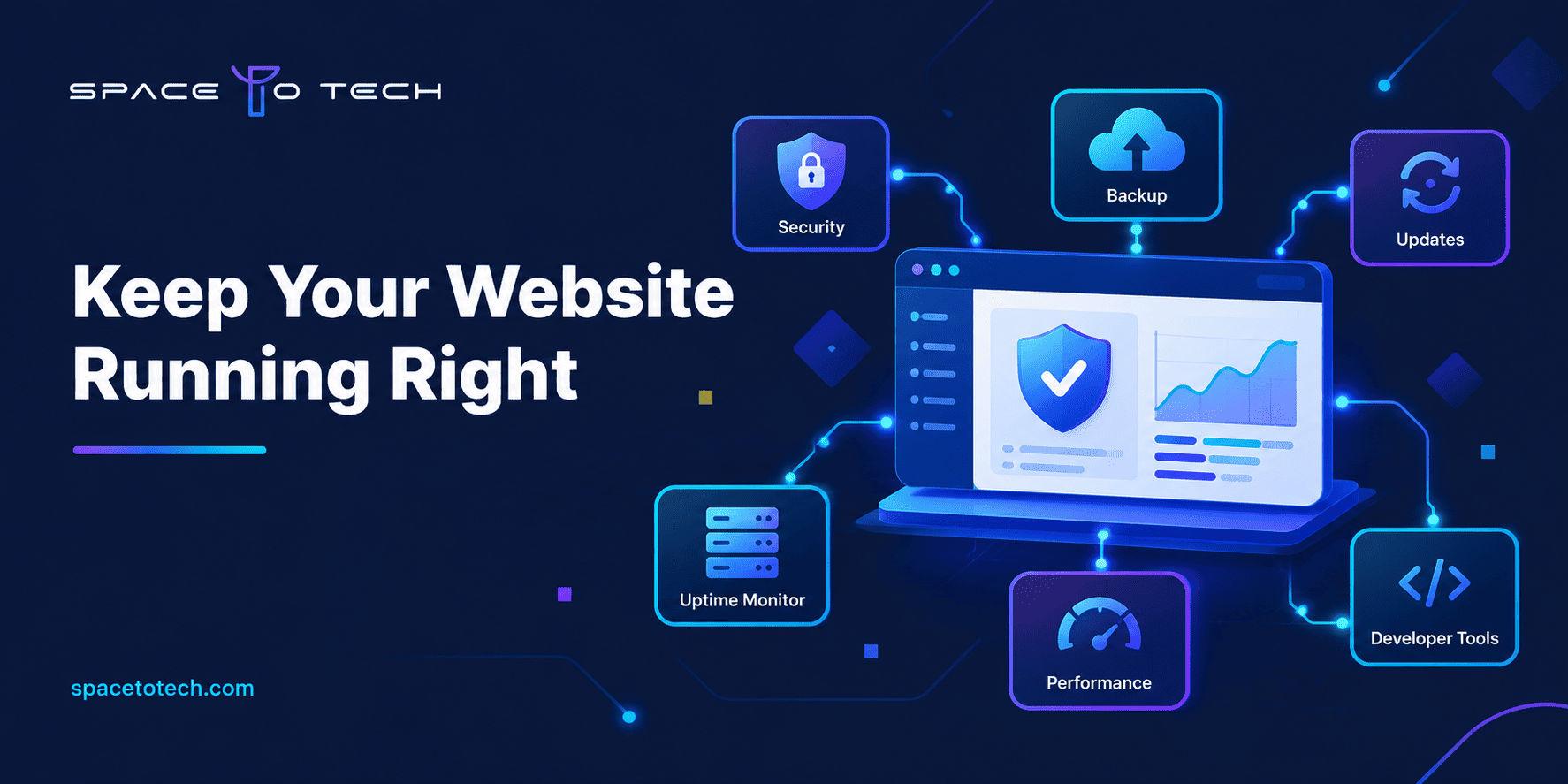
A website can look fine on the surface while a contact form quietly stops sending enquiries. A plugin update can break a checkout page, or an expired integration can interrupt a customer portal. Those problems rarely wait for a convenient moment.
Website maintenance cost depends on the technology behind the site, its day-to-day role in the business, and the amount of technical support it needs. A simple company website may need routine backups and updates, while an online store or custom application may require ongoing testing, monitoring and developer support.
If you are planning a new platform, it helps to discuss website maintenance cost while scoping the build, particularly when the project includes accounts, payments or third-party integrations. Space To Tech provides software and web development services for businesses building digital products, and the decisions made during development can shape maintenance work long after launch.
For websites with accounts, payment flows or business integrations, an experienced web app development company can help plan technical ownership and post-launch support. That is different from the initial development quote: maintenance is the recurring cost of keeping the finished system working.
This guide explains what professional website maintenance services cover, the factors behind monthly pricing, which tasks belong in a maintenance package, and how to assess the right level of support.
What Are Website Maintenance Services?
Website maintenance services are recurring technical tasks that keep a website available, secure and functional after publication. They include preventive work, such as backups and updates, and corrective work, such as diagnosing a broken form or fixing an application error.
Websites rely on more than the pages visitors see. They may use hosting services, a content management system, an email delivery provider, analytics scripts, API connections and a database. Each part has its own failure points. Maintenance means checking how these pieces work together and addressing issues before they disrupt users.
The work fits into the wider web development lifecycle, which also covers design, implementation, testing and deployment. Unlike an initial launch checklist, maintenance continues as the website and its dependencies change.
What Is Included in Website Maintenance?
Software, CMS and dependency updates
WordPress sites need attention to core software, plugins and themes. Custom applications may need updates to frameworks, runtime versions and third-party libraries. A sensible process checks compatibility, creates a recovery point, tests important changes where practical and confirms that core functionality still works afterward.
Security monitoring and patch management
Security tasks may include checking vulnerability notices, scanning for malware, reviewing access, applying patches and inspecting suspicious activity. Responsibilities vary between the hosting provider and the application owner. A website security checklist helps identify the controls to apply before launch and repeat afterward.
Backups and restoration checks
A backup is only useful if it can be restored. Maintenance should define how often backups run, where copies are stored, how long they are kept and who restores the website after failure. An ecommerce store processing transactions all day will have different recovery requirements from a static service website.
Uptime and application monitoring
Availability monitoring can detect a website that stops loading. More complex sites may also need checks for authentication, API endpoints, database health or transaction errors. Monitoring and incident response are separate commitments: an alert does not mean someone is contracted to resolve it immediately.
Speed and performance checks
As pages collect scripts, images and integrations, they may become slower. Maintenance can include reviewing Core Web Vitals, server response, caching, asset sizes and application bottlenecks. Routine monitoring does not automatically include extensive performance engineering.
Bug fixes and compatibility testing
A website may remain online while a booking form, mobile menu or checkout flow fails. Fixing a defect involves reproducing the issue, identifying its cause, making a controlled correction and testing the affected user journey. Complex integrations usually require more engineering time than straightforward content changes.
Content updates, reporting and support
Some maintenance plans include small edits such as changing business hours, text or images. Others charge separately for content work. A useful report lists updates completed, backups checked, issues found, fixes delivered and technical recommendations. Make sure the plan defines how many support hours are included.
Website Development Cost vs Website Maintenance Cost
Website development is the initial investment in planning, design, coding, integrations, testing and launch. Website maintenance cost covers the recurring effort required to keep that finished website secure, available and functional. The two budgets should not be blended into a single headline price.
For example, a company planning a 20-page website needs an initial build budget as well as a separate plan for security updates, backups and technical support. Our article on 20-page website cost in India covers the project-build expense, while this guide focuses on what happens after launch. The country-specific development pricing should not be treated as a global maintenance benchmark.
How Much Does Website Maintenance Cost in 2026?
There is no universal website maintenance rate. Providers bundle different services, and a low advertised monthly fee may cover only basic automated tasks. The amounts below are illustrative budgets in US dollars, not quoted Space To Tech rates or verified global averages. Hosting, licenses, taxes and major development may be extra.
Website type | Illustrative monthly budget | Likely scope |
These ranges illustrate how budgets can vary; they are not commitments that any particular service is available at the low end. A provider offering a $39 basic plan and one charging several hundred dollars may be selling very different levels of attention.
What Affects Website Maintenance Pricing?
Website complexity and technology
Page count is only part of the story. A ten-page client portal with logins and payment processing may require more maintenance than a fifty-page informational site. WordPress, Shopify, Webflow and custom frameworks also allocate platform responsibilities differently.
How often the site changes
Frequent releases, new integrations and regular publishing increase the need for regression testing and review. A website updated twice a year may require less hands-on support than one with weekly product changes.
Security, traffic and business criticality
A site that handles confidential records, money or critical workflows needs more careful monitoring and recovery planning. Traffic volume matters, but the business impact of downtime is often the better indicator of required support.
Response time and support coverage
Business-hours email support is different from weekend escalation or contracted incident response. Ask whether the service-level agreement specifies initial response, actual resolution targets or both. Faster coverage usually requires more engineering capacity.
Website Maintenance Packages: What Should Be Included?
Compare plans by actual deliverables, not names such as Basic or Premium. The matrix below shows an illustrative three-tier structure, not approved Space To Tech packages.
Task | Basic care | Business maintenance | Advanced support |
Confirm who handles recovery, how edits are counted, what requires a fresh quote, and whether unused support time carries forward. These details determine the actual value of monthly website maintenance packages.
Maintenance Costs by Platform
WordPress
WordPress website maintenance often includes core, plugin, theme and PHP compatibility updates, backups and security checks. A small brochure website may need a modest plan; a customized WooCommerce store needs more testing after changes.
Shopify, Wix and Webflow
Hosted platforms take responsibility for much of their underlying infrastructure. Business owners still need to manage apps, custom themes or code, forms, content, integrations and critical user journeys. Maintenance work often concentrates on these operational layers rather than patching the vendor’s core platform.
Custom websites and web applications
Custom software can involve application dependencies, user access, databases, APIs, cloud infrastructure and scheduled deployments. Businesses commissioning custom web application development should decide before launch who owns updates, testing, monitoring and production incidents.
Monthly vs Annual Website Maintenance Cost
A monthly retainer makes recurring costs more predictable. An annual contract may simplify budgeting, but it is not automatically cheaper. For example, a hypothetical $75 monthly plan totals $900 over twelve months before hosting, licenses, emergency work or taxes. Annual discounts should only be shown if the provider actually offers them.
Ask whether the contract includes an onboarding audit, defined support hours, a cancellation policy and charges for work outside scope. An hourly model may be appropriate for occasional fixes, while a retainer is often easier to manage for ongoing, predictable tasks.
Some businesses use a percentage of the original development cost to estimate an annual maintenance budget. That can be a rough planning shortcut for a simple site, but it is not a universal formula. A custom application with payments, frequent releases or strict availability requirements may need much more technical support regardless of its original build cost.
Hidden Website Maintenance Costs
- Hosting and domains: Infrastructure and registration may be billed separately from maintenance.
- Premium licenses: Paid themes, plugins, integrations and SaaS tools can renew independently.
- Emergency recovery: Malware cleanup or recovery without tested backups can require additional work.
- New development: Building a new customer feature or redesigning pages is not routine maintenance.
- Technical debt: An outdated or poorly documented site may require a one-time stabilization project before a normal maintenance plan is feasible.
How Often Should Website Maintenance Be Performed?
Frequency | Example activities |
This is a starting schedule rather than a mandatory timetable. Websites with transactions or frequent releases may require more frequent checks.
DIY vs Freelancer vs Development Company
DIY maintenance can work when a website is simple and its owner has the time and technical skills to manage updates, backups and testing. The trade-off is personal responsibility when something fails.
A freelance developer may be suitable for occasional fixes or a small, known technology stack. Confirm availability, handover documentation and backup coverage if the freelancer is unavailable.
A development company is often better suited to websites with custom functionality or multiple integrations because maintenance may require coordinated frontend, backend, database and testing expertise. That does not mean every agency offers 24/7 coverage; contractual terms still matter.
How to Choose a Website Maintenance Provider
- Check platform expertise. Ask for relevant experience with the website’s CMS, framework and integrations.
- Request an itemized scope. Updates, backups, bug fixes, performance work and content edits should not be assumed to be included.
- Inspect incident procedures. Confirm who receives alerts and how support requests are prioritized.
- Verify backup responsibilities. Ask where backups live, how long they are kept and whether restoration is tested.
- Retain access and ownership. Your domain, hosting accounts, source code and data should not become inaccessible when a contract ends.
- Ask for useful reporting. Maintenance activity should be recorded in language the business can understand.
The cheapest advertised package is not necessarily the most economical option if a broken checkout or unavailable portal can interrupt revenue. Choose based on exposure, technical complexity and clear service obligations.
When Basic Maintenance Is No Longer Enough
Routine care cannot always solve recurring architectural problems. Frequent crashes under traffic, obsolete dependencies, slow database queries, unstable integrations and repeated failures after deployment may signal the need for broader engineering work. In those situations, a technical assessment can separate immediate repairs from planned improvements.
How Space To Tech Fits into Long-Term Website Support
Space To Tech develops websites, web applications and custom software for businesses that rely on digital products. Its web and software development services cover systems whose long-term needs may extend beyond routine CMS updates.
For an existing website, a useful discussion starts with the current technology, recurring problems, integrations, ownership of infrastructure and the consequences of downtime. Those details help determine whether the appropriate next step is routine maintenance, targeted engineering work or a larger redevelopment effort.
If you need to review a website or application’s technical requirements, discuss your website support needs with Space To Tech to establish the scope of work before agreeing on a price.
Conclusion
Website maintenance cost should reflect what a website actually does for the business. A simple site may need scheduled checks and updates; an ecommerce store or customer portal needs more careful testing, monitoring and recovery planning. A clear scope, realistic support expectations and documented technical work matter more than a low headline price.
When maintenance is planned alongside the web development process, businesses can make better decisions about ownership, testing and long-term support instead of discovering those questions during an outage.
When your requirements extend beyond routine updates, Space To Tech’s software and web development team can discuss your website’s technical condition, development needs and a realistic post-launch support scope. Get a clear list of responsibilities and costs before choosing a plan.