Logistics operations rarely run on one system. Shipment data sits in carrier portals, fleet information lives in a telematics dashboard, orders flow through an ERP, warehouse activity is tracked in a separate WMS, and someone on the operations team still keeps a spreadsheet open just in case. Each tool works fine on its own. The trouble starts when they need to talk to each other.
Custom logistics software takes a different approach. Instead of forcing your operation to bend around a generic platform's fixed workflows, the software gets built around how your dispatchers, drivers, warehouse staff and customers actually work, and around the systems you already run.
That doesn't mean ripping out everything you use today. For a lot of businesses, the right starting point is smaller: a shipment visibility layer, a dispatch application, an integration hub, or a customer-facing tracking portal built on top of what's already there. Our custom software development guide walks through this build-around-what-exists approach in more depth if you want the broader picture before diving into the logistics-specific detail below.
This article covers when custom logistics software actually makes sense, what it can include, how it connects to your existing ERP, TMS, WMS and carrier systems, and, maybe most usefully, what to build first instead of trying to launch an entire logistics ecosystem on day one.
What Is Custom Logistics Software?
Custom logistics software is an application built specifically around one company's operational workflow, its shipments, fleet, warehouses, carriers and customer commitments, rather than a one-size-fits-all platform sold to every logistics business regardless of how they actually operate.
The difference from generic, off-the-shelf logistics platforms comes down to fit. A commercial TMS or WMS is built to serve thousands of customers, so it standardizes around common workflows and asks your team to adapt. Custom logistics software flips that: your dispatch process, your billing rules, your carrier mix and your reporting needs shape the software, not the other way around.
That doesn't mean custom software has to be a sprawling, all-in-one platform. It can be as focused as a single dispatch tool, a real-time visibility dashboard, or a layer that connects your ERP to your carriers. What makes it "custom" is that it's designed around your operation specifically, and it can grow, module by module, as your logistics business does.
When Does a Logistics Business Need Custom Software?
Not every logistics operation needs a custom build. Sometimes an existing platform, configured properly, is genuinely the right call. The signals below help separate a real custom-software case from a feature gap you could solve by buying something.
Your team relies on spreadsheets for critical logistics workflows
If dispatch assignments, delivery status, or billing data live in spreadsheets that someone updates manually throughout the day, that's not a minor inconvenience. It's a sign the workflow has outgrown manual tracking entirely.
Your systems do not share data
When your ERP, TMS and WMS each hold a different piece of the truth and nobody has a single, reliable view, teams end up reconciling numbers by hand instead of acting on them.
Your current TMS/WMS requires too many workarounds
Every logistics platform has limits. The question is how much extra manual work you're doing to compensate for those limits, and whether that workaround has quietly become a full-time job for someone.
Your operation has unique workflows
Multi-stop routes with unusual sequencing rules, non-standard billing structures, or a hybrid fleet-and-3PL model rarely fit a generic template without heavy compromise.
You need visibility across multiple carriers
If your team is logging into several carrier portals separately to answer one shipment-status question, a centralized visibility layer pulling from all of them solves a real, recurring problem.
Your business needs a proprietary customer experience
Some logistics businesses differentiate on the customer experience itself: a branded tracking portal, self-service documentation, or a specific communication flow that generic software can't replicate.
Scaling requires more manual coordination
If growth means hiring more people to do the same coordination work rather than the software absorbing more volume, that's a scalability ceiling worth addressing directly.
If the problem is simply a missing standard feature, buying existing software may be enough. If the problem comes from the way multiple workflows, systems and people interact, custom software becomes the more compelling option.
Types of Custom Logistics Software
Custom logistics software isn't one product category. It spans several, and most real-world builds combine a few of them rather than implementing all at once.
Transportation Management Software
Handles transportation planning, carrier coordination and shipment execution across your network.
Fleet Management Software
Gives visibility into vehicles, drivers and fleet utilization, often paired with GPS and telematics data.
Shipment Tracking Software
Provides real-time shipment status for internal teams and, often, for customers directly.
Route Optimization Software
Plans delivery routes around constraints like delivery windows, vehicle capacity and driver schedules.
Delivery and Last-Mile Software
Covers dispatch, delivery execution, driver manifests and proof-of-delivery capture.
Warehouse and Inventory Software
Supports warehouse workflows, stock movement and inventory visibility, frequently connected to order fulfillment.
Freight Management Software
Coordinates freight bookings, carrier selection and related documentation across shipments.
Logistics Visibility and Analytics Platforms
Consolidates data from multiple operational systems into one reporting and dashboard layer.
Key Features of Custom Logistics Software
Rather than a flat feature list, it helps to think about capability by the business function it actually supports.
Real-Time Shipment and Fleet Tracking
GPS and telematics feeds, live shipment status, vehicle location and automated alerts when something falls outside expected parameters. This is the foundation almost every other capability builds on.
Dispatch and Delivery Management
Driver assignment, delivery scheduling, dispatch workflows, proof of delivery and exception handling when a delivery doesn't go as planned. Dispatchers coordinating driver assignments across three or four separate tools is one of the most common problems a centralized dispatch module solves directly.
Route and Load Optimization
Route planning that accounts for delivery windows, fleet constraints and load requirements, helping reduce unnecessary mileage and support more consistent delivery performance.
Warehouse and Inventory Visibility
Stock movement tracking, warehouse status, order fulfillment progress and inventory synchronization between the warehouse floor and the systems that depend on that data.
Customer and Carrier Portals
Self-service tracking, shipment status, document access and communication tools that reduce the volume of "where is my shipment" support requests.
Analytics and Operational Dashboards
Shipment performance, delivery performance, fleet metrics, exception rates and operational trends in one place instead of scattered across systems.
Automated Workflows
Notifications, status updates, documentation generation, billing triggers and exception alerts that fire automatically instead of depending on someone remembering to send them.
Integrating Custom Logistics Software With Your Existing Systems
This is where custom logistics software earns its value, or doesn't. A platform with strong features but weak integrations just becomes one more disconnected tool.
ERP Integration
Logistics data needs to reach your financial, inventory and broader business systems without manual re-entry, so invoicing, inventory counts and operational reporting stay consistent.
TMS and WMS Integration
A custom layer can sit between transportation and warehouse systems, connecting workflows that were never designed to communicate with each other in the first place.
Carrier and Courier APIs
This is often the highest-leverage integration point. Pulling shipment status, tracking data, rates and delivery updates from multiple carrier APIs into one place eliminates the need to check each carrier separately. This becomes particularly valuable for logistics teams managing multiple carrier relationships.
GPS and Telematics
Location and fleet data can feed directly into operational dashboards, giving dispatch and management a live view without a separate telematics tool sitting apart from everything else.
CRM, E-commerce and Order Systems
Customer and order data connects to fulfillment and delivery, so a change on the sales side reflects immediately in the operational side.
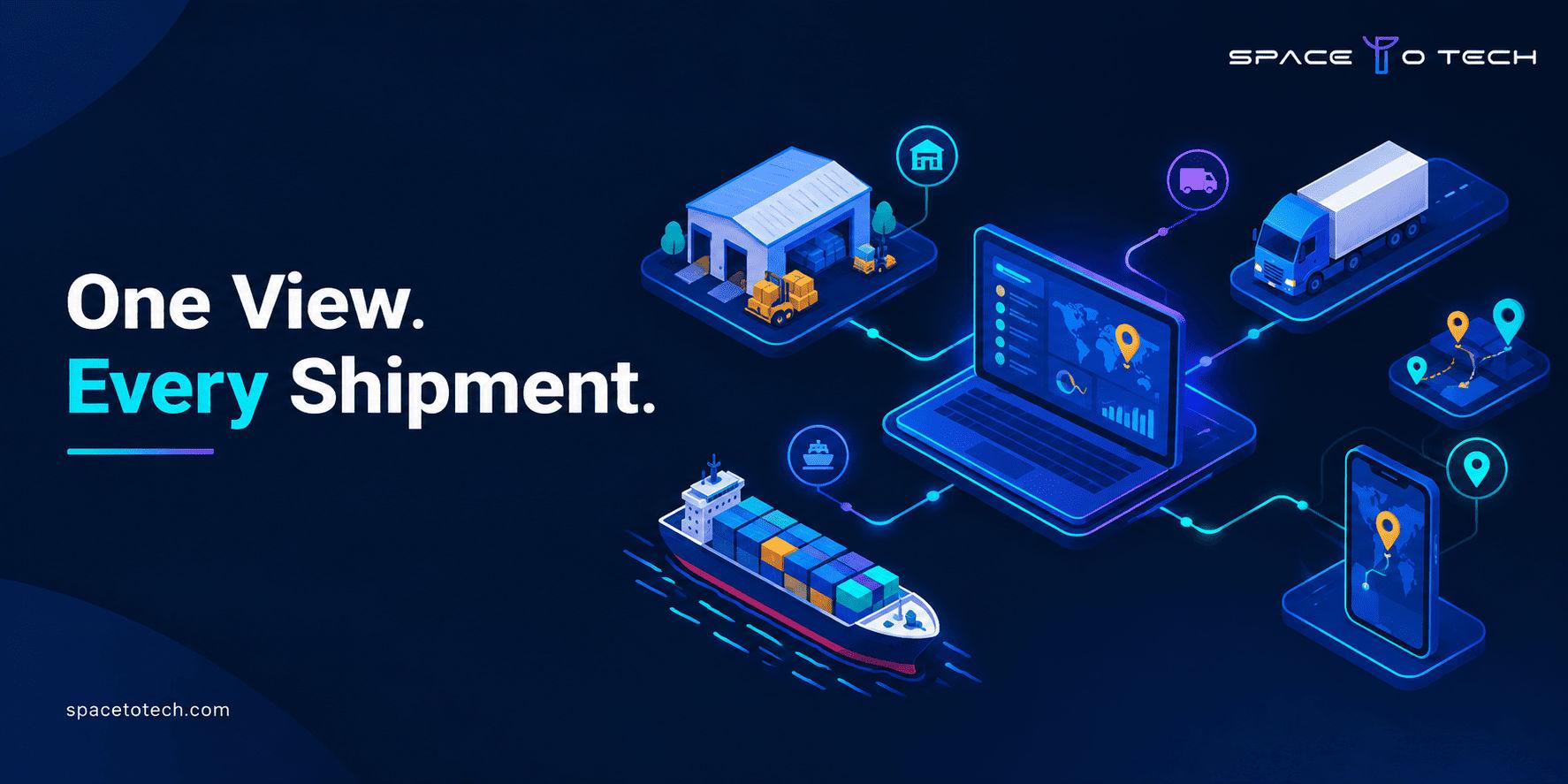
One Operational View
The goal isn't simply connecting more systems for the sake of it. The goal is a reliable, consistent flow of operational data so every team (dispatch, warehouse, customer service, finance) is acting on the same information at the same time. For logistics businesses building customer-facing dashboards or operational web portals on top of this data, our web application development for logistics platforms work focuses specifically on that kind of connected, data-driven interface.
AI and Automation in Logistics Software
AI in logistics software works best when it's applied to a specific, well-defined problem, not bolted on as a marketing feature.
Route Optimization
Machine-learning-assisted routing that adjusts to real-time traffic, weather and delivery-window changes.
Predictive ETA
Estimated arrival times that update dynamically based on live conditions rather than a static calculation set at dispatch.
Demand Forecasting
Anticipating shipment volume and resource needs based on historical and seasonal patterns.
Exception Detection
Flagging shipments or deliveries that deviate from expected patterns before they become customer complaints.
Automated Operational Alerts
Automatic notifications for delays, exceptions or capacity issues, including customer-facing updates handled through conversational interfaces. An AI chatbot can manage routine shipment-status questions, ETA changes and delay explanations without pulling a person into every conversation.
Decision Support
Surfacing the right operational data at the right moment so dispatchers and managers can make faster, better-informed calls.
It's worth saying plainly: AI isn't a requirement for every logistics platform. It earns its place where there's enough historical data and a clear operational use case, not simply because a competitor's page mentions it.
Benefits of Custom Logistics Software
- Better Operational Visibility: one consistent view of shipments, fleet and warehouse activity instead of scattered systems.
- Reduced Manual Coordination: less time spent reconciling data between tools that don't talk to each other.
- Faster Decision-Making: operational data available in real time instead of after a manual report is compiled.
- Fewer Data Silos: information flows between ERP, TMS, WMS and carrier systems instead of sitting isolated.
- Greater Workflow Flexibility: the software adapts to how your operation actually runs, not the reverse.
- Better Customer Visibility: self-service tracking and proactive updates reduce support load.
- Easier Scalability: new carriers, routes or warehouses can be added without rebuilding the whole system.
- Greater Control Over the Product and Data: you own the roadmap, the data model and the integration priorities.
Custom Logistics Software vs. Off-the-Shelf Software
Neither approach is automatically better. The right call depends on whether an existing platform can genuinely support your workflow and integration needs, or whether it's forcing your team into constant workarounds.
| Situation | Better Approach |
| Standard logistics workflows | Off-the-shelf |
| Highly unique workflow | Custom |
| Existing TMS works but reporting is weak | Custom reporting layer |
| Multiple systems don't communicate | Integration layer |
| Need a proprietary customer experience | Custom portal |
| Business processes are changing rapidly | Custom / modular approach |
| Existing platform covers 80-90% of requirements | Extend or integrate before replacing |
| Existing software creates expensive workarounds | Consider custom |
What Should Your First Version of Logistics Software Include?
You don't need to build an entire logistics ecosystem before you see any return. A focused first version, built around your most expensive bottleneck, proves the approach before you scale it.
1. Identify the most expensive operational bottleneck. Where is manual coordination costing the most time or money right now?
2. Map the users and workflow. Who touches this process daily, and in what order do they need information?
3. Identify required integrations. Which existing systems does this workflow depend on to function correctly?
4. Define the minimum viable workflow. What's the smallest version that actually solves the problem end to end?
5. Build the first operational module. Ship something your team can use, not a prototype that sits untested.
6. Measure usage and operational outcomes. Is it actually reducing manual work, or just adding another screen to check?
7. Expand into additional modules. Layer in the next workflow once the first one is proven and adopted.
This is also where a phased roadmap helps: core operational functionality first, integrations second, automation third, and analytics or AI once there's enough real usage data to make it meaningful.
Logistics Software Development Process
Requirements and Workflow Discovery
Mapping your actual dispatch, warehouse and shipment workflows, not a generic template, before any design work begins.
Architecture and Integration Planning
Deciding how the software will connect to your ERP, TMS, WMS and carrier APIs, and what the data flow between them looks like.
UX/UI Design
Designing for the people who'll use it daily: dispatchers, warehouse staff, drivers and customers, with their actual workflow in mind.
MVP Development
Building the first functional module defined in your phased roadmap, scoped tightly enough to ship and start learning from.
Integration and Testing
Connecting to live systems and validating that data flows correctly under real operational conditions, not just in a test environment.
Deployment
Rolling the software out to the team, with the operational and training support needed for real adoption.
Monitoring and Continuous Improvement
Tracking usage and outcomes after launch, then using that data to prioritize the next module or refinement.
How Much Does Custom Logistics Software Cost?
There's no honest single number here. Logistics platforms range from a narrow visibility tool built in a few months to an enterprise-wide system integrating a dozen carriers and multiple internal systems, and the gap between those two is enormous. What actually drives cost is scope, not the word "logistics" attached to the project. The main cost drivers include:
- Number of workflows and modules in scope
- Integrations required (ERP, TMS, WMS)
- Number and complexity of carrier APIs
- Real-time tracking and GPS/telematics requirements
- Mobile applications for drivers or field teams
- Dashboards and reporting depth
- Automation and workflow triggers
- AI-driven features, where genuinely justified
- Data migration from existing systems
- Security and compliance requirements
- Testing scope and post-launch maintenance
If you want to talk through where your specific requirements fall on that spectrum, our page on custom software development cost and engagement options breaks down how scope translates into budget and timeline.
Logistics Software Use Cases
Shipment Visibility Platform
Problem: Shipment information is spread across multiple carrier systems.
Solution: A centralized tracking and visibility platform.
Value: Operations teams and customers see one unified shipment view instead of checking several portals.
Fleet and Dispatch Management
Problem: Driver assignment and dispatch coordination happen manually across tools.
Solution: Centralized dispatch and fleet management software.
Value: Faster coordination and better operational control over daily assignments.
Warehouse and Delivery Coordination
Problem: Warehouse and delivery teams work from disconnected information.
Solution: Integrated warehouse, order and delivery workflows.
Value: Better synchronization between fulfillment and transportation, with fewer handoff errors.
Multi-Carrier Integration
Problem: Teams manually check multiple carrier systems for shipment updates.
Solution: A centralized carrier API integration layer.
Value: Consistent shipment data in one place and less manual checking.
Customer Tracking Portal
Problem: Customers repeatedly contact support for shipment status.
Solution: A self-service, customer-facing tracking portal.
Value: Better visibility for customers and a meaningfully lower support load.
How to Measure the Value of Custom Logistics Software
Benefits sound good on paper; what actually matters is whether the software changes daily operations in a measurable way. Track:
- Manual processing time for core workflows
- Shipment visibility (time to answer a "where is it" question)
- Dispatch turnaround time
- Delivery exception rate
- Order processing time
- Data reconciliation effort between systems
- Customer support requests related to tracking
- System adoption across the team
- Workflow completion time end to end
These are the metrics that tell you whether the platform is actually being used and actually working, not a projected percentage improvement pulled from a vendor's sales page.
How SpaceToTech Approaches Custom Logistics Software
Custom logistics software should be designed around the workflows a business actually needs to manage, not the other way around. Our broader custom software work spans warehouse and inventory workflows, route optimization, fleet visibility, shipment tracking and operational dashboards, the same building blocks covered throughout this article.
Depending on the use case, a logistics platform we build can also connect GPS and IoT data for fleet and cold-chain monitoring, barcode or RFID systems for warehouse accuracy, geofencing for location-based alerts, and carrier information for multi-carrier visibility. On the field side, our mobile development work, including Flutter app development for driver-facing tools, covers route updates, driver manifests, exception flows, live ETAs and proof-of-delivery capture, so the software works as well on a driver's phone as it does on a dispatcher's screen.
The right architecture ultimately depends on whether your business needs a complete logistics platform, a specific workflow application, or an integration layer connecting the systems you already run.
How to Choose the Right Custom Software Development Partner for Logistics
A few things matter more than a polished portfolio when you're evaluating who builds this for you:
- Logistics workflow understanding: do they ask about your dispatch and delivery process, or just pitch features?
- Integration experience: have they connected ERP, TMS, WMS and carrier APIs before, or only built standalone apps?
- API architecture: can the system handle multiple carrier integrations without becoming fragile?
- Scalability: will the architecture support more carriers, routes or warehouses without a rebuild?
- Security: how is operational and customer data protected across integrations?
- UX for operational users: is it designed for dispatchers and warehouse staff, not just decision-makers reviewing a demo?
- Mobile and field requirements: does their experience extend to driver-facing and field applications?
- QA and post-launch support: what happens after launch, when real usage surfaces edge cases?
- Ownership and documentation: do you own the code, data and documentation, or are you locked into the vendor?
- Ability to build incrementally: can they ship a focused first version and expand it, rather than requiring a full build upfront?
Custom logistics software isn't about stacking more features onto your operation. It's about building something that actually fits how your workflows, systems and people already work together. If your logistics operation has outgrown the tools it started with, talk to our team about what a focused first version could look like for your workflow.