Software Quality Assurance Services That ProtectYour Product, Brand, and Revenue

A missed bug doesn't just sit in a log file. It shows up in your App Store rating, your support queue, your next board meeting. At SpaceToTech, we catch those defects before your users do — with manual testing services and automation testing services built to ship software that works, every release.

Early defect detection

Manual + automation testing

Release-ready software quality

Reduced production risks

Improved user experience

Consistent performance assurance

Trusted by global brands

What Are Software Quality Assurance Services?

Software QA services ensure applications are secure, reliable, and high-performing before they reach users.

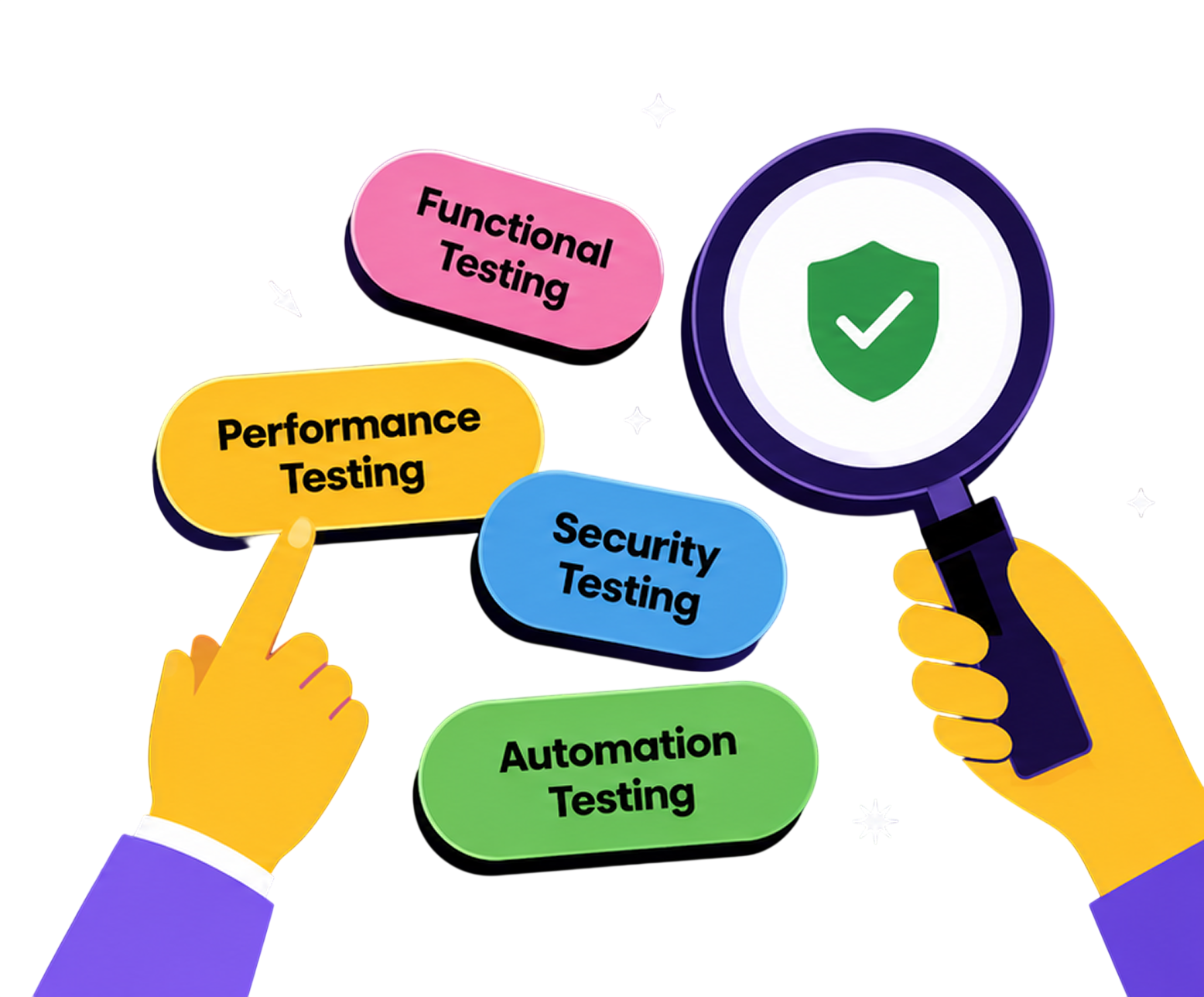
Functional Testing

Every feature you build has a specification — and functional testing verifies that specification is actually met. Our testers work through user flows, business logic, and edge cases systematically, logging every deviation against requirements.

Usability Testing

Usability testing puts real eyes on your interface with structured tasks and observation — uncovering friction points that no automated script would flag. We identify where users hesitate, abandon flows, and where UX assumptions do not match real behavior.

Compatibility Testing

Compatibility testing covers browsers, operating systems, screen resolutions, and device types — systematically, not by guesswork. If your app breaks on Firefox ESR or an older iOS version that 12% of your users still run, we find it before they do.

Exploratory Testing

Exploratory testing is structured creativity. There are no scripts — testers use the product the way real users do, probing edges, testing assumptions, and following hunches. Some of the most critical bugs in production-ready software were caught this way.

Regression Testing

Every code change is a potential break. Our regression cycles are structured to run fast, cover the right surface area, and give your team confidence to ship — so a two-week sprint does not mean three days of emergency fixes in week three.

Building Confidence Through Intelligent Quality Assurance

Reduce bugs, minimize risks, and improve product stability before the next release.

Quality assurance testing types

Our QA Testing Process — Step by Step

Most clients see their first test reports within 48 hours of onboarding. That's not because we rush — it's because our process is built for fast, structured integration with your existing workflow.

1. Requirement Analysis

2. Test Planning

3. Test Design & Scripting

4. Execution & Reporting

We review your specifications, user stories, and acceptance criteria before testing begins. This is where we identify ambiguities, flag untestable requirements, and design test coverage that actually reflects your business logic.

We define scope, testing types, environments, entry/exit criteria, and resource allocation. Your QA plan becomes a working document, not a one-time deliverable.

Test cases and automation scripts are written with reusability and maintainability in mind. Every test case maps to a requirement. Every script is peer-reviewed.

Tests run on schedule. Defects are logged in JIRA with full reproduction steps, severity ratings, and environment details. You get clear, readable reports — not raw log dumps.

Tools & Technologies We Use

Showcasing Innovative Projects & High-Performance Solutions Across Every Service

Cypress logo

Cypress

Selenium logo

Selenium

Playwright logo

Playwright

Appium logo

Appium

Quality Assurance Services with Industry-Specific Testing Expertise

SpaceToTech has delivered QA across 20+ industry verticals. Here's what that means in practice for the sectors that drive most of our work:

Healthcare & Telemedicine

Healthcare & Telemedicine

HIPAA compliance, patient data integrity, EHR integration testing, and FDA software validation in a clinical context.

Healthcare & Telemedicine

HIPAA compliance, patient data integrity, EHR integration testing, and FDA software validation. We understand what validated software means in a clinical context — access controls, audit trails, and defect evidence that hold up when regulators and care teams both need the truth.

FinTech & Banking

FinTech & Banking

PCI-DSS testing, transaction integrity, fraud-detection logic, and high-frequency platform performance.

FinTech & Banking

PCI-DSS testing, transaction integrity validation, fraud detection logic, and high-frequency trading platform performance. Errors in fintech don't just inconvenience users — they cost money. Our QA coverage is built around that reality.

E-Commerce & Retail

E-Commerce & Retail

Checkout flows, payment gateways, catalogue performance, and load testing for peak events like Black Friday.

E-Commerce & Retail

Checkout flow testing, payment gateway integration, product catalogue performance, and load testing for peak events. We've stress-tested platforms expecting Black Friday traffic levels so the first real spike is not the first real test.

SaaS & Enterprise Tools

SaaS & Enterprise Tools

Multi-tenant architecture, API reliability, and regression coverage across weekly SaaS releases.

SaaS & Enterprise Tools

Multi-tenant architecture testing, API reliability across client environments, and regression testing across weekly releases. For SaaS, continuous testing isn't optional — it's survival.

On-Demand & Logistics

On-Demand & Logistics

Real-time features, GPS accuracy, mobile-heavy workflows, and backend reliability under request spikes.

On-Demand & Logistics

Real-time feature testing, GPS accuracy, mobile-heavy workflows, and backend reliability under concurrent request spikes. Logistics QA has to hold up when the map, the network, and the queue all move at once.

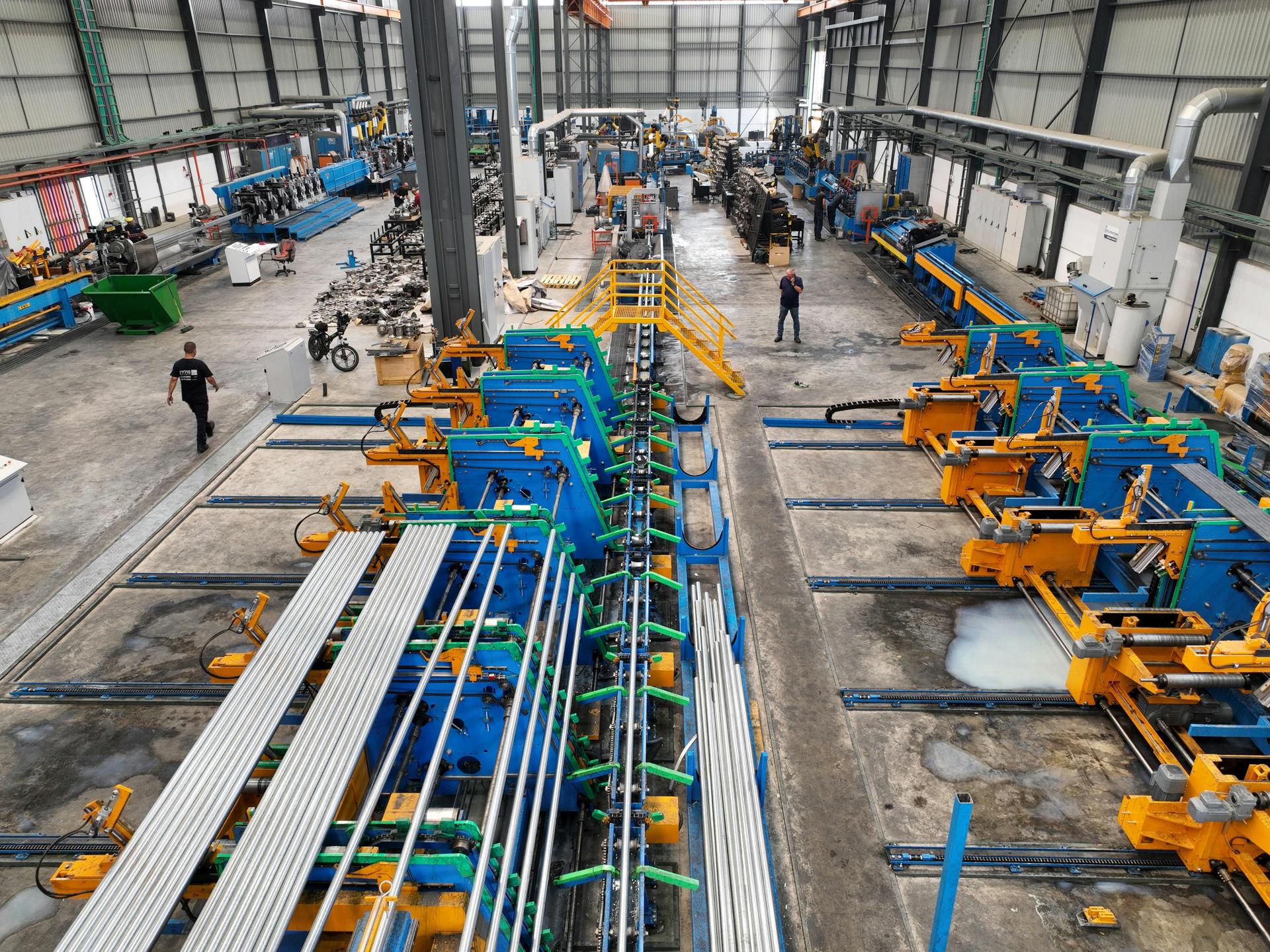
Manufacturing & IoT

Manufacturing & IoT

Embedded systems, sensor data integrity, and hardware-to-cloud integration testing.

Manufacturing & IoT

Embedded system testing, sensor data integrity, and integration testing between hardware controllers and cloud platforms. Manufacturing QA assumes noisy floors, legacy controllers, and releases that cannot take production down.

Healthcare & Telemedicine

Healthcare & Telemedicine

HIPAA compliance, patient data integrity, EHR integration testing, and FDA software validation in a clinical context.

Healthcare & Telemedicine

HIPAA compliance, patient data integrity, EHR integration testing, and FDA software validation. We understand what validated software means in a clinical context — access controls, audit trails, and defect evidence that hold up when regulators and care teams both need the truth.

FinTech & Banking

FinTech & Banking

PCI-DSS testing, transaction integrity, fraud-detection logic, and high-frequency platform performance.

FinTech & Banking

PCI-DSS testing, transaction integrity validation, fraud detection logic, and high-frequency trading platform performance. Errors in fintech don't just inconvenience users — they cost money. Our QA coverage is built around that reality.

E-Commerce & Retail

E-Commerce & Retail

Checkout flows, payment gateways, catalogue performance, and load testing for peak events like Black Friday.

E-Commerce & Retail

Checkout flow testing, payment gateway integration, product catalogue performance, and load testing for peak events. We've stress-tested platforms expecting Black Friday traffic levels so the first real spike is not the first real test.

SaaS & Enterprise Tools

SaaS & Enterprise Tools

Multi-tenant architecture, API reliability, and regression coverage across weekly SaaS releases.

SaaS & Enterprise Tools

Multi-tenant architecture testing, API reliability across client environments, and regression testing across weekly releases. For SaaS, continuous testing isn't optional — it's survival.

On-Demand & Logistics

On-Demand & Logistics

Real-time features, GPS accuracy, mobile-heavy workflows, and backend reliability under request spikes.

On-Demand & Logistics

Real-time feature testing, GPS accuracy, mobile-heavy workflows, and backend reliability under concurrent request spikes. Logistics QA has to hold up when the map, the network, and the queue all move at once.

Manufacturing & IoT

Manufacturing & IoT

Embedded systems, sensor data integrity, and hardware-to-cloud integration testing.

Manufacturing & IoT

Embedded system testing, sensor data integrity, and integration testing between hardware controllers and cloud platforms. Manufacturing QA assumes noisy floors, legacy controllers, and releases that cannot take production down.

What are the advantages of Outsourcing QA to SpaceToTech?

40–60%

Cost Savings

Software testing outsourcing to SpaceToTech gives you ISTQB-certified engineers, a proven process, and full-spectrum coverage — at 40–60% lower cost than a comparable in-house team in the US or UK.

Speed

First test reports within 48 hours of onboarding. No lengthy procurement, no ramp-up quarter.

Scale

From a single tester embedded in your sprint to a full dedicated QA team outsourcing model — we flex with your release cycles.

Coverage

Manual, automation, AI-powered, security, performance, and mobile testing under one engagement. No vendor juggling.

Transparency

Real-time JIRA access, weekly reporting, and direct communication with your assigned QA lead. No black box, no surprise invoices.

Software Quality Assurance Services for Teams Globally

ISTQB-certified QA engineers embedded in your sprint rhythm across India, USA, UK, UAE, and Australia.

World map

INDIA

Space to Tech operates from India with a QA team focused exclusively on software testing and quality assurance. The advantage isn't just pricing. It's pattern recognition built over time. Running QA across fintech, healthcare, logistics, and SaaS means edge cases get caught earlier—regression scenarios, API failures, device-specific bugs. For companies exploring software quality assurance services in India, that experience tends to show up as fewer issues reaching production and more predictable release cycles.

Projects We Are Proud Of

Domino's logo

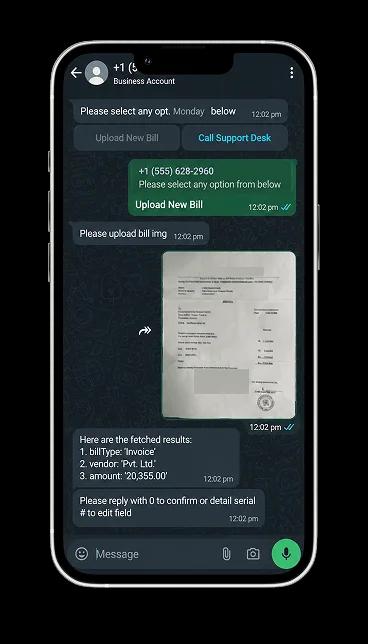
Domino's WhatsApp
Chatbot

Robust mobile ordering with live tracking, loyalty rewards, and seamless payment integration.

Domino's app preview
Vibasa logo

Vibasa Foundation

Building a kinder future through compassion, service, and collective action.

Vibasa app preview
Greenply logo

Greenply

Digital product experience for a leading brand, designed to strengthen discovery and customer trust.

Greenply app preview
Domino's logo

Domino's WhatsApp
Chatbot

Robust mobile ordering with live tracking, loyalty rewards, and seamless payment integration.

Domino's app preview
Vibasa logo

Vibasa Foundation

Building a kinder future through compassion, service, and collective action.

Vibasa app preview
Greenply logo

Greenply

Digital product experience for a leading brand, designed to strengthen discovery and customer trust.

Greenply app preview

Accelerate Agile Delivery With Reliable QA, Faster Feedback, and Better Software Quality

Faster releases with reliable software quality.

What Our Clients Say

Real outcomes, Real impact, Trusted by teams worldwide

“

SpaceToTech reduced our regression cycle from three days to under four hours. We went from shipping monthly to shipping weekly. That's not a testing improvement — that's a business model change.

Michael Carter

Michael Carter

VP Engineering

SaaS Platform, USA

“

We had a PCI-DSS audit coming up and weren't confident in our security posture. SpaceToTech ran a full penetration test, identified 11 vulnerabilities we hadn't caught internally, and helped us remediate before the audit date. Passed first time.

Jennifer Wilson

Jennifer Wilson

Director of Technology

FinTech Company, New York

“

Mobile crash rate dropped 62% in two sprints after SpaceToTech moved us onto real-device coverage and network-condition testing. Defect leakage into production is the lowest it has been in three years.

David Thompson

David Thompson

Chief Technology Officer

E-commerce Platform, Toronto

Clutch 5.0 rating

Recognized. Trusted. Preferred

Awards & Recognition

We are proud to be recognized by leading platforms and industry experts for our innovation, impact, and excellence

TopDevelopers

TopDevelopers

Top Mobile App Developers

Freelancer

Freelancer

Top Mobile App Developers

AppFutura

AppFutura

Top Mobile App Developers

GoodFirms

GoodFirms

Top Mobile App Development

Clutch

Clutch

Top Mobile App Developers

Excellence isn't claimed.It's recognized

These achievements reflect our commitment to
delivering world-class AI solutions that help
businesses grow and lead

Frequently Asked Questions About QA Services

What are software quality assurance services?
Software quality assurance services are structured testing and process verification activities carried out by dedicated QA professionals to ensure software meets defined quality standards before release. SpaceToTech provides end-to-end QA covering manual testing, automation, performance, security, and mobile — delivered as a managed service integrated into your development workflow.
What is the difference between QA and software testing?
Software testing is an activity — running tests to find defects. Quality assurance is a broader process that includes planning, methodology, standards, and continuous improvement across the entire SDLC. QA encompasses testing, but testing alone is not QA. SpaceToTech delivers both.
How much does software QA testing cost?
Costs vary by scope, team size, and testing types required. Software testing outsourcing to SpaceToTech typically runs 40–60% lower than equivalent in-house US or UK QA team costs. Engagements start with a scoping call where we assess your needs and provide a fixed or flexible quote. No lock-in contracts.
How long does a typical QA engagement take?
Most clients receive their first test reports within 48 hours of onboarding. Full engagement scope depends on project complexity — a focused API testing sprint can run 2–3 weeks, while ongoing embedded QA is structured per release cycle. SpaceToTech adapts to your sprint rhythm.
Do you provide QA for mobile apps?
Yes. SpaceToTech's mobile software testing services cover iOS and Android, native and cross-platform apps (React Native, Flutter), across real devices and multiple network conditions. We test for crashes, performance, layout issues, and integration bugs — not just on emulators.
What testing tools does SpaceToTech use?
Our stack includes Selenium, Playwright, Cypress, and Appium for automation; Postman and REST Assured for API testing; JMeter and Gatling for performance; OWASP ZAP and Burp Suite for security; and JIRA with TestNG for test management. Tool selection is matched to your tech stack and project needs.
Can you integrate with our existing CI/CD pipeline?
Yes. CI/CD integration is a standard part of our automation engagements. We work with Jenkins, GitHub Actions, GitLab CI, CircleCI, and Azure DevOps. Tests run automatically on every commit or pull request, with results reported directly into your pipeline. No manual trigger, no broken feedback loop.
Do you offer a dedicated QA team model?
Yes. Dedicated QA team outsourcing is one of SpaceToTech's most popular engagement models — a fixed team of ISTQB-certified QA engineers embedded in your sprint cycles, working exclusively on your product. Scales from one tester to a full squad depending on release volume and coverage requirements.
Do you offer AI-powered testing services?
Yes. SpaceToTech's AI-powered testing services include self-healing test automation, AI-assisted test generation, and anomaly detection integrated into your CI/CD pipeline. According to the World Quality Report, 72.8% of QA engineers now consider AI testing a top priority — and SpaceToTech has already built it into our standard service delivery.
Which industries do you serve?
SpaceToTech has active QA engagements across healthcare, fintech, e-commerce, SaaS, on-demand platforms, manufacturing, and more — 20+ verticals in total. Industry-specific knowledge matters in testing: a healthcare tester needs to understand HIPAA; a fintech tester needs to understand PCI-DSS. Our teams are matched by domain expertise, not just technical skill.

Supporting Insights

Mobile App Development Cost
Blogs30/09/2026

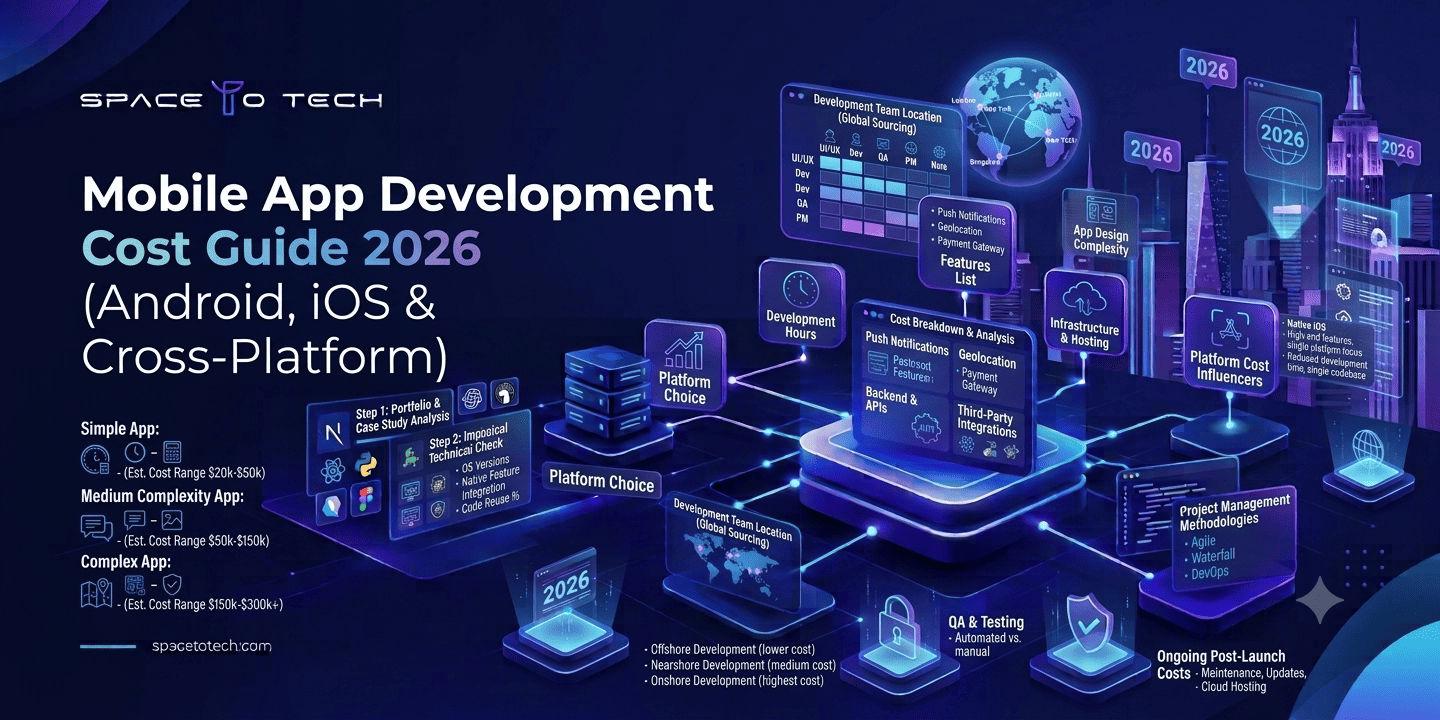
Mobile App Development Cost Guide 2026 (Android, iOS & Cross-Platform)

How Much Does Mobile App Development Cost in 2026? Short answer: A simple app typically costs $10,000-$40,000, a medium-complexity app $40,000-$120,000, and a complex app $120,000-$300,000 or more. Timelines run from 2 to 12+ months. App Complexity Typical Cost (USD) Timeline Simple $10,000-$40,000 2-4 months Medium $40,000-$120,000 4-8 months Complex $120,000-$300,000+ 8-12+ months These figures are indicative market ranges. Quotes vary by scope and vendor. One number is misleading because scope, platform, region and team model all move the price. Every mobile app development company also prices differently: fixed-price suits well-defined projects, hourly (time-and-materials) suits evolving scope, and a dedicated team suits long-term product work. Mobile App Development Cost by Platform: Android vs iOS vs Cross-Platform Your platform choice shapes both budget and reach. Android app development means building for a wide range of screen sizes and devices, which adds testing time. Developers typically use Kotlin or Java. iOS development uses Swift and targets a narrower device range, so testing is simpler. Budget extra time for App Store review. Cross-platform development uses one codebase for both stores. Flutter and React Native are the leading frameworks, and they often reduce cost and time to market compared with two native builds. The trade-off is that highly graphics-intensive or hardware-dependent apps may still need native code. Approach Relative Cost Performance Best For Android native Medium High Android-first markets iOS native Medium High  Premium, iOS-heavy audiences Cross-platform Lower Good-High MVPs, startups, broad reach PWA Lowest Moderate Content and lightweight tools Tip: Look at your audience geography. iOS dominates spending in the US, while Android leads user share in India. App Development Cost by Complexity Simple apps have basic screens, limited features and often no custom backend, such as calculators or brochure-style apps. Medium apps add custom UI, user accounts, APIs, payments and an admin panel. Most business apps sit here. Complex apps include real-time features, AI, IoT integration, advanced security and high scalability, such as fintech platforms or marketplaces. MVP vs full product: Startup founders should consider launching a minimum viable product with core features first. This validates demand before you invest in a full-scale product. An experienced mobile app development partner will help you decide which features belong in version one. Key Factors That Influence Mobile App Development Cost Features and functionality: Login, payments, chat, maps and push notifications each add hours. Payments and real-time chat are among the costliest. UI/UX and mobile app design: Custom animations and unique design systems cost more than template-based interfaces, but they improve retention. Backend, integrations and security: Third-party APIs, cloud architecture and compliance (GDPR, HIPAA, PCI-DSS) raise both effort and testing. Team size, seniority and timeline: A typical project involves a project manager, designer, developers and QA engineers. Rushed deadlines usually carry a premium. Tech stack: Popular stacks make hiring easier and reduce long-term risk. Niche stacks can inflate costs. Expert insight: In our experience at SpaceToTech , uncontrolled scope creep is the most common cause of budget overruns. A written scope document with change-request rules protects both sides. Cost Breakdown by Development Stage Custom app development follows a lifecycle, and the budget is distributed roughly like this: Stage Approx. Share Key Deliverables  Discovery and requirements 5-10% Research, technical specification UI/UX design 10-15% Wireframes, prototypes Development and integration 40-50% Frontend, backend, APIs QA testing and launch 15-20% Manual and automated tests, store submission Skipping discovery is a false economy. A solid specification prevents expensive rework later. Mobile App Development Cost by App Type and Industry E-commerce and retail : Product catalogues, payment gateways and inventory sync. Fintech and banking: KYC, encryption and regulatory compliance push costs higher. Healthcare and telemedicine: Video consultations, HIPAA-grade privacy and secure data storage. On-demand, logistics and social apps: Real-time tracking, matching algorithms and scalable infrastructure. AI chatbot and enterprise apps: Custom workflows and integrations with internal systems. SpaceToTech builds AI chatbots alongside mobile applications for businesses that want intelligent customer engagement. Regulated industries such as fintech and healthcare generally cost the most because of compliance and security testing. App Development Cost by Region: India vs USA vs UK vs Europe Location is one of the biggest price levers. These are indicative hourly ranges:  Region  Typical Hourly Rate  Pros and Cons India $20-$50 Cost-efficient, large talent pool; vetting required  Eastern Europe  $40-$80  Strong engineering, moderate cost UK / Western Europe $70-$150 Close collaboration; higher cost USA $100-$200 Time-zone and market proximity; highest cost The top mobile app development companies in India combine competitive rates with mature delivery processes, but quality varies. Check portfolios, references and verified reviews. Onshore, offshore or nearshore? Offshore teams offer the lowest rates. Nearshore teams share your time zone. Whichever you choose, confirm IP protection in writing. Think in terms of total cost of ownership : rework, management overhead and communication gaps can erase a low hourly rate. Top Mobile App Development Companies: How to Compare Pricing and Choose the Right Partner Searching for the top mobile app development companies in the world can be overwhelming. Instead of chasing rankings, evaluate each mobile app development agency against clear criteria. What defines a top app development company A relevant portfolio and live apps you can test Technical depth across Android, iOS and cross-platform Verified client reviews and references Process maturity: discovery, agile sprints, QA and post-launch support Using Clutch and other review platforms Directories like Clutch publish verified client reviews, hourly-rate ranges and project-size data. When you browse the top mobile app development companies on Clutch , read the detailed reviews rather than only the overall score, and cross-check with other platforms and direct references. Top mobile app development companies in the USA vs India The top mobile app development companies in the USA offer proximity, strong product strategy and familiarity with local regulation, at premium rates. Mobile application development companies in India, including Delhi NCR-based SpaceToTech, typically offer lower rates and scalable teams. Neither is automatically better. Choose based on budget, communication needs and project complexity. Red flags to watch for Vague quotes with no feature-level breakdown No discovery phase No post-launch support or maintenance plan Unwillingness to share references Questions to ask before signing Who owns the source code and IP? Will you receive full code handover? What SLAs cover bug fixes and support? Can I speak with past clients? Hidden and Ongoing Costs Many founders budget for the build and forget what follows: Maintenance and updates: Commonly 15-20% of build cost per year, covering OS updates, bug fixes and security patches. Hosting and cloud: Costs grow as your user base grows. Third-party APIs and licences: Maps, SMS, payments and analytics often carry usage-based fees. App store and compliance fees: Apple's developer programme is $99/year and Google Play has a one-time $25 fee, plus platform commissions on in-app sales. Check current terms before budgeting. Checklist: Build a first-year budget worksheet covering maintenance, hosting, APIs, store fees and marketing. How AI Is Changing Mobile App Development Costs in 2026 AI cuts some costs and adds others. Savings: AI-assisted coding, automated testing and faster prototyping shorten delivery cycles and reduce QA hours. New costs: Features like chatbots, recommendations and personalisation add development effort plus ongoing LLM API usage fees. Build vs buy: Pre-trained APIs are faster and cheaper to start with. Custom models cost more but offer differentiation and data control. Trends to watch: On-device AI, agentic app experiences and low-code acceleration are reshaping how software development teams estimate projects. How to Reduce App Development Cost Without Compromising Quality Start with an MVP. Prioritise features using the MoSCoW method (Must, Should, Could, Won't). Choose cross-platform where suitable. A shared codebase can materially reduce build cost. Reuse components. Design systems, open-source libraries and SDKs save hours. Define scope in writing. Clear documentation prevents costly changes. Use milestone-based payments. They tie spending to delivered results. Invest in discovery. It lowers rework risk. Plan post-launch upfront. Budgeting for maintenance avoids emergency spending. The right mobile app development partner will advise you honestly on where to cut and where not to. Conclusion Mobile app development cost in 2026 is not a single number. It depends on your app's complexity, your platform choice, the features you prioritise, and where your development team is based. Simple apps start around $10,000, while complex, compliance-heavy products can exceed $300,000. Cross-platform frameworks, a well-scoped MVP and a proper discovery phase are the most reliable ways to control spend without cutting quality. Remember that the build is only the beginning. Budget 15-20% of the initial cost each year for maintenance, hosting, APIs and store fees, and factor in the impact of AI, which can trim development time but add new feature and usage costs. Just as important is who you build with. Rather than chasing rankings, compare mobile app development companies on portfolio strength, verified reviews, transparent pricing, IP ownership and post-launch support. Whether you are weighing the top mobile app development companies in the USA or in India, the right mobile app development partner is the one that understands your goals and is honest about trade-offs. Ready to plan your app with clarity? Talk to SpaceToTech's mobile app development team for a free, no-obligation estimate tailored to your project.

React Native App Development Agencies
Blogs04/06/2026

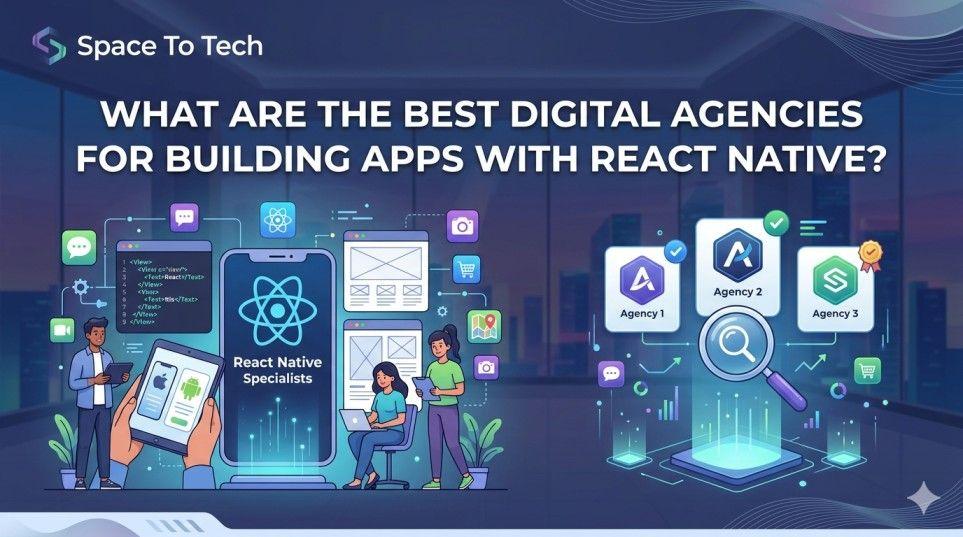
What Are the Best Digital Agencies for Building Apps With React Native?

What Are the Best Digital Agencies for Building Apps With React Native? Choosing the right React Native app development agency in 2026 is one of the most important decisions you will make for your mobile product. The market is flooded with hundreds of vendors all claiming to be the best — but the reality is that most are generalists with a React Native checkbox on their website, not specialists who live and breathe cross-platform mobile. This guide cuts through the noise. We evaluated over 40 agencies across portfolio depth, client reviews, pricing transparency, team expertise, and post-launch support. Whether you are a startup founder building your first MVP or an enterprise CTO scaling a product used by millions, you will find a reliable React Native development company on this list — and a clear framework for choosing the right one. Why React Native Is Still the Smart Choice in 2026 React Native powers apps for Meta, Microsoft, Shopify, and thousands of startups worldwide. In 2026, with the new JSI/Fabric architecture fully stable, its performance gap with native development has virtually closed. For most business applications, it delivers: Up to 40–60% cost savings vs. building separate iOS and Android apps A single JavaScript/TypeScript codebase with ~95% code reuse across platforms Access to the world’s largest developer talent pool (JavaScript) Faster time-to-market — critical for  For most product teams, custom React Native app development services offer the best balance of speed, cost, and quality in cross-platform mobile app development. How We Evaluated the Agencies Every agency on this list was assessed against six criteria: Portfolio quality and industry depth (fintech, healthcare, e-commerce, SaaS) Verified client reviews on Clutch, GoodFirms, and Google Pricing transparency and engagement model flexibility Team size, seniority mix, and React Native specialisation Communication standards and project management tools (Jira, Notion, Slack) Post-launch maintenance, SLA commitments, and long-term support Top React Native App Development Agencies in 2026 #1. SpaceToTech — Best Overall React Native Agency in 2026 Why SpaceToTech Leads This List SpaceToTech is our top pick for teams that need a true React Native app development partner — not just a vendor. Their dedicated team model, transparent pricing, and full-cycle development process make them the standout choice for both startups and enterprises in 2026. SpaceToTech is a specialist React Native app development company serving clients globally from its India-based team. What sets them apart is their obsessive focus on delivery quality — not just shipping code, but building scalable, maintainable products that grow with your business. Startup MVPs, enterprise mobile platforms, fintech, e-commerce, SaaS products Fixed price, time & material, dedicated team $25–$50/hr — delivering exceptional value without cutting corners Ongoing maintenance plans, performance monitoring, dedicated account manager End-to-end React Native expertise, proven delivery framework, and a client-first culture backed by verified 5-star reviews → Ready to build your app? Visit spacetotech.com to request a free project consultation. #2. Toptal — Best for High-Budget Enterprise Projects Toptal connects you with the top 3% of freelance React Native developers globally. Ideal for large enterprises with complex requirements and budgets to match. Hourly rates start at $150, making it less suitable for bootstrapped startups but excellent for organisations that need battle-tested senior talent fast. #3. Appinventiv — Best for Mid-Market and Growth-Stage Companies One of India’s most recognised React Native development companies , Appinventiv has delivered over 900 apps across healthcare, retail, and logistics. Strong project management processes and a large team make them reliable for mid-market digital transformation projects. #4. Simform — Best for Product Companies Simform operates as a true product engineering partner. Their React Native practice is mature, and they excel at long-term engagements where you need a stable, dedicated team embedded in your development cycle. Highly rated on Clutch with a 4.9-star average. #5. Yalantis — Best for Fintech and Healthcare Apps Based in Ukraine with US offices, Yalantis brings deep domain expertise in regulated industries. If your React Native app handles financial transactions or patient data, their compliance-first development approach is a significant advantage. #6–10. Other Strong Contenders Intellectsoft — Enterprise-focused, strong IoT + mobile integration Rootstrap — Excellent for funded US startups needing a full product team Softeq — Hardware-linked mobile apps, strong in Germany and USA Openxcell — Best affordable React Native development services for budget-conscious MVPs Bacancy Technology — Agile React Native teams for SaaS and startup scaling Agency Comparison Table: Pricing, Location & Specialties Use this table to quickly compare your shortlisted agencies before reaching out:  Agency  Location  Hourly Rate  Best For  Rating SpaceToTech India / Global $25–$50 Startups, MVPs, Enterprise ★ 5.0 Toptal USA / Remote $150–$250 Enterprise, High-budget ★ 4.8 Intellectsoft USA / Ukraine  $50–$99  Enterprise, IoT apps  ★ 4.7 Appinventiv  India / UAE $25–$49 Startups & Mid-market ★ 4.8 Simform USA / India $25–$49 Product companies  ★ 4.9  Yalantis Ukraine / USA $50–$99 Fintech, Healthcare ★ 4.7 Rootstrap USA / Uruguay $50–$99 Funded startups ★ 4.6 Softeq USA / Germany $50–$99 Enterprise, Hardware-linked ★ 4.7 Openxcell India $20–$40  Budget-friendly MVPs  ★ 4.6  Bacancy Technology India / USA $25–$50 Agile teams, SaaS ★ 4.7 How to Choose the Right React Native Agency for Your Project Hiring a React Native development team is not just a technical decision — it is a business relationship. Ask these five questions before signing any contract: Do they have proven experience in your specific industry vertical? Can they show live apps in the App Store / Google Play built with React Native? What is their engagement model — fixed scope or iterative sprints? Who owns the code and IP at project completion? What does post-launch support look like and is it included? Red flag to watch for: agencies that quote unusually low rates but cannot provide verified client references or a GitHub portfolio. When you outsource React Native development , the cheapest option almost always becomes the most expensive in the long run. How to Hire a React Native App Development Agency (Step-by-Step) Once you have shortlisted a few names from the list above, the next question is how to hire a React Native app development agency without losing weeks to back-and-forth calls. Some founders want to hire React Native developers as a dedicated team. Others are weighing a React Native software development agency against a single freelancer. The process below applies to most engagements, whether you are building a first MVP or scaling a mature product. Choosing among the best React Native development agencies is only half the job. The other half is picking the right engagement model, vetting technical depth, and locking down the contract. React Native Hiring Models: Hourly, Dedicated Team, or Project-Based Most React Native development agencies offer three ways to bring their engineers onto your project. The right one depends on how defined your scope is and how long you expect to need the team. The same models apply if you are shopping for a general native app development agency or a specialist in React Native development services. Model Best For Billing Typical Minimum Hourly Small fixes, audits, short scopes  Weekly A few hours to a few weeks Dedicated Team Ongoing product development, fast-scaling startups Monthly 1–3 months Project-Based (Fixed Scope) Well-defined MVPs with a fixed budget and timeline Milestone-based  Full project duration If your scope is still changing, a dedicated team usually works better than a fixed-price contract. If you have a clear specification and a hard budget, project-based billing keeps costs predictable. The Hiring Process, Step by Step 1. Share your requirements. Tell the agency your tech scope, timeline, and team size. A serious React Native development agency will ask about target platforms, integrations, and any existing codebase before quoting a number. Mention whether you also need Android app development or iOS-specific work, since this shapes team composition. 2. Review vetted profiles or a live portfolio. Ask for matched developer profiles, or for real apps on the App Store and Google Play rather than case study screenshots. A live React Native mobile app you can download and test tells you more than any pitch deck. 3. Interview and check technical depth. Speak directly with the React Native engineers who would work on your product, not just the sales lead. Ask specifically about experience with JSI, Fabric, and Turbo Modules, the building blocks of React Native's New Architecture. Agencies still running legacy-bridge workflows tend to be slower and costlier to maintain long-term. 4. Sign off and onboard. Confirm IP ownership, NDA terms, and communication tools (Slack, Jira, Notion) before work begins. Then track progress against a defined sprint or milestone schedule. Why React Native's New Architecture Matters When You Hire React Native's New Architecture, built on JSI (JavaScript Interface), Fabric, and Turbo Modules, replaced the older asynchronous bridge with a faster, more direct communication layer between JavaScript and native code. Agencies that have migrated their internal workflows and client apps to this architecture typically ship features with lower memory overhead and fewer runtime crashes than teams still on the legacy bridge. This is why the React Native framework's current state should shape your vetting questions. When you hire a React Native app development agency, ask whether their recent projects use the New Architecture. It is a fast way to separate teams that are current with React Native application development from generalists working off outdated tutorials. The same test applies whether you are evaluating a top React Native development agency or a smaller boutique studio In-House vs Freelancer vs Dedicated Agency Team Many teams debate whether to hire React Native developers in-house, look for freelance React Native talent, or partner with an agency. Here is how the three options compare. Factor In-House Hire Freelancer Dedicated Agency Team Time to Onboard Weeks to months Days to weeks, variable  Days to about two weeks Cost Highest: salary, benefits, infrastructure Unpredictable Predictable, no overhead Quality Consistency High, if hiring is right Inconsistent Vetted, senior-led Scalability Slow, new hiring cycles needed Limited to one person Scale team up or down on demand Best For Long-term core product roles One-off, narrowly scoped tasks Ongoing development, startup to enterprise Freelance React Native developers can be a good fit for a quick bug fix or a narrowly scoped feature. For a full app build, though, a dedicated team from an established agency brings project management, QA, and backup coverage that a solo contractor can't. In-house hiring makes sense once React Native development becomes a long-term core function of your company. React Native vs Flutter: Which Should You Choose in 2026? This is the question every CTO asks. Here is an honest comparison:  Factor  React Native  Flutter Language JavaScript / TypeScript Dart Performance Near-native (JSI/Fabric 2026) Excellent (compiled to native) Developer Pool Very large (JS ecosystem)  Growing, smaller than JS Code Reuse ~95% cross-platform  ~95% cross-platform Best For Startups, web-adjacent teams High-fidelity UI, Google-first Community Mature, Meta-backed Growing, Google-backed Avg. Agency Cost Slightly lower (wider talent) Slightly higher Our verdict: If your team has JavaScript experience, or you need to share logic with a web product, React Native is the stronger choice in 2026. Flutter is excellent for UI-heavy apps where design fidelity is the priority. Either way, working with an agency specialising in React Native apps — rather than a generalist shop — will deliver better outcomes for either framework. React Native App Development Cost in 2026 One of the most-searched questions in this space. Here is what you can expect to pay: $8,000–$25,000 $25,000–$80,000 $80,000–$250,000+ India-based agencies like SpaceToTech typically charge $25–$50/hr vs. $100–$250/hr for US or Western European agencies — for comparable (often superior) technical output. Affordable React Native development services do not mean cutting corners; they mean leveraging cost-effective talent markets with rigorous quality controls. Conclusion: Which React Native Agency Should You Choose? The best React Native app development agency in 2026 is not necessarily the biggest or the most expensive — it is the one that best aligns with your product vision, timeline, and budget. For the majority of startups, scaleups, and mid-market companies, SpaceToTech offers the most compelling combination of deep React Native expertise, transparent pricing, and a proven delivery process. For large enterprises with complex, high-stakes builds, agencies like Toptal or Yalantis are worth the premium. Whatever you decide: do not rush it. Vet the portfolio, read the Clutch reviews, and have a discovery call before committing. The right React Native app development partner will feel less like a vendor and more like an extension of your own team. → Build smarter in 2026. Contact SpaceToTech at spacetotech.com for a free 30-minute consultation and project estimate.


Web Development Consulting Agency
Blogs29/09/2026

How to Choose the Right Web Development Consulting Agency (2026 Guide)

Choosing a web development consulting agency is one of the most consequential technology decisions a growing business makes. Choose well and you launch faster, avoid rework, and build a platform that scales. Choose poorly and you inherit technical debt, missed deadlines, and code you don't control. This guide explains what these partners do, what to expect, and how to evaluate them. What Is a Web Development Consulting Agency? A web development consulting agency provides strategic guidance on architecture, tech stack, UX, security, and scalability. Typical deliverables include a technical audit, solution architecture, discovery workshop, and roadmap. The consultant acts as advisor, while a development team acts as builder. Consulting Agency vs. Web Development Agency vs. Freelancer   Consulting agency Web development agency Freelance consultant Scope Strategy plus optional delivery Design and build Narrow, task-based Cost Medium to high Medium to high Low to medium Scalability High High Limited Accountability Shared, contractual Team-level Individual Best for Complex or high-risk projects Well-defined builds Small fixes, second opinions When Specialization Matters Custom web development consultants add the most value in regulated or integration-heavy sectors such as fintech, healthcare, eCommerce, and SaaS. A generalist may suit a brochure site, but niche experience protects you from compliance and integration mistakes. Good consulting should drive measurable outcomes: faster time-to-market, lower rework cost, better conversion, and less technical debt. Tie each to a KPI such as Core Web Vitals, conversion rate, or uptime. What Does Full Website Development Include? Website development is a lifecycle, and consulting adds value at each stage: discovery, planning, design, development, QA, launch, and post-launch. Design: Brand consistency, accessibility (WCAG), and mobile-first layouts. Good web design balances beauty with usability. Technical SEO: Site architecture, schema markup, crawlability, URL structure, and Core Web Vitals. Retrofitting SEO costs far more than building it in. Front-end, back-end, and integrations: CMS choice, APIs, and CRM, ERP, or payment integrations. Headless versus traditional architecture should be decided by your content and scale needs. Security: HTTPS, OWASP risk mitigation, and GDPR and privacy compliance. Web Development Consulting Services: What a Good Firm Offers Reputable web development consulting firms typically provide: Web application development and architecture advisory: Custom web app and SaaS builds, with frameworks (React, Next.js, Node, .NET, Laravel) chosen for fit rather than fashion. Website development and redesign: New build, rebuild, or incremental redesign. A redesign is warranted by high bounce rates, an outdated stack, or poor mobile UX. Technology advisory: Stack selection, build-vs-buy analysis, and vendor evaluation, delivered as an assessment report and roadmap. DevOps and CI/CD: Automated deployments, monitoring, and rollback, which mean fewer outages and faster releases. Website speed optimization: Improving LCP, INP, and CLS through caching, CDN, and image optimization. Faster pages support conversion, so verify any load-time statistics against current Google or Deloitte research before citing them. Maintenance and support: Updates, security patches, SLAs, and uptime monitoring. Specialized Expertise: UI/UX, Cloud, and Legacy Modernization UI/UX consulting includes audits, user research, wireframes, and usability testing, measured by task completion, drop-off, and conversion. Cloud migration follows one of three paths: Approach Effort Risk Best for Lift-and-shift Low  Low Speed, minimal change Re-platform  Medium  Medium Cost optimization Re-architect High  Higher Long-term scalability Legacy modernization is needed when technology is unsupported, releases are slow, or integrations are blocked. Phased approaches such as the strangler pattern usually beat a big-bang rewrite. Verify expertise by asking for certifications, architecture samples, named clients, and measurable outcomes.  Modern Web Development Technology: Substance Over Buzzwords Modern stacks such as headless architecture, PWAs, API-first design, and serverless can improve performance, scalability, and maintainability. Trends like AI-assisted development, composable architecture, and edge computing are worth discussing where adoption is real. The best development consulting avoids over-engineering. Ask any prospective partner why a technology suits your project and what the alternatives were. To future-proof your site, insist on scalability planning, documentation, and protection against vendor lock-in. Long-Term Partnership: Why Support Matters Launch is the beginning. Security patches, performance drift, and content growth demand ongoing attention. A solid SLA covers response times, uptime commitments, escalation paths, and regular reporting. Retainers offer cost predictability and suit scaling companies, while ad-hoc support offers flexibility for startups. Insist on documentation, code ownership, and clean handover. An agency that holds your code hostage is a red flag. How to Choose the Right Web Development Consulting Agency: 6 Evaluation Criteria Define goals, budget, and scope first. List business objectives, must-haves, timeline, and internal resources. Check relevant experience. Look for industry fit, comparable project size, and live examples. Evaluate technical depth and team structure. Ask about the senior-to-junior mix, in-house versus outsourced staff, and certifications. A stable web development team beats a rotating cast. Assess process and communication. Compare agile versus waterfall, reporting cadence, time-zone overlap, and tooling. Verify reviews and proof. Check Clutch, GoodFirms, and Google reviews, and speak to past clients. Compare proposals objectively. Use a weighted scoring matrix covering scope clarity, hidden costs, and risk. Web Development Consulting Pricing and Engagement Models Model Risk to you Flexibility  Budget predictability Hourly High High Low Fixed-price Low Low High Retainer Medium Medium High Dedicated team Medium High Medium-high Cost depends on scope, complexity, integrations, region, and team seniority. As rough estimates (verify against current sources before publishing), advisory audits may start in the low thousands of dollars, business websites in the low-to-mid five figures, and complex web application projects in six figures. To avoid hidden costs, clarify change-request rules, third-party licenses, hosting, and post-launch support in writing. Red Flags and Key Questions Before Hiring Seven red flags: Vague proposals No discovery phase Guaranteed rankings No code ownership Unrealistic timelines Refusal to share references No defined development process Ask on the first call: How does your process work? Who will actually work on my project? What has gone wrong before and what did you learn? How do you handle security? Who owns the code? Common mistakes: choosing on price alone, skipping references, and leaving success metrics undefined. Pre-signing checklist: contract terms, IP ownership, SLAs, and an exit clause. Conclusion Choosing the right web development consulting agency comes down to three decisions: what you need (advice, building, or both), how to evaluate candidates (experience, depth, process, proof), and how to protect yourself (transparent pricing, code ownership, and a solid SLA). Ready to move forward? Book a free discovery call with SpaceToTech and get a clear roadmap for your project.


Ready to Ship Software Your Users Will Actually Trust?

Get a free consultation, a no-obligation audit of your current QA coverage, and an engagement model that works with your team's rhythm.

We’ve been helping Customer globally

So how does it work? Check for yourself by their feedback.

Client Feedback

We Build Digital Products That Drive Real Growth

From idea to launch, we help startups and enterprises build scalable apps, AI solutions & custom software.

View Our Work
Trusted byGlobal Clients

150+Projects Delivered

OngoingSupport
UAE

UAE

USA

USA

INDIA

INDIA

Book a Free Consultation

Your information is safe with us.