AI Chatbot Development in India -Intelligent Bots for Every Business

Businesses don't just need chatbots - they need faster responses, fewer support tickets, and a way to capture leads even after hours. That's where SpaceToTech's AI chatbot development makes the difference. We build intelligent chatbots that go beyond scripted replies - handling customer queries, qualifying leads, booking demos, and integrating seamlessly with your internal systems.

Improve response time by up to 50%

Reduce support workload by 40%

Increase lead capture after hours

Context-aware and self-learning bots

Seamless system integrations

Built for production, not demos

Trusted by global brands

What You Can Expect

0+

Chatbot Projects

0+

Industries Served

0%+

Ticket Deflection

24/7

Availability

Types of AI Chatbots We Develop In India

Different problems need different bots. A support chatbot is not built the same way as a lead generation assistant.
That's where most projects go wrong.

Customer Support Chatbots

Support teams often handle the same queries orders, refunds, and basic issues. Chatbots automate these, provide instant answers, and connect with tools like Zendesk or Freshdesk, involving humans only when needed.

Lead Generation & Sales Chatbots

Capture and qualify leads 24/7 without making prospects wait. These bots ask pre-screening questions, collect contact details, and route hot leads directly to your sales team's CRM.

WhatsApp & Messenger Chatbots

Meet your customers where they already spend their time. We build conversational flows on WhatsApp and Facebook Messenger for instant engagement, updates, and frictionless commerce.

Voice-Enabled Bots

Implement voice-driven interactions for hands-free support and accessibility. Perfect for smart home integrations, drive-through automation, and modern IVR systems.

Internal HR & IT Bots

Reduce the burden on internal teams by automating employee onboarding, leave requests, and common IT troubleshooting queries with a self-serve assistant.

E-commerce Chatbots

Guide users through product catalogs, offer personalized recommendations, and recover abandoned carts right within the chat interface to drive more revenue.

Real Business Impact: How Our AIChatbot Services Drive Growth

Our AI Chatbot Development Services In India

Most chatbot projects fail before development even starts.
Wrong assumptions. Wrong architecture. Wrong expectations.

Chatbot Strategy & Consulting

Discovery, use-case prioritization, and a delivery plan so your bot solves real workflows—not vanity demos.

Learn More

Conversational UX Design

Flows, tone, and fallbacks tuned for how people actually type—so handoffs to humans feel intentional, not broken.

Learn More

Custom AI Chatbot Development

No templates. Each chatbot is built for your data, use case, and systems—Dialogflow, Rasa, or GPT-based models focused on outcomes.

Learn More

Multi-Channel Deployment

Web, mobile, WhatsApp, Slack—users don't stay in one place. Bots are deployed across channels with consistent behavior.

Learn More

CRM & System Integration

Integrated with CRM and support tools, bots can look things up, update records, and handle tasks beyond surface-level answers.

Learn More

Maintenance & Support

AI models drift over time. Ongoing updates keep your chatbot relevant, accurate, and aligned with how users actually converse.

Learn More

Why Businesses Choose SpaceToTechfor Chatbot Development in India

Chatbot development and enterprise security

100%

Data sovereignty with on-premise deployment and PII scrubbing. We ensure your enterprise security is never compromised with full IP protection and strict protocols.

Security First

On-premise deployment and PII scrubbing are non-negotiable for enterprise clients. We offer full data sovereignty.

Human In The Loop

Bots aren't magic. We build seamless 'handovers' so complex issues reach your human agents instantly with context.

Whatsapp Costs

Integration is more than an API. We handle BSP management and session optimization to save you thousands in Meta fees.

Building Future-Ready Digital Experiences Across Industries

Our achievements are driven by real results—high-performing apps that support growth and deliver lasting business impact.Discover projects where we created meaningful outcomes.

Max Life Insurance

Transforming Digital Insurance Experience

The Problem

Max Life Insurance aimed to modernize its digital platform to deliver a seamless and user-friendly experience. The existing system lacked intuitive navigation, real-time tracking, and personalized features, making policy management inefficient.

Our Approach

Our team developed a high-performance, user-centric digital platform with intuitive UI/UX, secure and scalable architecture, real-time policy tracking, personalized dashboards, and seamless third-party integrations to enhance overall user experience.


What We Achieved

  • Improved user engagement and retention
  • Faster and seamless policy management
  • Enhanced customer experience with better UX
  • Scalable platform supporting growing users
Max Life Insurance App

What Most Chatbot Vendors Don't Tell You (But Should)

A lot of chatbot pages sound similar for a reason. Same features. Same claims. Same "AI-powered" language. The gaps usually show up after the project starts.
AI chatbot development at SpaceToTech

CMMI-Level Process — Why It Actually Matters

  • Most companies won't mention process maturity. And honestly, it's not the first thing buyers look for.
  • But it shows up later — missed timelines, unclear ownership, inconsistent delivery.
  • A structured development process changes that. It means defined checkpoints, proper QA cycles, and fewer surprises mid-project. Not exciting to talk about, but it's usually what separates a smooth build from a messy one.

Transform Customer Engagement with AI Chatbot Development Services

The way businesses communicate with their customers has changed forever. Today, speed, availability, and personalization are not optional — they are the baseline expectation. As one of the most trusted chatbot companies in India, Space To Tech builds enterprise-ready AI chatbot development services that help businesses automate conversations, resolve customer queries instantly, and deliver consistent, intelligent experiences across every digital channel. From simple chatbot service deployments to fully autonomous conversational chatbot ecosystems, our chatbot development india expertise covers every stage of the journey — strategy, design, development, integration, and optimization.

Industries We Serve with
AI Chatbot Services in India

Every industry has its own friction points. A chatbot that works for e-commerce usually fails in healthcare. Context changes everything.

Healthcare & Telemedicine

Healthcare & Telemedicine

Triage common questions, book visits, and route urgent cases—without exposing PHI in places it should not live.

Healthcare & Telemedicine

Healthcare chatbots handle appointment reminders, refill requests, and post-visit follow-ups while respecting consent and retention rules. Integrations to EHR read paths stay scoped so the assistant never over-shares. Clinicians get clean handovers with transcript context when symptoms need a human. Audit logs and role checks keep access predictable across shifts. Availability stays 24/7 so after-hours traffic does not collapse into voicemails.

E-Commerce & Retail

E-Commerce & Retail

Order status, returns, and sizing help—answered instantly so shoppers stay in flow instead of opening tickets.

E-Commerce & Retail

Retail bots resolve WISMO, exchange rules, and loyalty balances with data pulled from OMS and CRM in real time. Recommendations stay grounded in inventory so promises match what ships. Promotions and coupons validate before checkout to cut cart abandonment. Escalations bundle cart and customer id so agents skip repetitive discovery. Peak traffic absorbs without queue spikes because conversations parallelize safely.

FinTech & Banking

FinTech & Banking

Balances, card controls, and onboarding steps—delivered with step-up auth and clear limits on what the bot can action.

FinTech & Banking

Financial assistants surface statements, dispute starters, and branch hours while masking sensitive identifiers in chat transcripts. Risk signals can trigger stronger verification without blocking legitimate users. Payment and transfer intents route through approved rails with idempotency to avoid double posts. Compliance language stays versioned so disclosures update centrally. When fraud is suspected, the bot stops short and hands off with structured case metadata.

Logistics & Supply Chain

Logistics & Supply Chain

Shipment tracking, delay explanations, and proof-of-delivery questions—synchronized with TMS events as they land.

Logistics & Supply Chain

Logistics bots answer ETA changes, customs holds, and dock appointments using live milestone feeds. Drivers and recipients get consistent wording even when multiple carriers are involved. Exception workflows capture photos or reference numbers before routing to dispatch. Bulk shippers see aggregated statuses without exposing unrelated loads. Offline-tolerant flows queue intents until connectivity returns so yard checks still register.

EdTech & E-Learning

EdTech & E-Learning

Enrollment FAQs, lesson nudges, and tutor routing—tuned for students on uneven networks and small screens.

EdTech & E-Learning

Education assistants resume modules, quiz attempts, and payment plans without asking learners to repeat identity checks. Guardrails keep answers inside approved curriculum snippets. Advisors receive ranked handoffs when academic risk phrases appear. Multilingual intents reduce drop-off for global cohorts. Scheduled nudges respect quiet hours while still hitting certification deadlines.

Social Networking

Social Networking

Moderation triage, policy explanations, and creator support—scaled for bursts without drowning human reviewers.

Social Networking

Community bots deflect repetitive policy questions and gather structured reports before cases hit moderation queues. Abuse classifiers gate sensitive responses so automated replies never amplify harm. Feature discovery stays behind flags to avoid leaking experiments. Media-heavy threads degrade gracefully with pagination hints instead of freezing clients. Volume spikes route through backoff-aware APIs so core messaging stays responsive.

On-Demand & Marketplace

On-Demand & Marketplace

Order matching, rider updates, and payout statuses—kept in sync so buyers and sellers see one source of truth.

On-Demand & Marketplace

Marketplace assistants reconcile cancellations, refunds, and reassignments without conflicting bot and agent replies. Surge and promo rules explain themselves in plain language to reduce disputes. Identity-light flows verify only what is needed for the transaction stage. Multi-party chats summarize decisions so support does not replay entire threads. SLA timers surface proactive updates before users churn.

Real Estate

Real Estate

Listing Q&A, tour booking, and document checklists—without leaking private seller data or stale availability.

Real Estate

Property bots qualify budgets and neighborhoods then sync calendars for showings with agent buffers. MLS-fed answers stay cache-aware so stale photos trigger refresh prompts instead of wrong claims. Document rooms link to versioned contracts the assistant can summarize at a high level. Investor and rental flows branch separately to avoid mixed messaging. After-hours capture still notifies the right brokerage pod.

Food & Hospitality

Food & Hospitality

Reservations, menu allergens, and order fixes—fast enough to keep tables turning and delivery bags accurate.

Food & Hospitality

Hospitality bots coordinate dine-in, pick-up, and third-party delivery statuses from one kitchen truth. Dietary filters map ingredients to plain-language guidance before orders confirm. Waitlist estimates pull live cover counts instead of static guesses. Tip and split-bill intents stay PCI-aware by handing payments to hosted flows. Rush periods throttle non-critical small talk so operational answers stay prioritized.

SaaS & Enterprise Tools

SaaS & Enterprise Tools

Admin how-tos, license checks, and incident updates—grounded in your KB with citations humans can verify.

SaaS & Enterprise Tools

Enterprise assistants respect SSO, tenant scoping, and role matrices before returning tenant-specific steps. Deep links open the right admin surface instead of generic marketing pages. Change logs and outage banners inject fresh facts so the bot does not contradict status pages. Heavy analytics questions summarize aggregates instead of dumping raw tables. Escalations attach trace ids for engineering follow-up.

Manufacturing

Manufacturing

Maintenance requests, spare-part lookups, and line-down alerts—connected to CMMS without risky write-back.

Manufacturing

Factory-floor bots tolerate noisy inputs and gloved taps, favoring large tap targets and short confirmations. Read-only integrations surface machine telemetry summaries before technicians open tickets. Safety-critical intents refuse speculative repair steps and page on-call instead. Shift handovers capture concise summaries for the next crew. Multilingual support mirrors plant demographics without duplicating training sets.

Travel & Hospitality

Travel & Hospitality

Itinerary changes, baggage rules, and partner vouchers—consistent across channels so travelers are not told two stories.

Travel & Hospitality

Travel bots evaluate fare rules quickly, then present change fees transparently before capturing payment. Hotel and flight bundles stay synchronized when one leg moves. Partner API slowdowns degrade to cached policy snippets with freshness timestamps. Loyalty balances and upgrades explain eligibility without overpromising inventory. Crisis reroutes prioritize rebooking paths that still have seats.

Healthcare & Telemedicine

Healthcare & Telemedicine

Triage common questions, book visits, and route urgent cases—without exposing PHI in places it should not live.

Healthcare & Telemedicine

Healthcare chatbots handle appointment reminders, refill requests, and post-visit follow-ups while respecting consent and retention rules. Integrations to EHR read paths stay scoped so the assistant never over-shares. Clinicians get clean handovers with transcript context when symptoms need a human. Audit logs and role checks keep access predictable across shifts. Availability stays 24/7 so after-hours traffic does not collapse into voicemails.

E-Commerce & Retail

E-Commerce & Retail

Order status, returns, and sizing help—answered instantly so shoppers stay in flow instead of opening tickets.

E-Commerce & Retail

Retail bots resolve WISMO, exchange rules, and loyalty balances with data pulled from OMS and CRM in real time. Recommendations stay grounded in inventory so promises match what ships. Promotions and coupons validate before checkout to cut cart abandonment. Escalations bundle cart and customer id so agents skip repetitive discovery. Peak traffic absorbs without queue spikes because conversations parallelize safely.

FinTech & Banking

FinTech & Banking

Balances, card controls, and onboarding steps—delivered with step-up auth and clear limits on what the bot can action.

FinTech & Banking

Financial assistants surface statements, dispute starters, and branch hours while masking sensitive identifiers in chat transcripts. Risk signals can trigger stronger verification without blocking legitimate users. Payment and transfer intents route through approved rails with idempotency to avoid double posts. Compliance language stays versioned so disclosures update centrally. When fraud is suspected, the bot stops short and hands off with structured case metadata.

Logistics & Supply Chain

Logistics & Supply Chain

Shipment tracking, delay explanations, and proof-of-delivery questions—synchronized with TMS events as they land.

Logistics & Supply Chain

Logistics bots answer ETA changes, customs holds, and dock appointments using live milestone feeds. Drivers and recipients get consistent wording even when multiple carriers are involved. Exception workflows capture photos or reference numbers before routing to dispatch. Bulk shippers see aggregated statuses without exposing unrelated loads. Offline-tolerant flows queue intents until connectivity returns so yard checks still register.

EdTech & E-Learning

EdTech & E-Learning

Enrollment FAQs, lesson nudges, and tutor routing—tuned for students on uneven networks and small screens.

EdTech & E-Learning

Education assistants resume modules, quiz attempts, and payment plans without asking learners to repeat identity checks. Guardrails keep answers inside approved curriculum snippets. Advisors receive ranked handoffs when academic risk phrases appear. Multilingual intents reduce drop-off for global cohorts. Scheduled nudges respect quiet hours while still hitting certification deadlines.

Social Networking

Social Networking

Moderation triage, policy explanations, and creator support—scaled for bursts without drowning human reviewers.

Social Networking

Community bots deflect repetitive policy questions and gather structured reports before cases hit moderation queues. Abuse classifiers gate sensitive responses so automated replies never amplify harm. Feature discovery stays behind flags to avoid leaking experiments. Media-heavy threads degrade gracefully with pagination hints instead of freezing clients. Volume spikes route through backoff-aware APIs so core messaging stays responsive.

On-Demand & Marketplace

On-Demand & Marketplace

Order matching, rider updates, and payout statuses—kept in sync so buyers and sellers see one source of truth.

On-Demand & Marketplace

Marketplace assistants reconcile cancellations, refunds, and reassignments without conflicting bot and agent replies. Surge and promo rules explain themselves in plain language to reduce disputes. Identity-light flows verify only what is needed for the transaction stage. Multi-party chats summarize decisions so support does not replay entire threads. SLA timers surface proactive updates before users churn.

Real Estate

Real Estate

Listing Q&A, tour booking, and document checklists—without leaking private seller data or stale availability.

Real Estate

Property bots qualify budgets and neighborhoods then sync calendars for showings with agent buffers. MLS-fed answers stay cache-aware so stale photos trigger refresh prompts instead of wrong claims. Document rooms link to versioned contracts the assistant can summarize at a high level. Investor and rental flows branch separately to avoid mixed messaging. After-hours capture still notifies the right brokerage pod.

Food & Hospitality

Food & Hospitality

Reservations, menu allergens, and order fixes—fast enough to keep tables turning and delivery bags accurate.

Food & Hospitality

Hospitality bots coordinate dine-in, pick-up, and third-party delivery statuses from one kitchen truth. Dietary filters map ingredients to plain-language guidance before orders confirm. Waitlist estimates pull live cover counts instead of static guesses. Tip and split-bill intents stay PCI-aware by handing payments to hosted flows. Rush periods throttle non-critical small talk so operational answers stay prioritized.

SaaS & Enterprise Tools

SaaS & Enterprise Tools

Admin how-tos, license checks, and incident updates—grounded in your KB with citations humans can verify.

SaaS & Enterprise Tools

Enterprise assistants respect SSO, tenant scoping, and role matrices before returning tenant-specific steps. Deep links open the right admin surface instead of generic marketing pages. Change logs and outage banners inject fresh facts so the bot does not contradict status pages. Heavy analytics questions summarize aggregates instead of dumping raw tables. Escalations attach trace ids for engineering follow-up.

Manufacturing

Manufacturing

Maintenance requests, spare-part lookups, and line-down alerts—connected to CMMS without risky write-back.

Manufacturing

Factory-floor bots tolerate noisy inputs and gloved taps, favoring large tap targets and short confirmations. Read-only integrations surface machine telemetry summaries before technicians open tickets. Safety-critical intents refuse speculative repair steps and page on-call instead. Shift handovers capture concise summaries for the next crew. Multilingual support mirrors plant demographics without duplicating training sets.

Travel & Hospitality

Travel & Hospitality

Itinerary changes, baggage rules, and partner vouchers—consistent across channels so travelers are not told two stories.

Travel & Hospitality

Travel bots evaluate fare rules quickly, then present change fees transparently before capturing payment. Hotel and flight bundles stay synchronized when one leg moves. Partner API slowdowns degrade to cached policy snippets with freshness timestamps. Loyalty balances and upgrades explain eligibility without overpromising inventory. Crisis reroutes prioritize rebooking paths that still have seats.

AI Chatbot Development Services for Teams Globally

Providing intelligent automation across borders. Our network empowers conversational innovation in major global tech hubs.

World map

INDIA

Space To Tech operates from India with a team focused on production-ready AI chatbots?not demos that stall after launch. The advantage isn't just pricing. It's repetition across fintech, healthcare, logistics, and SaaS. Patterns for intent handling, CRM handoffs, and compliance become familiar, so builds move faster with fewer surprises. For companies exploring AI chatbot development in India, that usually shows up as steadier delivery and bots that actually deflect tickets.


Clutch 5.0 rating

Recognized. Trusted. Preferred

Awards & Recognition

We are proud to be recognized by leading platforms and industry experts for our innovation, impact, and excellence


TopDevelopers

TopDevelopers

Top Mobile App Developers

Freelancer

Freelancer

Top Mobile App Developers

AppFutura

AppFutura

Top Mobile App Developers

GoodFirms

GoodFirms

Top Mobile App Development

Clutch

Clutch

Top Mobile App Developers

Excellence isn't claimed.It's recognized

These achievements reflect our commitment to
delivering world-class AI solutions that help
businesses grow and lead

FAQ's

It's not just about setting replies. An AI chatbot understands intent ? even when users phrase things differently. Instead of following strict scripts, it adapts to how people actually type or speak, and improves based on past interactions.
There isn't a fixed number. A simple bot might sit somewhere around $2,000?$8,000. Once you add integrations or NLP, it climbs. More complex systems can cross $25,000 easily. Scope decides everything here.
Depends on how deep you go. A basic version can be ready in a few weeks. If you're adding integrations or training models, expect a couple of months. More advanced builds stretch further ? especially if data preparation is involved.
Almost anywhere users interact ? websites, apps, WhatsApp, Slack. Most businesses don't stick to one channel anymore, so bots are usually built to handle multiple from the start.
Yes, and without that, the chatbot stays limited. Integration allows it to pull customer data, update records, or trigger workflows. Otherwise, it's just answering surface-level questions.
Yes. It's actually one of the most requested use cases. WhatsApp is where users already are, so businesses prefer handling support and updates there instead of pushing users elsewhere.
There's no single stack. Some projects use Dialogflow or Rasa. Others need GPT-based APIs. It depends on what the chatbot is expected to do ? not what's trending.
You don't rely on assumptions. The bot is tested with real scenarios ? not just ideal flows. After launch, conversations are monitored, gaps are identified, and improvements are made continuously.

Supporting Insights

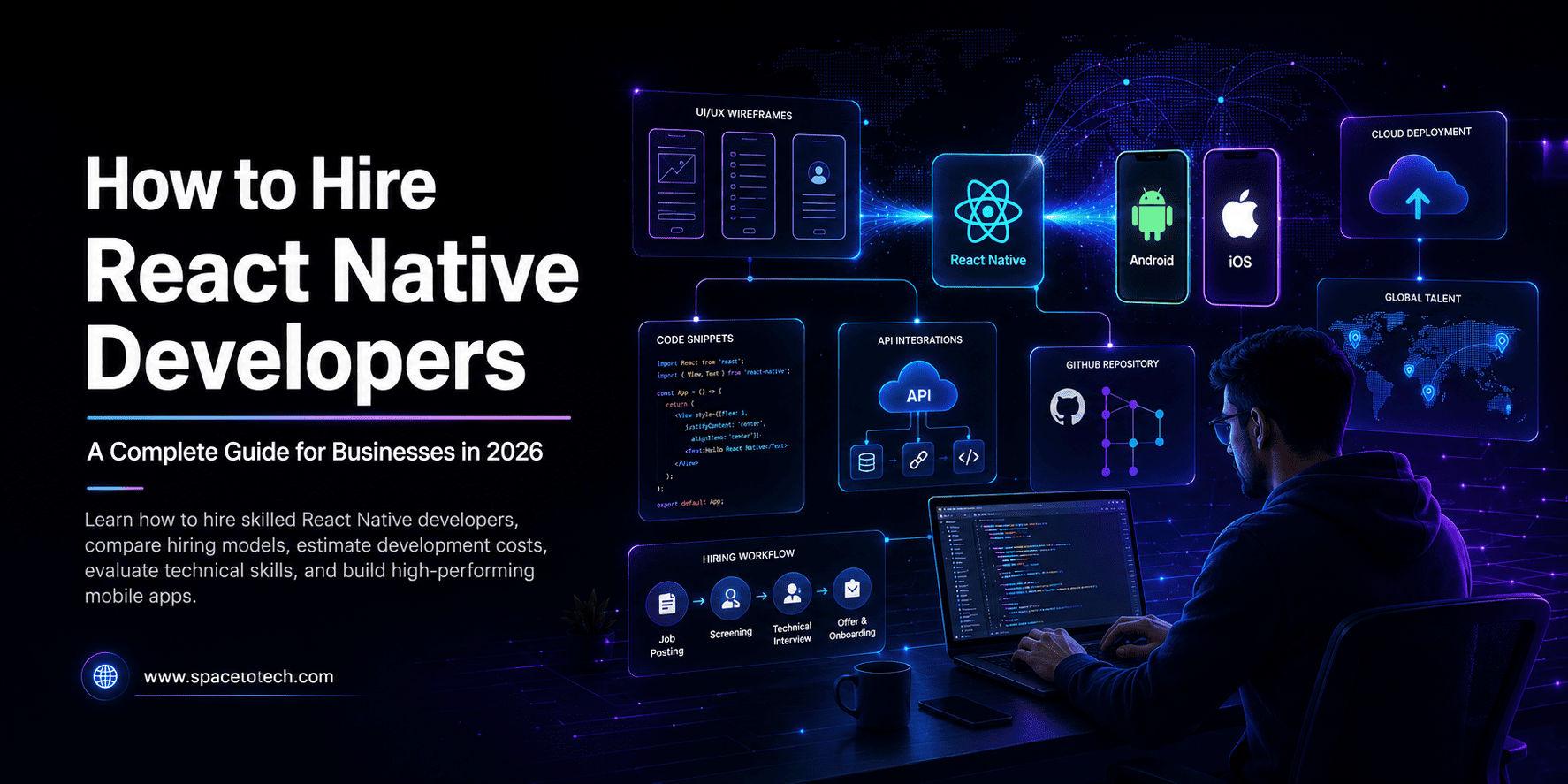
How to Hire React Native Developers – complete guide for businesses covering hiring process, technical skills, developer costs, hiring models, and React Native app development in 2026.
Blogs29/06/2026

How to Hire React Native Developers: A Complete Guide for Businesses in 2026

Hiring React Native developers has become one of the more consequential decisions a business makes before building a mobile product. It is not just a technical question. It affects your timeline, your budget, and whether the app you ship actually holds together six months after launch. React Native now pulls over 1.6 million weekly npm downloads as of 2026, which tells you the demand is real, but it also means the talent pool is uneven. Not every developer who lists React Native on a resume has shipped a production app that survived real user load. This guide covers everything you need to make that decision properly: what skills to look for when you hire React Native app developers, how the hiring process should actually work, what dedicated vs freelance looks like in practice, how much it costs by region, and why India has become the default sourcing option for global companies. If you are already exploring React Native app development services for your project, this will help you evaluate who you are working with. What Is a React Native Developer? A React Native developer builds mobile applications for both iOS and Android using JavaScript and React, from a single codebase. They handle UI components, state management, API integration, third-party integrations, and app store deployment. What separates a strong React Native developer from an average one in 2026 is familiarity with the New Architecture, specifically JSI (JavaScript Interface), Turbo Modules, and the Fabric renderer, which became the default in React Native 0.76, released in late 2024. If you want a fuller picture of what the framework can do and where it fits in the mobile development landscape, our complete React Native app development guide covers the architecture, use cases, and technical depth in detail. Why Businesses Choose React Native for Mobile App Development The core business case for React Native is straightforward. One codebase serves both iOS and Android, which means one team, one QA cycle, one deployment, and one maintenance overhead. For businesses managing cost and timeline, that structure changes the economics of mobile development in a meaningful way. Here is why companies across industries continue to choose it: A single development team covers both platforms, cutting team size by roughly half compared to separate native builds. Time to market is faster because features ship to both stores simultaneously, with no parallel sprint coordination between platform teams. React Native draws from the JavaScript talent pool, the largest developer community in the world, which makes hiring and replacement faster than native-only stacks. After the New Architecture, performance gaps between React Native and native apps are minimal for the vast majority of business use cases. It is backed by Meta and used in production by Shopify, Microsoft, Discord, and Bloomberg, which signals long-term viability. If you are still evaluating whether React Native fits your project or weighing it against another framework, our comparison of React Native vs Flutter breaks down the decision across cost, hiring, performance, and team composition. You can also read our analysis of React Native vs Native app development if you are deciding between cross-platform and fully native builds. When Should You Hire React Native Developers? The right time to hire React Native developers depends on what you are building and where you are in the product lifecycle. Here are the three scenarios where it makes the most sense. Startups Building Their First App Startups benefit the most from React Native because it compresses both cost and timeline at the stage when both matter most. A React Native team can ship an MVP to both iOS and Android in 3 to 5 months. A native approach for both platforms often runs 6 to 10 months. That difference is runway. If your product is pre-revenue and you need to validate the idea fast, React Native is the rational choice. Our guide on React Native for startups goes deeper on how the economics play out by funding stage. Enterprises Scaling Their Mobile Product Enterprise teams with existing React or JavaScript engineers can onboard React Native developers with less ramp-up time than a native hire would require. React Native also supports over-the-air updates, which means you can push fixes and feature changes without waiting for App Store review cycles, a meaningful operational advantage for large-scale products. The framework handles enterprise mobile apps reliably at significant scale, with Shopify as the most frequently cited production example. Businesses Maintaining an Existing App If you have a React Native app already in production and need to add features, improve performance, or integrate new services, a dedicated development team gives you consistent code quality over time. App maintenance gets messy when different freelancers have touched the codebase at different stages. A stable team with knowledge of your architecture avoids that problem. Skills to Look for When Hiring React Native Developers Most hiring mistakes happen here. Businesses write job descriptions asking for JavaScript experience and end up interviewing developers who have never shipped a production React Native app. Here is what actually matters. Core Technical Skills A solid React Native developer should have strong JavaScript ES6+ fundamentals and TypeScript discipline. TypeScript matters more than it used to because it prevents type-related bugs that compound fast in larger codebases and cross-team work. Beyond language, look for genuine React fluency: hooks, component lifecycle, clean state management using Redux or Zustand. These are not optional extras. They define whether a developer can write code your next hire can actually maintain. React Native Specific Knowledge Navigation (React Navigation), third-party integrations (payment gateways, push notifications, maps), and native modules are the practical workhorses of most React Native projects. In 2026, any developer worth hiring should also have a working understanding of the New Architecture. JSI replaced the old asynchronous bridge, Turbo Modules replaced legacy native modules, and Fabric replaced the old renderer. This is baseline knowledge now, not specialist depth. A developer who still builds primarily on the old bridge is accumulating technical debt on your behalf. Portfolio Review and Code Quality Ask to see apps on the App Store or Google Play that the developer actually shipped. Then check their GitHub. Look at how they structure components, whether they write tests, and how their commit history reads. A clean portfolio with verifiable links tells you more than four interview rounds. Generic claims like 'I have built 40 apps' without a single link you can open are a red flag. Code quality is not just a technical preference. It directly determines how expensive your app is to maintain over time. Communication Skills This matters especially for remote and offshore teams. A strong developer does not just answer your questions. They ask clarifying questions before committing to timelines. If someone says 'two weeks' without understanding the scope, that timeline is a guess, not a plan. Look for developers who push back constructively, flag scope risks early, and maintain a development workflow that keeps you informed without requiring you to chase them. Senior vs Mid-Level vs Junior React Native Developers Matching seniority to your project requirements is one of the most practical decisions in the hiring process. Overhiring for a simple app wastes budget. Underhiring for a complex integration creates technical debt that compounds over time. Level What They Handle Well  Avoid Assigning Them Junior (0-2 yrs) UI components, basic API calls, simple screen builds, bug fixes under guidance Architecture decisions, complex state, native module work Mid-Level (2-4 yrs) Feature development, API integration, code reviews, testing pipelines Sole ownership of large-scale architecture decisions Senior (4+ yrs) Architecture, New Architecture migration, native bridges, performance optimisation, technical leadership Pure UI work; it is a poor use of their bandwidth For most startup MVPs and mid-sized product builds, a combination of one senior React Native developer and one or two mid-level developers is the most cost-effective structure. The senior sets the architecture and reviews the work. The mid-levels build at speed. Freelance vs Dedicated React Native Developers When Freelance Works Freelance works for short, clearly scoped projects: a single feature addition, a bug audit, a one-time API integration. The engagement is fast to start and easy to end. The risk is continuity. If a post-launch issue hits and the freelancer is between projects or unavailable, you are stuck. Freelancers also have no institutional knowledge of your codebase, which means onboarding cost eats into the efficiency gain every time you bring someone new in. When a Dedicated Development Team Works Better For ongoing product development, a dedicated React Native developer or team is almost always the better structure. A dedicated developer is embedded in your workflow, understands your codebase, communicates within your sprint cycle, and brings continuity that a freelance rotation cannot provide. The outcome is consistent code quality, fewer surprises at launch, and a development workflow that improves over time rather than resetting with each new hire. This model is what SpaceToTech runs for its global clients: dedicated teams that work as a true extension of your product organisation, not rotating contractors. How to Hire React Native Developers: Step-by-Step Process Most hiring processes for React Native developers fail for the same reason: the job description is written before anyone has agreed on what the developer will actually build. Here is the process that consistently works. Step 1: Define Your Project Requirements Before Writing a Job Post Write down four things before you post anywhere: the exact mobile problem this hire solves (not 'build an app' but what the app must do), your timeline, the non-negotiable technical skills (Expo vs Bare React Native, specific integrations required), and the criteria you will use to evaluate success. If your CTO and your tech lead cannot agree on this document, they will disagree on every candidate you interview. Misaligned requirements at the start of the hiring process is the single biggest predictor of a failed hire. Step 2: Screen Candidates on Technical Depth Years of experience is a starting filter, not a measure of skill. Ask specific questions about recent work: What was the last app you shipped, and what was the hardest technical problem you solved on it? Have you worked with the New Architecture? How did you handle state management on a project with more than three developers? Candidates who answer in generalities have not solved those problems. Candidates who give specific, concrete answers probably have. Step 3: Run a Practical Technical Assessment Give candidates a 2 to 3 hour task that reflects real project work: integrate a third-party API, debug a state management issue, or build a small feature from a spec. Avoid algorithm puzzles and LeetCode-style problems. Application developers are not optimising search trees in production. What you want to see is how they approach a real problem, how they communicate when something is unclear, and what their code looks like when they are not performing for an interview. Step 4: Conduct a Structured Interview Prepare questions that test trade-off thinking, not definitions. 'What is JSI?' is not a useful interview question. 'Walk me through how you decided between Expo managed workflow and Bare React Native on your last project' tells you whether they have actually faced that decision. Ask how they handle a project where scope starts expanding. Ask what they would do differently on their most recent app. Open-ended, experience-based questions surface real capability faster than technical trivia. Step 5: Start with a Trial Period For dedicated or long-term engagements, a paid one-week trial task reduces risk for both sides. You evaluate code quality, communication style, and how they handle your existing codebase before committing to a full engagement. A developer who is reluctant to do a paid trial, when the task is fair and scoped, is worth noting. How Much Does It Cost to Hire React Native Developers? Development cost varies significantly based on where the developer is located, how senior they are, and which engagement model you use. Here is what businesses are paying in 2026: Region Hourly Rate (2026) Monthly Rate (Dedicated) USA / Canada $95 to $150+ per hour $15,000 to $25,000 per month Western Europe $60 to $120 per hour $9,000 to $16,000 per month Eastern Europe $30 to $80 per hour $5,000 to $10,000 per month India $15 to $45 per hour $1,500 to $4,500 per month Indian React Native developers typically cost 40 to 70 percent less than US-based counterparts. For a startup managing burn rate, that difference is not just a cost saving. It translates directly into additional development months at the same budget. A team that would cost $18,000 per month in the US often runs $4,000 to $5,000 per month when you hire dedicated React Native developers from India through a structured agency model. For a detailed breakdown of what different project types actually cost, our React Native app development cost guide for 2026 covers this by feature set, team size, and region. Common Mistakes to Avoid When Hiring React Native Developers Hiring based on years of experience instead of verifiable shipped work. A developer with 2 years and 5 live apps is often more capable than a developer with 6 years who has maintained the same legacy codebase throughout. Confusing React web developers with React Native mobile developers. The mental models are different. Web developers building for a browser and mobile developers handling device constraints, navigation paradigms, and app store deployment are not interchangeable, even if both use JavaScript. Writing a job description that asks for 'React Native experience' but actually requires New Architecture depth. That narrows the pool significantly and demands different compensation. Blending those two populations in your search is why offers keep getting rejected. Skipping the technical assessment because references were strong. References tell you what someone is like to work with. They do not tell you whether their code is maintainable. Run the task regardless. Treating offshore hiring as purely a cost play. The best India-based React Native teams deliver on quality and communication, not just price. Vet offshore candidates exactly as you would a local hire: same technical assessment, same structured interview. Why Hire React Native Developers in India? India has become the default sourcing market for React Native talent among global companies, and the reasons go well beyond cost. Depth of Talent Pool India is expected to have around 9.5 million tech professionals by FY 2026. React Native sits comfortably within that ecosystem because it builds on JavaScript and React, both of which have large, established Indian developer communities built over more than a decade. For any project size, sourcing React Native app developers in India is not a constraint. The pool is large enough to find specialists, not just generalists. Cost Efficiency Without Quality Compromise Indian React Native developers cost 40 to 70 percent below US market rates. The important distinction is that the better India-based agencies run their own multi-round technical vetting process before placing a developer on a client project. You are not getting cheaper talent. You are getting similarly skilled talent from a market with a lower cost of living. If you are evaluating how to structure this kind of engagement, our post on hiring software developers from India covers the vetting and onboarding process in detail. Overlap-Friendly Working Hours India Standard Time creates a usable overlap window with every major SpaceToTech client market. Morning standups work for US East Coast clients. Full-day overlap is available for GCC and Australia. UK teams share an afternoon window. Communication does not have to be asynchronous by default, which matters more than most buyers initially assume when they plan offshore work. In-House vs Remote React Native Developers In-house hiring gives you full-time availability, easier informal collaboration, and direct control over onboarding. The trade-off is cost: salary, benefits, equipment, and office overhead all add up. Senior React Native developer searches also take 6 to 8 weeks on average when sourcing independently, and that timeline extends when the role requires New Architecture depth. Remote React Native developers, particularly through a dedicated team model, give you specialised expertise faster and at a fraction of the cost. A pre-vetted agency can deliver first candidates in 48 to 72 hours. The trade-off is that onboarding remote teams requires intentional structure: documentation, async communication habits, and milestone-based delivery frameworks. When those are in place, the quality and velocity of remote dedicated teams is comparable to in-house, often better, because you are working with people who have done this specific kind of work many times before. Why Choose SpaceToTech for React Native Development? SpaceToTech is a mobile app development company that builds React Native apps for startups and enterprises across the US, UK, UAE, and Australia. The team works on the New Architecture by default, not as an optional add-on. Clients get a dedicated development structure: the same developers across the project lifecycle, milestone-based delivery, and direct access to the engineers building the product. Every engagement starts with a technical scoping call where we understand your project requirements, existing architecture, and delivery constraints. From there we propose the right team structure: a single dedicated developer for focused builds, or a full team for complex, multi-track product work. If you want to see what that looks like for your project, reach out through the React Native services page for a no-obligation discussion.

React Native vs Native App Development – Which Is Better for Your Business  | SpaceToTech
Blogs22/06/2026

React Native vs Native App Development: Which Is Better for Your Business?

Picture this: you're a startup founder with a solid app idea, a lean budget, and investors asking when you'll launch on both iOS and Android. The question sitting in your inbox from your tech lead reads: "Should we go React Native or build natively for each platform?" That single decision will shape your development timeline, your burn rate, and how fast you reach users. It's not a developer question — it's a business question. The react native vs native debate has been running for years, but in 2025–2026 the conversation looks very different. React Native's New Architecture has closed performance gaps that once made the choice obvious. Native development has simultaneously become more accessible with SwiftUI and Jetpack Compose. Neither option is universally superior. But one will be right for your business — and this guide on react native vs native app development breaks down every factor so you can make that call with confidence. From development cost and time-to-market to performance, scalability, and user experience, this article covers what every founder, product manager, and CTO needs to know before committing to a path. For teams already exploring cross platform app development, understanding these trade-offs is the starting point for every smart mobile strategy. Understanding React Native and Native App Development React Native is an open-source development framework created and maintained by Meta. It lets developers build mobile applications for both iOS and Android using JavaScript and React — a single codebase that compiles down to native code through its bridge and JavaScript Interface (JSI) architecture. Where React Native uses a single codebase to target multiple platforms simultaneously, native app development requires building separate apps — Swift or Objective-C for iOS, Kotlin or Java for Android — each tailored specifically to its platform. The distinction matters because it shapes everything: team size, timelines, costs, and the ceiling of what your app can achieve technically. Two terms worth knowing at a glance: native modules are platform-specific pieces of code (written in Swift or Kotlin) that React Native apps can call when they need direct access to device hardware; native components are the actual UI elements — buttons, text inputs, scroll views — that React Native renders using the platform's own rendering engine, not a web view. React Native is backed by Meta and benefits from strong community support, with over 120,000 questions answered on Stack Overflow alone. That ecosystem longevity matters for business decision-makers who worry about a framework going stale. For a deeper technical overview of how the framework is structured and what it can build, refer to our complete React Native guide . React Native vs Native Apps: Key Differences at a Glance Before going section by section, here's the headline contrast in the react native vs native apps decision — the five distinctions that matter most to a business audience: Codebase: React Native targets both platforms from one JavaScript codebase; native means two separate codebases in two different languages. Development cost: React Native typically runs 30–40% cheaper because a single team handles both platforms. Performance: Native delivers the highest possible performance; React Native is near-native for most business apps. Time to market: React Native ships to both app stores simultaneously; native teams run parallel tracks that double coordination overhead. Team size: React Native needs one cross-platform team; full native mobile app development for both platforms requires two specialised squads. These are the headline trade-offs. Everything below expands on each one in detail. Development Cost Comparison React Native projects typically cost 30–40% less than building two separate native apps. The reason is structural: one team, one codebase, and shared business logic mean you're not paying twice to build the same feature. Development resources — engineering hours, QA cycles, and tooling — are consolidated rather than duplicated. Three cost factors drive the difference: Initial development cost is the most visible. A native build for both platforms requires separate iOS and Android developers writing platform-specific code. React Native development lets a single team deliver both, which directly compresses your budget without sacrificing functionality for the vast majority of app types. Team size and development resources compound the savings. Native teams need Swift specialists, Kotlin specialists, and separate QA engineers who understand each platform's quirks. React Native teams draw from the broader JavaScript talent pool, which is deeper and more cost-competitive to hire from. Long-term maintenance cost is where the savings really accumulate. Every bug fix, design update, or feature addition gets deployed once in React Native — not twice. For startups operating within a startup budget, this ongoing efficiency is often the most compelling argument. Maintenance cost over a two-year roadmap can be 40–50% lower than maintaining two parallel native codebases. That said, native development cost can absolutely be justified for complex, high-scale apps where platform-specific performance or deep OS integration is non-negotiable. The economics only tip clearly toward React Native when you're building for both platforms. If you're weighing exact figures for your project, our breakdown of React Native app development cost in 2026 goes deeper on budget planning. Development Time and Time-to-Market Speed has a business value that's easy to underestimate. A founder who needs to validate an idea in the market in three months faces a very different calculation than one operating on a six-month runway with guaranteed funding. React Native allows simultaneous app publishing to both the App Store and Google Play. Developers write a feature once and it ships everywhere — no coordinating between two platform teams, no maintaining two separate sprint backlogs, no waiting for Android to catch up with iOS (or vice versa). Native teams building for both platforms typically run parallel development sprints, which doubles the coordination overhead. Features get built twice, reviewed twice, tested twice. Even with strong project management, that process adds weeks — sometimes months — to a launch timeline. For an MVP, that delay can be the difference between getting to market ahead of a competitor or behind one. The development speed advantage of React Native is well-documented: most industry estimates place time-to-market at 40–60% faster for cross-platform projects versus full native builds for both platforms. For a startup validating its idea, faster time to market directly reduces burn, compresses the feedback loop, and gets real user data into the product roadmap sooner. For an established company launching a new product line, faster time to market means earlier revenue. Performance Comparison This is where React Native has historically been on the defensive. And it's where the 2025–2026 landscape has shifted meaningfully. For most business applications — eCommerce platforms, SaaS tools, marketplace apps, enterprise workflow tools — React Native delivers app performance that is indistinguishable from native to end users. Engineering analyses through 2025 consistently show that for UI-driven applications using common patterns, React Native's performance is on par with fully native apps. Smooth scrolling, fluid animations, fast cold starts: these are all achievable in React Native when built correctly. The reason is architectural. React Native's New Architecture — specifically the Fabric Renderer, TurboModules, and JavaScript Interface (JSI) — has eliminated the performance bottlenecks that previously defined the native vs cross-platform debate. Fabric replaced the old UI manager, JSI removed the bridge bottleneck, TurboModules cut memory overhead, and the Hermes engine made JavaScript execution faster. The result is high performance at React Native's level that would have seemed implausible three years ago. That said, native performance still has a genuine edge in specific scenarios: real-time gaming, AR/VR applications, apps with heavy GPU usage, deep OS-level sensor access, or advanced computational tasks. For those use cases, iOS app development in Swift or Android app development in Kotlin — with direct hardware access — is still the technically superior choice. The honest summary: React Native cross-platform performance is now "good enough" for the vast majority of business apps. Native still wins at the performance ceiling. Most businesses building data-driven, UI-focused apps will never hit that ceiling. User Experience and UI Flexibility A common misconception is that React Native apps look like web apps wrapped in a native shell. That's not accurate. React Native uses real native components to render its UI — the same buttons, scroll views, and navigation elements that a Swift or Kotlin developer would use. The result is an app that looks and behaves like a native application on each platform, not a generic cross-platform compromise. The user experience trade-off is more nuanced than "React Native looks good enough." For most business apps, React Native delivers an excellent user interface and user experience without the overhead of maintaining two codebases. Where native development gains an edge: highly custom, platform-specific animations that rely on deep OS APIs, or UI patterns that need to match the very latest platform design languages immediately after release. When iOS introduces something like Dynamic Island or Android rolls out the latest Material You interactions, native developers can access those features the same day. React Native developers typically wait weeks or months for community library support to catch up. For companies where the UI itself is the product differentiator — where the design experience is the core value proposition — native gives designers and developers pixel-perfect control with no abstraction layer in the way. For companies where the product value is in the data, workflows, or service being delivered, React Native's user interface is more than sufficient. Code Reusability and Maintenance This is React Native's strongest business argument, and it's worth taking seriously. With a single codebase, every bug fix, feature update, and design change is deployed once and lands on both platforms simultaneously. That's not just convenient — it fundamentally changes the maintenance cost structure of your app over time. Long term maintenance in React Native is half the effort: one QA cycle, one deployment, one version to track. Contrast that with native development. Fixing a bug in a native iOS app means a separate fix written in Swift, reviewed, tested, and deployed. Fixing the same bug in the native Android app means a separate fix in Kotlin — another PR, another QA cycle, another App Store / Play Store submission. Two separate development tracks for every change, for the life of the product. Code reusability in React Native typically reaches 70–90% of shared code between platforms, depending on how much platform-specific UI customisation the app requires. The remaining 10–30% handles platform-specific visual tweaks. In practice, this means your engineering team spends the vast majority of their time building new features rather than maintaining parallel implementations. It's worth noting that code reusability extends further than mobile. In some architectures — particularly with React Native Web — teams can share business logic with their web front-end, creating a single source of truth across all platforms. The long-term maintenance implications of that kind of shared architecture are significant for any product team thinking beyond the initial launch. Scalability and Long-Term Growth "Can React Native scale to enterprise level?" This is one of the most common objections from CTOs evaluating the framework for serious production use. The answer is yes — with the right architecture and the right team. The evidence isn't theoretical. Shopify, Microsoft Teams, and Meta's own Facebook and Instagram apps all use React Native at significant scale. These are high-traffic, complex products with demanding performance requirements and large engineering teams. React Native handles them. App scalability in the framework is a function of architecture decisions, not an inherent ceiling of the technology. Third party integrations — payment gateways, mapping services, analytics platforms, push notification services, authentication providers — are well-supported across the React Native ecosystem. Most major SDKs provide React Native libraries, and the ones that don't typically have well-maintained community alternatives. Where native scales better is at the very high end of OS-level complexity: custom hardware integrations, advanced sensor access, real-time data processing at the system level. For enterprise applications that are primarily data-driven and workflow-focused, React Native is a proven, production-tested choice. For businesses evaluating alternative cross-platform frameworks, Flutter app development is another option worth comparing before committing to a path. When to Choose React Native React Native is the clear choice in several specific scenarios. This isn't about which technology is more impressive — it's about which one aligns with your business context. Choose React Native when: You're a startup validating an MVP and need to reach users on both platforms without doubling your development cost. The development speed advantage is real and the startup budget savings are significant. Your product needs to launch on iOS and Android simultaneously. React Native's simultaneous app publishing removes the coordination overhead of running two parallel native tracks. Your team has limited development resources and you can't sustain two specialised platform teams. One React Native team delivering both platforms is operationally simpler and more cost-effective. Your app relies heavily on third party integrations — payments, maps, analytics — where React Native's ecosystem is mature and well-supported. You're prioritising development speed and want to iterate quickly based on early user feedback. React Native's hot reloading and shared codebase compress the iteration cycle. Community support and ecosystem maturity matter to your decision. React Native's Meta-backed community is active, well-funded, and unlikely to stagnate. For teams ready to move forward, our React Native development services can help you launch faster with the right architecture from day one. Planning a mobile app project? Discuss your requirements with our React Native specialists and discover the most cost-effective development approach for your business. Talk to Our React Native Team → When to Choose Native App Development Native development is genuinely the better strategic choice in specific situations. Acknowledging that directly should build confidence in this comparison — there's no universal winner. Choose native when: Your app requires cutting-edge platform-specific features immediately after an iOS or Android OS release. Native developers access new APIs on launch day; React Native teams wait for ecosystem support. Performance is mission-critical at the OS level — real-time gaming, AR/VR experiences, heavy media processing, or apps that need deep hardware integration. These use cases genuinely benefit from the direct access that iOS app development and Android app development provide. Your business is large enough to sustain two dedicated platform teams long-term. If you already have Swift specialists and Kotlin specialists on staff, the organisational overhead of native development is already built in. Your product's competitive differentiator is a deeply customised UI that must mirror platform-specific features — Dynamic Island behaviour, advanced haptic patterns, platform-specific features tied to specific OS versions — immediately on launch. Enterprise applications at the very high end of complexity — custom hardware integrations, security-level OS access, advanced sensor fusion — can justify the additional cost and team size that native demands. React Native vs Native App Development: Comparison Table The table below summarises the core trade-offs in the react native vs native app development decision across nine factors. Use it as a quick reference when presenting options to stakeholders. Factor React Native Native App Development Development Cost Lower — single team, shared codebase Higher — separate iOS and Android teams Time to Market Faster — simultaneous app publishing Slower — two parallel development tracks Performance Near-native for most business apps Best possible — direct OS access Code Reusability 70–90% shared code across platforms Zero — separate codebases UI Flexibility Very good — uses native components Maximum — pixel-perfect platform control Maintenance Cost Lower — one codebase to maintain Higher — two separate update cycles Best For Startups, MVPs, cross-platform products High-performance or platform-specific apps Community Support Large — backed by Meta, strong ecosystem Platform-specific — Apple / Google support Team Size Needed Smaller — one cross-platform team Larger — dedicated iOS and Android teams Which Option Is Best for Your Business? There's no universal answer, because the right choice depends entirely on your business requirements. Here's how to think about it by situation: If you're a startup with a limited budget and a deadline: React Native is almost always the right starting point. You get both platforms, faster time to market, lower initial and long-term costs, and a codebase that's maintainable by one team. The performance and UI flexibility you're giving up are trade-offs you won't feel at the MVP stage. If you're an enterprise building a mission-critical tool with unique hardware requirements or deep OS integration: Native is worth the investment. The additional cost buys you capabilities and performance headroom that React Native can't match at the ceiling. If you're a mid-size company launching a cross-platform SaaS tool, marketplace, or eCommerce app: React Native is a strong fit. Companies like Shopify have proven it scales. Your user experience will be excellent, your maintenance cost will be lower, and your team will ship features faster. If your app's UI is the product — if the interaction design and visual experience are the primary differentiators — native gives designers the pixel-perfect control and immediate access to platform updates that React Native can't offer on day one. Ultimately, the decision comes down to this: if you're building for both iOS and Android with business requirements that fall within the majority of app categories, React Native delivers far more value per dollar spent. If you're operating at the performance ceiling or need features the moment a new OS ships, native is the right call. If you want a second opinion based on your specific project, our team at SpaceToTech helps founders and product teams choose the right approach based on their goals, timeline, and budget — not on what's trending. For founders specifically evaluating this for their first product, our guide on React Native for startups is worth reading before making a final decision. And if Flutter is still in the running, our breakdown of React Native vs Flutter covers that comparison directly. Still unsure which path is right for your project? Connect with our experts for a free consultation. We'll review your project goals, budget, and timeline and recommend the approach that gives your business the best outcome. Get a Free Consultation →

React Native vs Flutter 2026 comparison cover image
Blogs19/06/2026

React Native vs Flutter in 2026: Which Framework Should Businesses Choose?

Picking the wrong cross-platform framework doesn't just cost you a few weeks of rework it can quietly add 20–30% to your app's lifetime cost through hiring delays, rebuilds, and technical debt. We've watched founders make this call in five minutes based on a Reddit thread, and we've watched CTOs spend three months in analysis paralysis. Neither extreme works. This guide is written for the people who have to live with the decision founders, product managers, and CTOs not for developers comparing syntax. If you've already explored React Native app development services or Flutter app development services , you've probably noticed most comparisons online are written by developers, for developers. This one isn't. React Native vs Flutter: A Quick Answer for Decision-Makers In short: React Native vs Flutter comes down to talent availability versus UI consistency. React Native, built by Meta on JavaScript/TypeScript, gives you access to a much larger developer pool and lower hiring costs. Flutter, built by Google on Dart, gives you near pixel-perfect UI consistency across platforms and stronger web/desktop support out of the box. When React Native is the better business choice: you're working with a JavaScript team already, need to hire fast, want the largest possible developer talent pool, or you're building a consumer app where native look-and-feel matters more than pixel-identical UI. When Flutter is the better business choice: you need the same UI across mobile, web, and desktop from day one, you're building something animation- or graphics-heavy, or your team is comfortable investing extra hiring time for a smaller but fast-growing Dart talent pool. The honest answer depends on five factors: budget, timeline, team composition, long-term scalability needs, and risk tolerance for newer ecosystems. We'll walk through each below. Framework Overview: What Business Leaders Need to Know React Native , maintained by Meta, lets teams build mobile apps using JavaScript and TypeScript the most widely used programming languages in the world. It's been production-tested since 2015 and powers apps at Meta, Microsoft, and Shopify. For a deeper technical walkthrough, see our React Native app development guide . Flutter , built by Google, uses the Dart language and renders every pixel itself via the Skia graphics engine rather than relying on native platform components. This gives Flutter near-identical UI across iOS, Android, web, and desktop at the cost of a steeper learning curve for most existing dev teams. The core difference that affects your business: React Native talks to native UI components through a bridge (now the JSI in its New Architecture), so your app looks and feels native by default. Flutter draws its own UI from scratch, so it looks identical everywhere which is a feature for some brands and an unnecessary constraint for others. Performance: What It Actually Means for User Experience Forget frames-per-second benchmarks what matters to your business is retention, App Store ratings, and conversion. Both frameworks now deliver performance that's indistinguishable to end users for the vast majority of business apps: e-commerce, fintech dashboards, booking apps, internal tools. React Native's New Architecture has closed most of the historical gap with Flutter's compiled approach. Where Flutter still has an edge is animation-heavy or game-like interfaces, thanks to the Skia rendering engine. The practical takeaway: unless you're building something visually intensive, performance shouldn't be your deciding factor. Development Cost Comparison: React Native vs Flutter This is the section most comparison articles skip they mention cost as a factor without quantifying it. Here's actual market-rate data for 2026.  Factor  React Native  Flutter Avg. Developer Rate (US) $45–$150/hr $45–$130/hr Typical MVP Timeline 8–14 weeks 10–16 weeks Code Reuse (iOS + Android) ~70–80% ~85–95% Year 1 MVP Build Cost (est.) $40K–$120K $50K–$130K React Native usually wins on initial MVP cost simply because hiring is faster and cheaper. Flutter's higher code-reuse rate can narrow that gap over a longer product lifecycle, since less platform-specific code needs maintaining. For a granular breakdown across regions and project sizes, we've published a dedicated React Native app development cost guide. Total cost of ownership over three years tends to favor React Native for startups (lower entry cost, faster iteration) and is closer to a toss-up for enterprises, where Flutter's reduced platform-specific maintenance can offset its higher build cost. Hiring and Developer Availability: The Factor Most Articles Ignore Talent availability is often the real deciding factor, and it's rarely discussed with real numbers.  Region  React Native Talent Pool  Flutter Talent Pool Global (approx.) 3M+ JS-background developers 500K–800K Dart/Flutter developers Avg. Time to Hire (Senior) 3–6 weeks 5–10 weeks Freelancer Availability Excellent Good, growing fast Because React Native is built on JavaScript, virtually any experienced JS or front-end developer can ramp up quickly which is why agencies and in-house teams alike find it 4–5x easier to staff. If you're exploring offshore or distributed hiring to stretch your budget further, our breakdown on how to hire developers from India covers regional rate differences and vetting approaches that apply to both frameworks. Scalability: Which Framework Grows With Your Business? Both frameworks scale to enterprise workloads Meta, Microsoft, and Shopify run React Native at massive scale; BMW, eBay, and Alibaba run Flutter. The real scalability question isn't "can it handle growth," it's "can your team keep maintaining it as it grows." React Native's larger ecosystem means more pre-built libraries for payment gateways, analytics, and third-party integrations useful when you're racing to add features post-launch. Flutter's single, self-contained rendering approach means fewer platform-specific bugs creep in as your codebase grows, which can reduce long-term technical debt. Security and Enterprise Readiness For fintech, healthcare, or any regulated industry, security architecture matters more than UI polish. Both frameworks support the encryption, secure storage, and authentication patterns needed for HIPAA, GDPR, and SOC 2 compliant apps — neither has an inherent security advantage. What matters more is whether your development team follows secure coding practices regardless of framework, and whether your vendor has experience navigating compliance audits for the framework you choose. Community, Ecosystem, and Long-Term Risk React Native benefits from Meta's continued open-source investment and an enormous npm ecosystem long-term risk here is low. Flutter's community is large and growing quickly, backed by Google, though Google does have a documented history of sunsetting developer products over the years. That's a genuine, if modest, long-term risk worth factoring into a multi-year roadmap, even as Flutter's current momentum remains strong. React Native vs Flutter for Startups If you're a founder with a tight runway, the calculus is simple: faster hiring and lower upfront cost usually outweigh marginal UI differences. Most early-stage teams choose React Native because it shortens time-to-market and keeps burn rate predictable. We go deeper into MVP-specific decision-making, including investor perception of tech stack choices, in our dedicated guide on React Native for startups . React Native vs Flutter for Enterprise Applications For enterprise buyers, the decision shifts toward integration with existing systems, compliance requirements, and team scaling. Both frameworks are proven at scale — the better question is which one your existing engineering org can support. A team with strong JavaScript expertise will move faster on React Native; a team building a true multi-platform product (mobile + web + desktop) from one codebase may find Flutter's unified rendering model worth the Dart ramp-up. The Business Decision Framework: How to Choose in 2026 Run your project through these seven factors and weigh which matter most to you: Budget — React Native generally costs less to build and staff initially. Timeline — React Native MVPs typically ship 2–4 weeks faster. Team background — JavaScript teams favor React Native; teams open to learning Dart can consider Flutter. UI requirements — Need pixel-identical UI across platforms, including web/desktop? Lean Flutter. Hiring runway — Need to scale a team fast? React Native's talent pool is deeper. Long-term risk tolerance — React Native carries marginally lower platform-risk; Flutter carries marginally higher Google-dependency risk. Animation/graphics intensity — Heavy on custom animation or game-like UI? Flutter's Skia engine has an edge. For startups under roughly $100K budget: React Native is usually the pragmatic default. For scale-ups in the $100K–$1M range: the decision depends more on existing team skills than framework capability. For enterprise budgets above $1M: both are viable; the deciding factor is usually integration complexity and compliance needs rather than cost. Our Recommendation After building cross-platform apps across both frameworks for startups, scale-ups, and enterprise clients, our default recommendation is React Native for most business use cases it gets teams to market faster and keeps hiring costs manageable. We recommend Flutter specifically when a client needs identical UI across mobile, web, and desktop from a single codebase, or when the product is animation-heavy. If you're weighing this decision for your own project, our team can walk through your specific budget, timeline, and team setup explore our React Native app development services or get in touch through SpaceToTech for a framework consultation tailored to your business.

AI chatbot services help businesses boost customer engagement, automate support, and improve operational efficiency with smarter conversations.

We’ve been helping Customer globally

So how does it work? Check for yourself by their feedback.
Client Feedback

SignUp for a Call: to transform your Ideas into Reality.

Let’s Book a free consultation call for you
Your’s first and The right Step!

UAE

INDIA

USA

Giphy Coming Soon

Coming Soon

You agree to our Privacy Policy

Get a Callback